Review Essay
I know plenty of people grew up watching A Christmas Story, but I have to emphasize, whatever it meant in your family, it was almost surely a more central media experience in mine. Much of that owed to my father’s interest in Jean Shepherd, the writer of the short stories on which the film was based (and the man who narrates the film from the perspective of a grown-up, nostalgic Ralphie). I can close my eyes and instantly picture the covers of his short story collections, In God We Trust: All Others Pay Cash or A Fistful of Fig Newtons, sitting on our bookshelves. I still vividly remember a 1988 TV movie about Ralphie and his friends and family, set a few years after A Christmas Story during summer vacation—it’s called Ollie Hopnoodle’s Haven of Bliss and it’s a sweet, silly good time (also narrated by Shepherd) that I definitely saw multiple times as a child, as well. From 1997, the first year that TNT started airing A Christmas Story for 24 hours, from Christmas Eve to Christmas Day, I know a lot of families started building holiday memories with this film on in the background, and make no mistake, mine did also. “The Old Man” (as Jean Shepherd would call my father) turned it on the moment it started airing and I feel like there were years when he just left the TV on TNT until the marathon was over. It certainly was the backdrop for gift opening on Christmas Eve evening, or sitting by the fireplace the next morning eating Christmas cookies, in my years of transition from teen into adult, but again, I was well familiar with the movie and with Jean Shepherd long before that time. It’s baked into my brain—so much so that I didn’t even try to write about it last year, intimidated by the prospect of trying to make sense of how I feel about the film. But it’s a new year, and I felt like I finally had a handle on what the movie meant to me, so let’s see where the journey takes us.
The setup, if you’re one of the people who has somehow made it this far in life without seeing A Christmas Story, is straightforward. Our protagonist, Ralphie Parker, is a 9 year old living in small town Indiana as Christmas approaches in 1939, and we follow the ups and downs of his life as narrated through the gauzy, heightened nostalgic memories of an older man who’s transforming his childhood into a set of fables as he speaks. Ralphie’s central preoccupation is the acquisition of the perfect Christmas present—an official Red Ryder, carbine action, two-hundred shot, range model air rifle—but the film encompasses other intense childhood experiences, from being bullied by Scut Farkas (he had yellow eyes, so help me God, yellow eyes!) to being cheated by the producers of the Little Orphan Annie radio serial and the makers of Ovaltine. The secondary unfolding storyline is a strange mirror of Ralphie’s—his father, who presumably has a name but whom the credits and narrator consistently refer to as The Old Man, who just wants a little material satisfaction of his own at the holidays, whether we’re talking about him basking in the erotic glow of his “major award,” a lamp shaped like a woman’s leg in fishnet stockings, or him wrestling amid exuberant profanity with the house’s cantankerous furnace. Everybody wants something, in A Christmas Story, but what they get….well, that’s the movie’s genius, I think, or at least it’s part of why it works so well.
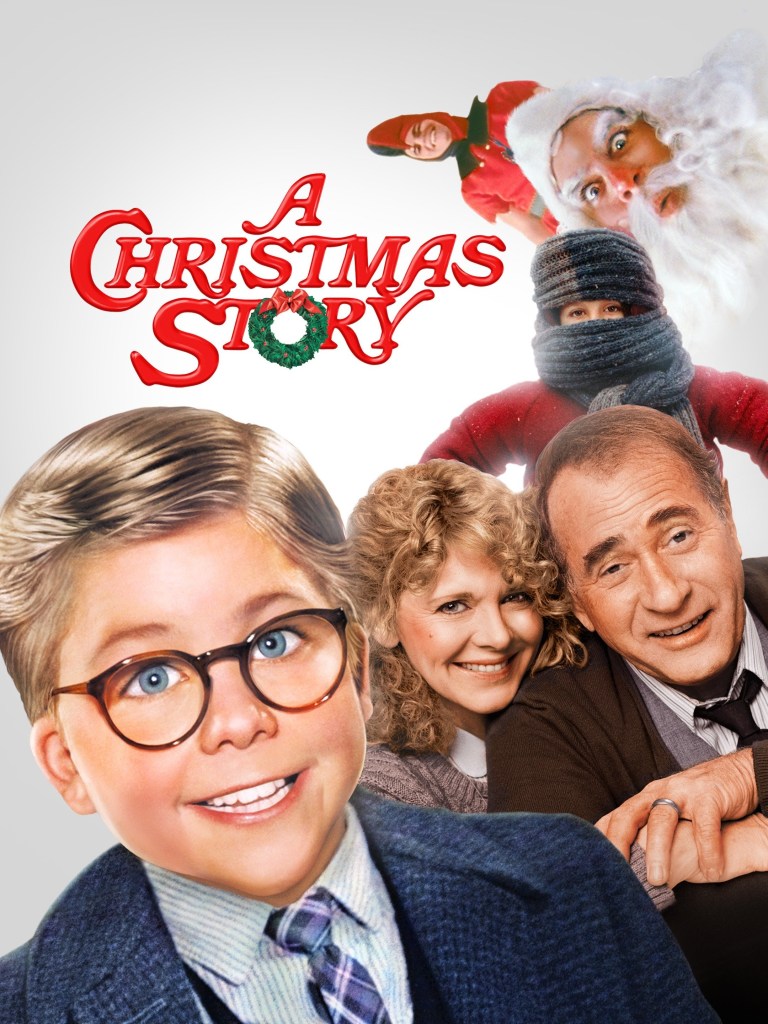
There is no question that one of the things the movie gets right (for those who love it) is the perfectly balanced tone of wistfulness and wry observation. Any American who feels a little hankering for the “good old days” sees a beautifully sanitized version of it in the old house on Cleveland Street, and the mythologizing of everything from the toy display in Higbee’s department store corner window to the soft crackle in the voices on the radio. Ralphie’s world is one adrift in time—in part because it sits neatly between a Depression that’s mostly past and a war that hasn’t yet filled the papers with death and loss, but also just in part because it is the world of a nine year old’s memories. There is a simplicity to the world we see through those eyes that Shepherd captures beautifully. But Shepherd’s good, too, at reminding us how deeply we feel the highs and lows of life as a child, as his narrator spins out phrases like, “in our world, you were either a bully, a toady, or one of the nameless rabble of victims.” The amused notes in his voice as he narrates extend to us a gentle ironic distance from the events—we can both sympathize with Ralphie’s indignant feeling that “mothers know nothing about marauders creeping through the snow,” while chuckling as adults who know that Ralphie’s mom actually has a pretty accurate sense of how “important” it is that he get a Red Ryder BB gun (which is to say, it’s not at all important). This keenly honed voice that ties events together, offers us context, and interprets the otherwise inscrutable aims and intentions of 9 year old Ralphie is the movie’s secret sauce, and it goes well with everything, including an adult’s deeper understanding of how Ralphie’s mother might have felt about the “major award”—at one point, Shepherd comments, “my mother was trying to insinuate herself between us and the statue,” and the grin we hear on the other side of his microphone tells us how to feel about the passive aggressive battle that emerges around the electric red light district that her husband insists on displaying to the neighborhood in the front room’s picture window.
A consistent theme the film explores is the way a child’s life unfolds at the mercy of powers too great to be controlled, with which we are in constant effort to appease and to cajole in the hopes of catching a break. Ralphie’s kid brother Randy can’t even walk to school unaided, once his mother has bundled him so tightly that, in Randy’s iconic whine, “I can’t put my arms down!” His mother, wearily, simply retorts, “you’ll put your arms down when you get to school” and shoves her helpless kindergartener out into the snow to be absent-mindedly looked after by his gun-obsessed older brother. Ralphie’s friend Flick can’t seem to buy a break—a sequence of childhood dares, culminating in the unstoppable force that is a triple dog dare, leaves his tongue stuck to a flagpole at recess, abandoned even by his closest friends. Later, he’s left behind again, sacrificed to Scut Farkas and Grover Dill to experience man’s inhumanity to man. Poor Schwartz, of course, has his own scene in which to cry “UNCLE!” as his arm twists, and moreover is the target of capricious (if technically accurate) accusations in Ralphie’s desperate attempt to deflect blame for a poorly timed F-bomb. Ralphie himself feels perpetually thwarted by every adult in his life, and lives in fear of violence that’s not just the Old West outlaws of his fevered imagination, given his daily sprint to escape random acts of harm at the hands of the local bullies, not to mention his fear of total “destruction” by The Old Man after Ralphie finally snaps in a flurry of thrown punches and hurled obscenities. Again, the narrator’s irony lets us choose how deeply to feel any of this—do we chuckle at Ralphie running from Farkas, or do we remember painfully those kids from our own childhood who wielded violence as a weapon in the spaces where they could get away with it? Maybe we do both.
But the film’s primary interest is materialism, and it’s where I think our cultural memory of this motion picture sells it a little short, thematically. Ralphie’s whole world revolves around his desire for the Red Ryder BB gun—it’s the first thing we hear him mumbling about when we meet him, and it’s certainly still his monomaniacal fixation at the movie’s end. Materialism isn’t just for Ralphie, though: as I mentioned earlier, The Old Man is tangling with it also. One of the first things we learn about The Old Man is Ralphie’s solemn commentary that “some men are Baptists; others Catholics; my father was an Oldsmobile man.” The beloved retail good as an object of worship is what both of them are contending with, and it’s reinforced by everything that surrounds them. Like, we might largely remember Ralphie’s teacher as an obstacle to his materialism, one of many adults who responds to his Red Ryder enthusiasm by calmly stating to him, “you’ll shoot your eye out.” But if we reflect on it, she’s told the whole class to “write a theme: ‘What I Want for Christmas.’” The materialism, in other words, goes all the way to the top. We are being presented the holiday primarily as an opportunity to express desires and have those desires fulfilled. On Christmas morning, surrounded by gifts, all four members of the Parker family “plunge into the cornucopia quivering with desire and the ecstasy of unbridled avarice,” as the narrator remembers it.
That’s why I think the movie has something to say, because, having established the central importance of material satisfaction, Shepherd undercuts it throughout the film’s final act. One of the movie’s most haunting lines, if we can lift it away from the glossy, warm Christmas feelings that surround it and hear it for what it is, is the adult Ralph telling us, “sometimes at the height of our revelries, when our joy is at its zenith, when all is most right with the world, the most unthinkable disasters descend upon us.” The Bumpuses’ dogs, for instance, in this movie are not really neighborhood dogs—we never see the Bumpus family, for one thing, and the dogs do not exist as actors in the film with any perceivable motives or desires. They simply appear at the worst possible moment, like the hands of Fate. They portend ill. The dogs emerge from the world outside the story to remind the characters within that we are all at the mercy of forces we cannot contain—this isn’t a childhood experience, it’s a human one. We laugh at the dogs because, in their tongue-lolling destruction, we come face-to-face with the absurdity of the things that rob us of tangible joys. The material world in A Christmas Story is both satisfying and fleeting. We can admire our major award but, sooner or later, it’s going to break. The gun of our imagination is a happier (and less painful) experience than the gun of reality. We can taste the roasted turkey but we will not get to sit at the banquet table and eat it. A Christmas Story can, at times, drift into the moral landscape of Ecclesiastes: all is vanity, it seems to say. Nothing lasts.
And yet. The experience of all this doesn’t seem to have wounded Ralphie permanently—to the contrary, the narrator reminds us at times how he walks away wiser from his losses. As the film draws to a close, what the characters have been given, really, is a deeper understanding of what it is that really matters to them. Ralphie’s world of imagination gives him more delight than the corporeal things he’s been expecting to enhance that world. His parents’ love for each other, snuggled beside one another as “Silent Night” plays on the radio, supplies a peace neither of them have felt all movie long. The family’s Christmas dinner (which does, alas, include a joke or two that are insensitive, though not outlandishly so) is not what they planned for, but they’ll remember it for much longer than the one they would have eaten. I don’t want to turn this movie into Citizen Kane—it is a funny, nostalgic romp through midcentury American suburban childhood, and it’s more cohesive as a collection of stories that give us Jean Shepherd’s perspective on the world than it is anything else. But I think part of why we can watch it over and over, and so many of us do, is that underneath the hood of its effective aesthetics and its very quotable one-liners, this is a movie that has something to tell us about ourselves, and about Christmas.
I Know That Face: Perhaps obviously, several of these performers reprise their roles almost 40 years later, when Peter Billingsley, R. D. Robb, and Scott Schwartz return in the same roles in 2022’s A Christmas Story Christmas as adult versions of Ralphie, Schwartz, and Flick (yes, it’s wild, but the actor who plays Flick is surnamed Schwartz, which surely causes some kind of confusion on set). Billingsley has a short acting career but one that’s heavily Christmas-inflected: he’s a ticket agent in Four Christmases, an uncredited “Ming Ming” in Elf, which is one of those modern “classics” I have to cover here someday, and amusingly in his very first role back in 1978 he had appeared as “child at Christmas party” in If Ever I See You Again. Robb goes on to voice Miguel in 1985’s He-Man and She-Ra: A Christmas Special, while Schwartz, after trying to make a career out of being an adult film star, appears as Ronald in A Wrestling Christmas Miracle, which looks….I’m going to say, “horrible”? They’re not the only returning characters, either: Zack Ward, who plays the yellow-eyed bully, Scut Farkas, returns in that role in A Christmas Story Christmas also, with a career about as Yuletide-infused as Billingsley’s. Ward appears as David Briggs in A Christmas in Vermont (I’ve made this joke before, but streaming fans, seriously, are there fifty of these?) and as Dave in 2nd Chance for Christmas.
That Takes Me Back: The number of things this movie could make a person nostalgic for is exhausting, so I just jotted down some observations along the way: I’m sure you have your own lists! Ralphie’s parents have twin beds in their bedroom, which are kind of a funny nod to the past, to me, since I think of that as the 1950s sitcom concession to morality expectations for broadcasters. Were real married couples in the 1930s routinely sleeping in twin beds, or is this a case where an adult Ralphie’s memories of his family are getting overlaid with his media impressions of days gone by? It’s wild to think that there was a time we might have had 3rd graders reading Silas Marner: post-pandemic, I’m not even sure we can get college freshmen to read George Eliot, though I suppose we can get them to ask ChatGPT to pretend they did. Young people may think it’s comedic exaggeration but I can affirm: that’s about how many electric plugs we used to cram on the same outlet—old houses really were like this, and we were ridiculously reckless with extension cords into extension cords. I do remember drinking Ovaltine once, I think, maybe at my grandparents, though even then, it was a novelty, something I was doing mostly because I had grown up watching A Christmas Story and I wondered what it tasted like. Do kids today still cry “uncle” when they’re under duress and trying to tap out, or has that gone the way of Ovaltine? Oh, and lastly, I definitely have long childhood memories of someone needing to “play Santa” and distribute gifts for opening (though “Santa” is not what we called it, I feel like? Though what else would we have said?).
I Understood That Reference: Obviously, the one Christmas media figure who matters in this story is that jolly old elf himself, as Ralphie realizes when exclaiming, “Santa! I’ll ask Santa!” After that point, of course, there’s emphasis on seeing Santa in the parade and inside Higbee’s, though we don’t get a ton more Santa mythology—Ralphie seems to have a more mercenary perspective on Saint Nick.
Holiday Vibes (10/10): As always, my rating here is influenced by how I’ve experienced this movie, and again, it’s the literal soundtrack of Christmas Eve to me: even holiday movies I love more than this one are not “more holiday” to me than this. Even if you don’t have that background, though, this is a film about a thoroughly American Christmas—tree haggling, parade going, gift lists and appeals to Santa, the decoration of a tree and the preparation of Christmas dinner. The holiday is, as adult Ralphie observes early on, the high point of “the kid year” and the movie treats it as such.
Actual Quality (9/10): It’s a very effective movie, given what it wants to do. There are elements I wish it would explore more deeply—the fixation on the Red Ryder BB gun is perfectly honest but it becomes dramatically a little boring in the last half of the movie, and I’d rather find out about lots of other memories instead. Mostly, though, it’s just a delivery mechanism for nostalgia, but a nostalgia seen through the lens of an experienced humorist who knows how not to make it so sentimental that it becomes tedious. Instead there’s a slight countercultural undercurrent, the suggestion of sympathy with some of the more scoundrelly (and less squeaky clean) sides of all these characters, that lets us both enjoy the memories and smirk at the ways we can identify with people who really aren’t even a little bit perfect. I know it’s not for everyone but it still, after all these years, works for me.
Party Mood-Setter? I mean, it is absolutely a movie you can put on in the background while celebrating almost any kind of holiday event. This is not just because it’s marathoned on Christmas every year, or at least I assume it still is, but I’m sure those experiences help add to the feeling that it works as a soundtrack. The film is also episodic and very quotable, so that we can enjoy it very much on the surface level as we walk by, leaning in for a couple of minutes for favorite scenes or lines, and then ducking out since, after all, we know where it’s going.
Plucked Heart Strings? Nobody involved with this film expected us to get tearful, and it sure doesn’t happen. Even if you agree with me that the movie’s exploring the edges of the darker truths about being a human being and the ways we are at the universe’s mercy, it’s doing that through humor and detachment that blunts much possibility of deeply felt emotion.
Recommended Frequency: I can’t count how many times I’ve seen this one: I basically have it committed to memory. And it still is a lot of fun to watch, when I do. It’s not quite an every year movie for me, anymore, but there’s nothing quite like it, and I’m sure I’ll see it many more times in my life. And if I did end up seeing it every single Christmas from now on, there’s no way I would get tired of it: it’s A Christmas Story. It’s part of the holidays.
You’ve got lots of ways to watch this one: are you a Disney+ or Hulu subscriber, or maybe HBO Max? If you still pay for cable (and heck, millions of Americans still do, it seems?), TNT or TBS will show it to you for free. You can rent it from basically any service, of course, or buy it on disc from Barnes and Noble. Though if you just want to check it out at your library, that’s exactly what you should do: there are almost 2,500 libraries with a copy on their shelves, according to Worldcat. I hope you’ll track it down, one way or another!


I must admit that, though I have historically tended toward overanalyzing things, I’ve never watched this one with an eye to a deeper meaning. It is certainly interesting to consider.
One thing that I do wish I saw more discussion of is Melinda Dillon’s portrayal of Mother. McGavin gets all the glory for his (iconic) turn as The Old Man, and I love him in this and everything I’ve seen him in. But I never see anyone discussing how Melinda Dillon is the true heart and soul of this movie. Her portrayal of Mother feels so real and true and lived-in. She is clever and resourceful and deeply kind and keeps everything together. (A big reason why I hated “A Christmas Story Christmas” was the huge disservice they did to the character of Mother, turning her into a dithering incompetent idiot who literally dives to the floor to avoid carolers. It’s getting me steamed up just thinking about it as I type this!)
I also have to say that that closing scene – with Mother and The Old Man sitting in the Christmas tree-lit dark, with quiet carols on the radio, watching the snow gently fall, as he softly rests his hand upon her back – is truly one of my favorite images in all of cinema. So tender and warm and beautiful, it will live forever in my mind, even if I never see the movie again.
LikeLike
Oh, this is such a great point — thank you for making an argument on behalf of Melinda’s performance. One of the down sides of having a “take” was that I got fixated on the parallels between Ralphie and The Old Man, and Mother is just having a very different experience. I love the ways she shows resilience, her sense of humor, and even the empathy we glimpse in moments like her tasting the soap (to see what she’s just put her son through). I haven’t seen the sequel and your description of it makes me less inclined to try it: she’s clearly (in the context of the era and its expectations for parent/child interaction) a good mom, doing the best she can anyway, and I wouldn’t enjoy seeing her treated as a punch line. And you’re so right about that closing scene: that just feels like what I think Christmas is supposed to be, somehow, and maybe most specifically, as a kid growing up, it’s what I thought it would be like for me as an adult if everything went well. We don’t always get those gentle, glowing moments at Christmas, but they are really treasured when they come, that’s for sure.
LikeLike