
Review Essay
As holiday movies go, The Great Rupert is maybe one of the goofiest possible examples: it’s hard for me, at least, to imagine a more gobsmacking summary than “stop-motion animated squirrel shoves a miser’s money through a hole in the wall, leading to a miraculous influx of wealth into the hands of an impoverished family whose circus act no longer draws a crowd.” Like, who even pitched this to a producer? What screenwriter generated this material? And, maybe most importantly…is it any good? Well…look, even at its weakest, we’ve got to give the movie this. It is the second greatest Christmas movie ever made to feature a rodent in a starring role (in this house, we give Rizzo the Rat his laurels for an impeccable supporting performance in The Muppet Christmas Carol), and a diversion that’s really unlike anything else you could possibly dial up on your television at this time of year. But let’s dig in a little, to see if I can say anything more definitive on the subject.
The centrally important feature of the film, storywise, is less a performing member of the family Sciuridae and more a cheaply converted carriage house that shares a wall with the Dingle family home. The Dingles rent the carriage house out to people needing the least expensive lodging imaginable (since, no matter how cheap the rent, the place is only barely worth it). The carriage house is, at the film’s beginning, occupied by Joe Mahoney, an old vaudeville star who’s sure the dancing squirrel, Rupert, is his ticket back to relevance in the world of entertainment. His attempts to sell the act to talent agent Phil Davis are unsuccessful, though, and ultimately Joe cannot pay his rent to the scowling Mr. Dingle and is forced to vacate the premises, leaving Rupert in a park to fend for himself while Mahoney hits the road in an attempt to make a little cash. As he leaves town, Joe crosses paths with some old friends: the Amendolas. Louie Amendola, with his wife and a teenage daughter, is at about the end of his own rope as an entertainer, and is down to a little pocket change. Mahoney tips him off to the vacancy at Dingle’s carriage house, where he reckons the Amendolas might get away without paying rent for a few months, anyway, like he did. They might not have been successful in leasing the place, though, if not for their meeting Dingle’s son Pete, who takes one look at the lovely young Rosalinda Amendola and decides to bend his dad’s rule about insisting on rent in advance from the next tenant. Returning to the carriage house, too, is a disgruntled Rupert, who found life in the park intolerable and who plans to take up residence in a little cranny in the wall adjoining both the Dingle residence and the Amendola’s new digs, where he’s been storing acorns for a rainy day. The dramatis personae, at this point, are basically in place, and the story that unfolds is, in a weird sense, almost inevitable.
The crucially important story element here is also one solidly grounded in these events having taken place on Christmas Eve, cementing this film’s claim as a work associated with the holiday. The Amendolas lack the kind of funds to give themselves even a meager Christmas feast (Louie is reduced to haggling in the street for a “Christmas tree” that’s barely a scraggly branch stood on end), and poor Rosalinda’s shoes don’t fit but her parents can’t afford to replace them. The Dingles, meanwhile, have come into sudden and shocking wealth: the father, Frank Dingle, has invested in a mine that finally came through, and the checks are going to roll in once a week from now on, it seems. Frank’s wife, Katie, wants to get to church to offer prayers of gratitude, but Frank wants to get to the bank instead—he doesn’t trust anybody with his money, not even his wife, and he decides to create a secret stash of cash inside his bedroom wall, where he will shove the money he gets from cashing his weekly check. These two situations combine for a moment that is somehow both funny and emotionally resonant, as the devout Mrs. Amendola prays to God for just a little money to get her daughter some new shoes, with a choir singing a carol outdoors somewhere in the background, and then Rupert the squirrel, agitated by the sudden appearance of a bunch of money being shoved into his acorn cubby by an unwitting Frank Dingle, kicks the bills out the other side of his nest so that money appears to fall from heaven like snowflakes into the amazed, outstretched hands of Mrs. Amendola. It’s a Christmas miracle. Well, “miracle.” After that, the movie leaves Christmas behind, really not to return at all, but that’s not unusual for a film I’m covering here at FTTH, after all.
The story from that point forward is really bananas, and the final act is completely implausible in every respect—law enforcement investigations halt because the officers just seem to have gotten bored, every unexpected loss is made good by an equally surprising act of generosity, and every longshot chance a person could bet on all come in at once, paying off in the most spectacular fashion. Any one of these happy accidents or coincidences might have worked as a “see, there is some good in the world” finale, but all of them at once leave the movie feeling either naive or surreal. Nobody here is quite real enough to have an emotional center we can really sympathize with (other than maybe Mrs. Amendola, whose devout prayers and later moral qualms about asking God for so much money felt authentic, to me), and the quality of the acting and editing overall certainly feels a lot more like a very long episode of a 1950s television sitcom than it does a feature film. If you love happy endings, though, and really never fuss about how plausible or logical they might be, this finish could work for you.
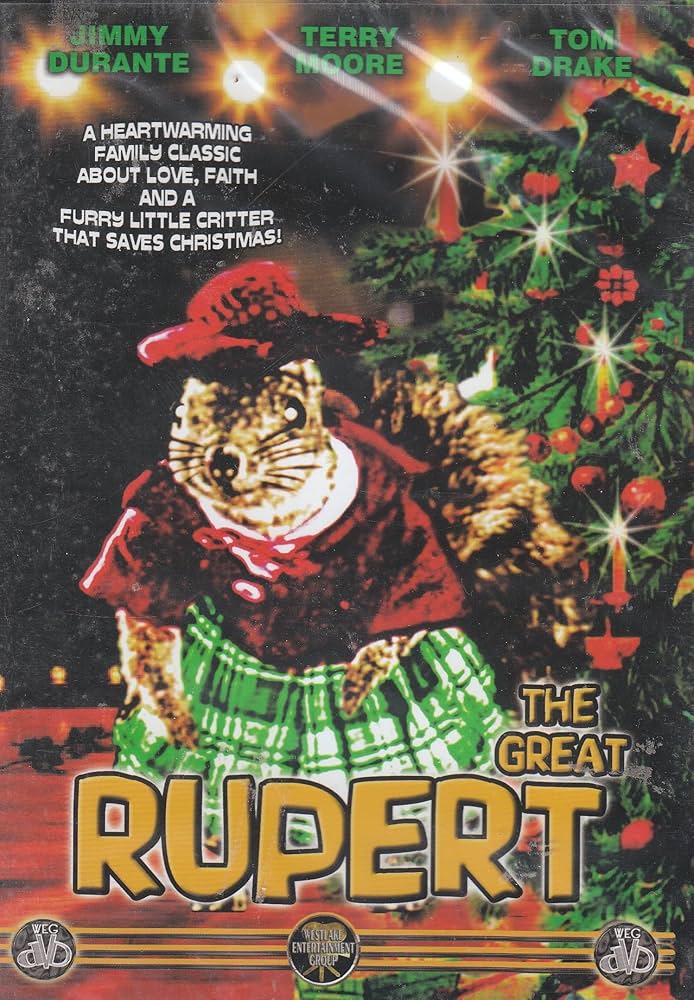
The titular performing squirrel is another element here that is likely to be divisive. On the one hand, the special effect of Rupert is really remarkably successful for a film that’s clearly in every other way a low-to-moderate budget production design, a B movie. George Pal, the movie’s producer, was an Oscar-nominated animator making the transition to live-action with The Great Rupert, and I can confirm that there’s a fluidity and a personality to the animated stop motion of the squirrel that’s impressive. On the other hand, Rupert and his antics often live fully in the uncanny valley, where his capering to concertina music while dressed in a kilt, for instance, is more unsettling than endearing. The rigid face of the squirrel (a model I hope is an artistic creation rather than a taxidermied real squirrel with articulated limbs) is such a strange juxtaposition to his energetically flailing limbs. Rupert’s role in the story is key but small, and therefore the sudden emphasis on him in the movie’s final few minutes is unexpected and a little destabilizing. You couldn’t do this film without him, but doing the film with him creates a really odd energy sometimes.
I think the thing I wrestle with in The Great Rupert is that I feel I should be tickled pink by it, when I think about its parts. I ought to be up for a hammy, confident comedic portrayal of Louie Amendola by Jimmy Durante, an icon of his era. I’m the kind of person who enjoys a solid message in favor of community and fraternity—Frank Dingle’s a villain (to the extent the movie has one) because he rejects his wife’s feeling that the money ought to be spent, and Louie Amendola’s a hero (to the extent the movie has one) because he uses his money to make as many people happy as possible, from his family in need of a Christmas dinner to local entrepreneurs in need of a cash infusion to refugees in Europe displaced by WWII in need of shoes. I tend to appreciate plot conceits in these “holiday movies” that rely to at least some extent on the religious content of Christmas as a feast—even though we know Mrs. Amendola’s miracle is directly caused by Rupert and not Jesus, there’s an undeniable feeling of grace in the scene that makes it seem like maybe a divine hand is working through the frankly lunatic chaos of Frank Dingle and a cashed check and a hole in the wall and a circus rodent falling like dominos to drop money into her hands at the moment she needs it most. I’d like to be a booster of this movie…but it’s just too flimsy an enterprise, somehow both slight and overwritten. It’s never really clear what the movie’s central story even is—Louie Amendola vs. Frank Dingle? Pete’s dream of romancing Rosalinda? Joe Mahoney’s hopes for squirrel stardom?—and none of them are really given the space they need. It’s a propulsive little movie, that packs a lot of both situation and comedy into its running time, and I would never look down my nose at anybody who says they just plain like it. It’s cheerful as cotton candy, after all, even when the scenes on film really ought to be pretty serious or even sad—without exception, this screenplay knows how to manufacture happy endings, and it refuses to be stopped.
I Know That Face: Tom Drake, the handsome but penniless musician Pete Dingle, had appeared earlier as John Truett in 1944’s Meet Me in St. Louis, a movie you’ll see covered here on the blog in just a couple of days. Terry Moore, here playing literal girl next door Rosalinda Amendola, is incredibly still acting today, in her late 90s; the only other holiday-related appearance I know of is a recent short film, 2021’s Evie Rose, in which she plays the 100 year old title character, celebrating Christmas with her teenage best friend. Of course Jimmy Durante, the generous Louie Amendola, has the unmistakable voice that younger generations might only know from him singing “Frosty the Snowman” on the soundtrack of the Rankin-Bass television program by the same name. And we have to doff our cap to Christmas perennial Sara Haden – underutilized here as the put-upon Katie Dingle, she’s appeared in other such holiday classics as The Shop Around the Corner (as Flora the shopgirl), which I blogged about last year, and The Bishop’s Wife (as Mildred Cassaway, secretary to the Bishop), a holiday film with a premise almost as strange as this one, though much less whimsical, and one I hope to cover, perhaps next year.
That Takes Me Back: You know, the whole idea of a circus feels stranger and stranger, the older I get—I grew up with them as a cultural experience that I and almost every kid I knew had had at some point, but my daughter’s never seen a circus and I wonder if she ever will (other than Cirque du Soleil). A movie that’s relying on us having multiple households of circus performers interacting (despite us basically never seeing a circus on screen) is pretty throwback. Oh, and cashing checks at the bank where everybody can see how much money you’re getting is a reality that on the one hand does seem perfectly normal to me, but it’s also something that I doubt a Gen Z kid would think of as even plausible. “You mean literally everyone in line at the bank would just hear talk out loud about exactly how much money you just put in your pocket?” “Yep.”
I Understood That Reference: Louie Amendola refers on multiple occasions to “Old Saint Nick,” a benevolent figure who wouldn’t forget the family. All they needed was an address (as he exclaims) for the generous fella from the North Pole to show up with gifts all round.
Holiday Vibes (6/10): So, probably the most centrally important scene in this movie involves a snowy Christmas Eve, a choir singing “Adeste Fideles” in the distance, a woman’s devout prayer to God on behalf of her family for some generosity on such an important holiday, and then, once her prayer’s granted, a truly effusive Christmas Day full of trees and tinsel, merriment and music at the landlord’s piano, etc. A movie that leaned a little harder into all that would score nearly perfectly. As it is, these scenes fade into the background and the movie’s not even all that interested in making itself feel “like Christmas” to some extent, so the rating falls somewhere in the middle of the seasonal bell curve.
Actual Quality (6/10): I’d love to give higher praise, but this is a movie I’ve tried to enjoy three times in the last five years, and each time I get to the end feeling like I was either rolling my eyes or checking my watch about as much as I was having a genuinely good time. It’s a gentle movie and it’s not going to bother basically anybody in the room, even if it fails to engage them. The jokes mostly don’t land, but the music is lively at least, and Rupert’s….well, Rupert is Rupert, and you’ll either love him or find him unsettling. It’s sure not my worst movie of the year, but I also really can’t tell you it’s any good, artistically.
Party Mood-Setter? It’s just not quite holiday enough to convince me it’s a great idea. But it’s certainly going to evoke that late 1940s vibe that feels like “the holidays” to a lot of folks, and it’s not going to confuse or bother you if your attention drifts in and out as it’s on in the background. Maybe if you’re out of other options?
Plucked Heart Strings? You know, weirdly, yes, there’s something moving about Mrs. Amendola’s prayer, and about her moral quandaries afterwards about whether it’s even right to keep asking for money they don’t desperately need. Queenie Smith, who got her acting training at the Metropolitan Opera in New York City, manages to convey a lot of pathos in a pretty small role. Even Louie’s generosity is sometimes pretty heart-warming. The main romance is, to me, pretty flat stuff, but I think the Amendolas as people shuttling from rags to riches would give you a little of that holiday glow.
Recommended Frequency: All in all, I think it’s just worth watching once. You’ll figure out right away if it’s not your thing or if it’s going to become a secret favorite. My returns to it have been, I think, unnecessary: I could have trusted my first impression of the movie, and I doubt I’ll see it again. If I do give it another go, years hence, it’ll be me looking to spend time with the emotional journey of the Amendolas again: the movie’s heart is better than its humor.
The rights holders for The Great Rupert clearly have zero concern about oversaturating the market. It is available from Tubi, Plex, Pluto, The Roku Channel, Sling TV, and something called Xumo, all of them ad-supported streams for free. Amazon Prime’s got it ad-free, if you’re a member, as does MGM+. You can pay to rent it, if you really want to, from Fandango at Home, or Apple TV. You’ll notice that a few of these services list it as A Christmas Wish which was the title given to it when a colorized version was released for sale in the 2000s (presumably they knew that would sell more discs than something called The Great Rupert). Barnes and Noble will sell you a DVD version for about ten bucks, and Worldcat reports that maybe a couple hundred libraries have it on disc. (Ask your librarian, though—it looks like the movie was added to some anthologies held by many libraries, so it may be there in a multi-disc case that has a generic name like “Holiday Collector’s Set”.)


This is another one that I watched for the first time earlier this year. I completely agree with your rating – mostly pleasant enough, with the occasional memorable moment, but not one that’s going into the permanent rotation.
In an incredibly bizarre and bizarrely-timed turn of events — shortly after I watched “The Great Rupert” I was watching one of the new Hallmark Countdown to Christmas movies, and in the movie they were screening “The Great Rupert” at an outdoor movie event! I was flabbergasted at their choice of films, and delighted that, had I not *just* watched it for the first time, I would not have recognized it!
LikeLike
Haha, that’s wild — see, that’s the kind of thing I’m always hoping to spot for the I Understood That Reference section but I don’t see enough of it. Maybe I do need to watch more Hallmark movies next year. 🙂
LikeLike