
Review Essay
One thing I’ve enjoyed about this blog project this year — along with getting to share things with you, and hear some of your comments back — is that I’ve tried to push myself to watch a wider range of movies than I normally would have watched. Sure, there’s lots of romantic comedies in the list, since that’s such a dominant element in the holiday genre (such as it is), but it’s been interesting to see the other uses Christmas can be put to. That’s certainly true of Carol, which I think is arguably the best film I watched for this project on an artistic level while also not being the kind of movie I normally think of this time of year at all.
Carol begins in medias res: we know that a slightly older woman named Carol is at a table with a young woman named Therese, and that there’s something between them that feels tightly wound, and somehow also fragile. A young man disrupts whatever their conversation had been, and they part, but the camera work and the editing helps emphasize for us that Therese is in a reverie, pulling her attention away from those around her and into the memories of meeting and knowing Carol. There’s no easy way to summarize this, so I’m going to miss a lot in this initial stage setting in saying simply that Therese is a shopgirl who met Carol, a wealthy mother looking for a Christmas gift for her child. It’s the 1950s — Christmas 1952, if I’m not mistaken — and for that reason it’s hard at first to know….are these women flirting with each other, or is this just awkward small talk? But then the film pursues their relationship and slowly opens up to us that these are in fact two lesbians — one of them out to a handful of people in her life, the other maybe not even fully out to herself yet. And, in that historical moment, this is incredibly precarious — Therese risks the relationships she has already built in her life (including a boyfriend). Carol risks her ability to even see her child, let alone act as her child’s parent. They run the risks anyway.
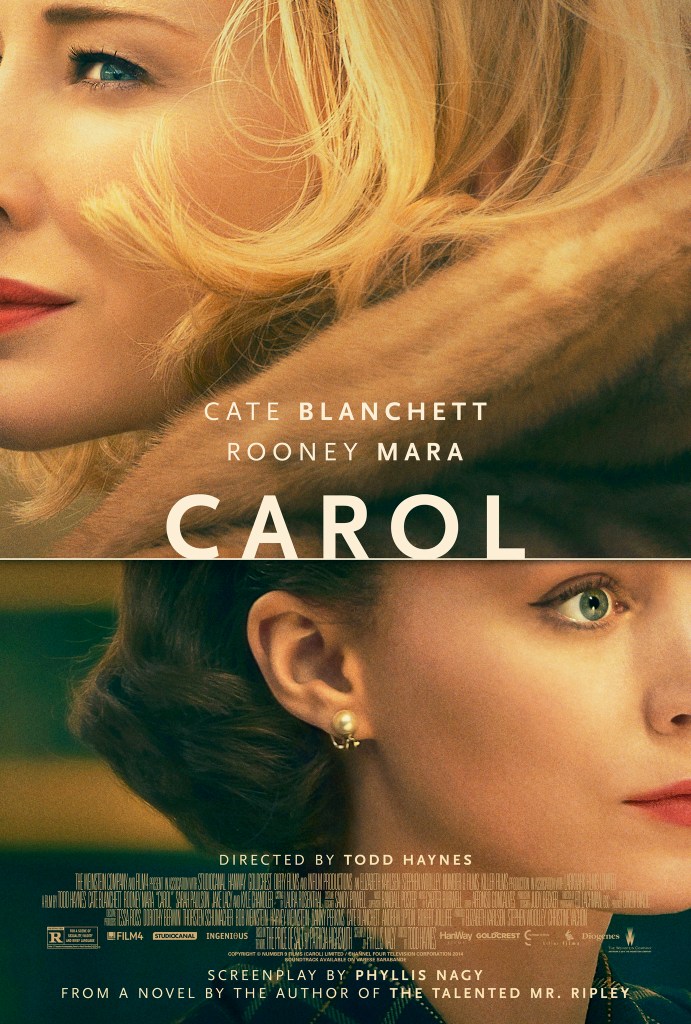
So much of the movie is about the question of whether a woman gets to have an identity that is her own: from the beginning, we watch Therese disappearing, whether under an obligatory Santa hat at work or into the vacant stare of dissociation I see as she tries to reckon with a boyfriend, Richard, who has big plans for her that don’t inspire her at all. Carol lives a little larger, but she’s constantly forced to push back — when her estranged husband, Harge, makes a reference to “Cy Harrison’s wife” she almost instinctively mutters “Jeannette” as if to say, “she doesn’t belong to Cy, or anybody else, you know”. Speaking of names, Therese is almost always referred to by her boyfriend as “Terry” — it’s only with Carol that she can count on hearing her real name, almost as though she’s not herself unless she’s with Carol.
And the film is also about the journey to find a space where you can be yourself. The journey is internal, sure, but there’s a pretty substantial journey undertaken in the film’s second act, as Carol and Therese drive west, escaping into the American interior like so many people in fact and in fiction, over the years. As they travel — initially as innocently as any two friends, but gradually opening up to the possibility of intimacy — the world slips by them and it’s maybe a little reminiscent of Remember the Night, except here both women are running away from their homes and not towards them. What will redefine them is not the loving context of family and community, but individuality and agency. The scene in which they finally have sex — and to be totally clear with you, dear reader, this is very explicit sex as you would expect from an R-rated drama, in case that’s not your holiday movie style — comes as a relief because you get the sense that you’re finally watching these people be authentic and unguarded. It’s a haunted sex scene, to be clear, because even as they’re in each other’s arms, we know that neither the 1950s nor the legal system adjudicating whether or not Carol gets to have contact with her daughter are going to let this be as easy as it feels in that moment. The relief they’re feeling is impermanent, and they know it; so do we.
The journey takes place at Christmas, and that’s where this film intersects with this blog. Sure, it qualifies the moment Therese puts on a Santa hat at Frankenberg’s, but there’s more than that in the use of this holiday. Carol and Therese’s first conversation deals with Christmas, at least a little — Carol loves it but also feels incapable, referencing how she always overcooks the turkey. I think the movie, as it unfolds, makes it clear that the turkey line is just cover for Carol’s fears of being inadequate as a mother (and perhaps as a wife): that the reason Christmas doesn’t achieve that looked-for perfection is because of something she’s getting wrong as a homemaker. Later, Carol fends off multiple invitations to friends at Christmas, as it becomes clearer that she needs her own space…a space into which she’s going to bring Therese, though. Christmas works here as a catalyst for action — Harge and Carol, for instance, fight about Christmas but it’s not about Christmas, of course, any more than most fights at Christmas are about the holiday. Christmas, meanwhile, threatens Therese a little, since she realizes she’s about to be treated as “family” by Richard’s family, and she doesn’t want to feel the inevitability of that — not yet and maybe not ever. She’d probably have run off with Carol any day of any week, but it being Christmas is even more of an inducement for her.
So much depends, in a film this contained and zoomed in, on the performances of the primary actors, since there are no huge set pieces here, no sweeping plot devices, to distract us. And the film has been wisely entrusted to Cate Blanchett as Carol and Rooney Mara as Therese. Carol is the most impossible of the roles — a woman established enough in a comfortable life to be proud and also wounded enough by the confines of that life to be vulnerable. We have to believe her when, on more than one occasion, she chooses someone else’s happiness over her own, whether or not she’s right about them — whether or not they deserve it. That Blanchett manages it is no surprise to anyone who’s ever seen her in anything, of course: I remember being blown away by her performance in Elizabeth, watching that movie on VHS from a Canadian video store back in grad school (talk about nostalgia), and the many times I’ve seen her since, she’s been uniformly wonderful (even in otherwise mediocre material). But I think there’s still something especially wonderful about her work in Carol, since there’s absolutely no special effects here to enhance her performance, and she has to face some tough emotions pretty directly on screen: it works. Mara’s task as Therese is to be believable as a young woman discovering that her ambiguity about her life isn’t some fundamental personality trait, but rather a reaction to trying to live as someone other than who she is. Her awakening to herself and to Carol is a liberation, but it’s navigated in the slow and sometimes difficult way that such journeys of self-discovery often take. And Mara’s really successful, I think, at not letting her portrayal become too cloying — really, both she and Blanchett give us characters who have sides that are not easy to warm up to. They’re not afraid to be human, and to invite our empathy without having to be saintly enough to earn it.
A lot happens in this film, and particularly in its final act, that I just have to leave to you as a viewer. It’s too nuanced and powerful a movie to spoil, even though it’s also not really a movie with a plot that’s relying on twists or tricks to keep you hooked. A lot of careful choices are made here by the director, by the actors, and by the screenwriter, that wring every drop of potential intensity out of the smallest interactions. When characters are betrayed, it hits hard. When they suffer or submit, it burdens me as an audience member. And the ending I get is not at all what I expected or had thought I was hoping for, but the way it resolves ultimately feels perfect to me, almost inevitable. There’s a sense of hope and of possibility, for me, that rounds out the subtle Christmastide feelings of the film into something that strikes the right emotional note.
I Know That Face: Jake Lacy, who here plays Therese’s unfortunate boyfriend Richard, appears as Joe in Love the Coopers, a film about a massive Christmas family reunion that was released the same fall as Carol. Kevin Crowley, here playing Fred Haymes, Carol’s lawyer, appears as Liam in the TV movie Country Christmas Album which is exactly what it sounds like, and has a bit part as Dr. Franklin in another TV movie, The Christmas Spirit, about a woman in a coma who appears in spirit form to persuade her community to something something look there’s a lot of holiday movies and I have definitely not seen them all. Sarah Paulson, here playing Carol’s devoted ex, Abby, has several holiday flicks under her belt: she stars as Emily in the Lifetime movie A Christmas Wedding, she plays Beth, the mother of a terminally ill 8 year old, in Hallmark’s November Christmas, and she is Grace Schwab in one of the segments of the anthology film New Year’s Eve. And Cate Blanchett, starring here in the title role, was once the uncredited voice of a “Mysterious Woman” in Eyes Wide Shut, which is also a critically acclaimed adaptation of a mid-20th century written work that takes us to a series of New York City gatherings at Christmas time, and is far, far more sexually explicit than even Carol is. I’m not saying it’ll never make the blog, but it’s not on the list for this year (or next, I think).
That Takes Me Back: I know this kind of shopping does still exist, but it’s been years since I engaged in the bustle of department store shopping at Christmas. I enjoyed the throwback feeling of a big decorated showcase space and the busy energy of the retail floor. Less appealing but certainly just as indicative of a bygone era was all the smoking indoors, all over the place, often in furs — the look and feel of the movie works with those 1950s symbols pretty successfully. I am too young to really feel a connection to the idea of a shared phone in the apartment hallway, but it sure reminds me of shows and books I encountered, growing up, and just the idea of a phone being in a place, and needing to go to that place to use the phone, is nostalgic. Oh, and in further technological notes, I’ll say that I do love a cash register that goes “ding” when the cashier pulls a lever, and I love anything called an “icebox,” especially one operated by a handle in the door.
I Understood That Reference: There’s very little sense of holiday media here, but Carol promises her daughter at one point that she won’t let Santa’s elf give her daughter’s presents away to another girl.
Holiday Vibes (5/10): In the movie’s first half, there’s a fair amount of this — as mentioned, Santa hats on the department store employees and discussions about turkeys, and then there’s handwritten note tags on gifts and home decorations. The use of seasonal colors, especially red, in the costuming is not at all subtle, and conveys a little about how the characters change (or don’t). By comparison with some films that are much more widely considered to be Christmas classics, honestly, this one holds up pretty well as committing to Christmas as a relevant setting for at least the movie’s initial work, even if the holiday recedes from view over time.
Actual Quality (9.5/10): This is a very, very good movie — Haynes is a gifted director and I love a Carter Burwell score, and the underlying story comes from an underappreciated and notable midcentury talent in the author Patricia Highsmith. As I’ve mentioned, too, the acting performances are really extraordinarily good: the movie earned every Oscar nomination it got, and was probably robbed of more than one statuette. Now, is it for you? Dear reader, I can’t know that: some of us are up for intense, often sad R-rated romantic dramas at this time of year and others of us wouldn’t touch them with a ten-foot pole. But if you think you might be in the former category, I really can’t say enough about how good a movie this is artistically. It’s worth your time.
Party Mood-Setter? If you’ve brought a shop clerk home and are hoping to take things “to the next level” then I guess so, but otherwise, haha, no of course not, this is an incredibly moody, melancholy, and sexual movie that isn’t going to pair very well with decorating the Christmas tree.
Plucked Heart Strings? You can’t help but feel emotionally connected to both Carol and Therese, even though the film’s management of itself is such that every emotion is somewhat muted, and I’d expect that most viewers won’t be reduced to tears. I found myself still feeling the movie’s emotional landscape after it was over, but it never caught me so by surprise that I was choked up, except perhaps for a single moment near the very end.
Recommended Frequency: It’s a great movie and it has some really vivid holiday moments, but it’s also such an intense viewing experience that I don’t think I’ll be rushing back to it every year. This is great film-making, though, with thoughtful acting and direction and writing and outstanding costuming by Sandy Powell (who has multiple Oscars) and a wonderful score by Carter Burwell (who SHOULD have multiple Oscars), and if anything I’ve said about it here makes it seem like something you’d enjoy, I think you should go for it. Just go in knowing this isn’t about hot chocolate and mistletoe and Santa laughing like a bowl full of jelly — both the movie’s highs and lows are just working in an entirely different register than the typical holiday movie.
If you’d like to watch Carol, Netflix will show it to subscribers for free. You can rent the title via streaming service from basically all the big ones, as usual, and Amazon will gladly sell it to you on disc (though if you’re anywhere that there are striking workers in its path, I encourage you not to cross those lines digitally, and to find the disc elsewhere, such as Barnes & Noble). And I don’t know what it is about Carol, but this film is available in even more libraries than White Christmas — over two thousand of them, according to Worldcat, so check this one out on disc from your local library for free, and enjoy it with my compliments.


Ah, the film that established Cate Blanchett as Our Patron Saint of Cinematic Lesbians. ❣️
I honestly thought I was one-and-done with this one when I finally, to my shame, got around to watching it a few years ago. I really have to prepare myself for this type of film, and most of the time I’m just too emotionally exhausted from existing in the world to handle this deep sort of drama. But darn if your review isn’t making me want to go on this journey with these two again…
LikeLiked by 1 person