Review Essay
I try not to make these reviews especially academic — I’d rather talk here just as a fan of holiday movies. But I think I should probably acknowledge that, as someone who researches representation in media (children’s picture books, specifically) and who also is working on a long-running research project into the lives of indigenous people (students at a boarding school in the 1890s-1900s, specifically), I probably come to this particular movie just a little more likely to want to say something about what this work means, separate from how fun or engaging it is as a work of media on its own. In all honesty, I’m sure my first encounter with this film, a couple of years ago, was motivated by my wanting to find authentic representation of Native American lives in a holiday movie, and it was one of the first titles I added to the list when I decided to attempt this blog project this year. But enough about James’s context as a viewer: what, exactly, is Christmas in the Clouds?
The thing about this movie is, it’s hard to answer that question. Like, this is a movie about Ray and Tina’s confused relationship, in which Tina thinks she’s falling for the man who’s been her unseen long-distance flirty pen pal for the last few months, while Ray thinks he’s falling for the undercover travel guide writer whose rating might determine the survival of the ski resort he’s managing on his reservation. But it’s also a movie about Joe, Ray’s dad, who badly wants to replace his dilapidated old Chevrolet Apache with a brand new Jeep Cherokee, if he can manage to win the reservation’s big bingo contest the night before Christmas Eve. And it’s also a movie about O’Malley, the drunk white curmudgeon who is the ACTUAL travel guide writer and wants to reconnect with his estranged daughter, and about Phil who’s chasing snow bunnies, and about a little kid who’s lost the mouse she decorated with colorful war paint, and, and, and. It’s a LOT.
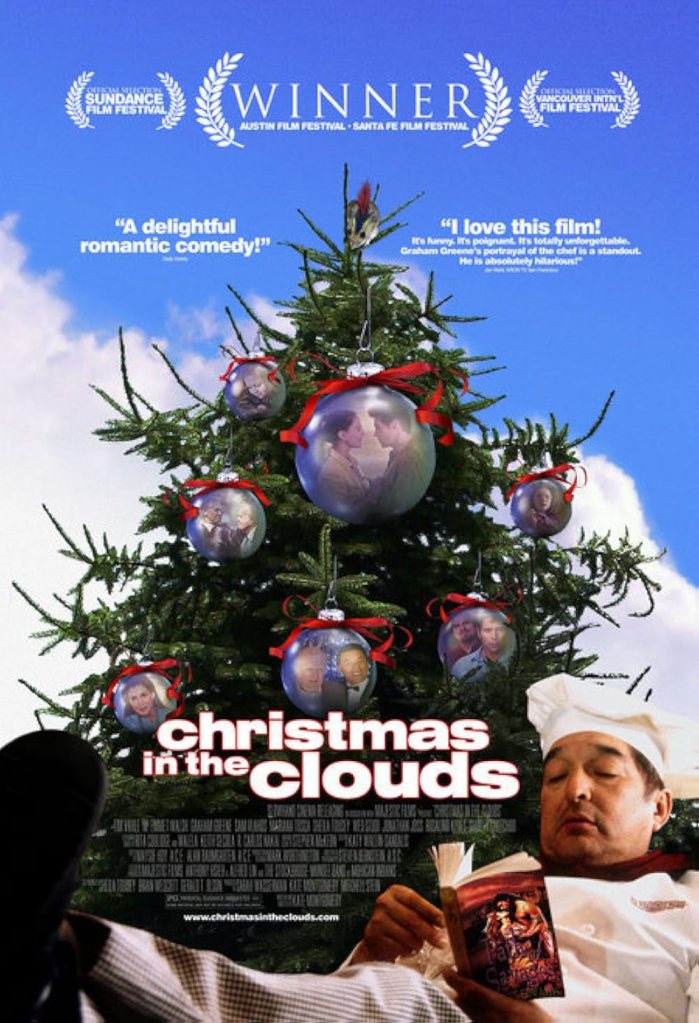
At its best, the film is a celebration of native identity and diversity — the opening narration tells us bluntly that “this story’s about now-a-days Indians” and those are the threads in this movie I really love. I love Ray’s pride in his work, which at one point spills into a pep talk to his employees about how their nation built the place, and the people who own and run it are native, and they deserve the best — which includes getting a better rating in the travel guide than some white corporate ski resort down the road. I love all the glimpses of what life is like on the rez — the front desk manager’s immersion in ridiculously over the top romance novels starring a kind of indigenous Fabio, and the scenes of multi-generational families gathering at the bingo hall, and the ways in which children and families intersect with the business of running a resort because there’s a sense that the whole community is invested in this place. I’m grateful that the film doesn’t present stereotypes to us like I’ve seen in other works about native people – we don’t get any stoic warriors or alluring princesses here, and the only person struggling with alcohol addiction is a flabby old white guy. It feels like a fun space to be in. I wish it was a little more precise about the native nation we’re working with — I have never felt it was specific enough, though I’ve seen other reviewers claim the characters are supposed to be Apache (I think they may be getting confused by Joe’s old truck). Given the setting, though, and the fact that the credits thank the people of the Uintah and Ouray Reservation, I think the most plausible in-fiction answer is that these people are connected with one of the bands of the Ute nation — it was great to see from the credits, at least, how engaged the production was with native organizations, since again, it often felt successful to me on that front.
Where it struggles…well, let’s start with the inexperienced writer/director, Kate Montgomery. Kate’s a white woman, and though she obviously approached this work with a desire to be supportive of native stories and performers (almost the entire cast, as far as I can tell, is Native American) she’s also an outsider. More importantly, as far as I can tell, this is the one screenplay she ever wrote — at least the only one that was ever produced — and I think that just limits how well she’s actually going to evoke the world she’s trying to portray. The actual plot feels borrowed from so many other movies — secret pen pals from The Shop Around the Corner, and a ski resort with no snow as the holidays approach from White Christmas, and a misidentified undercover VIP at the hotel from an admittedly very funny episode of Fawlty Towers, and an unlikely buddies in bed together scene from Planes, Trains, and Automobiles, etc. There are flashes of funny insight here — writing a role for the incredibly talented Graham Greene to play Earl, the vegetarian native chef who’s a wizard with eggplant but absolutely does not want to cook buffalo or venison no matter how much they need to impress a travel guide, for instance, was an amusing idea. But often the writing feels just a little forced. I think there’s some inexperience in the cast, also, and there are times when there’s just not a lot of energy on screen — the people talking are generally nice people and you’re rooting for them, but some combo of the camera work and the editing and the writing and the performance is leaving it a little flat.
Another result of her inexperience, I’d argue, is just that some scenes needed one more take — I’m sure this was a movie put together on a shoestring budget, but virtually every line by M. Emmet Walsh, the white travel writer and by far the most experienced actor in the cast, is so hammy that either he was refusing to take her corrections or she didn’t realize how odd the contrast would be between his cartoonish expressions and gestures and the much more composed, natural performances of basically every other actor she’s got. Maybe I shouldn’t blame Montgomery — I just feel a bit disappointed, sometimes, when I can feel the movie losing my engagement a little while I’m leaning in and ready to enjoy it. And I don’t know who’s responsible for casting here, but I’ll admit, I was seriously bummed to find out that the leading lady here, the character of Kristina Littlehawk (a Mohawk woman, in the script), is being played by Mariana Tosca, a woman of Greek descent. I mean, Mariana’s pretty and charismatic, but the whole point here is representation: come on, you know? Irene Bedard is right there. Or Kimberly Norris-Guerrero? And heck, it could have been any number of other native actors whose names I wouldn’t know — this is a tiny indie film and there’s no way Mariana Tosca was a name they needed on the poster. Again, I’m not criticizing her performance at all: I just wish that in a movie whose biggest raison d’etre is presenting native holiday movie stories with a native cast, the romantic lead was part of that experience.
But don’t let me talk you out of trying this movie, especially if you’re the kind of person who enjoys the Hallmark/Netflix/Lifetime holiday movie experiences — I think this film is working in that TV world of giving us some attractive people and a goofy but charming setup and a lovely setting. Nobody watching The Christmas Prince 6 is there to see Oscar-nominated acting performances — you’re there to get the same joys folks get out of all sorts of other media we usually call “guilty pleasures” but I’d argue there’s no need for us to feel guilty (and hopefully we don’t). There are more than a few scenes in this movie where we know exactly what’s going to happen — like, when an employee asks “are all the guests out of their rooms, because I need to turn off the hot water for a second”, we know that a guest is, unbeknownst to the staff, slipping back into their room for a shower, right? And you’re either going to roll your eyes at it or you’re going to giggle with delight — in the same way that some people love the moment in every James Bond movie when someone asks him his name or what he wants to drink and we already know the answer, and some people don’t.
The rom-com premise here mostly holds together, I think — it could have gotten very weird when Tina learns late in the film that her flirty pen pal wasn’t Ray at all, but his father Joe (I promise, this is no spoiler, the audience has been in on this since the movie’s opening scenes), but it just doesn’t, and I think the characters have convinced me that that’s how it would actually happen. Truthfully, in a film that’s tying up a few too many bows neatly for my taste, the ways in which the Tina and Ray misunderstandings unfold in the final act are in fact surprisingly successful: I criticized Montgomery’s writing enough earlier that I should be direct here in saying she definitely didn’t choose the easy or obvious moments in the end, and I was really pleased by it. There’s a lot of tension in the middle portion of the movie, though, and at times it does feel mostly like narrative contrivance that’s keeping everyone from saying the words that would actually fix things. My experience with the film is definitely a roller coaster, with plenty of ups and downs.
One more element that I think is important to mention is the music, because it’s great. From the opening moments, we’re hearing music by native artists — it helps establish a sense of place really effectively. Even later in the film, when we’re hearing instrumental adaptations of more familiar holiday music, the arrangements are noticeably unfamiliar — all of them composed and performed by a native musician. And when the end credits roll and I hear Keith Secola singing NDN Karz (a song I discovered a couple of years ago when I was assisting a friend with a native music playlist for a history course he was teaching), well, I’m smiling pretty wide. I love the ways this movie takes me somewhere new, while delivering something pretty standard in terms of the actual dot-to-dot details of its primary plot.
I Know That Face: Well, to dispose of him reasonably quickly, we will all recognize the face of the white alcoholic travel writer: M. Emmet Walsh, who’s playing Stewart O’Malley, has been in so many things I’ve seen, and as far as holiday media go, you might recognize him as Walt Scheel from Christmas with the Kranks. The native cast members have seemingly had fewer holiday media opportunities — native performers get fewer opportunities in general, based on all I’ve read and seen about Hollywood’s interactions with them — but I was delighted to learn that Rita Coolidge (who plays Ramona, the front desk person, here) is the voice of Melissa Raccoon in The Christmas Raccoons. (If you did not grow up on The Raccoons on CBC like I did, well, you missed something.) And speaking of Canadian television, we cannot fail to note that Graham Greene (the pained but proud vegetarian chef named Earl), among his many roles on screens large and small, appears in 27 episodes of The Red Green Show as Edgar K. B. Montrose, including “It’s a Wonderful Red Green Christmas”, and appears as Colin Reid in the TV movie, A Beachcombers Christmas. I dimly remember the Beachcombers from my Canadian TV-watching youth, and I have a much more comprehensive knowledge of (and affection for) Red Green and his crew — if you don’t know it, well, I’m pulling for you. We’re all in this together. Keep your stick on the ice.
That Takes Me Back: I liked that at check-in for the hotel, the desk attendants were handling paper reservation cards, and handing over an actual physical key for the hotel room: sure, it’s handy to use my phone as a key these days, but it was fun to remember what a hotel was like when I was young. I did think that pen pals who actually write each other letters in the mail in 2001 was pretty wild — this wasn’t that long ago, and it feels to me like even a few years later, it would have seemed totally implausible. After all, this movie is already a couple of years after the AOL conversations in You’ve Got Mail. And I had to smile at the use of the “funny papers” as simple Christmas wrapping for presents, in one scene, since these days most people would be far more likely to have wrapping paper around their house than they would have access to the comics section of a physical newspaper. Times really do change.
I Understood That Reference: The movie has a lot going for it, but I didn’t notice any references to Christmas stories or characters: Christmas in general, as you’ll see immediately below, was downplayed a bit by this script.
Holiday Vibes (3.5/10): It only really begins to feel like Christmas in the final half hour, though it does really ramp up that energy abruptly then to include gifts and carols and gatherings that boosted this rating substantially. Prior to that point, we get some good background hotel decor at times, but not much else. The movie’s many plots are already busy enough without trying to add too much Christmas pressure to them, I think.
Actual Quality (7.5/10): It’s hard to separate the pleasant quality of a representative native cast and setting from the moderately hackish quality of a lot of the screenplay and direction. This is a film made with great intentions and not quite enough skill to land the plane they’ve decided to fly in. I feel like a 7.5 is about right in terms of me being honest with myself — much better than the worst stuff I’ve watched for this blog, but not as strong as the good rom-coms I’ve watched. I’ve seen this film called “a Lifetime holiday movie but with a bigger production budget” and that doesn’t feel inaccurate — and as I noted earlier, I think that what it’s actually offering is going to be plenty appealing to an audience that’s looking for it.
Party Mood-Setter? Honestly I think this might be great for this kind of situation — the strengths of the setting and the music will still come across well if you’re slightly distracted while it’s on, and you can lean in or tune out as you like to the various plots as they appear and disappear. The film’s a pretty solid PG, too, so I think for most families it would be fine in the background (just one scene where Ray and Tina are waking up together, and it’s still coming across as pretty demure even then).
Plucked Heart Strings? I mean, honestly, no. The stakes are pretty low here — the resort isn’t about to close unless things work out, Tina and Ray are looking for love but not in dire straits, etc. — and therefore any happy endings we get are pleasant but not exactly material that makes you tearful with joy. That’s no criticism, either — the film set out to be pleasant company and I think it does achieve that goal.
Recommended Frequency: I can’t really imagine making this an annual holiday tradition unless something about the reservation setting really grabs you, but I have gotten enough good things out of it the two times I’ve seen it that I would certainly watch it again some day. For me I think it’ll be one I turn to now and again as a change-of-pace movie that reminds me there are a lot more stories to tell about the holidays. But I hope that, in the long run, enough native artists get the chance to make something in this cultural space that I can spend my time watching newer (and better) movies than this at the holidays that still achieve the kind of representation that matters, to me.
You can pretty easily watch Christmas in the Clouds if you’re so inclined: it’s available on ad-supported streamers like Tubi and Pluto and The Roku Channel. It’s also available on Amazon Prime, but only with ads for some reason, so being a subscriber won’t help you dodge those (if you follow that link, the movie description’s in Spanish for some reason, at least on my screen, but I checked and the audio track appears to be in English). If you’d like it on DVD, Amazon will sell you one for less than $6, and Worldcat tells me over 400 libraries worldwide have one to lend you. If you’re like millions of Americans and you go in for TV movie romantic comedies each December, I really think this one could be your thing, and I hope you give it a try if so!


Thanks for keeping your stick on the ice, James.
LikeLike
Linda, if folks can’t find me handsome, they should at least find me handy. 🙂
LikeLike