Review Essay
Remember the Night is another of these 1940s films, and one that would merit a nearly unreserved positive recommendation if not for a few minutes’ worth of totally unnecessary and irrelevant-to-the-plot racial material. In this case, just to be up front about it, we have a Black servant in a couple of scenes at the beginning of the film who’s either a savvy man pretending to be a fool, or else just a character written as a foolish Black servant: either way, too, his employer treats him pretty condescendingly. It’s certainly not the worst racism of the era on film, but it doesn’t need to be that to be uncomfortable and even unsettling. As always, I don’t mean to make excuses for the media of the past, and if for you that kind of material is a deal-breaker, I respect it and wouldn’t want to waste your time. But if you’re someone who can enjoy a film while deploring that kind of element, I think you’ll find this one has artistic value that’s worth appreciating.
The first ten minutes of the movie were its least successful (to me) so I do recommend hanging in there — not only do they feature most of the racial element I just mentioned, but they also largely feature people who aren’t our leading actors, and in particular a tedious, egotistical lawyer whose blathering on is a little tough to sit through without impatience (even though, to be clear, the movie knows he’s tedious — part of the point is that he’s long-winded and short on substance). Those minutes, though, establish the premise: that a woman shoplifter is, thanks to the skillful maneuvering of the DA assigned to prosecute her, about to spend Christmas behind bars waiting for an expert witness in her trial. He feels a little badly about the maneuver, enough that he arranges for her to get out on bond. But through a mixup, they find themselves in a car together, driving into the American Midwest to both of their family homes for the holiday. Elaborate, sure, but also a very solid basis for a romantic comedy to unfold.
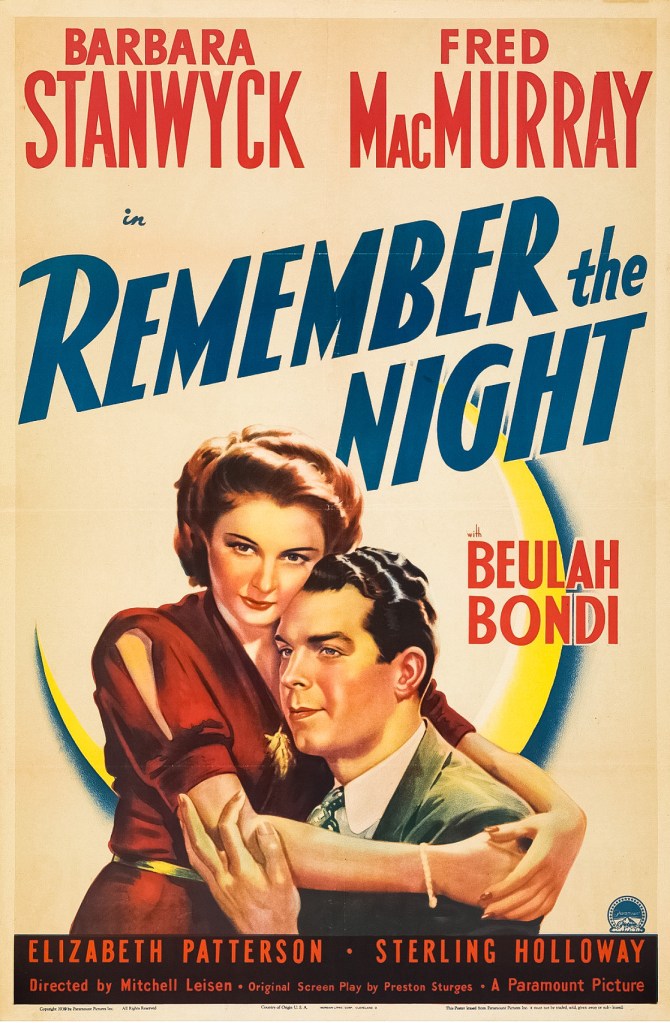
And the setting is brought really to life by the fantastic casting of the two lead roles. Fred MacMurray always was a chameleon, able to project such a range from sweet naivete to hard criminal purpose — I grew up with him as the sort of ideal Disney dad in films like The Shaggy Dog or The Absent-Minded Professor, but in this film, he’s excellent at managing the tougher balancing act of playing John “Jack” Sargent, a kindly smalltown fella who made good as one of the savviest minds in the New York City DA’s office. But here even Fred’s considerable talent is really getting blown out of the water by Barbara Stanwyck at basically the height of her powers — and she’s not just acting the hell out of the role, but she’s doing it in absolutely classic Edith Head costumes while speaking words out of a Preston Sturges screenplay (Sturges, for the unfamiliar, basically invents and achieves the apex of the screwball romantic comedies of the late ‘30s and early ‘40s that we now think of as classic Hollywood). Here, as Lee Leander, she has to run the gamut from exhibiting the kind of brassy self-confidence that’s helped her survive as a con and a thief for basically her whole adult life to the kind of fragile self-doubt that emerges as the fearful center around which she’s erected that facade to avoid confronting the pain of her upbringing. It’s an incredible performance, good enough to make me wonder why I’d never heard anyone talk about this film.
The funny thing about the film — given the fairly ridiculous premise and the snappy dialogue that Sturges is known for — is how naturalistic it so often is. Whether it’s moments where we hear Jack and Lee connecting over some shared memories of small town Indiana life, or the way Lee seems to shrink and tighten up with every mile she gets closer to home, there’s something honest about the emotions the two actors are working with — they don’t feel like they’re falling in love because of some machination in the script. They feel like they’re falling in love because it was meant to be — they almost feel like a couple that had been in love the whole time, and it’s only the movie that’s catching up to them. It’s pretty magical.
The magic of the film is less Christmassy than other films on this blog — to some extent by design, since really the film only feels like Christmas in two places. Either it’s the hyper-commercialized high street shopping of a bustling New York City, or else it’s the cornpone, apple-bobbing at a rummage sale, country Christmas energy of Jack’s hometown Indiana village. Everywhere else doesn’t seem to have the spirit at all, almost like it wasn’t Christmas anywhere else, really. That journey from Christmas to Christmas — from the one where Lee’s an operator who is never on the wrong foot, to the one where her defenses are laid bare and her authenticity can unfold in the softer light of home — is central, I think, to the movie’s thematic message. And I like how the film works in that way, but it hurts the holiday score a little, there’s no doubt.
In the end, it’s a film about love — love from the moment Jack realizes what he needs to do for Lee, just out of compassion for another human (and not yet thinking of romance), to the final….well, I won’t spoil it for you. And there’s so many kinds of love at work in this film — not just their love for each other at its best, but also the ways their love for each other trips the other person up or interferes with their designs, like it’s an O. Henry short story. There’s love here from family — both love that builds up and a love that can feel closed off. Even just the gentle moment of two elderly sisters, one a widow and the other a spinster, kissing each other on the cheek cheerfully as the clock strikes midnight on New Year’s Eve. There’s such remarkable strength, too, fueled by that love, and none of it stronger or more remarkable than what we see in Stanwyck’s performance as Lee in the film’s final act. She’s the best.
I Know That Face: There are SO many options here, it’s embarrassing, so I’ll pick just a few. Now, she’s not exactly inconspicuous, so I don’t want to dwell on her, but it would be silly not to remember that Barbara Stanwyck goes on to be Ann Mitchell in Meet John Doe, which reaches its climactic moments at Christmas, not to mention Elizabeth Lane in the by-now classic Christmas in Connecticut. But there’s other faces here you’ll recognize, and a voice too — the mothers in this film both have spots in other ‘40s Christmas flicks. Georgia Caine, Lee’s horrible mother, plays the minor role of Mrs. Johnson in The Miracle of Morgan’s Creek — another film culminating at Christmastime (and another Preston Sturges film). More memorably, Beulah Bondi, who here plays Jack’s much kinder yet still complicated mother, will be very familiar to many of us as George Bailey’s mother in the totally iconic It’s a Wonderful Life. And lastly, a voice — because Willie, the oddball servant in the Sargent home in Indiana, is portrayed by Sterling Holloway, of all people. Holloway’s utterly distinctive voice is best known to you as Winnie the Pooh, or the voice narrating Lambert the Sheepish Lion or The Little House or Ben and Me or any of dozens of other Disney short films, so much so that it’s hard for me to accept that that’s the voice of a regular person and not a cartoon character. Anyway, Holloway voices someone called Northwind in an animated TV movie called Tukiki and His Search for a Merry Christmas.
That Takes Me Back: Again, the 1940s films are generally an endless source of nostalgic elements and moments, but here’s a few that stuck out to me. I loved the moment early on when they’re reading a paper map while trying to manage detours in the middle of the night: I remember both the confusion and the exhilaration of that kind of navigating, which I was usually pretty good at, and it’s a bit of a shame that at this point GPS and a smartphone have taken over about 99% of that kind of human travel guidance. And then they haul out sandwiches wrapped in waxed paper — other than for crafting, I can’t think of the last time I used waxed paper, but it reminded me of my grandmother making sandwiches to take somewhere (I’m not sure this memory happened more than once or twice). And then later on, the “down home” Indiana Christmas involves both stringing popcorn for the Christmas tree, and bobbing for apples — the popcorn garland in particular is such a delightful glimpse of the much simpler Christmas trees of days past, and it made me smile to see the string on the tree in the background in a later scene.
I Understood That Reference: I know, I know, this is a weird category to include when it’s so often empty, but I think that in itself is interesting — it would have been easy, I think, for Sturges to incorporate some elements of Christmas stories (indeed, of THE Christmas story) here, and so it’s at least a little interesting to me that he doesn’t.
Holiday Vibes (4.5/10): So, as mentioned above, a lot of the film doesn’t really feel like Christmas — not the courtroom scenes, and almost all the travel from New York to Indiana seems to pass through towns and houses where no one is getting ready for Christmas at all. I do think there’s some thematic reason for it, so it’s not a critique of the film, but it does also consolidate the film’s holiday vibes into a pretty tight 25-30 minutes in Jack’s childhood home. As you can likely tell, I like this movie a lot, but I don’t think its evocation of Christmas is one of its strongest elements — I can easily see myself watching it at another time of year without it feeling out of place.
Actual Quality (9/10): I really enjoyed this movie, coming to it with almost no preconceptions at all. Sure, the opening ten minutes are both a little tedious and more than a little racially problematic: there’s no getting around it, and if you bail on the movie then, I get it. But after that, from costume to script to two stellar lead performances (and a couple of really great turns from the supporting cast, as well), this is a romantic comedy that’s really hitting all the moves the genre does best. Stanwyck is electric on film and MacMurray’s wonderfully subtle and loyal, and the two of them together manage both the surreality of the quick banter old Hollywood romance AND the reality of the emotional roller coaster two people might ride by falling in love in this way. If you like a good romantic comedy, I think you’ll love it, and if you usually find romantic comedies either squirm-inducing or silly, I think this is the kind of film that might make you say, “well, okay, THAT one is admittedly a solid movie”.
Party Mood-Setter? I mean, I would like to tell you no — as romantic comedies go, it’s leaning more on realistic emotion than on quips, so it’s a film that rewards your full attention and that might be hard to connect with if it’s just on in the background. But the film’s pretty great at conveying the combo of 40s nostalgia and fabulous Edith Head costumes, so if you want to do the movie a bit of an injustice and treat it as occasional eye candy, I think it could work in the background. I just also think that, when you’re really paying attention to it, it’s so good and human that it deserves the spotlight and I’m hoping you’ll give it center stage.
Plucked Heart Strings? For sure — I got genuinely choked up more than once, basically always at moments where Stanwyck as Lee really successfully conveys the feeling of a woman who’s never been given any tenderness or compassion in life experiencing the sudden shock of someone’s loving care. Especially because, at first, that’s all it is — not Jack trying to woo her, but just Jack (and later his family) seeing a person in need and reaching out to support her like it was the most natural thing in the world….because it is, to them.
Recommended Frequency: Oh man, this one feels like a candidate for “every year” to me; it’s certainly one I want to own so I can keep it in my regular rotation, and I feel like it’s a film that will reward future viewings. I think if the film as I’ve described it sounds appealing to you, it’s one to schedule for yourself this very holiday season: don’t delay!
Shockingly (to me) the only place I can find Remember the Night streaming right now is on Plex, the ad-supported free streaming service that shows up in this paragraph pretty frequently. It doesn’t look to me like it can be rented anywhere, though, which is unusual. It’s purchasable in a variety of media formats, though, on Amazon (and elsewhere I’m sure), if you’re willing to wait for delivery of physical media (and willing to trust me that it’s worth owning). And as always, try your local library — Worldcat tells me that there are hundreds of libraries with a copy on DVD.


I was pretty quick to buy this one once I had watched it for the first time a few years ago. I just knew I wanted it in my regular rotation. It does take a bit to get rolling, but once it did I was hooked. I’m just a sucker for loners getting to experience a traditional “family” Christmas (see also, While You Were Sleeping).
LikeLike
I should probably buy it — it really connected with me. I somehow missed While You Were Sleeping back in the 90s, and have never caught back up to it: sounds like it would be worth it. Would you call it a holiday movie? (I know your definition is less expansive than this blog’s ridiculously broad definition, and that’s why I’m curious. 🙂 )
LikeLike
While You Were Sleeping is most definitely a Christmas movie. The plot gets set in motion because Sandra Bullock’s character has to work on Christmas Day because “she doesn’t have any family.” Then, most of the rest film takes place over the holidays with things coming to a head on New Year’s and resolving soon thereafter.
LikeLiked by 1 person