How the Grinch Stole Christmas (2000)

Review Essay

We might as well get this out into the open from the outset: I like the 2000 film, How The Grinch Stole Christmas.  That’s a semi-controversial take already: the movie has long had plenty of detractors, and in some circles I’ve seen people make disparaging swipes at movies being “like that Jim Carrey Grinch movie,” as though it was shorthand for a bad holiday flick.  But it may not be THAT controversial—the film’s a perennial holiday showing even now, 25 years (!) after it was released, and I think a lot of people have at least moderately fond memories of it.  What’s probably going to be a little more startling, though, is my argument that, in fact, I love this movie, and I think it might be one of the best holiday movies ever made.  And what will be sacrilege for at least some of you is my argument that it’s a far better film than the 1966 Chuck Jones animated version of Dr. Seuss’s original book, which a couple of generations (mine included) grew up on.  It’s how I feel, though, and however hot the take, I’m going to do my best to persuade you that I’m onto something, anyway, even if you aren’t as taken with this movie as I am.

The basic premise of the Grinch tales in all their manifestations—and I’ll acknowledge up front, I’ve not seen the 2018 animated film or the televised Broadway musical, so I’ll have to leave them for some future blog post—is well known to almost anybody in the American cultural sphere.  Somewhere in the world of Dr. Seuss’s imagination, there’s a town called Whoville, populated by the Whos, a people about whom all we really know is that they celebrate Christmas with enthusiasm.  Neighboring this bucolic village is Mount Crumpit, and on the slopes of that mountain lives a sour, solitary creature called The Grinch, who hates Christmas (and, by extension, Whoville), because his heart is “two sizes too small.”  He eventually gets fed up with the sound of holiday festivities and steals all Christmas accoutrements from the homes of the Whos, before his inevitable change of heart.  It’s a simple story, fit for a children’s picture book, and I think it works just fine as Seussian spectacle (and as a short animated special).  I wasn’t ever really in love with the original, though, I’ll admit: it’s not among my 2-3 favorite Seuss books, and of all the midcentury Christmas specials airing on my family’s TV in my childhood, it was honestly one of the least essential, as far as I was concerned.  There just wasn’t much to the story—the animation was stylish and the voice acting was fun, but that’s about as far as it went.
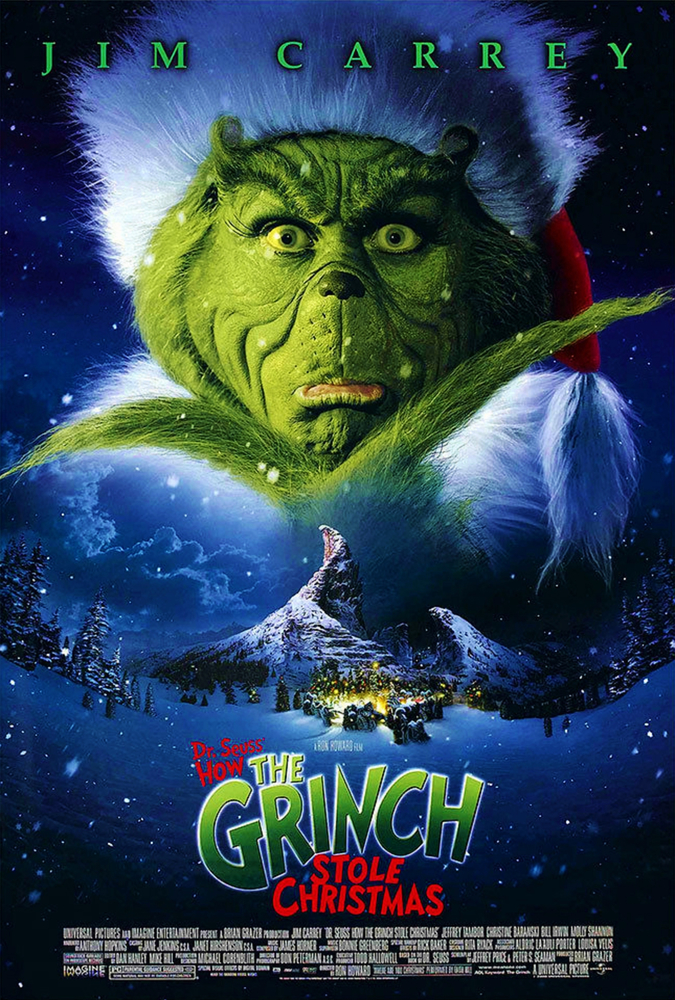
On the poster for How the Grinch Stole Christmas, Jim Carrey in his Grinch makeup (wearing a Santa costume) is staring at the viewer with his hand holding his chin.  Below his image, we see a snowy landscape, with a glowing vilage next to a thin, winding mountain peak, that establishes the scene in which it takes place.

The genius of the 2000 film adaptation, in my opinion, originates in its need to bulk up a very simple story into a feature-length screenplay.  As a result, the movie is forced to grapple with the Grinch as a character—why is he the way he is?  What’s his history with Christmas, or the Whos?  Depth is needed, and the script supplies it.  Furthermore, the only Who with any persistent importance in the story from its original book form (Cindy Lou) has to be given a sense of connection to the Grinch also, and here I think it’s managed really successfully.  The emotional investment she makes in The Grinch builds something powerful into the movie’s final act.  It all matters.

I suspect that one of the reasons the 2000 film takes heat from long-time Grinch fans is that it more or less up-ends the moral landscape of the original story—and in doing so, it puts our society in an unflattering light.  But that’s what I love about it.  The original tale is a simple one: us nice Christmas-observing nuclear families are the good guys, singing our little songs and having our little feasts.  The villain of the piece is the outsider: he does not look like us, he does not celebrate our holiday, and when our innocent celebration has made him angry, he tries to wreck our joy.  The fact that we continue to be happy because we have right-sized hearts convicts him at the last possible moment, so that he can repent and be integrated into the Christmas celebration.  Put it like that, and it doesn’t sound so nice, does it?  No offense to Ted Geisel, but it sounds a lot like the kind of pro-conformity message that he is otherwise famous for undermining in stories like “The Sneetches.”  The 2000 version, on the other hand, rightly understands that to the extent that there’s a plausible villain in this scenario, it’s the people of Whoville: they’re the ones whose material wealth is overflowing while a solitary creature is isolated outside their community, subsisting on their trash.  Their obsession with celebration is so all-consuming that they don’t consider the side effects of it—all the noise, noise, noise, noise!—which would be bad enough if the Grinch was merely someone indifferent to Christmas.  But of course it’s more complicated than that: from his youngest days, his experience of Christmas was isolating.  The holiday celebrated in Whoville demanded a great deal of cultural conformity that was unhealthy—the Grinch is mocked openly for his differences, and ultimately is driven out of town by bullying and ridicule at a young age.  Later, when the sound of the Whobilation’s Yuletide festivities is driving him crazy, the Grinch grabs a hammer to knock himself out with, saying, “Now, to take care of those pesky memories”: he knows that what bothers him here isn’t the noise, it’s the mistreatment that it now represents to him, because of his experience of the Whos.  And of course, most of the people of Whoville aren’t evil (their Mayor being the prime exception to the rule).  They’re just cheerfully complicit in some pretty cruel abuses out of a desire to remain comfortable and untargeted, themselves—they’ll quietly allow a powerful, arrogant blowhard to stand in public at a microphone, abusing outsiders for his own self-aggrandizement and making up passages from The Book of Who to suit his demented purposes while dismissing the one true believer willing to stand up to him in public and insist that the community’s values are actually imperiled.  Yep, if you thought you could escape the politics of 2025 here, I’m afraid I can’t let you.  What an incredibly apt movie for the moment.

And yet, what I think is most impressive about this movie is that the Grinch’s critique of the society bordering him is—for a movie in which Jim Carrey is a huge wisecracking green Yeti, essentially—pretty nuanced.  In a crucial scene, mid-film, The Grinch is given a triggering Christmas “gift” by the Mayor, in front of the whole town: it’s a reminder of the Grinch’s trauma, and the gathering treats it as a chuckle-inducing anecdote.  Remember that day where we made fun of you so badly that you fled into the mountains to live as a hermit….when you were, like, 8 years old?  Kids do the darnedest stuff, don’t they?  (I’m telling you, this film is wiser than it has any right to be about how “good” people do bad things.)  Anyway, you’d expect the guy to blow up in that moment: this is personal, it’s painful, and he could say so.  But he doesn’t confront Whoville until their town’s materialism is the thing on display, because I think on some level, the Grinch understands that that’s the real problem.  A society that’s more focused on the superficial, on presents and costumes and conspicuous consumption, is a society that loses touch with its own heart.  He doesn’t tell them it’s what leads them to hurt an outsider like him.  He doesn’t believe in their capacity to understand that truth, really—he has no faith in the Whos, and they’ve done little to deserve such faith, in any case.  This is what makes the triumph at the end of the story something powerful—it’s not just some mountain gremlin returning everyone’s Christmas ornaments so they can have the party they’d been planning on.  The Grinch comes back to them because they showed him that something he didn’t believe in was real—that this community could learn to find more joy in each other as people (him included) than they ever had in their stacks of Christmas presents.  He apologizes to them for how he’s behaved because they’ve earned his trust on a level he never imagined.

And yes, I know, I’m talking in soaring thematic terms about the ethical messages of a movie primarily intended to give us Jim Carrey making a fool of himself on screen.  Well, look, Jim’s not for everybody (and I don’t feel a ton of affection for some of his wildest comedic performances), but to me putting his manic energy inside this huge green fur suit is a match made in heaven.  My wife and I can (and do) quote half his lines all year long, from “Nice kid…. Baaaaaad judge of character.” to “One man’s toxic sludge is another man’s potpourri!” to “Oh no….I’m speaking in RHYME.”  I can imagine, of course, responding negatively to some of Carrey’s antics, but I just think it works for the character—it lightens what might otherwise be too heavy a story, honestly, to have the Grinch be someone who’s responded to being ostracized by becoming a standup comedian, transmuting his pain into a PG-friendly Don Rickles routine.

The other thing that gives this movie its needed heart is the performance by Taylor Momsen as Cindy Lou Who—sure, the character is earnestness personified, but that’s her dramatic function.  What I appreciate about Cindy Lou, and this only increases with time, is the way she expresses something far more mature than a child performance normally would.  This Cindy Lou is not merely some little kid woken up by the Grinch’s theft, as she is in the original.  She’s someone wrestling with the question of why Christmas doesn’t feel the way it used to—asking herself what the magic was, and where it’s gone.  This is not, I acknowledge, something an elementary schooler would normally feel.  But speaking as a kid who was a melancholy elementary schooler (somewhere I still have the Last Will and Testament I wrote at the age of about nine), it tracks.  More than that, though, what Cindy’s wrestling with is what we all wrestle with, no matter what holidays we do or don’t celebrate: where does our capacity for that childhood sense of wonder and delight go?  Is it just nostalgia for something that never existed and we’re smart enough to see that now, or was it real and we can find it again?  Given all that, it’s a really lovely (and touching) message that Cindy discovers that we can have that holiday happiness again, but only if we get our heads on correctly about what the holiday’s actually about.  We can’t find the joy in ever-increasing material consumption—the joy isn’t there.  It’s in the hearts of people who see and hear each other, of people who not only have the capacity to love but who put that capacity to work.  It’s in a community that, rather than seeing outsiders as threats to their stability, can look at those outsiders through the lens of the values they claim to profess, of welcome and inclusion and care.  THAT’S what can leave us singing “Fahoo, fores; dahoo, dores,” hand in hand with our neighbors.

And I think folks forget what high-quality craft goes into this film—Anthony Hopkins’s narration providing a lovely, lyrical insight into the story.  Incredible production design, from the costuming and makeup worn by the ridiculous Whos to the junkpunk vibes of the Grinch’s “lair” that’s filled with what are apparently his inventions.  A great symphonic score by the always reliable James Horner, and a sentimental song that seems to have stuck around in the Christmas pop canon in “Where Are You, Christmas?”  I think the admittedly larger-than-life presence of Jim Carrey in outlandish makeup slinging one-liners leaves people misremembering that that’s all this film has to offer.  Again, I know mileage varies.  A lot of you won’t get out of the movie what I see here.  But if you love it also, well, I hope I’m helping articulate some of the things that we might both be seeing in this film.

I Know That Face: Molly Shannon, who here plays Betty Lou Who (Cindy Lou’s decoration-obsessed mother), is a veteran of seasonal projects: she’s Tracy in The Santa Clause 2, she plays a fictionalized version of herself in It’s a Very Merry Muppet Christmas Movie, and in 2004’s The Twelve Days of Christmas Eve she plays Angie, a kind of angel who gives the protagonist 12 attempts to get Christmas Eve right (a la Groundhog Day).  But she can’t match the even more holiday-infused track record of Christine Baranski, the Grinch’s love interest here as Martha May Whovier—Christine’s playing Regina in 2020’s Christmas on the Square (a Dolly Parton project), she’s Ruth in A Bad Moms Christmas (a comedy I fear I’ll have to review one of these years), and she’s Lee Bellmont in Recipe for a Perfect Christmas.  Christine also voices Flo in Timothy Tweedle the First Christmas Elf, and she’s Prunella Stickler in Eloise at Christmastime, and of course as a sitcom regular (on Cybill, as Maryann Thorpe) she appears in Christmas episodes, including season 3’s “A Hell of a Christmas.”  I would be remiss if I didn’t take the chance to shine the spotlight on the director’s dad, Rance Howard, who’s Whoville’s “Elderly Timekeeper”—he voices Rudolph in Elf Sparkle and the Special Red Dress, he plays a blind man in Holiday in Your Heart (a LeAnn Rimes vehicle), and back in 1986 he was in his own Dolly Parton project, A Smoky Mountain Christmas, playing Dr. Jennings.  Lastly, we have to tip our cap to Jim Carrey, the Grinch himself, who of course got a much more negative review from me when I reviewed his work as nine different people in Disney’s A Christmas Carol.

That Takes Me Back: The whole village is wired in series, so that a single loosened bulb on the Whoville Christmas Tree turns out the lights all over town.  It reminded me, for a moment, of having to test every single bulb in the lights on the tree in order to figure out what had gone wrong.

I Understood That Reference: Of course, as the Grinch prepares to deploy his plan to steal Christmas, Santa’s been there ahead of him.  In any case, the Grinch is aware of the Rudolph narrative, since he riffs briefly with his dog, Max, about the reindeer’s having saved Christmas.


Holiday Vibes (8/10): Christmas in Whoville obviously both is and is not like Christmas anywhere else: there’s a lot here that “feels holiday” as Cindy Lou’s dad would probably have said, and of course my watching it routinely each December must add to that feeling.  To me, the feast and the presents and the decorations certainly create the right kind of feeling…but even more so, the message of love and our capacity to create community together is just what I want to feel at this time of year, and I’m glad it helps me do this.

Actual Quality (9/10): Look, I know this isn’t a flawless masterpiece—any movie where one of the jokes is getting a sleeping man (however odious) to kiss a dog’s butt is definitely not hoping to win any awards.  But I also think it absolutely deserves a much better reputation: it takes what is, frankly, a reactionary message about insiders and outsiders in the original tale, and transforms it into a much more thoughtful exploration of ostracism and its consequences.  It’s also funny, and sweet, and the whole movie takes place inside of a snowflake, like the one on your sleeve.  It’s great in my book, anyway.

Party Mood-Setter?  It’s absolutely quotable enough to just be rolling in the background while you do other things, and the story’s cultural saturation is so high that a Grinch on the screen probably won’t be too distracting to party-goers, even though it easily could suck people in.

Plucked Heart Strings?  I find some of Cindy Lou’s struggles pretty easy to identify with, but they don’t exactly make me mist up.  It’s an effective emotional arc, but I think you probably won’t need to watch the movie with a tissue box next to you.

Recommended Frequency: I’m not sure how to get through a year without watching this one.  It’s just too deeply ingrained into my memory (and my wife’s).  If you’ve never seen it, or just haven’t in a while, I hope you’ll consider giving it another spin.

This movie is fairly easy to access, though not necessarily for free—you can stream it if you’re a member of Amazon Prime, or Peacock, or Hulu.  You can pay to rent it from most of the usual places too, it looks like.  Barnes and Noble will sell it to you on disc, and around 1,500 libraries have a copy to check out for free, according to Worldcat.

Scrooged (1988)

Review Essay:

On Sundays at FFTH, I take on adaptations of Charles Dickens’s classic novella, A Christmas Carol.  This year, as with last, I tried to bring in one adaptation of the novella that’s more daring (and diverts more from the original text) in an attempt to see what kinds of interesting art can be made from the underlying structure of the tale.  And much as with last year’s total failure (I found Ghosts of Girlfriends Past almost unendurably awful, as you can see from the review I’m linking to there), Scrooged just really, really doesn’t work for me.  It’s at least a little better in my eyes than the openly misogynistic romantic “comedy” I watched last year, but after multiple tries, I just can’t find much sympathy in me for this approach to the story.  Let’s see if I can unpack where I think it goes wrong.

The premise feels high-concept but workable: instead of withered London moneylender Ebenezer Scrooge, this is the story of a narcissistic creep named Frank Cross, a quintessentially American mid-level manager who aspires to TV executive stardom.  His big swing for the limelight is a star-studded live broadcast of A Christmas Carol, which he wants to make the television event of the century when it airs on Christmas Eve.  Instead, though, he is confronted by the dead form of his former employer, and as he tries to stumble his way through Christmas Eve at the TV studio, he keeps drifting in and out of a warped version of Scrooge’s experience, in which Spirits have been sent to visit and confront him.  The whole thing is bleak right up until it’s very, very sincere, a tonal shift that is just one factor in the film’s primary problem: it hasn’t figured out what kind of movie it intends to be, and that’s pretty important given the attempts it is making to simultaneously produce a fairly straightforward mimicry of the Dickens original while also kind of sending it up by escalating some elements to the level of parody.

The DVD cover for Scrooged features the manic face of Bill Murray, looking directly into your soul with eyes and mouth agape and an intensity that suggests he's just told what he believes to be the funniest joke in existence and he is willing you to laugh at it. Next to the yawning rictus of his unsettling mouth, Murray holds a cigar gingerly between two fingers, waiting for it to be lit by a match held in the skeletal hand of an unseen creature (who appears to be wearing a Santa Claus coat, judging by the cuff of the sleeve).  In the background is an inexplicable full moon, looming above the New York City skyline.

At the beginning of the movie, though, I almost thought they had it worked out.  Cross and his lackeys are screening promos for various movies, and it’s clear: this is the Bah Humbug of 1980s America, in which Christmas is not dismissed, but rather it’s treated so cynically that all sincere sentiment in connection with the holiday has been eradicated.  What’s hard to take from the beginning, though, and never really gets calibrated successfully in my opinion, is the character of Frank Cross as played by Bill Murray: Murray, of course, is responsible for some truly remarkable and successful film performances, but he’s also an actor with a weirdly limited range, especially in the earlier stages of his career.  There’s no question that Cross as a character needs to be unpleasant—he’s Scrooge!—and in that sense, casting Murray to play this pompous, sardonic, condescending, panicky television executive can work, since he’s got the capacity to do that well.  Murray’s impulses as a comedian, though, undermine his performance here as an actor, since he trades in his opportunities to exhibit some kind of character growth for the chances to land quippy one-liners or the perfect smirk.  But it’s not just Bill’s fault: I think the screenplay is also so in love with the idea of all the jokes it can generate out of him in the lead role that it doesn’t give him much of a man to play even if he’d tried harder to do so.  I’ve enjoyed Murray in lots of films, even movies that count on a certain level of cringeworthiness to succeed (What About Bob?, anyone?), but I’ve watched Scrooged multiple times and I’ve never been able to invest myself at all in his performance.  There’s something desperate about it, like an actor who understands the film isn’t quite working while he’s making it, but he can’t figure out how to fix it from the inside.

I think that the film’s sense of humor overall is really where I consistently struggled to figure out what the filmmakers were trying to do.  A Christmas Carol definitely can be funny: Scrooge loves a good wisecrack, and many of the surrounding cast of characters are people in a light-hearted mood.  But the tone of Scrooged is so sour.  The character of Loudermilk is one example: he’s one of Cross’s underlings, who gets dressed down and then fired in the film’s opening minutes.  Thereafter, he keeps reappearing in the film, but almost always just so that there can be some gag in which he is mistreated again, often by Cross (directly or indirectly).  To me, there’s just no sympathy in the film for him: every single joke is punching down at a guy who exists only to be humiliated.  We’re supposed to laugh at how pathetic Loudermilk is, or at least the scenes are shot and edited like comedy sketches, rather than as haunting examples of the way Cross mistreats those under him.  Imagine if A Christmas Carol was designed so that, when Scrooge maliciously refuses coal to Bob Cratchit, we get a reaction shot of Bob turning blue that’s intended to make us laugh at how miserable he is.  Do they know what this story is about?  And Loudermilk’s not even the worst example of this: one of Cross’s many enemies is a woman from the network censorship office who is worried about the “family-friendly” nature of his crass, exploitative, live TV cavalcade, and she seems to exist in the story purely to be abused (often physically) for laughs like she’s one of the Three Stooges.  Except the Stooges are main characters and the audience is expected to root for them, whereas I can only describe the treatment of the network censor as accidentally misogynistic at best (and honestly, it doesn’t feel accidental to me).  The problem extends to the Spirits themselves, whose sense of humor is as mean-spirited as the rest of the movie’s: Christmas Past and Christmas Present are supposed to be here for Scrooge’s welfare, trying to wake in him a less callous and more humane understanding of himself.  I honestly don’t know what the heck the movie thinks it’s up to, but here, the Spirits are tormentors on a level that has nothing really to do with Dickens.  Christmas Past steals from Loudermilk for his own amusement—can we imagine a world in which one of the Spirits steals something from the Cratchits, as a joke at their expense?  Christmas Present seems to have been written as a woman who is simultaneously a sexually adventurous flirt with Cross, a hyperactive toddler he needs to manage, and a comically violent menace whose primary goal is to hurt Frank repeatedly…I have no clue why any of it is happening, other than that someone thought it would be funny.  If it makes you laugh, friend, I’m glad for you but also I don’t think I understand why.

Honestly, the humor is so bleak that I tried to construct an understanding of this movie as essentially a parody of A Christmas Carol.  I wouldn’t have much sympathy with the ethics of a film that thinks the Dickens classic is goody two-shoes nonsense, but I think I would at least find the motion picture interesting as a curiosity: can you persuade us that it’s dramatically satisfying to have an unrepentant Scrooge, surrounded by Spirits who are supposed to reform him but are having more fun being as gleefully mean as he is?  But that’s definitely not what this film is doing.  One reason is that they’ve cast the luminous Karen Allen, a woman who deserves SO much more than this screenplay is giving her, as Claire (the equivalent to Scrooge’s Belle), a dedicated social worker and professional bleeding heart.  It’s clear that the movie wants us to understand that she’s a good person and Frank needs to reform himself to get her back—a prospect as baffling and implausible as the primary relationship dynamic in Ghosts of Girlfriends Past, sure, but it’s the obvious point of the movie nevertheless.  At this point, I think I’ve decided that any Christmas Carol adaptation that wants to give Scrooge romantic happiness at the end is likely doomed to failure: it just requires too forgiving a woman (or else too appealing a Scrooge), and it turns his reform into something he’s doing in order to win a prize rather than a genuine change of heart.  And as I alluded to earlier, this movie is going to end with a sincere (well, sincere except for a final few jokes they couldn’t stop themselves from adding in) expression of holiday sentiment and goodwill from Frank Cross to the world via television broadcast.  A rich and self-satisfied man with no previous holiday spirit to speak of will suddenly lecture millions of viewers at home about their own callousness in watching the TV program he himself created and shoved down their throats….okay, that part actually does seem true to life, let’s give it to the movie.  Anyway, my point is, Scrooged, in trying to be both a black comedy and a soaring ode to virtue, is a film at war with itself, and as a viewer, I wanted to surrender.

What goes well?  Like I said, I think the jokes in the opening scenes are mostly aimed right: the film’s mocking sensationalism and the exploitation of Christmas for media stardom and millions in profits, and I get why the initial pitch for this movie persuaded producers and talent that it could be a great update of A Christmas Carol.  Grace, Cross’s long-suffering servant and our closest Cratchit analogue, has a story with some heart, and my few glimpses of her with her family made me wish I was watching her story instead of Frank’s.  Although I think the Christmas Past spirit is very badly written as a character, at least some of that segment of the movie works, especially Cross’s memories of his relationship with Claire, which feel authentic enough that there’s some real emotion in the break-up, and you can see where a better kind of Frank once existed.  I do think that some of the scare tactics of the ghosts/spirits work effectively (even though—or maybe because—they are pretty disgusting, like the Marley equivalent’s disintegrating body).  And, though here I’m at odds with the motion picture itself, I kind of like the character of Bryce Cummings, an “L.A. slimeball” (to quote Frank) who’s here to threaten Cross’s hold on his job—the screenplay sees him as a villain because he’s Frank’s antagonist and needs to be humiliated in the final act in order to give Frank a happy ending.  But what I liked about Cummings is how mean he is to Frank—in a way, he’s revealing that Cross was never as good at being a big shot as he wanted to be, and given how horrifyingly Frank’s treated everyone else in his life, I loved seeing our Scrooge character squirm for once as someone being thwarted by his competition.  I’m not sure how the movie itself doesn’t get that Cummings isn’t the villain—Scrooge is his own villain.  Whatever process this screenplay went through, I feel sure that too many hands touched it, and the result is an incoherent mess.

In the end, I think part of what I respond to negatively in Scrooged is just that I live in a world run by Frank Crosses, where media moguls (and the ghouls they have made famous) dominate far too much of society, amusing themselves excessively at the expense of people they think of as extras.  If I’m going to see a story about a Frank Cross, I need it to contend with his monstrous capacity for harm in a way that I can make sense of.  The narrative presented by Scrooged, on the other hand, is a chaotic muddle—a film that thinks Frank is funny enough that we can’t help chuckling at his mistreatment of others, but also redeemable enough that he won’t even need to apologize for most of that in order to get us to forgive him.  It wants to satirize an industry that fills our screens with sex and violence and special effects…but one of the consequences of that is a film selling itself to us with a lot of those very elements.  And even the movie at its most noble remains confused: what is the lesson Frank Cross needed to learn?  (His “Marley”—a former network boss named Hayward—is confusing to me.  He arrives neither chained nor haunted by any specific misdeeds, telling Cross to avoid the fate he has suffered as a “worm feast”…but that’s nonsense, since nothing Cross does is going to let him avoid mortality, and the message of A Christmas Carol isn’t “avoid death at all costs” in any case.)  And when/how does Frank Cross learn whatever it is he learns in the noise and mayhem of the events he experiences?  I’m still not sure.  That’s probably one of the most damning reviews I can give of an adaptation of A Christmas Carol: I don’t understand how this Scrooge has been transformed. 

I Know That Face:  Bobcat Goldthwait, who appears here in the astonishingly ill-conceived role of Eliot Loudermilk, plays the role of the Narrator in 2005’s A Halfway House Christmas, which from what I’m seeing online looks like an equally ill-conceived television program.  Alfre Woodard, an iconic performer who’s mostly wasted here in the part of Grace Cooley (the Bob Cratchit analogue), appears later in her career as Wanda Dean, a drug-addicted mother rescued at Christmastime by a drag queen, in 2000’s Holiday Heart.  It will be not at all surprising that Bill Murray (who in Scrooged is of course Frank Cross, the Scrooge-equivalent) appears as himself in the TV special, A Very Murray Christmas, but it might surprise you that the bartender in that program is a role played by David Johansen, who had appeared alongside Murray here as the Ghost of Christmas Past.  And John Houseman, who appears here in his final credited role as a thinly fictionalized version of himself, narrating the live Scrooge television broadcast that Frank Cross is trying to produce, had appeared as Ephraim Adams, the imperious old choirmaster, in 1980’s A Christmas Without Snow.  Houseman also plays a small role—Mr. Wabash, a CIA officer—in 1973’s Three Days of the Condor, a relatively taut thriller that happens to be set around the Christmas holidays (a la Die Hard) and will probably at some point make it onto this blog.

Spirit of Christmas Carol Present:  In fairness, we do get a very creepy undead Marley, and I think Yet to Come’s a good modern American version of the Spirit just in terms of character design.  The rest of the spirit work, as aforementioned, isn’t clicking for me, but I liked these elements and felt they captured something of the Dickens original.

Spirit of Christmas Carol Absent:  It’s surprising to me that nobody comes calling on Cross for donations, like the men who call on Scrooge in the original tale, and it is flat out weird that Marley isn’t burdened by chains or any other symbolism to communicate that he’s specifically suffering for his crimes against humanity.  Sure, Hayward mumbles something about how mankind should be his welfare, but it feels so tacked on to a scene that otherwise communicates nothing about the Hayward-Cross dynamic (as opposed to the depth of that Marley-Scrooge encounter) that I think the movie essentially whiffs on the dialogue itself.  Everything from the appearance in the film of Christmas Yet to Come through to the end credits is very different from the original story, and in a way that saps the story’s power, I think.


Christmas Carol Vibes (6/10): Starting with the title, there’s no way you’ll be confused about this being an adaptation of A Christmas Carol, and given that Frank Cross is trying to produce a much more faithful (in some respects) live version of the story at his TV studio, we do get images of traditional costumes, etc.  Spirits are taking him to the past, present and future, and he becomes sympathetic to the unwell child of his employee.  You know, the pieces are here.  But also, this really doesn’t capture the right tone of the story at far too many points.  If you’re in the mood for A Christmas Carol, I’m not sure this one will resolve a big chunk of that need.

Actual Quality (5/10): There’s a lot of money and talent on the screen here, and at the right moments (a fair proportion of the interactions between Frank and Claire, anytime Grace is center stage, etc.) I could see there was a movie I kind of wanted to watch.  And then everything else happens, and makes me feel foolish for coming back to this film more than once, trying to understand a motion picture that clearly doesn’t understand itself.  It’s an interesting effort in some ways, but it’s also a failed effort, without question.

Scrooge?  Murray’s register as an actor is great in the right roles, but when the writing lets him down, at least in the 1980s I just think he didn’t have the tools it would have taken to escape the problem of being obviously and exhaustingly self-satisfied on screen.  It undermines both sides of the Scrooge experience, in my opinion, even though I’ll admit he persuades me that he is a person other people hate and might love to see dead.  And especially when it’s time to be the reformed Frank Cross, he’s still leaning so hard into this smug, condescending persona that it undermines most of his lines of dialogue in a way that maybe another actor could have sold me on.

Supporting Cast?  I wish there was more for Claire to do, since Karen Allen’s got a lot more range than what’s asked of her, to be a largely trodden-upon do-gooder who in the final scene seems almost like a woman relieved that her abusive boyfriend has forgiven her (rather than a woman who rightly ought to be receiving his apology and weighing whether to forgive HIM).  The Spirits are badly written and directed—I don’t blame David Johansen or Carol Kane, even though I think it’s also true that really they’d be poorly cast as better written versions of the Spirits in most adaptations since their comedic energy is hostile and aggressive in ways that would be hard to calibrate when it comes to this story.  

Recommended Frequency?  I have tried so many times to like this film, given how many talented actors are in it, and given my feeling that there’s got to be a way to tell a good modern American version of the story.  It’s better than last year’s entry (Ghosts of Girlfriends Past), but that bar was ludicrously low, and frankly, I think I’m done trying to understand or appreciate this movie.  Despite its own self-satisfaction at its big swoopy emotional ending, I think the choices of the film-makers end up creating a work that’s almost as sour and bitter as Ebenezer Scrooge.  If they understood how to make a movie that celebrated human connection, compassion, and care, they applied very little of that understanding to huge sections of Scrooged.  An unfortunate miss, and one I won’t be coming back to again.

You might feel very differently, of course, which I respect, so how might you watch Scrooged?  Well, if you subscribe to some of the slightly less well-known streamers—Paramount+, AMC+, MGM+, for instance—you can stream it for free, and you can rent it streaming from all the usual places.  It’s quite inexpensive at Barnes and Noble on disc, and some 1,500 libraries have it for checkout, according to Worldcat, if you’d like to try it without paying (a wise option, in my opinion).  For those of you still waiting for a good, straightforward adaptation of A Christmas Carol, hey—watch this space.  Next Sunday, I should have something for you.

Bernard and the Genie (1991)

Review Essay

The selection process here at Film for the Holidays is pretty loose: it’s not like we’re being lobbied with gift baskets by streaming services (though Tubi, anything you want to send, I’m here for it), and other than a few very simple rules (1. Cover at least one movie per decade in the talkies era, 2. Every movie needs to have at least one unambiguous scene set at a winter holiday) I don’t really have much to guide me.  I try to come up with a mix of things I’ve seen before and things I haven’t; things I like and things I don’t; different genres and film-making styles, etc.  And along with all of the above, I’m always on the lookout for something that could be a diamond in the rough—some neglected, little-known gem that I can share with you all and add to our collective holiday fun.  That’s why I reached for this BBC production—an early ‘90s British TV vehicle for a young Alan Cumming and a just-hitting-his-prime Rowan Atkinson, along with a big role for Lenny Henry, who’s less famous than the other two fellows but who I’ve thought was hilarious from his early days on Chef! to his recent work on The Lord of the Rings: The Rings of Power.  Throw in that this is a screenplay by Richard Curtis—he of Four Weddings and a Funeral fame, with 4-5 other Christmas-related screenplays under his belt over the course of his career?  It just seemed like the perfect pick to be a surprisingly delightful lark. . . . Well, it ain’t.

The setup of this movie probably should have made me wary from the outset.  Cumming, as Bernard Bottle, is a bumbling young art dealer, fired by his outlandishly narcissistic boss, Charles Pinkworth (Atkinson), for having even raised the possibility of being generous to the senior citizens from whom he’d purchased some paintings that had proved to be hugely profitable at auction.  Bottle stumbles back weepily to his apartment where he learns that his best friend Kevin has been knocking boots with his long-time girlfriend Judy, so he really is at the end of his rope.  He polishes some old lamp he’s found, though, and KABOOM, just one singed testicle later (I’m sorry, but it’s literally what the doctors say when he wakes up), he finds himself in possession of a 2,000 year old genie named Josephus (Lenny Henry), with whom he is only able to communicate because in a moment of terror he shrieks, “I wish we could understand each other” and magically they can now talk freely, despite the language barrier.  The screenplay’s version of the ancient Middle East is so comically stupid that I can’t always tell if it’s offensive or just incoherent—though my guess is most people will find at least some moments and jokes offensive—and the problems of Bernard Bottle are so cartoonish (but also so easily resolved) that it’s not exactly clear how invested we’re supposed to be in his triumphs.

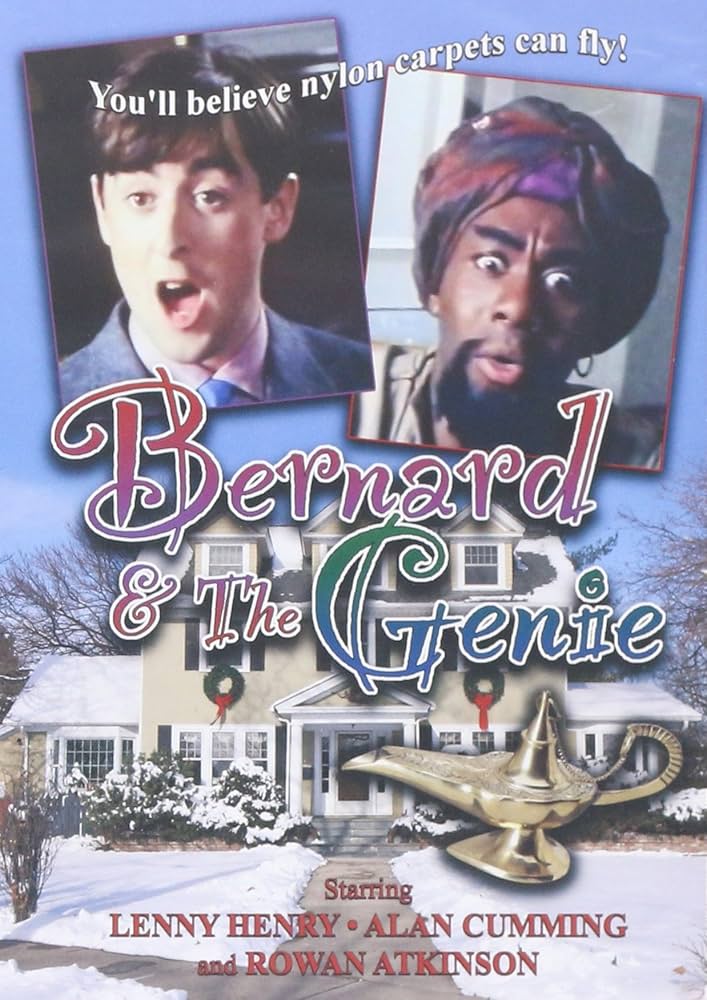
The DVD cover for Bernard and the Genie superimposes the title and a shiny golden oil lamp in front of a generic-looking, snow-covered suburban house that has nothing to do with the movie.  Above the title and house, images of Alan Cumming and Lenny Henry in his genie costume are making surprised faces, next to the tagline, "You'll believe nylon carpets can fly!"

By far the biggest problem with the script, a problem so big that if we just fixed this one element I think the movie’s at least 25% better, is Curtis’s decision to place no real limits on the genie’s power.  Josephus can literally snap his fingers and turn back time by minutes, hours, even days as needed to correct any mistakes he or Bottle might have made.  More seriously, though, the lack of limit extends to the number of wishes.  Bernard Bottle can make an infinite number of wishes.  There’s a reason that basically every wish story you’ve ever heard of extends a small number of wishes (usually three) to the wish-maker, from Aladdin to Darby O’Gill.  It’s just not that interesting to know what I would wish for if I have endless wishes: all pressure is off.  I can fix my house, my car, my job…I can fix the houses, cars, and jobs of anybody I meet, in fact, and I can take revenge on people who’ve wronged me, and I can do something about the world and its problems writ large, without any moment where I have to make a difficult choice.  It turns out that this one element—having only three wishes—is a load-bearing element in these stories, since it places a lot of weight on each individual decision to wish.  It forces the protagonist to learn to solve most of their problems themselves (in order to “save a wish”) and over time, by means of all that learning, our hero becomes, well, heroic.  A world in which Bernard has only three wishes is one in which he is forced to actually grow up, and become something other than a kind of life-sized Charlie Brown, but one with an infinite magic wand.

This is the point in a negative review where I stop and try to catalog the movie’s high points, but there’s not a lot to supply you with.  Lenny Henry, an actor I think has real comedic talent, has clearly been set loose in this role without any restraint from the writing or direction, and as a result his mugging for the camera is exhausting, like a kid running on too many Christmas cookies who you can’t wait to send to bed.  Because anything can happen, none of the chaos feels all that meaningful—like a series of Family Guy sight gags, whole stretches of the film’s second act just become jokes based on the fact that Josephus can do literally anything, from summoning a Big Mac to summoning the Mona Lisa.  Bernard can arrange the arrest of his former best friend on drug charges or transform himself into Bob Geldof or murder a police officer by accident (okay, I guess Mr. Bottle’s lawyer would like me to say “commit manslaughter” instead of “murder”), and all of these things will last for about fifteen seconds, and then anything bad about them can be undone, and anything good about them won’t last since there’s another wish coming.  Curtis’s screenplay is so overstuffed that there are definitely ideas that I think could have been funny in a movie that gave them room to breathe, like Bottle’s apartment having an elevator operator who is a charmingly pathological liar or Josephus having an obsession with the music of Barry White, but it’s the room to breathe that we’re missing.

And when I say overstuffed, I mean it.  I’ve made it to the fifth paragraph of my Bernard and the Genie review and I haven’t yet mentioned that a big chunk of the movie involves Josephus eventually claiming to have been a close personal friend of Jesus Christ, present at everything from the wedding at Cana to the feeding of the five thousand.  That’s the sort of thing that would in any other movie qualify as the singularly bananas story element you can’t wait to unpack, but here, by the time Josephus brings it up, all I could do was smile and shrug.  Sure, Josephus.  Why not?  His friendship with Jesus, who was a really chill guy (he says), supposedly makes him angry about Christmas commercialism, which is not what Jesus was all about (well, okay, that part checks out).  But Josephus makes this claim within a few minutes of him dispensing lottery cash to a guy he thinks deserves it, and doling out a ton of great presents for Christmas, etc., so what exactly is the movie’s anti-commercial message?  I’m not sure.

Okay, let me try a little harder: what can I actually praise here?  There’s something sort of right about Cumming as a naive young fellow counteracted by Atkinson as a brooding, domineering force of malevolence: this could have worked, and it almost does, though the film never comes up with great explanations for why the two characters do what they do.  Cumming as Bernard Bottle is in fact an appealing sad sack—as aforementioned, in a Charlie Brown kind of way—so that I remained a little more hopeful on his behalf than I’ve managed to be in some films where I just can’t care that much about Chevy Chase in Christmas Vacation or Steve Martin in Mixed Nuts.  And there’s a comfortable camaraderie between him and Josephus at times, where it does seem like these two bros would have had a lovely time just hanging out in a London flat wishing for cheeseburgers and one more chance to chat up that Santa’s elf in hot pants that they met earlier in the day.  There’s this funny bit the film does a couple of times where the soundtrack shifts into a song sung by a choir that functions kind of like a Greek chorus, commenting on what’s happening to Bernard in an amusing way, though it’s not deployed consistently enough.  That’s about it.  Oh, wait!  It’s really short.  The premise could definitely have taken up a lot more time, and I was grateful that everyone involved knew to keep this one brief with a plot that doesn’t slow down.

But when you’re praising a movie for only being 70 minutes long, dear reader, not much went well.  And the appalling thing here is just the waste of talent: I know for a fact this collection of people could make better art than this.  A simpler approach—down-on-his-luck art dealer meets a less stereotypical spirit from inside an old lamp who grants him a very limited number of powerful wishes to fix his life problems at Christmastime—with the exact same BBC resources and running time could have been something, if not special, at least amusing as a diversion and remembered with some fondness.  Sometimes less is more, you know?  Someone needed to say that to a young Lenny Henry, for a start, poor fellow.

I Know That Face: Rowan Atkinson, here portraying the villainous Charles Pinkworth, had previously played the various Blackadders in 1988’s Blackadder’s Christmas Carol, and of course will later appear memorably if briefly as Rufus the jewelry salesman in the always controversial Love, Actually.  Kevin Allen, who plays the unfaithful (in I guess more than one sense of the word) “friend” Kevin in this movie, had earlier played a taxi driver in the 1984 short film The Man Who Shot Christmas.  Our hero, Bernard Bottle, is of course the widely-beloved Alan Cumming, who’s in the cast of the 1995 television movie Coping with Christmas, who holds the role of a desk clerk in 1999’s Eyes Wide Shut (which, if Die Hard is a Christmas movie, it surely is also), who voices the titular Cinnamon Bear in the podcast series, The Cinnamon Bear: A Holiday Adventure, and who….wait, what?  Plays Mr. Flaxman, the villainous boss in the REMAKE of Bernard and the Genie, a 2023 Peacock movie titled Genie, starring Melissa McCarthy?  That exists??  Uff da.

That Takes Me Back: It’s a silly little thing, but something about seeing Josephus conjuring up Big Macs for himself in those tan styrofoam containers really took me back to childhood.  It’s not like I ate a ton of Big Macs, but they were in every ad of course, and I definitely remember finally feeling old enough/big enough that instead of ordering a cheeseburger on a rare visit to McDonald’s, I could get a Big Mac.  Very weird, in some ways, to see Big Macs used so prominently in a British production, but maybe McDonald’s was paying for product placement.

I Understood That Reference: Josephus’s talk about Jesus is all focused on him as an adult, so we don’t really get references to the nativity story.  There is plenty of chat about Santa, though—Josephus is surprised to learn that “the chap in the beard” goes around on flying reindeer, and later comments that “Mr. Beardy’s starting to sound like a non-event.”  Josephus ultimately sees himself on some level as having taken over Santa’s job, doling out wishes.


Holiday Vibes (6/10): There’s a surprising amount of Christmas stuff in a movie that didn’t necessarily need it, but that’s just part of the overstuffing, I guess.  From wishing for decorations through arranging for the right presents to the previously mentioned Santa’s helper in hot pants, there sure is a lot of activity around the holiday, even if the biggest story beats really don’t have anything to do with Christmas, per se.

Actual Quality (3.5/10): The movie’s only saved from the worst ratings I’ve handed out by finding ways to be pleasant company: certainly on the level of plot, pacing, performances, there’s a lot to criticize here and not a ton to enjoy.  This is not good work.

Party Mood-Setter?  I don’t know.  I guess in the sense that almost everything in the movie is just a quick gag followed by another quick gag, and another, you could watch it with very intermittent attention and get whatever it’s giving you.  But what it’s giving isn’t exactly cozy or gentle, and depending on which gags you’re checking in for, you might be getting some really uncomfortable jokes about life in the ancient Middle East.  I don’t think I’d use it for this.

Plucked Heart Strings?  There’s something real going on in the friendship of the two title characters, but it’s not going to move you emotionally unless you are way more sensitive to screenplay machinations than I am.

Recommended Frequency: I can’t in good conscience tell you to watch it once.  Part of me wants to watch it again to make sure it’s as bad as I think, and part of me remembers how these rewatches have basically never rescued a movie for me, so why waste even a brief 70 minutes?  I just don’t think this works.

If you’d like to see if I’m wrong about it (totally plausible), this little British TV movie can be streamed from Amazon Prime this December.  I’m not 100% sure if it’s rentable from Amazon if you’re not Prime members (we are, at my house, in part so we can get access to these holiday movies), but no other service seems to have it.  Barnes and Noble is out of copies on DVD, but Amazon has a few to sell, and if you happen to live near one of the 40 libraries in North America that own a copy (just one in the Pacific Northwest, for my local readers), you might be able to borrow the disc for free.  Or, and I’m just throwing this out there, you could just forget about tracking it down and move on to other fare!

The Nightmare Before Christmas (1993)

Review Essay

It’s kind of funny that The Nightmare Before Christmas lingers in the public consciousness far more as a Halloween movie than a Christmas movie, despite the fact that (with the exception of the opening scene) the film is really entirely about the late December and not the late October holiday.  In a way, we make the same error in understanding that the denizens of Halloween Town do when Jack persuades them to celebrate Christmas—thinking that this experience should be primarily about the expansion of the empire of Halloween’s cultural material into Christmas rather than respecting Christmas as having a value of its own as an entirely different kind of celebration.  If we look at the film itself more closely, to the extent that it’s about either holiday (and I’m about to admit some doubts on that front), it’s much more a film about Christmas and what it means, even if sometimes it’s speaking by means of its silence.  The movie is a fitting subject, therefore, for the work done here at Film for the Holidays.

The initial premise of the movie is simple enough: the cultural (if not political) leader of Halloween Town, Jack Skellington, the Pumpkin King, concludes the celebration of Halloween one October 31st with a sense of depression and malaise.  He’s tired of “the same old thing” and wants to rejuvenate his sense of identity by finding whatever it is he’s missing right now in merely putting on a more-or-less perfect Halloween celebration once a year.  His sense of longing is echoed by another resident of Halloween Town, Sally, a stitched-together undead young woman who was created to serve the needs (never fully explicated) of the local mad scientist, Dr. Finkelstein.  Sally wants independence from that life and some kind of connection with Jack, but she is both unsure how to get free and unsure how Jack might respond to an overture.  When Jack fortuitously stumbles into Christmas Town via a tree-shaped door in the woods, he comes away certain that the cultural conquest of Christmas by Halloween Town will pose exactly the kind of thrilling challenge that will invigorate him again, whereas Sally’s deeply worried about the whole endeavor, foreseeing disaster if Jack pursues this path.

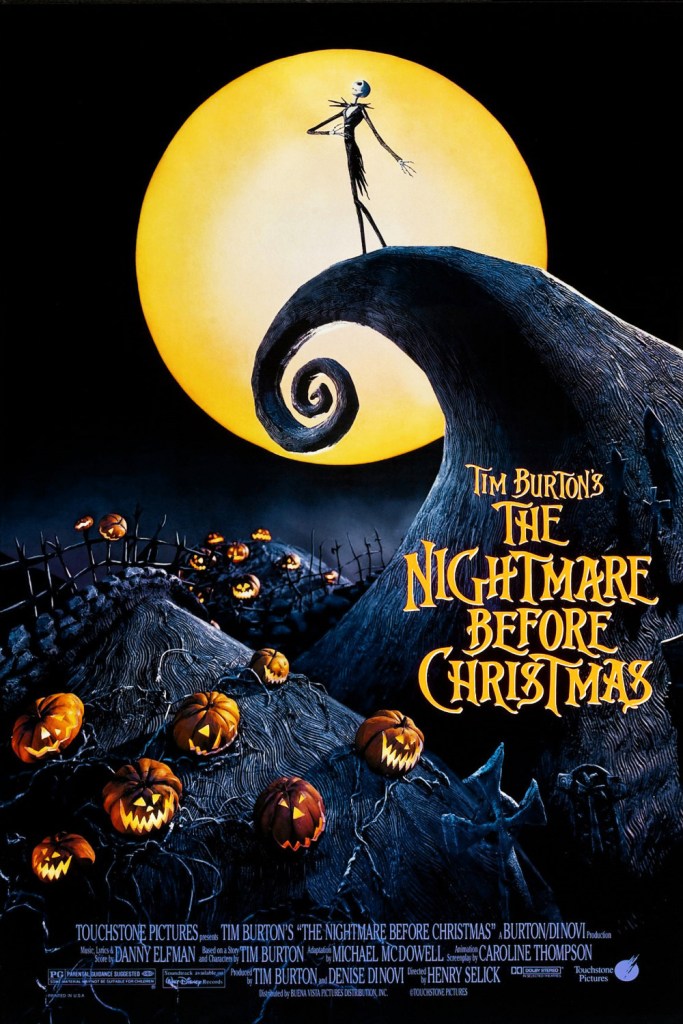
The poster for The Nightmare Before Christmas features Jack Skellington, the Pumpkin King, standing atop a strange curlicue hill, backlit by the full moon.  Below him are many ominous looking jack-o'-lanterns strewn across a cemetery and along a rickety wooden fence.

The film’s successful communication of the creepy delights of Halloween Town (realized, of course, both by Henry Selick’s amazing talents as an animator and by maybe the best score Danny Elfman ever composed, which would be saying something) is, I think, part of how we come to mistake the message of this movie.  It would be easy, if you haven’t seen it in years or only know it through cultural osmosis, to think that the thesis of Nightmare is that Christmas would be cooler/edgier/more awesome if it had a lot of ghouls and frights and toys with teeth, etc., and Jack Skellington & Co. basically save Christmas by making it hip again.  Those weird juxtapositions of Christmas cozy and Halloween horror are the really memorable moments in this motion picture, unquestionably.  But the message is in fact completely the opposite: Jack sucks at doing Christmas.  The residents of Halloween Town create a Christmas that is so chaotic and stressful that worldwide panic ensues, capped off by a military assault on Jack and his (undead?) flying “reindeer”.  Jack is so cavalier about the wellbeing of his Yuletide counterpart, “Sandy Claws” (as the Halloweenians call him), that he leaves the security of “Sandy” to three known juvenile delinquents whose primary allegiance is to the one genuinely bad person in Halloween Town, a sociopath named Oogie Boogie, who proceeds to subject an innocent and panicked Santa Claus to abuses designed to culminate in his murder.  I don’t mean to “spoil” a 30-year-old classic that surely almost all of my readers have seen at some point in their lives, but the final outcome of all this is certainly not a newly Halloweenized Christmas, but to the contrary a sense that the two holidays belong very much in their respective corners.  This is a story about the importance of a world with BOTH Halloween and Christmas, and of knowing which side of that line to be on.

And that’s what’s always going to be at issue in a project proceeding from the brilliant though often one-track mind of Tim Burton, who generates this film’s original story and acts as producer.  Burton is good at celebrating outsiders (and, despite all his successes and riches, at playing the role of the “outsider” himself) but usually he considers it impossible for them to make peace with the society Burton finds both appalling and weirdly appealing.  Edward Scissorhands does not find himself integrated into the world around him, any more than Lydia Deetz finds a way to be happy in the world away from the Maitland house.  I get the sense that Burton privately thinks Jack’s Christmas is in fact more fun than the real one, but also genuinely believes that it’s just not plausible that Jack’s version would catch on among the “normies” who want to find something pleasant in their stocking rather than something lethal.  We are allowed to visit Burton’s Halloween Town and admire its delights, but only he and his stable of outcasts are going to find it a happy place to settle down.

You may not think this a very fair take about a film you love—though, to be clear, I’ve watched this movie happily dozens of times, and I can sing along with it in numerous places, so it’s not a film I dislike!  I just think that, viewed through the lens of the holidays it purports to have something to say about, Nightmare’s message in the end is that Christmas people should do their thing and Halloween people theirs.  Jack maybe has a renewed sense of vigor at the end of the story, but it’s only a vigor that he ought to apply to making Halloween better, rather than dabbling in something else.  This was a film about people initially feeling hollow, aimless, wistful, and in the end, it’s arguing that they can be shaken back to life through a shared sense of crisis, but that probably they should have left well enough alone to begin with.  That’s the only sense I can make of the Sally subplot, in which she has a vision, argues for what ought to happen, and then is vindicated almost completely by what occurs.  Sally was right, and Jack should have listened—as another character tells him at the film’s conclusion, in fact.  Some kind of freedom is possible (as experienced by most of our characters, by the end), but we also need to know where home is, and not to wander too far from it, whether that home is the picket-fenced suburbs or the iron-fenced cemetery.  And what IS the Christmas that Jack doesn’t really understand?  It’s snowfall.  It’s nice toys.  It’s a predictable and cheerful celebration in which nothing strange or unexpected happens.  Not exactly the most ringing endorsement of a holiday, especially from a movie that has taken such delight in depicting the truly macabre people who make up the population of Halloween Town.

Luckily, I also don’t think that we’re forced to accept the messages art gives us without any agency of our own.  We can argue that the characters (and the screenplay) misread this situation, and that other, better outcomes were possible.  Part of the magic of Jack’s big number, “What’s This,” is that there is actually something profoundly wonderful about stepping outside the boundaries of your life and seeing something new.  I can’t explain why Burton wanted to make a movie that argues Jack shouldn’t ever step through the door into Christmas Town again, but I can at least make the case, for myself, that I think Jack knew a lot more about Christmas’s power than he seems to implement when it comes down to celebrating the holiday, and I would have been glad to see a movie give him (and Christmas) more credit for already having a lot on the ball.  After all, when he pitches Christmas at the town meeting, he seems to come from the point of view that the holiday isn’t much like Halloween at all—he’s constantly deflecting weird inquiries and at one point he basically breaks the fourth wall to tell us in the audience that he anticipated that he would have to ham up the relatively innocent figure of “Sandy Claws” to make Christmas sound intense enough to get people’s attention.  Why he forgets all this in practice for the next half hour of the movie is not really something I can explain.  Furthermore, I’m not sure it’s true: Christmas is a much spookier holiday than Burton gives it credit for being.  Its most famous modern tale is a ghost story.  Its original narrative is a story of terror (one of the characters appearing in every nativity set is an angel whose opening line is “Do not be afraid!”) and murder (Herod and the slaughter of the innocents) and squalor (both the stable and the shepherds).  It is neither a neat nor a tidy holiday—it’s only the sanitized commercial version of Christmas that seems that way, and it’s a disappointment, I think, that Burton didn’t apply his considerable talents to unearthing something more vital in it than he did.

It is a very mild disappointment, though.  The more I break this movie down, yeah, I can sure pick the plot and premise apart, but I don’t particularly enjoy doing that.  My critique of its missed opportunities is honest, and I think it’s a valid assessment of the film we’re given.  But more than critiquing it, I want to enjoy it, and I do: I find Jack charming and the residents of Halloween Town amusing and I sing along happily with almost every zany musical number.  In the end, the experience of the art has to matter as much as the analysis of it, right?  Anyway, it’s a movie that gives a lot to a lot of people, and I’m one of them, and if you’ve not seen it before (or not in a while) I hope I’ve steered you to it in a way that will help you both delight in it and engage with it thoughtfully.

I Know That Face: William Hickey voices the decrepit, predatory Dr. Finkelstein here—he’s Clark’s Uncle Lewis in National Lampoon’s Christmas Vacation, which I covered with criticism in a post on the blog last year, and in a 1987 television movie called A Hobo’s Christmas he plays a character named (well, surely nicknamed) Cincinnati Harold.  Ken Page, who in this film provides his memorable bass voice for Oogie Boogie, appears as Dwight in 1990’s The Kid Who Loved Christmas, an emotionally heavy television drama with an all-star cast of Black performers.  Paul Reubens, who made such a career out of playing charming oddballs and who voices Lock (one of “Boogie’s Boys”) in this film, shows up again as a voice actor in the direct-to-video Beauty and the Beast: The Enchanted Christmas, in which Reubens plays Fife, a piccolo who plays turncoat against the villain at a crucial moment.  Most famously, of course, Reubens plays his character of Pee-wee Herman in lots of settings, including as the titular star of 1988’s Christmas at Pee-wee’s Playhouse, and, bizarrely, as a performer in the 1985 Bryan Adams music video, “Reggae Christmas”.  Yikes.  Lastly, Catherine O’Hara voices Sally in this movie; she’s familiar to most of us from lots of other projects, but in the holiday realm in particular, she plays Christine Valco in 2004’s Surviving Christmas, as well as the aging character actress Marilyn Hack in For Your Consideration, a Christopher Guest film that ultimately is at least Thanksgiving-adjacent.  Oh, and of course she is Kevin’s frantic but seemingly not-that-attentive mother Kate in both Home Alone (which I will cover someday on this blog) and Home Alone 2: Lost in New York (which features a cameo appearance by one of the worst Americans of all time, so I probably am going to skip it for the rest of my life).

That Takes Me Back: It would be hilarious if I spotted elements from life in the demented chaos of Halloween Town that reminded me of growing up in the suburbs outside of Seattle, but no, I’m afraid the delirious world of Tim Burton / Henry Selick didn’t spark anything nostalgic for me.

I Understood That Reference: Jack skims A Christmas Carol and a book called Rudolph, as he seeks “a logical way to explain this Christmas thing”.  He later divides chestnuts by an open fire, in an echo of “A Visit From St. Nicholas.”


Holiday Vibes (4/10): This is a film with a ton of talk about Christmas and preparations for it, as well as some of its actual celebration, and Santa Claus (ahem, sorry, Sandy Claws) is a major supporting character, so it’s not nothing!  But as I note above, the movie’s intentions here definitely seem to carry it away from much real engagement with Christmas and towards the emotional journey of the main characters (and their realization, in the end, that Christmas isn’t for them).  So, it’s doing some of what we look for, but it’s missing a lot.

Actual Quality (9/10): Again, separate from the message and however we feel about it, this is an incredibly well made film: a great voice cast, great music, great stop-motion animation.  Sure, I have some mild irritation at the Burton of it all, but even there, I admire a lot of what Burton’s capable of as a filmmaker.  I’ve just come to find his stuff a little empty and self-aggrandizing over the years, and while there’s still some gems in his filmography, there’s fewer “10s” in there than I used to think, at least in my opinion.  Even if Burton’s wrong about Christmas, though, he knows how to make a compelling story, and so do all the other artists who worked on this.

Party Mood-Setter?  If this feels like the holidays to you, absolutely: the songs invite you to sing along and the story’s lightweight enough that you don’t need to focus at all.  But if it’s not “holiday” enough for you, I think it’s a little too weird a presence to be in the background.

Plucked Heart Strings?  I’m sure some people feel a deep resonance with Sally (and delight that she gets Jack at the end) but I don’t think anybody here is fully realized enough to make an emotional response happen for me.

Recommended Frequency: Oh, this is annual at some point in my household—whether in October, November, or December—and we all know the words to at least most of the songs.  If it isn’t for you yet, it’s worth trying to add it to your holiday rotation, in my opinion.  Proceed with a little caution, though, about what the movie’s really trying to persuade you to believe.

If you want to give the movie a whirl, it’s on Disney+, of course, since Disney paid for it in the first place.  It can be rented anywhere you think of renting a streaming film, and several versions are available on disc at your Barnes & Noble.  But there’s no need to pay for it: hundreds of libraries, according to Worldcat, carry this one on disc.

The Family Man (2000)

Review Essay

Folks, here’s the thing about The Family Man.  It’s somehow 12 different movies you’ve seen before and it’s none of them at all.  It’s A Christmas Carol and It’s A Wonderful Life and Groundhog Day and Big and 13 Going On 30, but it’s also really not like any of those movies in so many key ways that you should probably forget I just mentioned them.  It’s a film that, for me, gets some things so right and then fumbles the ball in such weirdly unexpected ways that it’s maybe one of the hardest films I’ve had to reach a numerical rating for, since it’s incredibly hard to reduce this motion picture to a single number (of any magnitude) without feeling like I’m only describing some of the movie I had in front of me.  If you’ve seen it, I really wonder what you think of it, and if you haven’t, I’ll work at avoiding spoiling the ending but you may want to take it in before I ramble on about it.  In the end, there’s one element at work inside The Family Man that does kind of explain all of it—its genius at its best and its wobbliness at its worst.  And that element is a man we’ve come to know (and love?) under the stage name Nicolas Cage.

It’s probably at about this point that you want to tap my shoulder and say, “James, you still haven’t told us literally anything about this movie?”  Okay, okay: on the one hand, this is a film with such a clear central premise that it should be easy to summarize.  It seems like a classic tale about the road not taken: Jack, a thirty-something Manhattan high finance whiz got where he is in life by leaving behind him a stable girlfriend, Kate, whose goals were more altruistic.  But a Christmas miracle suddenly places him in the world where he made the other choice—waking up in bed with his wife Kate on Christmas morning, with loud young kids and a needy dog and in-laws crashing through the front door.  And then of course he’d like to escape this bad dream he’s having, but instead he’s got to live his way through it until….well, the “until” is part of this movie’s mystery and either its ultimate success or its failure.  But the basic structure of a body swap / life swap / alternate timeline movie in which the fancy big city guy learns something as he stumbles through life in the suburbs is largely going to show up on screen in the way you’re expecting, at least for the movie’s long and chaotic second act.  The third act, on the other hand, is unexpected in ways I’m really not sure about—maybe it’s a strength of the movie or maybe it’s a weakness that it didn’t really arrive at its outcomes in one of the ways I’d expect films of this kind to work.  I really don’t want to spoil it, so I may have to leave that judgment to you.

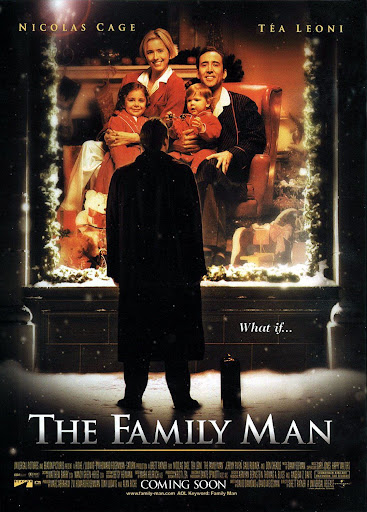
The poster for The Family Man depicts Nicolas Cage from behind as he stands in a trenchcoat on a snowy street with his briefcase on the sidewalk beside him. He is looking in through a large picture window at an image of himself seated in an armchair with Tea Leoni and their kids, cuddling together to post for a family Christmas photograph.  The tagline appearing next to him reads, "What if..."

Back to Nic Cage, though, and the reason this film is both really good and not really successful in landing the punches it wants to.  Cage is an astounding, generational talent: there’s nobody like him, and he does things nobody else can do, which is not to say he’s the finest actor working but he may be one of the most irreplaceable.  He’s on screen for nearly the entire running time of the movie, since this alternate universe switcheroo is one that effectively he alone is conscious of, so it’s his experience we’re tracking.  Given that fact, Cage’s fundamental watchability is hugely important—he makes everything from his character’s frustration to his character’s delight feel energized, even thrilling, as he takes the roller coaster ride of a man trying to figure out how he feels about this new life he’s been dropped into.  Even when the movie’s probably taking too long to complete the roller coaster ride (and it starts to feel a little pedestrian), you know Cage is capable of anything, and you keep your eyes on him.  As the character of Jack works out who he is, not as a balance sheet but as a person, he starts to understand why a man with his financial genius “settled” for the life of a suburban dad.  At its best, the film is both funny and heartfelt, as Jack navigates the sometimes outlandish silliness of his new world and discovers who he really cares about, and, maybe more importantly, discovers what it means to care about them.

And what makes all this not quite work, in my opinion, or at least not quite work in the ways that all-time great multiverse movies like Groundhog Day work, is that Jack is too compelling from the very beginning of the story.  The scenes we see of him on Christmas Eve prior to the dimensional shift are of a man who, sure, is a little arrogant and flighty in his personal relationships, a man maybe too used to the opera and fine whiskey and out of touch with “everyday life”.  But he’s also really happy?  And he’s not even a cruel person, that we see—sure, he’s in a world of high finance and mergers, etc., but there’s no obvious ways he’s complicit in ethical violations, and he’s upbeat and funny with his coworkers in ways that feel basically positive.  It’s not a bad life; to the contrary, it feels like a guy who’s figured out how to live at the top in ways he’s pretty fulfilled by.  Even if we consider the inciting incident that drags him to a new plane of existence, it’s not something he did wrong—to the contrary, he risks his own life pretty needlessly, since he could have remained an “innocent bystander”, but instead he steps forward to try to de-escalate a potentially lethal confrontation at the cash register of the shop he’s in, only to learn that the dangerous criminal is actually an angel.  Or something…honestly, the movie’s pretty bad at explaining the metaphysics of why this switch-up even happens or what qualified Jack for the experience.  Don Cheadle just smiles and tells Jack to remember he did this to himself, but what does that even mean?  Anyway, the result of all this is that we never really understand why we should be rooting for Jack not to go back to the life he came from, other than that Tea Leoni is hot (I mean, no arguments there), and that we know that in a Hollywood movie we’re supposed to be rooting for marriage and the suburbs and 2.3 children and a car in every garage, etc.  And knowing why we would be rooting for the suburbs is pretty darn important in a movie that is about really nothing else.

One of the other problems, fundamentally, is that the movie starts like it’s shot out of a cannon.  We literally know nothing about the Jack/Kate relationship prior to the breakup other than them standing at the airport gate in 1987 with her telling him she’s got a premonition he shouldn’t fly to London for his internship, and him telling her it’s ludicrous for her to ditch law school and him to ditch the internship.  It’s the only glimpse we’ll see of the relationship he left behind, and as a result, I just think it’s hard to invest myself fully in believing that clearly this young grad student should have listened to his girlfriend’s weird dream logic rather than continue to pursue a career he clearly thrives in.  And then once you start to lean on the logic of the movie, it does break down a bit…maybe most importantly, why is it true that Jack has to give up all his dreams and opportunities, whereas Kate still gets to go to law school (she’s an underpaid lawyer for a nonprofit in the “future” of the movie) and practice her craft, and the house and the life near her parents and all the rest of it are clearly the things she values in life.  Why are her values more important than his?  Again, if the movie made him an obvious monster at the outset—a selfish, cruel man who uses his gifts to oppress other folks—then it might be a simplistic moral fable but at least I would understand why Kate = good and Jack = bad.  As it is, the film’s values feel unfortunately like the echo of a ‘90s movie that presumes we know who the good and bad guys are without needing to actually make the case.

The holidayness of the movie is tough to calculate: again, I know that messages about family, etc., are often associated with this season of the year, but given how weird the movie’s ethics are, I’m not sure how much I want to credit it with having a meaningful message in that regard.  The magic of Christmas Eve / Christmas morning is definitely central to the film’s opening and closing sequences, but in the middle it’s just January in New Jersey, and given how detached from reality Jack is (either because of his palatial life as a wealthy financier, or because it’s Christmas Day and he woke up in the wrong house in someone else’s underpants and he’s frantically trying to put it all together) we don’t get a ton of Christmas celebration to lean into.  Add in the vagueness of the character Cheadle plays, who could easily have been more explicitly made an angel or an elf or Santa Claus or anything you like, and we lose even more chances to ground this experience in something more explicitly Yuletide.

I think in the end, this is a movie that feels like maybe it hooked Hollywood producers as a great premise, and then between that point and the final cut, neither the screenwriters (Diamond and Weissman, a partnership also responsible for….yikes, Evolution and Old Dogs, okay, some of this movie’s problems are making more sense now) nor the director (Brett Ratner, DOUBLE yikes, that man’s Wikipedia page has a whole section devoted to “sexual assault allegations”) figured out how to make it really work.  And the more I’m looking at what I just found out about the three guys involved, yeah, their struggle to tell a magical, nuanced tale about love and family life is maybe just a bit more explicable.  But here’s the thing: that premise is still really powerful.  And Cage and Leoni are probably just about perfect casting for a movie like this, in this era.  The second act may sag, and the third act may have a couple of unexpected curves in it, but ultimately their performances keep me hooked on the film, maybe in part because they make Jack and Kate alive enough that I don’t care too much about the screenplay not justifying why I should be rooting for them to be together again.  I just want these two people who are clearly passionate about each other to be together again.  That’s the kind of thing a movie can do, and this one does it well enough that it may be my most memorable takeaway.

I Know That Face: Saul Rubinek, who here plays the generally nebbish Alan Mintz, appears as Mr. Green in 2005’s Santa’s Slay, in which Mr. Claus is a demon who lost a bet with an angel.  Jeremy Piven, who in this film is Jack’s suburban buddy Arnie, plays the titular father in 2020’s My Dad’s Christmas Date, which sure sounds like a winner from the title, eh?  Nicolas Cage, Jack himself of course, was the surprising choice to voice Jacob Marley in a widely panned British adaptation of the classic story in 2001’s animated Christmas Carol: The Movie.  And Don Cheadle, here portraying “Cash” (an angel?), is of course well known for his role in the MCU as Colonel James Rhodes, including in the film Iron Man 3, which is acclaimed by the Die Hard crowd as yet another action movie that counts as a Christmas flick….and yes, by the forgiving standards of this very blog, I have to give it to them.  It counts.

That Takes Me Back: As a real fan of the paper map (who, yes, acknowledges that Google Maps has made everything simpler), I did love the chaos of Jack having to fumble with a paper map while driving his way around chaotically, like we used to.  It was nostalgic, too, to see a CRT monitor the size of a destroyer on his office desk, not to mention a checkbook with a bunch of entries for deposits and withdrawals in its register.  I wonder…do we even teach students to “balance a checkbook” in Home Economics these days, and if so, why?  Lastly, I couldn’t help but think of September 11th and all that’s changed since—certainly when I got a brief and shocking glimpse of the Twin Towers in an establishing shot (like we always used to do when filming New York City in the 1990s), and also when I watched a character making that old movie classic, the impulsive sprint to the gate at the airport, which now of course is simply impossible.

I Understood That Reference: Other than one character’s quip, “Santa Claus, you’re half an hour late,” I didn’t spot anything.


Holiday Vibes (4/10): As I note above, there’s not enough Christmas in the screenplay, or on screen, to really make this movie feel like Christmas to me.  But it’s in there enough that I can see this being a movie this time of year for some folks, and certainly any movie involving magic and snowfall has to get at least an extra half point, doesn’t it?

Actual Quality (8/10): Like I said at the outset, this movie defies numbers.  I could watch Cage prancing and singing around his enormous walk-in closet for 45 minutes but that doesn’t make this movie a 10, you know?  As it is, I’m trying to split the difference between my remaining really engaged with this movie throughout and my having a ton of notes about the ways I would have improved the film, given a chance.

Party Mood-Setter?  Probably not?  It’s hard to explain how weirdly intense the movie is—Jack’s outbursts are a lot to handle, even though I can generally track where they’re coming from.  Not really background fare.

Plucked Heart Strings?  There’s a moment or two that felt pretty authentic, but I’d be surprised if the film brought anybody to tears.  The complicated combination of the multiverse angle and therefore the weird emotional truth/falsity of these moments makes it harder to relate to than it would otherwise have been, I think.

Recommended Frequency: I have to be honest: I feel like I’ll watch it again, although I think there are other films that cover this kind of material better. There’s something to this movie, and maybe after another watch or two, I’ll understand better what, if anything, it means to me?

If you’d like to watch The Family Man yourself, right now you’ve got some options.  Subscribers to Peacock or to Amazon Prime will have an easy time.  You can rent it from all the usual streaming services, and Barnes and Noble will sell you the film on Blu-ray or DVD.  Public library users, Worldcat assures me you can snag this one from over 1,600 libraries in its database, so hopefully there’s a handy copy near you. Happy viewing to you!