The Shop Around the Corner (1940)

Review Essay

So much great art arises from a confrontation with our deepest fears and senses of unease about being human, and I feel like that’s the force that propels The Shop Around the Corner every year into being a film where the whole is somehow greater than the sum of its parts.  When I try to sketch out the plot, it feels like a simple (if clever) premise for a film I would watch and smile at but quickly forget.  And yet, it’s more than that for me.  In watching it multiple times in the last year, with this blog in the back of my mind and beginning to loom larger, I think what I’ve worked out is that this is a film about how hard it is to know yourself or other people — how easy it is to mistake and misdiagnose matters of human interaction — and yet how thrilling it is to finally see someone else or be seen.

Again, the premise of this movie, if you don’t know it, is simple enough: we are concerned with the people who work at Matuschek & Co., a leather goods retailer trying to keep afloat in Budapest amid the Great Depression.  Specifically, we’re most concerned with Matuschek’s star employee, the brilliant if brittle Alfred Kralik, and the young woman who slips through the door early in the movie’s first act hoping for a job at Matuschek, the effervescent Klara Novak who seems never to have had an unexpressed thought.  Sparks fly immediately and Novak’s success in securing a position via her moxie don’t reduce the tension — he’s bothered by her frankness and she by his reserve.  And what neither of them know is that, by an extraordinary chance, they’ve come into contact with their secret, romantic pen pal, since Kralik and Novak have been sending impassioned, elaborately written letters to each other via a postal box with pseudonyms, along with an express agreement not to sully the intellectual beauty of their conversation with such mundane details as where they live and work.  Yeah, yeah, it feels like a premise cooked up in a lab to support a romantic comedy — if the movie wasn’t working well, I guarantee it would feel creaky.  Yet, to me, it never does.
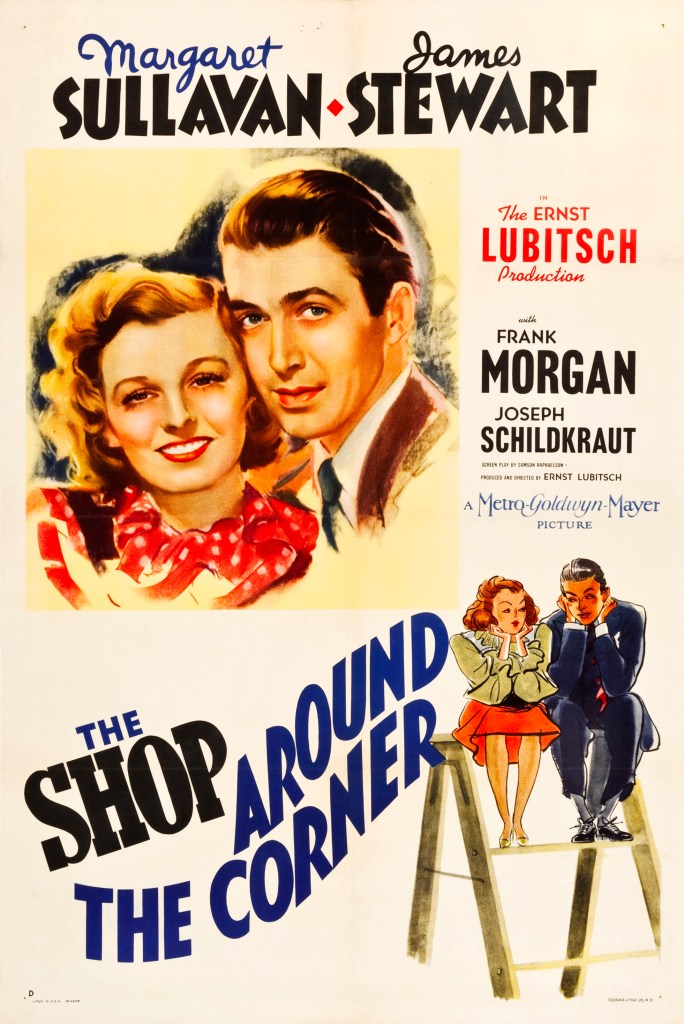
The poster for "The Shop Around the Corner" features the main characters twice -- in the top left, Margareet Sullavan and James Stewart are looking directly at us, their heads close to each other in a loving way, and in the bottom left, we see a more cartoonish sketch of the two of them, seated high on a stepladder with their elbows on their knees and their hands under their chins.

One reason this secret pen pal structure survives scrutiny, I think, is that the movie is about other things too — for instance, a major subplot involves the strange and steady rise in tensions between Kralik and his employer, Mr. Matuschek, for no reason Kralik can fully understand.  And in almost every conversation, we hear the backdrop hum of these people clawing their way towards what they think of as stability or respectability — the right living situation, the right clothes, the right opinion from the boss.  There are moments that can feel almost like an Austen or a Wharton novel, as the rigid formalities of conversation among genteel shop clerks threaten to bubble over with the tensions that characters feel under the surface.  As a result, watching Kralik and Novak’s romance progressing feels less like a singular event about which I need full understanding, and more like another chess piece in an elaborate game: what will become of any of these people when they finally start speaking plainly to each other?  How safe is it to say what you mean — or to have someone else understand what you mean when you say it?

So much of how it works, too, is in the incredible performances of the whole cast: sure, a lot of this hangs on Jimmy Stewart, who in the 1940s was at a peak few performers achieve of knowing just how far he could take an audience without losing its affection.  That charisma enables him to exhibit anger or pride or any number of other destabilizing emotions on screen and remain the film’s comfortable protagonist — he creates depth in a character that wasn’t going to have it automatically.  And opposite his frosty Kralik, Margaret Sullavan is the perfect Novak: Sullavan had brought Stewart into the limelight, requesting him as a lead opposite herself in the mid-30s and coaching Stewart (then more of a character actor) into stardom, and there’s a kind of music in every dialogue between them.  Sullavan, too, knows how to deploy her charisma perfectly, so that no matter how many abrupt and slightly cruel things Novak says in her filterless monologues, we never find ourselves turning away from her.  

So much of the film is interested in the balance between bravado and insecurity.  In the leads, we get to see both sides — Kralik’s assured manner in assessing the value of a cigarette box that plays Ochi Chërnye (almost zero) is juxtaposed against his fretting about his intellect as he discusses with a coworker the acquiring and reading of an encyclopedia volume.  Novak’s brassy sales pitch for that terrible cigarette box before she’s even secured a job for Matuschek stands in contrast against the nearly immobilizing despair she feels when she thinks her beau took one look at her and skipped their dinner without introducing himself.  Among the secondary cast, we get types — the self-effacing but sweet-tempered loveliness of Pirovitch; the self-promoting, cheeky chutzpah of Pepi Katona, the delivery boy — that build out these ways of responding to the fundamentally unsettling challenge of being a human who both wants and does not want to be seen, who both wants and does not want to see.

Christmas, James, I hear you say: what the heck does this have to do with Christmas?  Well, as the film progresses through its year, we approach the busy shopping season of Christmas and all the pressures descend even more severely on the shop’s employees.  More than that, Christmas itself as a festival having some connections with marriage — at least in this era, Christmastime engagements and weddings were pretty common, in my experience researching family histories anyway — means that the pressure rises on Kralik and Novak’s pen pal romance.  Will the truth be revealed?  Is an engagement in the offing?  Especially once we reach the point where one of them knows the truth (and isn’t revealing it) while the other is in the dark, there’s a way in which we as an audience know that Christmas will raise the final curtain and at last allow us to exhale with relief and delight.

This is a strange film to try to classify — for a romantic comedy, there’s very little romance (at least, very little romance where both characters on screen know they are romancing each other) and not a lot of comedy (though the moments that are funny are, to me, very funny).  Instead, it pulls as much as it can out of the tensions that build before the release that either a successful romance or a good joke brings — out of conversations where one thing is said and another meant, or where a character stops a phrase short of actually bringing the clarity they could supply.  It’s strange that this is one of two ‘40s Christmas movies starring Jimmy Stewart that involve a thwarted suicide, but at least I’ll note that this suicide has nothing to do with Kralik and Novak’s romance — the film isn’t interested in the overwrought tragedy of love, only in the tragicomedy of trying to know one’s self, and to know what one actually thinks about the people around them.  

I find a lot of delight, too, in the fact that this is by definition a romantic comedy that’s not about falling in love with someone because you have the hots for them.  I mean, Margaret Sullavan is an attractive woman, no question, but also, we know that Kralik doesn’t get hung up on Novak’s looks — to the contrary, he barely thinks about her at all, at first.  What appeals to him are the quick and lively thoughts of the woman he corresponds with compulsively, the woman who fills his dreams.  Similarly, if Novak’s attention is caught at all by Kralik (who, as a youngish Jimmy Stewart, is no slouch in the looks department either), we don’t learn much about it up front.  Sure, both parties are evidently a little anxious about whether or not they’ll be attracted to their pen pals when they meet, but I think the movie really hits its stride in exploring how delightful it is to love someone’s mind, and to discover how beautiful the mind of a person standing right next to you has been, this whole time.  It’s sure helped, I think, by the fact that maybe nobody’s voice in 20th Century film is more evocatively intimate and passionate than Jimmy Stewart when he’s just slightly hushed — reading a letter aloud to Pirovitch, say, or talking with Novak about what a wallet can mean to a man in love.

The movie, too, says so much by not saying things — it is a movie in 1940 set in Budapest but Europe’s rising political and military tensions don’t take the stage.  The closest we get to a mention of the Depression is when, at one point, someone says “that’s the biggest day since ‘28!” about the store’s one day profit total.  And the ending — which I have, I hope you’ve noticed, been rigorous in avoiding anything that might spoil you — is fast and understated, too.  I think Lubitsch, the film’s director, knows that we can fill in the gaps around and between these people very capably, if he makes them human enough.  Even when they’re playing games with each other, or devastating each other with little comments (both harsh truths and devious lies), they feel like people — heightened, brilliant people with screenwriters composing their dialogue, maybe, but people — and they’re people I love to watch every Christmas.  I hope you do too.

I Know That Face: It’s wild how many performers from It’s a Wonderful Life show up in this fairly small cast, six years earlier — Jimmy Stewart, of course, is Alfred Kralik here and George Bailey in that film.  But we can add in Charles Halton, who is the police detective in this film and Mr. Carter, the bank examiner, in It’s a Wonderful Life, as well as William Edmunds, who plays the waiter at the restaurant in this movie and who is unforgettable as Mr. Martini in the 1946 classic.  Moving on from Capra’s iconic movie, I can’t leave out a mention of the delightful Sara Haden (Flora, another of Mr. Matuschek’s shop employees), who will later play Mildred Cassaway, the secretary to the titular bishop in The Bishop’s Wife, a movie about an angel hitting on a married woman while building a cathedral, and the judgmental Mrs. Katie Dingle in The Great Rupert, a movie about a squirrel redistributing a miser’s wealth in answer to a Christmas prayer. Both of those movies sound made up (okay, I may be having a little fun with how to describe them), but I’ve watched them both with at least interest and sometimes delight, and I bet they’ll make this blog if it persists into next year.

That Takes Me Back: It’s funny: the internet should make it easier than ever to have anonymous pen pals, and yet it feels so old-fashioned here?  I guess there was a sense in which half the people you talked to on Twitter were anonymous pen pals, but let me tell you, there was precious little that was intellectually elevating about those conversations.  I have commented on this before, of course, but it remains wild how many plots in the pre-cellphone era consist of having arrangements for dinner that can’t be changed, since characters have no way to contact each other, and therefore hijinks ensue.  Oh, and though we certainly still have all sorts of weird dieting habits as a nation, when Novak tells the customer that, after gaining a few pounds from candy, you need massages and electric cabinets, I did smile to think of what on earth that was like.  Electric cabinets?

I Understood That Reference: We don’t get much here, but late in the movie at one point Pepi tells Mr. Matuschek that he’s going to be “Santa Claus” to the girl standing on the street corner.  Creepy, Pepi.  Take it down a notch.


Holiday Vibes (4/10): I mean, as I acknowledge above, Christmas only really comes in at the hour mark.  I would argue that, from there, it slowly zooms to fill the whole space as retailers and potential fiancees get immersed in the holiday.  And even if I turn away from the central relationship in the movie, there’s plenty of talk about Christmas between characters in ways that feel like the build up to the holiday to me.  Not enough to make this overwhelmingly a Christmassy vibe, but enough to earn its 4, I think.

Actual Quality (9.5/10): I love this movie, and I’m not alone in that — the American Film Institute put it in their top hundred love stories of all time, and of course it’s been memorably remade (more than once, though the one most of us think of is You’ve Got Mail).  I think in terms of what a romantic comedy can achieve, it really does almost everything it ought to do — it avoids most of the clumsy hurdles that such films often throw in the way of their protagonists (there’s no external threat from an attractive man or woman, there’s no real obstacle at all between them other than the fact that their correspondence is a secret and it remains that way for some time due to the insecurity both of them seem to feel) in ways that I find really satisfying.  It is just a very successful ‘40s romance that’ll sweep you off your feet if you let it.  I hope you will.

Party Mood-Setter? This one depends enough on rapid fire dialogue, or subtext and pretexts when it comes to these interactions, that I doubt it’s one you could pay attention to while painting an ornament.  It’s good enough (and brisk enough) though that I think you could make it a “let’s get together and watch this” event this December pretty successfully.

Plucked Heart Strings? My heart sure soars as some of these passages unfold — I don’t know if I’m just a sucker for Jimmy Stewart in this setting or if there really is a deeper emotional connection available from these characters, but yeah, I think it’s there.

Recommended Frequency: I mean, as far as, what am I going to do?  I’m going to watch it every single year.  No question.  I think for you, it will have to depend on how much this feels like a Christmas movie to you.  I’d love it if you gave it a try, though — here’s hoping it resonates for you as it does for me.

You can watch this movie on Max (which some of us subscribe to via their Amazon Prime channel) or rent it from Amazon, Fandango, Google, or Apple.  It looks to me like it’s available via a premium add-on at lots of services too, though I won’t try to game all those out.  If you want to be like me (in this one respect) you can own it on Blu-ray or DVD from someplace like Amazon.  And Worldcat says it’s in over 1,000 libraries on disc, so don’t forget about that wonderful resource.
Fitzwilly (1967)

Review Essay

As it opens, it’s not entirely clear what kind of film you’re watching in Fitzwilly – a jaunty, peppy score bounds along as we take in a perfectly professional and focused household staff at work in maintaining a grand New York mansion.  Sure, it seems a little strange at moments: the 1960s aren’t exactly the hey-day of old money socialites, and there’s something weirdly knowing, almost conspiratorial about the way our title character, the household’s butler, addresses us straight to camera.  But it takes a few minutes for the premise to emerge…it also takes a few minutes for it to become clear that it’s the Christmas season, but by now I hope readers at Film for the Holidays are accustomed to my broadly inclusive take on the holiday film.

What is Fitzwilly about, you might ask?  Well, there really are two films here, one of which makes sense commercially and one of which really doesn’t.  The commercial film is a light-hearted romantic comedy starring two well-known and loved television performers: Dick Van Dyke (overflowing, as always, with charm and a kind of spry delight) as Fitzwilly, a bright young butler, meets Miss Juliet Nowell (a Christmas pun, I suspect), a graduate student and recently hired secretary to Fitzwilly’s employer, Miss Vickie.  Juliet, played by Barbara Feldon (better known as the knockout member of the spy tandem in a sitcom called Get Smart), quickly finds herself at odds with Fitzwilly – some of it has to do with the other half of this film (which I’ll get to), but some of it is pretty standard rom-com fare.  She finds him overbearing, he finds her impertinent; they both come to realize the other is pretty special; she thinks he should aim higher in life than being a butler and he takes offense.  Their dialogue isn’t Shakespeare (Beatrice and Benedick they ain’t), but it’s lively and sometimes pointed, and there’s a real spark between the two of them.  Feldon and Van Dyke are both fun to just watch in action, and there’s a world in which they made a very by-the-numbers romantic comedy that has nothing at all to do with Christmas and I never saw it.

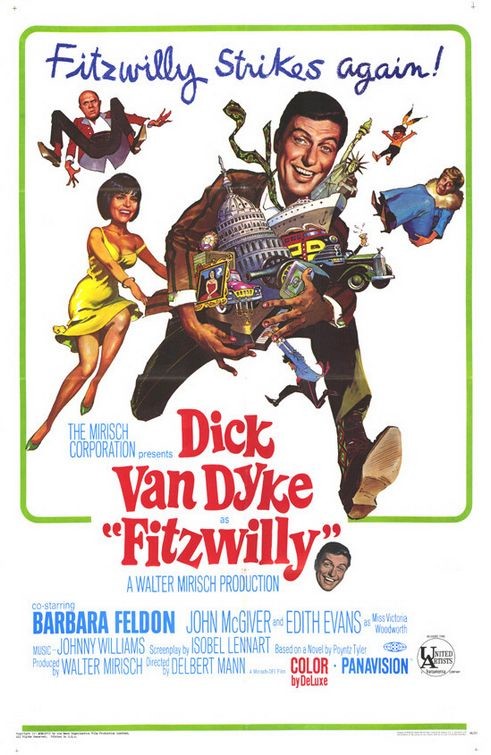
The poster for Fitzwilly features, at its top, the tagline "Fitzwilly strikes again!"  Beneath it, a smiling Dick Van Dyke leaves cast members strewn in his wake as he runs toward us, carrying in his arms a luxury car and a cruise ship and works of art, including the Statue of Liberty: the sense is that he's stealing the entire world.

Here in the real world, though, a very different thing is happening, as we realize before the film is ten minutes old: Fitzwilly is the story of how an efficient brigade of servants in an upper class household operate a secret and successful thieving ring, right under the noses of their employer, the local constabulary, and the New York City elite social scene.  Fitzwilly himself is the ringleader and mastermind – when he was a child, Miss Vickie took him under her wing, and when her father died and Fitzwilly discovered the aging socialite was left destitute (unbeknownst to her), he decided the knowledge of it would kill the woman.  Instead, far simpler (ha!) for him to coordinate an elaborate black market operation out of the house’s basement, ripping off major retailers and funneling the profits into Miss Vickie’s accounts just in time to ensure her bills are always paid.  They funnel the hottest items in their hands to an outlet in Philadelphia – St. Dismas Thrift Shoppe, to be precise, named cheekily for the “good thief” who was crucified next to Christ in the gospels.  They have to keep Miss Vickie in the dark, so he encourages her every eccentricity, especially if it either takes her out of the house (leading her absurd Platypus Troop of knock-off Boy Scouts) or sequesters her upstairs in her office (composing Inquire Within, her demented dictionary for people who cannot spell – as Miss Vickie herself says to Juliet, “when it is done, children and illiterates like you will rise from ignorance”).  Such a criminal conspiracy clearly can’t last forever without discovery…and it is, more to the point, badly imperiled by the arrival of a nosy young secretary who realizes early on that something doesn’t smell right about the situation in the house.  Hijinks ensue.

And in the background of all this, Christmas is under way – wreaths are on doors and trees are being set up.  An elaborate side scheme emerges in which Fitzwilly and the servants agree to lavishly furnish another family’s vacation home, skimming the profits for their own purposes, just in time for a good old-fashioned Florida Christmas.  The glitz of a technicolor red and green mid-60s holiday really pops on the screen, whenever it gets the chance, even if none of these people are really thinking much about Christmas.  Much, that is, until a series of setbacks makes a highwire Christmas Eve robbery – a heist that requires the speed and secrecy we associate with Santa Claus himself – more or less mandatory.  What a truly, truly bizarre plot.

For the sake of you, a potential viewer, I have to acknowledge that the plot really does strain the audience’s confidence (if not patience) throughout.  Money is coming in and out so often – with so many dollar amounts in the air – that it is very hard to understand how far ahead or behind they are: this is a problem in the third act, since the whole explanation for a high risk robbery sequence rests on the servants having their backs to the wall, financially.  Some capers are problematic (I understand that in 1967 they might still have been making weirdly racist mannequins of African tribal people for shopping displays, but maybe they didn’t need to be in the film) and others are just incredible in the oldest sense of that word (in no bar in America at any time could you get wildly enthusiastic men betting large sums of money on their certainty that Delilah cut Samson’s hair in the Bible’s book of Judges, let alone so widely and reliably that it was a guaranteed money-making endeavor).  But I have to acknowledge also that in some ways it doesn’t matter all that much – we’re watching because we want to see the main characters canoodle a little; we want to see if their elaborate, Ocean’s-Eleven-with-a-heart-of-gold heist can actually work; we want to see how they’ll all get out of this without going to jail.  And it’s not like I’m going to tell you how it all ends, but I think I can tell you that the film’s third act is consistent with the rest of it – if you’re liking it you’ll like it, I’m guessing, and if you aren’t it’s not going to salvage itself.

In a way, the whole film is designed to create a sense of dangerous allure, but defanged in a way that makes it totally safe.  Dick Van Dyke can play a master thief and even scoundrel, except he’s doing it with the best of intentions and hurting almost nobody but insurance companies.  Barbara Feldon can play a slightly slinky, even sexy young woman without the plot ever taking us too close to something that would be uncomfortable to watch with your grandmother in the room.  It’s done something sort of similar to Christmas as a backdrop, I’m afraid – there’s the sense that big Christmas celebrations need to come off with success, but we never really feel them as stakes.  Christmas might have provided an opportunity to explore things like charity or miraculous intervention, but the feast never really touches the key events of the story (other than, for instance, making sure there were many shoppers present on the day they need to knock over the department store and run away with cash).  Even the music is defanged – the peppy score I mentioned earlier?  It’s composed and arranged by a young Johnny Williams…yes, THAT John Williams, whose music memorably and powerfully enlivens pop culture properties from Star Wars to Indiana Jones to Harry Potter.  And, it’s fine.  But not really very special.  With apologies, Fitzwilly, that’s a reasonable assessment of you as a film, holistically.

I Know That Face: This cast is full of holiday performers: Barbara Feldon (the brightly inquisitive Miss Juliet Nowell) voices Patti Bear in The Bear Who Slept Through Christmas.  Dick Van Dyke (the titular Fitzwilly) plays an angel in Buttons: A Christmas Tale and narrates The Town Santa Forgot.  John McGiver (Albert, the servant with a troubled conscience) voices the Mayor in the Rankin-Bass Twas the Night Before Christmas.  A very young Sam Waterston (here playing the young chauffeur Oliver – I’m telling you, it’s a stacked cast and crew) appears in Hannah and Her Sisters, a film that is bookended by Thanksgiving celebrations.  Edith Evans (the indomitable Miss Vickie) was of course the Ghost of Christmas Past in Scrooge, which I reviewed just last Sunday – she’s far better here.  And John Fiedler (the nervous music store employee, Moron Dunne, who makes a truly inadvisable arrangement with Fitzwilly in disguise) has a long track record as a voice actor in the Hundred Acre Wood: he’s Piglet’s voice in, among other things, Winnie the Pooh: A Very Merry Pooh Year and A Winnie the Pooh Thanksgiving, not to mention Winnie the Pooh and Christmas Too.  Beyond his voice career, too, Fiedler played the role of Vollenhoven in the first film adaptation of Hans Brinker and the Silver Skates, a story brimful with allusions to Dutch Christmas customs, as the primary events take place throughout a holiday season.  

That Takes Me Back: This is going to be a little inconsistent, since I rolled my eyes at the drudgery of being a typist for those three old men in Beyond Tomorrow, but something about the vibe of this movie and maybe also Miss Vickie’s energy gave me a certain nostalgia for the era when a typist was someone you needed to hire.  I know it wasn’t actually glamorous, but it still took me back in a way that felt more pleasant this time around.  At one point there’s a significant plot moment centered around an enormous and incredibly expensive Xerox machine: just the sight of that massive brick of an appliance and how they’ll get it to work feels wild to me – what a different era.  Miss Vickie’s dedicated work on Inquire Within does make me long somewhat for a dictionary as a physical book to be consulted – what a lovely time to be alive. Oh, and it was such a sweet return to the simplicity of a society in which someone could be enchanted by the world-altering allure of a color TV set.

I Understood That Reference: In a film this elusive about its Christmas material, there’s less than I would have liked, but we do hear Fitzwilly saying, “On the night before Christmas when all through New York, large lumps of money are bouncing like cork…” as he cooks up their biggest heist, which is a fun parody of A Visit from St. Nicholas.  And then later, mid-heist, we hear someone shout, “Hey, they went thattaway, Scrooge!” to a police officer on the street as misdirection.


Holiday Vibes (3/10): For a film that has Christmas squarely in its sights for almost the whole running time (due to its connection to various schemes) it doesn’t deliver very much at all that felt like the holidays, to me, beyond some attractive backdrops.  If you’re looking for immersion in those cozy feelings (or even less comfortable vibes that do still go along with the holidays, awkward family visits and such), this isn’t really the film for you.

Actual Quality (7.5/10): The plot arcs are probably the film’s weakest point, and unfortunately, the movie is constructed in such a way that we really needed a tight script to make it work.  There’s too much business to take care of (and too little character development, with a couple of exceptions) for me to feel really invested in it.  I do enjoy watching Van Dyke and Feldon pull off some romantic chemistry together, and some of the scenes from 60s New York (finally a more fully multi-ethnic space on screen than the older holiday flicks manage, even if it still has a long way to go) did feel inviting to me.  Well, and who wouldn’t enjoy thinking about getting to be Robin Hood at least briefly, tricking and cheating and stealing but all of it for a wholesome cause?  In the end, it does seem like a C+ movie to me, but it’s a C+ movie with some upside.

Party Mood-Setter? I can’t really imagine this working (it’s got too many little twists and turns for inattentive viewing), though I also doubt it would be too distracting, since the events of the story don’t come across as all that urgent given how the narrative unfolds.

Plucked Heart Strings? There really aren’t any at all – but the film’s not trying for it either. The film’s about the fun side of a rom-com far more than it is about sincere emotional resonance.

Recommended Frequency: Fitzwilly is a very slight little thing – you’d be fine never having seen it, but if you’re the kind of person who’ll enjoy seeing Barbara Feldon and Dick Van Dyke lure each other into some passionate embraces, it’s not a bad way to spend an evening.  And if you’d like to just see this bizarre plot unfold at least once, I do think it’ll amuse you enough to see it through to the end.  I would say that, having now seen it twice for the blog, I’ll probably see it again at least one more time in my lifetime, but I’m not rushing back to it.

To try out Fitzwilly, this year, the easy way is to stream it free (with ads) on Pluto, unless you’re a subscriber to Screenpix, which is a premium add-on at Amazon Prime and the Roku Channel and lots of other places, showing older movies for a modest monthly fee (I am not).  You can rent it on Fandango at Home, too.  You can, of course, buy it on DVD (or Blu-ray, which surprised me a little) at Amazon, and according to Worldcat a few more than a hundred libraries have it for you on disc.

Remember the Night (1940)

Review Essay

Remember the Night is another of these 1940s films, and one that would merit a nearly unreserved positive recommendation if not for a few minutes’ worth of totally unnecessary and irrelevant-to-the-plot racial material.  In this case, just to be up front about it, we have a Black servant in a couple of scenes at the beginning of the film who’s either a savvy man pretending to be a fool, or else just a character written as a foolish Black servant: either way, too, his employer treats him pretty condescendingly.  It’s certainly not the worst racism of the era on film, but it doesn’t need to be that to be uncomfortable and even unsettling.  As always, I don’t mean to make excuses for the media of the past, and if for you that kind of material is a deal-breaker, I respect it and wouldn’t want to waste your time.  But if you’re someone who can enjoy a film while deploring that kind of element, I think you’ll find this one has artistic value that’s worth appreciating.

The first ten minutes of the movie were its least successful (to me) so I do recommend hanging in there — not only do they feature most of the racial element I just mentioned, but they also largely feature people who aren’t our leading actors, and in particular a tedious, egotistical lawyer whose blathering on is a little tough to sit through without impatience (even though, to be clear, the movie knows he’s tedious — part of the point is that he’s long-winded and short on substance).  Those minutes, though, establish the premise: that a woman shoplifter is, thanks to the skillful maneuvering of the DA assigned to prosecute her, about to spend Christmas behind bars waiting for an expert witness in her trial.  He feels a little badly about the maneuver, enough that he arranges for her to get out on bond.  But through a mixup, they find themselves in a car together, driving into the American Midwest to both of their family homes for the holiday.  Elaborate, sure, but also a very solid basis for a romantic comedy to unfold.

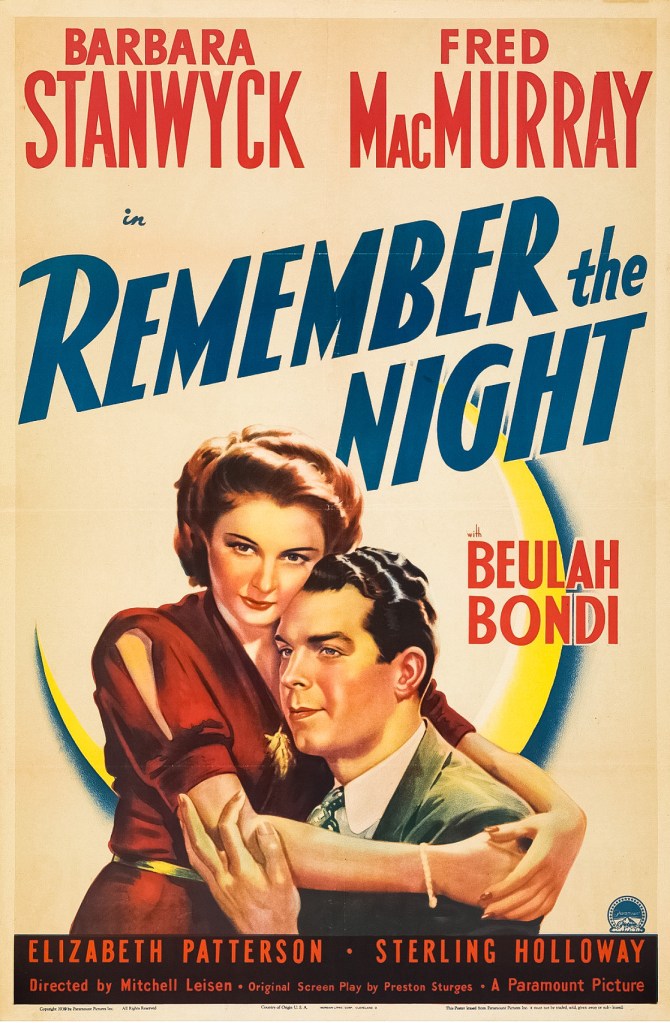
The poster for Remember the Night features Barbara Stanwyck on the right in a red dress, standing next to Fred MacMurray (who is dressed in a dark suit and tie) and placing her arms around him.

And the setting is brought really to life by the fantastic casting of the two lead roles.  Fred MacMurray always was a chameleon, able to project such a range from sweet naivete to hard criminal purpose — I grew up with him as the sort of ideal Disney dad in films like The Shaggy Dog or The Absent-Minded Professor, but in this film, he’s excellent at managing the tougher balancing act of playing John “Jack” Sargent, a kindly smalltown fella who made good as one of the savviest minds in the New York City DA’s office.  But here even Fred’s considerable talent is really getting blown out of the water by Barbara Stanwyck at basically the height of her powers — and she’s not just acting the hell out of the role, but she’s doing it in absolutely classic Edith Head costumes while speaking words out of a Preston Sturges screenplay (Sturges, for the unfamiliar, basically invents and achieves the apex of the screwball romantic comedies of the late ‘30s and early ‘40s that we now think of as classic Hollywood).  Here, as Lee Leander, she has to run the gamut from exhibiting the kind of brassy self-confidence that’s helped her survive as a con and a thief for basically her whole adult life to the kind of fragile self-doubt that emerges as the fearful center around which she’s erected that facade to avoid confronting the pain of her upbringing.  It’s an incredible performance, good enough to make me wonder why I’d never heard anyone talk about this film.

The funny thing about the film — given the fairly ridiculous premise and the snappy dialogue that Sturges is known for — is how naturalistic it so often is.  Whether it’s moments where we hear Jack and Lee connecting over some shared memories of small town Indiana life, or the way Lee seems to shrink and tighten up with every mile she gets closer to home, there’s something honest about the emotions the two actors are working with — they don’t feel like they’re falling in love because of some machination in the script.  They feel like they’re falling in love because it was meant to be — they almost feel like a couple that had been in love the whole time, and it’s only the movie that’s catching up to them.  It’s pretty magical.

The magic of the film is less Christmassy than other films on this blog — to some extent by design, since really the film only feels like Christmas in two places.  Either it’s the hyper-commercialized high street shopping of a bustling New York City, or else it’s the cornpone, apple-bobbing at a rummage sale, country Christmas energy of Jack’s hometown Indiana village.  Everywhere else doesn’t seem to have the spirit at all, almost like it wasn’t Christmas anywhere else, really.  That journey from Christmas to Christmas — from the one where Lee’s an operator who is never on the wrong foot, to the one where her defenses are laid bare and her authenticity can unfold in the softer light of home — is central, I think, to the movie’s thematic message.  And I like how the film works in that way, but it hurts the holiday score a little, there’s no doubt.

In the end, it’s a film about love — love from the moment Jack realizes what he needs to do for Lee, just out of compassion for another human (and not yet thinking of romance), to the final….well, I won’t spoil it for you.  And there’s so many kinds of love at work in this film — not just their love for each other at its best, but also the ways their love for each other trips the other person up or interferes with their designs, like it’s an O. Henry short story.  There’s love here from family — both love that builds up and a love that can feel closed off.  Even just the gentle moment of two elderly sisters, one a widow and the other a spinster, kissing each other on the cheek cheerfully as the clock strikes midnight on New Year’s Eve.  There’s such remarkable strength, too, fueled by that love, and none of it stronger or more remarkable than what we see in Stanwyck’s performance as Lee in the film’s final act.  She’s the best.

I Know That Face: There are SO many options here, it’s embarrassing, so I’ll pick just a few.  Now, she’s not exactly inconspicuous, so I don’t want to dwell on her, but it would be silly not to remember that Barbara Stanwyck goes on to be Ann Mitchell in Meet John Doe, which reaches its climactic moments at Christmas, not to mention Elizabeth Lane in the by-now classic Christmas in Connecticut.  But there’s other faces here you’ll recognize, and a voice too — the mothers in this film both have spots in other ‘40s Christmas flicks.  Georgia Caine, Lee’s horrible mother, plays the minor role of Mrs. Johnson in The Miracle of Morgan’s Creek — another film culminating at Christmastime (and another Preston Sturges film).  More memorably, Beulah Bondi, who here plays Jack’s much kinder yet still complicated mother, will be very familiar to many of us as George Bailey’s mother in the totally iconic It’s a Wonderful Life.  And lastly, a voice — because Willie, the oddball servant in the Sargent home in Indiana, is portrayed by Sterling Holloway, of all people.  Holloway’s utterly distinctive voice is best known to you as Winnie the Pooh, or the voice narrating Lambert the Sheepish Lion or The Little House or Ben and Me or any of dozens of other Disney short films, so much so that it’s hard for me to accept that that’s the voice of a regular person and not a cartoon character.  Anyway, Holloway voices someone called Northwind in an animated TV movie called Tukiki and His Search for a Merry Christmas.

That Takes Me Back: Again, the 1940s films are generally an endless source of nostalgic elements and moments, but here’s a few that stuck out to me.  I loved the moment early on when they’re reading a paper map while trying to manage detours in the middle of the night: I remember both the confusion and the exhilaration of that kind of navigating, which I was usually pretty good at, and it’s a bit of a shame that at this point GPS and a smartphone have taken over about 99% of that kind of human travel guidance.  And then they haul out sandwiches wrapped in waxed paper — other than for crafting, I can’t think of the last time I used waxed paper, but it reminded me of my grandmother making sandwiches to take somewhere (I’m not sure this memory happened more than once or twice).  And then later on, the “down home” Indiana Christmas involves both stringing popcorn for the Christmas tree, and bobbing for apples — the popcorn garland in particular is such a delightful glimpse of the much simpler Christmas trees of days past, and it made me smile to see the string on the tree in the background in a later scene.

I Understood That Reference: I know, I know, this is a weird category to include when it’s so often empty, but I think that in itself is interesting — it would have been easy, I think, for Sturges to incorporate some elements of Christmas stories (indeed, of THE Christmas story) here, and so it’s at least a little interesting to me that he doesn’t.


Holiday Vibes (4.5/10): So, as mentioned above, a lot of the film doesn’t really feel like Christmas — not the courtroom scenes, and almost all the travel from New York to Indiana seems to pass through towns and houses where no one is getting ready for Christmas at all.  I do think there’s some thematic reason for it, so it’s not a critique of the film, but it does also consolidate the film’s holiday vibes into a pretty tight 25-30 minutes in Jack’s childhood home.  As you can likely tell, I like this movie a lot, but I don’t think its evocation of Christmas is one of its strongest elements — I can easily see myself watching it at another time of year without it feeling out of place.

Actual Quality (9/10): I really enjoyed this movie, coming to it with almost no preconceptions at all.  Sure, the opening ten minutes are both a little tedious and more than a little racially problematic: there’s no getting around it, and if you bail on the movie then, I get it.  But after that, from costume to script to two stellar lead performances (and a couple of really great turns from the supporting cast, as well), this is a romantic comedy that’s really hitting all the moves the genre does best.  Stanwyck is electric on film and MacMurray’s wonderfully subtle and loyal, and the two of them together manage both the surreality of the quick banter old Hollywood romance AND the reality of the emotional roller coaster two people might ride by falling in love in this way.  If you like a good romantic comedy, I think you’ll love it, and if you usually find romantic comedies either squirm-inducing or silly, I think this is the kind of film that might make you say, “well, okay, THAT one is admittedly a solid movie”.

Party Mood-Setter? I mean, I would like to tell you no — as romantic comedies go, it’s leaning more on realistic emotion than on quips, so it’s a film that rewards your full attention and that might be hard to connect with if it’s just on in the background. But the film’s pretty great at conveying the combo of 40s nostalgia and fabulous Edith Head costumes, so if you want to do the movie a bit of an injustice and treat it as occasional eye candy, I think it could work in the background.  I just also think that, when you’re really paying attention to it, it’s so good and human that it deserves the spotlight and I’m hoping you’ll give it center stage.

Plucked Heart Strings? For sure — I got genuinely choked up more than once, basically always at moments where Stanwyck as Lee really successfully conveys the feeling of a woman who’s never been given any tenderness or compassion in life experiencing the sudden shock of someone’s loving care.  Especially because, at first, that’s all it is — not Jack trying to woo her, but just Jack (and later his family) seeing a person in need and reaching out to support her like it was the most natural thing in the world….because it is, to them.

Recommended Frequency: Oh man, this one feels like a candidate for “every year” to me; it’s certainly one I want to own so I can keep it in my regular rotation, and I feel like it’s a film that will reward future viewings.  I think if the film as I’ve described it sounds appealing to you, it’s one to schedule for yourself this very holiday season: don’t delay!

Shockingly (to me) the only place I can find Remember the Night streaming right now is on Plex, the ad-supported free streaming service that shows up in this paragraph pretty frequently. It doesn’t look to me like it can be rented anywhere, though, which is unusual.  It’s purchasable in a variety of media formats, though, on Amazon (and elsewhere I’m sure), if you’re willing to wait for delivery of physical media (and willing to trust me that it’s worth owning).  And as always, try your local library — Worldcat tells me that there are hundreds of libraries with a copy on DVD.

Bell, Book and Candle (1958)

Review Essay

The definition of a “Christmas film” is always negotiable — yes, Die Hard fans, I know you’re still out there, and no, I won’t be covering Bruce Willis and his machine gun, at least not in 2024 — and that’s certainly true here.  My general rule is that if Christmas is a key setting for more than a few minutes of the movie, it ought to count, and this film, which opens on a snowy scene with Jingle Bells playing in the background as people carry trees down a New York City sidewalk, really has to count.  But as I’ll discuss, it’s among the less seasonally oriented flicks I’ll cover here at Film for the Holidays.

The initial premise is more traditionally rom-com than anything else — stiff middle-aged publisher Shep (played by Jimmy Stewart) lives upstairs from “exotic” art dealer Gill (played by Kim Novak).  She thinks he’s attractive, he’s polite but has a fiancee, and she….well, she’s a witch, and one or two little spells couldn’t hurt, could they?  If it sounds like a Bewitched prequel, it basically is: that series was created after this film came out, by Columbia who released this movie in the first place.  And I’d love to tell you this movie charmed me as much as episodes of Bewitched did, once upon a time.  But it didn’t really land for me — and the reason I think the movie doesn’t work was honestly a real surprise to me.

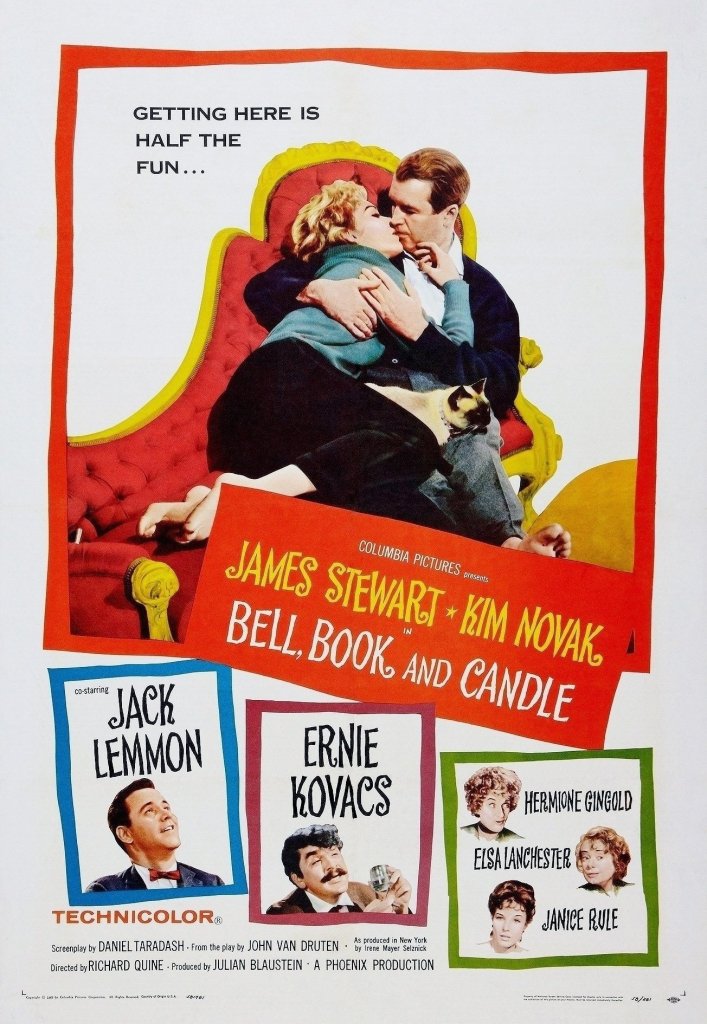
The movie poster for Bell, Book and Candle offers the tagline "Getting here is half the fun". The top half of the poster features Jimmy Stewart and Kim Novak, barefoot on a chaise longue, embracing, with a Siamese cat sitting atop them both. The bottom half is divided into multiple boxes announcing the supporting cast: Jack Lemmon, Ernie Kovacs, Hermione Gingold, Elsa Lanchester, and Janice Rule.

First off, though, quite a few individual elements here do work.  I love the late 1950s aesthetic — sure, the 1940s classics really established the genre of the holiday movie, but as a kid growing up in the late 20th Century, it was the 1950s that seemed to have created the Christmas look I think we were all nostalgic for, less wartime optimism and more the shimmer of the postwar boom.  Kim Novak as Gill is sensational most of the time — sultry and alluring in ways the ‘40s films wouldn’t really have let her be, and clearly presented as “daring” (Novak is barefoot basically the whole movie, which felt both avant-garde and playfully flirtatious, given that it’s New York City in December and her ground floor retail establishment can’t be all that warm).  Her brother, Nicky, is played by a really dazzlingly talented young Jack Lemmon, who pulls off a range from simpleton to scheming and makes the character feel coherent throughout — sure, it’s a comedic performance, but that doesn’t make his skill LESS impressive.  If anything, it’s a bit more impressive that he’s applying so much talent to a role that’s honestly not very consistently or compellingly written, on the page.  The two of them are on screen much of the movie’s running time, and thank goodness for that, since they’re usually doing something worth watching.

The big problem here — and I can’t believe I’m saying this — is that I think Jimmy Stewart’s performance is a distracting mess.  Now, Stewart’s one of the finest American actors of his generation, if not ever: I love his work in It’s A Wonderful Life, and if anything he’s even better in The Shop Around The Corner, both of them iconic holiday films and likely to be coming soon to a blog near you.  Here, though, everything about his presentation of the character goes weird from the beginning.  Stewart’s not helped by the fact that he looks all of the 50 years old he is when this movie comes out, and Kim Novak is very 25 — sometimes there’s a chemistry between them, but much more often you just really wish each of them would find someone their own age.  (And yes, folks, I know they’re also in a romance in Vertigo — I’m not telling you anything about that movie, I’m just telling you what I think doesn’t work about this one.)  Shep is written really oddly: at times he seems naive (his calm response to finding a strange old woman inside his locked apartment is very odd) but at other times he feels almost rakish, talking about the Kinsey Report with Gill when he barely knows her, or telling his secretary he wants her to have the negligee he had ordered for his fiancee.  And fundamentally, the thing Shep needs to pull off is the feeling that we’re watching a man gradually become unsettled, even haunted, by the feeling that his own emotions and thoughts have been invaded by magical compulsion, and that he’s so horrified by the thought that he decides to run away from his brand new fiancee who….well, who looks and acts like a sultry Kim Novak who’s half his age.  Stewart, to me, just doesn’t land the plane at all — his attempts to convey pretty simple experiences like “allergic to cats” or “scared of witchcraft” feel like awkward flailing by someone in Drama 101.  I can’t really explain why it’s not working, since Stewart clearly knows how to act (he was, I think undeniably, among the finest performers of his generation) — I can only think either that he felt the script was beneath him enough that he decided to ham it up, or else that maybe he felt a little embarrassed that they were casting him as a 25 year old’s love interest, and his feelings of unease or awkwardness emerged in his performance as a result.

The film has other issues, to be sure.  My notes as I was watching remarked on multiple occasions about pretty terrible sound editing — there’s a LOT of ADR (where an actor re-records their lines in the sound booth, after the fact), and it’s just not mixed well, so that it doesn’t sound like the actor is talking naturally in the room we see them in, but instead they sound like they’re in a recording booth talking directly into a microphone.  The script’s silliness is sometimes hard to follow: for instance, a character promises to keep a secret, but then almost immediately is handing out information left and right, and the film never seems to present it as a flub-up or subversion of the promise.  The movie struggles too, I think, to convey what tone we’re supposed to be picking up on: is this light-hearted or spooky?  Is Gillian basically well intentioned or basically self-serving?  And to be clear, I think intentional ambiguity in a movie is just fine: really good, even.  But there were too many moments for me where this felt less like conscious ambiguity and more like carelessness, or else honest confusion.

As a holiday film, well, I’ll give it a rating below, but I’ll admit, after the first 35 minutes or so, we leave Christmas in our wake completely, other than a scene in which kids are throwing snowballs and skating (which felt holiday-adjacent to me?).  And even in that first half hour, these are people who don’t seem all that interested in Christmas — we’re given some traditional music here, but these adults don’t seem to have gatherings to attend, last minute gifts to buy, etc.  They spend Christmas Eve in a nightclub without seemingly a care in the world.

Ultimately the film’s got fun moments where it cheekily gets close to breaking the “code” for films at the time — one bold line of dialogue occurs when Shep tells a character, late in the movie, that Gill is a witch, and the character replies “A witch?  Shep, you just never learned to spell.”  Which is maybe the classiest (and possibly only, in 1958) way you could call a character a….well, it starts with a b.  Again, though, it can’t ever really commit to a tone, since I think the whole premise leaves us caught between seeing Gill’s bewitching of Shep as lighthearted fun and a deep betrayal, and it’s just a bit too hard to square those things no matter how you squint at them.  So the fun, for me at least, is intermittent, and the lasting impression is more confused than classic when I think about the movie as a whole.  Scene by scene, or line by line, though?  There’s some real gems in this one when remembered in that way, and it’s a flirtatiously fun changeup to throw into the catalog of holiday films I’m taking on here.

I Know That Face: Obviously, Jimmy Stewart who plays Shepherd Henderson in this film is better known to Christmas movie fans as the star of Frank Capra’s classic It’s A Wonderful Life or of the less-famous but also brilliant The Shop Around the Corner — most of us probably see his face every single Christmas season, perhaps multiple times.  And Elsa Lanchester, the mischievous Aunt Queenie here, plays Matilda the housekeeper in the household of the Broughams in another half-forgotten mid-century Christmastime film, The Bishop’s Wife.

That Takes Me Back: This “takes me back” even farther than I was alive to see, but I was charmed that we don’t just see characters using a rotary phone, but we hear them referencing a phone number that begins with a word.  I’m tempted to start handing out my office extension on campus as “HArrison Six Two”.  A less appealing hit of nostalgia came along with the sight of someone smoking casually indoors (as Merle does at the Zodiac) — I was describing to my daughter just a few weeks ago how the world used to have things called “smoking” and “non-smoking” sections, a thing she can’t really envision.  And I don’t know that this is actually a throwback, but the work “negligee” feels SUPER old-fashioned to me for some reason.  If you all are constantly talking about negligees, I mean, a) I bet you throw a great party, and b) clearly you and I are having some of your most boring conversations (my apologies).  Oh, and I chuckled at the line, “A typewriter: I’ve got to get a typewriter.”

Sadly, I didn’t find that this film yielded anything at all in the I Understood That Reference category; better luck next time, maybe.


Holiday Vibes (2/10): This was a fun film to include on the blog, and it does come up as a “holiday movie” on some lists, but as noted above, the actual festive content is really brief, and we don’t even really get much of a “Christmas” for the film’s one Christmas Eve sequence.  If you’re someone who likes to think broadly about what counts as a holiday movie, it’s not like there’s nothing here for you….but there’s not a whole lot here for you.

Actual Quality (7/10): Bell, Book and Candle is a movie I wish I could recommend with more enthusiasm, since there’s undeniably some worthwhile things to enjoy here.  I have the feeling it’s one I’ll rewatch in a few years, thinking maybe I judged it too harshly….and find myself saying again “ah, right, it just doesn’t work as a romance”.  I do think that almost everything around the romance DOES work, and for that reason I hate to be so down about it.  But in a romantic comedy, if the romance ain’t working, I don’t know that the film has anywhere to go in the end.

Party Mood-Setter?  I mean, if you’re having a flirty, fun, fifties shindig this holiday season, throw Kim and Shep on the screen and don’t pay that much attention, maybe?  But honestly it’s got to be a “No” since what this question is asking is, can this background a festive holiday gathering, and here I don’t think it’s anywhere close to being enough of a holiday vibe.

Plucked Heart Strings?  There’s emotion on screen, but I don’t feel pulled in by any sentiment — Gill is certainly going through it, especially late in the film, but I never found myself feeling anything along with her.  Again, I think the tone is the challenge here, since it’s not clear to me who’s wronged who, or how, or even if anybody’s really been wronged at all, and the main characters became just a little too caricatured along the way for me to connect deeply with them like this.

Recommended Frequency? Look, if you’ve seen it and it didn’t win you over, I’m definitely not here to tell you to put it on this December.  But if you’ve never seen it, honestly, I think you could give it a go for Kim and Jack: Novak and Lemmon are really on their game here, and even if the film is only “fine” overall, I doubt you’ll regret getting to see the movie’s best scenes and lines. As for me, having seen it once already, I do think this will be a once a decade kind of movie for me — if it’s more than that for you, though, I’m delighted and hope you have fun in the fifties!

You can stream Bell, Book and Candle if you’re an Amazon Prime member, and Tubi will play it for you for free (with ads).  It can, of course, be rented from most of the usual places online.  Amazon will sell it to you on Blu-ray, or DVD, or VHS (is VHS making a comeback, folks, and nobody told me?).  And as always, I encourage you to make use of your local library: mine has the movie on DVD, at least, and I bet yours will too.

The Holiday (2006)

Review Essay

The Holiday’s a Nancy Meyers film through and through — and if you’re someone who knows those movies (What Women Want; Something’s Gotta Give; the 1990s Father of the Bride reboot films, which she screenwrote), you know a little bit about what you’re in for.  Lush interiors, especially really lavishly appointed kitchens; romantic/comedic dialogue that owes a zippy debt to Nora Ephron even if it’s rarely quite as stylishly composed; a willingness to take the emotion of a scene more than a little over the top.  This movie hits those marks reliably, and as a result is, to me, both reliably entertaining for a big chunk of its runtime and also a little too artificial and hollow to really land the punches it’s swinging for.

The premise is simple enough — Cameron Diaz’s Amanda and Kate Winslet’s Iris are both on serious rebounds after painful romantic fallouts that have left them questioning their own identities.  They find each other via a wonderfully hokey of-its-2006-era home swap website, and agree that Amanda will spend Christmas in a charming Surrey cottage while Iris spends her Christmas in a sprawling SoCal McMansion, buffeted by the Santa Ana winds.  They’re hoping not to find love, of course, which is why it’s so convenient when Iris’s brother Graham (played by Jude Law) drops in to find Amanda unexpectedly in residence at the cottage, and when Amanda’s ex’s buddy, Miles (played by a charmingly baby-faced Jack Black), shows up to retrieve some things and encounters an unanticipated English woman on holiday.  The rest….well, you know the rest, probably, though there’s a twist or two I won’t reveal.

The film poster for the movie, The Holiday, featuring the names and faces of the movie's four principal actors, Cameron Diaz, Kate Winslet, Jude Law, and Jack Black.

The film’s at its best when it’s not trying to advance the primary plot, which is Diaz and Law falling in love — two incredibly attractive humans at basically the height of their Hollywood stardom, but underwritten in ways I’ll get to in a moment.  The absolute best pairing in the movie, by contrast, is actually Kate Winslet’s Iris and her new neighbor, a frail old screenwriter who was big in the mid-20th Century but now gets lost walking down the street – a man named Arthur, played spiritedly by Eli Wallach, who was 91 at the film’s release.  Iris and Arthur are incredible pals, and his not-so-secret desire to lift her self-esteem and make her see herself as a sassy screwball heroine with “gumption” is maybe the sweetest part of the film – both romantic and comedic without being rote.  Meyers’s eye for exterior shots, especially in the English countryside, is really excellent, so there’s a lot of cinematic beauty here to enjoy at times when all we’re seeing is establishing shots or montages.

The two main pairings are underserved by the film in different ways.  Winslet and Black are honestly very cute together – Miles is a sweet, decent fellow who, when the “Jack Black” within him is dialed down to 85% or lower, is impossible not to like, and Winslet’s character is developed really successfully (I think the emotional richness of the Arthur subplot helps her a ton in this regard, plus Iris is just given a more sympathetic situation in the screenplay to begin with).  The problem with their subplot is that it’s given short shrift by a movie that’s more interested in Diaz and Law — Miles and Iris get a couple of really nice scenes together, but that’s about it, and the romance as a result feels a little hasty.  The challenge with Amanda and Graham, meanwhile, is connecting with them: Graham’s character has the biggest twist, and while the revelation we get about him really adds substance to his character, it’s also hard to reconcile all the pieces of the guy we’ve been introduced to with the person he apparently is?  Jude Law is, again, so hot in 2006 that even this straight dude can appreciate the man’s cheekbones, but in some ways that makes him harder to see as anything but a movie star in the spotlight.  And poor Cameron Diaz is handed, in Amanda, a character who never really feels like a person to me — she’s all screenwriting quirks and problems, and most of the moments that are meant to provide emotional depth for her end up seeming flat or unrealistic to me.  Diaz has been good in other things, but here I think the material’s not strong enough to let her succeed, or else maybe she’s not quite strong enough (unlike Winslet) to elevate it.  Maybe both.  There are still, for sure, some good moments for Diaz and Law, especially later in the film where we’re seeing a life that’s a lot less artificial and flashy.  In the end, though, I found myself rolling my eyes or checking my watch too often when one or both of them was on screen.

I Know That Face: In this category, there’s a couple of people with fun crossovers into holiday movie territory.  The aforementioned Eli Wallach, Amanda/Iris’s charming elderly next door neighbor Arthur, narrated The Gift of the Magi in 1958 — a TV movie you probably didn’t see, unless you were around in 1958, I’m guessing — and appeared as a character named Behrman in a segment called “The Last Leaf” in another TV movie, O. Henry’s Christmas, that, yeah, you probably didn’t see unless you were watching television in 1996 (I was, but I don’t remember this one: you can apparently watch a terrible transfer of the whole thing on YouTube right now).  Arthur’s Hanukkah buddy, Ernie, is played by Bill Macy (no, not William H. Macy….an older actor who, I presume, is part of the reason there’s an “H.” in William H. Macy, given Screen Actors Guild rules about having distinctive working names) who also plays a character named Doo-Dah in Surviving Christmas, yet another semi-forgotten 2000s holiday flick, and one I’ve never seen.  Shannyn Sossamon, who plays Miles’s crappy girlfriend Maggie, turned up in 2021’s High Holiday, which is apparently a movie about a family Christmas dinner in which someone slips weed into the salad dressing so that everyone (including her right wing politician father) will get blazed and say their true feelings out loud?  Sounds ghastly…I guess maybe someday I’ll watch it and find out.

That Takes Me Back: I have to say, there’s a number of slices of classic mid-2000s life here.  Iris’s job is writing wedding columns for a British newspaper, and while we get only glimpses of her older word-processing software in use, the fact that she’s working in old school journalism at all feels quaint these days.  At one point Amanda’s awful ex shouts at her, “You sleep with your BlackBerry.”  Can’t get more 2006 than that.  Iris is carrying a BlackBerry around, too, sending emails on it from the plane (prior to takeoff, we assume).  When Amanda searches for vacation homes to escape to, she types in a simple keyword search and gets actual functional Google results with no ads or promoted posts cluttering things up: talk about things we didn’t appreciate until they were gone.  And one of the most charming and funny and ultimately sad scenes for Iris and Miles unfolds as they peruse a video store stocked with every kind of film on DVD — I miss those places all the time anyway, but especially when I’m trying to track down forgotten holiday films.

I Understood That Reference: I wish there was anything of this kind to dwell on here, but somehow in a film that’s at least partially obsessed with classic Hollywood films and movies with great music (thanks to the careers of Arthur and Miles respectively, and their effusive personalities), no holiday-themed media ever comes up in the film’s screenplay, even in passing.  It’s a real missed opportunity.


Holiday Vibes (5/10):  I don’t want to seem ungrateful: after all, Meyers opens the movie at an office holiday party, and the soundtrack is chock full of Christmas bops, including multiple people singing to us about a merry little Christmas and Motown singers walking in a winter wonderland.  But the film’s not all that interested in Christmas other than as set dressing — there’s no family Christmas gathering on either side of the pond, only a couple of painful gift exchanges, and as the movie progresses, the sound’s less Motown and more Imogen Heap (which is not a complaint: I love Imogen Heap).  None of these people seem to be living lives in which ordinary Christmas activities are really part of the routine — it would have made sense to have a “frantic shopping for Christmas gift” section, or a “my homesickness is assuaged by this particular Christmas memory or moment that feels familiar” but it’s not in the cards.

Actual Quality (8/10):  It’s a solid Nancy Meyers movie with a great cast — there’s more than enough great set design and good cinematography, and some lovely people to watch fall in love on screen.  Hard to be disappointed in that.  It still drags at times, as noted, in the Amanda/Graham sections, and I found myself wondering how awesome it would be to just have a film about Iris — an English fish out of water in Southern California for Christmas, simultaneously finding herself loving and being loved by two sweet fellows, an elderly Hollywood widower who’s surely being reminded of the love of his life and a teddy bear of a film composer with an impish grin who’s on the rebound himself.  That film, I think, had real 9 or 9.5 out of 10 potential, especially with Winslet, Wallach, and Black in the main roles.  As it is, it’s a solid B- of a film, for me.

Party Mood-Setter?  To me, no — it’s too sexual for Christmas with the kids but not sexy enough for a more flirtatious party of young adults.  It’s playful enough and cinematic enough at times to get closer to qualifying, especially with those lush Nancy Meyers interiors, but fundamentally it’s a movie that needs your whole attention, and that wants to deliver most of its message through scenes that are at least a little poignant.  Not great for inconsistent attention while you’re doing something else.

Plucked Heart Strings?  This one is much closer, for me, but it’s still a no — the movie invests most of its big emotional arc in Cameron Diaz as Amanda, which again I think is not really working on either a screenplay or an acting level.  If you do get misty-eyed at this film, I think it’ll be out of sympathy for Kate Winslet’s Iris, whom she makes a human being with genuine pain in her life that she needs to triumph over.  I can see it — it just didn’t happen for me.

Recommended Frequency:  This is definitely a “now and then, in the right mood” film, from my perspective.  There’s not enough here to make it a perennial classic, especially because, ironically, the actual holiday content in a film called The Holiday is a bit thin.  But it’s also more than watchable enough, especially (as I’ve made pretty plain) the to-me-superior subplots involving Iris, for me to imagine putting it on again in the future, now and then, when I’m in the mood to see particular moments or a particular acting performance again.

You can find The Holiday streaming on Amazon Prime, or for rent at the usual places (AppleTV, Google Play, Fandango at Home, etc.). You could pick up the Blu-ray (or DVD) at Amazon pretty inexpensively, it looks like. And of course I will always recommend you check at your local library: according to Worldcat, there are thousands of copies waiting out there for you! As will always be true here, I earn nothing from any links I’m providing: they’re just here as a courtesy. If you give the movie a go, I hope you’ll leave your thoughts in the comments!