Last Christmas (2019)

Review Essay

One of the American authors who has written the most widely in connection with Christmas is the science fiction grandmaster Connie Willis, one of the most award-winning writers of her generation and a personal favorite of mine.  Connie’s a big reason this blog exists, in fact, but I won’t distract myself down that road in this post, anyway.  The reason I’m bringing her up in connection with Last Christmas is enough of a story.  I had the good fortune to get to speak with Connie this August, after having “won” the opportunity in a fund-raiser: she was a delightful and effusive conversationalist, and happily engaged with my questions on a variety of subjects.  One of them, naturally, was the subject of “the real Christmas movie,” as Connie referred to it: I asked her what she looks for in a great holiday film, and she said a lot of wise and thought-provoking things.  One of her observations was about the holiday romantic comedy: she thought that a lot of modern holiday rom-coms seem to approach the subject matter thinking that the point of the movie is to find someone to love, whereas what distinguishes a great romantic comedy is that the journey is about self-discovery.  You find your true self through the encounter with the person you love…whether or not you even get them in the end, in fact, since it’s finding yourself that matters.  And, in addition to a number of great older classic films she encouraged me to watch, she suggested that Last Christmas was really a good modern example of exactly the kind of self-discovery she was talking about, so I put it on this year’s slate.  (To be clear, I am obviously paraphrasing here from my memories of our conversation: I may well not be capturing Connie’s message perfectly, though I certainly felt I learned a lot from the talk!)

Maybe the most immediately interesting element in Last Christmas is how completely and disastrously self-sabotaging the main character, Kate, is: she lost her last living arrangement and is so desperate to find a new one that doesn’t involve slinking home to her immigrant family (who emigrated from the former Yugoslavia to London in the late 1990s) that she’s throwing herself into ill-advised one night stands and making selfish demands of the few remaining friends who will pick up the phone when she calls.  She’s a terrible employee at a Christmas shop run by a long-suffering Chinese woman Kate calls “Santa”, and she’s perhaps doing an even worse job of trying to make it in musical theater, running late and unprepared into the rare auditions she figures out how to get to at all.  Kate’s a hot mess…but let’s give it to her, she’s a self-aware hot mess, exclaiming out loud after one of her early failures, “why is my life so shit?”  Well, let’s give it to her that she’s aware things are not going well—how aware she is of the ways she’s contributing to the problems is a little less clear, at least at first.
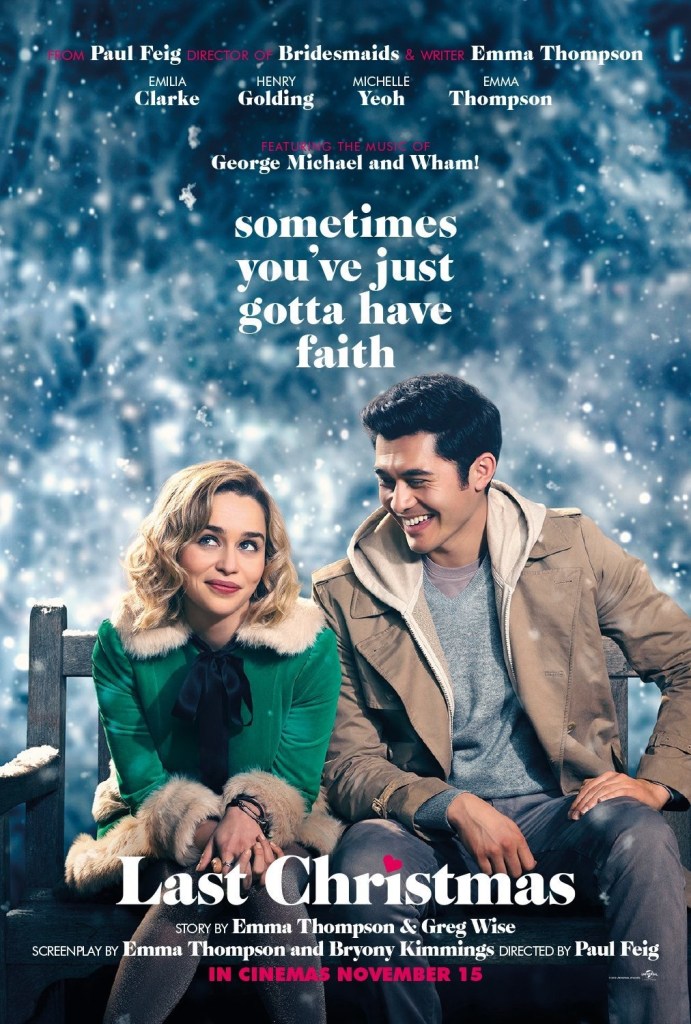
The poster for Last Christmas depicts Emilia Clarke in her elf costume, sitting on an outdoor park bench and smiling next to a grinning Henry Golding: the background is an out-of-focus snowy forest, it looks like.  Above their heads floats the movie's tagline: "sometimes you've just gotta have faith"

The romance in this romantic comedy comes along eventually, though, in the shape of a nice young fellow named Tom who keeps running into her.  Sure, in some ways, he’s a little too good to be true, since he always seems to know some lovely secret alley to stroll down, he appears to spend all his free time volunteering for the homeless, and he is patient and cheerful in the face of all of Kate’s frustrated exasperation with the world around him and sometimes with him, himself.  He sees something in her that she hasn’t figured out yet how to see in herself.  And though it’s not totally clear how this is working, contact with Tom seems to bring a little needed stability into Kate’s life.  She relents and finally goes to visit her impossible mother, Petra, who insists on accompanying Kate to a doctor’s appointment she clearly would rather skip: while there, we see the two women for who they are, confident and unyielding ladies who know everything in the world other than the woman sitting next to them.  There’s a weight on Kate, who seems to resent how much she already owes everyone in her life, how fragile she feels when she looks backwards and sees only the life of a first-generation immigrant kid on whom her parents placed too much pressure, not to mention the survivor of a serious medical emergency on whom now there’s even more pressure to eat right and live healthy in order to keep herself out of the hospital again.

One of the reasons all of this works is just a tremendously gifted cast of actresses: Emilia Clarke as Kate is maybe not quite up to the level of the supporting cast in talent, but this role seems to be right in her wheelhouse, playing the charisma someone this calamitous would have to have in order to survive, but also the woundedness that would live underneath that charisma.  She can’t quite rise to the level of a Barbara Stanwyck in Remember the Night, for me, but that’s a high bar to clear and Clarke’s getting close.  And the folks around her are justly famous: the always-brilliant Emma Thompson inhabits the role of Petra with the baffled dignity of a woman who intends only to understand enough of her new country and the new century to just get by.  Michelle Yeoh is frankly too much talent for the supporting role of “Santa” but all that means is that the store subplot, which would probably otherwise feel undercooked, actually carries a little dramatic weight…especially once we add in the explosively bold Patti LuPone as Joyce, a difficult-to-satisfy customer.  It would be hard to put these four women on the screen and not get something worth watching out of it.  And another key element here is just what Connie pointed out to me in recommending the film: if this was just a movie about Kate falling for Tom, it would be too slight to matter.  The fact that it’s about Kate as a holistic person—coming to terms with the damage she’s done, trying to rebuild a few bridges she’s burned, learning to find joy in places she wouldn’t have looked for it before—makes the Tom and Kate scenes sing a lot more sweetly.

I mentioned singing just now and of course you might expect this to be a musical, since it’s a film named for the Wham! holiday pop song, after all, and Kate’s interested in musical theater, and also we’ve got Patti LuPone, a Broadway and West End legend, in the cast.  I think it’s to the movie’s benefit that it doesn’t try to force that onto itself: music matters here, of course, and we do get some musical performances scattered throughout.  We also get a lot of George Michael / Wham! on the soundtrack, so much so that it can feel a little like a non-diegetic jukebox musical, and I’d say that it both doesn’t really work and it doesn’t hurt the film too much: again, luckily the movie isn’t forcing it too hard, and therefore the songs don’t always fit the story, but I prefer those slight mismatches to a situation where they’re twisting the plot around to try to hit a couple more song lyrics.  And it’s hard to complain about a movie dropping a lot of George Michael at me as an audience member, since that man knew his way around a pop song, and when the connection’s there, it really does enhance the experience.

One of the things I appreciated most about the film was its modest aims: for all that the screenplay starts us with a woman whose mistakes and faults are comically exaggerated, from then on, I thought it took an increasingly realistic tack.  Kate’s going to change herself, but it’s slow.  She makes the kind of amends a real person who’s made these mistakes might be able to make.  In one key conversation, in which she confesses to Tom that she’s “a mess”, he tells her to focus on the everyday, because every little action in our day makes or unmakes character.  And we start to see those dominos fall, as Kate seizes the little opportunities.  There are times when the situations that arise (or the dialogue exchanges within them) felt slightly cringey, but romantic comedies are always at risk of that kind of awkwardness.  It’s not a deep flaw of the film that at times it’s susceptible.

And while maybe you’ll see this movie’s ending coming, I didn’t.  I thought I understood where we were going and I was expecting to be happy about it.  But the layers that are applied near the end of the film really help me reconsider what the film’s ultimate message is, about what it means to reckon with who we are (and how complicated it is to answer the question “who am I?” honestly).  There are some genuinely moving moments as Kate takes hold of the understanding she’s being given, and we get more politics than I think I was expecting, as one of the things she really comes to terms with is her identity (and her family’s) as Croatian immigrants to the UK.  The true self she discovers is a beautiful one, one that is loving and therefore so easy to love.

I Know That Face: Margaret Clunie, a woman named Sarah who accidentally discovers Kate taking a shower after an overnight fling with (it turns out) Sarah’s boyfriend, also appears as Sherry in 2015’s Christmas Eve, a film about New Yorkers trapped in elevators on Christmas Eve in a power outage.  Margaret’s clearly typecast as someone having a bad holiday season, I guess?  Emilia Clarke, this movie’s star, of course, as Kate, recently voiced the Queen of Hearts for the animated TV movie, The Night Before Christmas in Wonderland.  The always funny Sue Perkins, who pops up here in a cameo as the director of an ice show Kate’s auditioning for, is of course best known to Americans as a host/presenter on The Great British Baking Show, including the two-part Christmas special that first aired in 2017.  And you likely don’t need the reminder that Emma Thompson, this movie’s difficult and overbearing immigrant mother, Petra, is no stranger to holiday fare: she plays Karen, a woman confronting infidelity while trying to manage parenting two children, in Love Actually, which this blog will someday cover, and she’s the uncredited narrator of a very short film based on the book Mog’s Christmas Calamity (a “short film” that was really mostly an advertisement for Sainsbury’s), which I highly doubt I will get to if I run this blog for twenty years, but I hope they paid her well..

That Takes Me Back: I don’t know that I was taken back anywhere—this is so close to the present.

I Understood That Reference: They say “Santa” all the time, of course, given that Kate treats the moniker as though it’s her boss’s real name, and the screenplay makes a ton of elf jokes, but they don’t deal too much in the Santa mythology, really.  That’s about all the film wants to do with any pre-existing Christmas texts, that I noticed.


Holiday Vibes (8.5/10): We don’t just have a Christmas setting (and many different versions of a classic modern Christmas pop song), but we have a main character who literally works in a seasonal retail environment.  Add in reluctantly reconnecting with family and some preparations for a big Christmas celebration, and we get I think a very Christmassy rom-com, and one that will please a lot of viewers.

Actual Quality (9/10): I think folks are going to be pleased by the quality of the film, too: if the romance seems a little too pat initially (Tom’s almost a Manic Pixie Dream Boy), just hang in there.  Trust me, it gets more complicated in time.  Honestly, with really good performances and a script that manages to spin a few plates at once because they feed into each other (rather than the more disjointed modern rom-coms I’ve tried lately), I found myself happily settling in for this one.  It delivers what a movie like this promises us, for the most part, which is a rare enough gift that it’s worth celebrating.

Party Mood-Setter?  It’s a great fit for cookie baking, I think, or a party where you don’t have anybody innocent enough to be scandalized by Kate jumping in and out of bed with all sorts of men, in the early going.  The extensive George Michael and George Michael cover soundtrack works to its advantage in this context, too, since you can hum along as you decorate.

Plucked Heart Strings?  I really wasn’t expecting this film to hit me, but it does succeed, maybe a little like the Remember the Night experience I allude to in the review above: watching a character’s tough exterior (whether Stanwyck or Clarke) slowly lower to reveal what their real pain is, and accept the possibility of love, is really powerful.

Recommended Frequency:  I wouldn’t say this was a home run for me, a film I’ll want every year.  But the leads are incredibly charismatic and the message of it is heartwarming enough that I think it would be welcome almost anytime I encountered it at the holidays: I’m sure I’ll return to it at least once every couple of years, if not more often.

If you’d like to try it out also, Netflix has it waiting for you: you can also rent it on streaming from basically all the places you’d think to look.  Barnes and Noble will sell you a hard copy, but if you’re thinking of snagging it for free at the local library, Worldcat suggests you have almost 1,400 options.  Happy viewing to you!

Christmas in Connecticut (1945)

Review Essay

Relationships to films are complicated—today’s entry, Christmas in Connecticut, being a helpful illustration in my own life—since so much depends not just on the contents of the movie itself but on who we are in the moment we’re watching, what we’re prepared to see in a work of art, and what expectations we bring to the experience.  I first watched this film years ago, and found it underwhelming at the time: I was just getting started on this fascination with holiday movies that led to the blog you’re reading, and I think the title (and some of the advance praise I’d read) made me think this would be an instant classic.  When it wasn’t, I set it on the heap of “fine, I guess” films, and I hadn’t re-examined that rating until my recent viewing.  To my pleasant surprise, I found myself really engaged by Christmas in Connecticut, and excited to share it with you all.  I can see both sides of this movie, that’s for sure, and I’ll try to make them both clear by the end.

The premise of the film is absolutely of its era—Jeff Jones, a sailor who survived the sinking of his destroyer, has gotten himself engaged to his nurse, which his buddy convinced him would secure Jeff better hospital food in recovery, and she thinks the only way to get him to want to settle down and get married for real is by having a real down home Christmas.  Her problem is that she and every other member of her social circle is living out of hotels and boarding houses as they contribute to the war effort, so she needs to borrow someone’s Christmas.  She calls in a favor, and Jeff’s signed up to be sent to the perfect celebration taking place on the idyllic Connecticut farm of nationally-famous homemaker Mrs. Elizabeth Lane, whose column about the lavish meals she cooks for her husband is a sensation from coast to coast.  The only problem?  There is no Elizabeth Lane—or rather, there is, but she’s a single gal in a Manhattan apartment who churns out bucolic fiction about a life she’s never lived, with the stories loosely based on a description of a Connecticut farm belonging to John Sloan, a suave architect whose marriage proposals she’s deflected countless times.  To save her job (and her editor’s), since their publisher has no idea her columns are a pack of lies, Lane agrees hastily to marry Sloan, and then fake her way through the perfect Christmas at a home she’s never seen, dealing out meals from a kitchen she has no ability to cook in.  As they arrive at the farmhouse, though, Lane’s not technically married to Sloan yet, which of course is going to create some complications of the heart when she gets a look at the grinning war hero she’s hosting for the holidays.

The poster for Christmas in Connecticut features, below the names of the three stars, a tiny image of Sydney Greenstreet looking down happily on a large central image of Barbara Stanwyck and Dennis Morgan cuddled up together on a rocking chair (she in his lap).  All around them, small red stars bedazzle an otherwise mostly white background.

How well all this works for you is going to depend a lot on your interest in / patience with the particular tropes and style of a 1940s rom-com, an era and genre to which, as experienced readers of the blog will know, I’m pretty susceptible.  Since the first time I watched this movie, I’ve seen a lot more of them, and I think that’s a big factor in my warming up to this movie on a second viewing: I mean, Barbara Stanwyck’s a highlight of anything she’s in, and here she manages the quirky charm of a woman who plans to bluff her way to success with a pair of deuces in her hand just about perfectly.  Even in black and white, her Edith Head costumes are as striking as ever.  More surprising to me is how skillfully Dennis Morgan as war hero Jefferson Jones plays off of her—Morgan’s career was mostly made up of roles where he’s the likeable square who loses the girl to a slightly grittier star (like Humphrey Bogart), but the structure of the screenplay here allows him to play that same naive persona as the star.  In this film, Lane’s already got the attentions of the brandy-drinking sophisticate in John Sloan, but what warms her heart is the corn-fed friendliness of a Midwestern boy who cheerfully offers to bathe and diaper the baby (an infant on loan in a hasty arrangement that is definitely not going to backfire spectacularly on Elizabeth, who holds the child like it’s a radioactive parcel) and spends his after-dinner energy sitting at the piano, warbling out Christmas carols and old love songs in an angelic tenor.  Sloan owns the farm, but Jones is the guy who seems at home there, in the fantasy world Lane never figured she could have (and is only slowly realizing she might want).  Stanwyck and Morgan’s flirtatious and furtive conversations crackle with romance long before it’s clear how they could possibly pair up, since the whole premise of their meeting is that she’s “happily married” and likely to remain so.  They’re fantastic.

The supporting cast are no slouches, either—Lane’s performance of the perfect Christmas is under the microscope thanks to the presence of her domineering publisher, Alexander Yardley, played with gleeful pomposity by Sydney Greenstreet, and she’s only pulling off the illusion of ideal domesticity thanks to the help of Felix Bessenak (“Uncle Felix” as she calls him, to maintain the cover story), the bespectacled Hungarian immigrant who runs a delicious New York City restaurant on the ground floor of the apartment Lane lives in, and who reluctantly agrees to come out to the farm to whip up a Christmas to remember.  Felix is maybe my favorite character (and in a movie starring Barbara Stanwyck, that’s saying something)—like a benevolent trickster spirit, Felix manages to be in the right place at the right time every step of the way to prevent Elizabeth from tying herself down in a marriage he knows she doesn’t really want, and to keep all options open for her to have a happy future.  He’s generous and joyful, while also having a sassy edge to him that plays really well on camera, and after learning the English word “catastrophe”, he takes great delight in declaring any kind of even mild difficulty as a “cat-as-TROAFF” (as he pronounces it).  S. Z. Sakall, who plays the part of Felix, was himself a Hungarian immigrant, and one who had narrowly avoided disaster fleeing his homeland in 1940—several close family members remained there, and died in Hitler’s concentration camps—and knowing that adds a layer of wonder for me as an audience member, watching an immigrant actor who’d known such grief become such an integral and happy part of this quintessentially American story.  Maybe it’s just that it’s 2025, and I feel a special debt these days to refugees and asylum seekers from around the globe who’ve given so much to make my country the vibrant place that it is.

What doesn’t work here?  Well, the thing I struggled with on my first viewing hasn’t really gotten better, and that’s the fact that there’s not all that much of a plot.  It’s obvious from early on that we’re being given an incredibly complicated Rube Goldberg device to orchestrate something pretty simple—Elizabeth and Jeff are going to fall for each other, but in a context where they just can’t really admit that openly, and we get the slightly illicit good time of rooting for Jeff to kiss a “married woman” and/or rooting for Elizabeth to throw herself at a guy she will eventually figure out has a fiancee waiting for him back at the hospital.  As a result, to the extent that we have a plot, it’s a farce, but really great farce requires pretty impeccably tight writing to make the tension wind itself up more and more as scenes progress, and this is a much more languid screenplay than that.  We have to accept a lot of strange coincidences and impulsive choices by characters to generate the necessary narrative energy and reach the resolutions we know we’re rooting for.  I’d also say that it’s a story with very little character development: the changes in any of the people on screen are subtle, from my perspective, and this is more about well-defined characters overcoming the plot obstacles in their path than it is about characters coming to learn something about themselves and grow.  I don’t think that makes a film bad, but if you’re looking for deeper emotional resonance, there won’t be as much here as I think there easily could have been.  And of course, in any film of the era, some of the dialogue is going to be corny: for me the worst example is Jeff trying to dole out advice about “how to rock in a rocking chair” but your mileage may vary.

There’s a lot here to enjoy, though.  For one thing, I applaud any movie of this era that handles race well in even a limited way, and this film gets high marks for its context: in the first act, there are two Black performers with speaking parts, and they’re both depicted positively and without stereotypes (a confident and efficient deliverywoman with a package for Elizabeth, and then an erudite young waiter who informs his boss, Felix, of the definition and Greek etymology of the word “catastrophe”).  Felix, too, really is playing the part of a minority, in this era, and while the movie’s having a little fun with his exclamations of “catastroph!” he’s not the butt of jokes as an outsider—as I noted, to the contrary, he’s almost the film’s ultimate insider, embraced and appreciated for who he is by basically everyone he encounters (other than perhaps Sloan’s Irish housekeeper, Nora).  Sure, I’m praising fairly limited progress on diversity in film, but given that it’s 1945 (and remembering other films of this vintage that I’ve seen) I’m grateful for what’s here.  Also, in terms of gender politics, it’s ahead of its time, or at least I was really pleasantly surprised that nobody in the film shames Elizabeth when it’s revealed she doesn’t really know how to care for an infant or cook.  Jeff’s jumping in to help with the baby is treated as natural and positive—he doesn’t consider it “women’s work,” and the only reason Elizabeth feels uneasy about it is her need to play her persona as Happy Homemaker and not the mere fact of her gender.  It’s hard not to feel affection for basically everyone on screen, and the folks who have done the most to deserve a little comeuppance do get it, though even this movie’s harshest consequences are pretty gentle.  Show up to just spend time with these characters, and you’ll get a good evening at the movies.

I Know That Face: We’ve got to acknowledge out of the gate that this is yet another film starring Barbara Stanwyck, arguably the queen of ‘40s Christmas movies, given her role as the guarded, wounded Lee Leander in Remember the Night, which I covered last year on the blog, and as the savvy, ambitious Ann Mitchell, the reporter to invites America to Meet John Doe, a movie I’ll be covering here before the month is out.  The man playing her alleged husband, John Sloan, in this film is one Reginald Gardner, who’d appeared as the writer Beverly Carlton in 1941’s The Man Who Came to Dinner, a screwball Christmas comedy that’s absolutely on my longlist and which I’m hoping I’ll get to in 2026.  S. Z. Sakall, who in this movie is my beloved “Uncle Felix”, will show up in 1949’s In the Good Old Summertime, a remake of The Shop Around the Corner which I glowingly reviewed last year: he plays Otto Oberkugen, the owner of Oberkugen’s Music Store, in that film, and his name appears in the end credits as “S. Z. ‘Cuddles’ Sakall.”  Maybe everybody loved this guy?  And lastly, I would be falling down on the job if I didn’t help you figure out why Judge Crowthers, who keeps showing up to try to perform a quick at-home wedding ceremony for Sloan and Lane, feels so familiar…I was sure I’d seen him somewhere.  Well, it turns out, that actor, Dick Elliott, makes a brief uncredited appearance the following year in a little movie called It’s a Wonderful Life, in which he is the man sitting on his porch who tells George Bailey to “kiss the girl instead of talking her to death,” before complaining loudly that “youth is wasted on the wrong people”.  What a legend.

That Takes Me Back: Obviously it’s always at least slightly jarring in films set before the 1990s how socially accepted smoking is at all times and in all places, but even so, it was especially wild to me to see Jeff smoking a cigarette in the hospital while being pushed around the recovery ward in a wheelchair.  Times have changed.  Shortly thereafter, Mary Lee, Jeff’s nurse fiancee, manages to secure the favor of a Christmas in Connecticut for her beau by reminding Mr. Yardley that she helped save his granddaughter when she was suffering from measles…a reminder of the past, yes, and also of the disease-riddled future the nation’s Health and Human Services Secretary dreams of at night, but I guess in polite company we’re supposed to pretend that the death and disability of children is just another of those political matters we shouldn’t mention at the Christmas table.  Apologies if it bothers you that I’m bringing it up anyway.  Speaking of things inhumane, it is always a little fascinating to me how luxurious and universally appealing furs were, in this era: I’m not going to throw paint at anybody, and obviously a vintage fur isn’t doing any additional harm on its own (those animals are long gone), but what little I know of the conditions under which mink fur coats were made suggests to me that maybe it’s nice they’re no longer considered the gold standard of wealth.

I Understood That Reference: I didn’t catch any references to any Christmas stories or poems, myself, which is at least slightly surprising.


Holiday Vibes (4.5/10): It is honestly kind of surprising how little holiday content is worked into a film that’s allegedly about giving a man a classic Christmas experience.  But we skip past a lot: we don’t sit for Christmas dinner, we don’t open gifts around the tree, we don’t go caroling, etc.  There’s definitely some pieces that are seasonal, with sleigh rides everywhere (as though the automobile has yet to reach rural Connecticut by 1945) and at least one scene of tree trimming, and a community dance on Christmas evening.  Really the movie’s energy is far less given to the holiday than it is to the mechanics of the plot devices—how to get Elizabeth and Jeff into a room together to flirt unobserved, how to heighten the comedic tension of things that will expose the lies, etc.  I am pretty sure this was a flaw in the movie for me the first time I watched it, since the title seems to promise a totally Yuletide extravaganza, so I’d advise you to keep expectations moderate on this front.

Actual Quality (9/10): So, this isn’t high art, but it is a confection—sweet and lighthearted and designed to gallop us through six crises quickly enough that they don’t inflict much stress.  We know where we’re going, and we get there comfortably.  There are just so many great performers here who can do a lot with even fairly pedestrian dialogue, and the setting couldn’t be more charming, with lavishly furnished 1940s glamour constantly intruded on by wandering cows and the needs of a countryside that’s mostly oriented around doing war work.  I had a great time with it this time around, and even though I know why I didn’t love my first viewing (and why I know some of you likely won’t love it either), I think this is the best assessment of how well the movie’s doing what it’s setting out to do.

Party Mood-Setter?  It’s hard to casually view a farce given the need to understand context in order to follow a lot of each scene’s potential humor, and there’s not quite enough holiday scenery for this to be a great background for a Christmas party or something similar.  If you know it well enough that it’s a film you know well, though, the energy of it is so cheerful that perhaps you could find the right time to throw it on while you’re working on something.

Plucked Heart Strings?  The film’s emotional only to the extent that there’s some pretty great chemistry between Elizabeth and Jeff, but it’s not a film that puts a lump in your throat out of either sadness or joy.  If you want the release of a little tearful delight, I think you’d need a different movie.

Recommended Frequency: Like I said above, it grows on you!  It’s working its way into my rotation, though, now that I think I’ve figured out the ways it works (and the things not to worry about).  I definitely intend to make it a regular (if not annual) part of my holiday viewing.

Christmas in Connecticut is a little frustratingly inaccessible compared to some other films on the slate this year: you can rent it from almost any of the streaming services, but only at the rate of $4.99, which to me is a trifle higher than I like to pay for a streaming rental.  You may want to consider picking up a Blu-ray or DVD copy at Barnes and Noble, given the relative difference in price, honestly—that or just do what I did, and get it on disc from your local library, of which some 1,200+ have it on the shelves, according to Worldcat.  I will say, though, if your only access to it is the streaming rental, I don’t think $5 would be too high a price to pay, if it sounds like your kind of movie: if I hadn’t had it at my local library, I wouldn’t have felt cheated at that amount to have streamed it, myself.

Desk Set (1957)

Review Essay

It’s pretty difficult for a work of mass media to manage the balancing act of being both kitschy and timely.  When it comes to Desk Set, though, there’s this strange fusion at the heart of the movie, where it’s so obviously a throwback with its high-gloss midcentury aesthetics and its notions about women in the workplace and an “electronic brain” the size of a studio apartment…but it’s also a cautionary tale about how tech executives will overpromise and underdeliver, driving employees out of their jobs to replace them with ersatz garbage substitutes that drain the humanity out of work that is meaningfully human.  It couldn’t be more 1957 AND more 2025, at least when viewed through a certain lens.  While I’ll ultimately argue that, in Desk Set, we’re looking at a good and not a great film, I’ll also argue that it’s a movie whose time has once again come round.  And if you haven’t seen it before, friend, I think you’ll be in for a treat.

The setup for Desk Set is fairly simple: high above the streets of New York City, in the offices of the Federal Broadcasting Company, the Research and Reference department operates through the energy and industry of four smart, attractive working women who answer every conceivable telephone inquiry from various FBC studios and personnel with wit and aplomb.  Their leader, Miss Watson (or “Bunny” as plenty of folks call her), is the dynamo who keeps the department humming—she seems to have every possible kind of information at ready recall, and she knows the two story reference stacks of her department like the back of her hand, so that no question can be shouted at her without her knowing exactly what encyclopedic work to consult, or what shelf it’s located on.  The department’s effective and efficient…so, of course, the executives up in the C Suite want to tinker with what isn’t broken, bringing in a “methods engineer”, Mr. Richard Sumner, who winces when he’s referred to as a common “efficiency expert”.  No, Sumner’s here to solve the problems the Research and Reference Department doesn’t have by re-engineering the space for a brand shiny new computer, his “baby”, called EMERAC.  Oh, sure, installing EMERAC will force them to displace most of the books, not to mention the desks where most of these women work….but then, will they be needed anymore, once Sumner’s magical machine starts rattling out answers at the speed of a teletype?  The conflict (along with the identity of its two principal combatants) is obvious.  So are the parallels to 2025, or at least I hope you can see them.  This reference librarian, staring grimly at the looming thunderclouds of a horde of incredibly expensive hallucinating plagiarism machines—sorry, “Generative AI support applications”—sure knows whose side he’s on.  Bunny, you have my sword.

The poster for Desk Set features Spencer Tracy and Katharine Hepburn at the top: Tracy is leaning on a railing, grinning ruefully, while Hepburn leans on the same railing, staring over at Tracy with a beaming smile.  Below their names and the movie title, a smaller inset photo shows the four librarians toasting each other with champagne around a desk, with their stacks of reference books visible behind them.

Why does Desk Set work as well as it does?  Well, for starters, it deploys the perfectly magical chemistry of Katherine Hepburn and Spencer Tracy, in their eighth screen pairing.  Hepburn is basically ideal casting for “Bunny” Watson—at fifty she’s both still an obvious stunner while being visibly old enough to work in the role of a woman nervous both about being made redundant at work and about maybe never getting that marriage proposal she’s been counting on from her boss (Mike Cutler, an arrogant and self-centered junior executive whose appeal to the hypercompetent Miss Watson must, I guess, depend on his flashy good looks).  Hepburn always comes across as smart and quick-witted in any role, and here, as the head of a bustling reference department, she’s the cool and collected jack-of-all-trades that any librarian dreams of being.  In Tracy, the film gets exactly the edge it needs: the character of Sumner could easily come across as oily and self-serving, much like Mike Cutler does, and in the original Broadway play that’s exactly how the character’s written.  But Tracy arrives on screen with the kind of gravitas we might not have expected in the role of, effectively, a gadget salesman, not to mention the kind of agile on-screen chemistry in banter with Hepburn that it’s going to take to make a romance work in the face of an obvious and major obstacle.  In their two sets of very capable hands, Miss Watson is more curious than cold to an obvious interloper in her domain, and Mr. Sumner’s clearly a little more interested in sizing up this remarkable woman than he is in measuring the office for vacuum tube installation.  It’s easy to lean forward and watch two masters of their craft whenever they’re on screen together.

The other thing that definitely works is the David vs. Goliath nature of the plot: we know from the beginning that the women in this office are underdogs, fighting not just the modern fascination with the latest technical advances but also the need of the otherwise useless suits in the penthouse to rationalize why they’re dropping a ton of money on a consultant.  And they’re charming as all get out, from the brassy Peg Costello, who plays not just Bunny’s employee but best friend and can rattle off Ty Cobb’s batting average at the drop of a hat, to the clever young Ruthie Saylor, who’s so keen to impress Miss Watson that a modern remake of Desk Set would have to acknowledge an obvious crush (chaste or no).  We want them to beat the “electronic brain” at its own game, not just to prove how skilled they are but so they can stay together, cracking wise and covering for each other’s mistakes and acting as mutual pals and confidants.  When Bunny Watson tells Peg Costello that, once they’re too “dried up” for dating, they’ll move in together and buy a bunch of cats, Peg instantly fires back, “But I don’t like cats; I like MEN.  And so do you!”  I laughed the genuine laughter of someone who would think Peg was a hoot and a half as a coworker, and I’ll admit, as a professional librarian, surely a little of Desk Set’s appeal is that I would find it endlessly fun to race up and down the spiral stairs of those reference stacks, shouting out the correct spellings for the names of Santa’s reindeer from the upper story.

Yes, Santa—don’t worry, I haven’t forgotten the blog’s one central premise.  Desk Set relies heavily on Christmas as a setting for its second act, in which Bunny’s Christmas gift for Mike Cutler finds an unexpected utility, and in which we then get a series of hijinks and revelations in connection with the FBC’s office Christmas parties that seem to stretch uninterrupted throughout the corporate skyscraper.  From the Reference department’s tree, which is so strewn with honest-to-goodness 1950s tinsel that you can barely see the needles underneath, to Bunny advising Kenny, the office errand boy, on how to hustle the legal department for better Christmas tips, we’re totally immersed in a bustling Manhattan holiday, even if most of the trappings of an ordinary holiday movie aren’t really at work here (no crackling fireplaces, nobody’s visiting anybody’s parents, etc.).  Some Christmas traditions are observed here, though—we get a drunken revelation or two, and one bad (and unsuccessful) marriage proposal, of a sort.  The holiday isn’t the point of the movie, but the ways in which the holiday makes demands of us (and makes us feel demanding of others) are key to advancing the narrative.

I said up front that this is merely a good and not a great film, and I want to make sure I’ve conveyed that that’s true.  Like lots of media of its era, Desk Set has weird politics that sit uncomfortably on 2025, whether it’s Hepburn chanting the Song of Hiawatha with an energy I could have lived without, or the gender dynamics that force the smartest female characters into some of the dumbest poses for the sake of landing a man.  Also, one of the effects of Tracy’s softening Sumner as a character is that the movie loses a little bit of urgency: it’s not just that as audience members we can count on Tracy and Hepburn winding up together, but maybe more importantly, we just don’t get a Richard Sumner who seems like he actually wants to put anybody out of a job anyway.  When, at the Christmas party, Bunny accuses him of being “in love with Emily EMERAC,” it honestly feels weirdly inaccurate, because he’s said very little about EMERAC (and a lot about Bunny Watson) up to that point.  The film’s third act, therefore, struggles a little both with establishing stakes and in working out how to resolve relationships between characters that don’t seem to need a ton of resolution?  The fable we get, in the end, is cheerful but slight, in part because it all feels so unlikely.  This movie is fun but it’s not trying to say a lot.

We don’t always need a lot said, though.  Sometimes it’s more than enough to sit back and enjoy something: enjoy Miss Watson finally choosing herself over a man she’s been chasing for years.  Enjoy Richard Sumner’s helpless smile as he realizes how damn clever this librarian is sitting across from him.  Enjoy both Watson and Sumner as the film dances pretty cheekily close to the boundaries of the Production Code in putting them alone in her uptown apartment in a rainstorm, changing out of their wet things and into bathrobes before having dinner together.  If you give Desk Set a chance—whether it’s this holiday season or just any time of the year you want to believe that human scrappiness and ingenuity will win out over Grok 9.0 or whatever the techbro overlords end up proclaiming as the winner of the GenAI Wars—I bet you’ll come away smiling.  And we need movies like that.

I Know That Face: Joan Blondell, appearing in this film as Bunny’s plucky sidekick, Peg Costello, had appeared in a supporting role in the 1947 movie Christmas Eve, about a woman reuniting with her adopted sons on the titular holiday.  Ida Moore is credited as “Old Lady” but we learn from the girls in Research at one point that she was the iconic FBC mascot back in the 1920s or 1930s—Moore plays Mrs. Feeney, the Bird Lady in 1951’s The Lemon Drop Kid, a Bob Hope flick in which he’s got gambling debts to discharge before Christmas.  And we forget how much Katherine Hepburn, here the indomitable Bunny Watson, really does appear in holiday media throughout her illustrious career: her first big role is Jo March in 1933’s Little Women  which sets its opening act at Christmas, her final credited role is as Cornelia Beaumont in the 1994 television movie One Christmas, and in-between she appears in 1968’s The Lion in Winter (which I’ll cover on this blog later this season) as Eleanor of Aquitaine, as well as playing the role of Linda Seton in the 1938 film Holiday, a screwball comedy that sets key moments on New Year’s Eve.

That Takes Me Back: I mean, obviously, I am nostalgic for reference books in stacks despite working in a building that still has reference books in stacks (not like we used to, though! Ah, the good old National Union Catalog…).  It’s always fun to watch a movie of the right vintage that I catch sight of the iconic AT&T Model 500 telephone: if you’re my age or older, you can’t click on that Wikipedia link and tell me you don’t recognize that profile in a heartbeat.  I know, I know, this movie’s about not getting sentimentally attached to technology and I agree in many senses, but I see that old telephone and I’m an 8 year old, spinning that dial so I can talk to Grandma again.  I do love real tinsel hanging from a Christmas tree—I feel like nowadays we act like garland counts as “tinsel” but they are NOT the same thing and this is apparently a hill I’m at least willing to get badly bruised on.  And, okay, I’m not even slightly nostalgic for Cutler’s particular brand of midcentury chauvinism but it does take me back, I guess, in that every time he opens his mouth I think, “thank goodness for HR departments”.

I Understood That Reference: As alluded to above, one phone call requires Peggy to rattle off the names of Santa’s reindeer, and another of the girls observes that soon they’ll be asked for the complete text of “A Visit from St. Nicholas,” which in fact Bunny does later have to recite.  Later, Sumner stumbles into Watson’s office with questions about A Christmas Carol, which maybe was intended as a more pointed allusion but if it was, I missed the intended meaning.


Holiday Vibes (4.5/10): The Christmas sequence isn’t the big opener or the big finale, so it maybe doesn’t have the same impact, but as I said earlier, there’s a lot of Christmas-related stuff here: gift giving and office parties and references to a ton of Christmas facts and stories.  It’s surprisingly seasonal for a movie that’s really not counting on Christmas at all as an emotional beat (or a source of thematic content).

Actual Quality (8.5/10): It’s a simple enough movie, but Tracy and Hepburn are a delight, and the film stands up on some level for the value of the human despite the allure of the machine.  It’s 2025 and I will take what I can get on that latter front, that’s for sure.  Seriously, it’s a romantic comedy first and foremost, and I’m a guy who is more willing to overlook the wobbles of a rom-com made 20-30 years before I was born than of rom-coms made in the last 2-3 years.  If you feel just the opposite, apply a necessary counterweight to my score in some measure, but even if you do, I would tell you that this one’s still worth your time.

Party Mood-Setter?  I think there’s not quite enough Christmas, and the success of the banter requires a little too much focus from you as an audience member, but honestly the midcentury vibes of the film are nice enough that I can easily imagine just having it on in the background while I was doing something else and finding it pleasant.

Plucked Heart Strings?  No, Hepburn and Tracy are a fun pair, but this isn’t deep romance as much as it is two seasoned combatants realizing they respect and admire each other enough that they’d make a good team.  In some ways that makes it more meaningful than something that’s more openly sentimental, but I really can’t imagine misting up at any point regardless.

Recommended Frequency: I think you’ve got to watch this one once for the Tracy/Hepburn of it, and honestly it might be a better Christmas movie than I’d realized….I just didn’t remember the Christmas sequences from when I watched it 20-25 years ago.  I bet it could make at least a semi-regular rotation and fit in nicely with more traditional members of the Christmas canon—I would take this over Bell, Book and Candle, at least, which I reviewed last year on the blog, and which seems to be the 1950s romantic comedy that every outlet online lists as a forgotten Christmas classic before they think of Desk Set.

Desk Set is surprisingly hard to get a hold of, given the fame of its stars: it’s not streaming for free anywhere, though almost all the major outlets for rental streaming will let you watch it for a few dollars.  The film is so hard to find on disc that I can’t link to Barnes & Noble, which doesn’t stock it: Amazon has only one copy I would call “affordable” and otherwise has either very expensive collector’s DVDs or a European Blu-ray from Spain.  This is one of the best case scenarios, I’d argue, for relying on your local library, since well over a thousand libraries in Worldcat claim to have a DVD copy available for checkout.  Regardless of how you track it down, I hope you enjoy enough of it that you’ll feel it was time well spent.

Let It Snow (2019)

Review Essay

I know it might bother this film’s fans to hear me say it, but the premise of 2019’s Let it Snow is essentially a time-compressed, teenage Love Actually.  Several different plot lines are all arcing and criss-crossing through spaces very close to each other, and in some cases there are connections between characters we didn’t expect.  The movie’s not really a comedy in a “ha ha” sense, but there’s certainly some funny moments.  In the end we realize that, again, much like Love Actually, the film-makers think that the right closing narration over the right piece of music will make it feel profound.  And maybe it does?  I want to be clear, too: I’m one of those people the Internet loves to hate…I actually enjoy the 2003 holiday romantic comedy anthology film, Love Actually.  So I’m not trying to criticize Let It Snow by saying that it’s got a familiar and almost comically overstuffed lineup of relationship scenarios—the couple that doesn’t know they belong together but they do.  The couple where he’s worshipped her from a-near and she’s oblivious.  The couple who would be great together if one of the girls was willing to step out of the closet and admit she likes girls.  The couple that are almost certainly about to break up and it’s a question of who gets there first.  We get expressions of family love, of the love between friends.  And we have one truly unhinged character who’s seemingly mostly in the movie to be comic relief and/or a plot device to keep things on the rails.  If you’re watching this movie, get ready for narrative whiplash (and be ready to take some notes to keep things straight).

The premise of the film—to the extent that I can call it a “premise”—is that there’s something magical about snow falling, and this particular snowy Christmas Eve in a small Illinois town is going to be chock full of magic.  It’s a stretch, to be sure: it’s not like snow is rare in this town, or like this is an unusually monumental amount of snowfall, etc. (it’s enough to temporarily halt a train, but everything else about the snowfall felt like a pretty standard Great Plains storm to me).  Nobody wished upon a snowflake, as far as I can tell, or cast a spell.  It feels mostly like an excuse to make the title make sense, and maybe to explain why so many unlikely events coincide in this film to knock over the correct dominos to make everything turn out okay.  I know it may feel like a spoiler to tell you things are going to work out, but I have to say, it’s baked deeply into this movie’s DNA that things are going to work out.  Unlike Love Actually (and I promise, this is my last comparison to that film), the screenplay here doesn’t really have the courage for genuinely broken hearts: the only main character left unpartnered at the end of this story is a person whose story clearly is happier ending up solo, despite the fact that basically every single relationship in the movie’s a long shot to succeed.  I can imagine that feeling triumphant, reassuring, or sweet, but to me it had more the feeling of being predestined.  I was glad for all these kids but the unreality of it left me feeling a little disconnected from the world of the film.

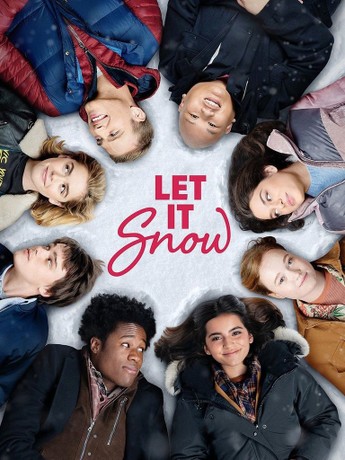
The promotional image for Let It Snow features the title hovering in the center of the image over a snowy background. Surrounding it, eight young people of diverse identities and orientations are lying down, some of them looking at each other and some of them looking directly at the camera / at us.

The film has some things going for it: several of its young stars show up with real skill to deliver on screen (in particular, Kiernan Shipka’s an old pro at her young age, between years on Mad Men and starring in the Sabrina the Teenage Witch reboot), and the movie’s soundtrack is absolutely loaded with well-curated tracks that fit into yet another of my Yuletide interests, songs that are technically holiday music without being “holiday music”.  While I found the character of “Tinfoil Woman” a little TOO obviously the invention of a Hollywood screenplay—I don’t care how quirky your small town is, there’s no way it is constantly being circled by a community-minded conspiracy theory freak whose truck can navigate even the snowiest of streets for the sake of rescuing helpless teenagers—any film that can have Joan Cusack in it is better off for the inclusion, and I was glad she was here.  I was also glad that the film didn’t try to diagnose or “fix” Tinfoil Woman—she’s on her own journey, and that’s not what this movie is about.  Another pleasant surprise was the fact that JP, the jock Angie’s got a crush on (who, therefore, stands in the way of Tobin, Angie’s best friend, dating Angie), is not a jerk or a heel, but instead is an attractive, sweet, funny, self-assured guy who treats Tobin almost as well as he treats Angie.

The headwind all of those strengths are trying to walk into, though, is a motion picture that, at the level of screenplay, editing, and direction, is just trying to do too much too fast at too many levels of emotion.  Rom-coms usually have the problem that everything in the script could be fixed rapidly if they just said one obvious true thing to each other that the screenplay works hard to keep them from saying.  Let It Snow, alas, has way too many plotlines and every single one of them hinges on something the characters obviously should say and almost certainly would say in real life, but don’t until the third act for dramatic reasons.  And the need to race through things can force weird exchanges, where characters who JUST had a magical moment together need to suddenly forget all about it so there can be a new conflict, or where characters say really awful, almost unforgivable things to each other because we need to communicate “someone just tried to burn a bridge in this relationship” with great efficiency.  Again, all of this haste just pushes me into checking out of emotional engagement with the film, despite the fact that there’s a lot of potential for genuine emotion in these teenagers and their tensions with family/friends.  Like, I know by now I ought to have run through the various major named characters and their deals, but there’s such a surplus of major characters, all of whom have deals, that I’m not sure how to do it well.

The movie is also weighed down with quirks, from a restaurant called Waffle Town that’s missing its W, leading multiple people to refer to it as “affle town,” to a character whose attempt to shave his chest leaves him with a comically bleeding nipple that’s a talking point for the entire running time of the film, to, uh, did I mention this small town has a resident they all call “Tinfoil Woman” who just drives circles around town in the snow looking to be a good Samaritan and who is also somehow a rambling lunatic?  We get an ecumenical, interfaith holiday pageant (between this and Single All the Way, what is with modern movies and the aversion to just staging a straightforward Christmas nativity play?  Hey Hollywood, everybody knows it’s Jesus’s birthday, I promise, it’s not going to offend your viewers if a small town on Christmas Eve includes a handful of people briefly engaged in sincere religious observance) that a character refers to as “one of the best, most insane things I have ever seen”.  A waitress tries to win over the girl of her dreams by serving up something called a “Quaffle Waffle”.  The quirk is off the charts.

What it comes down to for this movie (and for, I’m sure, dozens of other movies in this particular streaming-friendly subgenre of “small town holiday rom-coms with a lot of quirk and some cute young talent”) is the question of what you’ve come to the movie in search of.  If you want cute people in cute places whose problems, however serious on paper, end up being almost adorable themselves given how easily/fully they’re resolved by the time the end credits roll, this movie has you covered.  If you were hoping for something that covered fewer relationships with more depth, or that had found a way to make this premise into something deeper than a “be the real you, and people will love you for it” afterschool special, Let It Snow is going to let you down to some extent.  I had a very pleasant time when I was just admiring Kiernan Shipka’s elfin smile or appreciating the endless charisma of Shameik Moore as a stranded pop musician.  I had a more confounding time trying to keep up with what the movie wanted me to feel (and asking myself if I felt it), or trying to understand why a character was doing any of the things they were doing (other than “because the script said so”).  Not every movie needs to be an Oscar winner to be worthwhile, at this or any other time of year, so I certainly understand the value of a work like Let It Snow.  I just also can’t pretend that it soars to heights it didn’t take me to.  Three cheers for the diversity of the casting/storytelling here, though, and I hope that the talents who put this film together aim someday at getting something more substantial made, since I think we had a lot of the ingredients we needed for a modern classic.

I Know That Face: Isabela Merced, who’s here in one of the many leading roles as Julia, a bright girl with an edge and a chance to go to college but there’s this family thing, see, etc., appeared as a fictionalized version of herself in the 2015 television movie, the Nickelodeon Ho Ho Holiday Special.  Kiernan Shipka, who in this film plays the totally chill girl Angie (or “the Duke”) who would be in danger of Manic Pixie Dream status if she had more screen time, appears as Gryla in the 2024 Santa Claus heist movie, Red One.  And of course Joan Cusack, whose performance as “Tinfoil Woman” basically rescues a character the screenplay had set up for failure, is a well seasoned vet on the silver screen: she voices Mrs. Krum in the charming animated Santa movie, Klaus, and earlier in her career she’s the voice of the Lead Elf in Arthur Christmas.  She plays Agnes in The Christmas Train, a TV movie about…oh, come on, it’s all there in the title.  She’s the villainous Miss Rachel Bitterman in 2002’s It’s a Very Merry Muppet Christmas Movie.  I’m probably missing other qualifying credits, too: she’s Joan Cusack, she’s in dozens of movies, almost always in supporting parts, and in my experience she is absolutely always great.  I’m glad she was here.

That Takes Me Back: This 2019 movie about teenagers didn’t make me nostalgic for anything in particular, but at the speed that teenage subcultures change, I assume that a more plugged-in young person would find a lot here that feels positively ancient.

I Understood That Reference: Jesus makes a brief appearance at the all-inclusive world pageant—again, briefer than you might expect on his own holiday but that’s not what this movie wanted to show—and the wise men keep making occasional appearances due to Tobin’s costuming decisions which, like much of the film, remain at least somewhat confusing to me.


Holiday Vibes (8.5/10): Though it’s a movie that’s more about young love than it is the particular hurdles of holiday living, we still get a ton of Yuletide hijinks, from the kooky pageant to Julie bringing Stuart home for her family’s Christmas Eve observance.  Add in a magical snowfall and it’s checking a lot of the necessary boxes here: you’ll feel that seasonal glow, I’m certain.

Actual Quality (7.5/10): To some extent, Let It Snow is a movie where the parts are greater than the whole.  If I think just about an individual character moment or line of dialogue, I can start to convince myself that this was a really solid rom-com.  It’s only by stepping back slightly and asking myself if I was really invested in the film and if it holds together as a coherent story that I realize I was a lot more checked out from it than I have been from the better films I’ve seen for FFTH blog posts.  I think this is a fair rating (from my own perspective), but I think the holiday fluffiness of this movie means that the mileage will vary a lot (and, as seen below, it depends a little on what you want out of a movie watching experience).

Party Mood-Setter? This is 1,000% what this movie is for.  Checking in and out of the movie while not necessarily caring that much who’s who or what’s allegedly happening means you can coast on the attractive and bubbly cast, the solid soundtrack, and the moments of genuine humor.  If you’re baking some cookies or just want to throw something on in the background of a gathering to entertain people who have sat down at the edge of it for a moment, this is absolutely going to do the trick.

Plucked Heart Strings? There are moments, especially the ones involving Julie and her mom, that have genuine emotion: they don’t pack as much of a punch due to the pacing (and just the challenge of being invested in storylines that are mostly pre-engineered for resolution) but I can imagine feeling a catch in your throat as you watch, even if I didn’t experience it.

Recommended Frequency: This is another split the difference movie for me: I am sure I could go my whole life without watching it again as a dramatic work, but I am also sure I will not go my whole life without seeing it again, because it’s too perfect at filling that “let’s put on a holiday movie while we address Christmas cards or trim the tree” niche that folks want.  If you’re someone who does a lot of that, this may be an every year movie for you: for me, my guess is it’ll pop up now and then, in years where I’m a little more invested in those at-home holiday vibes.

Let It Snow is another of these streamer-exclusive films: Netflix made it, and if you want to watch it, you’ve got to go to Netflix.  If you go looking for DVD copies, either at a store or at your library, you are only going to find copies of the 2013 Hallmark movie Let It Snow starring TV holiday perennial Candace Cameron Bure (seriously, the woman’s been in a minimum of 17 Christmas movies, none of which are currently in the queue here at FFTH, for the record).  Whichever snow-themed holiday rom-com you’re seeking out, have fun with it!

Single All the Way (2021)

Review Essay

I’m going to open with the caveat that this is a movie living on the outskirts of a massive holiday movie industry that is absolutely serving a big and happy audience, and that I am not a part of that audience.  I’m not trying to get in anybody’s way as they consume the delightful fluff of Lifetime/Hallmark/Netflix Christmas flicks (and yes, diehards, I know that there are real tonal and stylistic differences between these channels/streamers when it comes to holiday media), and honestly, I’ve seen so few of them that even calling them “fluff” is probably unfair since if there’s some non-fluff in there, I wouldn’t know it.  My guess is that the movie I’m talking about today will work a lot better for folks who receive the tropes of the TV/streamer holiday romantic comedy like a warm hug.  For me, this is something less successful, but I’ll try to be generous where I can be.  That said, good grief, does Single All the Way feel like an extended Christmas episode for a cheesy sitcom that doesn’t exist.

The fundamental setup of the movie is trite but not necessarily doomed at the outset: Peter is a guy born in New Hampshire who escaped to the high-fashion world of models and marketing in Los Angeles years ago.  He’s headed back home to his small town for Christmas, accompanied by long-time best friend and roommate Nick who just dumped his trash fire of a boyfriend.  Peter’s family are (delightfully and not at all expectedly to me, given other films of this kind) really accepting of his identity as a gay man, even if they seem pretty clueless about LGBTQ+ folks in general.  So this isn’t a trek back home to the closet, as in Happiest Season, which I did genuinely appreciate.  But instead, alas, it’s a trip home to a family desperate to get Peter hitched to somebody—initially to his mom’s spinning instructor, James, via blind date, but then the family rapidly shifts to urgent, manic match-making maneuvers in an attempt to get Peter and Nick to fall for each other, despite their never having had any apparent romantic chemistry or tension in years of living together.  It’s a surprisingly exhausting experience, and if you think you know where it will end, yeah, you sure do.  Regardless of whether the ending makes any sense for these characters.

A promotional poster for Single All the Way depicts two men in their late 20s or early 30s standing together in the middle, looking upwards and smiling.  The man on the left is a Black man with short hair and beard; the man on the left is a clean-shaven white man wearing large earmuffs. Above them are five inset portrait photographs, two of them photos of the two men and the other three images of smiling middle-aged white women. The tagline reads "Peter and Nick are just friends. Peter's family knows better."

The tone of all this is, as I mentioned up top, really sitcom.  Like, really, really sitcom.  Jack from Will & Grace could wander into almost any of these scenes and not be totally out of place.  I don’t know at what point my eyes permanently rolled out of my head at the dialogue—I think I made it through “don your gay apparel” without collapsing, and I gritted my teeth through someone quipping that HGTV was the “Homosexual Gay Network”, but when someone described themselves as a “FOMO-sexual”, I was done.  And I want to emphasize that I love a good sitcom, so this isn’t me sniffing that the movie isn’t dark or artsy enough for me.  But the tone is so often broad and silly that it becomes incredibly hard to be invested in the emotional wellbeing of these characters when suddenly the screenplay expects me to take them seriously as people with hopes and dreams and baggage.  The antics they get up to—blind date hijinks for Peter, lots of home improvement work by Nick helping Peter’s father (since Nick works for Taskrabbit and he is really inspired by how Taskrabbit allows him to connect with and help others, and being a Taskrabbit at Christmas is almost like being a TaskElf, hahaha, hey, have I mentioned yet that Nick works for Taskrabbit and he feels kind of directionless in New Hampshire unless he’s working like a Taskrabbit?)—are incredibly mild. I’ll give it to this movie that, unlike Happiest Season, the goofiness is often less unhinged, but that also just means that the scenes are often a lot less memorable.  I’ve already forgotten a lot of the story beats within this movie’s second act.

There are things to praise here, to be clear, beyond my enthusiasm for a holiday movie that gives us a diverse cast (not just several key gay characters, but also at least a little welcome racial diversity for a movie set in New Hampshire).  Insane as both the characters they’re playing are, Kathy Najimy and Jennifer Coolidge (Peter’s mother and aunt) were kind of born to play sisters and to some extent they each make the other seem more realistic as a human being by being adjacent.  Coolidge as Aunt Sandy, the deranged megalomaniacal director of Jesus H. Christ, the town’s non-sectarian Christmas pageant, can at her best make even the wildest, most flailingly awkward moments seem plausible…she is not always at her best in this film, even so, but nobody could have done more to keep at least one of the movie’s toes on the ground where the pageant subplot is concerned.  Kathy Najimy as Peter’s mom….well, I have been to too many farmer’s markets to doubt the existence of people who buy kitschy, folksy, and at least allegedly funny wall decor, and Kathy is 100% landing the plane as a woman who would purchase a framed cross-stitch that says “Sleigh Queen”.  If you chuckled at that, friend, this is a movie you should check out.  The plan briefly entertained by Peter to pretend that he and Nick are dating (as a smokescreen to save himself from the blind date his mother’s going to send him on) dies a quick and fairly painless death more or less on arrival, which was a relief in the moment, at least.  And the best performance in the movie, bar none, is Luke Macfarlane as James, the spinning instructor for Peter’s mother, “Christmas Carol” (yes, that’s the name every character in this movie calls her, friends: how are you feeling about it, right now?), and also of course Peter’s blind date.  The character of James comes across as nuanced, thoughtful, patient: he undermines every likely stereotype, and he seems like a genuinely good dude with whom Peter might have built some really good chemistry, maybe even was initially building that chemistry.  I think this works against the film, to some extent, since it makes the ways Peter treats/mistreats James on his way to his destined-by-the-screenplay relationship with Nick even harder to enjoy when James is not only sympathetic but someone who feels more real, more human than our main character.

The overall arc of the film, really, was just too hard for me to enjoy: we’re asked to join all of Peter’s family in rooting for them to destroy his budding romance with James (based on a blind date his own mother started) and figure out how to basically force Peter and Nick to realize that they’re “perfect for each other”, by which I mean Peter’s dad who loves Nick’s handyman skills and a couple of teenage nieces who think it would be, like, sooooo cute if Peter and Nick dated and…well, you get the drift.  This isn’t a movie that’s figured out how to get these best friends to fall in love with each other by any means other than having a bunch of family members bashing them together like two Ken dolls they’re playing with.  I get that it’s supposed to be silly and sweet, but I don’t know: I was not in the mood for this movie’s brand of romance, and the whole thing ended up feeling almost offensive, as though the gay main characters were paper dolls being puppeted around by straight people who are, yes, “accepting” of their identity, but also not really treating them like people with their own desires and needs in relationships.  But honestly, using a word like “offensive” about Single All the Way would be inappropriate: this isn’t a movie that’s working hard enough in any direction to really mean the things it’s saying.  Like, this is a movie that wants us to nod along with a character claiming that if the town’s Christmas pageant is peppy enough, maybe it can “go on tour” after Christmas Day.  It wants us to accept that the highest powered marketing executives in the country would insist on an emergency photo shoot occurring on Christmas Eve at a moment’s notice….but they’re fine if the images produced are just iPhone snapshots in the woods, featuring whatever random local hunks are willing to pose in a hat and coat.  It’s never, ever mean-spirited, and as the queer main cast members are seemingly comfortable with what they’re appearing in, I wouldn’t tell you not to watch it.  I just think that, ultimately, this is not a script or a film that respects its characters in the ways I was looking for—the final scenes of revelation and admiration between Peter and Nick imply a greater psychological depth than has been developed for either of them.  The movie thinks it’s a story about self-discovery, but I experienced it much more as a story of social engineering, in which a family’s acceptance can also become a fenced yard in which your identity becomes a convenient way to pigeonhole you.  As always, though (and especially for films in this particular subgenre), your mileage may vary.

I Know That Face: Luke Macfarlane (as aforementioned, here he’s James, Peter’s incredibly attractive blind date) is an absolute veteran of TV Christmas movies, having appeared in at least NINE of them, including as Edward Ferris in 2019’s Sense, Sensibility and Snowmen, and as Chris, Santa Claus’s alleged son, in 2023’s Catch Me If You Claus.  I’ll give it to this subgenre: the movie titles are hilariously corny.  Barry Bostwick (here playing Peter’s genial father) is no stranger to the holiday circuit, himself, appearing in at least five such films, including 2017’s Christmas in Mississippi and 2019’s Christmas in Louisiana—the mind boggles at the potential for 48 sequels (more, even, if we throw in D.C., Puerto Rico, and Guam).  Add in Kathy Najimy (again, Peter’s well-meaning and overbearing mother), a member of the cast of at least four different holiday movies, including her appearance as Kim in 2013’s A Madea Christmas, and this little cast covers a remarkable breadth of the sizable collection of 21st Century TV movies that depict this special time of year.

That Takes Me Back: As a 2021 release, this movie’s too recent for any real nostalgia, of course, but someday the relentless Taskrabbit and Instagram references will be dated as hell.

I Understood That Reference: Kris Kringle shows up in the end credits song, and of course, thanks to Aunt Sandy’s lunatic obsession with a Christmas pageant that I will remind you again is titled Jesus H. Christ, we get a weirdly elaborate nativity scene on screen, since the movie can think of no more natural way to tie Peter and Nick together than forcing them to help out with the pageant before Aunt Sandy’s ego crushes every single participating child.  


Holiday Vibes (9.5/10): I have to hand it to this movie, it captures the feeling of a particular holiday energy, embodied by the kind of person who sees a framed poster in a country store that says “Nice Until Proven Naughty” and thinks, “That would be perfect for my entryway.”  And basically everything about the film once we reach New Hampshire is pretty Christmassy—snow and merriment and pageants and a countdown hanging on the wall that reminds passers-by to be good for St. Nick.  It’s generating plenty of holiday vibes, that’s for sure.

Actual Quality (6/10): As for the quality, on the other hand, this movie suffers.  Now, is it truly awful?  I can’t say that.  There are some fun performances and the movie’s pretty relaxing as a watch, as long as you don’t think too hard (as I clearly did) about the ethics of how this family is treating their visiting adult son/brother/uncle.  But is it good?  I struggle to even call it “fine”, given what I’m looking for in a movie: there’s just not enough ‘there’ there.  It’s a film that leans on the worst tropes in romantic comedy, for me, and (with my apologies) I just don’t think most of the cast is talented enough to really hold my attention: better actors might have saved some of this writing, but the two main characters here in particular are pretty bland, for me.

Party Mood-Setter?  Oh, 100%, especially if you’re at a party where those gathered will enjoy a little bit of eye candy from the hot men posing for the camera at multiple points throughout.  Sure, I think it’s empty calories, but that means that a party or a cookie baking afternoon is a potentially great venue for a movie that, if nothing else, fully lands the plane of “cute gay guys having a lovely white Christmas in small town New England”.

Plucked Heart Strings?  You’d have to find both Peter and Nick much more effectively realized as characters than I do to feel that lump in your throat as they finally confess their love for each other.  I guess I can imagine that reaction, even though I didn’t have it, but I don’t want to make you any promises!

Recommended Frequency: For a movie I didn’t like, honestly, this is maybe where I’d be gentlest: I can even imagine watching this one again, since I’ll acknowledge that I may just have been in too grouchy or critical a mood the first time around.  Most romantic comedies have premises that are at least a little unsettling or weird in the ethics department if you break them down far enough.  That said, I don’t know that I would ever seek it out again: there’s a lot of films out there, and this one missed me on too many levels for me to think it has much of a chance of warming my heart.  But if it sounds interesting to you, I think it’s well worth a try: you’ll decide early on if it’s really your style.

If you’d like to do just that, Single All the Way is one of those Netflix-produced movies that is really only available on the Netflix platform.  I see a couple DVD copies available from sketchy looking websites, which I assume are pirated, but other than that I can’t really give you options for renting it, buying it on disc, or securing it from your local library.  Apologies!  I try to stick mostly with films that we have a wider array of options to access, and I’ll try to get back to that array of options later this week.

It Happened on 5th Avenue (1947)

Review Essay

There’s a way in which It Happened on 5th Avenue is just about the perfect distillation of so many elements in the holiday genre I’ve been thinking about all month long (as have you, if you’ve been along for the ride here, and thank you for your readership if so).  This is a midcentury movie set in bustling New York City (like Remember the Night or Beyond Tomorrow) featuring a romance with a semi-painful age gap (like Bell, Book and Candle or, let’s face it folks, White Christmas if we think too long about Bing and Rosemary).  The acting is generally hammy (see half the films I’ve covered) and the actual amount of Christmas content is surprisingly small for a movie that shows up this often on lists of forgotten holiday “classics” (again, see half the films I’ve covered).  What’s distinctive, here, then — distinctive enough that I would want to write about it?  Well, to me, this may be one of the movies that has the most capacity for moral conscience…but it loses its nerve a little bit, and I think that’s interesting.  In that way, I think It Happened sidles up next to works like Tokyo Godfathers or any good adaptation of A Christmas Carol, and I am interested in the ways it can’t quite pull off those moves.

I’ll start by laying out the movie’s essential premise: everything revolves around the fact that Michael O’Connor, “the second richest man in the world”, every year leaves his opulent New York mansion behind for an estate in the Shenandoah mountains of Virginia for a solid four months and everyone in the world knows it.  This means that an enterprising yet sweet-tempered old street bum named McKeever can slip in with his adorable dog via the coal chute and live like a king for four months, as long as he’s not caught by the nightly patrolmen.  It means that when McKeever meets a down-on-his-luck veteran, Jim Bullock, he can afford the compassion of taking him in and lending him one of the house’s umpteen bedrooms.  It means that when O’Connor’s scallywag daughter Trudy runs away from her finishing school, she can expect to slip into an empty mansion to get her things…and that, when caught by McKeever and Jim, she can pretend to be an innocent farm girl all alone in a big city and in need of lodging (in part to see if she can win Jim’s affections).  It means that when Jim meets some old friends from his Army days…well, maybe you get the picture.  We can pack a LOT of humans into this mansion, and since Michael isn’t coming home, we’re gonna.  Except that Michael does come home.

The poster for the movie "It Happened on 5th Avenue" offers two vignettes with taglines: on the left, Jim hugs Trudy while she kisses his cheek beneath the tag "A guy with 50 bucks meets a gal with 50 million!" And on the right, McKeever stands proudly in a top hat and long underwear next to a scowling "Mike" holding a dog, under the tag "The world's second richest man changes places with a hobo!"

When I say that this movie has the capacity for moral conscience, I mean it — I think the underlying ideas here are honestly a lot deeper than the Jim and Trudy rom-com the film leans into becoming.  This movie was nominated for an Oscar for its story, an award they only handed out for a few years in the 1940s — actually, it loses out to another holiday film in Miracle on 34th Street — which I honestly think it halfway deserves.  The politics of the story it’s telling are pretty stark — Jim’s a veteran but he’s being made homeless by the wealthy O’Connor.  It’s nothing personal — O’Connor is just tearing down old, cheap housing to build some incredible skyscraper that won’t have any room in it for the likes of Jim.  The movie’s pretty clear about the dire straits here, too — Jim’s terrible apartment, which he attempts to defend from the Bekins movers and the cops, is a testament to how little he has.  He winds up sleeping on a park bench.  Later on, but still early in the story, Jim runs into two old Army buddies — their wives and children are traveling with them as they sleep in their station wagon on the streets of New York City.  The only apartment they can find refuses to rent to anyone with children, which is an astonishing policy to have here, two years into the baby boom, but I bet it wasn’t unheard of in the 1940s, which is not exactly a decade known for its progressive civil rights.  All of these people are scrambling to find a home for themselves while billionaire Michael O’Connor leaves a huge piece of New York real estate, full of enough bedrooms to house a hundred people, totally empty through the bitter cold of a New York winter.  In the hands of a Satoshi Kon or a Todd Haynes, I think this could have become a really searing look at the values of a society that creates such profound inequalities and treats them as normal.

The way the film loses its nerve, unfortunately, is by bringing Michael O’Connor into the romantic comedy as a potential foil — his return home (in disguise) allows us to watch him sputter as a young woman hangs her baby’s laundry in the parlor to dry or as McKeever doles out food from O’Connor’s pantry with lavish generosity.  Michael, as “Mike”, is treated pretty discourteously by most of the main cast, generally because they can’t understand why this old drifter is so sour-faced and grim about the prospect of free lodging and therefore treat him as someone who needs a bit of riling up.  I can’t deny that there’s a laugh or two to be had in all this, but it totally defangs the situation — O’Connor won’t ever be confronted about the injustice of leaving these people on the street because he’s too busy getting embroiled in more than one kind of romantic subplot.  The movie ultimately, I think, believes it can tell a Scrooge story here with O’Connor, and to the extent it does, I do like it — there’s a sense in which his heart grows three sizes in close proximity to Christmas, and ultimately he decides to look with kindness on the folks we’ve met.  I just rankle a little at the fact that O’Connor’s open heart seems limited to things like letting his daughter run her own life or being gracious to McKeever — New York City is full of McKeevers, not to mention full of young women down on their luck in the real ways that rich, spoiled Trudy O’Connor was only pretending to be.  A more fully rehabilitated Michael O’Connor could have taken responsibility on a larger scale for them — Scrooge was a wealthy moneylender, but he wasn’t richer than God, as O’Connor is presented as being here.  If you’ve decided to write a script featuring Elon Musk or Mark Zuckerberg as a character who’s about to reform, I think you’re obligated to talk about what someone that incredibly, astoundingly moneyed could really do for the sake of humanity.

I should move away from criticizing the film for what it doesn’t do, though, and address what it does.  There are some fun and sweet moments in the movie, but I have to say, I spend a little too much time rolling my eyes: a lot of the actors are a little overmatched by what’s being asked of them, and the result is that they recite the script more than they act it.  When a character actor as experienced as Victor Moore (McKeever) is reduced to saying things like, “Well, I feel I must admit the truth to you although I had hoped to avoid it,” I become conscious, at least, of how a movie with more confidence in its cast would have simply had him admit the truth in a way that conveyed reluctance.  You know, by acting?  With apologies to Moore and the rest of the cast, I find their fumbling takes me out of the experience a little.  And while I’ve critiqued plenty of midcentury films for their gender politics, it does feel particularly rough here, with a lot of weird off-hand remarks from Jim especially that grate more than a little — I’m not sure if it felt clever in 1947 to make jokes about domestic abuse to the teenage girl you’ve just met, but it does not feel clever to me now.  His relationship to Trudy, too, feels odd — in real life, Don DeFore is only about 33-34 here, and Gale Storm is about 24-25.  But Don looks and acts like he’s easily 40, an impression reinforced by some of the writing for his lines, and Gale’s being made up and costumed to look a lot closer to 17 — the net effect is weird, and when the script keeps having Jim put his arm around Trudy while Trudy complains to other characters that “he barely knows I exist” and asking “how can I get him to notice me” the whole enterprise feels a lot creepier than I’d like it to.

I watch this movie, though — for lots of reasons.  For McKeever and his little dog.  For the admittedly funny reactions of “Mike” as he watches his swank New York society house descend into tenement-style chaos.  For the optimism and energy of immediately post-war New York, and the sense from basically everybody on screen that big things are possible and that America may figure out every problem the world has without too much trouble.  Even the corny writing and slightly hammy acting feels safe and inviting (when it’s not weird about gender issues), like I’m sitting with my grandparents watching some old TV program they like.  The Christmas Eve celebration we get on screen really does feel like a found family, even if most of the characters in attendance are paper thin.  It Happened on 5th Avenue disappeared from the public eye for a long stretch of my childhood and early adulthood, so I didn’t know it at all until a few years ago, but I’m glad it’s resurfaced.  I just think the collection of ideas this script contained from the beginning is deserving of a stronger film and a better guiding principle to help this particular plane land.

I Know That Face:  Edward Brophy, who plays Patrolman Felton, had previously appeared as Morelli in The Thin Man, another one of those movies that’s got enough Christmas in it to make a list of holiday films but is also not really a holiday film by a lot of people’s standards.  Florence Auer, who’s briefly on screen as Miss Parker, the headmistress at the school Trudy runs away from, later appears as the unimaginatively named Third Lady in The Bishop’s Wife, a better late 1940s holiday movie than this one, in my opinion, though it’s probably no less weird.  And Charles Ruggles (who here plays the industrial titan, Michael O’Connor and whom we’re likeliest to know as the crusty yet twinkly-eyed grandfather in The Parent Trap) appears in a couple of holiday TV movies in the 1950s; he’s the Mayor in Once Upon a Christmas Time, and he’s Horace Bogardus in The Bells of St. Mary’s (the TV movie version, though, as I said), neither of which I can find anywhere to view, on stream or on disc.

That Takes Me Back: The idea that a music store would hire an enthusiastic and attractive young person to play the piano and sing in order to help sell sheet music is so fantastically old-fashioned, I can hardly believe it was a job even in 1947.  This movie also takes place in an era when outrageously rich people still had consciences, if you can imagine such a world.

I Understood That Reference: If there’s a reference here to another work of holiday media, it slipped by me.


Holiday Vibes (5/10): There’s a lot of busy energy in this movie as the various layers overlap, and it’s hard for me to gauge afterwards how much of the holidays we really got.  I think the movie’s reputation in this category is bolstered by having a couple of big moments take place at the mansion’s Christmas Eve and New Year’s Eve celebrations — there’s no question that the gaggle of people living there by that point in the story adds to the sense of festivity, too.  And I never know how much to lean on the “vibes” part of this section, but as I noted initially, this movie feels a lot like a lot of other movies in the loosely understood holiday genre: it will make you think of them often, and that boosts this score a point or two, I think.

Actual Quality (6/10): It Happened on 5th Avenue is an expensive bid for respectability from a low-budget film studio that wanted to rebrand itself, and I think it kind of shows.  Despite their dropping about ten times as much cash on this motion picture as they’d been accustomed to spending, I think there are limits to what everyone involved here could really pull off, artistically — the two romantic leads, DeFore and Storm, would go on to find their particular talents a lot better suited to the small screen than the silver screen, and everything else about the film is, to me, suggestive of a production team that was hoping to mimic the holiday classics of this decade rather than say something authentic of their own.  There are whole scenes I couldn’t tell you the point of, and the longer the movie runs, the less invested I become in many of its characters and their lives, which is the opposite of what ought to happen.  Maybe that’s too harsh: I do enjoy some key performances and themes in this film.  It’s no Ghosts of Girlfriends Past (or Jack Frost, for that matter).  Ultimately, though, I want to spend my 1940s holiday rom-com time with other films more than with this one…your mileage may, of course, vary!

Party Mood-Setter? The complicated plot here doesn’t really lend itself to inattentiveness, but I do think that if you’re in some cookie baking or wrapping marathon and you’ve already gone to a couple of ‘40s classics and just want to maintain that feeling in the background, it would accomplish that.  I’d steer you elsewhere, though.

Plucked Heart Strings? The only person who really gets my emotional investment here is McKeever, the best reason to watch this film.  Victor Moore, who plays the role of the aging hobo taking occupancy of the O’Connor estate, had been a comic star on the Broadway stage in the 1920s and 1930s (as well as getting at least a little screen time with some big stars in both the silent and talkie eras), and he imbues McKeever with a sweetness and an optimism that saves the movie for me from some of its less successful dialogue and plot contrivances.  I’m still not getting choked up about anything related to him in particular, but he’ll put a smile on your face, I can almost guarantee it.

Recommended Frequency: As you can by now tell from the roster here at Film for the Holidays, I’m a sucker for 1940s holiday movies, both classic and less-so.  If you’re in that same boat with me, yes, you should watch this at least once: good and bad, it evokes that historical moment and the beats of that particular kind of romantic comedy enough that it’s interesting to connect it to whichever others are your favorites.  Beyond that, I really can’t project how often you would return — I think I’ve watched it three times in six years, and at this point I’ve gotten about all the fun out of it I want to have.  I will come back to it someday for McKeever, but maybe not for many years, I suspect.

If you’re someone who wants to see the unimaginatively titled It Happened on 5th Avenue for yourself, Tubi and Plex are happy to give you ad-supported free access to the film, as is Sling TV, allegedly. Hulu and YouTube both identify it as available via some premium add-on subscription tier, and it’s rentable from all the places you might think to rent a streaming movie.  Barnes & Noble will gladly sell you the film on Blu-ray or DVD (as will Amazon, but this union household wouldn’t recommend crossing a picket line, and it’s looking like there are quite a few of those around Amazon facilities this December).  And Worldcat, of course, will remind you to check your public library for this movie on disc, since it’s available from several hundred library systems, according to their records.

White Christmas (1954)

Review Essay

Some of my favorite holiday movies make the list because of the depth of their ideas: they make me think the way I want to think at this time of year.  But others make the grade purely because of the power of their feelings: they just evoke an emotional response in me that feels like the holidays, regardless of what the underlying film intends to convey.  The latter category is, I think, the best way for me to broadly characterize White Christmas, a motion picture that surely most if not all of you are very familiar with: I love this movie, I watch it every Christmas, and if I think about it too much, I start to wonder why I have such a deep connection to it.  Let’s try to unpack both sides of that, shall we?

First, the basic premise, in case somehow this movie’s missed you in the past: the movie opens on Christmas Eve, 1944, with two soldiers (one an already-famous entertainer named Bob Wallace; the other an ambitious but green up-and-comer named Phil Davis) putting on a show in honor of their general and Christmas (seemingly in that order) before an artillery assault breaks out and Davis saves Wallace’s life.  Having done so, he extracts a series of promises from Wallace — to sing a duet together, to become partners, to start producing big musical revues — before they cross paths with the singing Haynes sisters, Betty and Judy, and find themselves (through a mishap or two) following the girls to Pine Tree, Vermont.  There, they discover their old general is a down-on-his-luck hotel owner in a snowless and therefore guestless December, and the boys spring into action to come to his aid (while Phil and Judy try to steer Betty and Bob into each other’s arms).  Along the way, there’s a lot of singing and dancing from some of the most talented folks in Hollywood at midcentury: there’s a reason this film endures.

The poster for "White Christmas" announces boldly that it is in VistaVision with color by Technicolor. The background scene is a snowy wooded landscape, where two white horses pull a sleigh: in the foreground, painted versions of the four principal cast members, dressed in red and white Santa outfits, gesture towards the viewer invitingly.

One of the things I noticed on this latest viewing is how the film repeatedly has these men make a promise with mostly good intentions but lacking in a little sincerity…and then that promise turns out to be really meaningful to them in unexpected ways.  Wallace promises Davis to sing a song with him out of guilt more than enthusiasm, and his whole life changes.  The two of them decide to keep faith with a weird dude they knew in the Army out of obligation, and that’s how they meet the Haynes sisters.  Davis’s promise to find Wallace a girl is motivated by a selfish desire for a little leisure time, but, well, other good things come of it for him.  I don’t think the film’s message is “do the right thing for the wrong reasons and you’ll succeed” but there’s definitely something going on there, under the surface.

Another element that’s definitely going on under the surface is social and cultural conservatism — this movie is fully locked into the moral landscape of mainstream America in the 1950s, and the “boy, girl, boy, girl” lineup of romance and matrimony fits a little too neatly.  The implication that marriage is the most central meaning in life is pretty clear.  The valorizing of the army is understandable for the era, but it’s over the top nevertheless: the movie’s absolutely not interested in a depiction of war or its aftermath that feels genuine (unlike say, The Holly and the Ivy, which I wrote about here just two days ago).  And not one but two musical numbers take swings at modern entertainment — “Choreography” memorably parodies modern dance (I think specifically the Martha Graham Dance Company) in making an argument that the old tap dancers and soft-shoers were obviously superior.  And, of course, the medley that ends with “Mandy” repeatedly reminds us that the performers REALLY miss those old-fashioned minstrel shows — weren’t those the good days?  For my part, I think MGDC is fine as a target — yes, there’s something a little sneering about that number, but it’s also pretty funny, and I am unaware of any weird bigotry associated with Martha Graham’s particular style of modern dance.  Minstrel shows, on the other hand, were a real blight on American entertainment — Bing Crosby, of course (who plays Wallace here), had appeared in blackface in a minstrel number in an earlier film, Holiday Inn, so he’s only thinking back about a decade as he yearns in song.  And of course the thing that’s ridiculous about both numbers here in White Christmas is that they are self-refuting — sure, the modern dance in “Choreography” is intentionally goofy in ways that make me laugh, but doesn’t that suggest that in fact the new modern dance style was capable of pretty evocative communication and therefore artistry?  And more importantly, doesn’t the fact that Clooney and Kaye and Crosby can joke around in song on stage, before Vera-Ellen comes out and dazzles us all with her skill as a dancer, prove that you can have all the old vaudeville fun you want on stage or screen without burdening it with awful racist caricatures?  We do not need “Georgie Primrose”, as the song here suggests, to have a good time: far from it, in fact.

I know, I know — none of this sounds like me being in love with this movie enough to watch it every Christmas.  Well, I haven’t really dealt yet with the four stars of this movie, and I have to say, each one of them is basically ideal casting, simply ideal.  Bing Crosby is just coming down from his apex of fame and talent here in the early 1950s: the film needs a proud but affable crooner and that fits Bing to a T.  His ability to work as a straight man had been pretty carefully honed, and for my money he is JUST young enough to still be playing a romantic lead in this film.  His comic foil, Danny Kaye, is a personal favorite of mine — Danny’s effortless and energetic presence on screen really never fails to make me laugh or hold my attention.  Everyone’s tastes are different of course — I complained back in my review of The Holiday about Jack Black dialing it up to 11 a little too often, and I’m sure there are folks who would feel the same about some of Kaye’s goofiness here, but for my money he can dial it up as high as he likes, I’m here for it.  As young Judy Haynes, Vera-Ellen is startlingly talented in every kind of dance she’s asked to perform — so good, in fact, that Kaye couldn’t keep up with her (if you’ve ever wondered why that one semi-anonymous dude is suddenly dancing with Judy in a couple of big numbers, it’s because he was a top-tier studio dancer covering the parts that Kaye, despite all his talent, just couldn’t do himself).  And I love the way she very subtly breaks the fourth wall — the next time you watch this film, pay attention to how many times Vera-Ellen makes direct eye contact with the camera, and flashes us a little conspiratorial smile as if to say, “God, I’m good.  Watch this next bit.”  Finally, Rosemary Clooney as Betty Haynes is, in my purely subjective opinion, just about perfect: she takes a role that, on the page, might be a bit stiff or stick-in-the-mud, and presents a woman who’s warm and guarded and winning.  Plus she’s got the voice of an angel and she’s a vision in Technicolor in basically every perfectly chosen Edith Head costume — maybe you can take your eyes off her, but I can’t.  And the end result of all four of them basically firing on every cylinder in every scene means that the film is always bursting with charisma, no matter how I feel about the writing or the pacing or the underlying message of any given moment.

And White Christmas is such a lush viewing experience too: I don’t know if any film’s color is more saturated than the reds and greens of this movie’s opening titles, and it’s paired with a really effusive orchestral overture.  The heightened theatricality of everything about the film somehow works to its advantage, for me: there’s no question that every outdoor setting looks like a sound stage, from the “war zone” in 1944 to the “boat dock” where Davis and Judy first dance to the “parking lot” outside the Pine Tree Inn.  But something about the artificial quality of those spaces just makes the whole thing feel slightly dreamlike to me in a way that’s really calming and satisfying.  Add in a few incredibly catchy Irving Berlin songs and some scintillating Robert Alton choreography and I just fall in love with the film every time.

Am I falling in love with a holiday movie, though?  For a film that opens and closes with two stirring renditions of “White Christmas”, the best selling single song of all time, I think there’s no question that this film is not all that connected to the holidays as far as its running time goes.  We get about 10 minutes at Christmas Eve in 1944 (more than half of it about General Waverly and not the holiday at all).  Then, while there’s some talk about the Christmas Eve looming at the film’s end, it’s not until the very last segment of the film that we get the holiday tableau you might remember, full of children in costume and Santa hats and the world’s largest Christmas tree.  But what a tableau it is.  Thematically…well, I’ve talked about this movie’s theme already, a little.  The more I think about what I think this film wants to say, the less comfortable I am with it — I don’t think it’s a harmful film, to be clear, but I think it just has a different sense of what’s important and in need of defense than what I believe in.  I have a hard time connecting most of the themes I do see to anything I would associate with Christmas in particular.  In the end, though, I can’t deny that the power of the movie’s full force being directed at the Christmas holiday really connects for those brief stretches where it’s doing that.  I come away fully washed in the VistaVision spectacle of the idealized midcentury holiday.  There’s a reason a ton of us watch this film every year and feel Christmassy about it.

I Know That Face: Mary Wickes, who plays Emma here (the hotel’s housekeeper and professional busybody), has a couple of other holiday turns under her belt: she plays Henrietta Sawyer in The Christmas Gift, a TV movie starring John Denver and Jane Kaczmarek (what an eclectic cast, eh?), and near the end of her career, she plays Aunt March in the 1994 edition of Little Women, another one of those movies that feels like Christmas far more than it is actually set at Christmas.  And Bing Crosby, here playing the seasoned entertainer and mogul Bob Wallace, is Father Chuck O’Malley in The Bells of St. Mary’s, a film that has a long enough sequence set at Christmas that it tends to make lists of holiday movies (and would certainly be eligible for this blog).  Bing, too, sang in that famous televised “Little Drummer Boy” duet with David Bowie that I alluded to when I reviewed Merry Christmas, Mr. Lawrence.

That Takes Me Back: Man, as a long-time happy Amtrak traveler (in the days when I could sleep sitting up overnight in coach: ah, youth), the vision of trains full of sleeper cars rolling through the night is nearly irresistible.  I loved, too, that in their conversation about whether to take the train or the plane, it’s clear that the train is luxury travel (since you can sleep), whereas on the airplane you’ll wind up sitting up all night.  No kidding, Bing.  It is fun to see the Haynes sisters have to fuss about their phonograph records (and phonograph) they travel with: technology has changed our relationship to music in so many ways.  And I know that I will never in my life get to say, as Bob Wallace does, “Young lady, get me the New York operator.”  And that’s okay, you know?  But I do kind of wish I’d gotten to do it.  

I Understood That Reference: The only Christmas story I heard them alluding to was a quick throwaway line when Ed Harrison tells Wallace he wants to show them off “playing Santa Claus to the old man,” right before Bob says to knock it off…though not in time to keep Emma from getting entirely the wrong idea about the situation.


Holiday Vibes (5.5/10): There is absolutely no way to score this film.  For those of us who watch this with religious attention every single year, it would seem ridiculous to set this any lower than a 9.5: when I hear the conductor calling out “Pine Tree” and the gang starts riffing on how they must be in California and not Vermont, it feels like Christmas to me and a few million other people, but that’s pretty silly, isn’t it?  And for those of you new to the film, I can easily imagine you, ⅔ of the way through, wondering if Christmas will matter to it at all other than that one opening scene you’ve already forgotten.  5.5 feels like the most honest middle ground I can offer to a movie that’s not about Christmas at all for all but about a half an hour, but those 30 minutes (distributed around the film a little) are incredibly evocative.

Actual Quality (9/10): Again, this is not a measure of how much I love it, but of how good the film is in my opinion.  And I would say that I think the screenplay’s pretty wobbly here, in terms of actually pacing things out, delivering the scenes characters need, etc.  But everything else — the aforementioned costumes and music and choreography and acting, and I didn’t even mention the really successful direction (from my perspective) by Michael Curtiz whose name you may recognize from little films like Yankee Doodle Dandy and something called Casablanca?  There’s a reason the film works despite having a plot that’s kind of barely there, and it’s because the creatives in every other capacity are bringing their A game.

Party Mood-Setter? You mean, is this a perfect background for your holiday festivities?  100%, as long as you don’t find the minstrel number too weird — again, my only quibbles here are with the writing, but if you want to be baking or decorating or hanging with family while occasionally tuning into a fun song or a sweet dance number or just marveling at a perfect outfit, this movie has your back.  

Plucked Heart Strings? I’ll be honest: I find Betty and Bob’s connection emotionally investing, but I definitely don’t get choked up here.  I get a smile out of seeing the positive resolutions later in the movie for multiple characters, but there are never tears in my eyes.

Recommended Frequency: I can’t tell you it has to be in your annual rotation, but it’s sure in mine and permanently.  And honestly, if you’re an appreciater of the genre of holiday movie (to the extent that there’s a good definition of such a genre), I just think this is going to be on your list already.  It’s too beautiful to look at, with too much talent to watch and listen to.  If somehow you’ve never seen it, I sure think watching it these holidays would be the right thing to do: I hope you enjoy it, if so.

To watch this holiday classic on streaming, Amazon Prime members have access via that subscription; it looks like if you’ve got some premium add-on subscription at places like Sling or Roku or AMC+, you might have access also.  You can rent it, also, from all the usual places.  Amazon will sell you the movie on disc — and with this year being the 60th “diamond” anniversary, let me tell you, there’s a sweet deal on a three disc combo pack that adds in some TV appearances by cast members, along with commentaries, etc.  Worldcat says every library on the planet has this movie on DVD (okay, they say it’s close to 1,500 libraries, but that’s huge when compared with literally every other movie I’ve checked there for this blog).

Christmas in the Clouds (2001)

Review Essay

I try not to make these reviews especially academic — I’d rather talk here just as a fan of holiday movies.  But I think I should probably acknowledge that, as someone who researches representation in media (children’s picture books, specifically) and who also is working on a long-running research project into the lives of indigenous people (students at a boarding school in the 1890s-1900s, specifically), I probably come to this particular movie just a little more likely to want to say something about what this work means, separate from how fun or engaging it is as a work of media on its own.  In all honesty, I’m sure my first encounter with this film, a couple of years ago, was motivated by my wanting to find authentic representation of Native American lives in a holiday movie, and it was one of the first titles I added to the list when I decided to attempt this blog project this year.  But enough about James’s context as a viewer: what, exactly, is Christmas in the Clouds?

The thing about this movie is, it’s hard to answer that question.  Like, this is a movie about Ray and Tina’s confused relationship, in which Tina thinks she’s falling for the man who’s been her unseen long-distance flirty pen pal for the last few months, while Ray thinks he’s falling for the undercover travel guide writer whose rating might determine the survival of the ski resort he’s managing on his reservation.  But it’s also a movie about Joe, Ray’s dad, who badly wants to replace his dilapidated old Chevrolet Apache with a brand new Jeep Cherokee, if he can manage to win the reservation’s big bingo contest the night before Christmas Eve.  And it’s also a movie about O’Malley, the drunk white curmudgeon who is the ACTUAL travel guide writer and wants to reconnect with his estranged daughter, and about Phil who’s chasing snow bunnies, and about a little kid who’s lost the mouse she decorated with colorful war paint, and, and, and.  It’s a LOT.

The poster for "Christmas in the Clouds" depicts a Christmas tree covered in large bauble ornaments, each of which displays one or two actors from one of the movie's many subplots. In the foreground, Graham Greene as Earl the chef has his feet up as he leans back to read a Native American romance novel.

At its best, the film is a celebration of native identity and diversity — the opening narration tells us bluntly that “this story’s about now-a-days Indians” and those are the threads in this movie I really love.  I love Ray’s pride in his work, which at one point spills into a pep talk to his employees about how their nation built the place, and the people who own and run it are native, and they deserve the best — which includes getting a better rating in the travel guide than some white corporate ski resort down the road.  I love all the glimpses of what life is like on the rez — the front desk manager’s immersion in ridiculously over the top romance novels starring a kind of indigenous Fabio, and the scenes of multi-generational families gathering at the bingo hall, and the ways in which children and families intersect with the business of running a resort because there’s a sense that the whole community is invested in this place.  I’m grateful that the film doesn’t present stereotypes to us like I’ve seen in other works about native people – we don’t get any stoic warriors or alluring princesses here, and the only person struggling with alcohol addiction is a flabby old white guy.  It feels like a fun space to be in.  I wish it was a little more precise about the native nation we’re working with — I have never felt it was specific enough, though I’ve seen other reviewers claim the characters are supposed to be Apache (I think they may be getting confused by Joe’s old truck).  Given the setting, though, and the fact that the credits thank the people of the Uintah and Ouray Reservation, I think the most plausible in-fiction answer is that these people are connected with one of the bands of the Ute nation — it was great to see from the credits, at least, how engaged the production was with native organizations, since again, it often felt successful to me on that front.

Where it struggles…well, let’s start with the inexperienced writer/director, Kate Montgomery.  Kate’s a white woman, and though she obviously approached this work with a desire to be supportive of native stories and performers (almost the entire cast, as far as I can tell, is Native American) she’s also an outsider.  More importantly, as far as I can tell, this is the one screenplay she ever wrote — at least the only one that was ever produced — and I think that just limits how well she’s actually going to evoke the world she’s trying to portray.  The actual plot feels borrowed from so many other movies — secret pen pals from The Shop Around the Corner, and a ski resort with no snow as the holidays approach from White Christmas, and a misidentified undercover VIP at the hotel from an admittedly very funny episode of Fawlty Towers, and an unlikely buddies in bed together scene from Planes, Trains, and Automobiles, etc.  There are flashes of funny insight here — writing a role for the incredibly talented Graham Greene to play Earl, the vegetarian native chef who’s a wizard with eggplant but absolutely does not want to cook buffalo or venison no matter how much they need to impress a travel guide, for instance, was an amusing idea.  But often the writing feels just a little forced.  I think there’s some inexperience in the cast, also, and there are times when there’s just not a lot of energy on screen — the people talking are generally nice people and you’re rooting for them, but some combo of the camera work and the editing and the writing and the performance is leaving it a little flat.

Another result of her inexperience, I’d argue, is just that some scenes needed one more take — I’m sure this was a movie put together on a shoestring budget, but virtually every line by M. Emmet Walsh, the white travel writer and by far the most experienced actor in the cast, is so hammy that either he was refusing to take her corrections or she didn’t realize how odd the contrast would be between his cartoonish expressions and gestures and the much more composed, natural performances of basically every other actor she’s got.  Maybe I shouldn’t blame Montgomery — I just feel a bit disappointed, sometimes, when I can feel the movie losing my engagement a little while I’m leaning in and ready to enjoy it.  And I don’t know who’s responsible for casting here, but I’ll admit, I was seriously bummed to find out that the leading lady here, the character of Kristina Littlehawk (a Mohawk woman, in the script), is being played by Mariana Tosca, a woman of Greek descent.  I mean, Mariana’s pretty and charismatic, but the whole point here is representation: come on, you know?  Irene Bedard is right there.  Or Kimberly Norris-Guerrero?  And heck, it could have been any number of other native actors whose names I wouldn’t know — this is a tiny indie film and there’s no way Mariana Tosca was a name they needed on the poster.  Again, I’m not criticizing her performance at all: I just wish that in a movie whose biggest raison d’etre is presenting native holiday movie stories with a native cast, the romantic lead was part of that experience.

But don’t let me talk you out of trying this movie, especially if you’re the kind of person who enjoys the Hallmark/Netflix/Lifetime holiday movie experiences — I think this film is working in that TV world of giving us some attractive people and a goofy but charming setup and a lovely setting.  Nobody watching The Christmas Prince 6 is there to see Oscar-nominated acting performances — you’re there to get the same joys folks get out of all sorts of other media we usually call “guilty pleasures” but I’d argue there’s no need for us to feel guilty (and hopefully we don’t).  There are more than a few scenes in this movie where we know exactly what’s going to happen — like, when an employee asks “are all the guests out of their rooms, because I need to turn off the hot water for a second”, we know that a guest is, unbeknownst to the staff, slipping back into their room for a shower, right?  And you’re either going to roll your eyes at it or you’re going to giggle with delight — in the same way that some people love the moment in every James Bond movie when someone asks him his name or what he wants to drink and we already know the answer, and some people don’t.

The rom-com premise here mostly holds together, I think — it could have gotten very weird when Tina learns late in the film that her flirty pen pal wasn’t Ray at all, but his father Joe (I promise, this is no spoiler, the audience has been in on this since the movie’s opening scenes), but it just doesn’t, and I think the characters have convinced me that that’s how it would actually happen.  Truthfully, in a film that’s tying up a few too many bows neatly for my taste, the ways in which the Tina and Ray misunderstandings unfold in the final act are in fact surprisingly successful: I criticized Montgomery’s writing enough earlier that I should be direct here in saying she definitely didn’t choose the easy or obvious moments in the end, and I was really pleased by it.  There’s a lot of tension in the middle portion of the movie, though, and at times it does feel mostly like narrative contrivance that’s keeping everyone from saying the words that would actually fix things.  My experience with the film is definitely a roller coaster, with plenty of ups and downs.

One more element that I think is important to mention is the music, because it’s great.  From the opening moments, we’re hearing music by native artists — it helps establish a sense of place really effectively.  Even later in the film, when we’re hearing instrumental adaptations of more familiar holiday music, the arrangements are noticeably unfamiliar — all of them composed and performed by a native musician.  And when the end credits roll and I hear Keith Secola singing NDN Karz (a song I discovered a couple of years ago when I was assisting a friend with a native music playlist for a history course he was teaching), well, I’m smiling pretty wide.  I love the ways this movie takes me somewhere new, while delivering something pretty standard in terms of the actual dot-to-dot details of its primary plot.

I Know That Face: Well, to dispose of him reasonably quickly, we will all recognize the face of the white alcoholic travel writer: M. Emmet Walsh, who’s playing Stewart O’Malley, has been in so many things I’ve seen, and as far as holiday media go, you might recognize him as Walt Scheel from Christmas with the Kranks.  The native cast members have seemingly had fewer holiday media opportunities — native performers get fewer opportunities in general, based on all I’ve read and seen about Hollywood’s interactions with them — but I was delighted to learn that Rita Coolidge (who plays Ramona, the front desk person, here) is the voice of Melissa Raccoon in The Christmas Raccoons. (If you did not grow up on The Raccoons on CBC like I did, well, you missed something.)  And speaking of Canadian television, we cannot fail to note that Graham Greene (the pained but proud vegetarian chef named Earl), among his many roles on screens large and small, appears in 27 episodes of The Red Green Show as Edgar K. B. Montrose, including “It’s a Wonderful Red Green Christmas”, and appears as Colin Reid in the TV movie, A Beachcombers Christmas.  I dimly remember the Beachcombers from my Canadian TV-watching youth, and I have a much more comprehensive knowledge of (and affection for) Red Green and his crew — if you don’t know it, well, I’m pulling for you.  We’re all in this together.  Keep your stick on the ice.

That Takes Me Back: I liked that at check-in for the hotel, the desk attendants were handling paper reservation cards, and handing over an actual physical key for the hotel room: sure, it’s handy to use my phone as a key these days, but it was fun to remember what a hotel was like when I was young.  I did think that pen pals who actually write each other letters in the mail in 2001 was pretty wild — this wasn’t that long ago, and it feels to me like even a few years later, it would have seemed totally implausible.  After all, this movie is already a couple of years after the AOL conversations in You’ve Got Mail.  And I had to smile at the use of the “funny papers” as simple Christmas wrapping for presents, in one scene, since these days most people would be far more likely to have wrapping paper around their house than they would have access to the comics section of a physical newspaper.  Times really do change.

I Understood That Reference: The movie has a lot going for it, but I didn’t notice any references to Christmas stories or characters: Christmas in general, as you’ll see immediately below, was downplayed a bit by this script.


Holiday Vibes (3.5/10): It only really begins to feel like Christmas in the final half hour, though it does really ramp up that energy abruptly then to include gifts and carols and gatherings that boosted this rating substantially.  Prior to that point, we get some good background hotel decor at times, but not much else.  The movie’s many plots are already busy enough without trying to add too much Christmas pressure to them, I think.

Actual Quality (7.5/10): It’s hard to separate the pleasant quality of a representative native cast and setting from the moderately hackish quality of a lot of the screenplay and direction.  This is a film made with great intentions and not quite enough skill to land the plane they’ve decided to fly in.  I feel like a 7.5 is about right in terms of me being honest with myself — much better than the worst stuff I’ve watched for this blog, but not as strong as the good rom-coms I’ve watched.  I’ve seen this film called “a Lifetime holiday movie but with a bigger production budget” and that doesn’t feel inaccurate — and as I noted earlier, I think that what it’s actually offering is going to be plenty appealing to an audience that’s looking for it.

Party Mood-Setter? Honestly I think this might be great for this kind of situation — the strengths of the setting and the music will still come across well if you’re slightly distracted while it’s on, and you can lean in or tune out as you like to the various plots as they appear and disappear.  The film’s a pretty solid PG, too, so I think for most families it would be fine in the background (just one scene where Ray and Tina are waking up together, and it’s still coming across as pretty demure even then).

Plucked Heart Strings? I mean, honestly, no.  The stakes are pretty low here — the resort isn’t about to close unless things work out, Tina and Ray are looking for love but not in dire straits, etc. — and therefore any happy endings we get are pleasant but not exactly material that makes you tearful with joy.  That’s no criticism, either — the film set out to be pleasant company and I think it does achieve that goal.

Recommended Frequency: I can’t really imagine making this an annual holiday tradition unless something about the reservation setting really grabs you, but I have gotten enough good things out of it the two times I’ve seen it that I would certainly watch it again some day.  For me I think it’ll be one I turn to now and again as a change-of-pace movie that reminds me there are a lot more stories to tell about the holidays.  But I hope that, in the long run, enough native artists get the chance to make something in this cultural space that I can spend my time watching newer (and better) movies than this at the holidays that still achieve the kind of representation that matters, to me.

You can pretty easily watch Christmas in the Clouds if you’re so inclined: it’s available on ad-supported streamers like Tubi and Pluto and The Roku Channel.  It’s also available on Amazon Prime, but only with ads for some reason, so being a subscriber won’t help you dodge those (if you follow that link, the movie description’s in Spanish for some reason, at least on my screen, but I checked and the audio track appears to be in English).  If you’d like it on DVD, Amazon will sell you one for less than $6, and Worldcat tells me over 400 libraries worldwide have one to lend you.  If you’re like millions of Americans and you go in for TV movie romantic comedies each December, I really think this one could be your thing, and I hope you give it a try if so!

Happiest Season (2020)

Review Essay

I’ve tried my best to avoid spoiling the final acts of movies here at Film for the Holidays, but it’s going to be tougher than usual in this review, since so much of what I think works best about this film happens in its final third.  I’m committed to not giving up all this movie’s secrets, though, so if you come away from it thinking, “I still don’t get why he likes this movie,” I hope you can trust that there’s some depths in its final minutes that I couldn’t talk about.  Happiest Season is uneven, like many of the romantic comedies I’ve watched for this year, but when it’s on its game, it has an incredible power.

I’m not even sure, honestly, if this is a “rom-com” — our central couple in Happiest Season are already comfortably paired up when the story opens as they visit a “candy cane lane”, with Christmas enthusiast Harper trying hard to hype up the holiday to a somewhat guarded Abby, though it’s clear from the beginning that Abby at least loves how much Harper loves it.  It only really becomes a comedy about relationships as the film progresses, and it becomes clear that all was not as happy here as it at first seemed — or maybe rather, all was happy once, but the act of going home for Christmas unravels to some extent a relationship that had once been closely knit.  Because, of course, Harper and Abby are a sweet young lesbian couple…and Harper, who wants Abby home with her for Christmas, is (unbeknownst to Abby, initially) still in the closet at home.  So, this isn’t a story about falling in love.  This is a story about whether your love is something you can be open about…and about the somewhat funny but more frustrating and sad experience of having to pretend to be someone you’re not in order to win the chance to be the person you’ve always been.  Is that confusing?  Well, Happiest Season is a little confusing, at times.

The poster for "Happiest Season" features the main cast members, posed in a photo inside a picture frame which is hanging slightly askew.  All of them are smiling except for Mackenzie Davis as Harper, who looks glassy-eyed and worried.  Underneath the title, the tagline appears: "This holiday, come out and meet the family."

I think part of the confusion, for me, is that the film is trying to sandwich together really painful (if sometimes painful and funny) realities about life as a closeted adult with the kind of over-the-top goofball comedy of the agonies of being around your partner’s weird family and childhood friends for the holidays.  The realities about the closet really work: it’s so clear from the beginning that Harper both thinks she can earn her parents’ acceptance and love if she closets herself just a little longer and understands that in fact that’s not really true at all and that the idea of being who she is at home terrifies her almost as much as it would terrify her parents if they ever figured it out.  Abby’s road is so hard to walk — as someone who clearly hasn’t hidden herself from anyone in years, the act of hiding becomes exhausting fast.  She has to start asking herself if Harper’s so good at hiding from her family that maybe she’s been hiding from Abby too….maybe, even, that she’s more hidden around Abby than around her family?  This is a bittersweet movie, then, but one that’s got my attention.  The problem is that it is grafted onto the broadest possible comedy: this family isn’t just performatively happy at Christmas (like many families are), the dad is running for office and it is in fact imperative that everyone self-consciously perform happiness this Christmas at an endless string of semi-public social engagements.  Harper’s sisters aren’t just weird and competitive: one is so weird it feels like she only is allowed to speak to other humans for a week at Christmas, and the other is so competitive that she can grab Harper in a WWE wrestling move and we don’t find it surprising.  It’s not just awkward being back around your partner’s childhood friends who know stories you don’t: Harper literally has not one ex in her orbit but two, one her secret lesbian soulmate from high school and the other the boy her parents always figured their straight daughter would marry someday, and she ends up hanging out with the latter at the world’s most garishly overbearing sportsbar that’s literally called “Fratty’s”.  The script is worried we won’t get it and therefore piles on the awkward until the situation can barely hold up underneath it.

The way I survive the movie’s long second act as a viewer, then, is by latching on to some really good acting work that’s showing up on screen. Kristen Stewart was much maligned back when everyone thought she was just the awkward vampire girl in the Twilight movies, but I think by now most folks know she’s a real talent: in Happiest Season, she owns the screen with incredible poise and calm, almost like a young Jodie Foster (speaking of folks who had to stay closeted publicly into their adult years).  Another incredibly successful performance is Abby’s best friend John, a flamboyantly gay man played by Dan Levy — on the page, he really shouldn’t work, since he switches back and forth so freely between acts of outrageous stupidity/goofiness and moments of incredible candor and insight, but I don’t know what to tell you.  Levy is really, really good at both sides of this, ultimately selling me on John as a gay man who masks the pain of his past with comedic patter that feels like something out of a Will & Grace episode, but who is ready at any moment to draw back the curtain and reveal enough of the truths he’s earned by living to help pull somebody else (in this case, Abby) out of the flames.  I wish the film established his depth a little earlier, but there’s no question he comes into his own as it progresses.  And the other brilliant light in the supporting cast is, as should come as no surprise, the effortlessly deadpan Aubrey Plaza playing Riley, Harper’s high school lesbian girlfriend who got not just dumped but outed by Harper in a desperate but selfish act of self-preservation.  Plaza is always wry and compelling, in my experience, as a performer — she knows how to be both cool and genuine in the same moment, which is hard to achieve — and as Riley she is given a part that somehow isn’t a corny caricature, unlike literally everyone else from Harper’s hometown.  Instead, she gets to play this nuanced, wounded but still walking young woman who’s never fully escaped the social ostracism she faced as a teenager but also has never fully achieved the kind of exit velocity she’d need to exit the gravity well of this Stepford town with its white elephant gift exchanges and ladies who lunch and a single, lively drag bar that seems like the only place to have any fun at all.  The movie could definitely use some more of Riley and John at the expense of Harper’s weird family, whose screentime seems to mostly consist of flailing attempts at humor that land only intermittently, for me.

As I said up front, there’s a lot I want to say about the final third of this movie, but I’m going to try to steer around most of it so you can experience this film on your own terms.  In the end, the tug of war I’m describing above, which kept pulling me into this film and then knocking me back out again, is finally and powerfully resolved by the movie pushing in all its chips on being honest and authentic and a little painful in facing what it’s like to come out (and what it’s like to bear the burden of being kept in the closet by the person you love).  Characters start to get a handle on themselves, a handle on how the things they’ve been saying or doing have affected other people without them knowing it, and a handle on the question of what it means to be a part of a family (whether that’s a couple in love or a collection of parents and kids sharing a holiday together).  Not everyone grows up in the ways or at the speeds you want them to, and not every resolution is satisfying, but I have to be honest — I cry at Happiest Season, every time I watch it, because it does achieve the agonizing truth of all of these things at once in a couple of powerfully written and delivered speeches by characters who are finally opening the doors to themselves.  The movie’s ultimate commitment to saying what it means rather than trying to fit into some imagined Hollywood formula is maybe a bit too late for this to be a great motion picture, but that doesn’t mean that the moment itself isn’t great.  Because it is, every time, for me.

As is often the case here at FFTH, I’m left pondering what a Christmas movie is about, and what it’s supposed to be about.  Here, I think the movie is about the second chances in life — those we give and those we get, even when we’re giving them to the undeserving or getting them while being undeserving ourselves.  It’s about the ways in which we apologize inadequately because we can’t understand the harm we’ve done, and how even an inadequate apology builds enough of a bridge for understanding to cross it.  It’s about love — and the difference between love as an exhibition for the audience you think is watching and love as the desperate and daring act of selfless devotion that it has to be if it’s going to do anything worthwhile in our hearts.  Those things resonate, for me, as Christmas messages — tied to the best Christmas stories I know, and to the underlying power of the feast I celebrate at Christmas — and therefore Happiest Season, in the end, sticks its landing, no matter how many minor deductions it received from the judges while it was spinning in mid-air.

I Know That Face: Aubrey Plaza, who here plays Riley Johnson, Harper’s first girlfriend, previously voiced the role of Grumpy Cat in Grumpy Cat’s Worst Christmas Ever — a movie that, I am informed by a relative, may be one of the most unsuccessful things ever committed to film, but surely we can’t blame Aubrey for that: the project is astoundingly ill-conceived at takeoff.  Mary Steenburgen, here playing Harper’s painfully superficial and tightly-wound mother, Tipper, is a veteran of television and movies: for the holidays, she’s been Maggie in Zoey’s Extraordinary Christmas (a Roku Channel movie, I am informed), she played Marilyn (one of the quartet of divorced parents being visited) in Four Christmases, and back in the 1980s, she was Ginny Grainger, a cynical mother learning the meaning of the holiday in Disney’s One Magic Christmas.  And Victor Garber, who here plays Harper’s ambitious politician father, Ted, has been in everything, of course: in terms of holiday fare, he voices Fluffy in Bob’s Broken Sleigh, he’s Taylor in Call Me Claus (a TV movie in which somehow Whoopi Goldberg has to become Santa Claus), he is the voice of the never-seen “Irate Neighbor” in the painful “comedy” Mixed Nuts, about which I have already probably written too much, and lastly he is Greg (Tom Hanks’s brother-in-law) in Sleepless in Seattle, a film whose inciting incident, of course, is a long appearance by a widowed father on a nationally syndicated radio call-in show on Christmas Eve.

That Takes Me Back: There’s not much here to be taken back to, it’s so recent.  My guess, though, is that a lot of the suburban sheen of Harper’s hometown is going to feel more and more painfully “early 2020s” over the years ahead.

I Understood That Reference: It’s a Wonderful Life is playing at the Guthrie Theater downtown — seemingly every year, which seems both plausible and like a nice tip of the cap from this film to a movie that was even more interested in second chances, etc.  And Santa Claus is making multiple appearances here, including references in conversation with the twins, a mention in the crowd participation song from the drag queens, and a plastic Santa being wielded as a blunt implement in a sister fistfight.  Oh, and Abby, very early in the story, accidentally bodyslams an inflatable Frosty the Snowman by falling off the roof onto him.  The film is a lot of things, but it’s never subtle.

Holiday Vibes (9.5/10): This movie really hits almost all the notes I could expect it to, from the glitter of a competitively decorated neighborhood to the agony of gift exchange, from the strain of trying to cooperate in the taking of the perfect family group photo to the cringe-inducing tedium of finding yourself at a holiday party with your partner where you know no one and are almost instantly abandoned.  The only reason I’m not stacking it up at a 10 is that Harper’s family are so over the top bizarre in some scenes that I think it takes me out of the moment a little and diminishes the reality I’m otherwise feeling.

Actual Quality (8/10): It is so hard to rate this film — the scenes involving Harper’s sisters (or, to a lesser extent, her parents) are excruciating enough often enough that I fidget while sitting through them.  But then I’m back in a scene showing me Kristen Stewart and Dan Levy or Aubrey Plaza, and everything is firing on all cylinders.  Enduring the movie’s roughest middle patches ends up being worthwhile, since the finish connects for me.  But what does that mean, in score terms?  I could argue this up a little and down a little, and I ended up trying to split the difference.

Party Mood-Setter? The tonal shifts would make this impossible, I think — at its goofiest it could be on in the background while you did something else, but you’d feel weird and sad trying to go on with mundane Christmas activities when characters start opening themselves up to each other tearfully as the film progresses.

Plucked Heart Strings? As I’ve already said, I can’t deny what this movie does to me.  It hits like a truck.

Recommended Frequency: I don’t think I would watch it every year, but I’m glad I’ve seen it, and I know I will watch it again.  I do think it’s strained a little by needing to break new ground here, though, and to some extent I’d rather hope for more inclusive Christmas movies that are a little better managed in terms of tone and intention.  I think this one opens the door for other kinds of storytelling that trust the audience just a touch more, but regardless of the films that follow it, there’s no question it achieves some moments that stick with you, and for that reason alone I would encourage you to make it a film you visit at least now and then at Christmas time.

Happiest Season is easily streamed if you’re a subscriber to Disney+ or Hulu. Sadly, though, that’s about the only way to view it, that I know of — it doesn’t appear to be rentable from any other service, and I can’t find a DVD of it in the English language that’s not an Australian regional disc that won’t play on most American setups.  Worldcat claims to know of disc copies in 90ish libraries, but I’m not sure those are any more playable in most systems in the United States.  If you don’t have Disney+ or Hulu, I think it’s worth a try geting a hold of one, though, if you can!

Ghosts of Girlfriends Past (2009)

Review Essay

I want to acknowledge up front that of all the films on the blog this year, Ghosts of Girlfriends Past is going to be the biggest stretch as a “holiday film” of any kind — other than a handful of snowy scenes establishing that it’s wintertime and a single shouted reference to Christmas, this movie really does nothing at all to position itself for the holidays.  But it’s undeniably a film that’s adapting A Christmas Carol, and for this segment, I knew that I wanted one of the Carol adaptations I reviewed to be something really radical in trying to reinvent the story.  The basic structure of Dickens’s novella is so classic and yet so easy to riff on that Wikipedia has an article dedicated just to its adaptations, and it’s enormous: everything from an experimental theatrical production called Fellow Passengers which stages the whole story with just three actors to The Passions of Carol which is apparently an adult film version of the story (um, “adult”, but you know what I mean) to the 1994 TV movie A Flintstones Christmas Carol in which Fred and Barney and Wilma and Betty present the whole story, though how on earth they make that work…well, maybe I’ll watch it someday.  Anyway, I wanted to try something interesting out for the blog that I hadn’t seen before — not The Passions of Carol interesting, but interesting all the same — so I picked Ghosts of Girlfriends Past.  All I knew about it was that it had a really talented cast (three Oscar winners plus Jennifer Garner, and it’s kind of astonishing she hasn’t picked up at least one nomination over the years) and the premise struck me as potentially viable — a cad is transformed by confrontations with the women he’s wronged — so I committed myself to watching it and writing it up.  I, uh, I have made some mistakes in this blogging project, folks, and boy howdy was this one of them.

So, I want to talk about why Ghosts of Girlfriends Past doesn’t really work in any way, but particularly through the lens of thinking about it as an adaptation of A Christmas Carol — like, I do think it’s also a bad romantic comedy and work of art in general, but primarily I think it’s clarifying for me as a lens for thinking about Dickens’s novella and the reasons it endures and continues to resonate with us.  At first, I struggled to understand why elements that I think work in the other versions of this story weren’t working here, but over time, I feel like I learned some things about where the magic in the original tale lies.

The poster for Ghosts of Girlfriends Past shows a smiling Matthew McConaughey facing left while a smirking Jennifer Garner facing right pulls on his scarf, as if to spin him around to follow her.  Framed photos of three attractive women hang on the wall behind them, each one ogling Matthew as if he is God's gift to women.  In front of them, the movie's tagline appears: "You can't always run from your past."

Before I do that, let’s just be up front about some things about this movie that are so gross, many of you would probably tap out of it immediately, since I nearly did.  The movie’s homophobia and transphobia are depressingly prevalent for a major Hollywood release in the 21st Century — it’s not just characters casually using slurs (though they do) but it’s also a script that thinks it’s super funny to allude, not once but twice, to the idea that you might accidentally have sex with a trans person who tricked you.  It’s not funny either time, but it’s also exhausting enough to me as a cishet person that I have to imagine it would be really grating for someone more personally touched by that kind of joke.  There’s also just so much rampant sexism, including more than a few really gross moments where a man’s abusing a position of power to degrade or objectify a woman — this is the kind of movie that would have been much harder to release after #MeToo, and in the wake of that movement this movie plays even rougher than it probably came across when it was first in theaters.  Furthermore, as I’ll explore later in the review, I think this sexism isn’t just gross as an attitude but it’s also really artistically backwards in a way that damages whatever mileage they were hoping to get out of adapting A Christmas Carol in the first place.

First of all, let’s tackle the movie’s biggest problem — Matthew McConaughey’s Scrooge analogue, Connor Meade, just isn’t Scroogeish in ways that will work for this story structure.  Scrooge is fundamentally miserable in a way that anyone can see: there’s nothing about his life that seems appealing or worthy of someone’s envy.  And I think that’s what makes it possible for us to empathize with his growth as a person in the story — he has absolutely committed acts of really vicious cruelty, but he’s done so much harm to himself in the process that the possibility of healing for everybody involved is a welcome relief.  Connor Meade, on the other hand, is this smiling sleazeball whose whole world (as we are immediately made aware) consists of being good at degrading and objectifying women for fun and profit, in that order.  As the movie presents it, every man wants to be him and every woman wants to do him — every woman but one, of course, the perfect woman and therefore his unattainable heart’s desire.  A movie structured around THAT arc, in which Meade has to give up all his fun and wild times in order to get the one thing the world won’t give him, is an almost perfect inverse of Scrooge’s horrified and awestruck realization that he has been clinging to wounds and woundedness, and that there will be a release of joy in his life by unburdening himself from wanting literally anything more than to see other people made happy.  Sure, the screenplay attempts to make the connection — at one point, while Meade is breaking up with three women simultaneously on one Skype call (I can’t believe it either, folks, and I saw it with my own two eyes), he is accused by them of having taken their love without returning it, “hoarding love like a miser”.  Yeah, it makes no sense in context either.  Also, this film absolutely does not present women in general as offering Connor Meade anything other than casual, gleeful sex, and as the screenplay makes repeatedly and tediously obvious, he’s been more than happy to return the favor, no hoarding whatsoever.

Nearly as huge a problem, though, is Michael Douglas’s Jacob Marley analogue, Uncle Wayne — in fact, Uncle Wayne’s an even bigger swing and miss by the screenplay, but as a secondary character he perhaps does a little less damage.  Here’s the problem with Uncle Wayne in a single phrase: he’s not repentant.  Like, not even a little.  He was a grade A slimeball whose toxic attitudes about women he instilled in an impressionable young Connor — now that he’s dead, you might think he’s come to terms with how disgusting he was being, but no, he just has some vague hand-waving to do about how Connor, he’s got this special connection to Jenny (poor, poor Jennifer Garner in yet another thankless role) and that’s real special now, you don’t want to keep having fun with thousands of hot younger women, you want to settle down.  The screenplay might as well have him say “I had my kicks, Connor, but you shouldn’t have yours”.  He keeps reappearing throughout the movie, too, but only because the movie seems to think we will find him a charming jerk, I guess — also because he looms large in the “Ghost of Girlfriends Past” sequence as Connor’s surrogate father after being orphaned.  Regardless, though, he’s so consistently awful: he makes a joke to Connor in middle school that alleges that Connor’s middle school girlfriend has an STD, and even at the end of the movie after Connor’s “redemption” there’s Uncle Wayne in the corner, hitting on a ghost who reminds him she’s underage.  Jacob Marley’s power in the original comes from his hauntedness — he is burdened by the gravity of his own harms, and he is panicked for the safety of his dear old friend who is blithely continuing to forge an ever-longer chain.  Scrooge is genuinely rattled by Marley up front, begging him to “speak comfort” to him — before even the first Spirit’s arrival, Scrooge has already come into contact with real fear.  Without that context, we are just cruising into Connor’s past as though it might be fun to revisit all these “conquests” — language I cringe to use but it’s definitely how this film treats sexual interactions between men and women, at least.

And then, though I think Emma Stone’s Ghost is probably the best performance in the movie, we hit a Past segment that just sucks.  It sucks to have Connor hero-worshipping sleazeball Uncle Wayne — didn’t the screenwriters recognize that what Scrooge found to admire in his own past was the warm and friendly Fezziwig whose generosity stood in stark contrast to Scrooge’s adult life, and not some cruel miser who had inspired Scrooge’s life of misdeeds?  It sucks to see Emma Stone’s good work undermined by such stupid writing — when she (Connor’s first intimate partner) takes him to the scene of their first and only time, she starts hyping herself up like she was Neal Armstrong landing on the Moon.  Watching a 20 year old actress playing a 15 year old girl dancing next to 40 year old Matthew McConaughey about how pumped she is that she got to be the first person to sleep with Connor Meade, King of Sex….  Wait, what was the point of this sequence?  Oh right, how sad and empty all this action makes him.  I guess.  Honestly, half of the movie’s problem, everywhere and at all times, is how little it ascribes agency to Connor and how much it treats women in the aggregate and in specific as a problem for him.  In a memorably awful scene, we see Connor confronted en masse by every woman he’s ever slept with — they descend on him like some rabid horde, desperate for him, and he emerges from the vision terrified.  But here’s the thing — what’s terrifying Connor is the women and their insatiable lusts.  Not his own greed and harm.  It would be like Scrooge having a vision of the money at the bank trying to drown him and then waking up, scared of the bad, bad gold for making him foreclose on all those mortgages.

The real world sequences into which Connor keeps being reinserted between Ghost segments — another notable departure from the Christmas Carol outline — are bad in another way, and again it has to do with the film’s relentless misogyny.  Connor’s at a wedding, the wedding of his brother in fact, and so we keep seeing various elements and characters of the wedding appear on screen — a lunatic bridezilla who, as presented, seems like someone who would be awful for Connor’s brother to marry.  Three horndog bridesmaids who seem to have made a bet with each other over who can first “land” Connor Meade if you know what I mean and honestly, dear reader, I hope you don’t.  I hope by this point you’ve dissociated and are in a happier mental place.  About the only non-awful people at the wedding are Connor’s brother Paul who still believes in him — the story’s Fred analogue — and then Jenny (the prize for becoming Good Connor) and Brad, a kind, empathetic, professional dude who’s hitting it off with Jenny and therefore is treated purely as an obstacle / plot device by the screenplay and not, you know, a real person who has his own journey to make.  I’d complain about Jenny not getting to be a real person either but by now I’m figuring we’re all clear on how all female characters are treated here — it’s just interesting, I guess, to notice that the only men who treat women as having agency are also being brushed aside.

I think the underlying challenge here is that the movie has no real thesis.  Dickens, goodness knows, had a thesis about the cruelty and inhumanity of early Victorian England — we can be as critical as we like of the ways Dickens’s treatment of social harm presents it too much as individual sinfulness and not enough as systemic and systematic harm imposed on a large scale, but the guy had identified an actual problem and wanted to awaken some kind of human response to address it.  What is the problem here, in this film?  At one point, Connor goes on a rant about how “these days” we’ve made being single a crime…dear reader, you are living in the 21st Century.  If you had to make a list of the problems we face “these days,” would that have made your top 100?  It would not have made mine.  Are we expected to believe that men like Uncle Wayne and Connor would have found happiness and joy in faithful monogamy had the women of America not been uniformly sexually predatory (except for Jenny and I guess whoever Uncle Wayne’s Jenny was)?  The film seems to kind of believe that Connor screwed up by not “going for it” with Jenny when they were about 11 years old and she had a crush on him, but what exactly is that argument?  The one time in his life Connor didn’t treat a woman like a scratch-off lottery ticket, it was somehow the wrong thing to do?  There’s a hint at times of a much more unsettlingly awful thesis — namely, that negging and other forms of cruel game playing “work” on women to an almost universal extent and that therefore this is, from a certain perspective, kind of their fault.  But the less said about that kind of garbage the better — that particular element really pinpoints this movie as having been made in the late 2000s, in the years immediately after Neil Strauss’s deplorable but then-ubiquitous pickup artist advice book, The Game, hit shelves.

Fundamentally, the structure of A Christmas Carol isn’t working in this movie because the Ghosts aren’t really there to do what the Ghosts do in Dickens’s novella.  The original version is designed to make Scrooge mindful of humanity — to connect him empathetically with human caring and human concern, and to give him a perspective on his own life as it might appear to others around him.  The Ghosts in this version seem primarily to be working to convince him that he would be happier with Jenny than he is chasing an endless parade of hot women around hotel rooms — I’m not saying that’s bad advice, to be clear, especially given that I much prefer my own domestic situation to Connor Meade’s life as presented in the film’s opening act.  But it’s so selfishly focused: the Ghosts’ advice is rarely about the harm Connor’s done to others or the good he might have done, and instead is on trying to persuade this scoundrel that he’s more miserable than he lets on, but he can fix it all with the right woman, who fortunately for him has had the undying hots for him since sixth grade.  I feel like in the end the only thing Connor’s learned is that he should have been willing to make the personal sacrifice of staying in bed and snuggling Jennifer Garner, a sacrifice I imagine millions of American men (heck, people of any gender) would find it pretty darn easy to make, themselves, without having paranormal visitation on the subject.

I haven’t gotten much into the movie’s later developments — honestly, I think it gets more depressing as it goes.  I could have gone all my life without hearing Connor Meade — post-two-ghosts, by the way, this guy should be on the verge of personal realization and redemption — saying the phrase “your little estrogen lynch mob.”  He then meets the Ghost of Girlfriends Yet to Come and starts hitting on her, at which point, folks, I just started laughing.  Not at the film, but just at the fact that I had decided to watch this thing.  I mean, come on.  Imagine if Scrooge meets the Ghost of Christmas Yet to Come and the first words out of his mouth were “oh great, you’re here, let’s go imprison a debtor together, shall we?”  The movie doesn’t even believe in its own half-assed redemption arc.  Why should we?  And yet, I guess I’ll say this — this stretch of the film, before the finale, is probably the best, most Christmas Carol-like it gets.  Yet to Come is mute, Connor faces his own death and is panicked, there’s something happening for him even if it’s not particularly inspiring.  And then there’s a car chase and an ex-Marine gets punched out and Connor Meade gets to deliver a preachy, heavy-handed message about the power of love and happiness and why am I still writing about this film.  Seriously, folks — if you can’t get that Scrooge ought to spend the final sequence of A Christmas Carol doing good for others (and not lecturing others while doing some good for himself/his boys), you should not have undertaken the work of writing an adaptation of A Christmas Carol in any medium, let alone an expensive Hollywood motion picture.  The End.

I Know That Face: Breckin Meyer, who plays Connor’s optimistic but increasingly frustrated brother Paul, appears in Go, a 1999 black comedy thriller that is not at all a holiday film but is also absolutely set at Christmas: in other words, it’s probably as much a holiday movie as Die Hard is, and therefore a movie I’ll cover here at some point, I assume.  In Go, Meyer plays “Tiny”, a supporting role as the buddy of Simon, the guy who was supposed to sell ecstasy to his co-worker before he left for Vegas, and oh boy I just cannot summarize this movie: it’s a trip.  Paul’s bridezilla fiancée Sandra is played by Lacey Chabert, who is Dana, one of many bodies to hit the floor in the horror flick Black Christmas (the 2006 version, for those who know there are more than one).  Chabert then gets into the world of Hallmark Channel acting so successfully that there’s no way I can name all of the many Christmas TV movies she appears in, but if you’re thinking “hey, wasn’t she in that one cheesy holiday movie,” you are absolutely correct.  Most recently and memorably, she plays the leading lady role in Hot Frosty, Netflix’s “let’s say a grieving widow found a snowman so attractive he became her real life lover” answer to the question “what if we made Jack Frost but way, way weirder?”.  At this point, I hope Ms. Chabert is at least having a chat with her agent about which scripts she gets shown, but maybe she’s having fun and if so more power to her.  And Daniel Sunjata, who plays the perfect potential boyfriend Brad (whom Jenny really should end up with instead of Connor), has one other holiday appearance, in a Disney TV movie entitled Christmas…Again?! as Mike Clybourne, the single father of a 12 year old who turns Christmas into Groundhog Day with an errant wish.

Spirit of Christmas Carol Present: There’s so little of A Christmas Carol here in any kind of genuine fashion, but I guess I’ll give it to them that ultimately our “Scrooge” figure is ushered by a mute spirit of Yet to Come to his own gravesite, only to wake up and sprint to his window and shout to a boy below “What day is it?  Is it Christmas Day?”  That’s not just the most Christmas Carol moment in the script, but it’s one of the few that I would argue seems to actually work.  

Spirit of Christmas Carol Absent: <insert full text of A Christmas Carol, by Charles Dickens>  I mean, there’s no point trying to make a list this time around.  There are Ghosts and a put-upon personal employee and a sad childhood memory but even in those cases this is missing so much of what makes the original special, and the list of things they’re not even attempting is vast.


Christmas Carol Vibes (2.5/10): Let’s put this as charitably as possible: I’ll admit that this is, fundamentally, a story about how an awful person is changed by an encounter with a bad and deceased former role model, followed by three spirits who represent the harm he has done, is doing, and is gonna do.  He seems happier in the end.  That’s about as far as I can take it.  Otherwise, this is just a version of the story that is out of touch with the novella’s moral universe — it does not understand what’s wrong with Scrooge, or what Marley hopes to awaken in him, or why the Ghosts and their visitations get through to Scrooge, or what it is that Scrooge has learned in the end.  It is more like A Christmas Carol than Die Hard is, or Home Alone, but not by much.

Actual Quality (2/10): I cannot believe there’s a movie bad enough to make me long for my experience watching some of my earlier panned movies, but I would gladly watch Jack Frost twice if it meant I never had to watch this movie once.  Everything about the screenplay (and direction) in this film works against what few strengths the performers brought to the film, so that even when they’re successful, it’s upsetting.  I’m slightly afraid that one of you will turn out to be a huge fan of this one, but I guess if you do, we’ll see what you have to tell me.  I really can’t imagine coming to like this film, though, regardless of what I hear about it!

Scrooge?  Oy.  I mean, McConaughey’s doing a serviceable job bringing Connor Meade to life — as noted above, though, what’s frustrating about this portrayal is that it has so little to do with Scrooge in A Christmas Carol that I don’t think I got anything new or helpful out of it.  The highest praise I can give this performance is that the character as written is pretty insufferably awful, and Matthew must have acted it well, since I really, really dislike Connor Meade even when he’s reformed at the movie’s end.  

Supporting Cast?  The cast as a whole is under-served by the material, which I’ll acknowledge up front: we can’t possibly hold all these actors accountable for the mess they’re inhabiting.  And yet I’d also say that at least most of them are not doing the script any favors, much of the time.  For praise, I’ll single out Emma Stone in certain scenes (in the Girlfriend Past role), and Jennifer Garner at least some of the time (acting as this film’s Belle, I guess, maybe mixed with Tiny Tim but what am I even saying anymore) persuades me that there’s a real character on her side of this broken relationship.  Otherwise, this cast mostly consists of performances I wish I could forget (and I bet they wish it also).

Recommended Frequency?  I have no idea why anyone would watch this even once.  I am absolutely never going to watch it again.  I would promise to do better research in the future, but I do expect that at least one side benefit of a blogging project like this one is occasionally getting to watch the blogger suffer for our own amusement.  If so, I hope you’ve enjoyed this with my compliments, and I’m sure I’ll walk into a fence post again for your entertainment sometime again, either this season or next year.

What are you doing here?  Go watch something else.  Okay, fine, if you’re saying “there’s no way this is as gross and unendurable as James is saying, I’ve got to see it”, Max will show it to you if you’re a subscriber. You can rent it from every streaming service that rents movies, as far as I can tell, and if you want it on DVD for a white elephant gift exchange with people you don’t like that much, Amazon will sell it to you for less than $5.00 because in this case, at least, the free market is accurately assessing the supply and demand curves for this film.  This thing is on disc in over 1,400 Worldcat libraries — a huge increase over basically every other film I’ve yet checked in Worldcat — because we live in an unjust universe.  If you check it out of the library, that circulation data may convince them to keep the DVD on their shelves, so I advise against it strongly.  And if you do love this movie, friend, I am sorry for being this hard on it, but it’s one of the worst things I’ve watched as an adult: I guess I would invite you to change my mind, but honestly we should both probably just save our time for other things.