Boxing Day (2021)

Review Essay

It might be easy to feel like all the good holiday film premises have already been made: as this blog will make clear, there’s no shortage of “Christmas movies” for consumption.  But I think one thing that’s easy for at least some of us to forget is how restricted the storytelling base has been for a long time: the pool of people getting the opportunity to screenwrite, direct, and star in movies has been limited in this country to a fairly white crowd (and not just white Americans, but white Americans from certain demographic categories of geography, class, etc.).  Boxing Day, then, is a great reminder of how a pretty ordinary premise — a dude is bringing his new loved one to meet his family at the holidays but uh oh there’s some unexpected secrets to be revealed! — can take on some new life and offer a meaningfully different experience when the directing, writing, and performances are coming from a cultural space that’s been underrepresented.  Here, Aml Ameen takes us right inside the world of Black British-Caribbean people in London, and the extended networks of family and friendship that tie them together, and the result is a pretty charming (though, again, fairly simple) piece of holiday entertainment.

Again, the writing isn’t really where the film’s breaking ground, at least on the level of the big plot elements.  This is the story of Melvin, a newly-successful Black author, who’s returning semi-triumphant to his hometown of London at Christmas to promote his new book, accompanied by his lovely African-American girlfriend (practically-but-not-technically fiancee) Lisa who’s never been there before.  It’s also the story of Georgia, Melvin’s childhood sweetheart but now ex, who (we learn early in the film) got left in the lurch when Melvin fled the family drama across the ocean — and Georgia (or “Gigi” as she’s mostly referred to) has spent the intervening years becoming a massive pop star while remaining incredibly close to Melvin’s family.  But in a larger sense it’s a whole family wrestling with change — can we move on from Mom and Dad getting divorced, can we accept new partners if they’re not British (or not Black?), can we accept that the next generation thinks and acts differently than we did, etc.  Melvin’s having changed in ways they didn’t expect (or welcome) is just the catalyst for a lot of bigger conversations that are had — some of them resolved and some not so much.  That’s all right, I think: family is often messy, and the film’s reasonably honest about that.
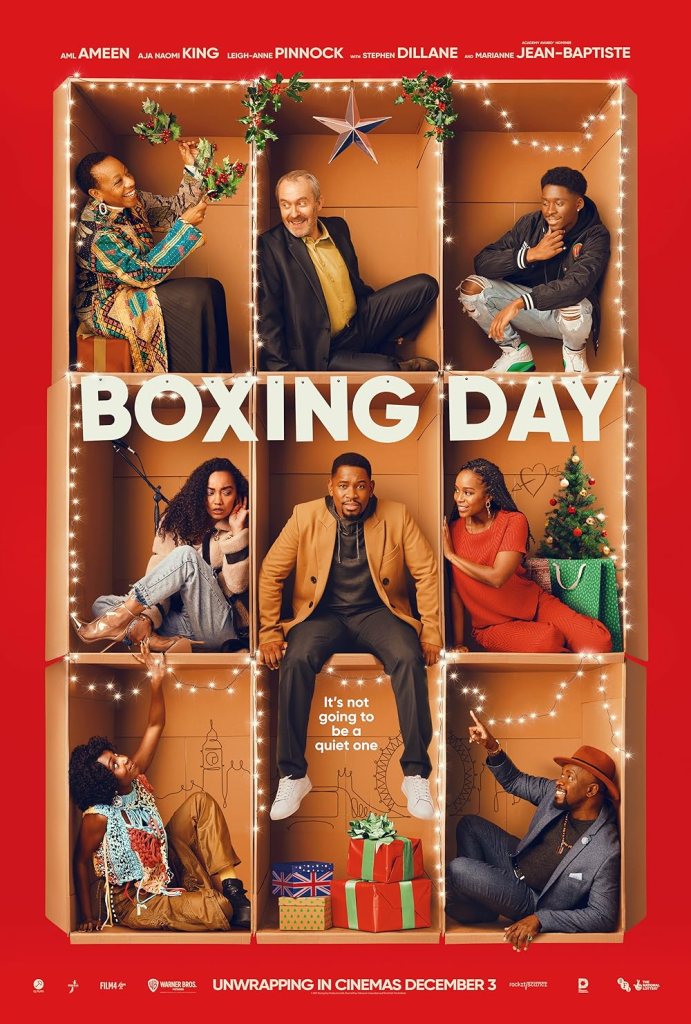
The poster for Boxing Day carries the tagline, "It's not going to be a quiet one". Visually, eight members of the primary cast are arranged in a 3x3 grid of open cardboard boxes, each one in their own box like the opening of the Brady Bunch. The 9th box, at bottom center, is filled with gifts, one of which bears the Union Jack flag emblem.

A lot of what’s fun about the film, for me, is just seeing into the context of a family very unlike mine, and lives unlike mine.  Whether it’s Gigi and Melvin’s sister (nicknamed, I swear, “Boobsy”) playfully arguing about how their different skin tones are perceived, or Melvin’s brother Josh in a fight with his cousin Joseph over who gets to flirt with the alluring Alison, or just Melvin’s “auntie” Valerie — who, to be honest, I have no clue whether she’s his actual aunt or his mom’s cousin or just some lady from the block — shouting about how he doesn’t need an American, she’ll find him a good Jamaican church girl?  You just feel immersed in someplace that I sure hope and expect is authentic, given that the writer/director’s coming from that world.  And honestly, it was a fun place to visit — a holiday gathering that felt alive and lively even when it was uncomfortable.

There’s no denying that at times the film creaks a little — production values can feel a little more like a TV movie at times, and not all the cast was quite experienced or steady enough to make their scenes pop.  The script, too, can be a bit rushed, so that sometimes key pieces of information slip by too fast, or I find myself watching a scene without 100% understanding who’s who here, and what they’re here to do.  The tone of it carries it through, though, and I liked that the script avoided the really hack moves you might otherwise have expected.  A big Hollywood film, for instance, might have had Lisa act out in dumb ways when she realizes her fiancee’s ex is essentially Ariana Grande — had her try to climb out a bathroom window and get stuck, maybe, or sabotage the ex in some way that backfires, etc.  Instead, Lisa just settles into the social space, giving as well as she gets when talk is lively, and slipping in slightly more barbed words via innocent-seeming asides when she can’t help but take a swipe (or riposte in response to one).  It’s what a real person might do, in other words, and when it blows up (as it inevitably would) it feels more honest.  In the end there’s some movie magic, of course, but I liked that for the most part the film wanted me to just believe in these characters rather than go for a cheap joke it could use in a trailer.

Characters grow up a little quickly here, but the movie needs them to, and in any case, I felt like the movie’s message in part was that nobody here was all that messed up in the first place, really.  Sometimes people are more ready to be responsible or tolerant than even their loved ones would guess; sometimes people are better able to move on, or to accept other people moving on, than they’d have even thought was true of themselves.  We know what kind of movie we’re in, of course, from the very beginning.  And what’s a holiday film for, after all, if not to persuade us that our natures do in fact have better angels, and that sometimes we listen to them?  In a December like the one many Americans are living through in 2024, a message like that might be more than a little necessary: I was glad to get it, myself.

I Know That Face: One delightful surprise here was that Lisa Davina Philip (who plays Auntie Valerie here) is the same actress who played the widow-seeking-widower postwoman Ms. Johnston in Jingle Jangle — she’s putting down absolutely scene-stealing performances in both movies, but the roles are so different that I literally didn’t realize the two actresses were the same person until IMDB told me so.  You can see my thoughts about Jingle Jangle on that blog post.  Claire Skinner (who plays Caroline, who is Gigi’s mother and Shirley’s good friend) played Madge Arwell, one of two title characters in the Doctor Who Christmas special, “The Doctor, The Widow and the Wardrobe.”  And lastly, Marianne Jean-Baptiste (who plays Shirley here) is Veronica in New Year’s Day, a movie in which two teenage boys complete a lot of dangerous dares on the titular day — and yeah, I guess that film is a stretch as a “holiday movie”, but New Year’s Day is undeniably a holiday in the wintertime so I think it should count.

That Takes Me Back: This movie’s too recent yet to really take me back to any particular nostalgic sight or sound….it sure won’t be long, though, before it’s reminding me of the good old days of 2021, huh?  It felt of its moment, anyway, and we’ll see how that feels, in time.

I Understood That Reference: Lisa has fun teasing Melvin a bit about his Britishness, which comes out in a couple of A Christmas Carol quips as she says “Damn, Scrooge!” and “Good luck, Tiny Tim!” to him on different occasions.  At one point, in the background, someone playing Santa nearly falls over at Shirley and Richard’s amateur Christmas theatrical, which as far as I can tell from the glimpses we get is a very strange nativity play, its own Christmas story of course.  And lastly, a guy standing in the street while music plays, showing one after another the set of cue cards that spell out a message of love….that just has to be a Love Actually reference, doesn’t it?  


Holiday Vibes (8/10): In terms of strict depiction of “American classic Christmas”, maybe this doesn’t hit every mark.  But in terms of bringing us into multiple lively and socially complex family spaces in the context of holiday traditions, this is firing on all cylinders — there’s no question that the movie does a lot to bring me the feeling of visiting family at this time of year.  It’s a different enough family experience from what most of my envisioned audience would encounter that I think it’s not quite to the apex of my imagined ideal, but it’s unquestionably a solidly holiday flick.

Actual Quality (8/10): So, with a lot of holiday films, there’s this balancing act between your emotional and your intellectual reaction to the film (this is true for me, anyway), and I think that’s certainly the case here.  My assessment of the film’s quality, then, is to say it’s good but not great: there’s an honesty to the writing on the level of dialogue, but the plot is a little goofily over the top at times, and the uneven range of acting experience and skill in a very classically indie movie cast means that some scenes are great and others have a harder time engaging my attention.  It’s not award-worthy work, but it’s definitely solid film-making.

Party Mood-Setter?  The film’s got great energy and some quotable moments, and if you and a bunch of your youngish adult friends are getting together to have cocktails and decorate sugar cookies or do a secret Santa exchange I can easily imagine this on the TV at a low volume for you to pay a low, casual level of attention to.  

Plucked Heart Strings?  Hmmm.  I can imagine a couple of moments later in the film being emotionally resonant, since the script is often handling something real about family, and if that’s intersecting with your particular experiences of family, I think the authenticity could get to you.  I didn’t feel those moments myself, though, and I’m hesitant to give it the nod on the basis of my guessing how others might react.

Recommended Frequency?  I mean, I’ve seen it only once, but this feels like it could be an every year movie for me.  It’s warm and sweet and silly in just the right kinds of ways: it makes me feel like I’m eavesdropping on a family I’ll never be a part of but would get a kick out of joining for a potluck.  As I said earlier, there’s a gap here — I can tell you intellectually what’s not totally working about the movie.  But I liked it a lot on that emotional level, and I think if you give it a try, it would probably win you over in that same way, and I hope you give it a chance.

Amazon Prime will show this to you, if you’re subscribed, and if not, Tubi will show it to you for free (with ads).  As far as I can tell, the film had such a limited (and UK focused) release that there’s either no DVD/Blu-ray copy available anymore, or it never really had a release on this side of the Atlantic.  As a result, this may be a rare film that won’t be accessible via your local library, but it couldn’t hurt to ask, in my opinion.
Bell, Book and Candle (1958)

Review Essay

The definition of a “Christmas film” is always negotiable — yes, Die Hard fans, I know you’re still out there, and no, I won’t be covering Bruce Willis and his machine gun, at least not in 2024 — and that’s certainly true here.  My general rule is that if Christmas is a key setting for more than a few minutes of the movie, it ought to count, and this film, which opens on a snowy scene with Jingle Bells playing in the background as people carry trees down a New York City sidewalk, really has to count.  But as I’ll discuss, it’s among the less seasonally oriented flicks I’ll cover here at Film for the Holidays.

The initial premise is more traditionally rom-com than anything else — stiff middle-aged publisher Shep (played by Jimmy Stewart) lives upstairs from “exotic” art dealer Gill (played by Kim Novak).  She thinks he’s attractive, he’s polite but has a fiancee, and she….well, she’s a witch, and one or two little spells couldn’t hurt, could they?  If it sounds like a Bewitched prequel, it basically is: that series was created after this film came out, by Columbia who released this movie in the first place.  And I’d love to tell you this movie charmed me as much as episodes of Bewitched did, once upon a time.  But it didn’t really land for me — and the reason I think the movie doesn’t work was honestly a real surprise to me.

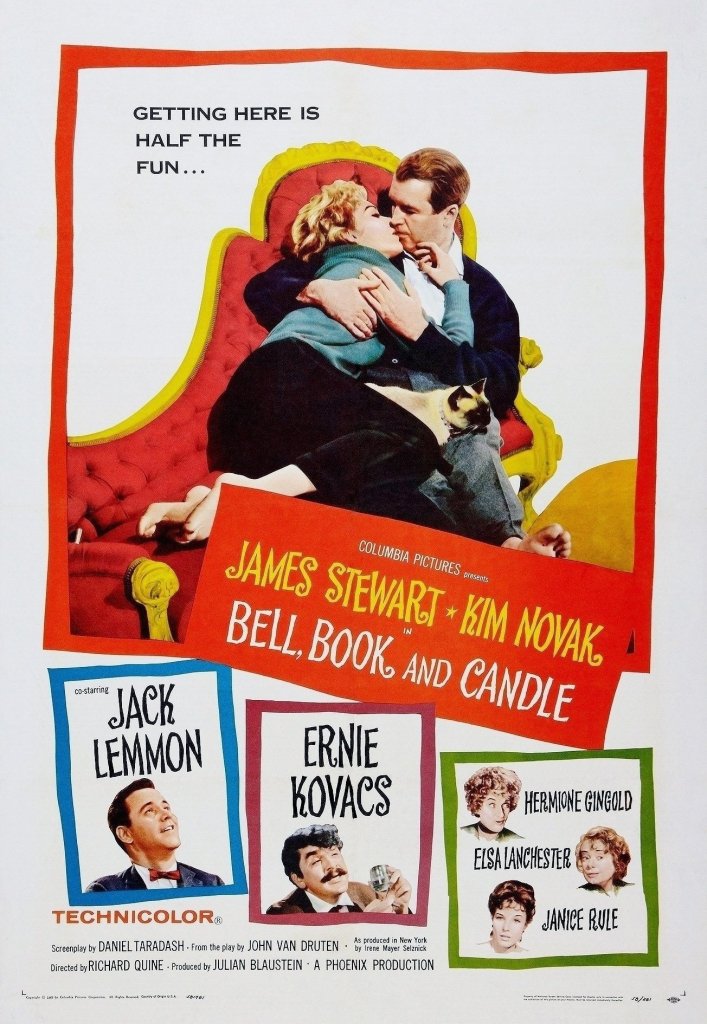
The movie poster for Bell, Book and Candle offers the tagline "Getting here is half the fun". The top half of the poster features Jimmy Stewart and Kim Novak, barefoot on a chaise longue, embracing, with a Siamese cat sitting atop them both. The bottom half is divided into multiple boxes announcing the supporting cast: Jack Lemmon, Ernie Kovacs, Hermione Gingold, Elsa Lanchester, and Janice Rule.

First off, though, quite a few individual elements here do work.  I love the late 1950s aesthetic — sure, the 1940s classics really established the genre of the holiday movie, but as a kid growing up in the late 20th Century, it was the 1950s that seemed to have created the Christmas look I think we were all nostalgic for, less wartime optimism and more the shimmer of the postwar boom.  Kim Novak as Gill is sensational most of the time — sultry and alluring in ways the ‘40s films wouldn’t really have let her be, and clearly presented as “daring” (Novak is barefoot basically the whole movie, which felt both avant-garde and playfully flirtatious, given that it’s New York City in December and her ground floor retail establishment can’t be all that warm).  Her brother, Nicky, is played by a really dazzlingly talented young Jack Lemmon, who pulls off a range from simpleton to scheming and makes the character feel coherent throughout — sure, it’s a comedic performance, but that doesn’t make his skill LESS impressive.  If anything, it’s a bit more impressive that he’s applying so much talent to a role that’s honestly not very consistently or compellingly written, on the page.  The two of them are on screen much of the movie’s running time, and thank goodness for that, since they’re usually doing something worth watching.

The big problem here — and I can’t believe I’m saying this — is that I think Jimmy Stewart’s performance is a distracting mess.  Now, Stewart’s one of the finest American actors of his generation, if not ever: I love his work in It’s A Wonderful Life, and if anything he’s even better in The Shop Around The Corner, both of them iconic holiday films and likely to be coming soon to a blog near you.  Here, though, everything about his presentation of the character goes weird from the beginning.  Stewart’s not helped by the fact that he looks all of the 50 years old he is when this movie comes out, and Kim Novak is very 25 — sometimes there’s a chemistry between them, but much more often you just really wish each of them would find someone their own age.  (And yes, folks, I know they’re also in a romance in Vertigo — I’m not telling you anything about that movie, I’m just telling you what I think doesn’t work about this one.)  Shep is written really oddly: at times he seems naive (his calm response to finding a strange old woman inside his locked apartment is very odd) but at other times he feels almost rakish, talking about the Kinsey Report with Gill when he barely knows her, or telling his secretary he wants her to have the negligee he had ordered for his fiancee.  And fundamentally, the thing Shep needs to pull off is the feeling that we’re watching a man gradually become unsettled, even haunted, by the feeling that his own emotions and thoughts have been invaded by magical compulsion, and that he’s so horrified by the thought that he decides to run away from his brand new fiancee who….well, who looks and acts like a sultry Kim Novak who’s half his age.  Stewart, to me, just doesn’t land the plane at all — his attempts to convey pretty simple experiences like “allergic to cats” or “scared of witchcraft” feel like awkward flailing by someone in Drama 101.  I can’t really explain why it’s not working, since Stewart clearly knows how to act (he was, I think undeniably, among the finest performers of his generation) — I can only think either that he felt the script was beneath him enough that he decided to ham it up, or else that maybe he felt a little embarrassed that they were casting him as a 25 year old’s love interest, and his feelings of unease or awkwardness emerged in his performance as a result.

The film has other issues, to be sure.  My notes as I was watching remarked on multiple occasions about pretty terrible sound editing — there’s a LOT of ADR (where an actor re-records their lines in the sound booth, after the fact), and it’s just not mixed well, so that it doesn’t sound like the actor is talking naturally in the room we see them in, but instead they sound like they’re in a recording booth talking directly into a microphone.  The script’s silliness is sometimes hard to follow: for instance, a character promises to keep a secret, but then almost immediately is handing out information left and right, and the film never seems to present it as a flub-up or subversion of the promise.  The movie struggles too, I think, to convey what tone we’re supposed to be picking up on: is this light-hearted or spooky?  Is Gillian basically well intentioned or basically self-serving?  And to be clear, I think intentional ambiguity in a movie is just fine: really good, even.  But there were too many moments for me where this felt less like conscious ambiguity and more like carelessness, or else honest confusion.

As a holiday film, well, I’ll give it a rating below, but I’ll admit, after the first 35 minutes or so, we leave Christmas in our wake completely, other than a scene in which kids are throwing snowballs and skating (which felt holiday-adjacent to me?).  And even in that first half hour, these are people who don’t seem all that interested in Christmas — we’re given some traditional music here, but these adults don’t seem to have gatherings to attend, last minute gifts to buy, etc.  They spend Christmas Eve in a nightclub without seemingly a care in the world.

Ultimately the film’s got fun moments where it cheekily gets close to breaking the “code” for films at the time — one bold line of dialogue occurs when Shep tells a character, late in the movie, that Gill is a witch, and the character replies “A witch?  Shep, you just never learned to spell.”  Which is maybe the classiest (and possibly only, in 1958) way you could call a character a….well, it starts with a b.  Again, though, it can’t ever really commit to a tone, since I think the whole premise leaves us caught between seeing Gill’s bewitching of Shep as lighthearted fun and a deep betrayal, and it’s just a bit too hard to square those things no matter how you squint at them.  So the fun, for me at least, is intermittent, and the lasting impression is more confused than classic when I think about the movie as a whole.  Scene by scene, or line by line, though?  There’s some real gems in this one when remembered in that way, and it’s a flirtatiously fun changeup to throw into the catalog of holiday films I’m taking on here.

I Know That Face: Obviously, Jimmy Stewart who plays Shepherd Henderson in this film is better known to Christmas movie fans as the star of Frank Capra’s classic It’s A Wonderful Life or of the less-famous but also brilliant The Shop Around the Corner — most of us probably see his face every single Christmas season, perhaps multiple times.  And Elsa Lanchester, the mischievous Aunt Queenie here, plays Matilda the housekeeper in the household of the Broughams in another half-forgotten mid-century Christmastime film, The Bishop’s Wife.

That Takes Me Back: This “takes me back” even farther than I was alive to see, but I was charmed that we don’t just see characters using a rotary phone, but we hear them referencing a phone number that begins with a word.  I’m tempted to start handing out my office extension on campus as “HArrison Six Two”.  A less appealing hit of nostalgia came along with the sight of someone smoking casually indoors (as Merle does at the Zodiac) — I was describing to my daughter just a few weeks ago how the world used to have things called “smoking” and “non-smoking” sections, a thing she can’t really envision.  And I don’t know that this is actually a throwback, but the work “negligee” feels SUPER old-fashioned to me for some reason.  If you all are constantly talking about negligees, I mean, a) I bet you throw a great party, and b) clearly you and I are having some of your most boring conversations (my apologies).  Oh, and I chuckled at the line, “A typewriter: I’ve got to get a typewriter.”

Sadly, I didn’t find that this film yielded anything at all in the I Understood That Reference category; better luck next time, maybe.


Holiday Vibes (2/10): This was a fun film to include on the blog, and it does come up as a “holiday movie” on some lists, but as noted above, the actual festive content is really brief, and we don’t even really get much of a “Christmas” for the film’s one Christmas Eve sequence.  If you’re someone who likes to think broadly about what counts as a holiday movie, it’s not like there’s nothing here for you….but there’s not a whole lot here for you.

Actual Quality (7/10): Bell, Book and Candle is a movie I wish I could recommend with more enthusiasm, since there’s undeniably some worthwhile things to enjoy here.  I have the feeling it’s one I’ll rewatch in a few years, thinking maybe I judged it too harshly….and find myself saying again “ah, right, it just doesn’t work as a romance”.  I do think that almost everything around the romance DOES work, and for that reason I hate to be so down about it.  But in a romantic comedy, if the romance ain’t working, I don’t know that the film has anywhere to go in the end.

Party Mood-Setter?  I mean, if you’re having a flirty, fun, fifties shindig this holiday season, throw Kim and Shep on the screen and don’t pay that much attention, maybe?  But honestly it’s got to be a “No” since what this question is asking is, can this background a festive holiday gathering, and here I don’t think it’s anywhere close to being enough of a holiday vibe.

Plucked Heart Strings?  There’s emotion on screen, but I don’t feel pulled in by any sentiment — Gill is certainly going through it, especially late in the film, but I never found myself feeling anything along with her.  Again, I think the tone is the challenge here, since it’s not clear to me who’s wronged who, or how, or even if anybody’s really been wronged at all, and the main characters became just a little too caricatured along the way for me to connect deeply with them like this.

Recommended Frequency? Look, if you’ve seen it and it didn’t win you over, I’m definitely not here to tell you to put it on this December.  But if you’ve never seen it, honestly, I think you could give it a go for Kim and Jack: Novak and Lemmon are really on their game here, and even if the film is only “fine” overall, I doubt you’ll regret getting to see the movie’s best scenes and lines. As for me, having seen it once already, I do think this will be a once a decade kind of movie for me — if it’s more than that for you, though, I’m delighted and hope you have fun in the fifties!

You can stream Bell, Book and Candle if you’re an Amazon Prime member, and Tubi will play it for you for free (with ads).  It can, of course, be rented from most of the usual places online.  Amazon will sell it to you on Blu-ray, or DVD, or VHS (is VHS making a comeback, folks, and nobody told me?).  And as always, I encourage you to make use of your local library: mine has the movie on DVD, at least, and I bet yours will too.

The Holiday (2006)

Review Essay

The Holiday’s a Nancy Meyers film through and through — and if you’re someone who knows those movies (What Women Want; Something’s Gotta Give; the 1990s Father of the Bride reboot films, which she screenwrote), you know a little bit about what you’re in for.  Lush interiors, especially really lavishly appointed kitchens; romantic/comedic dialogue that owes a zippy debt to Nora Ephron even if it’s rarely quite as stylishly composed; a willingness to take the emotion of a scene more than a little over the top.  This movie hits those marks reliably, and as a result is, to me, both reliably entertaining for a big chunk of its runtime and also a little too artificial and hollow to really land the punches it’s swinging for.

The premise is simple enough — Cameron Diaz’s Amanda and Kate Winslet’s Iris are both on serious rebounds after painful romantic fallouts that have left them questioning their own identities.  They find each other via a wonderfully hokey of-its-2006-era home swap website, and agree that Amanda will spend Christmas in a charming Surrey cottage while Iris spends her Christmas in a sprawling SoCal McMansion, buffeted by the Santa Ana winds.  They’re hoping not to find love, of course, which is why it’s so convenient when Iris’s brother Graham (played by Jude Law) drops in to find Amanda unexpectedly in residence at the cottage, and when Amanda’s ex’s buddy, Miles (played by a charmingly baby-faced Jack Black), shows up to retrieve some things and encounters an unanticipated English woman on holiday.  The rest….well, you know the rest, probably, though there’s a twist or two I won’t reveal.

The film poster for the movie, The Holiday, featuring the names and faces of the movie's four principal actors, Cameron Diaz, Kate Winslet, Jude Law, and Jack Black.

The film’s at its best when it’s not trying to advance the primary plot, which is Diaz and Law falling in love — two incredibly attractive humans at basically the height of their Hollywood stardom, but underwritten in ways I’ll get to in a moment.  The absolute best pairing in the movie, by contrast, is actually Kate Winslet’s Iris and her new neighbor, a frail old screenwriter who was big in the mid-20th Century but now gets lost walking down the street – a man named Arthur, played spiritedly by Eli Wallach, who was 91 at the film’s release.  Iris and Arthur are incredible pals, and his not-so-secret desire to lift her self-esteem and make her see herself as a sassy screwball heroine with “gumption” is maybe the sweetest part of the film – both romantic and comedic without being rote.  Meyers’s eye for exterior shots, especially in the English countryside, is really excellent, so there’s a lot of cinematic beauty here to enjoy at times when all we’re seeing is establishing shots or montages.

The two main pairings are underserved by the film in different ways.  Winslet and Black are honestly very cute together – Miles is a sweet, decent fellow who, when the “Jack Black” within him is dialed down to 85% or lower, is impossible not to like, and Winslet’s character is developed really successfully (I think the emotional richness of the Arthur subplot helps her a ton in this regard, plus Iris is just given a more sympathetic situation in the screenplay to begin with).  The problem with their subplot is that it’s given short shrift by a movie that’s more interested in Diaz and Law — Miles and Iris get a couple of really nice scenes together, but that’s about it, and the romance as a result feels a little hasty.  The challenge with Amanda and Graham, meanwhile, is connecting with them: Graham’s character has the biggest twist, and while the revelation we get about him really adds substance to his character, it’s also hard to reconcile all the pieces of the guy we’ve been introduced to with the person he apparently is?  Jude Law is, again, so hot in 2006 that even this straight dude can appreciate the man’s cheekbones, but in some ways that makes him harder to see as anything but a movie star in the spotlight.  And poor Cameron Diaz is handed, in Amanda, a character who never really feels like a person to me — she’s all screenwriting quirks and problems, and most of the moments that are meant to provide emotional depth for her end up seeming flat or unrealistic to me.  Diaz has been good in other things, but here I think the material’s not strong enough to let her succeed, or else maybe she’s not quite strong enough (unlike Winslet) to elevate it.  Maybe both.  There are still, for sure, some good moments for Diaz and Law, especially later in the film where we’re seeing a life that’s a lot less artificial and flashy.  In the end, though, I found myself rolling my eyes or checking my watch too often when one or both of them was on screen.

I Know That Face: In this category, there’s a couple of people with fun crossovers into holiday movie territory.  The aforementioned Eli Wallach, Amanda/Iris’s charming elderly next door neighbor Arthur, narrated The Gift of the Magi in 1958 — a TV movie you probably didn’t see, unless you were around in 1958, I’m guessing — and appeared as a character named Behrman in a segment called “The Last Leaf” in another TV movie, O. Henry’s Christmas, that, yeah, you probably didn’t see unless you were watching television in 1996 (I was, but I don’t remember this one: you can apparently watch a terrible transfer of the whole thing on YouTube right now).  Arthur’s Hanukkah buddy, Ernie, is played by Bill Macy (no, not William H. Macy….an older actor who, I presume, is part of the reason there’s an “H.” in William H. Macy, given Screen Actors Guild rules about having distinctive working names) who also plays a character named Doo-Dah in Surviving Christmas, yet another semi-forgotten 2000s holiday flick, and one I’ve never seen.  Shannyn Sossamon, who plays Miles’s crappy girlfriend Maggie, turned up in 2021’s High Holiday, which is apparently a movie about a family Christmas dinner in which someone slips weed into the salad dressing so that everyone (including her right wing politician father) will get blazed and say their true feelings out loud?  Sounds ghastly…I guess maybe someday I’ll watch it and find out.

That Takes Me Back: I have to say, there’s a number of slices of classic mid-2000s life here.  Iris’s job is writing wedding columns for a British newspaper, and while we get only glimpses of her older word-processing software in use, the fact that she’s working in old school journalism at all feels quaint these days.  At one point Amanda’s awful ex shouts at her, “You sleep with your BlackBerry.”  Can’t get more 2006 than that.  Iris is carrying a BlackBerry around, too, sending emails on it from the plane (prior to takeoff, we assume).  When Amanda searches for vacation homes to escape to, she types in a simple keyword search and gets actual functional Google results with no ads or promoted posts cluttering things up: talk about things we didn’t appreciate until they were gone.  And one of the most charming and funny and ultimately sad scenes for Iris and Miles unfolds as they peruse a video store stocked with every kind of film on DVD — I miss those places all the time anyway, but especially when I’m trying to track down forgotten holiday films.

I Understood That Reference: I wish there was anything of this kind to dwell on here, but somehow in a film that’s at least partially obsessed with classic Hollywood films and movies with great music (thanks to the careers of Arthur and Miles respectively, and their effusive personalities), no holiday-themed media ever comes up in the film’s screenplay, even in passing.  It’s a real missed opportunity.


Holiday Vibes (5/10):  I don’t want to seem ungrateful: after all, Meyers opens the movie at an office holiday party, and the soundtrack is chock full of Christmas bops, including multiple people singing to us about a merry little Christmas and Motown singers walking in a winter wonderland.  But the film’s not all that interested in Christmas other than as set dressing — there’s no family Christmas gathering on either side of the pond, only a couple of painful gift exchanges, and as the movie progresses, the sound’s less Motown and more Imogen Heap (which is not a complaint: I love Imogen Heap).  None of these people seem to be living lives in which ordinary Christmas activities are really part of the routine — it would have made sense to have a “frantic shopping for Christmas gift” section, or a “my homesickness is assuaged by this particular Christmas memory or moment that feels familiar” but it’s not in the cards.

Actual Quality (8/10):  It’s a solid Nancy Meyers movie with a great cast — there’s more than enough great set design and good cinematography, and some lovely people to watch fall in love on screen.  Hard to be disappointed in that.  It still drags at times, as noted, in the Amanda/Graham sections, and I found myself wondering how awesome it would be to just have a film about Iris — an English fish out of water in Southern California for Christmas, simultaneously finding herself loving and being loved by two sweet fellows, an elderly Hollywood widower who’s surely being reminded of the love of his life and a teddy bear of a film composer with an impish grin who’s on the rebound himself.  That film, I think, had real 9 or 9.5 out of 10 potential, especially with Winslet, Wallach, and Black in the main roles.  As it is, it’s a solid B- of a film, for me.

Party Mood-Setter?  To me, no — it’s too sexual for Christmas with the kids but not sexy enough for a more flirtatious party of young adults.  It’s playful enough and cinematic enough at times to get closer to qualifying, especially with those lush Nancy Meyers interiors, but fundamentally it’s a movie that needs your whole attention, and that wants to deliver most of its message through scenes that are at least a little poignant.  Not great for inconsistent attention while you’re doing something else.

Plucked Heart Strings?  This one is much closer, for me, but it’s still a no — the movie invests most of its big emotional arc in Cameron Diaz as Amanda, which again I think is not really working on either a screenplay or an acting level.  If you do get misty-eyed at this film, I think it’ll be out of sympathy for Kate Winslet’s Iris, whom she makes a human being with genuine pain in her life that she needs to triumph over.  I can see it — it just didn’t happen for me.

Recommended Frequency:  This is definitely a “now and then, in the right mood” film, from my perspective.  There’s not enough here to make it a perennial classic, especially because, ironically, the actual holiday content in a film called The Holiday is a bit thin.  But it’s also more than watchable enough, especially (as I’ve made pretty plain) the to-me-superior subplots involving Iris, for me to imagine putting it on again in the future, now and then, when I’m in the mood to see particular moments or a particular acting performance again.

You can find The Holiday streaming on Amazon Prime, or for rent at the usual places (AppleTV, Google Play, Fandango at Home, etc.). You could pick up the Blu-ray (or DVD) at Amazon pretty inexpensively, it looks like. And of course I will always recommend you check at your local library: according to Worldcat, there are thousands of copies waiting out there for you! As will always be true here, I earn nothing from any links I’m providing: they’re just here as a courtesy. If you give the movie a go, I hope you’ll leave your thoughts in the comments!