Carol (2015)

Review Essay

One thing I’ve enjoyed about this blog project this year — along with getting to share things with you, and hear some of your comments back — is that I’ve tried to push myself to watch a wider range of movies than I normally would have watched.  Sure, there’s lots of romantic comedies in the list, since that’s such a dominant element in the holiday genre (such as it is), but it’s been interesting to see the other uses Christmas can be put to.  That’s certainly true of Carol, which I think is arguably the best film I watched for this project on an artistic level while also not being the kind of movie I normally think of this time of year at all.

Carol begins in medias res: we know that a slightly older woman named Carol is at a table with a young woman named Therese, and that there’s something between them that feels tightly wound, and somehow also fragile.  A young man disrupts whatever their conversation had been, and they part, but the camera work and the editing helps emphasize for us that Therese is in a reverie, pulling her attention away from those around her and into the memories of meeting and knowing Carol.  There’s no easy way to summarize this, so I’m going to miss a lot in this initial stage setting in saying simply that Therese is a shopgirl who met Carol, a wealthy mother looking for a Christmas gift for her child.  It’s the 1950s — Christmas 1952, if I’m not mistaken — and for that reason it’s hard at first to know….are these women flirting with each other, or is this just awkward small talk?  But then the film pursues their relationship and slowly opens up to us that these are in fact two lesbians — one of them out to a handful of people in her life, the other maybe not even fully out to herself yet.  And, in that historical moment, this is incredibly precarious — Therese risks the relationships she has already built in her life (including a boyfriend).  Carol risks her ability to even see her child, let alone act as her child’s parent.  They run the risks anyway.

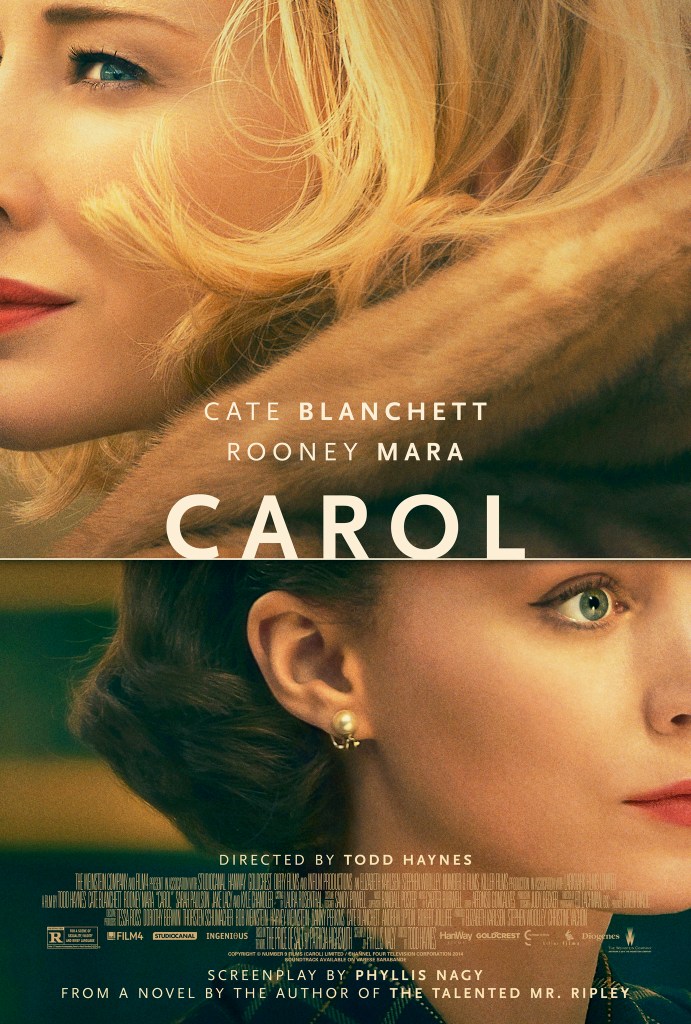
The poster for the movie "Carol" primarily features the two major actors -- in the top half, we see a partial view of Cate Blanchett's head and face in profile as Carol, and in the bottom half, we see a partial view of Rooney Mara's head and face in profile as Therese.

So much of the movie is about the question of whether a woman gets to have an identity that is her own: from the beginning, we watch Therese disappearing, whether under an obligatory Santa hat at work or into the vacant stare of dissociation I see as she tries to reckon with a boyfriend, Richard, who has big plans for her that don’t inspire her at all.  Carol lives a little larger, but she’s constantly forced to push back — when her estranged husband, Harge, makes a reference to “Cy Harrison’s wife” she almost instinctively mutters “Jeannette” as if to say, “she doesn’t belong to Cy, or anybody else, you know”.  Speaking of names, Therese is almost always referred to by her boyfriend as “Terry” — it’s only with Carol that she can count on hearing her real name, almost as though she’s not herself unless she’s with Carol.

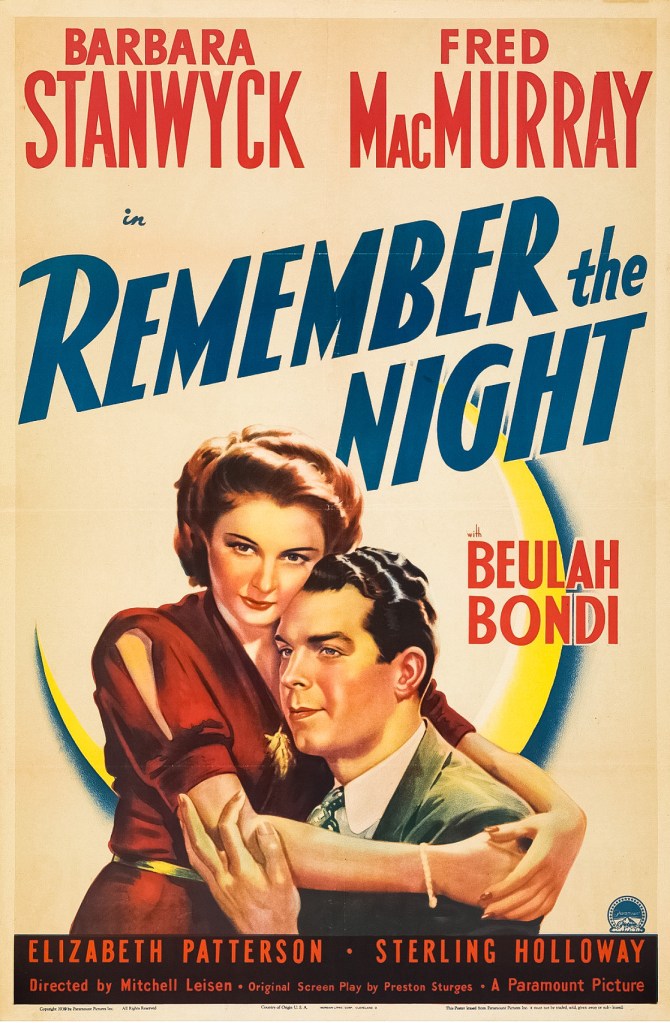
And the film is also about the journey to find a space where you can be yourself.  The journey is internal, sure, but there’s a pretty substantial journey undertaken in the film’s second act, as Carol and Therese drive west, escaping into the American interior like so many people in fact and in fiction, over the years.  As they travel — initially as innocently as any two friends, but gradually opening up to the possibility of intimacy — the world slips by them and it’s maybe a little reminiscent of Remember the Night, except here both women are running away from their homes and not towards them.  What will redefine them is not the loving context of family and community, but individuality and agency.  The scene in which they finally have sex — and to be totally clear with you, dear reader, this is very explicit sex as you would expect from an R-rated drama, in case that’s not your holiday movie style — comes as a relief because you get the sense that you’re finally watching these people be authentic and unguarded.  It’s a haunted sex scene, to be clear, because even as they’re in each other’s arms, we know that neither the 1950s nor the legal system adjudicating whether or not Carol gets to have contact with her daughter are going to let this be as easy as it feels in that moment.  The relief they’re feeling is impermanent, and they know it; so do we.

The journey takes place at Christmas, and that’s where this film intersects with this blog.  Sure, it qualifies the moment Therese puts on a Santa hat at Frankenberg’s, but there’s more than that in the use of this holiday.  Carol and Therese’s first conversation deals with Christmas, at least a little — Carol loves it but also feels incapable, referencing how she always overcooks the turkey.  I think the movie, as it unfolds, makes it clear that the turkey line is just cover for Carol’s fears of being inadequate as a mother (and perhaps as a wife): that the reason Christmas doesn’t achieve that looked-for perfection is because of something she’s getting wrong as a homemaker.  Later, Carol fends off multiple invitations to friends at Christmas, as it becomes clearer that she needs her own space…a space into which she’s going to bring Therese, though.  Christmas works here as a catalyst for action — Harge and Carol, for instance, fight about Christmas but it’s not about Christmas, of course, any more than most fights at Christmas are about the holiday.  Christmas, meanwhile, threatens Therese a little, since she realizes she’s about to be treated as “family” by Richard’s family, and she doesn’t want to feel the inevitability of that — not yet and maybe not ever.  She’d probably have run off with Carol any day of any week, but it being Christmas is even more of an inducement for her.

So much depends, in a film this contained and zoomed in, on the performances of the primary actors, since there are no huge set pieces here, no sweeping plot devices, to distract us.  And the film has been wisely entrusted to Cate Blanchett as Carol and Rooney Mara as Therese.  Carol is the most impossible of the roles — a woman established enough in a comfortable life to be proud and also wounded enough by the confines of that life to be vulnerable.  We have to believe her when, on more than one occasion, she chooses someone else’s happiness over her own, whether or not she’s right about them — whether or not they deserve it.  That Blanchett manages it is no surprise to anyone who’s ever seen her in anything, of course: I remember being blown away by her performance in Elizabeth, watching that movie on VHS from a Canadian video store back in grad school (talk about nostalgia), and the many times I’ve seen her since, she’s been uniformly wonderful (even in otherwise mediocre material).  But I think there’s still something especially wonderful about her work in Carol, since there’s absolutely no special effects here to enhance her performance, and she has to face some tough emotions pretty directly on screen: it works.  Mara’s task as Therese is to be believable as a young woman discovering that her ambiguity about her life isn’t some fundamental personality trait, but rather a reaction to trying to live as someone other than who she is.  Her awakening to herself and to Carol is a liberation, but it’s navigated in the slow and sometimes difficult way that such journeys of self-discovery often take.  And Mara’s really successful, I think, at not letting her portrayal become too cloying — really, both she and Blanchett give us characters who have sides that are not easy to warm up to.  They’re not afraid to be human, and to invite our empathy without having to be saintly enough to earn it.

A lot happens in this film, and particularly in its final act, that I just have to leave to you as a viewer.  It’s too nuanced and powerful a movie to spoil, even though it’s also not really a movie with a plot that’s relying on twists or tricks to keep you hooked.  A lot of careful choices are made here by the director, by the actors, and by the screenwriter, that wring every drop of potential intensity out of the smallest interactions.  When characters are betrayed, it hits hard.  When they suffer or submit, it burdens me as an audience member.  And the ending I get is not at all what I expected or had thought I was hoping for, but the way it resolves ultimately feels perfect to me, almost inevitable.  There’s a sense of hope and of possibility, for me, that rounds out the subtle Christmastide feelings of the film into something that strikes the right emotional note.

I Know That Face: Jake Lacy, who here plays Therese’s unfortunate boyfriend Richard, appears as Joe in Love the Coopers, a film about a massive Christmas family reunion that was released the same fall as Carol.  Kevin Crowley, here playing Fred Haymes, Carol’s lawyer, appears as Liam in the TV movie Country Christmas Album which is exactly what it sounds like, and has a bit part as Dr. Franklin in another TV movie, The Christmas Spirit, about a woman in a coma who appears in spirit form to persuade her community to something something look there’s a lot of holiday movies and I have definitely not seen them all.  Sarah Paulson, here playing Carol’s devoted ex, Abby, has several holiday flicks under her belt: she stars as Emily in the Lifetime movie A Christmas Wedding, she plays Beth, the mother of a terminally ill 8 year old, in Hallmark’s November Christmas, and she is Grace Schwab in one of the segments of the anthology film New Year’s Eve.  And Cate Blanchett, starring here in the title role, was once the uncredited voice of a “Mysterious Woman” in Eyes Wide Shut, which is also a critically acclaimed adaptation of a mid-20th century written work that takes us to a series of New York City gatherings at Christmas time, and is far, far more sexually explicit than even Carol is.  I’m not saying it’ll never make the blog, but it’s not on the list for this year (or next, I think).

That Takes Me Back: I know this kind of shopping does still exist, but it’s been years since I engaged in the bustle of department store shopping at Christmas.  I enjoyed the throwback feeling of a big decorated showcase space and the busy energy of the retail floor.  Less appealing but certainly just as indicative of a bygone era was all the smoking indoors, all over the place, often in furs — the look and feel of the movie works with those 1950s symbols pretty successfully.  I am too young to really feel a connection to the idea of a shared phone in the apartment hallway, but it sure reminds me of shows and books I encountered, growing up, and just the idea of a phone being in a place, and needing to go to that place to use the phone, is nostalgic.  Oh, and in further technological notes, I’ll say that I do love a cash register that goes “ding” when the cashier pulls a lever, and I love anything called an “icebox,” especially one operated by a handle in the door.  

I Understood That Reference: There’s very little sense of holiday media here, but Carol promises her daughter at one point that she won’t let Santa’s elf give her daughter’s presents away to another girl.


Holiday Vibes (5/10): In the movie’s first half, there’s a fair amount of this — as mentioned, Santa hats on the department store employees and discussions about turkeys, and then there’s handwritten note tags on gifts and home decorations.  The use of seasonal colors, especially red, in the costuming is not at all subtle, and conveys a little about how the characters change (or don’t). By comparison with some films that are much more widely considered to be Christmas classics, honestly, this one holds up pretty well as committing to Christmas as a relevant setting for at least the movie’s initial work, even if the holiday recedes from view over time.

Actual Quality (9.5/10): This is a very, very good movie — Haynes is a gifted director and I love a Carter Burwell score, and the underlying story comes from an underappreciated and notable midcentury talent in the author Patricia Highsmith.  As I’ve mentioned, too, the acting performances are really extraordinarily good: the movie earned every Oscar nomination it got, and was probably robbed of more than one statuette.  Now, is it for you?  Dear reader, I can’t know that: some of us are up for intense, often sad R-rated romantic dramas at this time of year and others of us wouldn’t touch them with a ten-foot pole.  But if you think you might be in the former category, I really can’t say enough about how good a movie this is artistically.  It’s worth your time.

Party Mood-Setter?  If you’ve brought a shop clerk home and are hoping to take things “to the next level” then I guess so, but otherwise, haha, no of course not, this is an incredibly moody, melancholy, and sexual movie that isn’t going to pair very well with decorating the Christmas tree.

Plucked Heart Strings? You can’t help but feel emotionally connected to both Carol and Therese, even though the film’s management of itself is such that every emotion is somewhat muted, and I’d expect that most viewers won’t be reduced to tears.  I found myself still feeling the movie’s emotional landscape after it was over, but it never caught me so by surprise that I was choked up, except perhaps for a single moment near the very end.

Recommended Frequency: It’s a great movie and it has some really vivid holiday moments, but it’s also such an intense viewing experience that I don’t think I’ll be rushing back to it every year.  This is great film-making, though, with thoughtful acting and direction and writing and outstanding costuming by Sandy Powell (who has multiple Oscars) and a wonderful score by Carter Burwell (who SHOULD have multiple Oscars), and if anything I’ve said about it here makes it seem like something you’d enjoy, I think you should go for it.  Just go in knowing this isn’t about hot chocolate and mistletoe and Santa laughing like a bowl full of jelly — both the movie’s highs and lows are just working in an entirely different register than the typical holiday movie.

If you’d like to watch Carol, Netflix will show it to subscribers for free.  You can rent the title via streaming service from basically all the big ones, as usual, and Amazon will gladly sell it to you on disc (though if you’re anywhere that there are striking workers in its path, I encourage you not to cross those lines digitally, and to find the disc elsewhere, such as Barnes & Noble).  And I don’t know what it is about Carol, but this film is available in even more libraries than White Christmas — over two thousand of them, according to Worldcat, so check this one out on disc from your local library for free, and enjoy it with my compliments.

White Christmas (1954)

Review Essay

Some of my favorite holiday movies make the list because of the depth of their ideas: they make me think the way I want to think at this time of year.  But others make the grade purely because of the power of their feelings: they just evoke an emotional response in me that feels like the holidays, regardless of what the underlying film intends to convey.  The latter category is, I think, the best way for me to broadly characterize White Christmas, a motion picture that surely most if not all of you are very familiar with: I love this movie, I watch it every Christmas, and if I think about it too much, I start to wonder why I have such a deep connection to it.  Let’s try to unpack both sides of that, shall we?

First, the basic premise, in case somehow this movie’s missed you in the past: the movie opens on Christmas Eve, 1944, with two soldiers (one an already-famous entertainer named Bob Wallace; the other an ambitious but green up-and-comer named Phil Davis) putting on a show in honor of their general and Christmas (seemingly in that order) before an artillery assault breaks out and Davis saves Wallace’s life.  Having done so, he extracts a series of promises from Wallace — to sing a duet together, to become partners, to start producing big musical revues — before they cross paths with the singing Haynes sisters, Betty and Judy, and find themselves (through a mishap or two) following the girls to Pine Tree, Vermont.  There, they discover their old general is a down-on-his-luck hotel owner in a snowless and therefore guestless December, and the boys spring into action to come to his aid (while Phil and Judy try to steer Betty and Bob into each other’s arms).  Along the way, there’s a lot of singing and dancing from some of the most talented folks in Hollywood at midcentury: there’s a reason this film endures.

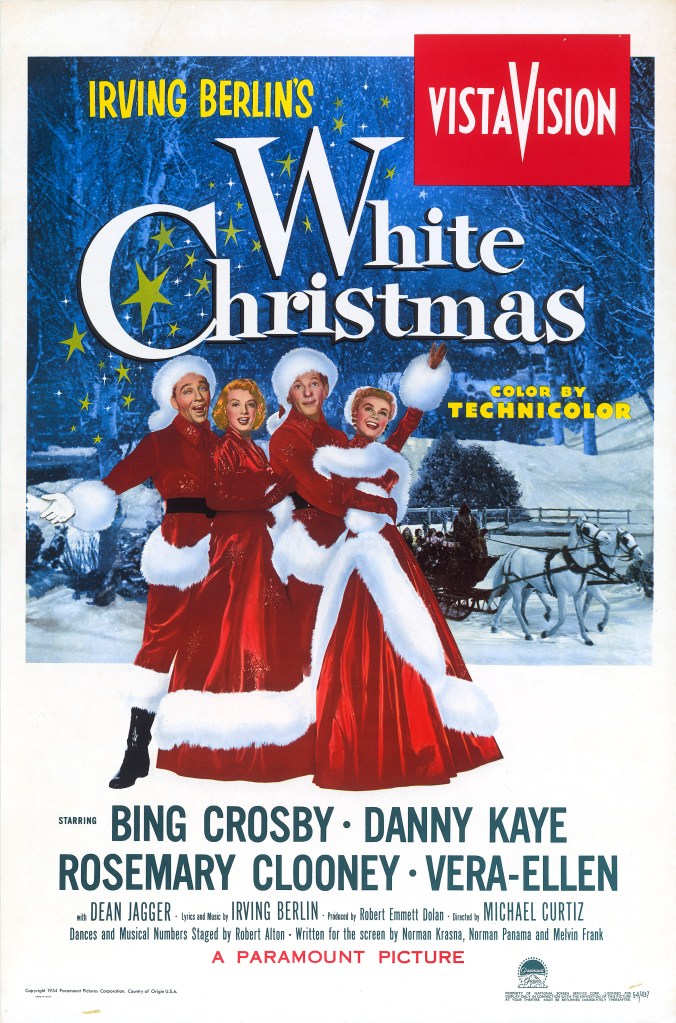
The poster for "White Christmas" announces boldly that it is in VistaVision with color by Technicolor. The background scene is a snowy wooded landscape, where two white horses pull a sleigh: in the foreground, painted versions of the four principal cast members, dressed in red and white Santa outfits, gesture towards the viewer invitingly.

One of the things I noticed on this latest viewing is how the film repeatedly has these men make a promise with mostly good intentions but lacking in a little sincerity…and then that promise turns out to be really meaningful to them in unexpected ways.  Wallace promises Davis to sing a song with him out of guilt more than enthusiasm, and his whole life changes.  The two of them decide to keep faith with a weird dude they knew in the Army out of obligation, and that’s how they meet the Haynes sisters.  Davis’s promise to find Wallace a girl is motivated by a selfish desire for a little leisure time, but, well, other good things come of it for him.  I don’t think the film’s message is “do the right thing for the wrong reasons and you’ll succeed” but there’s definitely something going on there, under the surface.

Another element that’s definitely going on under the surface is social and cultural conservatism — this movie is fully locked into the moral landscape of mainstream America in the 1950s, and the “boy, girl, boy, girl” lineup of romance and matrimony fits a little too neatly.  The implication that marriage is the most central meaning in life is pretty clear.  The valorizing of the army is understandable for the era, but it’s over the top nevertheless: the movie’s absolutely not interested in a depiction of war or its aftermath that feels genuine (unlike say, The Holly and the Ivy, which I wrote about here just two days ago).  And not one but two musical numbers take swings at modern entertainment — “Choreography” memorably parodies modern dance (I think specifically the Martha Graham Dance Company) in making an argument that the old tap dancers and soft-shoers were obviously superior.  And, of course, the medley that ends with “Mandy” repeatedly reminds us that the performers REALLY miss those old-fashioned minstrel shows — weren’t those the good days?  For my part, I think MGDC is fine as a target — yes, there’s something a little sneering about that number, but it’s also pretty funny, and I am unaware of any weird bigotry associated with Martha Graham’s particular style of modern dance.  Minstrel shows, on the other hand, were a real blight on American entertainment — Bing Crosby, of course (who plays Wallace here), had appeared in blackface in a minstrel number in an earlier film, Holiday Inn, so he’s only thinking back about a decade as he yearns in song.  And of course the thing that’s ridiculous about both numbers here in White Christmas is that they are self-refuting — sure, the modern dance in “Choreography” is intentionally goofy in ways that make me laugh, but doesn’t that suggest that in fact the new modern dance style was capable of pretty evocative communication and therefore artistry?  And more importantly, doesn’t the fact that Clooney and Kaye and Crosby can joke around in song on stage, before Vera-Ellen comes out and dazzles us all with her skill as a dancer, prove that you can have all the old vaudeville fun you want on stage or screen without burdening it with awful racist caricatures?  We do not need “Georgie Primrose”, as the song here suggests, to have a good time: far from it, in fact.

I know, I know — none of this sounds like me being in love with this movie enough to watch it every Christmas.  Well, I haven’t really dealt yet with the four stars of this movie, and I have to say, each one of them is basically ideal casting, simply ideal.  Bing Crosby is just coming down from his apex of fame and talent here in the early 1950s: the film needs a proud but affable crooner and that fits Bing to a T.  His ability to work as a straight man had been pretty carefully honed, and for my money he is JUST young enough to still be playing a romantic lead in this film.  His comic foil, Danny Kaye, is a personal favorite of mine — Danny’s effortless and energetic presence on screen really never fails to make me laugh or hold my attention.  Everyone’s tastes are different of course — I complained back in my review of The Holiday about Jack Black dialing it up to 11 a little too often, and I’m sure there are folks who would feel the same about some of Kaye’s goofiness here, but for my money he can dial it up as high as he likes, I’m here for it.  As young Judy Haynes, Vera-Ellen is startlingly talented in every kind of dance she’s asked to perform — so good, in fact, that Kaye couldn’t keep up with her (if you’ve ever wondered why that one semi-anonymous dude is suddenly dancing with Judy in a couple of big numbers, it’s because he was a top-tier studio dancer covering the parts that Kaye, despite all his talent, just couldn’t do himself).  And I love the way she very subtly breaks the fourth wall — the next time you watch this film, pay attention to how many times Vera-Ellen makes direct eye contact with the camera, and flashes us a little conspiratorial smile as if to say, “God, I’m good.  Watch this next bit.”  Finally, Rosemary Clooney as Betty Haynes is, in my purely subjective opinion, just about perfect: she takes a role that, on the page, might be a bit stiff or stick-in-the-mud, and presents a woman who’s warm and guarded and winning.  Plus she’s got the voice of an angel and she’s a vision in Technicolor in basically every perfectly chosen Edith Head costume — maybe you can take your eyes off her, but I can’t.  And the end result of all four of them basically firing on every cylinder in every scene means that the film is always bursting with charisma, no matter how I feel about the writing or the pacing or the underlying message of any given moment.

And White Christmas is such a lush viewing experience too: I don’t know if any film’s color is more saturated than the reds and greens of this movie’s opening titles, and it’s paired with a really effusive orchestral overture.  The heightened theatricality of everything about the film somehow works to its advantage, for me: there’s no question that every outdoor setting looks like a sound stage, from the “war zone” in 1944 to the “boat dock” where Davis and Judy first dance to the “parking lot” outside the Pine Tree Inn.  But something about the artificial quality of those spaces just makes the whole thing feel slightly dreamlike to me in a way that’s really calming and satisfying.  Add in a few incredibly catchy Irving Berlin songs and some scintillating Robert Alton choreography and I just fall in love with the film every time.

Am I falling in love with a holiday movie, though?  For a film that opens and closes with two stirring renditions of “White Christmas”, the best selling single song of all time, I think there’s no question that this film is not all that connected to the holidays as far as its running time goes.  We get about 10 minutes at Christmas Eve in 1944 (more than half of it about General Waverly and not the holiday at all).  Then, while there’s some talk about the Christmas Eve looming at the film’s end, it’s not until the very last segment of the film that we get the holiday tableau you might remember, full of children in costume and Santa hats and the world’s largest Christmas tree.  But what a tableau it is.  Thematically…well, I’ve talked about this movie’s theme already, a little.  The more I think about what I think this film wants to say, the less comfortable I am with it — I don’t think it’s a harmful film, to be clear, but I think it just has a different sense of what’s important and in need of defense than what I believe in.  I have a hard time connecting most of the themes I do see to anything I would associate with Christmas in particular.  In the end, though, I can’t deny that the power of the movie’s full force being directed at the Christmas holiday really connects for those brief stretches where it’s doing that.  I come away fully washed in the VistaVision spectacle of the idealized midcentury holiday.  There’s a reason a ton of us watch this film every year and feel Christmassy about it.

I Know That Face: Mary Wickes, who plays Emma here (the hotel’s housekeeper and professional busybody), has a couple of other holiday turns under her belt: she plays Henrietta Sawyer in The Christmas Gift, a TV movie starring John Denver and Jane Kaczmarek (what an eclectic cast, eh?), and near the end of her career, she plays Aunt March in the 1994 edition of Little Women, another one of those movies that feels like Christmas far more than it is actually set at Christmas.  And Bing Crosby, here playing the seasoned entertainer and mogul Bob Wallace, is Father Chuck O’Malley in The Bells of St. Mary’s, a film that has a long enough sequence set at Christmas that it tends to make lists of holiday movies (and would certainly be eligible for this blog).  Bing, too, sang in that famous televised “Little Drummer Boy” duet with David Bowie that I alluded to when I reviewed Merry Christmas, Mr. Lawrence.

That Takes Me Back: Man, as a long-time happy Amtrak traveler (in the days when I could sleep sitting up overnight in coach: ah, youth), the vision of trains full of sleeper cars rolling through the night is nearly irresistible.  I loved, too, that in their conversation about whether to take the train or the plane, it’s clear that the train is luxury travel (since you can sleep), whereas on the airplane you’ll wind up sitting up all night.  No kidding, Bing.  It is fun to see the Haynes sisters have to fuss about their phonograph records (and phonograph) they travel with: technology has changed our relationship to music in so many ways.  And I know that I will never in my life get to say, as Bob Wallace does, “Young lady, get me the New York operator.”  And that’s okay, you know?  But I do kind of wish I’d gotten to do it.  

I Understood That Reference: The only Christmas story I heard them alluding to was a quick throwaway line when Ed Harrison tells Wallace he wants to show them off “playing Santa Claus to the old man,” right before Bob says to knock it off…though not in time to keep Emma from getting entirely the wrong idea about the situation.


Holiday Vibes (5.5/10): There is absolutely no way to score this film.  For those of us who watch this with religious attention every single year, it would seem ridiculous to set this any lower than a 9.5: when I hear the conductor calling out “Pine Tree” and the gang starts riffing on how they must be in California and not Vermont, it feels like Christmas to me and a few million other people, but that’s pretty silly, isn’t it?  And for those of you new to the film, I can easily imagine you, ⅔ of the way through, wondering if Christmas will matter to it at all other than that one opening scene you’ve already forgotten.  5.5 feels like the most honest middle ground I can offer to a movie that’s not about Christmas at all for all but about a half an hour, but those 30 minutes (distributed around the film a little) are incredibly evocative.

Actual Quality (9/10): Again, this is not a measure of how much I love it, but of how good the film is in my opinion.  And I would say that I think the screenplay’s pretty wobbly here, in terms of actually pacing things out, delivering the scenes characters need, etc.  But everything else — the aforementioned costumes and music and choreography and acting, and I didn’t even mention the really successful direction (from my perspective) by Michael Curtiz whose name you may recognize from little films like Yankee Doodle Dandy and something called Casablanca?  There’s a reason the film works despite having a plot that’s kind of barely there, and it’s because the creatives in every other capacity are bringing their A game.

Party Mood-Setter? You mean, is this a perfect background for your holiday festivities?  100%, as long as you don’t find the minstrel number too weird — again, my only quibbles here are with the writing, but if you want to be baking or decorating or hanging with family while occasionally tuning into a fun song or a sweet dance number or just marveling at a perfect outfit, this movie has your back.  

Plucked Heart Strings? I’ll be honest: I find Betty and Bob’s connection emotionally investing, but I definitely don’t get choked up here.  I get a smile out of seeing the positive resolutions later in the movie for multiple characters, but there are never tears in my eyes.

Recommended Frequency: I can’t tell you it has to be in your annual rotation, but it’s sure in mine and permanently.  And honestly, if you’re an appreciater of the genre of holiday movie (to the extent that there’s a good definition of such a genre), I just think this is going to be on your list already.  It’s too beautiful to look at, with too much talent to watch and listen to.  If somehow you’ve never seen it, I sure think watching it these holidays would be the right thing to do: I hope you enjoy it, if so.

To watch this holiday classic on streaming, Amazon Prime members have access via that subscription; it looks like if you’ve got some premium add-on subscription at places like Sling or Roku or AMC+, you might have access also.  You can rent it, also, from all the usual places.  Amazon will sell you the movie on disc — and with this year being the 60th “diamond” anniversary, let me tell you, there’s a sweet deal on a three disc combo pack that adds in some TV appearances by cast members, along with commentaries, etc.  Worldcat says every library on the planet has this movie on DVD (okay, they say it’s close to 1,500 libraries, but that’s huge when compared with literally every other movie I’ve checked there for this blog).

Christmas in the Clouds (2001)

Review Essay

I try not to make these reviews especially academic — I’d rather talk here just as a fan of holiday movies.  But I think I should probably acknowledge that, as someone who researches representation in media (children’s picture books, specifically) and who also is working on a long-running research project into the lives of indigenous people (students at a boarding school in the 1890s-1900s, specifically), I probably come to this particular movie just a little more likely to want to say something about what this work means, separate from how fun or engaging it is as a work of media on its own.  In all honesty, I’m sure my first encounter with this film, a couple of years ago, was motivated by my wanting to find authentic representation of Native American lives in a holiday movie, and it was one of the first titles I added to the list when I decided to attempt this blog project this year.  But enough about James’s context as a viewer: what, exactly, is Christmas in the Clouds?

The thing about this movie is, it’s hard to answer that question.  Like, this is a movie about Ray and Tina’s confused relationship, in which Tina thinks she’s falling for the man who’s been her unseen long-distance flirty pen pal for the last few months, while Ray thinks he’s falling for the undercover travel guide writer whose rating might determine the survival of the ski resort he’s managing on his reservation.  But it’s also a movie about Joe, Ray’s dad, who badly wants to replace his dilapidated old Chevrolet Apache with a brand new Jeep Cherokee, if he can manage to win the reservation’s big bingo contest the night before Christmas Eve.  And it’s also a movie about O’Malley, the drunk white curmudgeon who is the ACTUAL travel guide writer and wants to reconnect with his estranged daughter, and about Phil who’s chasing snow bunnies, and about a little kid who’s lost the mouse she decorated with colorful war paint, and, and, and.  It’s a LOT.

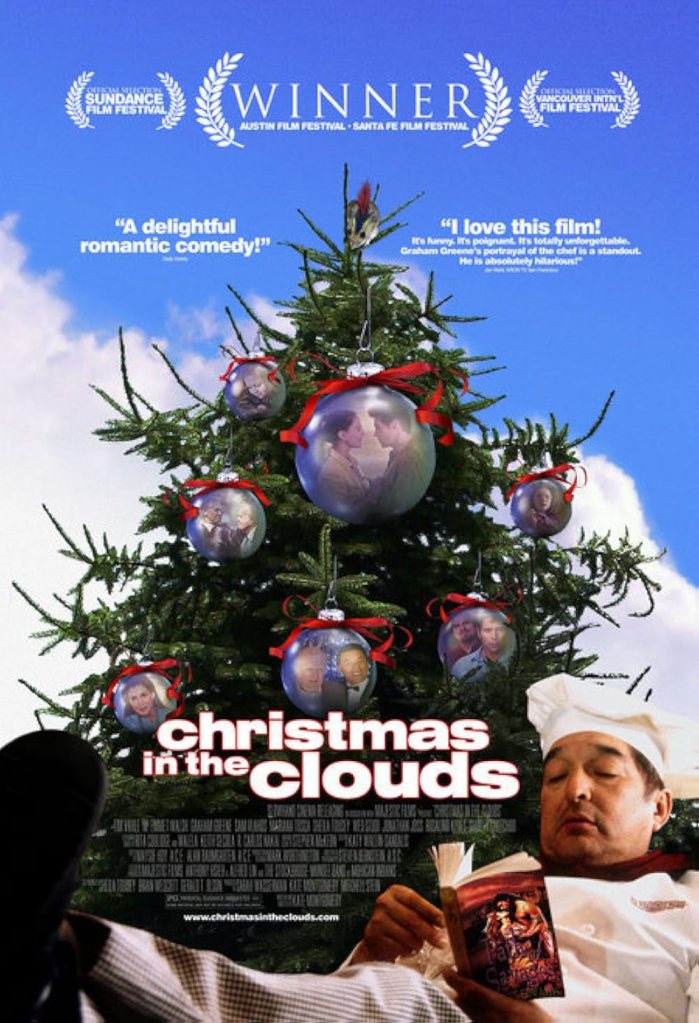
The poster for "Christmas in the Clouds" depicts a Christmas tree covered in large bauble ornaments, each of which displays one or two actors from one of the movie's many subplots. In the foreground, Graham Greene as Earl the chef has his feet up as he leans back to read a Native American romance novel.

At its best, the film is a celebration of native identity and diversity — the opening narration tells us bluntly that “this story’s about now-a-days Indians” and those are the threads in this movie I really love.  I love Ray’s pride in his work, which at one point spills into a pep talk to his employees about how their nation built the place, and the people who own and run it are native, and they deserve the best — which includes getting a better rating in the travel guide than some white corporate ski resort down the road.  I love all the glimpses of what life is like on the rez — the front desk manager’s immersion in ridiculously over the top romance novels starring a kind of indigenous Fabio, and the scenes of multi-generational families gathering at the bingo hall, and the ways in which children and families intersect with the business of running a resort because there’s a sense that the whole community is invested in this place.  I’m grateful that the film doesn’t present stereotypes to us like I’ve seen in other works about native people – we don’t get any stoic warriors or alluring princesses here, and the only person struggling with alcohol addiction is a flabby old white guy.  It feels like a fun space to be in.  I wish it was a little more precise about the native nation we’re working with — I have never felt it was specific enough, though I’ve seen other reviewers claim the characters are supposed to be Apache (I think they may be getting confused by Joe’s old truck).  Given the setting, though, and the fact that the credits thank the people of the Uintah and Ouray Reservation, I think the most plausible in-fiction answer is that these people are connected with one of the bands of the Ute nation — it was great to see from the credits, at least, how engaged the production was with native organizations, since again, it often felt successful to me on that front.

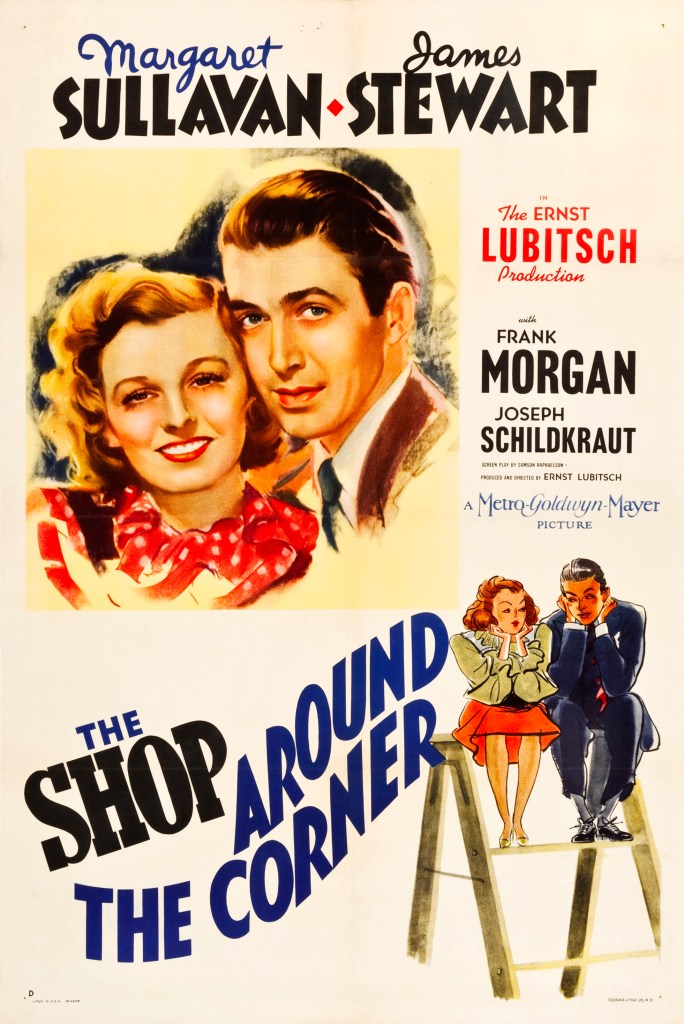
Where it struggles…well, let’s start with the inexperienced writer/director, Kate Montgomery.  Kate’s a white woman, and though she obviously approached this work with a desire to be supportive of native stories and performers (almost the entire cast, as far as I can tell, is Native American) she’s also an outsider.  More importantly, as far as I can tell, this is the one screenplay she ever wrote — at least the only one that was ever produced — and I think that just limits how well she’s actually going to evoke the world she’s trying to portray.  The actual plot feels borrowed from so many other movies — secret pen pals from The Shop Around the Corner, and a ski resort with no snow as the holidays approach from White Christmas, and a misidentified undercover VIP at the hotel from an admittedly very funny episode of Fawlty Towers, and an unlikely buddies in bed together scene from Planes, Trains, and Automobiles, etc.  There are flashes of funny insight here — writing a role for the incredibly talented Graham Greene to play Earl, the vegetarian native chef who’s a wizard with eggplant but absolutely does not want to cook buffalo or venison no matter how much they need to impress a travel guide, for instance, was an amusing idea.  But often the writing feels just a little forced.  I think there’s some inexperience in the cast, also, and there are times when there’s just not a lot of energy on screen — the people talking are generally nice people and you’re rooting for them, but some combo of the camera work and the editing and the writing and the performance is leaving it a little flat.

Another result of her inexperience, I’d argue, is just that some scenes needed one more take — I’m sure this was a movie put together on a shoestring budget, but virtually every line by M. Emmet Walsh, the white travel writer and by far the most experienced actor in the cast, is so hammy that either he was refusing to take her corrections or she didn’t realize how odd the contrast would be between his cartoonish expressions and gestures and the much more composed, natural performances of basically every other actor she’s got.  Maybe I shouldn’t blame Montgomery — I just feel a bit disappointed, sometimes, when I can feel the movie losing my engagement a little while I’m leaning in and ready to enjoy it.  And I don’t know who’s responsible for casting here, but I’ll admit, I was seriously bummed to find out that the leading lady here, the character of Kristina Littlehawk (a Mohawk woman, in the script), is being played by Mariana Tosca, a woman of Greek descent.  I mean, Mariana’s pretty and charismatic, but the whole point here is representation: come on, you know?  Irene Bedard is right there.  Or Kimberly Norris-Guerrero?  And heck, it could have been any number of other native actors whose names I wouldn’t know — this is a tiny indie film and there’s no way Mariana Tosca was a name they needed on the poster.  Again, I’m not criticizing her performance at all: I just wish that in a movie whose biggest raison d’etre is presenting native holiday movie stories with a native cast, the romantic lead was part of that experience.

But don’t let me talk you out of trying this movie, especially if you’re the kind of person who enjoys the Hallmark/Netflix/Lifetime holiday movie experiences — I think this film is working in that TV world of giving us some attractive people and a goofy but charming setup and a lovely setting.  Nobody watching The Christmas Prince 6 is there to see Oscar-nominated acting performances — you’re there to get the same joys folks get out of all sorts of other media we usually call “guilty pleasures” but I’d argue there’s no need for us to feel guilty (and hopefully we don’t).  There are more than a few scenes in this movie where we know exactly what’s going to happen — like, when an employee asks “are all the guests out of their rooms, because I need to turn off the hot water for a second”, we know that a guest is, unbeknownst to the staff, slipping back into their room for a shower, right?  And you’re either going to roll your eyes at it or you’re going to giggle with delight — in the same way that some people love the moment in every James Bond movie when someone asks him his name or what he wants to drink and we already know the answer, and some people don’t.

The rom-com premise here mostly holds together, I think — it could have gotten very weird when Tina learns late in the film that her flirty pen pal wasn’t Ray at all, but his father Joe (I promise, this is no spoiler, the audience has been in on this since the movie’s opening scenes), but it just doesn’t, and I think the characters have convinced me that that’s how it would actually happen.  Truthfully, in a film that’s tying up a few too many bows neatly for my taste, the ways in which the Tina and Ray misunderstandings unfold in the final act are in fact surprisingly successful: I criticized Montgomery’s writing enough earlier that I should be direct here in saying she definitely didn’t choose the easy or obvious moments in the end, and I was really pleased by it.  There’s a lot of tension in the middle portion of the movie, though, and at times it does feel mostly like narrative contrivance that’s keeping everyone from saying the words that would actually fix things.  My experience with the film is definitely a roller coaster, with plenty of ups and downs.

One more element that I think is important to mention is the music, because it’s great.  From the opening moments, we’re hearing music by native artists — it helps establish a sense of place really effectively.  Even later in the film, when we’re hearing instrumental adaptations of more familiar holiday music, the arrangements are noticeably unfamiliar — all of them composed and performed by a native musician.  And when the end credits roll and I hear Keith Secola singing NDN Karz (a song I discovered a couple of years ago when I was assisting a friend with a native music playlist for a history course he was teaching), well, I’m smiling pretty wide.  I love the ways this movie takes me somewhere new, while delivering something pretty standard in terms of the actual dot-to-dot details of its primary plot.

I Know That Face: Well, to dispose of him reasonably quickly, we will all recognize the face of the white alcoholic travel writer: M. Emmet Walsh, who’s playing Stewart O’Malley, has been in so many things I’ve seen, and as far as holiday media go, you might recognize him as Walt Scheel from Christmas with the Kranks.  The native cast members have seemingly had fewer holiday media opportunities — native performers get fewer opportunities in general, based on all I’ve read and seen about Hollywood’s interactions with them — but I was delighted to learn that Rita Coolidge (who plays Ramona, the front desk person, here) is the voice of Melissa Raccoon in The Christmas Raccoons. (If you did not grow up on The Raccoons on CBC like I did, well, you missed something.)  And speaking of Canadian television, we cannot fail to note that Graham Greene (the pained but proud vegetarian chef named Earl), among his many roles on screens large and small, appears in 27 episodes of The Red Green Show as Edgar K. B. Montrose, including “It’s a Wonderful Red Green Christmas”, and appears as Colin Reid in the TV movie, A Beachcombers Christmas.  I dimly remember the Beachcombers from my Canadian TV-watching youth, and I have a much more comprehensive knowledge of (and affection for) Red Green and his crew — if you don’t know it, well, I’m pulling for you.  We’re all in this together.  Keep your stick on the ice.

That Takes Me Back: I liked that at check-in for the hotel, the desk attendants were handling paper reservation cards, and handing over an actual physical key for the hotel room: sure, it’s handy to use my phone as a key these days, but it was fun to remember what a hotel was like when I was young.  I did think that pen pals who actually write each other letters in the mail in 2001 was pretty wild — this wasn’t that long ago, and it feels to me like even a few years later, it would have seemed totally implausible.  After all, this movie is already a couple of years after the AOL conversations in You’ve Got Mail.  And I had to smile at the use of the “funny papers” as simple Christmas wrapping for presents, in one scene, since these days most people would be far more likely to have wrapping paper around their house than they would have access to the comics section of a physical newspaper.  Times really do change.

I Understood That Reference: The movie has a lot going for it, but I didn’t notice any references to Christmas stories or characters: Christmas in general, as you’ll see immediately below, was downplayed a bit by this script.


Holiday Vibes (3.5/10): It only really begins to feel like Christmas in the final half hour, though it does really ramp up that energy abruptly then to include gifts and carols and gatherings that boosted this rating substantially.  Prior to that point, we get some good background hotel decor at times, but not much else.  The movie’s many plots are already busy enough without trying to add too much Christmas pressure to them, I think.

Actual Quality (7.5/10): It’s hard to separate the pleasant quality of a representative native cast and setting from the moderately hackish quality of a lot of the screenplay and direction.  This is a film made with great intentions and not quite enough skill to land the plane they’ve decided to fly in.  I feel like a 7.5 is about right in terms of me being honest with myself — much better than the worst stuff I’ve watched for this blog, but not as strong as the good rom-coms I’ve watched.  I’ve seen this film called “a Lifetime holiday movie but with a bigger production budget” and that doesn’t feel inaccurate — and as I noted earlier, I think that what it’s actually offering is going to be plenty appealing to an audience that’s looking for it.

Party Mood-Setter? Honestly I think this might be great for this kind of situation — the strengths of the setting and the music will still come across well if you’re slightly distracted while it’s on, and you can lean in or tune out as you like to the various plots as they appear and disappear.  The film’s a pretty solid PG, too, so I think for most families it would be fine in the background (just one scene where Ray and Tina are waking up together, and it’s still coming across as pretty demure even then).

Plucked Heart Strings? I mean, honestly, no.  The stakes are pretty low here — the resort isn’t about to close unless things work out, Tina and Ray are looking for love but not in dire straits, etc. — and therefore any happy endings we get are pleasant but not exactly material that makes you tearful with joy.  That’s no criticism, either — the film set out to be pleasant company and I think it does achieve that goal.

Recommended Frequency: I can’t really imagine making this an annual holiday tradition unless something about the reservation setting really grabs you, but I have gotten enough good things out of it the two times I’ve seen it that I would certainly watch it again some day.  For me I think it’ll be one I turn to now and again as a change-of-pace movie that reminds me there are a lot more stories to tell about the holidays.  But I hope that, in the long run, enough native artists get the chance to make something in this cultural space that I can spend my time watching newer (and better) movies than this at the holidays that still achieve the kind of representation that matters, to me.

You can pretty easily watch Christmas in the Clouds if you’re so inclined: it’s available on ad-supported streamers like Tubi and Pluto and The Roku Channel.  It’s also available on Amazon Prime, but only with ads for some reason, so being a subscriber won’t help you dodge those (if you follow that link, the movie description’s in Spanish for some reason, at least on my screen, but I checked and the audio track appears to be in English).  If you’d like it on DVD, Amazon will sell you one for less than $6, and Worldcat tells me over 400 libraries worldwide have one to lend you.  If you’re like millions of Americans and you go in for TV movie romantic comedies each December, I really think this one could be your thing, and I hope you give it a try if so!

Happiest Season (2020)

Review Essay

I’ve tried my best to avoid spoiling the final acts of movies here at Film for the Holidays, but it’s going to be tougher than usual in this review, since so much of what I think works best about this film happens in its final third.  I’m committed to not giving up all this movie’s secrets, though, so if you come away from it thinking, “I still don’t get why he likes this movie,” I hope you can trust that there’s some depths in its final minutes that I couldn’t talk about.  Happiest Season is uneven, like many of the romantic comedies I’ve watched for this year, but when it’s on its game, it has an incredible power.

I’m not even sure, honestly, if this is a “rom-com” — our central couple in Happiest Season are already comfortably paired up when the story opens as they visit a “candy cane lane”, with Christmas enthusiast Harper trying hard to hype up the holiday to a somewhat guarded Abby, though it’s clear from the beginning that Abby at least loves how much Harper loves it.  It only really becomes a comedy about relationships as the film progresses, and it becomes clear that all was not as happy here as it at first seemed — or maybe rather, all was happy once, but the act of going home for Christmas unravels to some extent a relationship that had once been closely knit.  Because, of course, Harper and Abby are a sweet young lesbian couple…and Harper, who wants Abby home with her for Christmas, is (unbeknownst to Abby, initially) still in the closet at home.  So, this isn’t a story about falling in love.  This is a story about whether your love is something you can be open about…and about the somewhat funny but more frustrating and sad experience of having to pretend to be someone you’re not in order to win the chance to be the person you’ve always been.  Is that confusing?  Well, Happiest Season is a little confusing, at times.

The poster for "Happiest Season" features the main cast members, posed in a photo inside a picture frame which is hanging slightly askew.  All of them are smiling except for Mackenzie Davis as Harper, who looks glassy-eyed and worried.  Underneath the title, the tagline appears: "This holiday, come out and meet the family."

I think part of the confusion, for me, is that the film is trying to sandwich together really painful (if sometimes painful and funny) realities about life as a closeted adult with the kind of over-the-top goofball comedy of the agonies of being around your partner’s weird family and childhood friends for the holidays.  The realities about the closet really work: it’s so clear from the beginning that Harper both thinks she can earn her parents’ acceptance and love if she closets herself just a little longer and understands that in fact that’s not really true at all and that the idea of being who she is at home terrifies her almost as much as it would terrify her parents if they ever figured it out.  Abby’s road is so hard to walk — as someone who clearly hasn’t hidden herself from anyone in years, the act of hiding becomes exhausting fast.  She has to start asking herself if Harper’s so good at hiding from her family that maybe she’s been hiding from Abby too….maybe, even, that she’s more hidden around Abby than around her family?  This is a bittersweet movie, then, but one that’s got my attention.  The problem is that it is grafted onto the broadest possible comedy: this family isn’t just performatively happy at Christmas (like many families are), the dad is running for office and it is in fact imperative that everyone self-consciously perform happiness this Christmas at an endless string of semi-public social engagements.  Harper’s sisters aren’t just weird and competitive: one is so weird it feels like she only is allowed to speak to other humans for a week at Christmas, and the other is so competitive that she can grab Harper in a WWE wrestling move and we don’t find it surprising.  It’s not just awkward being back around your partner’s childhood friends who know stories you don’t: Harper literally has not one ex in her orbit but two, one her secret lesbian soulmate from high school and the other the boy her parents always figured their straight daughter would marry someday, and she ends up hanging out with the latter at the world’s most garishly overbearing sportsbar that’s literally called “Fratty’s”.  The script is worried we won’t get it and therefore piles on the awkward until the situation can barely hold up underneath it.

The way I survive the movie’s long second act as a viewer, then, is by latching on to some really good acting work that’s showing up on screen. Kristen Stewart was much maligned back when everyone thought she was just the awkward vampire girl in the Twilight movies, but I think by now most folks know she’s a real talent: in Happiest Season, she owns the screen with incredible poise and calm, almost like a young Jodie Foster (speaking of folks who had to stay closeted publicly into their adult years).  Another incredibly successful performance is Abby’s best friend John, a flamboyantly gay man played by Dan Levy — on the page, he really shouldn’t work, since he switches back and forth so freely between acts of outrageous stupidity/goofiness and moments of incredible candor and insight, but I don’t know what to tell you.  Levy is really, really good at both sides of this, ultimately selling me on John as a gay man who masks the pain of his past with comedic patter that feels like something out of a Will & Grace episode, but who is ready at any moment to draw back the curtain and reveal enough of the truths he’s earned by living to help pull somebody else (in this case, Abby) out of the flames.  I wish the film established his depth a little earlier, but there’s no question he comes into his own as it progresses.  And the other brilliant light in the supporting cast is, as should come as no surprise, the effortlessly deadpan Aubrey Plaza playing Riley, Harper’s high school lesbian girlfriend who got not just dumped but outed by Harper in a desperate but selfish act of self-preservation.  Plaza is always wry and compelling, in my experience, as a performer — she knows how to be both cool and genuine in the same moment, which is hard to achieve — and as Riley she is given a part that somehow isn’t a corny caricature, unlike literally everyone else from Harper’s hometown.  Instead, she gets to play this nuanced, wounded but still walking young woman who’s never fully escaped the social ostracism she faced as a teenager but also has never fully achieved the kind of exit velocity she’d need to exit the gravity well of this Stepford town with its white elephant gift exchanges and ladies who lunch and a single, lively drag bar that seems like the only place to have any fun at all.  The movie could definitely use some more of Riley and John at the expense of Harper’s weird family, whose screentime seems to mostly consist of flailing attempts at humor that land only intermittently, for me.

As I said up front, there’s a lot I want to say about the final third of this movie, but I’m going to try to steer around most of it so you can experience this film on your own terms.  In the end, the tug of war I’m describing above, which kept pulling me into this film and then knocking me back out again, is finally and powerfully resolved by the movie pushing in all its chips on being honest and authentic and a little painful in facing what it’s like to come out (and what it’s like to bear the burden of being kept in the closet by the person you love).  Characters start to get a handle on themselves, a handle on how the things they’ve been saying or doing have affected other people without them knowing it, and a handle on the question of what it means to be a part of a family (whether that’s a couple in love or a collection of parents and kids sharing a holiday together).  Not everyone grows up in the ways or at the speeds you want them to, and not every resolution is satisfying, but I have to be honest — I cry at Happiest Season, every time I watch it, because it does achieve the agonizing truth of all of these things at once in a couple of powerfully written and delivered speeches by characters who are finally opening the doors to themselves.  The movie’s ultimate commitment to saying what it means rather than trying to fit into some imagined Hollywood formula is maybe a bit too late for this to be a great motion picture, but that doesn’t mean that the moment itself isn’t great.  Because it is, every time, for me.

As is often the case here at FFTH, I’m left pondering what a Christmas movie is about, and what it’s supposed to be about.  Here, I think the movie is about the second chances in life — those we give and those we get, even when we’re giving them to the undeserving or getting them while being undeserving ourselves.  It’s about the ways in which we apologize inadequately because we can’t understand the harm we’ve done, and how even an inadequate apology builds enough of a bridge for understanding to cross it.  It’s about love — and the difference between love as an exhibition for the audience you think is watching and love as the desperate and daring act of selfless devotion that it has to be if it’s going to do anything worthwhile in our hearts.  Those things resonate, for me, as Christmas messages — tied to the best Christmas stories I know, and to the underlying power of the feast I celebrate at Christmas — and therefore Happiest Season, in the end, sticks its landing, no matter how many minor deductions it received from the judges while it was spinning in mid-air.

I Know That Face: Aubrey Plaza, who here plays Riley Johnson, Harper’s first girlfriend, previously voiced the role of Grumpy Cat in Grumpy Cat’s Worst Christmas Ever — a movie that, I am informed by a relative, may be one of the most unsuccessful things ever committed to film, but surely we can’t blame Aubrey for that: the project is astoundingly ill-conceived at takeoff.  Mary Steenburgen, here playing Harper’s painfully superficial and tightly-wound mother, Tipper, is a veteran of television and movies: for the holidays, she’s been Maggie in Zoey’s Extraordinary Christmas (a Roku Channel movie, I am informed), she played Marilyn (one of the quartet of divorced parents being visited) in Four Christmases, and back in the 1980s, she was Ginny Grainger, a cynical mother learning the meaning of the holiday in Disney’s One Magic Christmas.  And Victor Garber, who here plays Harper’s ambitious politician father, Ted, has been in everything, of course: in terms of holiday fare, he voices Fluffy in Bob’s Broken Sleigh, he’s Taylor in Call Me Claus (a TV movie in which somehow Whoopi Goldberg has to become Santa Claus), he is the voice of the never-seen “Irate Neighbor” in the painful “comedy” Mixed Nuts, about which I have already probably written too much, and lastly he is Greg (Tom Hanks’s brother-in-law) in Sleepless in Seattle, a film whose inciting incident, of course, is a long appearance by a widowed father on a nationally syndicated radio call-in show on Christmas Eve.

That Takes Me Back: There’s not much here to be taken back to, it’s so recent.  My guess, though, is that a lot of the suburban sheen of Harper’s hometown is going to feel more and more painfully “early 2020s” over the years ahead.

I Understood That Reference: It’s a Wonderful Life is playing at the Guthrie Theater downtown — seemingly every year, which seems both plausible and like a nice tip of the cap from this film to a movie that was even more interested in second chances, etc.  And Santa Claus is making multiple appearances here, including references in conversation with the twins, a mention in the crowd participation song from the drag queens, and a plastic Santa being wielded as a blunt implement in a sister fistfight.  Oh, and Abby, very early in the story, accidentally bodyslams an inflatable Frosty the Snowman by falling off the roof onto him.  The film is a lot of things, but it’s never subtle.

Holiday Vibes (9.5/10): This movie really hits almost all the notes I could expect it to, from the glitter of a competitively decorated neighborhood to the agony of gift exchange, from the strain of trying to cooperate in the taking of the perfect family group photo to the cringe-inducing tedium of finding yourself at a holiday party with your partner where you know no one and are almost instantly abandoned.  The only reason I’m not stacking it up at a 10 is that Harper’s family are so over the top bizarre in some scenes that I think it takes me out of the moment a little and diminishes the reality I’m otherwise feeling.

Actual Quality (8/10): It is so hard to rate this film — the scenes involving Harper’s sisters (or, to a lesser extent, her parents) are excruciating enough often enough that I fidget while sitting through them.  But then I’m back in a scene showing me Kristen Stewart and Dan Levy or Aubrey Plaza, and everything is firing on all cylinders.  Enduring the movie’s roughest middle patches ends up being worthwhile, since the finish connects for me.  But what does that mean, in score terms?  I could argue this up a little and down a little, and I ended up trying to split the difference.

Party Mood-Setter? The tonal shifts would make this impossible, I think — at its goofiest it could be on in the background while you did something else, but you’d feel weird and sad trying to go on with mundane Christmas activities when characters start opening themselves up to each other tearfully as the film progresses.

Plucked Heart Strings? As I’ve already said, I can’t deny what this movie does to me.  It hits like a truck.

Recommended Frequency: I don’t think I would watch it every year, but I’m glad I’ve seen it, and I know I will watch it again.  I do think it’s strained a little by needing to break new ground here, though, and to some extent I’d rather hope for more inclusive Christmas movies that are a little better managed in terms of tone and intention.  I think this one opens the door for other kinds of storytelling that trust the audience just a touch more, but regardless of the films that follow it, there’s no question it achieves some moments that stick with you, and for that reason alone I would encourage you to make it a film you visit at least now and then at Christmas time.

Happiest Season is easily streamed if you’re a subscriber to Disney+ or Hulu. Sadly, though, that’s about the only way to view it, that I know of — it doesn’t appear to be rentable from any other service, and I can’t find a DVD of it in the English language that’s not an Australian regional disc that won’t play on most American setups.  Worldcat claims to know of disc copies in 90ish libraries, but I’m not sure those are any more playable in most systems in the United States.  If you don’t have Disney+ or Hulu, I think it’s worth a try geting a hold of one, though, if you can!

Ghosts of Girlfriends Past (2009)

Review Essay

I want to acknowledge up front that of all the films on the blog this year, Ghosts of Girlfriends Past is going to be the biggest stretch as a “holiday film” of any kind — other than a handful of snowy scenes establishing that it’s wintertime and a single shouted reference to Christmas, this movie really does nothing at all to position itself for the holidays.  But it’s undeniably a film that’s adapting A Christmas Carol, and for this segment, I knew that I wanted one of the Carol adaptations I reviewed to be something really radical in trying to reinvent the story.  The basic structure of Dickens’s novella is so classic and yet so easy to riff on that Wikipedia has an article dedicated just to its adaptations, and it’s enormous: everything from an experimental theatrical production called Fellow Passengers which stages the whole story with just three actors to The Passions of Carol which is apparently an adult film version of the story (um, “adult”, but you know what I mean) to the 1994 TV movie A Flintstones Christmas Carol in which Fred and Barney and Wilma and Betty present the whole story, though how on earth they make that work…well, maybe I’ll watch it someday.  Anyway, I wanted to try something interesting out for the blog that I hadn’t seen before — not The Passions of Carol interesting, but interesting all the same — so I picked Ghosts of Girlfriends Past.  All I knew about it was that it had a really talented cast (three Oscar winners plus Jennifer Garner, and it’s kind of astonishing she hasn’t picked up at least one nomination over the years) and the premise struck me as potentially viable — a cad is transformed by confrontations with the women he’s wronged — so I committed myself to watching it and writing it up.  I, uh, I have made some mistakes in this blogging project, folks, and boy howdy was this one of them.

So, I want to talk about why Ghosts of Girlfriends Past doesn’t really work in any way, but particularly through the lens of thinking about it as an adaptation of A Christmas Carol — like, I do think it’s also a bad romantic comedy and work of art in general, but primarily I think it’s clarifying for me as a lens for thinking about Dickens’s novella and the reasons it endures and continues to resonate with us.  At first, I struggled to understand why elements that I think work in the other versions of this story weren’t working here, but over time, I feel like I learned some things about where the magic in the original tale lies.

The poster for Ghosts of Girlfriends Past shows a smiling Matthew McConaughey facing left while a smirking Jennifer Garner facing right pulls on his scarf, as if to spin him around to follow her.  Framed photos of three attractive women hang on the wall behind them, each one ogling Matthew as if he is God's gift to women.  In front of them, the movie's tagline appears: "You can't always run from your past."

Before I do that, let’s just be up front about some things about this movie that are so gross, many of you would probably tap out of it immediately, since I nearly did.  The movie’s homophobia and transphobia are depressingly prevalent for a major Hollywood release in the 21st Century — it’s not just characters casually using slurs (though they do) but it’s also a script that thinks it’s super funny to allude, not once but twice, to the idea that you might accidentally have sex with a trans person who tricked you.  It’s not funny either time, but it’s also exhausting enough to me as a cishet person that I have to imagine it would be really grating for someone more personally touched by that kind of joke.  There’s also just so much rampant sexism, including more than a few really gross moments where a man’s abusing a position of power to degrade or objectify a woman — this is the kind of movie that would have been much harder to release after #MeToo, and in the wake of that movement this movie plays even rougher than it probably came across when it was first in theaters.  Furthermore, as I’ll explore later in the review, I think this sexism isn’t just gross as an attitude but it’s also really artistically backwards in a way that damages whatever mileage they were hoping to get out of adapting A Christmas Carol in the first place.

First of all, let’s tackle the movie’s biggest problem — Matthew McConaughey’s Scrooge analogue, Connor Meade, just isn’t Scroogeish in ways that will work for this story structure.  Scrooge is fundamentally miserable in a way that anyone can see: there’s nothing about his life that seems appealing or worthy of someone’s envy.  And I think that’s what makes it possible for us to empathize with his growth as a person in the story — he has absolutely committed acts of really vicious cruelty, but he’s done so much harm to himself in the process that the possibility of healing for everybody involved is a welcome relief.  Connor Meade, on the other hand, is this smiling sleazeball whose whole world (as we are immediately made aware) consists of being good at degrading and objectifying women for fun and profit, in that order.  As the movie presents it, every man wants to be him and every woman wants to do him — every woman but one, of course, the perfect woman and therefore his unattainable heart’s desire.  A movie structured around THAT arc, in which Meade has to give up all his fun and wild times in order to get the one thing the world won’t give him, is an almost perfect inverse of Scrooge’s horrified and awestruck realization that he has been clinging to wounds and woundedness, and that there will be a release of joy in his life by unburdening himself from wanting literally anything more than to see other people made happy.  Sure, the screenplay attempts to make the connection — at one point, while Meade is breaking up with three women simultaneously on one Skype call (I can’t believe it either, folks, and I saw it with my own two eyes), he is accused by them of having taken their love without returning it, “hoarding love like a miser”.  Yeah, it makes no sense in context either.  Also, this film absolutely does not present women in general as offering Connor Meade anything other than casual, gleeful sex, and as the screenplay makes repeatedly and tediously obvious, he’s been more than happy to return the favor, no hoarding whatsoever.

Nearly as huge a problem, though, is Michael Douglas’s Jacob Marley analogue, Uncle Wayne — in fact, Uncle Wayne’s an even bigger swing and miss by the screenplay, but as a secondary character he perhaps does a little less damage.  Here’s the problem with Uncle Wayne in a single phrase: he’s not repentant.  Like, not even a little.  He was a grade A slimeball whose toxic attitudes about women he instilled in an impressionable young Connor — now that he’s dead, you might think he’s come to terms with how disgusting he was being, but no, he just has some vague hand-waving to do about how Connor, he’s got this special connection to Jenny (poor, poor Jennifer Garner in yet another thankless role) and that’s real special now, you don’t want to keep having fun with thousands of hot younger women, you want to settle down.  The screenplay might as well have him say “I had my kicks, Connor, but you shouldn’t have yours”.  He keeps reappearing throughout the movie, too, but only because the movie seems to think we will find him a charming jerk, I guess — also because he looms large in the “Ghost of Girlfriends Past” sequence as Connor’s surrogate father after being orphaned.  Regardless, though, he’s so consistently awful: he makes a joke to Connor in middle school that alleges that Connor’s middle school girlfriend has an STD, and even at the end of the movie after Connor’s “redemption” there’s Uncle Wayne in the corner, hitting on a ghost who reminds him she’s underage.  Jacob Marley’s power in the original comes from his hauntedness — he is burdened by the gravity of his own harms, and he is panicked for the safety of his dear old friend who is blithely continuing to forge an ever-longer chain.  Scrooge is genuinely rattled by Marley up front, begging him to “speak comfort” to him — before even the first Spirit’s arrival, Scrooge has already come into contact with real fear.  Without that context, we are just cruising into Connor’s past as though it might be fun to revisit all these “conquests” — language I cringe to use but it’s definitely how this film treats sexual interactions between men and women, at least.

And then, though I think Emma Stone’s Ghost is probably the best performance in the movie, we hit a Past segment that just sucks.  It sucks to have Connor hero-worshipping sleazeball Uncle Wayne — didn’t the screenwriters recognize that what Scrooge found to admire in his own past was the warm and friendly Fezziwig whose generosity stood in stark contrast to Scrooge’s adult life, and not some cruel miser who had inspired Scrooge’s life of misdeeds?  It sucks to see Emma Stone’s good work undermined by such stupid writing — when she (Connor’s first intimate partner) takes him to the scene of their first and only time, she starts hyping herself up like she was Neal Armstrong landing on the Moon.  Watching a 20 year old actress playing a 15 year old girl dancing next to 40 year old Matthew McConaughey about how pumped she is that she got to be the first person to sleep with Connor Meade, King of Sex….  Wait, what was the point of this sequence?  Oh right, how sad and empty all this action makes him.  I guess.  Honestly, half of the movie’s problem, everywhere and at all times, is how little it ascribes agency to Connor and how much it treats women in the aggregate and in specific as a problem for him.  In a memorably awful scene, we see Connor confronted en masse by every woman he’s ever slept with — they descend on him like some rabid horde, desperate for him, and he emerges from the vision terrified.  But here’s the thing — what’s terrifying Connor is the women and their insatiable lusts.  Not his own greed and harm.  It would be like Scrooge having a vision of the money at the bank trying to drown him and then waking up, scared of the bad, bad gold for making him foreclose on all those mortgages.

The real world sequences into which Connor keeps being reinserted between Ghost segments — another notable departure from the Christmas Carol outline — are bad in another way, and again it has to do with the film’s relentless misogyny.  Connor’s at a wedding, the wedding of his brother in fact, and so we keep seeing various elements and characters of the wedding appear on screen — a lunatic bridezilla who, as presented, seems like someone who would be awful for Connor’s brother to marry.  Three horndog bridesmaids who seem to have made a bet with each other over who can first “land” Connor Meade if you know what I mean and honestly, dear reader, I hope you don’t.  I hope by this point you’ve dissociated and are in a happier mental place.  About the only non-awful people at the wedding are Connor’s brother Paul who still believes in him — the story’s Fred analogue — and then Jenny (the prize for becoming Good Connor) and Brad, a kind, empathetic, professional dude who’s hitting it off with Jenny and therefore is treated purely as an obstacle / plot device by the screenplay and not, you know, a real person who has his own journey to make.  I’d complain about Jenny not getting to be a real person either but by now I’m figuring we’re all clear on how all female characters are treated here — it’s just interesting, I guess, to notice that the only men who treat women as having agency are also being brushed aside.

I think the underlying challenge here is that the movie has no real thesis.  Dickens, goodness knows, had a thesis about the cruelty and inhumanity of early Victorian England — we can be as critical as we like of the ways Dickens’s treatment of social harm presents it too much as individual sinfulness and not enough as systemic and systematic harm imposed on a large scale, but the guy had identified an actual problem and wanted to awaken some kind of human response to address it.  What is the problem here, in this film?  At one point, Connor goes on a rant about how “these days” we’ve made being single a crime…dear reader, you are living in the 21st Century.  If you had to make a list of the problems we face “these days,” would that have made your top 100?  It would not have made mine.  Are we expected to believe that men like Uncle Wayne and Connor would have found happiness and joy in faithful monogamy had the women of America not been uniformly sexually predatory (except for Jenny and I guess whoever Uncle Wayne’s Jenny was)?  The film seems to kind of believe that Connor screwed up by not “going for it” with Jenny when they were about 11 years old and she had a crush on him, but what exactly is that argument?  The one time in his life Connor didn’t treat a woman like a scratch-off lottery ticket, it was somehow the wrong thing to do?  There’s a hint at times of a much more unsettlingly awful thesis — namely, that negging and other forms of cruel game playing “work” on women to an almost universal extent and that therefore this is, from a certain perspective, kind of their fault.  But the less said about that kind of garbage the better — that particular element really pinpoints this movie as having been made in the late 2000s, in the years immediately after Neil Strauss’s deplorable but then-ubiquitous pickup artist advice book, The Game, hit shelves.

Fundamentally, the structure of A Christmas Carol isn’t working in this movie because the Ghosts aren’t really there to do what the Ghosts do in Dickens’s novella.  The original version is designed to make Scrooge mindful of humanity — to connect him empathetically with human caring and human concern, and to give him a perspective on his own life as it might appear to others around him.  The Ghosts in this version seem primarily to be working to convince him that he would be happier with Jenny than he is chasing an endless parade of hot women around hotel rooms — I’m not saying that’s bad advice, to be clear, especially given that I much prefer my own domestic situation to Connor Meade’s life as presented in the film’s opening act.  But it’s so selfishly focused: the Ghosts’ advice is rarely about the harm Connor’s done to others or the good he might have done, and instead is on trying to persuade this scoundrel that he’s more miserable than he lets on, but he can fix it all with the right woman, who fortunately for him has had the undying hots for him since sixth grade.  I feel like in the end the only thing Connor’s learned is that he should have been willing to make the personal sacrifice of staying in bed and snuggling Jennifer Garner, a sacrifice I imagine millions of American men (heck, people of any gender) would find it pretty darn easy to make, themselves, without having paranormal visitation on the subject.

I haven’t gotten much into the movie’s later developments — honestly, I think it gets more depressing as it goes.  I could have gone all my life without hearing Connor Meade — post-two-ghosts, by the way, this guy should be on the verge of personal realization and redemption — saying the phrase “your little estrogen lynch mob.”  He then meets the Ghost of Girlfriends Yet to Come and starts hitting on her, at which point, folks, I just started laughing.  Not at the film, but just at the fact that I had decided to watch this thing.  I mean, come on.  Imagine if Scrooge meets the Ghost of Christmas Yet to Come and the first words out of his mouth were “oh great, you’re here, let’s go imprison a debtor together, shall we?”  The movie doesn’t even believe in its own half-assed redemption arc.  Why should we?  And yet, I guess I’ll say this — this stretch of the film, before the finale, is probably the best, most Christmas Carol-like it gets.  Yet to Come is mute, Connor faces his own death and is panicked, there’s something happening for him even if it’s not particularly inspiring.  And then there’s a car chase and an ex-Marine gets punched out and Connor Meade gets to deliver a preachy, heavy-handed message about the power of love and happiness and why am I still writing about this film.  Seriously, folks — if you can’t get that Scrooge ought to spend the final sequence of A Christmas Carol doing good for others (and not lecturing others while doing some good for himself/his boys), you should not have undertaken the work of writing an adaptation of A Christmas Carol in any medium, let alone an expensive Hollywood motion picture.  The End.

I Know That Face: Breckin Meyer, who plays Connor’s optimistic but increasingly frustrated brother Paul, appears in Go, a 1999 black comedy thriller that is not at all a holiday film but is also absolutely set at Christmas: in other words, it’s probably as much a holiday movie as Die Hard is, and therefore a movie I’ll cover here at some point, I assume.  In Go, Meyer plays “Tiny”, a supporting role as the buddy of Simon, the guy who was supposed to sell ecstasy to his co-worker before he left for Vegas, and oh boy I just cannot summarize this movie: it’s a trip.  Paul’s bridezilla fiancée Sandra is played by Lacey Chabert, who is Dana, one of many bodies to hit the floor in the horror flick Black Christmas (the 2006 version, for those who know there are more than one).  Chabert then gets into the world of Hallmark Channel acting so successfully that there’s no way I can name all of the many Christmas TV movies she appears in, but if you’re thinking “hey, wasn’t she in that one cheesy holiday movie,” you are absolutely correct.  Most recently and memorably, she plays the leading lady role in Hot Frosty, Netflix’s “let’s say a grieving widow found a snowman so attractive he became her real life lover” answer to the question “what if we made Jack Frost but way, way weirder?”.  At this point, I hope Ms. Chabert is at least having a chat with her agent about which scripts she gets shown, but maybe she’s having fun and if so more power to her.  And Daniel Sunjata, who plays the perfect potential boyfriend Brad (whom Jenny really should end up with instead of Connor), has one other holiday appearance, in a Disney TV movie entitled Christmas…Again?! as Mike Clybourne, the single father of a 12 year old who turns Christmas into Groundhog Day with an errant wish.

Spirit of Christmas Carol Present: There’s so little of A Christmas Carol here in any kind of genuine fashion, but I guess I’ll give it to them that ultimately our “Scrooge” figure is ushered by a mute spirit of Yet to Come to his own gravesite, only to wake up and sprint to his window and shout to a boy below “What day is it?  Is it Christmas Day?”  That’s not just the most Christmas Carol moment in the script, but it’s one of the few that I would argue seems to actually work.  

Spirit of Christmas Carol Absent: <insert full text of A Christmas Carol, by Charles Dickens>  I mean, there’s no point trying to make a list this time around.  There are Ghosts and a put-upon personal employee and a sad childhood memory but even in those cases this is missing so much of what makes the original special, and the list of things they’re not even attempting is vast.


Christmas Carol Vibes (2.5/10): Let’s put this as charitably as possible: I’ll admit that this is, fundamentally, a story about how an awful person is changed by an encounter with a bad and deceased former role model, followed by three spirits who represent the harm he has done, is doing, and is gonna do.  He seems happier in the end.  That’s about as far as I can take it.  Otherwise, this is just a version of the story that is out of touch with the novella’s moral universe — it does not understand what’s wrong with Scrooge, or what Marley hopes to awaken in him, or why the Ghosts and their visitations get through to Scrooge, or what it is that Scrooge has learned in the end.  It is more like A Christmas Carol than Die Hard is, or Home Alone, but not by much.

Actual Quality (2/10): I cannot believe there’s a movie bad enough to make me long for my experience watching some of my earlier panned movies, but I would gladly watch Jack Frost twice if it meant I never had to watch this movie once.  Everything about the screenplay (and direction) in this film works against what few strengths the performers brought to the film, so that even when they’re successful, it’s upsetting.  I’m slightly afraid that one of you will turn out to be a huge fan of this one, but I guess if you do, we’ll see what you have to tell me.  I really can’t imagine coming to like this film, though, regardless of what I hear about it!

Scrooge?  Oy.  I mean, McConaughey’s doing a serviceable job bringing Connor Meade to life — as noted above, though, what’s frustrating about this portrayal is that it has so little to do with Scrooge in A Christmas Carol that I don’t think I got anything new or helpful out of it.  The highest praise I can give this performance is that the character as written is pretty insufferably awful, and Matthew must have acted it well, since I really, really dislike Connor Meade even when he’s reformed at the movie’s end.  

Supporting Cast?  The cast as a whole is under-served by the material, which I’ll acknowledge up front: we can’t possibly hold all these actors accountable for the mess they’re inhabiting.  And yet I’d also say that at least most of them are not doing the script any favors, much of the time.  For praise, I’ll single out Emma Stone in certain scenes (in the Girlfriend Past role), and Jennifer Garner at least some of the time (acting as this film’s Belle, I guess, maybe mixed with Tiny Tim but what am I even saying anymore) persuades me that there’s a real character on her side of this broken relationship.  Otherwise, this cast mostly consists of performances I wish I could forget (and I bet they wish it also).

Recommended Frequency?  I have no idea why anyone would watch this even once.  I am absolutely never going to watch it again.  I would promise to do better research in the future, but I do expect that at least one side benefit of a blogging project like this one is occasionally getting to watch the blogger suffer for our own amusement.  If so, I hope you’ve enjoyed this with my compliments, and I’m sure I’ll walk into a fence post again for your entertainment sometime again, either this season or next year.

What are you doing here?  Go watch something else.  Okay, fine, if you’re saying “there’s no way this is as gross and unendurable as James is saying, I’ve got to see it”, Max will show it to you if you’re a subscriber. You can rent it from every streaming service that rents movies, as far as I can tell, and if you want it on DVD for a white elephant gift exchange with people you don’t like that much, Amazon will sell it to you for less than $5.00 because in this case, at least, the free market is accurately assessing the supply and demand curves for this film.  This thing is on disc in over 1,400 Worldcat libraries — a huge increase over basically every other film I’ve yet checked in Worldcat — because we live in an unjust universe.  If you check it out of the library, that circulation data may convince them to keep the DVD on their shelves, so I advise against it strongly.  And if you do love this movie, friend, I am sorry for being this hard on it, but it’s one of the worst things I’ve watched as an adult: I guess I would invite you to change my mind, but honestly we should both probably just save our time for other things.

The Shop Around the Corner (1940)

Review Essay

So much great art arises from a confrontation with our deepest fears and senses of unease about being human, and I feel like that’s the force that propels The Shop Around the Corner every year into being a film where the whole is somehow greater than the sum of its parts.  When I try to sketch out the plot, it feels like a simple (if clever) premise for a film I would watch and smile at but quickly forget.  And yet, it’s more than that for me.  In watching it multiple times in the last year, with this blog in the back of my mind and beginning to loom larger, I think what I’ve worked out is that this is a film about how hard it is to know yourself or other people — how easy it is to mistake and misdiagnose matters of human interaction — and yet how thrilling it is to finally see someone else or be seen.

Again, the premise of this movie, if you don’t know it, is simple enough: we are concerned with the people who work at Matuschek & Co., a leather goods retailer trying to keep afloat in Budapest amid the Great Depression.  Specifically, we’re most concerned with Matuschek’s star employee, the brilliant if brittle Alfred Kralik, and the young woman who slips through the door early in the movie’s first act hoping for a job at Matuschek, the effervescent Klara Novak who seems never to have had an unexpressed thought.  Sparks fly immediately and Novak’s success in securing a position via her moxie don’t reduce the tension — he’s bothered by her frankness and she by his reserve.  And what neither of them know is that, by an extraordinary chance, they’ve come into contact with their secret, romantic pen pal, since Kralik and Novak have been sending impassioned, elaborately written letters to each other via a postal box with pseudonyms, along with an express agreement not to sully the intellectual beauty of their conversation with such mundane details as where they live and work.  Yeah, yeah, it feels like a premise cooked up in a lab to support a romantic comedy — if the movie wasn’t working well, I guarantee it would feel creaky.  Yet, to me, it never does.

The poster for "The Shop Around the Corner" features the main characters twice -- in the top left, Margareet Sullavan and James Stewart are looking directly at us, their heads close to each other in a loving way, and in the bottom left, we see a more cartoonish sketch of the two of them, seated high on a stepladder with their elbows on their knees and their hands under their chins.

One reason this secret pen pal structure survives scrutiny, I think, is that the movie is about other things too — for instance, a major subplot involves the strange and steady rise in tensions between Kralik and his employer, Mr. Matuschek, for no reason Kralik can fully understand.  And in almost every conversation, we hear the backdrop hum of these people clawing their way towards what they think of as stability or respectability — the right living situation, the right clothes, the right opinion from the boss.  There are moments that can feel almost like an Austen or a Wharton novel, as the rigid formalities of conversation among genteel shop clerks threaten to bubble over with the tensions that characters feel under the surface.  As a result, watching Kralik and Novak’s romance progressing feels less like a singular event about which I need full understanding, and more like another chess piece in an elaborate game: what will become of any of these people when they finally start speaking plainly to each other?  How safe is it to say what you mean — or to have someone else understand what you mean when you say it?

So much of how it works, too, is in the incredible performances of the whole cast: sure, a lot of this hangs on Jimmy Stewart, who in the 1940s was at a peak few performers achieve of knowing just how far he could take an audience without losing its affection.  That charisma enables him to exhibit anger or pride or any number of other destabilizing emotions on screen and remain the film’s comfortable protagonist — he creates depth in a character that wasn’t going to have it automatically.  And opposite his frosty Kralik, Margaret Sullavan is the perfect Novak: Sullavan had brought Stewart into the limelight, requesting him as a lead opposite herself in the mid-30s and coaching Stewart (then more of a character actor) into stardom, and there’s a kind of music in every dialogue between them.  Sullavan, too, knows how to deploy her charisma perfectly, so that no matter how many abrupt and slightly cruel things Novak says in her filterless monologues, we never find ourselves turning away from her.  

So much of the film is interested in the balance between bravado and insecurity.  In the leads, we get to see both sides — Kralik’s assured manner in assessing the value of a cigarette box that plays Ochi Chërnye (almost zero) is juxtaposed against his fretting about his intellect as he discusses with a coworker the acquiring and reading of an encyclopedia volume.  Novak’s brassy sales pitch for that terrible cigarette box before she’s even secured a job for Matuschek stands in contrast against the nearly immobilizing despair she feels when she thinks her beau took one look at her and skipped their dinner without introducing himself.  Among the secondary cast, we get types — the self-effacing but sweet-tempered loveliness of Pirovitch; the self-promoting, cheeky chutzpah of Pepi Katona, the delivery boy — that build out these ways of responding to the fundamentally unsettling challenge of being a human who both wants and does not want to be seen, who both wants and does not want to see.

Christmas, James, I hear you say: what the heck does this have to do with Christmas?  Well, as the film progresses through its year, we approach the busy shopping season of Christmas and all the pressures descend even more severely on the shop’s employees.  More than that, Christmas itself as a festival having some connections with marriage — at least in this era, Christmastime engagements and weddings were pretty common, in my experience researching family histories anyway — means that the pressure rises on Kralik and Novak’s pen pal romance.  Will the truth be revealed?  Is an engagement in the offing?  Especially once we reach the point where one of them knows the truth (and isn’t revealing it) while the other is in the dark, there’s a way in which we as an audience know that Christmas will raise the final curtain and at last allow us to exhale with relief and delight.

This is a strange film to try to classify — for a romantic comedy, there’s very little romance (at least, very little romance where both characters on screen know they are romancing each other) and not a lot of comedy (though the moments that are funny are, to me, very funny).  Instead, it pulls as much as it can out of the tensions that build before the release that either a successful romance or a good joke brings — out of conversations where one thing is said and another meant, or where a character stops a phrase short of actually bringing the clarity they could supply.  It’s strange that this is one of two ‘40s Christmas movies starring Jimmy Stewart that involve a thwarted suicide, but at least I’ll note that this suicide has nothing to do with Kralik and Novak’s romance — the film isn’t interested in the overwrought tragedy of love, only in the tragicomedy of trying to know one’s self, and to know what one actually thinks about the people around them.  

I find a lot of delight, too, in the fact that this is by definition a romantic comedy that’s not about falling in love with someone because you have the hots for them.  I mean, Margaret Sullavan is an attractive woman, no question, but also, we know that Kralik doesn’t get hung up on Novak’s looks — to the contrary, he barely thinks about her at all, at first.  What appeals to him are the quick and lively thoughts of the woman he corresponds with compulsively, the woman who fills his dreams.  Similarly, if Novak’s attention is caught at all by Kralik (who, as a youngish Jimmy Stewart, is no slouch in the looks department either), we don’t learn much about it up front.  Sure, both parties are evidently a little anxious about whether or not they’ll be attracted to their pen pals when they meet, but I think the movie really hits its stride in exploring how delightful it is to love someone’s mind, and to discover how beautiful the mind of a person standing right next to you has been, this whole time.  It’s sure helped, I think, by the fact that maybe nobody’s voice in 20th Century film is more evocatively intimate and passionate than Jimmy Stewart when he’s just slightly hushed — reading a letter aloud to Pirovitch, say, or talking with Novak about what a wallet can mean to a man in love.

The movie, too, says so much by not saying things — it is a movie in 1940 set in Budapest but Europe’s rising political and military tensions don’t take the stage.  The closest we get to a mention of the Depression is when, at one point, someone says “that’s the biggest day since ‘28!” about the store’s one day profit total.  And the ending — which I have, I hope you’ve noticed, been rigorous in avoiding anything that might spoil you — is fast and understated, too.  I think Lubitsch, the film’s director, knows that we can fill in the gaps around and between these people very capably, if he makes them human enough.  Even when they’re playing games with each other, or devastating each other with little comments (both harsh truths and devious lies), they feel like people — heightened, brilliant people with screenwriters composing their dialogue, maybe, but people — and they’re people I love to watch every Christmas.  I hope you do too.

I Know That Face: It’s wild how many performers from It’s a Wonderful Life show up in this fairly small cast, six years earlier — Jimmy Stewart, of course, is Alfred Kralik here and George Bailey in that film.  But we can add in Charles Halton, who is the police detective in this film and Mr. Carter, the bank examiner, in It’s a Wonderful Life, as well as William Edmunds, who plays the waiter at the restaurant in this movie and who is unforgettable as Mr. Martini in the 1946 classic.  Moving on from Capra’s iconic movie, I can’t leave out a mention of the delightful Sara Haden (Flora, another of Mr. Matuschek’s shop employees), who will later play Mildred Cassaway, the secretary to the titular bishop in The Bishop’s Wife, a movie about an angel hitting on a married woman while building a cathedral, and the judgmental Mrs. Katie Dingle in The Great Rupert, a movie about a squirrel redistributing a miser’s wealth in answer to a Christmas prayer. Both of those movies sound made up (okay, I may be having a little fun with how to describe them), but I’ve watched them both with at least interest and sometimes delight, and I bet they’ll make this blog if it persists into next year.

That Takes Me Back: It’s funny: the internet should make it easier than ever to have anonymous pen pals, and yet it feels so old-fashioned here?  I guess there was a sense in which half the people you talked to on Twitter were anonymous pen pals, but let me tell you, there was precious little that was intellectually elevating about those conversations.  I have commented on this before, of course, but it remains wild how many plots in the pre-cellphone era consist of having arrangements for dinner that can’t be changed, since characters have no way to contact each other, and therefore hijinks ensue.  Oh, and though we certainly still have all sorts of weird dieting habits as a nation, when Novak tells the customer that, after gaining a few pounds from candy, you need massages and electric cabinets, I did smile to think of what on earth that was like.  Electric cabinets?

I Understood That Reference: We don’t get much here, but late in the movie at one point Pepi tells Mr. Matuschek that he’s going to be “Santa Claus” to the girl standing on the street corner.  Creepy, Pepi.  Take it down a notch.


Holiday Vibes (4/10): I mean, as I acknowledge above, Christmas only really comes in at the hour mark.  I would argue that, from there, it slowly zooms to fill the whole space as retailers and potential fiancees get immersed in the holiday.  And even if I turn away from the central relationship in the movie, there’s plenty of talk about Christmas between characters in ways that feel like the build up to the holiday to me.  Not enough to make this overwhelmingly a Christmassy vibe, but enough to earn its 4, I think.

Actual Quality (9.5/10): I love this movie, and I’m not alone in that — the American Film Institute put it in their top hundred love stories of all time, and of course it’s been memorably remade (more than once, though the one most of us think of is You’ve Got Mail).  I think in terms of what a romantic comedy can achieve, it really does almost everything it ought to do — it avoids most of the clumsy hurdles that such films often throw in the way of their protagonists (there’s no external threat from an attractive man or woman, there’s no real obstacle at all between them other than the fact that their correspondence is a secret and it remains that way for some time due to the insecurity both of them seem to feel) in ways that I find really satisfying.  It is just a very successful ‘40s romance that’ll sweep you off your feet if you let it.  I hope you will.

Party Mood-Setter? This one depends enough on rapid fire dialogue, or subtext and pretexts when it comes to these interactions, that I doubt it’s one you could pay attention to while painting an ornament.  It’s good enough (and brisk enough) though that I think you could make it a “let’s get together and watch this” event this December pretty successfully.

Plucked Heart Strings? My heart sure soars as some of these passages unfold — I don’t know if I’m just a sucker for Jimmy Stewart in this setting or if there really is a deeper emotional connection available from these characters, but yeah, I think it’s there.

Recommended Frequency: I mean, as far as, what am I going to do?  I’m going to watch it every single year.  No question.  I think for you, it will have to depend on how much this feels like a Christmas movie to you.  I’d love it if you gave it a try, though — here’s hoping it resonates for you as it does for me.

You can watch this movie on Max (which some of us subscribe to via their Amazon Prime channel) or rent it from Amazon, Fandango, Google, or Apple.  It looks to me like it’s available via a premium add-on at lots of services too, though I won’t try to game all those out.  If you want to be like me (in this one respect) you can own it on Blu-ray or DVD from someplace like Amazon.  And Worldcat says it’s in over 1,000 libraries on disc, so don’t forget about that wonderful resource.

Fitzwilly (1967)

Review Essay

As it opens, it’s not entirely clear what kind of film you’re watching in Fitzwilly – a jaunty, peppy score bounds along as we take in a perfectly professional and focused household staff at work in maintaining a grand New York mansion.  Sure, it seems a little strange at moments: the 1960s aren’t exactly the hey-day of old money socialites, and there’s something weirdly knowing, almost conspiratorial about the way our title character, the household’s butler, addresses us straight to camera.  But it takes a few minutes for the premise to emerge…it also takes a few minutes for it to become clear that it’s the Christmas season, but by now I hope readers at Film for the Holidays are accustomed to my broadly inclusive take on the holiday film.

What is Fitzwilly about, you might ask?  Well, there really are two films here, one of which makes sense commercially and one of which really doesn’t.  The commercial film is a light-hearted romantic comedy starring two well-known and loved television performers: Dick Van Dyke (overflowing, as always, with charm and a kind of spry delight) as Fitzwilly, a bright young butler, meets Miss Juliet Nowell (a Christmas pun, I suspect), a graduate student and recently hired secretary to Fitzwilly’s employer, Miss Vickie.  Juliet, played by Barbara Feldon (better known as the knockout member of the spy tandem in a sitcom called Get Smart), quickly finds herself at odds with Fitzwilly – some of it has to do with the other half of this film (which I’ll get to), but some of it is pretty standard rom-com fare.  She finds him overbearing, he finds her impertinent; they both come to realize the other is pretty special; she thinks he should aim higher in life than being a butler and he takes offense.  Their dialogue isn’t Shakespeare (Beatrice and Benedick they ain’t), but it’s lively and sometimes pointed, and there’s a real spark between the two of them.  Feldon and Van Dyke are both fun to just watch in action, and there’s a world in which they made a very by-the-numbers romantic comedy that has nothing at all to do with Christmas and I never saw it.

The poster for Fitzwilly features, at its top, the tagline "Fitzwilly strikes again!"  Beneath it, a smiling Dick Van Dyke leaves cast members strewn in his wake as he runs toward us, carrying in his arms a luxury car and a cruise ship and works of art, including the Statue of Liberty: the sense is that he's stealing the entire world.

Here in the real world, though, a very different thing is happening, as we realize before the film is ten minutes old: Fitzwilly is the story of how an efficient brigade of servants in an upper class household operate a secret and successful thieving ring, right under the noses of their employer, the local constabulary, and the New York City elite social scene.  Fitzwilly himself is the ringleader and mastermind – when he was a child, Miss Vickie took him under her wing, and when her father died and Fitzwilly discovered the aging socialite was left destitute (unbeknownst to her), he decided the knowledge of it would kill the woman.  Instead, far simpler (ha!) for him to coordinate an elaborate black market operation out of the house’s basement, ripping off major retailers and funneling the profits into Miss Vickie’s accounts just in time to ensure her bills are always paid.  They funnel the hottest items in their hands to an outlet in Philadelphia – St. Dismas Thrift Shoppe, to be precise, named cheekily for the “good thief” who was crucified next to Christ in the gospels.  They have to keep Miss Vickie in the dark, so he encourages her every eccentricity, especially if it either takes her out of the house (leading her absurd Platypus Troop of knock-off Boy Scouts) or sequesters her upstairs in her office (composing Inquire Within, her demented dictionary for people who cannot spell – as Miss Vickie herself says to Juliet, “when it is done, children and illiterates like you will rise from ignorance”).  Such a criminal conspiracy clearly can’t last forever without discovery…and it is, more to the point, badly imperiled by the arrival of a nosy young secretary who realizes early on that something doesn’t smell right about the situation in the house.  Hijinks ensue.

And in the background of all this, Christmas is under way – wreaths are on doors and trees are being set up.  An elaborate side scheme emerges in which Fitzwilly and the servants agree to lavishly furnish another family’s vacation home, skimming the profits for their own purposes, just in time for a good old-fashioned Florida Christmas.  The glitz of a technicolor red and green mid-60s holiday really pops on the screen, whenever it gets the chance, even if none of these people are really thinking much about Christmas.  Much, that is, until a series of setbacks makes a highwire Christmas Eve robbery – a heist that requires the speed and secrecy we associate with Santa Claus himself – more or less mandatory.  What a truly, truly bizarre plot.

For the sake of you, a potential viewer, I have to acknowledge that the plot really does strain the audience’s confidence (if not patience) throughout.  Money is coming in and out so often – with so many dollar amounts in the air – that it is very hard to understand how far ahead or behind they are: this is a problem in the third act, since the whole explanation for a high risk robbery sequence rests on the servants having their backs to the wall, financially.  Some capers are problematic (I understand that in 1967 they might still have been making weirdly racist mannequins of African tribal people for shopping displays, but maybe they didn’t need to be in the film) and others are just incredible in the oldest sense of that word (in no bar in America at any time could you get wildly enthusiastic men betting large sums of money on their certainty that Delilah cut Samson’s hair in the Bible’s book of Judges, let alone so widely and reliably that it was a guaranteed money-making endeavor).  But I have to acknowledge also that in some ways it doesn’t matter all that much – we’re watching because we want to see the main characters canoodle a little; we want to see if their elaborate, Ocean’s-Eleven-with-a-heart-of-gold heist can actually work; we want to see how they’ll all get out of this without going to jail.  And it’s not like I’m going to tell you how it all ends, but I think I can tell you that the film’s third act is consistent with the rest of it – if you’re liking it you’ll like it, I’m guessing, and if you aren’t it’s not going to salvage itself.

In a way, the whole film is designed to create a sense of dangerous allure, but defanged in a way that makes it totally safe.  Dick Van Dyke can play a master thief and even scoundrel, except he’s doing it with the best of intentions and hurting almost nobody but insurance companies.  Barbara Feldon can play a slightly slinky, even sexy young woman without the plot ever taking us too close to something that would be uncomfortable to watch with your grandmother in the room.  It’s done something sort of similar to Christmas as a backdrop, I’m afraid – there’s the sense that big Christmas celebrations need to come off with success, but we never really feel them as stakes.  Christmas might have provided an opportunity to explore things like charity or miraculous intervention, but the feast never really touches the key events of the story (other than, for instance, making sure there were many shoppers present on the day they need to knock over the department store and run away with cash).  Even the music is defanged – the peppy score I mentioned earlier?  It’s composed and arranged by a young Johnny Williams…yes, THAT John Williams, whose music memorably and powerfully enlivens pop culture properties from Star Wars to Indiana Jones to Harry Potter.  And, it’s fine.  But not really very special.  With apologies, Fitzwilly, that’s a reasonable assessment of you as a film, holistically.

I Know That Face: This cast is full of holiday performers: Barbara Feldon (the brightly inquisitive Miss Juliet Nowell) voices Patti Bear in The Bear Who Slept Through Christmas.  Dick Van Dyke (the titular Fitzwilly) plays an angel in Buttons: A Christmas Tale and narrates The Town Santa Forgot.  John McGiver (Albert, the servant with a troubled conscience) voices the Mayor in the Rankin-Bass Twas the Night Before Christmas.  A very young Sam Waterston (here playing the young chauffeur Oliver – I’m telling you, it’s a stacked cast and crew) appears in Hannah and Her Sisters, a film that is bookended by Thanksgiving celebrations.  Edith Evans (the indomitable Miss Vickie) was of course the Ghost of Christmas Past in Scrooge, which I reviewed just last Sunday – she’s far better here.  And John Fiedler (the nervous music store employee, Moron Dunne, who makes a truly inadvisable arrangement with Fitzwilly in disguise) has a long track record as a voice actor in the Hundred Acre Wood: he’s Piglet’s voice in, among other things, Winnie the Pooh: A Very Merry Pooh Year and A Winnie the Pooh Thanksgiving, not to mention Winnie the Pooh and Christmas Too.  Beyond his voice career, too, Fiedler played the role of Vollenhoven in the first film adaptation of Hans Brinker and the Silver Skates, a story brimful with allusions to Dutch Christmas customs, as the primary events take place throughout a holiday season.  

That Takes Me Back: This is going to be a little inconsistent, since I rolled my eyes at the drudgery of being a typist for those three old men in Beyond Tomorrow, but something about the vibe of this movie and maybe also Miss Vickie’s energy gave me a certain nostalgia for the era when a typist was someone you needed to hire.  I know it wasn’t actually glamorous, but it still took me back in a way that felt more pleasant this time around.  At one point there’s a significant plot moment centered around an enormous and incredibly expensive Xerox machine: just the sight of that massive brick of an appliance and how they’ll get it to work feels wild to me – what a different era.  Miss Vickie’s dedicated work on Inquire Within does make me long somewhat for a dictionary as a physical book to be consulted – what a lovely time to be alive. Oh, and it was such a sweet return to the simplicity of a society in which someone could be enchanted by the world-altering allure of a color TV set.

I Understood That Reference: In a film this elusive about its Christmas material, there’s less than I would have liked, but we do hear Fitzwilly saying, “On the night before Christmas when all through New York, large lumps of money are bouncing like cork…” as he cooks up their biggest heist, which is a fun parody of A Visit from St. Nicholas.  And then later, mid-heist, we hear someone shout, “Hey, they went thattaway, Scrooge!” to a police officer on the street as misdirection.


Holiday Vibes (3/10): For a film that has Christmas squarely in its sights for almost the whole running time (due to its connection to various schemes) it doesn’t deliver very much at all that felt like the holidays, to me, beyond some attractive backdrops.  If you’re looking for immersion in those cozy feelings (or even less comfortable vibes that do still go along with the holidays, awkward family visits and such), this isn’t really the film for you.

Actual Quality (7.5/10): The plot arcs are probably the film’s weakest point, and unfortunately, the movie is constructed in such a way that we really needed a tight script to make it work.  There’s too much business to take care of (and too little character development, with a couple of exceptions) for me to feel really invested in it.  I do enjoy watching Van Dyke and Feldon pull off some romantic chemistry together, and some of the scenes from 60s New York (finally a more fully multi-ethnic space on screen than the older holiday flicks manage, even if it still has a long way to go) did feel inviting to me.  Well, and who wouldn’t enjoy thinking about getting to be Robin Hood at least briefly, tricking and cheating and stealing but all of it for a wholesome cause?  In the end, it does seem like a C+ movie to me, but it’s a C+ movie with some upside.

Party Mood-Setter? I can’t really imagine this working (it’s got too many little twists and turns for inattentive viewing), though I also doubt it would be too distracting, since the events of the story don’t come across as all that urgent given how the narrative unfolds.

Plucked Heart Strings? There really aren’t any at all – but the film’s not trying for it either. The film’s about the fun side of a rom-com far more than it is about sincere emotional resonance.

Recommended Frequency: Fitzwilly is a very slight little thing – you’d be fine never having seen it, but if you’re the kind of person who’ll enjoy seeing Barbara Feldon and Dick Van Dyke lure each other into some passionate embraces, it’s not a bad way to spend an evening.  And if you’d like to just see this bizarre plot unfold at least once, I do think it’ll amuse you enough to see it through to the end.  I would say that, having now seen it twice for the blog, I’ll probably see it again at least one more time in my lifetime, but I’m not rushing back to it.

To try out Fitzwilly, this year, the easy way is to stream it free (with ads) on Pluto, unless you’re a subscriber to Screenpix, which is a premium add-on at Amazon Prime and the Roku Channel and lots of other places, showing older movies for a modest monthly fee (I am not).  You can rent it on Fandango at Home, too.  You can, of course, buy it on DVD (or Blu-ray, which surprised me a little) at Amazon, and according to Worldcat a few more than a hundred libraries have it for you on disc.

Remember the Night (1940)

Review Essay

Remember the Night is another of these 1940s films, and one that would merit a nearly unreserved positive recommendation if not for a few minutes’ worth of totally unnecessary and irrelevant-to-the-plot racial material.  In this case, just to be up front about it, we have a Black servant in a couple of scenes at the beginning of the film who’s either a savvy man pretending to be a fool, or else just a character written as a foolish Black servant: either way, too, his employer treats him pretty condescendingly.  It’s certainly not the worst racism of the era on film, but it doesn’t need to be that to be uncomfortable and even unsettling.  As always, I don’t mean to make excuses for the media of the past, and if for you that kind of material is a deal-breaker, I respect it and wouldn’t want to waste your time.  But if you’re someone who can enjoy a film while deploring that kind of element, I think you’ll find this one has artistic value that’s worth appreciating.

The first ten minutes of the movie were its least successful (to me) so I do recommend hanging in there — not only do they feature most of the racial element I just mentioned, but they also largely feature people who aren’t our leading actors, and in particular a tedious, egotistical lawyer whose blathering on is a little tough to sit through without impatience (even though, to be clear, the movie knows he’s tedious — part of the point is that he’s long-winded and short on substance).  Those minutes, though, establish the premise: that a woman shoplifter is, thanks to the skillful maneuvering of the DA assigned to prosecute her, about to spend Christmas behind bars waiting for an expert witness in her trial.  He feels a little badly about the maneuver, enough that he arranges for her to get out on bond.  But through a mixup, they find themselves in a car together, driving into the American Midwest to both of their family homes for the holiday.  Elaborate, sure, but also a very solid basis for a romantic comedy to unfold.

The poster for Remember the Night features Barbara Stanwyck on the right in a red dress, standing next to Fred MacMurray (who is dressed in a dark suit and tie) and placing her arms around him.

And the setting is brought really to life by the fantastic casting of the two lead roles.  Fred MacMurray always was a chameleon, able to project such a range from sweet naivete to hard criminal purpose — I grew up with him as the sort of ideal Disney dad in films like The Shaggy Dog or The Absent-Minded Professor, but in this film, he’s excellent at managing the tougher balancing act of playing John “Jack” Sargent, a kindly smalltown fella who made good as one of the savviest minds in the New York City DA’s office.  But here even Fred’s considerable talent is really getting blown out of the water by Barbara Stanwyck at basically the height of her powers — and she’s not just acting the hell out of the role, but she’s doing it in absolutely classic Edith Head costumes while speaking words out of a Preston Sturges screenplay (Sturges, for the unfamiliar, basically invents and achieves the apex of the screwball romantic comedies of the late ‘30s and early ‘40s that we now think of as classic Hollywood).  Here, as Lee Leander, she has to run the gamut from exhibiting the kind of brassy self-confidence that’s helped her survive as a con and a thief for basically her whole adult life to the kind of fragile self-doubt that emerges as the fearful center around which she’s erected that facade to avoid confronting the pain of her upbringing.  It’s an incredible performance, good enough to make me wonder why I’d never heard anyone talk about this film.

The funny thing about the film — given the fairly ridiculous premise and the snappy dialogue that Sturges is known for — is how naturalistic it so often is.  Whether it’s moments where we hear Jack and Lee connecting over some shared memories of small town Indiana life, or the way Lee seems to shrink and tighten up with every mile she gets closer to home, there’s something honest about the emotions the two actors are working with — they don’t feel like they’re falling in love because of some machination in the script.  They feel like they’re falling in love because it was meant to be — they almost feel like a couple that had been in love the whole time, and it’s only the movie that’s catching up to them.  It’s pretty magical.

The magic of the film is less Christmassy than other films on this blog — to some extent by design, since really the film only feels like Christmas in two places.  Either it’s the hyper-commercialized high street shopping of a bustling New York City, or else it’s the cornpone, apple-bobbing at a rummage sale, country Christmas energy of Jack’s hometown Indiana village.  Everywhere else doesn’t seem to have the spirit at all, almost like it wasn’t Christmas anywhere else, really.  That journey from Christmas to Christmas — from the one where Lee’s an operator who is never on the wrong foot, to the one where her defenses are laid bare and her authenticity can unfold in the softer light of home — is central, I think, to the movie’s thematic message.  And I like how the film works in that way, but it hurts the holiday score a little, there’s no doubt.

In the end, it’s a film about love — love from the moment Jack realizes what he needs to do for Lee, just out of compassion for another human (and not yet thinking of romance), to the final….well, I won’t spoil it for you.  And there’s so many kinds of love at work in this film — not just their love for each other at its best, but also the ways their love for each other trips the other person up or interferes with their designs, like it’s an O. Henry short story.  There’s love here from family — both love that builds up and a love that can feel closed off.  Even just the gentle moment of two elderly sisters, one a widow and the other a spinster, kissing each other on the cheek cheerfully as the clock strikes midnight on New Year’s Eve.  There’s such remarkable strength, too, fueled by that love, and none of it stronger or more remarkable than what we see in Stanwyck’s performance as Lee in the film’s final act.  She’s the best.

I Know That Face: There are SO many options here, it’s embarrassing, so I’ll pick just a few.  Now, she’s not exactly inconspicuous, so I don’t want to dwell on her, but it would be silly not to remember that Barbara Stanwyck goes on to be Ann Mitchell in Meet John Doe, which reaches its climactic moments at Christmas, not to mention Elizabeth Lane in the by-now classic Christmas in Connecticut.  But there’s other faces here you’ll recognize, and a voice too — the mothers in this film both have spots in other ‘40s Christmas flicks.  Georgia Caine, Lee’s horrible mother, plays the minor role of Mrs. Johnson in The Miracle of Morgan’s Creek — another film culminating at Christmastime (and another Preston Sturges film).  More memorably, Beulah Bondi, who here plays Jack’s much kinder yet still complicated mother, will be very familiar to many of us as George Bailey’s mother in the totally iconic It’s a Wonderful Life.  And lastly, a voice — because Willie, the oddball servant in the Sargent home in Indiana, is portrayed by Sterling Holloway, of all people.  Holloway’s utterly distinctive voice is best known to you as Winnie the Pooh, or the voice narrating Lambert the Sheepish Lion or The Little House or Ben and Me or any of dozens of other Disney short films, so much so that it’s hard for me to accept that that’s the voice of a regular person and not a cartoon character.  Anyway, Holloway voices someone called Northwind in an animated TV movie called Tukiki and His Search for a Merry Christmas.

That Takes Me Back: Again, the 1940s films are generally an endless source of nostalgic elements and moments, but here’s a few that stuck out to me.  I loved the moment early on when they’re reading a paper map while trying to manage detours in the middle of the night: I remember both the confusion and the exhilaration of that kind of navigating, which I was usually pretty good at, and it’s a bit of a shame that at this point GPS and a smartphone have taken over about 99% of that kind of human travel guidance.  And then they haul out sandwiches wrapped in waxed paper — other than for crafting, I can’t think of the last time I used waxed paper, but it reminded me of my grandmother making sandwiches to take somewhere (I’m not sure this memory happened more than once or twice).  And then later on, the “down home” Indiana Christmas involves both stringing popcorn for the Christmas tree, and bobbing for apples — the popcorn garland in particular is such a delightful glimpse of the much simpler Christmas trees of days past, and it made me smile to see the string on the tree in the background in a later scene.

I Understood That Reference: I know, I know, this is a weird category to include when it’s so often empty, but I think that in itself is interesting — it would have been easy, I think, for Sturges to incorporate some elements of Christmas stories (indeed, of THE Christmas story) here, and so it’s at least a little interesting to me that he doesn’t.


Holiday Vibes (4.5/10): So, as mentioned above, a lot of the film doesn’t really feel like Christmas — not the courtroom scenes, and almost all the travel from New York to Indiana seems to pass through towns and houses where no one is getting ready for Christmas at all.  I do think there’s some thematic reason for it, so it’s not a critique of the film, but it does also consolidate the film’s holiday vibes into a pretty tight 25-30 minutes in Jack’s childhood home.  As you can likely tell, I like this movie a lot, but I don’t think its evocation of Christmas is one of its strongest elements — I can easily see myself watching it at another time of year without it feeling out of place.

Actual Quality (9/10): I really enjoyed this movie, coming to it with almost no preconceptions at all.  Sure, the opening ten minutes are both a little tedious and more than a little racially problematic: there’s no getting around it, and if you bail on the movie then, I get it.  But after that, from costume to script to two stellar lead performances (and a couple of really great turns from the supporting cast, as well), this is a romantic comedy that’s really hitting all the moves the genre does best.  Stanwyck is electric on film and MacMurray’s wonderfully subtle and loyal, and the two of them together manage both the surreality of the quick banter old Hollywood romance AND the reality of the emotional roller coaster two people might ride by falling in love in this way.  If you like a good romantic comedy, I think you’ll love it, and if you usually find romantic comedies either squirm-inducing or silly, I think this is the kind of film that might make you say, “well, okay, THAT one is admittedly a solid movie”.

Party Mood-Setter? I mean, I would like to tell you no — as romantic comedies go, it’s leaning more on realistic emotion than on quips, so it’s a film that rewards your full attention and that might be hard to connect with if it’s just on in the background. But the film’s pretty great at conveying the combo of 40s nostalgia and fabulous Edith Head costumes, so if you want to do the movie a bit of an injustice and treat it as occasional eye candy, I think it could work in the background.  I just also think that, when you’re really paying attention to it, it’s so good and human that it deserves the spotlight and I’m hoping you’ll give it center stage.

Plucked Heart Strings? For sure — I got genuinely choked up more than once, basically always at moments where Stanwyck as Lee really successfully conveys the feeling of a woman who’s never been given any tenderness or compassion in life experiencing the sudden shock of someone’s loving care.  Especially because, at first, that’s all it is — not Jack trying to woo her, but just Jack (and later his family) seeing a person in need and reaching out to support her like it was the most natural thing in the world….because it is, to them.

Recommended Frequency: Oh man, this one feels like a candidate for “every year” to me; it’s certainly one I want to own so I can keep it in my regular rotation, and I feel like it’s a film that will reward future viewings.  I think if the film as I’ve described it sounds appealing to you, it’s one to schedule for yourself this very holiday season: don’t delay!

Shockingly (to me) the only place I can find Remember the Night streaming right now is on Plex, the ad-supported free streaming service that shows up in this paragraph pretty frequently. It doesn’t look to me like it can be rented anywhere, though, which is unusual.  It’s purchasable in a variety of media formats, though, on Amazon (and elsewhere I’m sure), if you’re willing to wait for delivery of physical media (and willing to trust me that it’s worth owning).  And as always, try your local library — Worldcat tells me that there are hundreds of libraries with a copy on DVD.

Beyond Tomorrow (1940)

Review Essay

Beyond Tomorrow is very much a film of its era, which means that I suspect it’ll land very differently for different folks, more so than usual.  If you’re a fan of standard-issue 1940s movies to the extent that you even admire their quirks – the relatively stationary camera in most scenes, the forced Transatlantic accent, the aggressively sentimental orchestral scores, etc. – then there’s plenty to appreciate here.  If you find most of that stiff and stagey, well, this may not be such a “forgotten classic” for you.  I lean in favor of appreciating 1940s filmmaking, so for me this was a fun movie to encounter, at least as an object to examine and analyze.

There’s a strange A Christmas Carol quality to the setup in Beyond Tomorrow – it’s the night of Christmas Eve, we’ve got multiple rich old guys and a couple of people who work for them, we’re about to see three ghosts on screen, and the movie’s ultimately interested in questions surrounding whether or not a life can be redeemed and a mistake put right.  And yet it’s not really structured in imitation of Dickens at all: in the long run, it’s the rich old men who, for the most part, are teaching a lesson rather than understanding one, and it’s the simple, humble young working class couple they come into contact with who have something to learn.

The movie poster for Beyond Tomorrow shows three old men in tuxes in the background, toasting towards the movie title and a young man and woman kissing each other.  The tagline reads "A picture so far off the beaten track -- so beautiful in its theme of life 'beyond tomorrow'... so full of rich human hope and love and desire that it merits attention as the outstandingly different attraction of the season!"

The first half of this film is where almost all its best moments live.  It’s bursting with holiday energy, a montage of wreaths and bustling shoppers and a big old house getting ready for Christmas Eve dinner.  For a film of its era, it’s at least nodding in the direction of diversity – the all-white cast, anyway, encompasses folks speaking with lilts and brogues that run the gamut from English patrician to Texas buckaroo, from Russian emigre to Irish blarney.  There’s something nicely cosmopolitan about the energy, and the setup is cheerfully Christmassy, as the three old guys realize they’re running out of friends (in part because, as we learn, one of them has recently been in some kind of ethical or criminal scandal, and basically everybody but his two closest buddies has deserted him, and therefore all three of them).  That’s not what’s Christmassy, of course – the holiday vibes here come when the three of them place a bet, tossing three wallets into the snow out their window, with nothing inside but ten dollars and their three business cards.  Two of them are sure humans are good and will return the wallets with money intact; the third is at least allegedly misanthropic enough to believe they won’t, but you sense right away that it’s mostly bluster.  The film’s charmingly open about its philosophy – a character says out loud “There are no strangers on Christmas Eve” – and the outcome’s a lovely dinner with two young people, Jimmy and Jean, who are young and single and attractive and talented….exactly the sort of people who it’s most difficult to imagine finding themselves without a place to go on Christmas Eve, but whatever, this is a holiday fantasy and it’s fun.

At first it seems like we’re probably being set up for the old guys acting as a kind of three-headed Cyrano for Jimmy, but instead they all die in a plane crash.  Yeah, sorry, that was abrupt and spoilery, but a) it’s the movie’s actual premise, even if it arrives 35 minutes in, so I couldn’t figure out how to talk about the movie without acknowledging it, and b) it’s that abrupt in the movie too.  After that, this is actually a moral fable, as Jimmy turns the money and encouragement he got from the three old guys into the kind of A Star Is Born quandary that Hollywood loves – it turns out that being a celebrity means encountering unscrupulous people (especially, of course, she-devil women who want to lure you to the dark side).  Jean’s job is to be sad about things in general but not to talk too much about it.  The three old ghosts are allegedly here to help sort things out, but they seem to have almost no power over the living, and in any case the rules of the afterlife seem to slowly interfere with the possibility that they’ll be able to do much of anything at all.  I won’t spoil the ending but also if you think you know how this will end, I bet you’ll be at least partly right.  It’s a 1940s moral fable: it’s not trying to surprise you much.

And to be clear, it’s a very 1940s film in ways that will rightly bother some people – I think the only sign of a person of color is a single Black taxi driver who is at least given a generous tip from the one person who found a wallet and didn’t return it.  The old Englishman, Chadwick, says some truly appalling things about colonialism and how nice it is for the world that the United Kingdom conquered so much of it – he has other good qualities, but oof, that one conversation’s rough.  The cinematography (and writing) of the era doesn’t lend itself to naturalism, which means that depicting grief on screen doesn’t hit all that hard (Jimmy and Jean’s mourning the loss of the old guys never really resonates, though a couple of other characters manage to convey real loss, at least in a moment or two).  And, yeah, as aforementioned, the whole “Jimmy may get lured to his ruin by the sexuality of an eeeeevil woman” is pretty bad in terms of what it implies about the genders – there’s no sense that this woman might have any complexity (she’s called “soulless” at one point, not as an insult but as an implicitly “accurate” description), and there’s also no sense that Jimmy bears literally any moral responsibility for, you know, being a grown adult man who’s entertaining the idea of cheating on his fiancee.

If you’re not up for that kind of thing, I get it.  I get enough out of the movie’s first half to be able to let the second half stumble along past me, but I’ll admit, the messages I want to take away from the film are not probably the principal messages the filmmakers wanted to convey.  To me, this is a tale about generosity and the possibility of a Christmas peace being so pervasive that it can remake not just moments but lives.  I don’t have much interest in what it goes on to say, either about men and women, or about “young people these days”, or even about fame and fortune (though the movie’s probably not completely wrong to be wary of them): there’s one good thing about the 1940s, though.  They keep their feature films short.  If you like it, it’s breezy fun, and if you don’t, it’s over fast. 

I Know That Face: There’s surprisingly little overlap here with the prominent Christmas classics of the 30s, 40s, and 50s – I was expecting someone to have played a bit part in Miracle on 34th Street or to have been in a crowd scene in It’s a Wonderful Life.  Still, though, there’s some interesting intersections with more holidays-adjacent movies.  Alex Melesh, playing Josef the Russian butler, had played a waiter in The 3 Wise Guys, which is a flick co-written by Damon Runyon that opens on Christmas Day, with later climactic and culminating events on subsequent Christmases – not one I’ve seen (yet).  Harry Carey, who plays the curmudgeonly George Melton, starred as Bob Sangster in the original 1916 silent film The Three Godfathers, and the remake 3 Godfathers in 1948 is actually dedicated to him – both films are Westerns that pull some elements of the Magi from the Christmas story into the tropes and conventions of that genre, and tomorrow, in fact, I’ll be reviewing a movie that’s (very) loosely inspired by them.  And two cast members appear in different Little Women adaptations: Little Women famously opens at Christmas, and basically every adaptation of the novel involves some fairly prominent holiday scenes as a result.  From the Beyond Tomorrow cast, C. Aubrey Smith (the aging Brit, Chadwick, here) plays Mr. Laurence in the 1949 adaptation of Alcott’s novel, and Jean Parker (Jean Lawrence, the sweet young romantic interest here) plays Beth March in the 1933 adaptation.

That Takes Me Back:  Again, this is such a 1940s film – there would be plenty to call attention to, much of it both nostalgic and yet also not exactly fondly recalled, you know?  I mean, there’s an old-fashioned zing to the sight and sound of fingers tapping furiously at a typewriter, but of course here (as often, in the old days) it’s a bunch of nameless women taking dictation while one or more important old white dudes talk, and then they’re out of the way before we can learn anything about them.  It’s a reminder, I guess, of the ways that technology has leveled certain things about the world, even as it in many other ways hasn’t.  More pleasantly, I did enjoy the old school vibe of these senior citizens drinking Tom and Jerrys, a classic holiday 19th century punch that really doesn’t get much play these days (but maybe it should? If you’re drinking one tonight, let me know in the comments).  Also, one method by which exposition is delivered is a montage of images from a handwritten daily diary, and it reminded me of diary entries and letters I’ve seen from my own family from earlier decades, where just noting things they did that day was commonplace.  And sure, in a way, it’s what we do with social media, except it’s also not, you know?  Overall, if you want to glide back in time, Beyond Tomorrow will gladly take you there, but whether or not you like what you find will vary widely.

I Understood That Reference: Despite the setup being, as I noted above, something like a forgotten Dickens novella or an O. Henry short story, as far as I could tell there wasn’t a mention of any classic Christmas tales or figures of any kind.


Holiday Vibes (5/10):  It’s just all so front-loaded – if somehow the whole film could have taken place on Christmas Eve and Christmas Day, they really had it working.  I felt like I was at a celebration worth attending, and I was mostly enjoying the old fellows in the room while trying not to pay too much attention to the occasional racist remark….some of you are saying “hey, uh, that is actually just how Christmas with my family goes,” so it’s hitting the mark there.  I liked the messaging, too, around belief in humanity’s capacity for good, etc.  It’s just that the film wanders away and never really comes back to it – in the end it didn’t feel as Christmassy as I was expecting from the opening scenes.

Actual Quality (5.5/10):  I mean, it’s hard to pick a number here.  The Jimmy and Jean plot is so rough: she has so little agency, and weirdly, so does he?  But the three old guys, there’s really something there – the power of friendship, the desire to see people happy, etc.  It sucks that their version of the afterlife is a lot kinder to the most vocally racist of the trio than it is to the guy who’s challenging his colonialist paternalism, though.  I get some good feelings from some scenes later on in the film that do carry some emotional heft about the question of being ready to go, or what you’ll find on the other side.  But the film hasn’t really set up the rules or expectations of the afterlife in a way that the audience can follow.  Ultimately it’s both an underbaked film about ghosts and letting go of the Earth, and an underbaked 1940s romance.  I wish it had been courageous enough to do one of them well (ideally the first of those options).

Party Mood-Setter?  I think no, overall – there’s just not enough holiday here.  Though since the movie’s best stuff happens early, and after that you really only want to pay attention to the big splashy moments, it could work for a gathering where you just kind of want to be able to tune out over time, or chuckle occasionally at the ways it gets increasingly weird and outdated?

Plucked Heart Strings?  Okay, so, hear me out – I became genuinely emotional when one of the old guys got ready to step into the beyond, and suddenly out of the shadows emerged a dead loved one, who died too young, years before.  So, is this a great or even a good film?  I am (clearly) not making that argument.  But I can’t deny, there was a moment (and maybe one other, even closer to the film’s end) where I felt really moved.  The premise has power.  This is one of those 1940s films that really deserves a thoughtful remake.

Recommended Frequency:  Honestly, unless the 1940s stuff I’ve mentioned is just too likely to trigger bad reactions for you, I’d suggest you watch it once, sometime when you haven’t got anything else to do.  The premise and some of the acting/writing do enough that thinking about what you’re liking (and what’s not working) is honestly really interesting, I think, and again, you’ll get enough of a holiday kick from the first half that you’ll enjoy thinking back on that dinner table (while you look up a recipe for Tom and Jerrys).  I think once is all I’ll ever bother with, but I’m glad I did.
If you’d like to watch Beyond Tomorrow, Amazon Prime is streaming a colorized version with ads (it’s their Freevee service), and if you’d rather watch ads on a non-Bezos-related site, this old movie is available almost everywhere on free ad-supported services like Tubi and Pluto and Plex (and more).  Tubi and Plex are showing the original black and white version, and Pluto’s is in color.  You can, if you find ads too tedious, pay to rent it at Amazon Prime, Fandango, or Apple TV, and Amazon will also sell you a DVD version if this is one you want to own.  It’s on DVD in libraries, too, of course – more than a couple hundred, according to Worldcat.

Boxing Day (2021)

Review Essay

It might be easy to feel like all the good holiday film premises have already been made: as this blog will make clear, there’s no shortage of “Christmas movies” for consumption.  But I think one thing that’s easy for at least some of us to forget is how restricted the storytelling base has been for a long time: the pool of people getting the opportunity to screenwrite, direct, and star in movies has been limited in this country to a fairly white crowd (and not just white Americans, but white Americans from certain demographic categories of geography, class, etc.).  Boxing Day, then, is a great reminder of how a pretty ordinary premise — a dude is bringing his new loved one to meet his family at the holidays but uh oh there’s some unexpected secrets to be revealed! — can take on some new life and offer a meaningfully different experience when the directing, writing, and performances are coming from a cultural space that’s been underrepresented.  Here, Aml Ameen takes us right inside the world of Black British-Caribbean people in London, and the extended networks of family and friendship that tie them together, and the result is a pretty charming (though, again, fairly simple) piece of holiday entertainment.

Again, the writing isn’t really where the film’s breaking ground, at least on the level of the big plot elements.  This is the story of Melvin, a newly-successful Black author, who’s returning semi-triumphant to his hometown of London at Christmas to promote his new book, accompanied by his lovely African-American girlfriend (practically-but-not-technically fiancee) Lisa who’s never been there before.  It’s also the story of Georgia, Melvin’s childhood sweetheart but now ex, who (we learn early in the film) got left in the lurch when Melvin fled the family drama across the ocean — and Georgia (or “Gigi” as she’s mostly referred to) has spent the intervening years becoming a massive pop star while remaining incredibly close to Melvin’s family.  But in a larger sense it’s a whole family wrestling with change — can we move on from Mom and Dad getting divorced, can we accept new partners if they’re not British (or not Black?), can we accept that the next generation thinks and acts differently than we did, etc.  Melvin’s having changed in ways they didn’t expect (or welcome) is just the catalyst for a lot of bigger conversations that are had — some of them resolved and some not so much.  That’s all right, I think: family is often messy, and the film’s reasonably honest about that.

The poster for Boxing Day carries the tagline, "It's not going to be a quiet one". Visually, eight members of the primary cast are arranged in a 3x3 grid of open cardboard boxes, each one in their own box like the opening of the Brady Bunch. The 9th box, at bottom center, is filled with gifts, one of which bears the Union Jack flag emblem.

A lot of what’s fun about the film, for me, is just seeing into the context of a family very unlike mine, and lives unlike mine.  Whether it’s Gigi and Melvin’s sister (nicknamed, I swear, “Boobsy”) playfully arguing about how their different skin tones are perceived, or Melvin’s brother Josh in a fight with his cousin Joseph over who gets to flirt with the alluring Alison, or just Melvin’s “auntie” Valerie — who, to be honest, I have no clue whether she’s his actual aunt or his mom’s cousin or just some lady from the block — shouting about how he doesn’t need an American, she’ll find him a good Jamaican church girl?  You just feel immersed in someplace that I sure hope and expect is authentic, given that the writer/director’s coming from that world.  And honestly, it was a fun place to visit — a holiday gathering that felt alive and lively even when it was uncomfortable.

There’s no denying that at times the film creaks a little — production values can feel a little more like a TV movie at times, and not all the cast was quite experienced or steady enough to make their scenes pop.  The script, too, can be a bit rushed, so that sometimes key pieces of information slip by too fast, or I find myself watching a scene without 100% understanding who’s who here, and what they’re here to do.  The tone of it carries it through, though, and I liked that the script avoided the really hack moves you might otherwise have expected.  A big Hollywood film, for instance, might have had Lisa act out in dumb ways when she realizes her fiancee’s ex is essentially Ariana Grande — had her try to climb out a bathroom window and get stuck, maybe, or sabotage the ex in some way that backfires, etc.  Instead, Lisa just settles into the social space, giving as well as she gets when talk is lively, and slipping in slightly more barbed words via innocent-seeming asides when she can’t help but take a swipe (or riposte in response to one).  It’s what a real person might do, in other words, and when it blows up (as it inevitably would) it feels more honest.  In the end there’s some movie magic, of course, but I liked that for the most part the film wanted me to just believe in these characters rather than go for a cheap joke it could use in a trailer.

Characters grow up a little quickly here, but the movie needs them to, and in any case, I felt like the movie’s message in part was that nobody here was all that messed up in the first place, really.  Sometimes people are more ready to be responsible or tolerant than even their loved ones would guess; sometimes people are better able to move on, or to accept other people moving on, than they’d have even thought was true of themselves.  We know what kind of movie we’re in, of course, from the very beginning.  And what’s a holiday film for, after all, if not to persuade us that our natures do in fact have better angels, and that sometimes we listen to them?  In a December like the one many Americans are living through in 2024, a message like that might be more than a little necessary: I was glad to get it, myself.

I Know That Face: One delightful surprise here was that Lisa Davina Philip (who plays Auntie Valerie here) is the same actress who played the widow-seeking-widower postwoman Ms. Johnston in Jingle Jangle — she’s putting down absolutely scene-stealing performances in both movies, but the roles are so different that I literally didn’t realize the two actresses were the same person until IMDB told me so.  You can see my thoughts about Jingle Jangle on that blog post.  Claire Skinner (who plays Caroline, who is Gigi’s mother and Shirley’s good friend) played Madge Arwell, one of two title characters in the Doctor Who Christmas special, “The Doctor, The Widow and the Wardrobe.”  And lastly, Marianne Jean-Baptiste (who plays Shirley here) is Veronica in New Year’s Day, a movie in which two teenage boys complete a lot of dangerous dares on the titular day — and yeah, I guess that film is a stretch as a “holiday movie”, but New Year’s Day is undeniably a holiday in the wintertime so I think it should count.

That Takes Me Back: This movie’s too recent yet to really take me back to any particular nostalgic sight or sound….it sure won’t be long, though, before it’s reminding me of the good old days of 2021, huh?  It felt of its moment, anyway, and we’ll see how that feels, in time.

I Understood That Reference: Lisa has fun teasing Melvin a bit about his Britishness, which comes out in a couple of A Christmas Carol quips as she says “Damn, Scrooge!” and “Good luck, Tiny Tim!” to him on different occasions.  At one point, in the background, someone playing Santa nearly falls over at Shirley and Richard’s amateur Christmas theatrical, which as far as I can tell from the glimpses we get is a very strange nativity play, its own Christmas story of course.  And lastly, a guy standing in the street while music plays, showing one after another the set of cue cards that spell out a message of love….that just has to be a Love Actually reference, doesn’t it?  


Holiday Vibes (8/10): In terms of strict depiction of “American classic Christmas”, maybe this doesn’t hit every mark.  But in terms of bringing us into multiple lively and socially complex family spaces in the context of holiday traditions, this is firing on all cylinders — there’s no question that the movie does a lot to bring me the feeling of visiting family at this time of year.  It’s a different enough family experience from what most of my envisioned audience would encounter that I think it’s not quite to the apex of my imagined ideal, but it’s unquestionably a solidly holiday flick.

Actual Quality (8/10): So, with a lot of holiday films, there’s this balancing act between your emotional and your intellectual reaction to the film (this is true for me, anyway), and I think that’s certainly the case here.  My assessment of the film’s quality, then, is to say it’s good but not great: there’s an honesty to the writing on the level of dialogue, but the plot is a little goofily over the top at times, and the uneven range of acting experience and skill in a very classically indie movie cast means that some scenes are great and others have a harder time engaging my attention.  It’s not award-worthy work, but it’s definitely solid film-making.

Party Mood-Setter?  The film’s got great energy and some quotable moments, and if you and a bunch of your youngish adult friends are getting together to have cocktails and decorate sugar cookies or do a secret Santa exchange I can easily imagine this on the TV at a low volume for you to pay a low, casual level of attention to.  

Plucked Heart Strings?  Hmmm.  I can imagine a couple of moments later in the film being emotionally resonant, since the script is often handling something real about family, and if that’s intersecting with your particular experiences of family, I think the authenticity could get to you.  I didn’t feel those moments myself, though, and I’m hesitant to give it the nod on the basis of my guessing how others might react.

Recommended Frequency?  I mean, I’ve seen it only once, but this feels like it could be an every year movie for me.  It’s warm and sweet and silly in just the right kinds of ways: it makes me feel like I’m eavesdropping on a family I’ll never be a part of but would get a kick out of joining for a potluck.  As I said earlier, there’s a gap here — I can tell you intellectually what’s not totally working about the movie.  But I liked it a lot on that emotional level, and I think if you give it a try, it would probably win you over in that same way, and I hope you give it a chance.

Amazon Prime will show this to you, if you’re subscribed, and if not, Tubi will show it to you for free (with ads).  As far as I can tell, the film had such a limited (and UK focused) release that there’s either no DVD/Blu-ray copy available anymore, or it never really had a release on this side of the Atlantic.  As a result, this may be a rare film that won’t be accessible via your local library, but it couldn’t hurt to ask, in my opinion.