Last Christmas (2019)

Review Essay

One of the American authors who has written the most widely in connection with Christmas is the science fiction grandmaster Connie Willis, one of the most award-winning writers of her generation and a personal favorite of mine.  Connie’s a big reason this blog exists, in fact, but I won’t distract myself down that road in this post, anyway.  The reason I’m bringing her up in connection with Last Christmas is enough of a story.  I had the good fortune to get to speak with Connie this August, after having “won” the opportunity in a fund-raiser: she was a delightful and effusive conversationalist, and happily engaged with my questions on a variety of subjects.  One of them, naturally, was the subject of “the real Christmas movie,” as Connie referred to it: I asked her what she looks for in a great holiday film, and she said a lot of wise and thought-provoking things.  One of her observations was about the holiday romantic comedy: she thought that a lot of modern holiday rom-coms seem to approach the subject matter thinking that the point of the movie is to find someone to love, whereas what distinguishes a great romantic comedy is that the journey is about self-discovery.  You find your true self through the encounter with the person you love…whether or not you even get them in the end, in fact, since it’s finding yourself that matters.  And, in addition to a number of great older classic films she encouraged me to watch, she suggested that Last Christmas was really a good modern example of exactly the kind of self-discovery she was talking about, so I put it on this year’s slate.  (To be clear, I am obviously paraphrasing here from my memories of our conversation: I may well not be capturing Connie’s message perfectly, though I certainly felt I learned a lot from the talk!)

Maybe the most immediately interesting element in Last Christmas is how completely and disastrously self-sabotaging the main character, Kate, is: she lost her last living arrangement and is so desperate to find a new one that doesn’t involve slinking home to her immigrant family (who emigrated from the former Yugoslavia to London in the late 1990s) that she’s throwing herself into ill-advised one night stands and making selfish demands of the few remaining friends who will pick up the phone when she calls.  She’s a terrible employee at a Christmas shop run by a long-suffering Chinese woman Kate calls “Santa”, and she’s perhaps doing an even worse job of trying to make it in musical theater, running late and unprepared into the rare auditions she figures out how to get to at all.  Kate’s a hot mess…but let’s give it to her, she’s a self-aware hot mess, exclaiming out loud after one of her early failures, “why is my life so shit?”  Well, let’s give it to her that she’s aware things are not going well—how aware she is of the ways she’s contributing to the problems is a little less clear, at least at first.

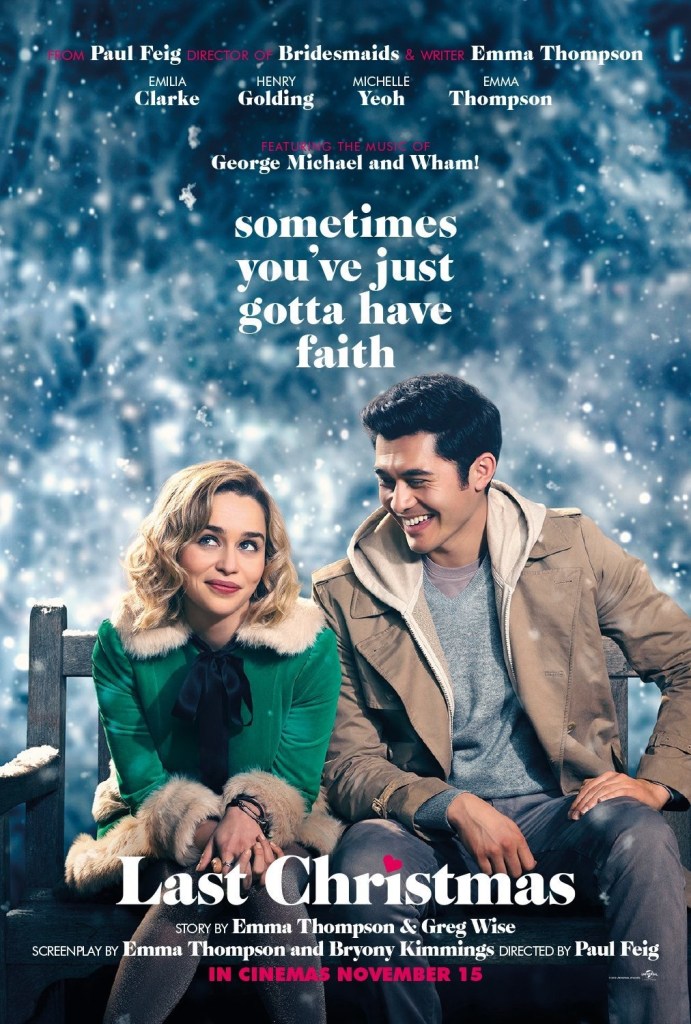
The poster for Last Christmas depicts Emilia Clarke in her elf costume, sitting on an outdoor park bench and smiling next to a grinning Henry Golding: the background is an out-of-focus snowy forest, it looks like.  Above their heads floats the movie's tagline: "sometimes you've just gotta have faith"

The romance in this romantic comedy comes along eventually, though, in the shape of a nice young fellow named Tom who keeps running into her.  Sure, in some ways, he’s a little too good to be true, since he always seems to know some lovely secret alley to stroll down, he appears to spend all his free time volunteering for the homeless, and he is patient and cheerful in the face of all of Kate’s frustrated exasperation with the world around him and sometimes with him, himself.  He sees something in her that she hasn’t figured out yet how to see in herself.  And though it’s not totally clear how this is working, contact with Tom seems to bring a little needed stability into Kate’s life.  She relents and finally goes to visit her impossible mother, Petra, who insists on accompanying Kate to a doctor’s appointment she clearly would rather skip: while there, we see the two women for who they are, confident and unyielding ladies who know everything in the world other than the woman sitting next to them.  There’s a weight on Kate, who seems to resent how much she already owes everyone in her life, how fragile she feels when she looks backwards and sees only the life of a first-generation immigrant kid on whom her parents placed too much pressure, not to mention the survivor of a serious medical emergency on whom now there’s even more pressure to eat right and live healthy in order to keep herself out of the hospital again.

One of the reasons all of this works is just a tremendously gifted cast of actresses: Emilia Clarke as Kate is maybe not quite up to the level of the supporting cast in talent, but this role seems to be right in her wheelhouse, playing the charisma someone this calamitous would have to have in order to survive, but also the woundedness that would live underneath that charisma.  She can’t quite rise to the level of a Barbara Stanwyck in Remember the Night, for me, but that’s a high bar to clear and Clarke’s getting close.  And the folks around her are justly famous: the always-brilliant Emma Thompson inhabits the role of Petra with the baffled dignity of a woman who intends only to understand enough of her new country and the new century to just get by.  Michelle Yeoh is frankly too much talent for the supporting role of “Santa” but all that means is that the store subplot, which would probably otherwise feel undercooked, actually carries a little dramatic weight…especially once we add in the explosively bold Patti LuPone as Joyce, a difficult-to-satisfy customer.  It would be hard to put these four women on the screen and not get something worth watching out of it.  And another key element here is just what Connie pointed out to me in recommending the film: if this was just a movie about Kate falling for Tom, it would be too slight to matter.  The fact that it’s about Kate as a holistic person—coming to terms with the damage she’s done, trying to rebuild a few bridges she’s burned, learning to find joy in places she wouldn’t have looked for it before—makes the Tom and Kate scenes sing a lot more sweetly.

I mentioned singing just now and of course you might expect this to be a musical, since it’s a film named for the Wham! holiday pop song, after all, and Kate’s interested in musical theater, and also we’ve got Patti LuPone, a Broadway and West End legend, in the cast.  I think it’s to the movie’s benefit that it doesn’t try to force that onto itself: music matters here, of course, and we do get some musical performances scattered throughout.  We also get a lot of George Michael / Wham! on the soundtrack, so much so that it can feel a little like a non-diegetic jukebox musical, and I’d say that it both doesn’t really work and it doesn’t hurt the film too much: again, luckily the movie isn’t forcing it too hard, and therefore the songs don’t always fit the story, but I prefer those slight mismatches to a situation where they’re twisting the plot around to try to hit a couple more song lyrics.  And it’s hard to complain about a movie dropping a lot of George Michael at me as an audience member, since that man knew his way around a pop song, and when the connection’s there, it really does enhance the experience.

One of the things I appreciated most about the film was its modest aims: for all that the screenplay starts us with a woman whose mistakes and faults are comically exaggerated, from then on, I thought it took an increasingly realistic tack.  Kate’s going to change herself, but it’s slow.  She makes the kind of amends a real person who’s made these mistakes might be able to make.  In one key conversation, in which she confesses to Tom that she’s “a mess”, he tells her to focus on the everyday, because every little action in our day makes or unmakes character.  And we start to see those dominos fall, as Kate seizes the little opportunities.  There are times when the situations that arise (or the dialogue exchanges within them) felt slightly cringey, but romantic comedies are always at risk of that kind of awkwardness.  It’s not a deep flaw of the film that at times it’s susceptible.

And while maybe you’ll see this movie’s ending coming, I didn’t.  I thought I understood where we were going and I was expecting to be happy about it.  But the layers that are applied near the end of the film really help me reconsider what the film’s ultimate message is, about what it means to reckon with who we are (and how complicated it is to answer the question “who am I?” honestly).  There are some genuinely moving moments as Kate takes hold of the understanding she’s being given, and we get more politics than I think I was expecting, as one of the things she really comes to terms with is her identity (and her family’s) as Croatian immigrants to the UK.  The true self she discovers is a beautiful one, one that is loving and therefore so easy to love.

I Know That Face: Margaret Clunie, a woman named Sarah who accidentally discovers Kate taking a shower after an overnight fling with (it turns out) Sarah’s boyfriend, also appears as Sherry in 2015’s Christmas Eve, a film about New Yorkers trapped in elevators on Christmas Eve in a power outage.  Margaret’s clearly typecast as someone having a bad holiday season, I guess?  Emilia Clarke, this movie’s star, of course, as Kate, recently voiced the Queen of Hearts for the animated TV movie, The Night Before Christmas in Wonderland.  The always funny Sue Perkins, who pops up here in a cameo as the director of an ice show Kate’s auditioning for, is of course best known to Americans as a host/presenter on The Great British Baking Show, including the two-part Christmas special that first aired in 2017.  And you likely don’t need the reminder that Emma Thompson, this movie’s difficult and overbearing immigrant mother, Petra, is no stranger to holiday fare: she plays Karen, a woman confronting infidelity while trying to manage parenting two children, in Love Actually, which this blog will someday cover, and she’s the uncredited narrator of a very short film based on the book Mog’s Christmas Calamity (a “short film” that was really mostly an advertisement for Sainsbury’s), which I highly doubt I will get to if I run this blog for twenty years, but I hope they paid her well..

That Takes Me Back: I don’t know that I was taken back anywhere—this is so close to the present.

I Understood That Reference: They say “Santa” all the time, of course, given that Kate treats the moniker as though it’s her boss’s real name, and the screenplay makes a ton of elf jokes, but they don’t deal too much in the Santa mythology, really.  That’s about all the film wants to do with any pre-existing Christmas texts, that I noticed.


Holiday Vibes (8.5/10): We don’t just have a Christmas setting (and many different versions of a classic modern Christmas pop song), but we have a main character who literally works in a seasonal retail environment.  Add in reluctantly reconnecting with family and some preparations for a big Christmas celebration, and we get I think a very Christmassy rom-com, and one that will please a lot of viewers.

Actual Quality (9/10): I think folks are going to be pleased by the quality of the film, too: if the romance seems a little too pat initially (Tom’s almost a Manic Pixie Dream Boy), just hang in there.  Trust me, it gets more complicated in time.  Honestly, with really good performances and a script that manages to spin a few plates at once because they feed into each other (rather than the more disjointed modern rom-coms I’ve tried lately), I found myself happily settling in for this one.  It delivers what a movie like this promises us, for the most part, which is a rare enough gift that it’s worth celebrating.

Party Mood-Setter?  It’s a great fit for cookie baking, I think, or a party where you don’t have anybody innocent enough to be scandalized by Kate jumping in and out of bed with all sorts of men, in the early going.  The extensive George Michael and George Michael cover soundtrack works to its advantage in this context, too, since you can hum along as you decorate.

Plucked Heart Strings?  I really wasn’t expecting this film to hit me, but it does succeed, maybe a little like the Remember the Night experience I allude to in the review above: watching a character’s tough exterior (whether Stanwyck or Clarke) slowly lower to reveal what their real pain is, and accept the possibility of love, is really powerful.

Recommended Frequency:  I wouldn’t say this was a home run for me, a film I’ll want every year.  But the leads are incredibly charismatic and the message of it is heartwarming enough that I think it would be welcome almost anytime I encountered it at the holidays: I’m sure I’ll return to it at least once every couple of years, if not more often.

If you’d like to try it out also, Netflix has it waiting for you: you can also rent it on streaming from basically all the places you’d think to look.  Barnes and Noble will sell you a hard copy, but if you’re thinking of snagging it for free at the local library, Worldcat suggests you have almost 1,400 options.  Happy viewing to you!

Scrooged (1988)

Review Essay:

On Sundays at FFTH, I take on adaptations of Charles Dickens’s classic novella, A Christmas Carol.  This year, as with last, I tried to bring in one adaptation of the novella that’s more daring (and diverts more from the original text) in an attempt to see what kinds of interesting art can be made from the underlying structure of the tale.  And much as with last year’s total failure (I found Ghosts of Girlfriends Past almost unendurably awful, as you can see from the review I’m linking to there), Scrooged just really, really doesn’t work for me.  It’s at least a little better in my eyes than the openly misogynistic romantic “comedy” I watched last year, but after multiple tries, I just can’t find much sympathy in me for this approach to the story.  Let’s see if I can unpack where I think it goes wrong.

The premise feels high-concept but workable: instead of withered London moneylender Ebenezer Scrooge, this is the story of a narcissistic creep named Frank Cross, a quintessentially American mid-level manager who aspires to TV executive stardom.  His big swing for the limelight is a star-studded live broadcast of A Christmas Carol, which he wants to make the television event of the century when it airs on Christmas Eve.  Instead, though, he is confronted by the dead form of his former employer, and as he tries to stumble his way through Christmas Eve at the TV studio, he keeps drifting in and out of a warped version of Scrooge’s experience, in which Spirits have been sent to visit and confront him.  The whole thing is bleak right up until it’s very, very sincere, a tonal shift that is just one factor in the film’s primary problem: it hasn’t figured out what kind of movie it intends to be, and that’s pretty important given the attempts it is making to simultaneously produce a fairly straightforward mimicry of the Dickens original while also kind of sending it up by escalating some elements to the level of parody.

The DVD cover for Scrooged features the manic face of Bill Murray, looking directly into your soul with eyes and mouth agape and an intensity that suggests he's just told what he believes to be the funniest joke in existence and he is willing you to laugh at it. Next to the yawning rictus of his unsettling mouth, Murray holds a cigar gingerly between two fingers, waiting for it to be lit by a match held in the skeletal hand of an unseen creature (who appears to be wearing a Santa Claus coat, judging by the cuff of the sleeve).  In the background is an inexplicable full moon, looming above the New York City skyline.

At the beginning of the movie, though, I almost thought they had it worked out.  Cross and his lackeys are screening promos for various movies, and it’s clear: this is the Bah Humbug of 1980s America, in which Christmas is not dismissed, but rather it’s treated so cynically that all sincere sentiment in connection with the holiday has been eradicated.  What’s hard to take from the beginning, though, and never really gets calibrated successfully in my opinion, is the character of Frank Cross as played by Bill Murray: Murray, of course, is responsible for some truly remarkable and successful film performances, but he’s also an actor with a weirdly limited range, especially in the earlier stages of his career.  There’s no question that Cross as a character needs to be unpleasant—he’s Scrooge!—and in that sense, casting Murray to play this pompous, sardonic, condescending, panicky television executive can work, since he’s got the capacity to do that well.  Murray’s impulses as a comedian, though, undermine his performance here as an actor, since he trades in his opportunities to exhibit some kind of character growth for the chances to land quippy one-liners or the perfect smirk.  But it’s not just Bill’s fault: I think the screenplay is also so in love with the idea of all the jokes it can generate out of him in the lead role that it doesn’t give him much of a man to play even if he’d tried harder to do so.  I’ve enjoyed Murray in lots of films, even movies that count on a certain level of cringeworthiness to succeed (What About Bob?, anyone?), but I’ve watched Scrooged multiple times and I’ve never been able to invest myself at all in his performance.  There’s something desperate about it, like an actor who understands the film isn’t quite working while he’s making it, but he can’t figure out how to fix it from the inside.

I think that the film’s sense of humor overall is really where I consistently struggled to figure out what the filmmakers were trying to do.  A Christmas Carol definitely can be funny: Scrooge loves a good wisecrack, and many of the surrounding cast of characters are people in a light-hearted mood.  But the tone of Scrooged is so sour.  The character of Loudermilk is one example: he’s one of Cross’s underlings, who gets dressed down and then fired in the film’s opening minutes.  Thereafter, he keeps reappearing in the film, but almost always just so that there can be some gag in which he is mistreated again, often by Cross (directly or indirectly).  To me, there’s just no sympathy in the film for him: every single joke is punching down at a guy who exists only to be humiliated.  We’re supposed to laugh at how pathetic Loudermilk is, or at least the scenes are shot and edited like comedy sketches, rather than as haunting examples of the way Cross mistreats those under him.  Imagine if A Christmas Carol was designed so that, when Scrooge maliciously refuses coal to Bob Cratchit, we get a reaction shot of Bob turning blue that’s intended to make us laugh at how miserable he is.  Do they know what this story is about?  And Loudermilk’s not even the worst example of this: one of Cross’s many enemies is a woman from the network censorship office who is worried about the “family-friendly” nature of his crass, exploitative, live TV cavalcade, and she seems to exist in the story purely to be abused (often physically) for laughs like she’s one of the Three Stooges.  Except the Stooges are main characters and the audience is expected to root for them, whereas I can only describe the treatment of the network censor as accidentally misogynistic at best (and honestly, it doesn’t feel accidental to me).  The problem extends to the Spirits themselves, whose sense of humor is as mean-spirited as the rest of the movie’s: Christmas Past and Christmas Present are supposed to be here for Scrooge’s welfare, trying to wake in him a less callous and more humane understanding of himself.  I honestly don’t know what the heck the movie thinks it’s up to, but here, the Spirits are tormentors on a level that has nothing really to do with Dickens.  Christmas Past steals from Loudermilk for his own amusement—can we imagine a world in which one of the Spirits steals something from the Cratchits, as a joke at their expense?  Christmas Present seems to have been written as a woman who is simultaneously a sexually adventurous flirt with Cross, a hyperactive toddler he needs to manage, and a comically violent menace whose primary goal is to hurt Frank repeatedly…I have no clue why any of it is happening, other than that someone thought it would be funny.  If it makes you laugh, friend, I’m glad for you but also I don’t think I understand why.

Honestly, the humor is so bleak that I tried to construct an understanding of this movie as essentially a parody of A Christmas Carol.  I wouldn’t have much sympathy with the ethics of a film that thinks the Dickens classic is goody two-shoes nonsense, but I think I would at least find the motion picture interesting as a curiosity: can you persuade us that it’s dramatically satisfying to have an unrepentant Scrooge, surrounded by Spirits who are supposed to reform him but are having more fun being as gleefully mean as he is?  But that’s definitely not what this film is doing.  One reason is that they’ve cast the luminous Karen Allen, a woman who deserves SO much more than this screenplay is giving her, as Claire (the equivalent to Scrooge’s Belle), a dedicated social worker and professional bleeding heart.  It’s clear that the movie wants us to understand that she’s a good person and Frank needs to reform himself to get her back—a prospect as baffling and implausible as the primary relationship dynamic in Ghosts of Girlfriends Past, sure, but it’s the obvious point of the movie nevertheless.  At this point, I think I’ve decided that any Christmas Carol adaptation that wants to give Scrooge romantic happiness at the end is likely doomed to failure: it just requires too forgiving a woman (or else too appealing a Scrooge), and it turns his reform into something he’s doing in order to win a prize rather than a genuine change of heart.  And as I alluded to earlier, this movie is going to end with a sincere (well, sincere except for a final few jokes they couldn’t stop themselves from adding in) expression of holiday sentiment and goodwill from Frank Cross to the world via television broadcast.  A rich and self-satisfied man with no previous holiday spirit to speak of will suddenly lecture millions of viewers at home about their own callousness in watching the TV program he himself created and shoved down their throats….okay, that part actually does seem true to life, let’s give it to the movie.  Anyway, my point is, Scrooged, in trying to be both a black comedy and a soaring ode to virtue, is a film at war with itself, and as a viewer, I wanted to surrender.

What goes well?  Like I said, I think the jokes in the opening scenes are mostly aimed right: the film’s mocking sensationalism and the exploitation of Christmas for media stardom and millions in profits, and I get why the initial pitch for this movie persuaded producers and talent that it could be a great update of A Christmas Carol.  Grace, Cross’s long-suffering servant and our closest Cratchit analogue, has a story with some heart, and my few glimpses of her with her family made me wish I was watching her story instead of Frank’s.  Although I think the Christmas Past spirit is very badly written as a character, at least some of that segment of the movie works, especially Cross’s memories of his relationship with Claire, which feel authentic enough that there’s some real emotion in the break-up, and you can see where a better kind of Frank once existed.  I do think that some of the scare tactics of the ghosts/spirits work effectively (even though—or maybe because—they are pretty disgusting, like the Marley equivalent’s disintegrating body).  And, though here I’m at odds with the motion picture itself, I kind of like the character of Bryce Cummings, an “L.A. slimeball” (to quote Frank) who’s here to threaten Cross’s hold on his job—the screenplay sees him as a villain because he’s Frank’s antagonist and needs to be humiliated in the final act in order to give Frank a happy ending.  But what I liked about Cummings is how mean he is to Frank—in a way, he’s revealing that Cross was never as good at being a big shot as he wanted to be, and given how horrifyingly Frank’s treated everyone else in his life, I loved seeing our Scrooge character squirm for once as someone being thwarted by his competition.  I’m not sure how the movie itself doesn’t get that Cummings isn’t the villain—Scrooge is his own villain.  Whatever process this screenplay went through, I feel sure that too many hands touched it, and the result is an incoherent mess.

In the end, I think part of what I respond to negatively in Scrooged is just that I live in a world run by Frank Crosses, where media moguls (and the ghouls they have made famous) dominate far too much of society, amusing themselves excessively at the expense of people they think of as extras.  If I’m going to see a story about a Frank Cross, I need it to contend with his monstrous capacity for harm in a way that I can make sense of.  The narrative presented by Scrooged, on the other hand, is a chaotic muddle—a film that thinks Frank is funny enough that we can’t help chuckling at his mistreatment of others, but also redeemable enough that he won’t even need to apologize for most of that in order to get us to forgive him.  It wants to satirize an industry that fills our screens with sex and violence and special effects…but one of the consequences of that is a film selling itself to us with a lot of those very elements.  And even the movie at its most noble remains confused: what is the lesson Frank Cross needed to learn?  (His “Marley”—a former network boss named Hayward—is confusing to me.  He arrives neither chained nor haunted by any specific misdeeds, telling Cross to avoid the fate he has suffered as a “worm feast”…but that’s nonsense, since nothing Cross does is going to let him avoid mortality, and the message of A Christmas Carol isn’t “avoid death at all costs” in any case.)  And when/how does Frank Cross learn whatever it is he learns in the noise and mayhem of the events he experiences?  I’m still not sure.  That’s probably one of the most damning reviews I can give of an adaptation of A Christmas Carol: I don’t understand how this Scrooge has been transformed. 

I Know That Face:  Bobcat Goldthwait, who appears here in the astonishingly ill-conceived role of Eliot Loudermilk, plays the role of the Narrator in 2005’s A Halfway House Christmas, which from what I’m seeing online looks like an equally ill-conceived television program.  Alfre Woodard, an iconic performer who’s mostly wasted here in the part of Grace Cooley (the Bob Cratchit analogue), appears later in her career as Wanda Dean, a drug-addicted mother rescued at Christmastime by a drag queen, in 2000’s Holiday Heart.  It will be not at all surprising that Bill Murray (who in Scrooged is of course Frank Cross, the Scrooge-equivalent) appears as himself in the TV special, A Very Murray Christmas, but it might surprise you that the bartender in that program is a role played by David Johansen, who had appeared alongside Murray here as the Ghost of Christmas Past.  And John Houseman, who appears here in his final credited role as a thinly fictionalized version of himself, narrating the live Scrooge television broadcast that Frank Cross is trying to produce, had appeared as Ephraim Adams, the imperious old choirmaster, in 1980’s A Christmas Without Snow.  Houseman also plays a small role—Mr. Wabash, a CIA officer—in 1973’s Three Days of the Condor, a relatively taut thriller that happens to be set around the Christmas holidays (a la Die Hard) and will probably at some point make it onto this blog.

Spirit of Christmas Carol Present:  In fairness, we do get a very creepy undead Marley, and I think Yet to Come’s a good modern American version of the Spirit just in terms of character design.  The rest of the spirit work, as aforementioned, isn’t clicking for me, but I liked these elements and felt they captured something of the Dickens original.

Spirit of Christmas Carol Absent:  It’s surprising to me that nobody comes calling on Cross for donations, like the men who call on Scrooge in the original tale, and it is flat out weird that Marley isn’t burdened by chains or any other symbolism to communicate that he’s specifically suffering for his crimes against humanity.  Sure, Hayward mumbles something about how mankind should be his welfare, but it feels so tacked on to a scene that otherwise communicates nothing about the Hayward-Cross dynamic (as opposed to the depth of that Marley-Scrooge encounter) that I think the movie essentially whiffs on the dialogue itself.  Everything from the appearance in the film of Christmas Yet to Come through to the end credits is very different from the original story, and in a way that saps the story’s power, I think.


Christmas Carol Vibes (6/10): Starting with the title, there’s no way you’ll be confused about this being an adaptation of A Christmas Carol, and given that Frank Cross is trying to produce a much more faithful (in some respects) live version of the story at his TV studio, we do get images of traditional costumes, etc.  Spirits are taking him to the past, present and future, and he becomes sympathetic to the unwell child of his employee.  You know, the pieces are here.  But also, this really doesn’t capture the right tone of the story at far too many points.  If you’re in the mood for A Christmas Carol, I’m not sure this one will resolve a big chunk of that need.

Actual Quality (5/10): There’s a lot of money and talent on the screen here, and at the right moments (a fair proportion of the interactions between Frank and Claire, anytime Grace is center stage, etc.) I could see there was a movie I kind of wanted to watch.  And then everything else happens, and makes me feel foolish for coming back to this film more than once, trying to understand a motion picture that clearly doesn’t understand itself.  It’s an interesting effort in some ways, but it’s also a failed effort, without question.

Scrooge?  Murray’s register as an actor is great in the right roles, but when the writing lets him down, at least in the 1980s I just think he didn’t have the tools it would have taken to escape the problem of being obviously and exhaustingly self-satisfied on screen.  It undermines both sides of the Scrooge experience, in my opinion, even though I’ll admit he persuades me that he is a person other people hate and might love to see dead.  And especially when it’s time to be the reformed Frank Cross, he’s still leaning so hard into this smug, condescending persona that it undermines most of his lines of dialogue in a way that maybe another actor could have sold me on.

Supporting Cast?  I wish there was more for Claire to do, since Karen Allen’s got a lot more range than what’s asked of her, to be a largely trodden-upon do-gooder who in the final scene seems almost like a woman relieved that her abusive boyfriend has forgiven her (rather than a woman who rightly ought to be receiving his apology and weighing whether to forgive HIM).  The Spirits are badly written and directed—I don’t blame David Johansen or Carol Kane, even though I think it’s also true that really they’d be poorly cast as better written versions of the Spirits in most adaptations since their comedic energy is hostile and aggressive in ways that would be hard to calibrate when it comes to this story.  

Recommended Frequency?  I have tried so many times to like this film, given how many talented actors are in it, and given my feeling that there’s got to be a way to tell a good modern American version of the story.  It’s better than last year’s entry (Ghosts of Girlfriends Past), but that bar was ludicrously low, and frankly, I think I’m done trying to understand or appreciate this movie.  Despite its own self-satisfaction at its big swoopy emotional ending, I think the choices of the film-makers end up creating a work that’s almost as sour and bitter as Ebenezer Scrooge.  If they understood how to make a movie that celebrated human connection, compassion, and care, they applied very little of that understanding to huge sections of Scrooged.  An unfortunate miss, and one I won’t be coming back to again.

You might feel very differently, of course, which I respect, so how might you watch Scrooged?  Well, if you subscribe to some of the slightly less well-known streamers—Paramount+, AMC+, MGM+, for instance—you can stream it for free, and you can rent it streaming from all the usual places.  It’s quite inexpensive at Barnes and Noble on disc, and some 1,500 libraries have it for checkout, according to Worldcat, if you’d like to try it without paying (a wise option, in my opinion).  For those of you still waiting for a good, straightforward adaptation of A Christmas Carol, hey—watch this space.  Next Sunday, I should have something for you.

Christmas in Connecticut (1945)

Review Essay

Relationships to films are complicated—today’s entry, Christmas in Connecticut, being a helpful illustration in my own life—since so much depends not just on the contents of the movie itself but on who we are in the moment we’re watching, what we’re prepared to see in a work of art, and what expectations we bring to the experience.  I first watched this film years ago, and found it underwhelming at the time: I was just getting started on this fascination with holiday movies that led to the blog you’re reading, and I think the title (and some of the advance praise I’d read) made me think this would be an instant classic.  When it wasn’t, I set it on the heap of “fine, I guess” films, and I hadn’t re-examined that rating until my recent viewing.  To my pleasant surprise, I found myself really engaged by Christmas in Connecticut, and excited to share it with you all.  I can see both sides of this movie, that’s for sure, and I’ll try to make them both clear by the end.

The premise of the film is absolutely of its era—Jeff Jones, a sailor who survived the sinking of his destroyer, has gotten himself engaged to his nurse, which his buddy convinced him would secure Jeff better hospital food in recovery, and she thinks the only way to get him to want to settle down and get married for real is by having a real down home Christmas.  Her problem is that she and every other member of her social circle is living out of hotels and boarding houses as they contribute to the war effort, so she needs to borrow someone’s Christmas.  She calls in a favor, and Jeff’s signed up to be sent to the perfect celebration taking place on the idyllic Connecticut farm of nationally-famous homemaker Mrs. Elizabeth Lane, whose column about the lavish meals she cooks for her husband is a sensation from coast to coast.  The only problem?  There is no Elizabeth Lane—or rather, there is, but she’s a single gal in a Manhattan apartment who churns out bucolic fiction about a life she’s never lived, with the stories loosely based on a description of a Connecticut farm belonging to John Sloan, a suave architect whose marriage proposals she’s deflected countless times.  To save her job (and her editor’s), since their publisher has no idea her columns are a pack of lies, Lane agrees hastily to marry Sloan, and then fake her way through the perfect Christmas at a home she’s never seen, dealing out meals from a kitchen she has no ability to cook in.  As they arrive at the farmhouse, though, Lane’s not technically married to Sloan yet, which of course is going to create some complications of the heart when she gets a look at the grinning war hero she’s hosting for the holidays.

The poster for Christmas in Connecticut features, below the names of the three stars, a tiny image of Sydney Greenstreet looking down happily on a large central image of Barbara Stanwyck and Dennis Morgan cuddled up together on a rocking chair (she in his lap).  All around them, small red stars bedazzle an otherwise mostly white background.

How well all this works for you is going to depend a lot on your interest in / patience with the particular tropes and style of a 1940s rom-com, an era and genre to which, as experienced readers of the blog will know, I’m pretty susceptible.  Since the first time I watched this movie, I’ve seen a lot more of them, and I think that’s a big factor in my warming up to this movie on a second viewing: I mean, Barbara Stanwyck’s a highlight of anything she’s in, and here she manages the quirky charm of a woman who plans to bluff her way to success with a pair of deuces in her hand just about perfectly.  Even in black and white, her Edith Head costumes are as striking as ever.  More surprising to me is how skillfully Dennis Morgan as war hero Jefferson Jones plays off of her—Morgan’s career was mostly made up of roles where he’s the likeable square who loses the girl to a slightly grittier star (like Humphrey Bogart), but the structure of the screenplay here allows him to play that same naive persona as the star.  In this film, Lane’s already got the attentions of the brandy-drinking sophisticate in John Sloan, but what warms her heart is the corn-fed friendliness of a Midwestern boy who cheerfully offers to bathe and diaper the baby (an infant on loan in a hasty arrangement that is definitely not going to backfire spectacularly on Elizabeth, who holds the child like it’s a radioactive parcel) and spends his after-dinner energy sitting at the piano, warbling out Christmas carols and old love songs in an angelic tenor.  Sloan owns the farm, but Jones is the guy who seems at home there, in the fantasy world Lane never figured she could have (and is only slowly realizing she might want).  Stanwyck and Morgan’s flirtatious and furtive conversations crackle with romance long before it’s clear how they could possibly pair up, since the whole premise of their meeting is that she’s “happily married” and likely to remain so.  They’re fantastic.

The supporting cast are no slouches, either—Lane’s performance of the perfect Christmas is under the microscope thanks to the presence of her domineering publisher, Alexander Yardley, played with gleeful pomposity by Sydney Greenstreet, and she’s only pulling off the illusion of ideal domesticity thanks to the help of Felix Bessenak (“Uncle Felix” as she calls him, to maintain the cover story), the bespectacled Hungarian immigrant who runs a delicious New York City restaurant on the ground floor of the apartment Lane lives in, and who reluctantly agrees to come out to the farm to whip up a Christmas to remember.  Felix is maybe my favorite character (and in a movie starring Barbara Stanwyck, that’s saying something)—like a benevolent trickster spirit, Felix manages to be in the right place at the right time every step of the way to prevent Elizabeth from tying herself down in a marriage he knows she doesn’t really want, and to keep all options open for her to have a happy future.  He’s generous and joyful, while also having a sassy edge to him that plays really well on camera, and after learning the English word “catastrophe”, he takes great delight in declaring any kind of even mild difficulty as a “cat-as-TROAFF” (as he pronounces it).  S. Z. Sakall, who plays the part of Felix, was himself a Hungarian immigrant, and one who had narrowly avoided disaster fleeing his homeland in 1940—several close family members remained there, and died in Hitler’s concentration camps—and knowing that adds a layer of wonder for me as an audience member, watching an immigrant actor who’d known such grief become such an integral and happy part of this quintessentially American story.  Maybe it’s just that it’s 2025, and I feel a special debt these days to refugees and asylum seekers from around the globe who’ve given so much to make my country the vibrant place that it is.

What doesn’t work here?  Well, the thing I struggled with on my first viewing hasn’t really gotten better, and that’s the fact that there’s not all that much of a plot.  It’s obvious from early on that we’re being given an incredibly complicated Rube Goldberg device to orchestrate something pretty simple—Elizabeth and Jeff are going to fall for each other, but in a context where they just can’t really admit that openly, and we get the slightly illicit good time of rooting for Jeff to kiss a “married woman” and/or rooting for Elizabeth to throw herself at a guy she will eventually figure out has a fiancee waiting for him back at the hospital.  As a result, to the extent that we have a plot, it’s a farce, but really great farce requires pretty impeccably tight writing to make the tension wind itself up more and more as scenes progress, and this is a much more languid screenplay than that.  We have to accept a lot of strange coincidences and impulsive choices by characters to generate the necessary narrative energy and reach the resolutions we know we’re rooting for.  I’d also say that it’s a story with very little character development: the changes in any of the people on screen are subtle, from my perspective, and this is more about well-defined characters overcoming the plot obstacles in their path than it is about characters coming to learn something about themselves and grow.  I don’t think that makes a film bad, but if you’re looking for deeper emotional resonance, there won’t be as much here as I think there easily could have been.  And of course, in any film of the era, some of the dialogue is going to be corny: for me the worst example is Jeff trying to dole out advice about “how to rock in a rocking chair” but your mileage may vary.

There’s a lot here to enjoy, though.  For one thing, I applaud any movie of this era that handles race well in even a limited way, and this film gets high marks for its context: in the first act, there are two Black performers with speaking parts, and they’re both depicted positively and without stereotypes (a confident and efficient deliverywoman with a package for Elizabeth, and then an erudite young waiter who informs his boss, Felix, of the definition and Greek etymology of the word “catastrophe”).  Felix, too, really is playing the part of a minority, in this era, and while the movie’s having a little fun with his exclamations of “catastroph!” he’s not the butt of jokes as an outsider—as I noted, to the contrary, he’s almost the film’s ultimate insider, embraced and appreciated for who he is by basically everyone he encounters (other than perhaps Sloan’s Irish housekeeper, Nora).  Sure, I’m praising fairly limited progress on diversity in film, but given that it’s 1945 (and remembering other films of this vintage that I’ve seen) I’m grateful for what’s here.  Also, in terms of gender politics, it’s ahead of its time, or at least I was really pleasantly surprised that nobody in the film shames Elizabeth when it’s revealed she doesn’t really know how to care for an infant or cook.  Jeff’s jumping in to help with the baby is treated as natural and positive—he doesn’t consider it “women’s work,” and the only reason Elizabeth feels uneasy about it is her need to play her persona as Happy Homemaker and not the mere fact of her gender.  It’s hard not to feel affection for basically everyone on screen, and the folks who have done the most to deserve a little comeuppance do get it, though even this movie’s harshest consequences are pretty gentle.  Show up to just spend time with these characters, and you’ll get a good evening at the movies.

I Know That Face: We’ve got to acknowledge out of the gate that this is yet another film starring Barbara Stanwyck, arguably the queen of ‘40s Christmas movies, given her role as the guarded, wounded Lee Leander in Remember the Night, which I covered last year on the blog, and as the savvy, ambitious Ann Mitchell, the reporter to invites America to Meet John Doe, a movie I’ll be covering here before the month is out.  The man playing her alleged husband, John Sloan, in this film is one Reginald Gardner, who’d appeared as the writer Beverly Carlton in 1941’s The Man Who Came to Dinner, a screwball Christmas comedy that’s absolutely on my longlist and which I’m hoping I’ll get to in 2026.  S. Z. Sakall, who in this movie is my beloved “Uncle Felix”, will show up in 1949’s In the Good Old Summertime, a remake of The Shop Around the Corner which I glowingly reviewed last year: he plays Otto Oberkugen, the owner of Oberkugen’s Music Store, in that film, and his name appears in the end credits as “S. Z. ‘Cuddles’ Sakall.”  Maybe everybody loved this guy?  And lastly, I would be falling down on the job if I didn’t help you figure out why Judge Crowthers, who keeps showing up to try to perform a quick at-home wedding ceremony for Sloan and Lane, feels so familiar…I was sure I’d seen him somewhere.  Well, it turns out, that actor, Dick Elliott, makes a brief uncredited appearance the following year in a little movie called It’s a Wonderful Life, in which he is the man sitting on his porch who tells George Bailey to “kiss the girl instead of talking her to death,” before complaining loudly that “youth is wasted on the wrong people”.  What a legend.

That Takes Me Back: Obviously it’s always at least slightly jarring in films set before the 1990s how socially accepted smoking is at all times and in all places, but even so, it was especially wild to me to see Jeff smoking a cigarette in the hospital while being pushed around the recovery ward in a wheelchair.  Times have changed.  Shortly thereafter, Mary Lee, Jeff’s nurse fiancee, manages to secure the favor of a Christmas in Connecticut for her beau by reminding Mr. Yardley that she helped save his granddaughter when she was suffering from measles…a reminder of the past, yes, and also of the disease-riddled future the nation’s Health and Human Services Secretary dreams of at night, but I guess in polite company we’re supposed to pretend that the death and disability of children is just another of those political matters we shouldn’t mention at the Christmas table.  Apologies if it bothers you that I’m bringing it up anyway.  Speaking of things inhumane, it is always a little fascinating to me how luxurious and universally appealing furs were, in this era: I’m not going to throw paint at anybody, and obviously a vintage fur isn’t doing any additional harm on its own (those animals are long gone), but what little I know of the conditions under which mink fur coats were made suggests to me that maybe it’s nice they’re no longer considered the gold standard of wealth.

I Understood That Reference: I didn’t catch any references to any Christmas stories or poems, myself, which is at least slightly surprising.


Holiday Vibes (4.5/10): It is honestly kind of surprising how little holiday content is worked into a film that’s allegedly about giving a man a classic Christmas experience.  But we skip past a lot: we don’t sit for Christmas dinner, we don’t open gifts around the tree, we don’t go caroling, etc.  There’s definitely some pieces that are seasonal, with sleigh rides everywhere (as though the automobile has yet to reach rural Connecticut by 1945) and at least one scene of tree trimming, and a community dance on Christmas evening.  Really the movie’s energy is far less given to the holiday than it is to the mechanics of the plot devices—how to get Elizabeth and Jeff into a room together to flirt unobserved, how to heighten the comedic tension of things that will expose the lies, etc.  I am pretty sure this was a flaw in the movie for me the first time I watched it, since the title seems to promise a totally Yuletide extravaganza, so I’d advise you to keep expectations moderate on this front.

Actual Quality (9/10): So, this isn’t high art, but it is a confection—sweet and lighthearted and designed to gallop us through six crises quickly enough that they don’t inflict much stress.  We know where we’re going, and we get there comfortably.  There are just so many great performers here who can do a lot with even fairly pedestrian dialogue, and the setting couldn’t be more charming, with lavishly furnished 1940s glamour constantly intruded on by wandering cows and the needs of a countryside that’s mostly oriented around doing war work.  I had a great time with it this time around, and even though I know why I didn’t love my first viewing (and why I know some of you likely won’t love it either), I think this is the best assessment of how well the movie’s doing what it’s setting out to do.

Party Mood-Setter?  It’s hard to casually view a farce given the need to understand context in order to follow a lot of each scene’s potential humor, and there’s not quite enough holiday scenery for this to be a great background for a Christmas party or something similar.  If you know it well enough that it’s a film you know well, though, the energy of it is so cheerful that perhaps you could find the right time to throw it on while you’re working on something.

Plucked Heart Strings?  The film’s emotional only to the extent that there’s some pretty great chemistry between Elizabeth and Jeff, but it’s not a film that puts a lump in your throat out of either sadness or joy.  If you want the release of a little tearful delight, I think you’d need a different movie.

Recommended Frequency: Like I said above, it grows on you!  It’s working its way into my rotation, though, now that I think I’ve figured out the ways it works (and the things not to worry about).  I definitely intend to make it a regular (if not annual) part of my holiday viewing.

Christmas in Connecticut is a little frustratingly inaccessible compared to some other films on the slate this year: you can rent it from almost any of the streaming services, but only at the rate of $4.99, which to me is a trifle higher than I like to pay for a streaming rental.  You may want to consider picking up a Blu-ray or DVD copy at Barnes and Noble, given the relative difference in price, honestly—that or just do what I did, and get it on disc from your local library, of which some 1,200+ have it on the shelves, according to Worldcat.  I will say, though, if your only access to it is the streaming rental, I don’t think $5 would be too high a price to pay, if it sounds like your kind of movie: if I hadn’t had it at my local library, I wouldn’t have felt cheated at that amount to have streamed it, myself.

Meet Me in St. Louis (1944)

Review Essay

Part of the fun of the Film for the Holidays experience, for me, is finally sitting down to watch a movie I have been meaning on some level to watch for years, only to find that it’s not quite what I was expecting.  Sure, sometimes this is a negative experience, but more often it’s a neutral or positive one as I find myself recalibrating my expectations on the fly: it’s more interesting, at least, to be surprised.  In the case of 1944’s movie musical, Meet Me in St. Louis, I was expecting to be mostly dialed in for the star power of the incomparable Judy Garland, and don’t get me wrong, Miss Show Business is here and as fabulous as any of us would expect.  But sometimes in these holiday films, you get kind of fascinated by a truly charismatic supporting player—they’re not always even in sync with the rest of the cast or screenplay, but they’re so undeniably magnetic that you find yourself leaning in every time they’re on screen.  Think Dan Levy as Abby’s flamboyant friend John in Happiest Season.  Anyway, there’s a performance like that in Meet Me in St. Louis, and it tickled me.

Let’s handle the central story of the motion picture first, though—this is the story of the Smith family, and in some ways it’s an almost Austenesque premise wherein the oldest girls, Rose and Esther, are both pretty keen to land a guy (and grappling with some societal hurdles and conventions to do so) while maneuvering around a difficult parent (here, Mr. Alonzo Smith, their father).  It’s also a story about turn-of-the-century American optimism—St. Louis as a city “on the grow” about to welcome the whole world to the Louisiana Purchase Exposition, a place western enough that the big cities back east are a different country you can only reach by means of echoing long-distance phone lines but also connected enough that kids from the local high school head to the elite universities of the Atlantic Seaboard pretty routinely.  And it’s at least attempting to also be a story about the pressures on a lower middle class family: Mr. Smith’s worried enough about money that he’s willing to uproot the family to make a big move for his work, but not so worried about money that he can’t change his mind about that, at least in theory.  The film doesn’t really land this last punch, I’m afraid, since the family hardly ever seems low income (given their pretty lavish digs in a lovely neighborhood, with the girls expecting to head off to college, and Mr. Smith’s professional standing as a lawyer), and this is a problem since a lot of the conflict in the story hinges on the idea that the Smiths are so in need of the promotion/raise that they’re willing to throw away a whole lot of happiness in order to get it.  Sensible plots aren’t exactly the hallmark of the Golden Age Hollywood musical, and it’s probably fair to say that most people are being drawn here for that mix of MGM talent and Tin Pan Alley songwriting that make for a bit of a sensory extravaganza.  But I still think we can do a little better than this.

The poster for "MGM's Meet Me in St. Louis" features overlapping portraits of several young people (two teenage girls, a younger girl, and a teenage boy), along with the credits for the main cast.  The only tagline reads "Glorious Love Story with Music".

In some ways the movie’s a bit more grown up than you might expect: both Rose and Esther Smith are pretty savvy about boys.  Esther (the character Judy Garland plays) at one point informs her big sister that “I’m going to let John Truett kiss me tonight.”  When Rose chides her, saying, “Men don’t want the bloom rubbed off,” Esther quips back, “I think I have too much bloom.  Maybe that’s the trouble with men.”  These ladies know a thing or two about the need to attract a fellow’s attentions without, shall we say, overindulging either themselves or the fellow in the process.  And of course it’s the 1940s, so the film’s going to ask us to play along with romanticizing things like a young man getting passionate enough that he grabs a young woman and kisses her, no permission sought: the fact that we know very well it’s what she wants doesn’t really make the moment 100% fun, from my perspective, but maybe I’m being too much of a wet blanket about it.  Nobody in this film manages to seem like a bad person for more than about five minutes (and only for the sake of creating just enough conflict to keep the story humming along).  When the meanest character in your motion picture is *checks notes* a devoted father who thinks he needs to relocate his family for their economic well-being, well, the stakes are pretty low.

I teased you a little up-front, though, with my claim that the show here is stolen by a high charisma supporting cast member, and I need to deliver the goods, so here it is: Margaret O’Brien, the child actress, is incredibly compelling as “Tootie” Smith, the youngest of the family’s five kids.  We’re introduced to Tootie having wandered away from the family home to help deliver ice on a horse-drawn wagon, entertaining the delivery man between stops by discussing her plans for the burial and mourning of one of her dolls who she plans to have “die” later that day—as she tells him, the doll has four fatal diseases, “and it only takes one.”  Later, on Halloween, we follow her through the neighborhood in an era predating the “or treat” option: Tootie’s all tricks, all the time, and her idea of a trick is on the level of stealing lawn furniture to add it to a bonfire, throwing flour at neighbors in an act of mock assassination, and, most memorably, the attempt to derail a double-decker streetcar by placing a hastily prepared mannequin on the tracks.  She is a menace to society, and I love her.  Admittedly, Tootie’s also young enough to be scared of the mayhem she’s capable of, but I think that only adds to the impressiveness of the mischief she accomplishes in one brief night out.  She’s endlessly quotable and really my big complaint of the film’s second half is that it spends way too much time worrying about getting Esther and John’s romance sorted out (over, it has to be said, the most comically miniscule of hurdles) and far too little time letting me watch Tootie, I don’t know, pursue a career as a juvenile arsonist or weigh the pros and cons of poisoning her grade school teacher or whatever other kinds of sheer chaos she is probably up to, off screen.

Now, here’s where I probably ought to admit a certain amount of favoritism at work here, or at least my predisposition to cheer for spunky kids like Tootie Smith in St. Louis in 1903.  Two of my great-grandparents were small town Missouri children in 1903-1904: my great-grandfather Warren was a scamp (injuring his hand as a 12 year old in an “accidental revolver discharge”…lord knows what Warren’s parents were doing at the time) and my great-grandmother Opal, who I will always and only ever think of as “Nana”, was a bright and brave woman all her life.  In 1904, the year of the Exposition, Opal was a 9 year old living in Lewistown, Missouri: at 150 miles from St. Louis, she was too far away to get to go to the Fair with her father and grandmother, but her dad gave Opal and her younger sister Nellie the consolation prize of a trip to Quincy, Illinois (about 30 miles away) to see Barnum and Bailey’s Circus that summer.  It was pretty easy for me to enjoy this 1900s peek into a Missouri family’s life, sanitized and historically inaccurate as I know much of it is, since it let me muse just a little about what it might have been like for Opal and Warren to hear tales of the World’s Fair or play a prank on Halloween.  If you feel any kind of connection or kinship to this part of the country or that era of history, I bet this will work a little better for you, too.

And of course, what this movie does best of all is its music, which I haven’t really touched on.  It’s a mix of songs: I’d never heard “The Boy Next Door” before but Judy Garland can make anything sound like a classic the moment she gets started.  I was familiar with the chorus of “The Trolley Song”—and I bet many of you, too, know “Clang! Clang! Clang! went the trolley”—probably from the Looney Tunes or some similar source.  And I could certainly sing all of this movie’s biggest hit and the one that pulls it squarely to Christmas (yes, don’t worry, I haven’t forgotten the conceit of this blog): Esther, in an attempt to soothe the fragile and frantic emotions of an agitated Tootie, pulls her little sister into her arms and sings, “Have Yourself a Merry Little Christmas.”  We get about 25 minutes of Christmas out of the film, but it’s a climactic 25 minutes, coming as it does at a point where the family’s preparing to move to New York, and treating the holiday as a huge final farewell—one last dance, one last tree in the front room, one last chance to maybe see if that John kid can get his act together and propose.  At its best, it’s a perfect Golden Age holiday sequence—red and green gowns that dazzle the eye, a real humdinger of an emotional song performed beautifully, and a finish that affirms love and family and togetherness in the way we want all our holiday flicks to end.  It’s just not always able to hold onto that perfection, since some of the machinations of the plot at the end are creaky, and while the song is beautiful and in Judy’s confident hands it packs an emotional heft out of the gate, its lyrics are sometimes a strange fit for the moment and the characters involved.  The movie works, but it doesn’t work as well as it wants to believe it does.  What it does do, aided so much by the energy of Judy Garland and Margaret O’Brien, is give us the Smiths as a convincing and loving family, whose holiday celebration is genuinely joyful to look in on, and at this time of year, what else do we really want?

I Know That Face:  We just saw Tom Drake of course, who here is Esther’s beau, John Truett, when he appeared as Pat Dingle, a similarly fresh-faced boy next door, in The Great Rupert.  Margaret O’Brien, one of the last surviving child stars of the 1940s and the adorably gremlin “Tootie” Smith in this film, has voice acting roles in Elf Sparkle Meets Christmas the Horse and Elf Sparkle and the Special Red Dress (playing Mrs. Claus in the latter), as well as portraying Mrs. Foxworth in This Is Our Christmas.  And Margaret also plays Beth March in 1949’s Little Women—a film that, much like this one, incorporates a significant Christmas sequence even though it’s not exactly a “holiday movie”—and she’s not alone, since the March parents in that version of Little Women are played by Leon Ames and Mary Astor, the same actors portraying her parents in this movie, while Harry Davenport, who’s Tootie’s grandfather in this film, appears in the Alcott adaptation as Dr. Barnes.

That Takes Me Back:  This film’s set so long ago that it’s not so much making me nostalgic for things I remember as it makes me curious about things that maybe my grandparents or great-grandparents would have been nostalgic for.  Would the making of your own household ketchup have been such an engrossing enterprise back then, as it seems to be in the opening scenes?  Did people really tie ribbons in bows around the necks of housecats back then?  I associate this more with animated Disney films, in part because most of the cats I have known would have declared a vendetta against anyone subjected them to such indignities, and yet there the bow is on Tootie’s cat.  As I mentioned earlier, the film gives me a glimpse of a Halloween full of tricks only, and honestly, the chaos and vandalism is overwhelming enough that I can understand the citizenry of St. Louis getting together after Halloween 1903 and agreeing to the new “tradition” of trick-or-treating as a kind of public safety measure.  Anyone who knew Tootie Smith would have gotten to work the next day in an attempt to invent the fun size candy bar.  Oh, and there’s some shenanigans involving a dance card, which made me wonder when the end of the dance card era was (and why it ended).

I Understood That Reference:  Tootie’s waiting up for Santa Claus, but of course he won’t show up until she’s asleep.  How will he find the family next year in New York, though?  Gosh darn it, Tootie, you’re too dang cute sometimes.  When you’re not feeling murderous, that is.


Holiday Vibes (4.5/10): As noted above, the final half hour or so of the film really does a pretty good job of realizing an emotionally resonant and colorfully delightful Christmas holiday.  The addition to the canon of a now-ubiquitous holiday song has to count for something here, too.  But the score can only get so high before I say, hang on a second, the vast majority of the running time unfolds without even any reference to a winter holiday.  The score of 4.5 is probably generous, all things told, but like all my numerical scores, it’s to be taken with a grain of salt.

Actual Quality (8/10): At its best, this is a lot of fun—a couple of great songs, a lovely Christmas tableau, a charming performance from a child actress.  At its worst, it’s super forgettable: some of the music isn’t all that catchy, there’s so little conflict of any real consequence, and the film’s biggest questions as we get to the third act are a mixture of problems that will clearly be resolved with ease and problems that barely seem like problems.  The plot’s not strong enough to be a selling point, but it doesn’t give itself over into spectacle quite enough to get away with a weak story the way that other films frankly do (the plot of White Christmas, for instance, isn’t better than the plot of Meet Me in St. Louis, but that movie finds way more ways to captivate an audience and let the plot take a back seat).  Shaking all that up, this ends up a B/B- of a movie for me as an artistic product (even if I felt a little more charitable towards it, as a viewer).

Party Mood-Setter?  There’s not quite enough Christmas in the film to work for this purpose.  But it’s so gentle and full of nostalgia that I don’t think it would particularly distract you if you did turn it on.

Plucked Heart Strings?  I mean, I was not expecting this, but I really did find myself getting emotional at the Christmas gathering: the love of the people involved, and their gratitude for each other, got to me on some level.

Recommended Frequency:  I’d say that Meet Me in St. Louis is a film that, if you watched it for a few Christmases in a row, would become “a Christmas movie” just as much as a lot of other films that are not set primarily at Christmas but have some key Christmas scenes—in the vein of It’s A Wonderful Life or White Christmas in that way.  I’m not sure it’s quite great enough for me to make that effort, but it’s more than good enough for a viewing and it’s one I will absolutely watch again, as much for the old-time nostalgia of it as for the holiday elements.

As with so many other films this year, you can watch this (with ads) on Tubi. It’s rentable on streaming from almost all the places you might think to pay to rent it, too.  The Blu-ray is cheaper than the DVD at Barnes and Noble, if you know you want to own it, and Worldcat will help you find it in over 1,800 libraries worldwide.

The Great Rupert (1950)

Review Essay

As holiday movies go, The Great Rupert is maybe one of the goofiest possible examples: it’s hard for me, at least, to imagine a more gobsmacking summary than “stop-motion animated squirrel shoves a miser’s money through a hole in the wall, leading to a miraculous influx of wealth into the hands of an impoverished family whose circus act no longer draws a crowd.”  Like, who even pitched this to a producer?  What screenwriter generated this material?  And, maybe most importantly…is it any good?  Well…look, even at its weakest, we’ve got to give the movie this.  It is the second greatest Christmas movie ever made to feature a rodent in a starring role (in this house, we give Rizzo the Rat his laurels for an impeccable supporting performance in The Muppet Christmas Carol), and a diversion that’s really unlike anything else you could possibly dial up on your television at this time of year.  But let’s dig in a little, to see if I can say anything more definitive on the subject.

The centrally important feature of the film, storywise, is less a performing member of the family Sciuridae and more a cheaply converted carriage house that shares a wall with the Dingle family home.  The Dingles rent the carriage house out to people needing the least expensive lodging imaginable (since, no matter how cheap the rent, the place is only barely worth it).  The carriage house is, at the film’s beginning, occupied by Joe Mahoney, an old vaudeville star who’s sure the dancing squirrel, Rupert, is his ticket back to relevance in the world of entertainment.  His attempts to sell the act to talent agent Phil Davis are unsuccessful, though, and ultimately Joe cannot pay his rent to the scowling Mr. Dingle and is forced to vacate the premises, leaving Rupert in a park to fend for himself while Mahoney hits the road in an attempt to make a little cash.  As he leaves town, Joe crosses paths with some old friends: the Amendolas.  Louie Amendola, with his wife and a teenage daughter, is at about the end of his own rope as an entertainer, and is down to a little pocket change.  Mahoney tips him off to the vacancy at Dingle’s carriage house, where he reckons the Amendolas might get away without paying rent for a few months, anyway, like he did.  They might not have been successful in leasing the place, though, if not for their meeting Dingle’s son Pete, who takes one look at the lovely young Rosalinda Amendola and decides to bend his dad’s rule about insisting on rent in advance from the next tenant.  Returning to the carriage house, too, is a disgruntled Rupert, who found life in the park intolerable and who plans to take up residence in a little cranny in the wall adjoining both the Dingle residence and the Amendola’s new digs, where he’s been storing acorns for a rainy day.  The dramatis personae, at this point, are basically in place, and the story that unfolds is, in a weird sense, almost inevitable.

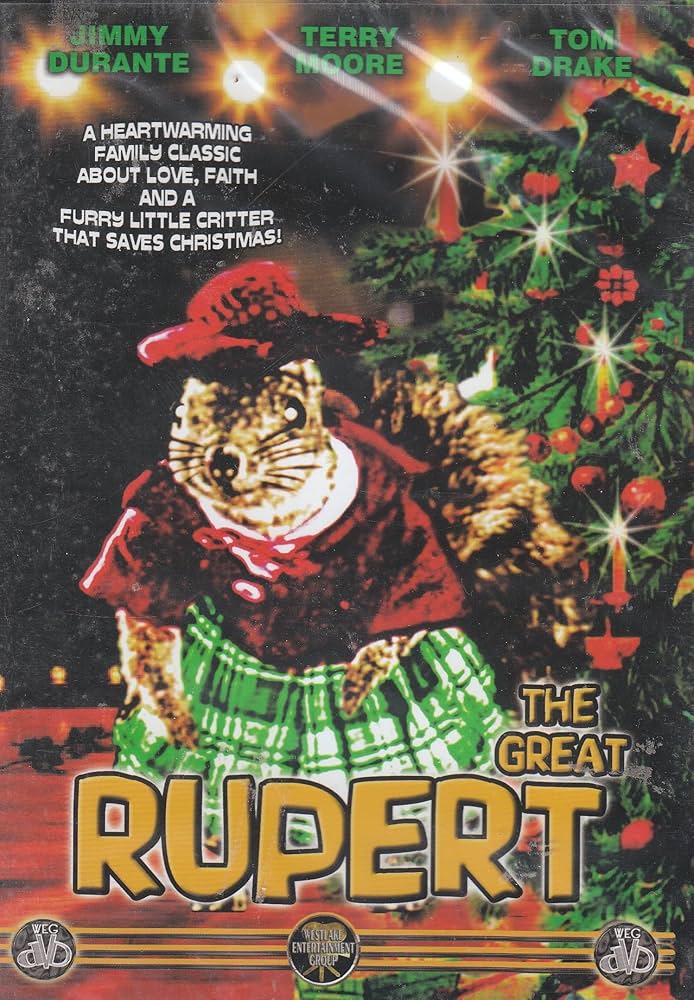
The DVD cover for The Great Rupert depicts an eerie-looking stuffed squirrel, dressed in a red hat and sweater and a green-and-white skirt, standing near a Christmas tree and looking at the viewer.  Above his head reads the tagline: "A heartwarming family classic about love, faith and a furry little critter that saves Christmas!"

The crucially important story element here is also one solidly grounded in these events having taken place on Christmas Eve, cementing this film’s claim as a work associated with the holiday.  The Amendolas lack the kind of funds to give themselves even a meager Christmas feast (Louie is reduced to haggling in the street for a “Christmas tree” that’s barely a scraggly branch stood on end), and poor Rosalinda’s shoes don’t fit but her parents can’t afford to replace them.  The Dingles, meanwhile, have come into sudden and shocking wealth: the father, Frank Dingle, has invested in a mine that finally came through, and the checks are going to roll in once a week from now on, it seems.  Frank’s wife, Katie, wants to get to church to offer prayers of gratitude, but Frank wants to get to the bank instead—he doesn’t trust anybody with his money, not even his wife, and he decides to create a secret stash of cash inside his bedroom wall, where he will shove the money he gets from cashing his weekly check.  These two situations combine for a moment that is somehow both funny and emotionally resonant, as the devout Mrs. Amendola prays to God for just a little money to get her daughter some new shoes, with a choir singing a carol outdoors somewhere in the background, and then Rupert the squirrel, agitated by the sudden appearance of a bunch of money being shoved into his acorn cubby by an unwitting Frank Dingle, kicks the bills out the other side of his nest so that money appears to fall from heaven like snowflakes into the amazed, outstretched hands of Mrs. Amendola.  It’s a Christmas miracle.  Well, “miracle.”  After that, the movie leaves Christmas behind, really not to return at all, but that’s not unusual for a film I’m covering here at FTTH, after all.

The story from that point forward is really bananas, and the final act is completely implausible in every respect—law enforcement investigations halt because the officers just seem to have gotten bored, every unexpected loss is made good by an equally surprising act of generosity, and every longshot chance a person could bet on all come in at once, paying off in the most spectacular fashion.  Any one of these happy accidents or coincidences might have worked as a “see, there is some good in the world” finale, but all of them at once leave the movie feeling either naive or surreal.  Nobody here is quite real enough to have an emotional center we can really sympathize with (other than maybe Mrs. Amendola, whose devout prayers and later moral qualms about asking God for so much money felt authentic, to me), and the quality of the acting and editing overall certainly feels a lot more like a very long episode of a 1950s television sitcom than it does a feature film.  If you love happy endings, though, and really never fuss about how plausible or logical they might be, this finish could work for you.

The titular performing squirrel is another element here that is likely to be divisive.  On the one hand, the special effect of Rupert is really remarkably successful for a film that’s clearly in every other way a low-to-moderate budget production design, a B movie.  George Pal, the movie’s producer, was an Oscar-nominated animator making the transition to live-action with The Great Rupert, and I can confirm that there’s a fluidity and a personality to the animated stop motion of the squirrel that’s impressive.  On the other hand, Rupert and his antics often live fully in the uncanny valley, where his capering to concertina music while dressed in a kilt, for instance, is more unsettling than endearing.  The rigid face of the squirrel (a model I hope is an artistic creation rather than a taxidermied real squirrel with articulated limbs) is such a strange juxtaposition to his energetically flailing limbs.  Rupert’s role in the story is key but small, and therefore the sudden emphasis on him in the movie’s final few minutes is unexpected and a little destabilizing.  You couldn’t do this film without him, but doing the film with him creates a really odd energy sometimes.

I think the thing I wrestle with in The Great Rupert is that I feel I should be tickled pink by it, when I think about its parts.  I ought to be up for a hammy, confident comedic portrayal of Louie Amendola by Jimmy Durante, an icon of his era.  I’m the kind of person who enjoys a solid message in favor of community and fraternity—Frank Dingle’s a villain (to the extent the movie has one) because he rejects his wife’s feeling that the money ought to be spent, and Louie Amendola’s a hero (to the extent the movie has one) because he uses his money to make as many people happy as possible, from his family in need of a Christmas dinner to local entrepreneurs in need of a cash infusion to refugees in Europe displaced by WWII in need of shoes.  I tend to appreciate plot conceits in these “holiday movies” that rely to at least some extent on the religious content of Christmas as a feast—even though we know Mrs. Amendola’s miracle is directly caused by Rupert and not Jesus, there’s an undeniable feeling of grace in the scene that makes it seem like maybe a divine hand is working through the frankly lunatic chaos of Frank Dingle and a cashed check and a hole in the wall and a circus rodent falling like dominos to drop money into her hands at the moment she needs it most.  I’d like to be a booster of this movie…but it’s just too flimsy an enterprise, somehow both slight and overwritten.  It’s never really clear what the movie’s central story even is—Louie Amendola vs. Frank Dingle? Pete’s dream of romancing Rosalinda? Joe Mahoney’s hopes for squirrel stardom?—and none of them are really given the space they need.  It’s a propulsive little movie, that packs a lot of both situation and comedy into its running time, and I would never look down my nose at anybody who says they just plain like it.  It’s cheerful as cotton candy, after all, even when the scenes on film really ought to be pretty serious or even sad—without exception, this screenplay knows how to manufacture happy endings, and it refuses to be stopped.

I Know That Face: Tom Drake, the handsome but penniless musician Pete Dingle, had appeared earlier as John Truett in 1944’s Meet Me in St. Louis, a movie you’ll see covered here on the blog in just a couple of days.  Terry Moore, here playing literal girl next door Rosalinda Amendola, is incredibly still acting today, in her late 90s; the only other holiday-related appearance I know of is a recent short film, 2021’s Evie Rose, in which she plays the 100 year old title character, celebrating Christmas with her teenage best friend.  Of course Jimmy Durante, the generous Louie Amendola, has the unmistakable voice that younger generations might only know from him singing “Frosty the Snowman” on the soundtrack of the Rankin-Bass television program by the same name.  And we have to doff our cap to Christmas perennial Sara Haden – underutilized here as the put-upon Katie Dingle, she’s appeared in other such holiday classics as The Shop Around the Corner (as Flora the shopgirl), which I blogged about last year, and The Bishop’s Wife (as Mildred Cassaway, secretary to the Bishop), a holiday film with a premise almost as strange as this one, though much less whimsical, and one I hope to cover, perhaps next year.

That Takes Me Back: You know, the whole idea of a circus feels stranger and stranger, the older I get—I grew up with them as a cultural experience that I and almost every kid I knew had had at some point, but my daughter’s never seen a circus and I wonder if she ever will (other than Cirque du Soleil).  A movie that’s relying on us having multiple households of circus performers interacting (despite us basically never seeing a circus on screen) is pretty throwback.  Oh, and cashing checks at the bank where everybody can see how much money you’re getting is a reality that on the one hand does seem perfectly normal to me, but it’s also something that I doubt a Gen Z kid would think of as even plausible.  “You mean literally everyone in line at the bank would just hear talk out loud about exactly how much money you just put in your pocket?”  “Yep.”

I Understood That Reference: Louie Amendola refers on multiple occasions to “Old Saint Nick,” a benevolent figure who wouldn’t forget the family.  All they needed was an address (as he exclaims) for the generous fella from the North Pole to show up with gifts all round.


Holiday Vibes (6/10): So, probably the most centrally important scene in this movie involves a snowy Christmas Eve, a choir singing “Adeste Fideles” in the distance, a woman’s devout prayer to God on behalf of her family for some generosity on such an important holiday, and then, once her prayer’s granted, a truly effusive Christmas Day full of trees and tinsel, merriment and music at the landlord’s piano, etc.  A movie that leaned a little harder into all that would score nearly perfectly.  As it is, these scenes fade into the background and the movie’s not even all that interested in making itself feel “like Christmas” to some extent, so the rating falls somewhere in the middle of the seasonal bell curve.

Actual Quality (6/10): I’d love to give higher praise, but this is a movie I’ve tried to enjoy three times in the last five years, and each time I get to the end feeling like I was either rolling my eyes or checking my watch about as much as I was having a genuinely good time.  It’s a gentle movie and it’s not going to bother basically anybody in the room, even if it fails to engage them.  The jokes mostly don’t land, but the music is lively at least, and Rupert’s….well, Rupert is Rupert, and you’ll either love him or find him unsettling.  It’s sure not my worst movie of the year, but I also really can’t tell you it’s any good, artistically.

Party Mood-Setter? It’s just not quite holiday enough to convince me it’s a great idea. But it’s certainly going to evoke that late 1940s vibe that feels like “the holidays” to a lot of folks, and it’s not going to confuse or bother you if your attention drifts in and out as it’s on in the background.  Maybe if you’re out of other options?

Plucked Heart Strings?  You know, weirdly, yes, there’s something moving about Mrs. Amendola’s prayer, and about her moral quandaries afterwards about whether it’s even right to keep asking for money they don’t desperately need.  Queenie Smith, who got her acting training at the Metropolitan Opera in New York City, manages to convey a lot of pathos in a pretty small role. Even Louie’s generosity is sometimes pretty heart-warming.  The main romance is, to me, pretty flat stuff, but I think the Amendolas as people shuttling from rags to riches would give you a little of that holiday glow.

Recommended Frequency: All in all, I think it’s just worth watching once.  You’ll figure out right away if it’s not your thing or if it’s going to become a secret favorite.  My returns to it have been, I think, unnecessary: I could have trusted my first impression of the movie, and I doubt I’ll see it again.  If I do give it another go, years hence, it’ll be me looking to spend time with the emotional journey of the Amendolas again: the movie’s heart is better than its humor.

The rights holders for The Great Rupert clearly have zero concern about oversaturating the market.  It is available from Tubi, Plex, Pluto, The Roku Channel, Sling TV, and something called Xumo, all of them ad-supported streams for free.  Amazon Prime’s got it ad-free, if you’re a member, as does MGM+.  You can pay to rent it, if you really want to, from Fandango at Home, or Apple TV.  You’ll notice that a few of these services list it as A Christmas Wish which was the title given to it when a colorized version was released for sale in the 2000s (presumably they knew that would sell more discs than something called The Great Rupert).  Barnes and Noble will sell you a DVD version for about ten bucks, and Worldcat reports that maybe a couple hundred libraries have it on disc. (Ask your librarian, though—it looks like the movie was added to some anthologies held by many libraries, so it may be there in a multi-disc case that has a generic name like “Holiday Collector’s Set”.)

The Family Man (2000)

Review Essay

Folks, here’s the thing about The Family Man.  It’s somehow 12 different movies you’ve seen before and it’s none of them at all.  It’s A Christmas Carol and It’s A Wonderful Life and Groundhog Day and Big and 13 Going On 30, but it’s also really not like any of those movies in so many key ways that you should probably forget I just mentioned them.  It’s a film that, for me, gets some things so right and then fumbles the ball in such weirdly unexpected ways that it’s maybe one of the hardest films I’ve had to reach a numerical rating for, since it’s incredibly hard to reduce this motion picture to a single number (of any magnitude) without feeling like I’m only describing some of the movie I had in front of me.  If you’ve seen it, I really wonder what you think of it, and if you haven’t, I’ll work at avoiding spoiling the ending but you may want to take it in before I ramble on about it.  In the end, there’s one element at work inside The Family Man that does kind of explain all of it—its genius at its best and its wobbliness at its worst.  And that element is a man we’ve come to know (and love?) under the stage name Nicolas Cage.

It’s probably at about this point that you want to tap my shoulder and say, “James, you still haven’t told us literally anything about this movie?”  Okay, okay: on the one hand, this is a film with such a clear central premise that it should be easy to summarize.  It seems like a classic tale about the road not taken: Jack, a thirty-something Manhattan high finance whiz got where he is in life by leaving behind him a stable girlfriend, Kate, whose goals were more altruistic.  But a Christmas miracle suddenly places him in the world where he made the other choice—waking up in bed with his wife Kate on Christmas morning, with loud young kids and a needy dog and in-laws crashing through the front door.  And then of course he’d like to escape this bad dream he’s having, but instead he’s got to live his way through it until….well, the “until” is part of this movie’s mystery and either its ultimate success or its failure.  But the basic structure of a body swap / life swap / alternate timeline movie in which the fancy big city guy learns something as he stumbles through life in the suburbs is largely going to show up on screen in the way you’re expecting, at least for the movie’s long and chaotic second act.  The third act, on the other hand, is unexpected in ways I’m really not sure about—maybe it’s a strength of the movie or maybe it’s a weakness that it didn’t really arrive at its outcomes in one of the ways I’d expect films of this kind to work.  I really don’t want to spoil it, so I may have to leave that judgment to you.

The poster for The Family Man depicts Nicolas Cage from behind as he stands in a trenchcoat on a snowy street with his briefcase on the sidewalk beside him. He is looking in through a large picture window at an image of himself seated in an armchair with Tea Leoni and their kids, cuddling together to post for a family Christmas photograph.  The tagline appearing next to him reads, "What if..."

Back to Nic Cage, though, and the reason this film is both really good and not really successful in landing the punches it wants to.  Cage is an astounding, generational talent: there’s nobody like him, and he does things nobody else can do, which is not to say he’s the finest actor working but he may be one of the most irreplaceable.  He’s on screen for nearly the entire running time of the movie, since this alternate universe switcheroo is one that effectively he alone is conscious of, so it’s his experience we’re tracking.  Given that fact, Cage’s fundamental watchability is hugely important—he makes everything from his character’s frustration to his character’s delight feel energized, even thrilling, as he takes the roller coaster ride of a man trying to figure out how he feels about this new life he’s been dropped into.  Even when the movie’s probably taking too long to complete the roller coaster ride (and it starts to feel a little pedestrian), you know Cage is capable of anything, and you keep your eyes on him.  As the character of Jack works out who he is, not as a balance sheet but as a person, he starts to understand why a man with his financial genius “settled” for the life of a suburban dad.  At its best, the film is both funny and heartfelt, as Jack navigates the sometimes outlandish silliness of his new world and discovers who he really cares about, and, maybe more importantly, discovers what it means to care about them.

And what makes all this not quite work, in my opinion, or at least not quite work in the ways that all-time great multiverse movies like Groundhog Day work, is that Jack is too compelling from the very beginning of the story.  The scenes we see of him on Christmas Eve prior to the dimensional shift are of a man who, sure, is a little arrogant and flighty in his personal relationships, a man maybe too used to the opera and fine whiskey and out of touch with “everyday life”.  But he’s also really happy?  And he’s not even a cruel person, that we see—sure, he’s in a world of high finance and mergers, etc., but there’s no obvious ways he’s complicit in ethical violations, and he’s upbeat and funny with his coworkers in ways that feel basically positive.  It’s not a bad life; to the contrary, it feels like a guy who’s figured out how to live at the top in ways he’s pretty fulfilled by.  Even if we consider the inciting incident that drags him to a new plane of existence, it’s not something he did wrong—to the contrary, he risks his own life pretty needlessly, since he could have remained an “innocent bystander”, but instead he steps forward to try to de-escalate a potentially lethal confrontation at the cash register of the shop he’s in, only to learn that the dangerous criminal is actually an angel.  Or something…honestly, the movie’s pretty bad at explaining the metaphysics of why this switch-up even happens or what qualified Jack for the experience.  Don Cheadle just smiles and tells Jack to remember he did this to himself, but what does that even mean?  Anyway, the result of all this is that we never really understand why we should be rooting for Jack not to go back to the life he came from, other than that Tea Leoni is hot (I mean, no arguments there), and that we know that in a Hollywood movie we’re supposed to be rooting for marriage and the suburbs and 2.3 children and a car in every garage, etc.  And knowing why we would be rooting for the suburbs is pretty darn important in a movie that is about really nothing else.

One of the other problems, fundamentally, is that the movie starts like it’s shot out of a cannon.  We literally know nothing about the Jack/Kate relationship prior to the breakup other than them standing at the airport gate in 1987 with her telling him she’s got a premonition he shouldn’t fly to London for his internship, and him telling her it’s ludicrous for her to ditch law school and him to ditch the internship.  It’s the only glimpse we’ll see of the relationship he left behind, and as a result, I just think it’s hard to invest myself fully in believing that clearly this young grad student should have listened to his girlfriend’s weird dream logic rather than continue to pursue a career he clearly thrives in.  And then once you start to lean on the logic of the movie, it does break down a bit…maybe most importantly, why is it true that Jack has to give up all his dreams and opportunities, whereas Kate still gets to go to law school (she’s an underpaid lawyer for a nonprofit in the “future” of the movie) and practice her craft, and the house and the life near her parents and all the rest of it are clearly the things she values in life.  Why are her values more important than his?  Again, if the movie made him an obvious monster at the outset—a selfish, cruel man who uses his gifts to oppress other folks—then it might be a simplistic moral fable but at least I would understand why Kate = good and Jack = bad.  As it is, the film’s values feel unfortunately like the echo of a ‘90s movie that presumes we know who the good and bad guys are without needing to actually make the case.

The holidayness of the movie is tough to calculate: again, I know that messages about family, etc., are often associated with this season of the year, but given how weird the movie’s ethics are, I’m not sure how much I want to credit it with having a meaningful message in that regard.  The magic of Christmas Eve / Christmas morning is definitely central to the film’s opening and closing sequences, but in the middle it’s just January in New Jersey, and given how detached from reality Jack is (either because of his palatial life as a wealthy financier, or because it’s Christmas Day and he woke up in the wrong house in someone else’s underpants and he’s frantically trying to put it all together) we don’t get a ton of Christmas celebration to lean into.  Add in the vagueness of the character Cheadle plays, who could easily have been more explicitly made an angel or an elf or Santa Claus or anything you like, and we lose even more chances to ground this experience in something more explicitly Yuletide.

I think in the end, this is a movie that feels like maybe it hooked Hollywood producers as a great premise, and then between that point and the final cut, neither the screenwriters (Diamond and Weissman, a partnership also responsible for….yikes, Evolution and Old Dogs, okay, some of this movie’s problems are making more sense now) nor the director (Brett Ratner, DOUBLE yikes, that man’s Wikipedia page has a whole section devoted to “sexual assault allegations”) figured out how to make it really work.  And the more I’m looking at what I just found out about the three guys involved, yeah, their struggle to tell a magical, nuanced tale about love and family life is maybe just a bit more explicable.  But here’s the thing: that premise is still really powerful.  And Cage and Leoni are probably just about perfect casting for a movie like this, in this era.  The second act may sag, and the third act may have a couple of unexpected curves in it, but ultimately their performances keep me hooked on the film, maybe in part because they make Jack and Kate alive enough that I don’t care too much about the screenplay not justifying why I should be rooting for them to be together again.  I just want these two people who are clearly passionate about each other to be together again.  That’s the kind of thing a movie can do, and this one does it well enough that it may be my most memorable takeaway.

I Know That Face: Saul Rubinek, who here plays the generally nebbish Alan Mintz, appears as Mr. Green in 2005’s Santa’s Slay, in which Mr. Claus is a demon who lost a bet with an angel.  Jeremy Piven, who in this film is Jack’s suburban buddy Arnie, plays the titular father in 2020’s My Dad’s Christmas Date, which sure sounds like a winner from the title, eh?  Nicolas Cage, Jack himself of course, was the surprising choice to voice Jacob Marley in a widely panned British adaptation of the classic story in 2001’s animated Christmas Carol: The Movie.  And Don Cheadle, here portraying “Cash” (an angel?), is of course well known for his role in the MCU as Colonel James Rhodes, including in the film Iron Man 3, which is acclaimed by the Die Hard crowd as yet another action movie that counts as a Christmas flick….and yes, by the forgiving standards of this very blog, I have to give it to them.  It counts.

That Takes Me Back: As a real fan of the paper map (who, yes, acknowledges that Google Maps has made everything simpler), I did love the chaos of Jack having to fumble with a paper map while driving his way around chaotically, like we used to.  It was nostalgic, too, to see a CRT monitor the size of a destroyer on his office desk, not to mention a checkbook with a bunch of entries for deposits and withdrawals in its register.  I wonder…do we even teach students to “balance a checkbook” in Home Economics these days, and if so, why?  Lastly, I couldn’t help but think of September 11th and all that’s changed since—certainly when I got a brief and shocking glimpse of the Twin Towers in an establishing shot (like we always used to do when filming New York City in the 1990s), and also when I watched a character making that old movie classic, the impulsive sprint to the gate at the airport, which now of course is simply impossible.

I Understood That Reference: Other than one character’s quip, “Santa Claus, you’re half an hour late,” I didn’t spot anything.


Holiday Vibes (4/10): As I note above, there’s not enough Christmas in the screenplay, or on screen, to really make this movie feel like Christmas to me.  But it’s in there enough that I can see this being a movie this time of year for some folks, and certainly any movie involving magic and snowfall has to get at least an extra half point, doesn’t it?

Actual Quality (8/10): Like I said at the outset, this movie defies numbers.  I could watch Cage prancing and singing around his enormous walk-in closet for 45 minutes but that doesn’t make this movie a 10, you know?  As it is, I’m trying to split the difference between my remaining really engaged with this movie throughout and my having a ton of notes about the ways I would have improved the film, given a chance.

Party Mood-Setter?  Probably not?  It’s hard to explain how weirdly intense the movie is—Jack’s outbursts are a lot to handle, even though I can generally track where they’re coming from.  Not really background fare.

Plucked Heart Strings?  There’s a moment or two that felt pretty authentic, but I’d be surprised if the film brought anybody to tears.  The complicated combination of the multiverse angle and therefore the weird emotional truth/falsity of these moments makes it harder to relate to than it would otherwise have been, I think.

Recommended Frequency: I have to be honest: I feel like I’ll watch it again, although I think there are other films that cover this kind of material better. There’s something to this movie, and maybe after another watch or two, I’ll understand better what, if anything, it means to me?

If you’d like to watch The Family Man yourself, right now you’ve got some options.  Subscribers to Peacock or to Amazon Prime will have an easy time.  You can rent it from all the usual streaming services, and Barnes and Noble will sell you the film on Blu-ray or DVD.  Public library users, Worldcat assures me you can snag this one from over 1,600 libraries in its database, so hopefully there’s a handy copy near you. Happy viewing to you!

The Thin Man (1934)

Review Essay

Here at Film for the Holidays, one of my inexplicable commitments each holiday season has been to commit to watching at least one movie from every decade spanning from the 1930s to the 2020s.  Last year I cheated slightly by making my pick from the 1930s a Christmas Carol adaptation, so it’s only this year that I’m picking something just a little more unusual off of the (relatively small) pile of 1930s holiday flicks.  I am sure some of my readers will have gotten to this movie long before I did, but if perhaps you (like me) have waited until this point in life to check out maybe the first great fictional couple of Hollywood’s sound era, Nick and Nora Charles, well, I think it’s time to give The Thin Man a viewing.  Say what we will about its seasonal content—and I will say it, eventually—there’s no denying that the spark under the hood of this motion picture is the crackle of romantic banter that’s been imitated in a thousand movies, and yet there’s still something fresh and fun about encountering the original article.

Before we can revel in Nick and Nora, though, this is a mystery with a ton of characters to set up, and set them up it does—the Charleses don’t appear until a good ten minutes into this film, which only has a running time of about an hour and a half.  By then, we’ve established a wide array of characters—the brilliant inventor Clyde Wynant, his greedy ex-wife Mimi Jorgensen (and her new husband, a real ne’er-do-well’s ne’er-do-well named Chris), his doting daughter Dorothy, and his creepy son Gilbert (who, had he been born about a century later, would definitely be either a true crime YouTuber or the moderator of a deeply unsettling subreddit).  Wynant, of course, has a wider array of orbiting humans than this—a couple of put-upon employees, among them a secretary named Julia Wolf who seems to have her way with his money (and maybe not just his money, if you catch my drift), a lawyer named MacCaulay who fusses about managing Wynant’s business affairs every time he disappears, a prospective son-in-law named Tommy, and a rival for Julia Wolf’s affections in the form of the most outlandish ‘30s mobster caricature imaginable, the spitfire-talking lowlife Joe Morelli (though there’s at least one other guy lurking around in the shadows, here, whose name we don’t have at first).  I think I still haven’t listed everyone we meet in this story BEFORE we meet our detective, Nick Charles, but maybe that makes sense, since at first there’s no crime to solve….just Clyde Wynant leaving town for a while, mysteriously, having promised his daughter Dorothy to be home by Christmas in time for her wedding, so he can give her away at the altar, angering his ex-wife in the process.  But then the movie hops forward to the dining room / bar / ballroom at New York City’s Hotel Normandie on Christmas Eve, where Dorothy is nervously chatting with her fiancé about how worried she is that her father still hasn’t shown up, and we have ourselves at least some of the makings of a mystery to investigate, though it’s certainly not the film’s most pressing conundrum by the time we really get going.

The poster for the movie, The Thin Man, advertises, at the top, "William Powell, Myrna Loy, in Dashiell Hammett's master mystery".  Below that, we see a man and woman, staring intently into each other's eyes as they each curl their right arm around the other's, and drink a cocktail from a small, clear glass.  The woman's in black with a white collar and black hat; the man is in a black suit with a white collared shirt and striped tie.  Below them, a different auburn-haired woman in a black dress and scarf faces towards the viewer and is looking down and to the viewer's left.

I have to admit, though, and this is me speaking as a big fan of mysteries in general (novels, movies, TV shows: you name it)—the appeal of The Thin Man isn’t really the mystery and its (somewhat creaky) solution.  It’s the effortlessly charming Nick Charles and his vivacious, cheerfully cutting wife, Nora.  The characters and their quippy, booze-soaked repartee seem to have worked in almost every format and setting from Dashiell Hammett’s original novel to later appearances in series written for radio and then television, but it’s really undeniable that the reason “Nick and Nora” still have cultural cachet in the 21st Century, whether we’re talking about a style of martini glass or an infinite playlist, is the film version of these characters as inhabited by William Powell and Myrna Loy.  Powell, a slender, coolly casual presence who, by 1934, has stepped smoothly from silent screen stardom into the talkies with such ease that he’s about to pick up his first of three Academy Award nominations for this movie, is definitely firing on all cylinders, but I’ll be honest and say that his co-star is this movie’s secret sauce.  Myrna Loy in the early 1930s is a kid from Helena who started out grabbing every bit part she could in silent ‘20s films and had mostly graduated to secondary roles as either femme fatales or “exotic” women of color—maybe only 1930’s Hollywood could look at a Montanan woman named Myrna and think “she’s believable as a Chinese villainess, right?”, but think it they did.  Anyway, this is her big swing of the bat, and she hits it out of the park like Ohtani, so fully connecting with audiences that she goes on a run for the rest of the 1930s and 1940s where she plays opposite almost every major male star of the era, not to mention demonstrating such magnetism side-by-side with William Powell that he’ll go on to play opposite her in an incredible THIRTEEN additional movies, including five more outings as Nick and Nora between 1936 and 1947.

I think what’s magical about Nick and Nora is the way they keep us convinced how much they’re in love with each other even while they are pretty verbally ruthless towards each other (and, in fairness, everyone around them, but they’re surrounded by such a cavalcade of rogues and fools that it’s easy to laugh along with the Charleses as they land jokes at the expense of the rest of the characters).  They’re helped to some extent by the fact that The Thin Man is one of the last Hollywood films to come out in a pre-Code environment: it hits the nation’s theaters in late May of 1934, right before the Hays Code takes effect on July 1st of that year, which means that every “morally questionable” element of this film, from its violence to Nick and Nora’s overindulgence in martinis to the not-too-subtle winks in the direction of their life in the bedroom, is allowed to be just a little more salacious.  It mostly does come down, though, to Powell and Loy being that good on screen together—good enough that when Nora accuses Nick a little jealously of his attentions to the starry-eyed young Dorothy, he can protest that, to the contrary, his type is “lanky brunettes with wicked jaws,” and the phrase sounds sweet as molasses.  He can shove an unwilling Nora into a taxi, telling the driver to “take her to Grant’s Tomb” to keep her out of harm’s way, and later, when he faux-innocently asks her how she liked the place, receive her reply of “It’s lovely. I’m having a copy made for you.” with a smile on his face that we genuinely believe.  Most of all, I think what works about the two of them here is that the script successfully makes them a team that completes the work of one good detective—sure, Nick’s the one with the professional experience and seemingly the skill, but it takes Nora’s persistence to get him to engage in the first place, and more than a little of her dogged resilience to get all the pieces to fall into place by the end in just the way Nick needs them.  When he says at one point, “Come on, Dr. Watson, let’s go places,” as he pulls her out the door of their suite, it feels a little less like a jab and a little more like a man starting to admit to himself that his frivolous, rich wife is turning out to be better at this private eye work than he would have thought….though this is Nick and Nora, of course it’s also a jab, and one she’ll hit back over the net at him sooner or later.

But James, I hear you saying….you just keep talking about Nick and Nora.  What about the mystery?  Heck, what about Christmas?  Isn’t this a holiday movie blog?  Look, friends, if you want to know why you should watch The Thin Man, it is 90% Nick and Nora saying things like “The next person that says ‘Merry Christmas’ to me? I’ll kill him.” or “Waiter, please serve the nuts. Sorry, I mean, waiter, please serve the guests the nuts.”  But sure, let’s at least nod at the rest of all this.  The real mystery kicks into gear on Christmas Day, when Mimi Jorgensen goes to try and get some money out of Julia Wolf (since apparently, despite the divorce, Clyde Wynant has been keeping his ex-wife’s household afloat financially, and not just Dorothy and Gilbert) and finds the young woman dead.  Mimi shrieks, she calls the police….and then she surreptitiously pockets something we can’t see off of the body.  What is it?  Time will tell.  Anyway, this triggers a parade of Wynants (and ex-Wynants) to the Charleses’ hotel suite, crashing an incredibly lively, some might say “bacchanalian” Christmas party, as first Dorothy and eventually her mother and her creepy kid brother show up seeking the help of old family friend and semi-retired detective Nick Charles.  From here, the chaos never really stops—the film flips back and forth between Nick interviewing at least one potential suspect and the discovery of either a new body or a new piece of evidence.  It’s not obvious for a big chunk of the running time if this is a mystery involving where the murderous Clyde Wynant could possibly have gone or one involving who killed Clyde Wynant and then framed him for a series of murders: the film will of course tell you by the end, and so there’s no need for me to do so.  To be honest, the mystery isn’t paced particularly well, since we learn some information so early that it doesn’t create a ton of suspense and some fairly key details emerge so late that there’s not much hope of an audience member solving the case through anything beyond a lucky (if semi-educated) guess.  The investigation of one or more crimes serves more as the backdrop that allows Nora to pester Nick (and Nick to infuriate Nora), with just enough twists along the way that your interest is held.  It’s been years since I read Hammett’s original novel, but my memory of it is that it’s slightly better as a mystery than the movie is, but that it also is fundamentally a detective story that is at least 75% about the vibes and not the plot (unlike, say, a Hercule Poirot).  When you get to the final scene where all the suspects are in one room together, sure, you’re looking forward to the resolution of the mystery, but honestly I think most of the fun even then is coming from the cheeky asides Nick and Nora are making to each other at the expense of the folks around them.

As far as Christmas goes, well, we meet Nora in the first place as a woman stumbling back from holiday shopping, who subsequently wakes up with a horrible hangover on Christmas morning, mumbling about the urgency of “trimming that darn Christmas tree”.  I mention Nick and Nora’s anarchic Christmas party earlier in the review, and really it’s the one seasonal element in the whole film: the party is a set piece that lasts long enough to be memorable, but it’s not exactly central to the story, either of the mystery or of Nick and Nora’s relationship.  The party is full of characters we never meet who will never play much of a role in the story beyond creating some nucleation sites for locating a great one-liner, like the fellow who tells Nora, “I think your husband’s great!”  She throws him back that feline smile of hers as she replies, “Well, I’m glad somebody does.”  Near the end of the gathering, as Nora and Nick watch the revelers belting out a very inebriated version of “O Christmas Tree”, she turns to him and says “Oh Nicky, I love you because you know such lovely people.”  And it’s a slam on Nick’s truly depraved social milieu from the rich woman who married him, while also being the bubbling up of genuine admiration from a woman who seems to feel like, after years of ease and wealth out west in California, this return to the seamy, seedy underbelly of Prohibition-era New York City is thrilling on a level she never anticipated.  In the end, though, this is far less a Christmas movie than it is a movie about mobsters who say “yeah, see?” right before pulling out a revolver like a cartoon character trying to threaten Bugs Bunny, or molls who, when they realize they’ve been dating an informant for the cops, burst tearfully out the door rather than remain in a relationship with a stool pigeon.  Not everyone will want this film bellying up to the bar alongside some much more evergreen-bedecked and candy-cane-fueled festive fare, but if you’re inclined to let it in the door, I think you’ll find it (like both Nick and Nora) is a charmer.

I Know That Face: Porter Hall, here playing MacCaulay, Wynant’s lawyer, appears, of course, in 1947’s Miracle on 34th Street, recently chronicled on this very blog, where he plays Sawyer, the malevolent psychologist who tries to get Kris Kringle locked up at Bellevue.  Edward Brophy, portraying the street tough Joe Morelli in this movie, swaps sides of the law to play a patrolman, Cecil Felton, in 1947’s It Happened on 5th Avenue, which I wrote about last year.  Myrna Loy, irreplaceable here as Nora, will later portray Mrs. Anna Smith in the TV movie version of Meet Me in St. Louis (1959), and at the start of her career she’d been an uncredited slave girl in 1925’s Ben-Hur: A Tale of the Christ, which of course stages the first Christmas in the early going.  And, in a real blink-and-you-might-miss-it appearance, one of the Christmas merrymakers at Nick and Nora’s party is played by an uncredited Charles Williams, who will, much later in a career that was otherwise mostly full of similarly uncredited performances, make his way into a film’s credits as Cousin Eustace, one of the fretful employees at the Bailey Savings & Loan in 1946’s It’s A Wonderful Life, which I covered for you all here last year on Christmas Eve.

That Takes Me Back: When, near the end of the film, Nora hosts a dinner party, it was fun to see her and Nick talking about putting down little name cards at places around the dinner table: maybe there are still some folks out there doing dinners like this (if so, invite me over!), but for me it feels mostly like a pleasant throwback to holiday dinners when I was a kid.  And it doesn’t matter how often it comes up, as it does during Nick and Nora’s Christmas party, but it will never fail to take me back in time when I see a character making a long distance call (especially when, as in this case, it’s clearly part of the joke to think about how wastefully expensive it is).  In a world where we basically never think about “long distance” anymore—so much so that I’m not sure my 12 year old would even know what the phrase means—it’s wild to think of how universal that experience once was.

I Understood That Reference: The only real reference to anything textually Christmassy is a quick back-and-forth quip between (who else?) Nora and Nick, when on Christmas morning she hears a knock at the door.  “Who’s that,” she asks Nick?  And he replies, “Probably Santa Claus.”


Holiday Vibes (2.5/10): As I cover in the review, really we get all of Christmas in just a couple of scenes—Christmas Eve down at the bar/ballroom portion of the Hotel Normandie and then Christmas Day up in Nick and Nora’s hotel suite, neither of them really classic depictions of holiday joy.  I have to give a little bit of credit to the party for at least being so exuberant that it really does feel like every two-bit ex-con and dipsomaniac in the five boroughs has found his or her way to reconnect with Nick Charles this holiday, but ultimately if you want a seasonally festive film experience, this isn’t going to deliver much.

Actual Quality (8.5/10): It’s hard in some ways to really rate the quality of a movie that is all about the energy and dialogue and not really at all about the plot, especially when the movie’s at least pretending to be primarily a mystery, a genre that is ordinarily heavily dependent on a successfully intricate plot.  It all really hangs on how much fun you’re having with Nick and Nora: if you find them more tedious or mean-spirited than I do, this could drop to a 7.5 or a 7 if we’re just judging it on the basis of “how good a detective story is this?”  And if the rat-a-tat of both comic delivery and 1930’s mobster gunfire is the music you love to hear, I can imagine this film climbing to a 9 or higher: Roger Ebert, the noted critic, listed this as one of his “Great Movies” of all time.  I think the fairest assessment is somewhere in the middle of that curve—I didn’t have quite as great a time with this flick as I have with a number of others I’ve reviewed for the blog, but I enjoyed myself, and I think you likely will too.

Party Mood-Setter?  The answer’s definitely “No,” not only because it’s not as “holiday” a movie as you’d really need for a seasonal celebration, but also because it’s so dependent on rapidfire banter and quick turns of phrase that to get the fun out of it, it really needs at least most if not all of your attention.

Plucked Heart Strings?  It’s just not that kind of movie.  The emotional register here is delight at how fun it is to watch Nick and Nora be semi-spitefully in love with each other, not pathos as you get in touch with wistful joy (or deep sadness).

Recommended Frequency: This one definitely rewards rewatching, since the first time through, there’s no way to avoid being mostly caught up in trying to track all the characters to figure out suspects and subplots and red herrings.  Once you’re freed from worrying about the mystery, a second viewing lets you settle in to just enjoy what the movie’s doing best—and I’d say that the end of the movie is what helps cement my certainty that Nick and Nora are actually good together (and genuinely attracted to each other), which altered to some extent my reading of their interactions the second time through the film.  I would definitely tell you to watch this one once, if you haven’t seen it (or haven’t in a long time), though I’ll admit that I think it would work almost as well in June as I find it does in December.

The Thin Man is still a few years away from the public domain, so your free options for streaming it are Tubi or Fandango at Home, both of them ad-supported, of course.  You can pay to rent it digitally from all the places you would normally think to do that.  The film’s widely available on disc, too, of course—just The Thin Man on Blu-ray if you like, or you could pick up all six films if you’re a real Nick-and-Nora-head.  And I’m nearly willing to issue a guarantee that you’ll be able to get the movie at your local library, since Worldcat says there’s over 1,600 libraries with at least one copy of the DVD.  If you want to try this movie out, it won’t be hard to do, and I encourage you to give it a try if it sounds remotely interesting.

Single All the Way (2021)

Review Essay

I’m going to open with the caveat that this is a movie living on the outskirts of a massive holiday movie industry that is absolutely serving a big and happy audience, and that I am not a part of that audience.  I’m not trying to get in anybody’s way as they consume the delightful fluff of Lifetime/Hallmark/Netflix Christmas flicks (and yes, diehards, I know that there are real tonal and stylistic differences between these channels/streamers when it comes to holiday media), and honestly, I’ve seen so few of them that even calling them “fluff” is probably unfair since if there’s some non-fluff in there, I wouldn’t know it.  My guess is that the movie I’m talking about today will work a lot better for folks who receive the tropes of the TV/streamer holiday romantic comedy like a warm hug.  For me, this is something less successful, but I’ll try to be generous where I can be.  That said, good grief, does Single All the Way feel like an extended Christmas episode for a cheesy sitcom that doesn’t exist.

The fundamental setup of the movie is trite but not necessarily doomed at the outset: Peter is a guy born in New Hampshire who escaped to the high-fashion world of models and marketing in Los Angeles years ago.  He’s headed back home to his small town for Christmas, accompanied by long-time best friend and roommate Nick who just dumped his trash fire of a boyfriend.  Peter’s family are (delightfully and not at all expectedly to me, given other films of this kind) really accepting of his identity as a gay man, even if they seem pretty clueless about LGBTQ+ folks in general.  So this isn’t a trek back home to the closet, as in Happiest Season, which I did genuinely appreciate.  But instead, alas, it’s a trip home to a family desperate to get Peter hitched to somebody—initially to his mom’s spinning instructor, James, via blind date, but then the family rapidly shifts to urgent, manic match-making maneuvers in an attempt to get Peter and Nick to fall for each other, despite their never having had any apparent romantic chemistry or tension in years of living together.  It’s a surprisingly exhausting experience, and if you think you know where it will end, yeah, you sure do.  Regardless of whether the ending makes any sense for these characters.

A promotional poster for Single All the Way depicts two men in their late 20s or early 30s standing together in the middle, looking upwards and smiling.  The man on the left is a Black man with short hair and beard; the man on the left is a clean-shaven white man wearing large earmuffs. Above them are five inset portrait photographs, two of them photos of the two men and the other three images of smiling middle-aged white women. The tagline reads "Peter and Nick are just friends. Peter's family knows better."

The tone of all this is, as I mentioned up top, really sitcom.  Like, really, really sitcom.  Jack from Will & Grace could wander into almost any of these scenes and not be totally out of place.  I don’t know at what point my eyes permanently rolled out of my head at the dialogue—I think I made it through “don your gay apparel” without collapsing, and I gritted my teeth through someone quipping that HGTV was the “Homosexual Gay Network”, but when someone described themselves as a “FOMO-sexual”, I was done.  And I want to emphasize that I love a good sitcom, so this isn’t me sniffing that the movie isn’t dark or artsy enough for me.  But the tone is so often broad and silly that it becomes incredibly hard to be invested in the emotional wellbeing of these characters when suddenly the screenplay expects me to take them seriously as people with hopes and dreams and baggage.  The antics they get up to—blind date hijinks for Peter, lots of home improvement work by Nick helping Peter’s father (since Nick works for Taskrabbit and he is really inspired by how Taskrabbit allows him to connect with and help others, and being a Taskrabbit at Christmas is almost like being a TaskElf, hahaha, hey, have I mentioned yet that Nick works for Taskrabbit and he feels kind of directionless in New Hampshire unless he’s working like a Taskrabbit?)—are incredibly mild. I’ll give it to this movie that, unlike Happiest Season, the goofiness is often less unhinged, but that also just means that the scenes are often a lot less memorable.  I’ve already forgotten a lot of the story beats within this movie’s second act.

There are things to praise here, to be clear, beyond my enthusiasm for a holiday movie that gives us a diverse cast (not just several key gay characters, but also at least a little welcome racial diversity for a movie set in New Hampshire).  Insane as both the characters they’re playing are, Kathy Najimy and Jennifer Coolidge (Peter’s mother and aunt) were kind of born to play sisters and to some extent they each make the other seem more realistic as a human being by being adjacent.  Coolidge as Aunt Sandy, the deranged megalomaniacal director of Jesus H. Christ, the town’s non-sectarian Christmas pageant, can at her best make even the wildest, most flailingly awkward moments seem plausible…she is not always at her best in this film, even so, but nobody could have done more to keep at least one of the movie’s toes on the ground where the pageant subplot is concerned.  Kathy Najimy as Peter’s mom….well, I have been to too many farmer’s markets to doubt the existence of people who buy kitschy, folksy, and at least allegedly funny wall decor, and Kathy is 100% landing the plane as a woman who would purchase a framed cross-stitch that says “Sleigh Queen”.  If you chuckled at that, friend, this is a movie you should check out.  The plan briefly entertained by Peter to pretend that he and Nick are dating (as a smokescreen to save himself from the blind date his mother’s going to send him on) dies a quick and fairly painless death more or less on arrival, which was a relief in the moment, at least.  And the best performance in the movie, bar none, is Luke Macfarlane as James, the spinning instructor for Peter’s mother, “Christmas Carol” (yes, that’s the name every character in this movie calls her, friends: how are you feeling about it, right now?), and also of course Peter’s blind date.  The character of James comes across as nuanced, thoughtful, patient: he undermines every likely stereotype, and he seems like a genuinely good dude with whom Peter might have built some really good chemistry, maybe even was initially building that chemistry.  I think this works against the film, to some extent, since it makes the ways Peter treats/mistreats James on his way to his destined-by-the-screenplay relationship with Nick even harder to enjoy when James is not only sympathetic but someone who feels more real, more human than our main character.

The overall arc of the film, really, was just too hard for me to enjoy: we’re asked to join all of Peter’s family in rooting for them to destroy his budding romance with James (based on a blind date his own mother started) and figure out how to basically force Peter and Nick to realize that they’re “perfect for each other”, by which I mean Peter’s dad who loves Nick’s handyman skills and a couple of teenage nieces who think it would be, like, sooooo cute if Peter and Nick dated and…well, you get the drift.  This isn’t a movie that’s figured out how to get these best friends to fall in love with each other by any means other than having a bunch of family members bashing them together like two Ken dolls they’re playing with.  I get that it’s supposed to be silly and sweet, but I don’t know: I was not in the mood for this movie’s brand of romance, and the whole thing ended up feeling almost offensive, as though the gay main characters were paper dolls being puppeted around by straight people who are, yes, “accepting” of their identity, but also not really treating them like people with their own desires and needs in relationships.  But honestly, using a word like “offensive” about Single All the Way would be inappropriate: this isn’t a movie that’s working hard enough in any direction to really mean the things it’s saying.  Like, this is a movie that wants us to nod along with a character claiming that if the town’s Christmas pageant is peppy enough, maybe it can “go on tour” after Christmas Day.  It wants us to accept that the highest powered marketing executives in the country would insist on an emergency photo shoot occurring on Christmas Eve at a moment’s notice….but they’re fine if the images produced are just iPhone snapshots in the woods, featuring whatever random local hunks are willing to pose in a hat and coat.  It’s never, ever mean-spirited, and as the queer main cast members are seemingly comfortable with what they’re appearing in, I wouldn’t tell you not to watch it.  I just think that, ultimately, this is not a script or a film that respects its characters in the ways I was looking for—the final scenes of revelation and admiration between Peter and Nick imply a greater psychological depth than has been developed for either of them.  The movie thinks it’s a story about self-discovery, but I experienced it much more as a story of social engineering, in which a family’s acceptance can also become a fenced yard in which your identity becomes a convenient way to pigeonhole you.  As always, though (and especially for films in this particular subgenre), your mileage may vary.

I Know That Face: Luke Macfarlane (as aforementioned, here he’s James, Peter’s incredibly attractive blind date) is an absolute veteran of TV Christmas movies, having appeared in at least NINE of them, including as Edward Ferris in 2019’s Sense, Sensibility and Snowmen, and as Chris, Santa Claus’s alleged son, in 2023’s Catch Me If You Claus.  I’ll give it to this subgenre: the movie titles are hilariously corny.  Barry Bostwick (here playing Peter’s genial father) is no stranger to the holiday circuit, himself, appearing in at least five such films, including 2017’s Christmas in Mississippi and 2019’s Christmas in Louisiana—the mind boggles at the potential for 48 sequels (more, even, if we throw in D.C., Puerto Rico, and Guam).  Add in Kathy Najimy (again, Peter’s well-meaning and overbearing mother), a member of the cast of at least four different holiday movies, including her appearance as Kim in 2013’s A Madea Christmas, and this little cast covers a remarkable breadth of the sizable collection of 21st Century TV movies that depict this special time of year.

That Takes Me Back: As a 2021 release, this movie’s too recent for any real nostalgia, of course, but someday the relentless Taskrabbit and Instagram references will be dated as hell.

I Understood That Reference: Kris Kringle shows up in the end credits song, and of course, thanks to Aunt Sandy’s lunatic obsession with a Christmas pageant that I will remind you again is titled Jesus H. Christ, we get a weirdly elaborate nativity scene on screen, since the movie can think of no more natural way to tie Peter and Nick together than forcing them to help out with the pageant before Aunt Sandy’s ego crushes every single participating child.  


Holiday Vibes (9.5/10): I have to hand it to this movie, it captures the feeling of a particular holiday energy, embodied by the kind of person who sees a framed poster in a country store that says “Nice Until Proven Naughty” and thinks, “That would be perfect for my entryway.”  And basically everything about the film once we reach New Hampshire is pretty Christmassy—snow and merriment and pageants and a countdown hanging on the wall that reminds passers-by to be good for St. Nick.  It’s generating plenty of holiday vibes, that’s for sure.

Actual Quality (6/10): As for the quality, on the other hand, this movie suffers.  Now, is it truly awful?  I can’t say that.  There are some fun performances and the movie’s pretty relaxing as a watch, as long as you don’t think too hard (as I clearly did) about the ethics of how this family is treating their visiting adult son/brother/uncle.  But is it good?  I struggle to even call it “fine”, given what I’m looking for in a movie: there’s just not enough ‘there’ there.  It’s a film that leans on the worst tropes in romantic comedy, for me, and (with my apologies) I just don’t think most of the cast is talented enough to really hold my attention: better actors might have saved some of this writing, but the two main characters here in particular are pretty bland, for me.

Party Mood-Setter?  Oh, 100%, especially if you’re at a party where those gathered will enjoy a little bit of eye candy from the hot men posing for the camera at multiple points throughout.  Sure, I think it’s empty calories, but that means that a party or a cookie baking afternoon is a potentially great venue for a movie that, if nothing else, fully lands the plane of “cute gay guys having a lovely white Christmas in small town New England”.

Plucked Heart Strings?  You’d have to find both Peter and Nick much more effectively realized as characters than I do to feel that lump in your throat as they finally confess their love for each other.  I guess I can imagine that reaction, even though I didn’t have it, but I don’t want to make you any promises!

Recommended Frequency: For a movie I didn’t like, honestly, this is maybe where I’d be gentlest: I can even imagine watching this one again, since I’ll acknowledge that I may just have been in too grouchy or critical a mood the first time around.  Most romantic comedies have premises that are at least a little unsettling or weird in the ethics department if you break them down far enough.  That said, I don’t know that I would ever seek it out again: there’s a lot of films out there, and this one missed me on too many levels for me to think it has much of a chance of warming my heart.  But if it sounds interesting to you, I think it’s well worth a try: you’ll decide early on if it’s really your style.

If you’d like to do just that, Single All the Way is one of those Netflix-produced movies that is really only available on the Netflix platform.  I see a couple DVD copies available from sketchy looking websites, which I assume are pirated, but other than that I can’t really give you options for renting it, buying it on disc, or securing it from your local library.  Apologies!  I try to stick mostly with films that we have a wider array of options to access, and I’ll try to get back to that array of options later this week.

It’s a Wonderful Life (1946)

Review Essay

It’s so hard to talk about It’s a Wonderful Life, since for some of us every single scene is imprinted on our memories from childhood, the strangeness and wonder of this fable about life and hope and worth so indelibly associated with Christmas that it would be very difficult to say anything new or original.  And for others, the film is unfamiliar — a “holiday classic” but one that’s long enough and black-and-white enough that you haven’t picked it up yet, perhaps especially because the movie’s fans tell you it’ll put you through the emotional wringer and that’s not necessarily something we all want to sign up for.  What can I say about a movie many of you have either memorized or else long avoided?  Well, it’s Christmas Eve and I guess there’s no reason to say anything other than what I think and hope it connects with you, wherever you’re coming from.  If you’ve come here to spend any of these important holiday minutes with me, I owe you nothing less.

The premise of this film is well known, I think: a man named George Bailey is shown the world as it would have been without him, as though he was never born, and it transforms him.  And it has something to do with Christmas, though I imagine when folks who’ve not seen it hear these summaries, it’s always a little puzzling what the connection really is.  So, I’ll offer a different way of seeing this film, if that’s all right.  The author of the short story on which this movie is based always acknowledged a debt to Charles Dickens and A Christmas Carol, and I think it’s evident here: the movie’s three great sections are George Bailey’s Past, Present, and a grim vision of what will become of the world without him (though, of course, to be precise, it’s the world as though he had never been).  George is no Ebenezer Scrooge — the real “covetous old sinner” of this piece, Scrooge’s counterpart, is the malevolent spider in his web, Henry F. Potter, whom this film can neither explain nor redeem.  Instead, our attention is on an ordinary man in so many respects, both kind and hot-tempered, both ambitious and loyal, a good man and a flawed one.  We see him at his triumphs and at his most desperate.  And so we learn alongside him as people more able to put ourselves in his shoes than most of us can ever fit into Scrooge’s.  It’s a carol for an American life.

The poster for It's A Wonderful Life shows a painting of Donna Reed held high in the air by a smiling Jimmy Stewart -- they gaze into each other's eyes lovingly.

It carries with it that same background of Christmas religious observance that Dickens employs in his novella: we open on a snowy Christmas Eve in the town of Bedford Falls, and all we know is that behind every closed door and window, simple and heartfelt prayers are being offered for a man named George Bailey, whom we have not yet seen.  And then, in the movie’s weirdest device, we are in some astronomical photograph, as blinking galaxies and stars represent God, Joseph (whether an angel or the adoptive father of Jesus is unclear), and of course, Clarence Odbody, AS2 (Angel, Second Class).  Clarence is tasked with assisting George Bailey out of a terrible condition — far worse than being sick, God observes, George is discouraged.  He is contemplating suicide.  The next hour and a half, then, unfold for Clarence the life of George Bailey, with a particular emphasis on Christmas Eve, 1945, the day of George’s profound despair, as this novice angel tries to “win his wings,” a metaphysical situation that is never really explained further.

I think what must surely be challenging or even off-putting to a new viewer is the character of George Bailey himself — Capra plans to take full advantage of the fact that, as I observed in writing about The Shop Around the Corner, Stewart had developed this screen persona by the 1940s that allowed him to play characters who were irascible and difficult and rude without losing the audience’s trust.  Capra extends that quality down into the boy actor playing the younger version, as from the beginning we understand that George is brash and ambitious and self-confident to a fault…but he’s also wise beyond his years at times, and loyal to his sense of ethics, and always willing to make a sacrifice for someone in need.  It’s why he taunts his kid brother Harry into a daredevil sled ride that forces George to leap into an icy lake to save him.  He’s condescending about coconut and bragging about his membership “in the National Geographic Society” but one glance at a telegram and he realizes his boss is grieving — and he risks anger and even violence to save Gower, the druggist, from his own despair.  Those scenes are hard to watch, but what’s hard to watch in them is what’s most human — some of us have known griefs as profound as Gower’s, a pit so deep we cannot see out of it, in which every human voice wakes further to agony.  Some of us have had to be as brave as George, standing up to someone’s pain knowing it may cause us pain, ourselves — for the sake of helping them, of helping others.  The emotions that come home in the movie’s justifiably famous closing scene are all laid in us here, bit by bit, as George’s life unfolds.  We come to care about the people he cares about, and through them, we care for him.

If you’re a newcomer to this movie, please don’t feel it’s all death and sadness: there’s a liveliness to so much of the film.  We get it from the banter of Bert and Ernie, the policeman and the cab driver (no, despite Internet rumors to the contrary, as far as we know Henson did not name two roommates on Sesame Street for these men).  It shows up in the Bailey home, with criss-crossing dialogue and Harry balancing a pie on his head and Annie, the family’s maid, very rightly referring to the Bailey boys as “lunkheads”.  Even if you’ve never really watched the film, I’m guessing you might know about the Charleston contest, as George and Mary accidentally dance their way into a swimming pool.  What’s great about their flirtations that night is that George is just as complicated as ever, but Mary sees through him to the man he’s going to become.  She’s not planning on “fixing” George Bailey, but she knows better than he does who George Bailey really is.  What I love about the movie, though, is how it weaves its deeper ideas into the fun moments.  Ernie the cabbie is George’s wisecracking friend, but it’s also a loan to him that becomes a rhetorical football between George’s idealism about the common man and Potter’s domineering sneers about the working class’s need to learn “thrift”.  The chaos of that dining room scene at the Baileys surrounds a really serious conversation in which Peter Bailey (who, without knowing it, is having the last conversation he’ll ever have with his son) tries to convey to George what matters in life…and George both knows in his heart his dad is right and doesn’t want to give up his dreams for it anyway.  And of course, George’s relationship to Mary is the hinge on which the whole movie turns, at every step.

I’ve heard complaints about the movie, over the years, about the ways it handles some gender dynamics, and I won’t defend any 1940s movie as wholly innocent of those charges: we just know better now, or at least some of us do.  This is, I should note, still a lot better at giving women agency than much more modern films like Ghosts of Girlfriends Past, but that’s a low bar to clear.  I do think, though, that sometimes those critiques have been misplaced.  For instance (and apologies for spoilers, but so much of this movie’s success is about its final half hour that I cannot avoid them all), Mary Hatch doesn’t end up an “old maid” librarian because the movie’s punishing her for not having George in her life — this is what she’s said from the beginning, telling George at one point very plainly that if it hadn’t been for him, there wasn’t anyone else in town she wanted to marry.  And the movie’s also not arguing that being an “old maid” or a librarian is a fate worse than death — it’s a fate that feels like death to George, because it IS his death.  Or rather, it’s damning proof that Clarence is right, and that this is a world in which he was never born, never did anything, never kissed Mary Hatch Bailey on their wedding night or built a life with her.  It’s not Mary he’s grieving: it’s himself.

I’ve heard complaints also about George’s outbursts at his kids, and certainly I can understand that depending on your own experiences, it may be very painful to watch the movie’s “hero” act so dismissively and harshly to his children, shouting at them and smashing things.  I don’t want to minimize the harm there, but again, I think the movie doesn’t either.  That Christmas Eve, George is facing the ruination of his entire life — he sacrificed everything for the sake of Bedford Falls and the building and loan, and now the business will fail and the town will slip into Potter’s cruel hands and his own family life will be destroyed by scandal and prison, he expects.  He’s barely holding it together until those moments when he’s not holding it together at all.  But I think it’s clear from the ways the children react that this is not the father they know — that they expect support and love from him, and it is a startling betrayal to find those things missing.  That doesn’t make an evening of borderline abusive conduct “okay”, but I think it reframes the situation for us — we have to believe that we’re seeing a man prepare to commit suicide because he believes the world is better off without him.  So he has to wreck himself and that family’s peace enough to have that moment where he’s stammering apologies and trying to command them to restore the home he’s terrified of losing, and his wife and children look at him with such fear that he feels they’ll be happier without him.  It is not the well but the sick who need a doctor, as the Gospels remind us: for George Bailey to be saved, he’s got to realize the harm he’s done.  If you don’t want to roll with that, I get it.  But for those of us willing to take that journey with George, it’s the movie’s power.

I refuse to spoil any more of the movie’s final half hour, much of which plays out like a Twilight Zone episode, but of course it’s a Twilight Zone episode that follows 100 minutes of establishing scenes, so that we know every single minor character on screen and we can feel the depths of George’s confusion and ultimate agony as he explores a world without him in it.  The movie’s values are on its sleeve throughout, and say what we will about Capra, he understood what endangered American freedom and joy.  It’s what endangers it still.  This sequence is an indictment of Potter, and of a society resigned to letting the Potters of the world have their way.  And the whole time, I know, a new viewer will keep saying to themselves, “okay, this is all happening on Christmas Eve.  But where’s this movie that’s supposed to be so holiday-inspirational that it moves me to tears?”

And then you get the ten minutes that either work for you or don’t.  If it’s too sentimental for you, too neatly resolved, too implausible, then I get it.  There are other movies that maybe will kindle hope for you, if hope’s something you’re willing to take from a world that rarely seems to reward it.  For the rest of us, this is where the movie breaks us open.  I watched this film for what I am sure is at least the 40th time this December, preparing for this blog post.  And I wept like a child for most of its final sequence, even though I could also probably recite it to you by heart.  Gratitude is overwhelming like that, I think — when we confront the fact that we can be grateful for life even at its darkest extremes, even when we feel most lost.  And what the film is urgent in reminding us is that we are more loved than we know; there is more joy than we’ve yet found.  No man is a failure who has friends, as Clarence says, which is both glib and profound.  I get that that’s not a comfort to everyone out there, but I hope that the movie’s argument speaks even to those who feel friendless, reminding them that any life has touched so many other lives, and we have given so much more love than pain, those of us who aren’t Potters, at least.  Half the people we see in the film’s finale are not George Bailey’s friends.  They are people who have known the worth of his life, and who are ready to return blessing for blessing.  That’s the Christmas magic of this movie, and the reason that, despite being a film that spends only about half its running time on Christmas Eve and very little of its Christmas Eve time doing anything that feels connected to the holiday, it remains not just a holiday classic, but to many folks THE holiday classic, the film we cannot do without.  It’s so powerful for me that there have been Decembers I couldn’t take watching it, because it would have hit me too hard.  Whether or not it’s that kind of movie for you, I wish you this movie’s sense of gladness and of hope, of joy at being alive, of the discovery of friendship and fellowship in those places in your life you least expected them.  For those preparing for Christmas or Hanukkah tomorrow, or Kwanzaa the next day, or simply preparing for a break in life’s chaos here at the turning of the year, peace to you, and thank you for reading this little blog.

I Know That Face: Henry Travers, who here plays the angel Clarence Odbody, plays the businessman Horace Bogardus in The Bells of St. Mary’s, one of those movies that has a Christmas sequence and is therefore a holiday movie, as well as playing Matey, the brother to Anne Shirley’s landlord, in Anne of Windy Poplars…another movie that has a Christmas sequence and is therefore a holiday movie.  Ward Bond, who here plays Bert the policeman, plays a different kind of cop in 3 Godfathers, a loose Western retelling of the three wise men (and at least partial inspiration for Tokyo Godfathers), in which Bond plays Sheriff Buck Sweet.  And of course we’ve already seen Beulah Bondi, here Mrs. Bailey, in Remember the Night, as well as Jimmy Stewart, here our George Bailey, in both The Shop Around the Corner and Bell, Book and Candle.

That Takes Me Back: As someone who remembers being mesmerized by the spinning of a record on our record player, I love the sight of the phonograph that, while playing, can also turn the spit to roast two chickens on George’s wedding night.  My guess is that my daughter would barely understand the phrase “a long distance telephone call” other than from context clues, and therefore would have absolutely no chance at understanding what it means that Harry’s “reversing the charges”.  Some things have changed a lot since I was young.  This is where I’d normally make a quip about how the movie takes me back to when we held greedy, amoral men with too much money and absolutely no conscience accountable under the law, but in this case there’s nothing at all nostalgic about It’s a Wonderful Life — Potter seemingly will get away with having stolen eight thousand dollars from the Baileys, and go on being the man in Bedford Falls with the most power and capital, even if Harry Bailey is right (as I hope he is) in calling his brother George “the richest man in town,” speaking on a human level.

I Understood That Reference: Speaking of Henry Travers’s filmography (as I was just a moment ago), we see in a couple of shots that The Bells of St. Mary’s is playing at the theater in Bedford Falls that Christmas Eve.  Tommy is, I think, wearing a Santa mask when he tries to scare his father and George in his panic doesn’t know what to do other than hug him frantically…but honestly, I could be misreading it, it’s a weird mask.


Holiday Vibes (7/10): This is another one where there’s no easy rating: give it a 10 and a new viewer will, 45 minutes in, wonder what the heck is so Christmassy about it, but give it some low number and that’ll underplay how powerfully this movie’s scenes and its message have taken up residence in millions of people’s experiences of December and the holidays.  I think a 7 is fair, given that half the film’s on Christmas Eve, and we encounter enough of it (from decorations to music to the movie’s themes) that it’s playing an important role.  Plus the big finish.  Knocks me flat, every time.

Actual Quality (10/10): This film has, for some reason, long had a reputation as being underappreciated by critics, but I don’t think that’s true — sure, a few pieces have knocked it for its sentimentality, but it was nominated for a bunch of Oscars, and in recent years it has placed high on almost every kind of movie list from the organizations that put these things out on both sides of the Atlantic.  For me, it’s absolutely top tier: those of you I’ve made aware of Flickchart are probably asking where this one ranks, and while it’s moved around a little over the years, I think it’s solidly a top 25 movie for me (and it’s currently sitting at #20).  But the movies I love aren’t always the ones I think have the greatest quality, so let me double down here on this movie’s artistry: the cast is tremendous, and the film successfully sweeps us through half a century of American life, touching on the influenza epidemic, the roaring 20s, the crash that started the Great Depression, the second World War, etc., without feeling cheap or cheesy in the ways it uses those contexts.  It is hard to pull off this movie’s intended outcomes, mixing some comic moments with a classic romance featuring two stars but wrapping all of it in one of the most fantastic premises you’ll find in a major Hollywood release of that era.  The fact that it succeeds on all fronts leaves me feeling there’s no way I can dock it even half a point.

Party Mood-Setter? So, it really shouldn’t work in this setting, since the film is complicated and has a pretty wild premise, and then the emotion at the end hits like a truck.  But I’d be lying if I said there weren’t households that know this film so well that it can be a Christmas vibe you’re only half paying attention to — how many of us, indeed, remember Christmas Eves where this movie was just on in the background while our families did other things?  If it works that way for you, though, you’ll already know it: for folks newer to the movie, I wouldn’t recommend using it in that fashion.

Plucked Heart Strings? I know sometimes we say things like “I cried” and mean them only metaphorically, so I want to be clear: I cried human tears while rewatching this.  A lot of them.  Tissues were involved.  I think it may have hit harder because it’s 2024 and I have a lot of feelings about the Potters of the world and the bravery of communities banding together to protect each other from them.  It may also have hit harder just because I was thinking in such detail about the film that its themes really reached me.  But I think it’s also just a movie that does this to people — I ran into a “reaction video” on YouTube about It’s a Wonderful Life, where a woman (I think a Millennial) filmed herself watching it for the first time.  Yeah, I know, I don’t really get this genre of video either, folks, but I was curious.  She got within about 5 minutes of the end and was remarking at how confused she was that her viewers had told her she’d cry at this movie, because it just doesn’t hit like that.  And then she spent the last five minutes in full, heaving sobs as the movie came crashing down around her — it hit her so hard that afterwards, in conversation with her off-screen partner, she tells him she feels so embarrassed by her reaction that she’s not sure if she should post it.  I share all that just to say, I think that’s how this film works.  It surprises us with joy in a way that gets past our defenses.  Maybe it doesn’t hit you like that, but I’d come to it, if you are approaching it for the first time or the first time in a long time, ready to let yourself feel this way.

Recommended Frequency: As I mention above, to me, this is only kept off of the “every single year” list by the fact that it’s powerful enough to be hard to take some years.  It’s still easily a 9 out of 10 years movie for me, and if you’ve not seen it even in just the last few, I’d tell you you’re overdue.  I hope you get a lot of joy out of it.

Before I tell you about where you can watch this movie, I do want to note: this is the last Film for the Holidays movie review of 2024.  It might be the last one ever!  But the day after Christmas, if you want, I’ll be posting a survey here.  It’s intended to get a better understanding of what the blog’s viewers might care about if I was thinking of doing this again — what to keep the same and what to change.  It’ll be very short and obviously totally up to you which questions to answer if any.  But I hope, if you’ve come here at all regularly, you’ll pop back here and tell me what you think: even if what you think is “yeah, James, failed experiment, use your free time for something else”.

If you want to watch It’s a Wonderful Life, you can go very old school and watch it over the air tonight, Christmas Eve, on NBC at 8pm Eastern / 5pm Pacific.  You can stream it on Amazon Prime if you’re a subscriber, or stream it for free (with ads) on the Roku Channel or Plex.  It looks like you can rent it from Google Play or Apple TV or Fandango at Home (as well as Amazon, I expect, if you’re not a Prime subscriber).  This is a classic, folks, and if you want to own it, I think you should — Blu-ray and DVD copies are really inexpensive (in my opinion) at Barnes & Noble right now.  And of course Worldcat assures me it’s in thousands of libraries, so I think you should go check out your local library’s film collection.

If you don’t swing back through here for the survey, folks, it was a delight sharing this journey from Thanksgiving to Christmas with you.  Whatever holidays you are or aren’t celebrating, I appreciate you giving me a little time during a stretch of the year where free time is often hard to come by.  Perhaps I’ll be back in 2025 and so will you, but if either (or both) of us are not, happy film watching to you, and a happy new year regardless!

It Happened on 5th Avenue (1947)

Review Essay

There’s a way in which It Happened on 5th Avenue is just about the perfect distillation of so many elements in the holiday genre I’ve been thinking about all month long (as have you, if you’ve been along for the ride here, and thank you for your readership if so).  This is a midcentury movie set in bustling New York City (like Remember the Night or Beyond Tomorrow) featuring a romance with a semi-painful age gap (like Bell, Book and Candle or, let’s face it folks, White Christmas if we think too long about Bing and Rosemary).  The acting is generally hammy (see half the films I’ve covered) and the actual amount of Christmas content is surprisingly small for a movie that shows up this often on lists of forgotten holiday “classics” (again, see half the films I’ve covered).  What’s distinctive, here, then — distinctive enough that I would want to write about it?  Well, to me, this may be one of the movies that has the most capacity for moral conscience…but it loses its nerve a little bit, and I think that’s interesting.  In that way, I think It Happened sidles up next to works like Tokyo Godfathers or any good adaptation of A Christmas Carol, and I am interested in the ways it can’t quite pull off those moves.

I’ll start by laying out the movie’s essential premise: everything revolves around the fact that Michael O’Connor, “the second richest man in the world”, every year leaves his opulent New York mansion behind for an estate in the Shenandoah mountains of Virginia for a solid four months and everyone in the world knows it.  This means that an enterprising yet sweet-tempered old street bum named McKeever can slip in with his adorable dog via the coal chute and live like a king for four months, as long as he’s not caught by the nightly patrolmen.  It means that when McKeever meets a down-on-his-luck veteran, Jim Bullock, he can afford the compassion of taking him in and lending him one of the house’s umpteen bedrooms.  It means that when O’Connor’s scallywag daughter Trudy runs away from her finishing school, she can expect to slip into an empty mansion to get her things…and that, when caught by McKeever and Jim, she can pretend to be an innocent farm girl all alone in a big city and in need of lodging (in part to see if she can win Jim’s affections).  It means that when Jim meets some old friends from his Army days…well, maybe you get the picture.  We can pack a LOT of humans into this mansion, and since Michael isn’t coming home, we’re gonna.  Except that Michael does come home.

The poster for the movie "It Happened on 5th Avenue" offers two vignettes with taglines: on the left, Jim hugs Trudy while she kisses his cheek beneath the tag "A guy with 50 bucks meets a gal with 50 million!" And on the right, McKeever stands proudly in a top hat and long underwear next to a scowling "Mike" holding a dog, under the tag "The world's second richest man changes places with a hobo!"

When I say that this movie has the capacity for moral conscience, I mean it — I think the underlying ideas here are honestly a lot deeper than the Jim and Trudy rom-com the film leans into becoming.  This movie was nominated for an Oscar for its story, an award they only handed out for a few years in the 1940s — actually, it loses out to another holiday film in Miracle on 34th Street — which I honestly think it halfway deserves.  The politics of the story it’s telling are pretty stark — Jim’s a veteran but he’s being made homeless by the wealthy O’Connor.  It’s nothing personal — O’Connor is just tearing down old, cheap housing to build some incredible skyscraper that won’t have any room in it for the likes of Jim.  The movie’s pretty clear about the dire straits here, too — Jim’s terrible apartment, which he attempts to defend from the Bekins movers and the cops, is a testament to how little he has.  He winds up sleeping on a park bench.  Later on, but still early in the story, Jim runs into two old Army buddies — their wives and children are traveling with them as they sleep in their station wagon on the streets of New York City.  The only apartment they can find refuses to rent to anyone with children, which is an astonishing policy to have here, two years into the baby boom, but I bet it wasn’t unheard of in the 1940s, which is not exactly a decade known for its progressive civil rights.  All of these people are scrambling to find a home for themselves while billionaire Michael O’Connor leaves a huge piece of New York real estate, full of enough bedrooms to house a hundred people, totally empty through the bitter cold of a New York winter.  In the hands of a Satoshi Kon or a Todd Haynes, I think this could have become a really searing look at the values of a society that creates such profound inequalities and treats them as normal.

The way the film loses its nerve, unfortunately, is by bringing Michael O’Connor into the romantic comedy as a potential foil — his return home (in disguise) allows us to watch him sputter as a young woman hangs her baby’s laundry in the parlor to dry or as McKeever doles out food from O’Connor’s pantry with lavish generosity.  Michael, as “Mike”, is treated pretty discourteously by most of the main cast, generally because they can’t understand why this old drifter is so sour-faced and grim about the prospect of free lodging and therefore treat him as someone who needs a bit of riling up.  I can’t deny that there’s a laugh or two to be had in all this, but it totally defangs the situation — O’Connor won’t ever be confronted about the injustice of leaving these people on the street because he’s too busy getting embroiled in more than one kind of romantic subplot.  The movie ultimately, I think, believes it can tell a Scrooge story here with O’Connor, and to the extent it does, I do like it — there’s a sense in which his heart grows three sizes in close proximity to Christmas, and ultimately he decides to look with kindness on the folks we’ve met.  I just rankle a little at the fact that O’Connor’s open heart seems limited to things like letting his daughter run her own life or being gracious to McKeever — New York City is full of McKeevers, not to mention full of young women down on their luck in the real ways that rich, spoiled Trudy O’Connor was only pretending to be.  A more fully rehabilitated Michael O’Connor could have taken responsibility on a larger scale for them — Scrooge was a wealthy moneylender, but he wasn’t richer than God, as O’Connor is presented as being here.  If you’ve decided to write a script featuring Elon Musk or Mark Zuckerberg as a character who’s about to reform, I think you’re obligated to talk about what someone that incredibly, astoundingly moneyed could really do for the sake of humanity.

I should move away from criticizing the film for what it doesn’t do, though, and address what it does.  There are some fun and sweet moments in the movie, but I have to say, I spend a little too much time rolling my eyes: a lot of the actors are a little overmatched by what’s being asked of them, and the result is that they recite the script more than they act it.  When a character actor as experienced as Victor Moore (McKeever) is reduced to saying things like, “Well, I feel I must admit the truth to you although I had hoped to avoid it,” I become conscious, at least, of how a movie with more confidence in its cast would have simply had him admit the truth in a way that conveyed reluctance.  You know, by acting?  With apologies to Moore and the rest of the cast, I find their fumbling takes me out of the experience a little.  And while I’ve critiqued plenty of midcentury films for their gender politics, it does feel particularly rough here, with a lot of weird off-hand remarks from Jim especially that grate more than a little — I’m not sure if it felt clever in 1947 to make jokes about domestic abuse to the teenage girl you’ve just met, but it does not feel clever to me now.  His relationship to Trudy, too, feels odd — in real life, Don DeFore is only about 33-34 here, and Gale Storm is about 24-25.  But Don looks and acts like he’s easily 40, an impression reinforced by some of the writing for his lines, and Gale’s being made up and costumed to look a lot closer to 17 — the net effect is weird, and when the script keeps having Jim put his arm around Trudy while Trudy complains to other characters that “he barely knows I exist” and asking “how can I get him to notice me” the whole enterprise feels a lot creepier than I’d like it to.

I watch this movie, though — for lots of reasons.  For McKeever and his little dog.  For the admittedly funny reactions of “Mike” as he watches his swank New York society house descend into tenement-style chaos.  For the optimism and energy of immediately post-war New York, and the sense from basically everybody on screen that big things are possible and that America may figure out every problem the world has without too much trouble.  Even the corny writing and slightly hammy acting feels safe and inviting (when it’s not weird about gender issues), like I’m sitting with my grandparents watching some old TV program they like.  The Christmas Eve celebration we get on screen really does feel like a found family, even if most of the characters in attendance are paper thin.  It Happened on 5th Avenue disappeared from the public eye for a long stretch of my childhood and early adulthood, so I didn’t know it at all until a few years ago, but I’m glad it’s resurfaced.  I just think the collection of ideas this script contained from the beginning is deserving of a stronger film and a better guiding principle to help this particular plane land.

I Know That Face:  Edward Brophy, who plays Patrolman Felton, had previously appeared as Morelli in The Thin Man, another one of those movies that’s got enough Christmas in it to make a list of holiday films but is also not really a holiday film by a lot of people’s standards.  Florence Auer, who’s briefly on screen as Miss Parker, the headmistress at the school Trudy runs away from, later appears as the unimaginatively named Third Lady in The Bishop’s Wife, a better late 1940s holiday movie than this one, in my opinion, though it’s probably no less weird.  And Charles Ruggles (who here plays the industrial titan, Michael O’Connor and whom we’re likeliest to know as the crusty yet twinkly-eyed grandfather in The Parent Trap) appears in a couple of holiday TV movies in the 1950s; he’s the Mayor in Once Upon a Christmas Time, and he’s Horace Bogardus in The Bells of St. Mary’s (the TV movie version, though, as I said), neither of which I can find anywhere to view, on stream or on disc.

That Takes Me Back: The idea that a music store would hire an enthusiastic and attractive young person to play the piano and sing in order to help sell sheet music is so fantastically old-fashioned, I can hardly believe it was a job even in 1947.  This movie also takes place in an era when outrageously rich people still had consciences, if you can imagine such a world.

I Understood That Reference: If there’s a reference here to another work of holiday media, it slipped by me.


Holiday Vibes (5/10): There’s a lot of busy energy in this movie as the various layers overlap, and it’s hard for me to gauge afterwards how much of the holidays we really got.  I think the movie’s reputation in this category is bolstered by having a couple of big moments take place at the mansion’s Christmas Eve and New Year’s Eve celebrations — there’s no question that the gaggle of people living there by that point in the story adds to the sense of festivity, too.  And I never know how much to lean on the “vibes” part of this section, but as I noted initially, this movie feels a lot like a lot of other movies in the loosely understood holiday genre: it will make you think of them often, and that boosts this score a point or two, I think.

Actual Quality (6/10): It Happened on 5th Avenue is an expensive bid for respectability from a low-budget film studio that wanted to rebrand itself, and I think it kind of shows.  Despite their dropping about ten times as much cash on this motion picture as they’d been accustomed to spending, I think there are limits to what everyone involved here could really pull off, artistically — the two romantic leads, DeFore and Storm, would go on to find their particular talents a lot better suited to the small screen than the silver screen, and everything else about the film is, to me, suggestive of a production team that was hoping to mimic the holiday classics of this decade rather than say something authentic of their own.  There are whole scenes I couldn’t tell you the point of, and the longer the movie runs, the less invested I become in many of its characters and their lives, which is the opposite of what ought to happen.  Maybe that’s too harsh: I do enjoy some key performances and themes in this film.  It’s no Ghosts of Girlfriends Past (or Jack Frost, for that matter).  Ultimately, though, I want to spend my 1940s holiday rom-com time with other films more than with this one…your mileage may, of course, vary!

Party Mood-Setter? The complicated plot here doesn’t really lend itself to inattentiveness, but I do think that if you’re in some cookie baking or wrapping marathon and you’ve already gone to a couple of ‘40s classics and just want to maintain that feeling in the background, it would accomplish that.  I’d steer you elsewhere, though.

Plucked Heart Strings? The only person who really gets my emotional investment here is McKeever, the best reason to watch this film.  Victor Moore, who plays the role of the aging hobo taking occupancy of the O’Connor estate, had been a comic star on the Broadway stage in the 1920s and 1930s (as well as getting at least a little screen time with some big stars in both the silent and talkie eras), and he imbues McKeever with a sweetness and an optimism that saves the movie for me from some of its less successful dialogue and plot contrivances.  I’m still not getting choked up about anything related to him in particular, but he’ll put a smile on your face, I can almost guarantee it.

Recommended Frequency: As you can by now tell from the roster here at Film for the Holidays, I’m a sucker for 1940s holiday movies, both classic and less-so.  If you’re in that same boat with me, yes, you should watch this at least once: good and bad, it evokes that historical moment and the beats of that particular kind of romantic comedy enough that it’s interesting to connect it to whichever others are your favorites.  Beyond that, I really can’t project how often you would return — I think I’ve watched it three times in six years, and at this point I’ve gotten about all the fun out of it I want to have.  I will come back to it someday for McKeever, but maybe not for many years, I suspect.

If you’re someone who wants to see the unimaginatively titled It Happened on 5th Avenue for yourself, Tubi and Plex are happy to give you ad-supported free access to the film, as is Sling TV, allegedly. Hulu and YouTube both identify it as available via some premium add-on subscription tier, and it’s rentable from all the places you might think to rent a streaming movie.  Barnes & Noble will gladly sell you the film on Blu-ray or DVD (as will Amazon, but this union household wouldn’t recommend crossing a picket line, and it’s looking like there are quite a few of those around Amazon facilities this December).  And Worldcat, of course, will remind you to check your public library for this movie on disc, since it’s available from several hundred library systems, according to their records.