Black Nativity (2013)

Review Essay

It’s often the case at Film for the Holidays that I’m criticizing (if not lambasting) some movie that other people really love, sometimes a lot of people.  Yesterday’s salvo at Scrooged, for instance, presumably ruffled at least a few feathers: that movie has its fans, and I get that I might have irritated some of them with my reading of it.  So sometimes it’s good for me instead, I think, to try to make the case for a movie that most people don’t like very much, since I don’t just want to seem like a guy taking potshots.  Certainly that’s the context of today’s post, in which I really had a good experience watching Kasi Lemmons’s adaptation of the Langston Hughes play Black Nativity, a film that seems to have left audiences and critics alike feeling disappointed at its mediocrity.  I’ll confess, I’m not sure I get why people disliked it, and I’ll do my best at least to explain what it is that moved me about the film.

This movie adaptation takes the Hughes original—a retelling of the original narrative of Jesus’ birth through the lens of the Black experience in America and richly infused with gospel music—and encases it in a new narrative written for the screenplay, the story of a fatherless boy named Langston, growing up on the streets of Baltimore.  When he and his mother, Naima, are about to face eviction from their home, Langston is packed off via Greyhound bus to New York City, where the grandfather he doesn’t know presides over a thriving Black church in the heart of Harlem.  Langston doesn’t understand a lot of the context of his life: who was his father, anyway, and where’d he go?  Who are his grandparents, and why have they been estranged from his mother for so long?  How can he, a boy on the cusp of manhood, stand up for himself and his mother, and provide the home he knows they both need—can he, in fact, do that at all?  And, speaking of context, what does it mean to him and to those around him to be Black Americans at this point in history—why is he named Langston, and what does the legacy of the civil rights era mean to people living generations in its wake?  It’s a film trying to do and say a lot…and I think it succeeds.

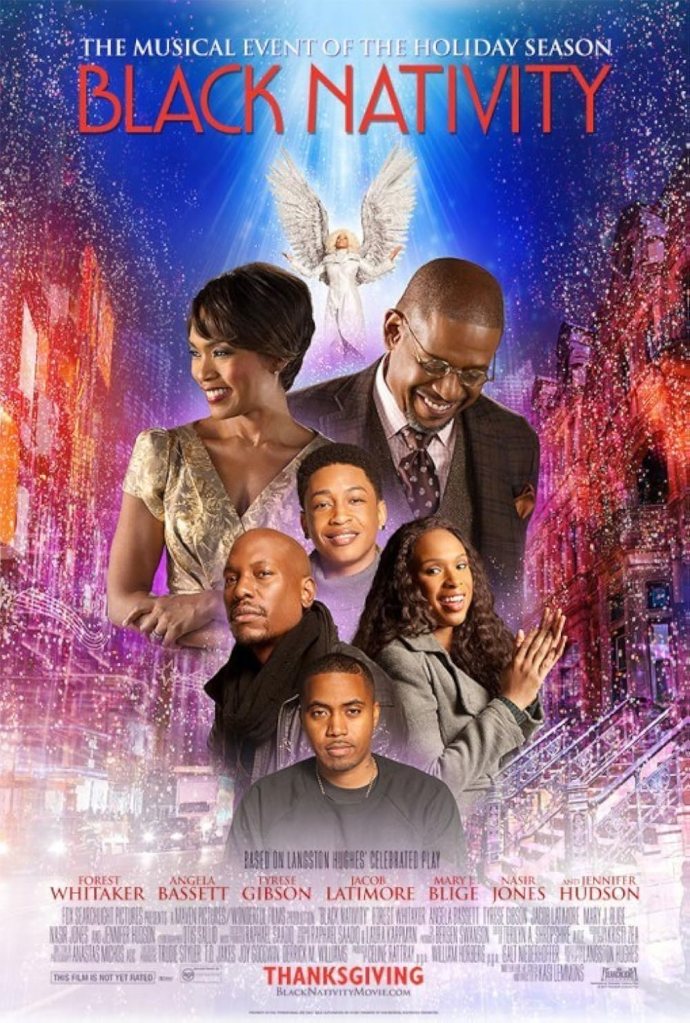
The poster for Black Nativity calls it "The Musical Event of the Holiday Season".  The six main cast members all appear, superimposed on each other, in a column in the center of the poster, flanked on either side by colorful, snowy New York City streets.  Above them, in a dark blue night sky, a light shines down on an angel with her wings outspread over them all.

One of the ways it succeeds is by building a lot of thoughtful complexity into the conflicts between characters.  As Langston goes unwillingly out of Baltimore via bus, we get to see his mother Naima (played by the multi-talented Jennifer Hudson) singing about the challenges of parenting that she keeps navigating because she believes in him more than she believes in herself, while also seeing his POV, in which he assumes his mother thinks of him as an obstacle and a burden, sent away to relieve herself of a problem.  The duality of that parent/child misunderstanding is going to be revisited, of course, when we eventually contend with the much more deeply embedded divides between Naima and her parents (Forest Whitaker and Angela Bassett—friends, if this movie fails its audience, it’s sure not for lack of on-screen talent), and by then we’ve got this lens to help us anticipate that neither side sees the whole story.  And even the parents’ side is complicated—a simpler, less thoughtful movie would likely give us a couple upset at their runaway daughter, waiting for her to apologize to them for all the grief they put her through.  But here, when Langston starts to get some answers out of his grandparents, his Grandma Aretha says that they’re waiting for Naima to forgive them.  And when he painfully confronts them about their absence from his life, almost shouting, “What kind of parents are you?” he hears the pain in their own experience, in the words of the reply: “We’re the broken-hearted kind.”  This is a family so haunted by regret and so walled in by grief that they don’t know how to stop hurting each other, yet they also clearly have the capacity to understand that this isn’t a case of the right and the wrong—at least Langston’s grandparents get it on some level from the beginning, and he and his mother are on a journey towards understanding.  As Aretha says, herself, at a later moment, “We’re so human.  We’ve all done things.  That’s between us and God.”  Is that an acceptance of blame, though, or an evasion of it?  Given her tone and her body language, I see Langston’s grandmother as accepting the reality of what she’s done wrong; her husband’s a more complicated guy, maybe in part because as a minister he’s a little more liable to moralize or try to explicate some ethical truth, but I also see him owning some part of the harm he’s done.  When I compare this family and their emotional landscape to the much better reviewed A Christmas Tale, which I wrote about a few days ago, I don’t know—I just find this film a lot more thoughtful, and more willing to believe in our capacity to understand ourselves and each other, which is what I want this time of year, maybe.

Some of the elements in the movie, I’ll acknowledge, are a little too simplified for the sake of the screenplay: Langston’s arrest right after his arrival in New York City feels implausible even for a justice system that’s biased against Black suspects, given what we and the characters in that scene can clearly observe, and the connections he makes with the criminal side of NYC, both in the jail cell and then persisting on the sidewalks of Harlem once he’s free, might be a little too sanitized and convenient.  The setup, though, is meant to keep Langston poised between pathways in life.  Is he going to be a young man who’s proud of his heritage or one who’s ready to sell his birthright for a bowl of pottage, to use an analogy his grandfather, Reverend Cobbs, would appreciate?  Is he going to walk down the sidewalk to the church where he’s the beloved (if wayward) grandson of a family he isn’t sure he belongs in, or to the street corner where, if he plays his cards right, he can pick up the weapon or the illegal goods that maybe can make him the cash he needs to halt eviction proceedings?  Everywhere he goes, from a jail cell to a pawn shop to the front pew of Holy Resurrection Baptist Church, he is confronted by not only his legacy, but what his legacy means to generations of older Black men who are putting a burden of expectation on him that he’s not sure he wants (or is able to carry).  I’m sure there’s a lot to this context I don’t understand as a guy who hasn’t lived Langston’s life (or Reverend Cobbs’s), but what I could understand of it had a lot of power.  I’ll also accept that musicals are hard for a lot of modern audiences, especially musicals set in the real world—it can be a strange juxtaposition between gritty life in the street and a character singing their feelings, and if that’s part of what people reacted to negatively, well, I get it even if I think the musical elements are good more often than they are cheesy.

The movie reaches its high point on Christmas Eve, when Reverend Cobbs insists on Langston accompanying his grandparents to church.  From the pulpit at Holy Resurrection, we develop a deeper understanding of what Reverend Cobbs means to his community, as he begins to expound on the story of Jesus’ birth, “according to my brother Luke.”  Langston falls into a bit of a reverie here—a dream? A daydream?—and his dream sequence consists of elements of the original Hughes play, staged dramatically all around Langston as though the events of the gospels were happening in the streets of Harlem.  The young pregnant woman his grandfather tried to help with a little money is the Virgin Mary; the crook he met in jail has a makeshift tent in an alleyway that Langston pleads for him to share so that the baby can be born.  We get an angel and a promise, and as song and dance start to involve all of these characters, even Langston, in the narrative, the events and the words combine to present one of the movie’s basic thematic claims: that Christmas is about a baby who came to put right a world broken by sin, and what “sin” means here is the weight of having done things you regret, things that hurt others and left their mark on you too.  From that perspective, we all need the opportunity for a renewal that hardly ever comes back around to lives that missed their chance at it the first time.  This is a deeply religious claim about the metaphysics of salvation, of course, but it’s also a simple secular truth that in each new generation—the birth of Maria’s baby, the birth of Langston to Naima—there is a chance of healing where there once was harm.  And it’s so overwhelming an experience for Langston that it shakes him right out of his pew.  He won’t believe in redemption when he lives in such an unredeemed family; he can’t accept grace in the world if it’s so obvious there isn’t grace for him and his mom.  He sprints out the doors of the church into the cold of a Christmas Eve night in New York City, alone.

And even if this movie’s not as good as I think it is, I’m not going to spoil for you what happens then.  Black Nativity has a lot to say about it not being too late for any of us, if we’re willing to tell the truth, not just about the hurt done to us but the ways we’ve hurt others.  We can be failures by plenty of society’s metrics without being unredeemable—in fact, I’d say this is a film that argues there’s no such thing as “unredeemable.”  And an act of unexpected mercy can re-order not just one life, but the lives of many.  Sure, there are ways that some of the film’s final confrontations are too clean, too simple.  Family is messy, and so is the kind of sin that several characters bring to each other to acknowledge, to accept, to make amends for, and the movie pretends for our sake that it won’t be all that messy in the end if we can be grateful for what we have.  I don’t think that’s true enough to the story this film has been telling.  I’d say that, far more than “be grateful,” the message we need echoed back to us in the end is that, yes, broken people break those around them.  But it is only people who can be authentic in their brokenness who will have the capacity to bring the kind of healing we all need.  Regardless, though, the end credits roll on a Black church in the heart of Harlem, a community that knows a thing or two about injustice and hope and dreams deferred, where the choir and congregation are on their feet singing about the troubles of the world and what’s coming to end them all.  It’s an exhilarating feeling, for this audience member, anyway.  I hope it will be for you, too.

I Know That Face: Forest Whitaker, here playing Reverend Cobbs, Langston’s grandfather, was of course a different kind of distant grandfather as Jeronicus in Jingle Jangle: A Christmas Journey, which I covered last year.  Tyrese Gibson, who plays Tyson (or “Loot”) in this film, appears in the role of “Bob” in The Christmas Chronicles: Part Two, the second in a series of Kurt Russell / Goldie Hawn Santa Claus movies that, I suspect, I will have to surrender to and watch at some point.

That Takes Me Back: There’s a pay phone in this motion picture….and it WORKS.  I wonder if 2013 is nearly the last year you could put a working pay phone in a movie and not have it feel like a period piece.  It sure took me back to having to carry around 35 cents in case I needed to call home.  Oh, and one of the ways Langston learns something about his mother is that, when he gets to his grandparents, Naima’s room is full of CDs she left behind her, which express her musical taste (and how young she must have been when she left).  I wonder how a modern movie would handle that….stumbling into your mom’s teenage Spotify playlists?

I Understood That Reference: This is the most elaborate / stylized “original Christmas” story I’ve seen in a movie – Joseph and Mary, the innkeeper, the stable, an angel speaking to shepherds in the field, etc., but all of it transformed by this gospel fantasia lens into the story as Langston understands it.  That’s certainly the Christmas tale that Black Nativity is in conversation with, as the title makes no disguise of.


Holiday Vibes (7.5/10): We don’t get a ton of “holiday gathering at the family home” stuff, since this family’s in such a weird place, but New York City at Christmas is a pretty powerful energy all of its own, and for anybody who like me grew up with church experiences at Christmas being pretty formative, the experience at Holy Resurrection Baptist Church is very resonant.  It’s good at evoking the time of year in lots of ways.

Actual Quality (9/10): Like I said, not a whole lot of people agree with me on this one, but I’m sticking with my own experiences here, and I thought this was a really powerful film.  Some wobbles here and there, as noted above, but overall I felt really moved by the characters’ relationships to each other, I enjoyed the gospel music thoroughly, and I think if you’re either someone whose experience of Christmas is similar to the Cobbs family (lots of praying and singing) or if you at least can be culturally curious about the experience of Christmas in the Black American church as an outsider, I think this movie has a lot to say about how those spaces can and ideally should give life to people.  2025 has been a rough year and I’ll take the hope I’m given.

Party Mood-Setter?  I’m leaning no, since so much of it is more emotional and intense than I’d normally look for in a background movie, but it’s also true that one of the movie’s big strengths is its gospel soundtrack and you can get plenty of joy out of that just letting it play in the background, I bet.

Plucked Heart Strings?  I’ve got to admit: I was genuinely caught off-guard by the movie more than once, with a moment that felt emotionally real in a way I was not expecting.  I was tearful by the end, and my guess is that lots of people might feel similarly moved: the emotions being tapped into here felt pretty universal to me, though as I’ve noted, apparently this is not a well-reviewed movie, so there’s something I’m missing (or something others are).

Recommended Frequency: I’d say that this is one I’d love to work into an annual rotation, and certainly one I think you should return to regularly, especially if you’re someone for whom the original story of Christmas “from brother Luke” is a meaningful part of your holiday experience.

Subscribers to Peacock can watch this one ad-free, and if you are happy to watch it with ads, our old standby, Tubi, has got your back again.  All the usual places will rent you a streaming copy for about four bucks, and ten dollars will get you a Blu-ray/DVD combo pack at either Amazon or Walmart (Barnes and Noble didn’t have it when I checked).  Worldcat says you public library users have options, though: about 700 libraries hold it on disc.

The Nightmare Before Christmas (1993)

Review Essay

It’s kind of funny that The Nightmare Before Christmas lingers in the public consciousness far more as a Halloween movie than a Christmas movie, despite the fact that (with the exception of the opening scene) the film is really entirely about the late December and not the late October holiday.  In a way, we make the same error in understanding that the denizens of Halloween Town do when Jack persuades them to celebrate Christmas—thinking that this experience should be primarily about the expansion of the empire of Halloween’s cultural material into Christmas rather than respecting Christmas as having a value of its own as an entirely different kind of celebration.  If we look at the film itself more closely, to the extent that it’s about either holiday (and I’m about to admit some doubts on that front), it’s much more a film about Christmas and what it means, even if sometimes it’s speaking by means of its silence.  The movie is a fitting subject, therefore, for the work done here at Film for the Holidays.

The initial premise of the movie is simple enough: the cultural (if not political) leader of Halloween Town, Jack Skellington, the Pumpkin King, concludes the celebration of Halloween one October 31st with a sense of depression and malaise.  He’s tired of “the same old thing” and wants to rejuvenate his sense of identity by finding whatever it is he’s missing right now in merely putting on a more-or-less perfect Halloween celebration once a year.  His sense of longing is echoed by another resident of Halloween Town, Sally, a stitched-together undead young woman who was created to serve the needs (never fully explicated) of the local mad scientist, Dr. Finkelstein.  Sally wants independence from that life and some kind of connection with Jack, but she is both unsure how to get free and unsure how Jack might respond to an overture.  When Jack fortuitously stumbles into Christmas Town via a tree-shaped door in the woods, he comes away certain that the cultural conquest of Christmas by Halloween Town will pose exactly the kind of thrilling challenge that will invigorate him again, whereas Sally’s deeply worried about the whole endeavor, foreseeing disaster if Jack pursues this path.

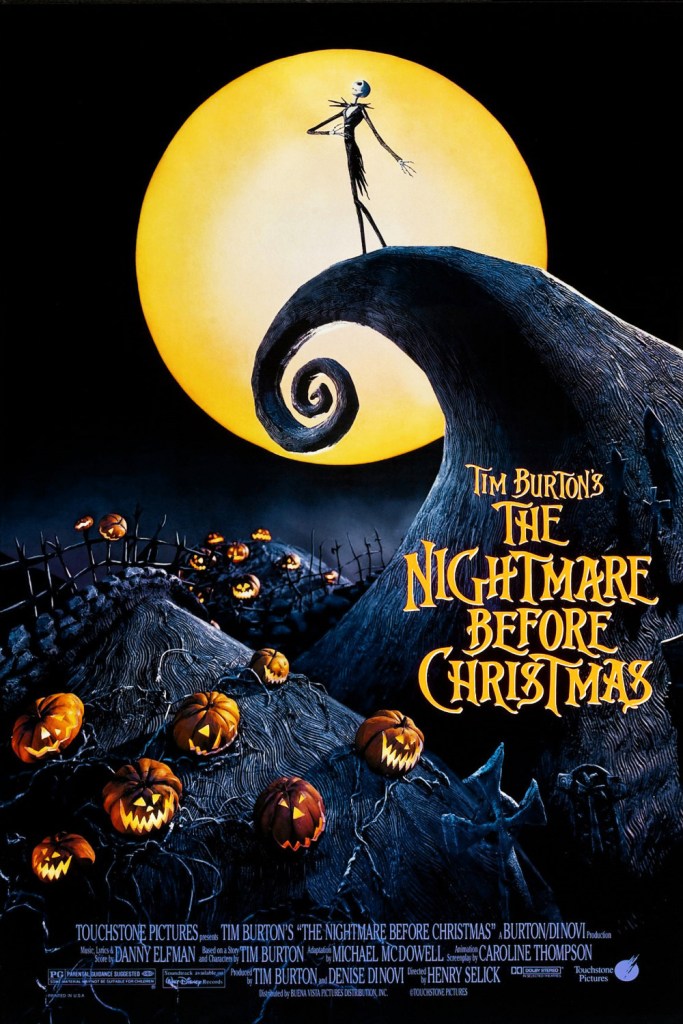
The poster for The Nightmare Before Christmas features Jack Skellington, the Pumpkin King, standing atop a strange curlicue hill, backlit by the full moon.  Below him are many ominous looking jack-o'-lanterns strewn across a cemetery and along a rickety wooden fence.

The film’s successful communication of the creepy delights of Halloween Town (realized, of course, both by Henry Selick’s amazing talents as an animator and by maybe the best score Danny Elfman ever composed, which would be saying something) is, I think, part of how we come to mistake the message of this movie.  It would be easy, if you haven’t seen it in years or only know it through cultural osmosis, to think that the thesis of Nightmare is that Christmas would be cooler/edgier/more awesome if it had a lot of ghouls and frights and toys with teeth, etc., and Jack Skellington & Co. basically save Christmas by making it hip again.  Those weird juxtapositions of Christmas cozy and Halloween horror are the really memorable moments in this motion picture, unquestionably.  But the message is in fact completely the opposite: Jack sucks at doing Christmas.  The residents of Halloween Town create a Christmas that is so chaotic and stressful that worldwide panic ensues, capped off by a military assault on Jack and his (undead?) flying “reindeer”.  Jack is so cavalier about the wellbeing of his Yuletide counterpart, “Sandy Claws” (as the Halloweenians call him), that he leaves the security of “Sandy” to three known juvenile delinquents whose primary allegiance is to the one genuinely bad person in Halloween Town, a sociopath named Oogie Boogie, who proceeds to subject an innocent and panicked Santa Claus to abuses designed to culminate in his murder.  I don’t mean to “spoil” a 30-year-old classic that surely almost all of my readers have seen at some point in their lives, but the final outcome of all this is certainly not a newly Halloweenized Christmas, but to the contrary a sense that the two holidays belong very much in their respective corners.  This is a story about the importance of a world with BOTH Halloween and Christmas, and of knowing which side of that line to be on.

And that’s what’s always going to be at issue in a project proceeding from the brilliant though often one-track mind of Tim Burton, who generates this film’s original story and acts as producer.  Burton is good at celebrating outsiders (and, despite all his successes and riches, at playing the role of the “outsider” himself) but usually he considers it impossible for them to make peace with the society Burton finds both appalling and weirdly appealing.  Edward Scissorhands does not find himself integrated into the world around him, any more than Lydia Deetz finds a way to be happy in the world away from the Maitland house.  I get the sense that Burton privately thinks Jack’s Christmas is in fact more fun than the real one, but also genuinely believes that it’s just not plausible that Jack’s version would catch on among the “normies” who want to find something pleasant in their stocking rather than something lethal.  We are allowed to visit Burton’s Halloween Town and admire its delights, but only he and his stable of outcasts are going to find it a happy place to settle down.

You may not think this a very fair take about a film you love—though, to be clear, I’ve watched this movie happily dozens of times, and I can sing along with it in numerous places, so it’s not a film I dislike!  I just think that, viewed through the lens of the holidays it purports to have something to say about, Nightmare’s message in the end is that Christmas people should do their thing and Halloween people theirs.  Jack maybe has a renewed sense of vigor at the end of the story, but it’s only a vigor that he ought to apply to making Halloween better, rather than dabbling in something else.  This was a film about people initially feeling hollow, aimless, wistful, and in the end, it’s arguing that they can be shaken back to life through a shared sense of crisis, but that probably they should have left well enough alone to begin with.  That’s the only sense I can make of the Sally subplot, in which she has a vision, argues for what ought to happen, and then is vindicated almost completely by what occurs.  Sally was right, and Jack should have listened—as another character tells him at the film’s conclusion, in fact.  Some kind of freedom is possible (as experienced by most of our characters, by the end), but we also need to know where home is, and not to wander too far from it, whether that home is the picket-fenced suburbs or the iron-fenced cemetery.  And what IS the Christmas that Jack doesn’t really understand?  It’s snowfall.  It’s nice toys.  It’s a predictable and cheerful celebration in which nothing strange or unexpected happens.  Not exactly the most ringing endorsement of a holiday, especially from a movie that has taken such delight in depicting the truly macabre people who make up the population of Halloween Town.

Luckily, I also don’t think that we’re forced to accept the messages art gives us without any agency of our own.  We can argue that the characters (and the screenplay) misread this situation, and that other, better outcomes were possible.  Part of the magic of Jack’s big number, “What’s This,” is that there is actually something profoundly wonderful about stepping outside the boundaries of your life and seeing something new.  I can’t explain why Burton wanted to make a movie that argues Jack shouldn’t ever step through the door into Christmas Town again, but I can at least make the case, for myself, that I think Jack knew a lot more about Christmas’s power than he seems to implement when it comes down to celebrating the holiday, and I would have been glad to see a movie give him (and Christmas) more credit for already having a lot on the ball.  After all, when he pitches Christmas at the town meeting, he seems to come from the point of view that the holiday isn’t much like Halloween at all—he’s constantly deflecting weird inquiries and at one point he basically breaks the fourth wall to tell us in the audience that he anticipated that he would have to ham up the relatively innocent figure of “Sandy Claws” to make Christmas sound intense enough to get people’s attention.  Why he forgets all this in practice for the next half hour of the movie is not really something I can explain.  Furthermore, I’m not sure it’s true: Christmas is a much spookier holiday than Burton gives it credit for being.  Its most famous modern tale is a ghost story.  Its original narrative is a story of terror (one of the characters appearing in every nativity set is an angel whose opening line is “Do not be afraid!”) and murder (Herod and the slaughter of the innocents) and squalor (both the stable and the shepherds).  It is neither a neat nor a tidy holiday—it’s only the sanitized commercial version of Christmas that seems that way, and it’s a disappointment, I think, that Burton didn’t apply his considerable talents to unearthing something more vital in it than he did.

It is a very mild disappointment, though.  The more I break this movie down, yeah, I can sure pick the plot and premise apart, but I don’t particularly enjoy doing that.  My critique of its missed opportunities is honest, and I think it’s a valid assessment of the film we’re given.  But more than critiquing it, I want to enjoy it, and I do: I find Jack charming and the residents of Halloween Town amusing and I sing along happily with almost every zany musical number.  In the end, the experience of the art has to matter as much as the analysis of it, right?  Anyway, it’s a movie that gives a lot to a lot of people, and I’m one of them, and if you’ve not seen it before (or not in a while) I hope I’ve steered you to it in a way that will help you both delight in it and engage with it thoughtfully.

I Know That Face: William Hickey voices the decrepit, predatory Dr. Finkelstein here—he’s Clark’s Uncle Lewis in National Lampoon’s Christmas Vacation, which I covered with criticism in a post on the blog last year, and in a 1987 television movie called A Hobo’s Christmas he plays a character named (well, surely nicknamed) Cincinnati Harold.  Ken Page, who in this film provides his memorable bass voice for Oogie Boogie, appears as Dwight in 1990’s The Kid Who Loved Christmas, an emotionally heavy television drama with an all-star cast of Black performers.  Paul Reubens, who made such a career out of playing charming oddballs and who voices Lock (one of “Boogie’s Boys”) in this film, shows up again as a voice actor in the direct-to-video Beauty and the Beast: The Enchanted Christmas, in which Reubens plays Fife, a piccolo who plays turncoat against the villain at a crucial moment.  Most famously, of course, Reubens plays his character of Pee-wee Herman in lots of settings, including as the titular star of 1988’s Christmas at Pee-wee’s Playhouse, and, bizarrely, as a performer in the 1985 Bryan Adams music video, “Reggae Christmas”.  Yikes.  Lastly, Catherine O’Hara voices Sally in this movie; she’s familiar to most of us from lots of other projects, but in the holiday realm in particular, she plays Christine Valco in 2004’s Surviving Christmas, as well as the aging character actress Marilyn Hack in For Your Consideration, a Christopher Guest film that ultimately is at least Thanksgiving-adjacent.  Oh, and of course she is Kevin’s frantic but seemingly not-that-attentive mother Kate in both Home Alone (which I will cover someday on this blog) and Home Alone 2: Lost in New York (which features a cameo appearance by one of the worst Americans of all time, so I probably am going to skip it for the rest of my life).

That Takes Me Back: It would be hilarious if I spotted elements from life in the demented chaos of Halloween Town that reminded me of growing up in the suburbs outside of Seattle, but no, I’m afraid the delirious world of Tim Burton / Henry Selick didn’t spark anything nostalgic for me.

I Understood That Reference: Jack skims A Christmas Carol and a book called Rudolph, as he seeks “a logical way to explain this Christmas thing”.  He later divides chestnuts by an open fire, in an echo of “A Visit From St. Nicholas.”


Holiday Vibes (4/10): This is a film with a ton of talk about Christmas and preparations for it, as well as some of its actual celebration, and Santa Claus (ahem, sorry, Sandy Claws) is a major supporting character, so it’s not nothing!  But as I note above, the movie’s intentions here definitely seem to carry it away from much real engagement with Christmas and towards the emotional journey of the main characters (and their realization, in the end, that Christmas isn’t for them).  So, it’s doing some of what we look for, but it’s missing a lot.

Actual Quality (9/10): Again, separate from the message and however we feel about it, this is an incredibly well made film: a great voice cast, great music, great stop-motion animation.  Sure, I have some mild irritation at the Burton of it all, but even there, I admire a lot of what Burton’s capable of as a filmmaker.  I’ve just come to find his stuff a little empty and self-aggrandizing over the years, and while there’s still some gems in his filmography, there’s fewer “10s” in there than I used to think, at least in my opinion.  Even if Burton’s wrong about Christmas, though, he knows how to make a compelling story, and so do all the other artists who worked on this.

Party Mood-Setter?  If this feels like the holidays to you, absolutely: the songs invite you to sing along and the story’s lightweight enough that you don’t need to focus at all.  But if it’s not “holiday” enough for you, I think it’s a little too weird a presence to be in the background.

Plucked Heart Strings?  I’m sure some people feel a deep resonance with Sally (and delight that she gets Jack at the end) but I don’t think anybody here is fully realized enough to make an emotional response happen for me.

Recommended Frequency: Oh, this is annual at some point in my household—whether in October, November, or December—and we all know the words to at least most of the songs.  If it isn’t for you yet, it’s worth trying to add it to your holiday rotation, in my opinion.  Proceed with a little caution, though, about what the movie’s really trying to persuade you to believe.

If you want to give the movie a whirl, it’s on Disney+, of course, since Disney paid for it in the first place.  It can be rented anywhere you think of renting a streaming film, and several versions are available on disc at your Barnes & Noble.  But there’s no need to pay for it: hundreds of libraries, according to Worldcat, carry this one on disc.

Scrooge (1970)

Review Essay

In gearing up to create Film for the Holidays, one of the things I resolved to do early on was to spread out and cover at least one film from every decade in the “talkie” film era if I could.  This is a simple enough task for every decade but one: the 1970s are an extraordinarily holiday-free zone.  I couldn’t tell you if it was the oil crisis or stagflation or the Watergate scandal, etc., but something seems to have knocked the holiday spirit right out of Western filmmaking.  Take a gander at Wikipedia’s list of Christmas films (and I sure wish you would: goodness knows I’ve spent enough time there in the last year) and you’ll find that the list of theatrical releases amounts to a handful of horror movies, a Norwegian fairy tale classic that’s basically unavailable outside Norway, and a Santa Claus bank heist filmed in Canada (okay, that one sounds pretty interesting to me).  I’ll admit, 1970s TV movies do try to fill in that gap a bit, but still, I was trying to stick mostly to theatrical releases here and I was feeling stuck, until I remembered that Scrooge was released in 1970: I’ve always been fascinated by this particular version of A Christmas Carol, and I’m delighted to get the chance to unpack both what I think it does really wonderfully and what I think it really fumbles.

Scrooge is, if you’re unfamiliar, a musical adaptation — not the only such adaptation of Carol, of course, but the first musical film version I know of.  And it’s one that seems tailor made for me as a viewer: the screenplay and music are by Leslie Bricusse, a talented British composer who created the music and lyrics for 1967’s Doctor Dolittle (a film I have loved since childhood even though I will admit its every flaw to you) and 1971’s Willy Wonka and the Chocolate Factory (a film I have loved since childhood and which I would gladly and spiritedly defend as being nearly flawless).  You’d also know his work from James Bond songs like “Goldfinger” or “You Only Live Twice” — Bricusse is a pro, in other words, and that should set this film up for success.  Add in Albert Finney, a marvelously charismatic actor, in the title role, and some seasoned British pros in the other roles (most notably the wonderful Alec Guinness as Jacob Marley), and I always end up thinking, “wait, do I love this movie?”  But then I rewatch it, and remember, oh right: I don’t love it.  I don’t hate it!  But I don’t love it.  Let’s try and sort out why, shall we?

The movie poster for Scrooge features the tagline "What the dickens have they done to Scrooge?" arcing above a crowded street scene in Victorian London, with a dancing Scrooge in the foreground, looking directly at us.

First, let’s give Scrooge credit for some things it gets very right: A Christmas Carol is a ghost story.  Much of the time, though, the ghost experiences are more thrilling than they are chilling, and while I enjoy those versions, I really admire Bricusse and company leaning into the creepiness of this story.  From opening titles that carry a sort of eerie Edward Gorey quality to the (mostly invented for this version) sequence in which Jacob Marley flies Ebenezer through the ghostly skies above London to the (totally invented for this version) plummet of Scrooge into literal Hell at the end of the Yet to Come experience, this movie often achieves something at least uncomfortable if not unsettling.  And yet another thing this version gets right is an investment in joyful characters — the Cratchit children, in particular, get more of the spotlight here (thanks in part to the early segment in which they accompany their cheerily elfin father through the streets of London doing last minute Christmas shopping).  I like the sweetness of the moments we get with the Cratchits, and I think the film at least sometimes accomplishes something really moving by juxtaposing such light-heartedness with the sort of nightmarish threat that lurks in Scrooge’s experiences.  Also, while the casting of Albert Finney as Scrooge is more than a little strange — at 34, surely he’s about the youngest actor to play Scrooge in any production outside of a high school or collegiate setting — I’ll get to my larger assessment of him in a later section.  Here in my list of the film’s strengths, I do just want to note that Finney’s undeniably talented and energetic, and I think he’s giving this character a lot of spark and liveliness, which is very watchably compelling in a number of scenes.

The film does a lot to displace Scrooge’s experiences into more cinematic spaces, and I’m not sure that always works: seeing him bedevil debtors in the streets does drive home his malice, but it also creates scenes that just don’t feel as true to the original novella, to me.  I can’t imagine men collecting for charity chasing an elderly man down the sidewalks after he’s turned them down; I also can’t really follow what we’re supposed to understand about his relationship to these scamp urchins who taunt him in the streets.  While we sympathize with them, I expect, they’re also not really winningly kind or charming themselves, and the movie doesn’t develop them as characters enough to clarify why they’re getting so much screen time.  Later in the movie, Christmas Past shows him this lush springtime picnic with Isabel Fezziwig (since in this version it’s the boss’s daughter he falls for), and while it’s a compelling visual, it also makes no sense to me at all: isn’t the logic of the ghosts that they only have access to Christmas Days, those past, those yet to come, or the one we’re experiencing at present?  It sort of felt like they wanted to broaden the landscape for Finney to inhabit, but again, I just don’t think it adds more than it detracts from the immersion.

And I’ve been putting off saying this, but it really has to be acknowledged: this is one of the least hummable musicals I’ve ever encountered.  I have seen Scrooge at least five times in my life, probably more than that, and yet if asked to sing more than a line of any of its songs, I think there’s only one of them that sticks (I’ll get to it in a moment).  I’m not sure what Bricusse, who has a track record of writing some very memorable songs, was thinking with numbers like “I Hate People” and “December the 25th”, but they rarely manage to get beyond serviceable melodic moments that are far too easily forgotten.  The one really successful song, which includes a full-energy dance choreography through the streets of London, is ”Thank You Very Much”, but even that song fits so strangely into the story — the song, in which Scrooge joins with lusty enthusiasm, is actually being sung by Scrooge’s many debtors after his death, “thanking” him for dying and setting them free from his oppressive control.  Scrooge, though, totally ignorant of what the song is about, treats the whole number as a delightful lark, maybe even as a chance to revel in the feeling that he can start to envision himself thanking people openly?  It’s a strange scene, where we as an audience can appreciate the awful but profound irony of Scrooge gleefully capering amid the throng, loudly and unknowingly singing a song about how wonderful it is that he’s dead.  What a macabre film.  Anyway, when the most hummable, toe-tappable song in your musical is an ironic celebration of the main character’s death, I would argue that the musical probably missed a chance or two to connect, but there’s no accounting for taste, and I bet one of you loves this soundtrack: I wish I could agree, since I sure do love Bricusse’s other work.

Ultimately, I think this is the challenge Scrooge poses those of us who love A Christmas Carol — it’s a whole that’s somehow a bit less than the sum of its parts.  Conceptually, it seems like it could deliver the best Dickens has to give us, both in terms of dialing up the horror elements in the story and in terms of sweetening the sentimental moments with song.  But I’d argue that in fact it gets out of step with itself enough that often the points in the narrative that most need chills are lacking in them, and the most soaring musical phrases don’t sit very neatly on the story beats that ought to feel emotionally overwhelming.  I think my ultimate conclusion is that Bricusse simply wasn’t inspired by this material the way he was by Hugh Lofting’s characters, or Roald Dahl’s novel: whether it’s because Dickens’s story is too iconic, or perhaps just a fallow period for Bricusse between other, more engaging projects, he couldn’t get a hold of this one, and the resulting script and soundtrack feel like a first draft more than a final one.  I’m glad it exists, and I do return to it, hoping each time to get something I’m sure is in there somewhere — so far, though, I’ve always been wrong about that.

I Know That Face: Edith Evans, who here I feel isn’t really well cast or written as the Ghost of Christmas Past, is a central and to me successful figure as the rich old Miss Victoria Woodworth in Fitzwilly, which I’ll cover elsewhere here on the blog.  Also appearing in Fitzwilly (uncredited in that film as Mr. Cotty) is Laurence Naismith, who here is the giddily dancing Mr. Fezziwig.  And Geoffrey Bayldon, who in Scrooge plays the astonished Pringle, the owner of the toy shop Scrooge visits on Christmas Day, later plays Jacob Marley himself on the final episode of the British television series Hallelujah! — an episode entitled “A Goose for Mrs. Scratchitt” that, as far as I can understand it, loosely adapts A Christmas Carol.

Spirit of Christmas Carol Present: I do like that Scrooge sees ghosts abroad in London at the end of his Marley confrontation.  It’s much different in the book than it is here, of course, and to me that diminishes the success of its inclusion, but as I keep saying, I admire the ambition here of working more of that paranormal content into this adaptation.  And I am always enthusiastic when a Carol adaptation remembers to include Ebenezer’s sister coming to school to bring him home to a kinder Father; who, the ghost reminds us, is Fred’s mother.  I found a lot of the Christmas Past sequence in this version really flat (whether Evans was directed to be detached or whether the writing just wasn’t there for her, I don’t think her performance ultimately works), but the film’s calling attention to Scrooge’s painful upbringing, along with the feeling that there was joy to be had, and love too, in the family he’s distanced himself from, is an important elevation of a couple of lines in the novella that I find really significant.  Lastly, the confrontation we get between Scrooge and Isabel as she leaves him is really very close to the book, in terms of the dialogue itself — adaptations often don’t know how to wrap things up between the two of them, if they bother to do it at all, and I liked the commitment here to the original Dickens text.

Spirit of Christmas Carol Absent: There’s a fair amount missing in this version, in part because they wanted to develop the Cratchit family differently: as a result of that intention, Bob and Tim haven’t been to church prior to their coming home for Christmas Present, nor is there a Martha in the family, waiting to surprise her father.  As I noted, I do like the family dynamic we get, but there’s no denying they’ve gone well off the characters as Dickens presents them.  And the Yet to Come sequence is much altered, without the same scenes making him aware of a recent death — after all, if he knew more about the death, there’s no way he would sing along gaily and obliviously to “Thank You Very Much” — and the segment concludes with a totally original plummet to Hell along with some grisly conversation there.  Marley reappears at that point, to offer some pointed and stinging commentary back in Ebenezer’s direction.  As someone who’s seen plenty of Carol adaptations, I did find the novelty interesting, but I have to be honest: tonally, I just don’t think it works, and it muddies more than a little the arc that Scrooge is on by the film’s end.


Christmas Carol Vibes (8.5/10): Without question, this film does a lot to capture the spirit of the original for long sequences, and its commitment to creating a visual spectacle of Victorian London certainly succeeds at times, but there are enough unusual departures here that, as more or less “straight” adaptations of A Christmas Carol go, this one’s a bit further from the mark.  If you want the Carol experience, this will certainly deliver a lot of what you’re looking for, but I doubt it’ll be The Christmas Carol for almost any viewer: if that’s you, I’d love to hear from you in the comments.

Actual Quality (7.5/10): It’s really hard to answer this, but I think that fundamentally this is an adaptation of A Christmas Carol that gains little and loses more than it gains in monkeying with the underlying narrative.  And on top of that, I think this is a musical that, purely as a musical, just doesn’t drop enough great songs into your ears as you take it in.  A not-musical-enough musical that’s also a not-christmas-carol-enough Christmas Carol…but it’s good enough that I keep going back to it hoping it’ll deliver on either or both fronts?  I don’t know — that feels like a film that got about ¾ of the way up the mountain, to me, and that’s where I’ll mark it.

Scrooge?

As Ebenezer Scrooges go, I found this portrayal to be a very affected performance, which often feels like it’s playing up his frailty and his unwillingness to be affected by anything other than booze.  Finney’s charismatic, but either the writing or acting damage things a little here, and honestly, I wonder if it’s not simply the fact that they’ve cast a man in his 30s to play an elderly miser?  Under the circumstances, perhaps either a caricature of outrageous frailty or else a doddering drunkard were the only ways he felt really comfortable playing a role twice his age.  Certainly Finney is a good actor in general, and I think in the late 1990s (with a stronger script) might have been an excellent Scrooge, but this particular intersection of performer and material doesn’t really land the plane, for me.

Supporting Cast?

I’d call the performances across the rest of the cast very uneven, personally — as already noted, I think the Cratchits really work, anchored by some fine performances from Bob and Tiny Tim, in particular.  But, also as already noted, the Ghost of Christmas Past feels to me like she doesn’t want to be there.  And, maybe most astonishingly, Jacob Marley as performed by Alec Guinness is so incredibly bizarre, it’s hard to pay attention to the script.  Guinness uses these strange, inhuman gestures in a portrayal so outlandish and attention-grabbing, I was most reminded of John Cleese as the conjurer “Tim” in Monty Python and the Holy Grail.  I’ll grant him this: he presents a Marley who would freak almost anybody out, but it ends up being distracting (and, with apologies to Sir Alec, if you’re casting for a role in a musical, you need an actor who can sing, and to my ears that is not true of Guinness).  It’s harder to judge Tom Jenkins and some of the other minor roles that don’t appear in other adaptations since they’re invented here, but I do think most of those go fairly well.

Recommended Frequency? For me, as I’ve noted, it’s a once in a while choice — this definitely isn’t in my top two or three Christmas Carols, and a person only has time for so many of them in any given December.  But there are undeniably good things about this version, and some undeniably singular elements in it: when I do revisit it, I can invest myself in enjoying these things, or at least appraising them thoughtfully enough that I think the movie was worth my time.  If you’ve not seen it in the last decade, you should give it a whirl sometime.

Jingle Jangle: A Christmas Journey (2020)

Review Essay

I’ll acknowledge at the outset that most Christmas films that latch onto our hearts (to any degree) are films we encountered via childhood — our own, the childhood of those around us, or the child that lingers within as we age.  I say that just because I’m about to be a little gentler to this movie than I suspect it may deserve, but that’s because it’s a film I have only ever seen in the company of my delightful kid, for whom it is a “Christmas classic” at this point because she’s seen it annually for about as long as she can remember.  Also, that first year that she and I watched it together, it was the pandemic year — we’d been largely confined to our house for months and months, and the holidays ahead of us were about to be conducted really entirely on Zoom.  So the exuberance and the physicality of this film landed a little more soundly, for me, because I was feeling that vulnerability and sadness that the pandemic brought with it — I was ready to feel like a kid alongside her.

Exuberance and physicality are really the hallmarks of Jingle Jangle, a Netflix film that attempts that trickiest of endeavors — creating a new fairy tale, something that feels like you’ve heard it all your life even though you never have before.  The two undeniably powerful things about the movie are its costumes and its production design: every single moment you’re watching, the screen is popping with vibrance and detail and a charisma that can’t be denied.  Even if you don’t love the movie you’re watching, I find it really hard to believe you wouldn’t want to walk down that street, or into that toy shop.  It’s a world worth seeing, then, and one that’s both tapping into an old school Victorian Christmas spirit and turning it upside down with the diversity of its humanity, and with the not-very-Victorian energy of modern pop and hip hop music and dance.

Movie poster for Jingle Jangle: A Christmas Journey.  Journey, the film's child star, is a young Black girl in the foreground, smiling in a red coat and standing with arms wide and looking upward. Behind her left shoulder is a floating gold robot with large eyes. In the background,the crowded shelves of an eccentric toy store are visible.

I know, I know, it’s the third paragraph and I haven’t touched the plot yet — well, folks, the plot’s the piece of the movie I have the hardest time defending.  I mentioned the “new fairy tale” idea earlier, and I think that’s the best way to understand the movie — so much of it really wouldn’t make sense in a realistic world where there’s any consistency at all, but the logic of fairyland is famously a little less reliable.  Here’s the premise: Jeronicus Jangle, a brilliant toy inventor, has a wife and child and a great life, until one day, after achieving his greatest invention yet, his assistant (Gustafson) who feels overlooked and neglected steals both the invention and Jeronicus’s book of inventions and creates a brand new toy empire.  Jeronicus is ruined, and soon loses everything — his store’s a shambles, his wife dies, he alienates his brilliant inventor daughter.  But then HER daughter, a girl named Journey who is an inventor herself, decides to go visit her grandfather for Christmas basically unannounced.  Will the chipper enthusiasm and open-hearted love of a little girl warm the bitter old man’s heart?  Will Gustafson’s theft of Jangle’s inventions finally come back to haunt him?  Will there be a singing widowed postal worker who serenades Jeronicus on the daily with her three backup singers chiming in like Gladys Knight and the Pips?  Uh….yeah, yes is the answer to all three of those questions.  Jingle Jangle is kind of a wild ride sometimes.

So, basically everything about the plot really is cuckoo bananas — there’s just no reasonable way Gustafson could have gotten away with his theft when Jeronicus could simply have reported it, nor is there any real explanation other than “it happened” for how Jeronicus suddenly was unable to remember or recreate literally any of the inventions he’d come up with previously, let alone create anything new.  And sure, I could excuse those elements as “magical” except this is ALSO a script that later treats the theft of inventions as something the local constabulary treats really seriously with the administration of swift justice.  That same script wants me to believe that Jeronicus was unable to make any good inventions at all after Gustafson’s betrayal….except for the single exception of an adorable flying, talking robot that puts basically all his other ideas to shame.  Again, I guess, magic?  I don’t know — there’s also a massive logical flaw in the frame tale that surrounds this fairy story, but I really don’t want you to think about the plot that much, it’s not what the movie’s for.

The movie’s for so many other things — the aforementioned brilliant costumes, props, and sets.  Some really excellent acting performances show up on screen: I mean, sure, this isn’t the best work ever by either Forest Whitaker or Keegan-Michael Key but the two of them are fun to watch even when they’re working with a pretty basic script.  The music, with John Legend doing some co-writing and Usher showing up for the end credits, is definitely an asset, also.  And there’s just no denying that, in a genre that tends to skew lily white, there’s something truly fantastic about seeing a full cast of Black performers — major roles, minor ones, extras — in outlandishly lovely Victorian costume on snowy cobbled streets, showing off their skills as dancers and singers and overall performers.  White kids have gotten to grow up watching Danny Kaye and Vera-Ellen in White Christmas, after all, or the showy musical performances in the 1970 adaptation of Scrooge, and it makes me glad that other kids can grow up seeing folks who look like themselves and their families, spreading some holiday cheer.  Heck, I’m glad my White kid is getting that opportunity – that Christmas joy for her will be a more multicultural and multiracial experience than the world my generation grew up with.  I wouldn’t just give a pass to any film that came along with a diverse cast, to be sure, but there’s more than enough good things going on here for me to be willing not to think too hard about how exactly the story unfolds.

I Know That Face: Hugh Bonneville, one of the few non-Black performers in the main cast, appears as Mr. Delacroix here (sort of investor in / landlord for Jeronicus, it seems?), and also appears as the narrator in Silent Night: A Song for the World, a kind of docudrama re-enacting the writing of the Christmas hymn.  Lisa Davina Phillip, who for me steals every scene she’s in as the postwoman Ms. Johnston, also appears as Auntie Valerie in Boxing Day, a romantic comedy in which a British writer brings his American fiancee home to the UK for Christmas to meet his eccentric family (stay tuned for more on that one).  And Anika Noni Rose, who here plays the adult daughter of Jeronicus, appeared as a choir member back in 2004 in Surviving Christmas, the film in which an unpleasant billionaire hires a family to spend the holiday with him. Hoo boy, it’s hard not to make some political commentary about that one, but it’s only day two of the blog, maybe I can let some pitches go by, eh?

That Takes Me Back: A child’s reference to “The Jangleater 2000” took me back to when calling something a “2000” sounded futuristic and cool — what do kids say these days?  3000, maybe, since Buddy gets to be the Buddy 3000?  Also, this movie takes place at a time when rich and powerful people could still be held accountable by the legal system….oh, sorry, is that too dark for you? Guess James couldn’t hold it back after all: look, folks, it’s 2024, I can’t pretend not to be paying attention to the world, even if the goal here is more escapism than activism.

I Understood That Reference:  In the film’s prologue, before she spins her (highly unlikely) story, Grandma’s asked by one of her unnamed grandchildren if she’ll read them The Night Before Christmas, though she deflects the request since “it’s time for a new story”.  (Okay, Grandma, I’m picking up the subtext of race in that remark, and you’re right — that’s what I like about this movie, that instead of retreading the old Christmas tales, it’s presenting something different.)


Holiday Vibes (7.5/10): While the story is less about Christmas and more about the fantastical adventures of Journey, this has so many of the 19th Century trappings that, between A Christmas Carol and Currier & Ives lithographs, we associate with nostalgic holiday celebrations and wintry scenes of yore — mechanical toys and rich Victorian costuming and horses clopping along on cobblestones, etc.  This will press plenty of festive buttons, if you’re coming to it looking for those feelings.

Actual Quality (7.5/10): Again, the plot is bonkers: we cannot think about it at all.  But plot’s not the only thing a movie is made of.  If I just focus on the settings and costumes, the music and the acting, the overall feel of this movie?  I’m having a very fun time with it — and if I’m watching it alongside my 5th grader, add at least a full point to this rating, you know?  I know the film’s got plenty of issues, but I’m so darn glad it exists.

Party Mood-Setter? This is a perfect role for this movie to play, since at the low level of attention of “it’s on while we’re wrapping presents” or what have you, all the movie’s best stuff is still going to shine through aggressively, and the weaknesses of its overall structure are going to be less visible.  I’d highly recommend giving it a try in that setting.

Plucked Heart Strings? I think for a child audience, it might land the punches it wants to throw.  As an adult viewer, the plot ends up being silly enough that I can’t really take the problems of Jeronicus (or anybody else) seriously enough to feel actually tearful, but I certainly care about the characters, and that’s a testament to the things that are working here.

Recommended Frequency: This is an annual movie for me, in part because it’s one of my daughter’s top 5 holiday movies of all time (I asked her for a ranking).  I think it easily offers enough in the way of charm and color and energy to be worth it every year, and with each passing year, I get more accustomed to its weird plot, so that the ways in which it doesn’t work are less noticeable or problematic for me now. Again, I think you should give it a whirl, and I think it’s fine if it’s just something you’ve put on in the background while you construct a Yule log out of gingerbread or make homemade eggnog or whatever fun holiday practices you engage in.

This time around, there’s only one place I can steer you: if you want to watch Jingle Jangle: A Christmas Journey, as a Netflix movie, it is unavailable on any streaming service or rental/purchase service other than Netflix itself.