How the Grinch Stole Christmas (2000)

Review Essay

We might as well get this out into the open from the outset: I like the 2000 film, How The Grinch Stole Christmas.  That’s a semi-controversial take already: the movie has long had plenty of detractors, and in some circles I’ve seen people make disparaging swipes at movies being “like that Jim Carrey Grinch movie,” as though it was shorthand for a bad holiday flick.  But it may not be THAT controversial—the film’s a perennial holiday showing even now, 25 years (!) after it was released, and I think a lot of people have at least moderately fond memories of it.  What’s probably going to be a little more startling, though, is my argument that, in fact, I love this movie, and I think it might be one of the best holiday movies ever made.  And what will be sacrilege for at least some of you is my argument that it’s a far better film than the 1966 Chuck Jones animated version of Dr. Seuss’s original book, which a couple of generations (mine included) grew up on.  It’s how I feel, though, and however hot the take, I’m going to do my best to persuade you that I’m onto something, anyway, even if you aren’t as taken with this movie as I am.

The basic premise of the Grinch tales in all their manifestations—and I’ll acknowledge up front, I’ve not seen the 2018 animated film or the televised Broadway musical, so I’ll have to leave them for some future blog post—is well known to almost anybody in the American cultural sphere.  Somewhere in the world of Dr. Seuss’s imagination, there’s a town called Whoville, populated by the Whos, a people about whom all we really know is that they celebrate Christmas with enthusiasm.  Neighboring this bucolic village is Mount Crumpit, and on the slopes of that mountain lives a sour, solitary creature called The Grinch, who hates Christmas (and, by extension, Whoville), because his heart is “two sizes too small.”  He eventually gets fed up with the sound of holiday festivities and steals all Christmas accoutrements from the homes of the Whos, before his inevitable change of heart.  It’s a simple story, fit for a children’s picture book, and I think it works just fine as Seussian spectacle (and as a short animated special).  I wasn’t ever really in love with the original, though, I’ll admit: it’s not among my 2-3 favorite Seuss books, and of all the midcentury Christmas specials airing on my family’s TV in my childhood, it was honestly one of the least essential, as far as I was concerned.  There just wasn’t much to the story—the animation was stylish and the voice acting was fun, but that’s about as far as it went.

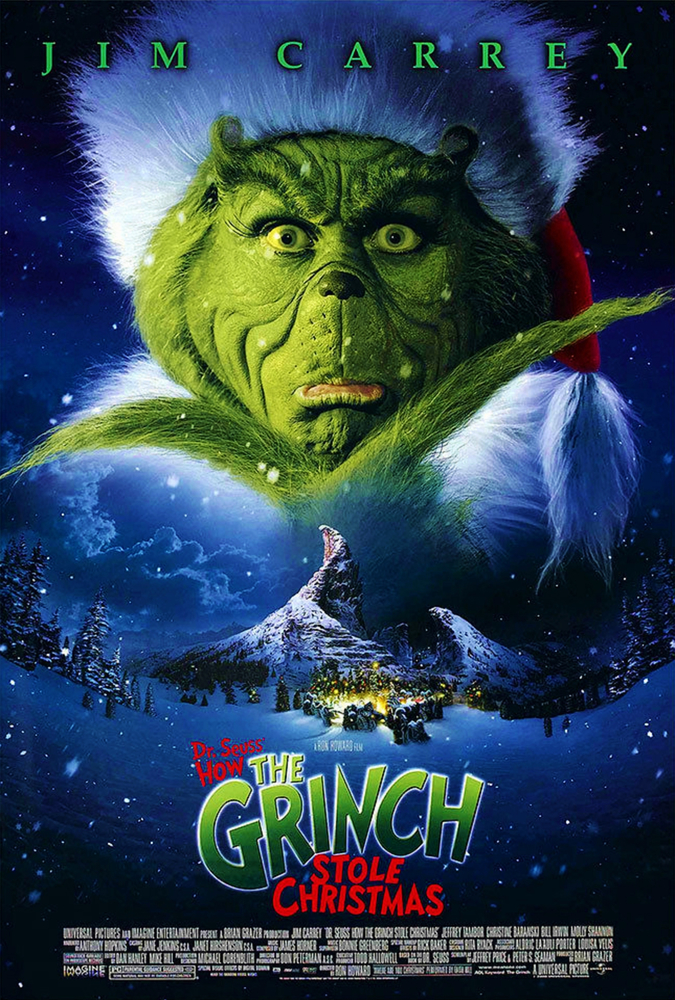
On the poster for How the Grinch Stole Christmas, Jim Carrey in his Grinch makeup (wearing a Santa costume) is staring at the viewer with his hand holding his chin.  Below his image, we see a snowy landscape, with a glowing vilage next to a thin, winding mountain peak, that establishes the scene in which it takes place.

The genius of the 2000 film adaptation, in my opinion, originates in its need to bulk up a very simple story into a feature-length screenplay.  As a result, the movie is forced to grapple with the Grinch as a character—why is he the way he is?  What’s his history with Christmas, or the Whos?  Depth is needed, and the script supplies it.  Furthermore, the only Who with any persistent importance in the story from its original book form (Cindy Lou) has to be given a sense of connection to the Grinch also, and here I think it’s managed really successfully.  The emotional investment she makes in The Grinch builds something powerful into the movie’s final act.  It all matters.

I suspect that one of the reasons the 2000 film takes heat from long-time Grinch fans is that it more or less up-ends the moral landscape of the original story—and in doing so, it puts our society in an unflattering light.  But that’s what I love about it.  The original tale is a simple one: us nice Christmas-observing nuclear families are the good guys, singing our little songs and having our little feasts.  The villain of the piece is the outsider: he does not look like us, he does not celebrate our holiday, and when our innocent celebration has made him angry, he tries to wreck our joy.  The fact that we continue to be happy because we have right-sized hearts convicts him at the last possible moment, so that he can repent and be integrated into the Christmas celebration.  Put it like that, and it doesn’t sound so nice, does it?  No offense to Ted Geisel, but it sounds a lot like the kind of pro-conformity message that he is otherwise famous for undermining in stories like “The Sneetches.”  The 2000 version, on the other hand, rightly understands that to the extent that there’s a plausible villain in this scenario, it’s the people of Whoville: they’re the ones whose material wealth is overflowing while a solitary creature is isolated outside their community, subsisting on their trash.  Their obsession with celebration is so all-consuming that they don’t consider the side effects of it—all the noise, noise, noise, noise!—which would be bad enough if the Grinch was merely someone indifferent to Christmas.  But of course it’s more complicated than that: from his youngest days, his experience of Christmas was isolating.  The holiday celebrated in Whoville demanded a great deal of cultural conformity that was unhealthy—the Grinch is mocked openly for his differences, and ultimately is driven out of town by bullying and ridicule at a young age.  Later, when the sound of the Whobilation’s Yuletide festivities is driving him crazy, the Grinch grabs a hammer to knock himself out with, saying, “Now, to take care of those pesky memories”: he knows that what bothers him here isn’t the noise, it’s the mistreatment that it now represents to him, because of his experience of the Whos.  And of course, most of the people of Whoville aren’t evil (their Mayor being the prime exception to the rule).  They’re just cheerfully complicit in some pretty cruel abuses out of a desire to remain comfortable and untargeted, themselves—they’ll quietly allow a powerful, arrogant blowhard to stand in public at a microphone, abusing outsiders for his own self-aggrandizement and making up passages from The Book of Who to suit his demented purposes while dismissing the one true believer willing to stand up to him in public and insist that the community’s values are actually imperiled.  Yep, if you thought you could escape the politics of 2025 here, I’m afraid I can’t let you.  What an incredibly apt movie for the moment.

And yet, what I think is most impressive about this movie is that the Grinch’s critique of the society bordering him is—for a movie in which Jim Carrey is a huge wisecracking green Yeti, essentially—pretty nuanced.  In a crucial scene, mid-film, The Grinch is given a triggering Christmas “gift” by the Mayor, in front of the whole town: it’s a reminder of the Grinch’s trauma, and the gathering treats it as a chuckle-inducing anecdote.  Remember that day where we made fun of you so badly that you fled into the mountains to live as a hermit….when you were, like, 8 years old?  Kids do the darnedest stuff, don’t they?  (I’m telling you, this film is wiser than it has any right to be about how “good” people do bad things.)  Anyway, you’d expect the guy to blow up in that moment: this is personal, it’s painful, and he could say so.  But he doesn’t confront Whoville until their town’s materialism is the thing on display, because I think on some level, the Grinch understands that that’s the real problem.  A society that’s more focused on the superficial, on presents and costumes and conspicuous consumption, is a society that loses touch with its own heart.  He doesn’t tell them it’s what leads them to hurt an outsider like him.  He doesn’t believe in their capacity to understand that truth, really—he has no faith in the Whos, and they’ve done little to deserve such faith, in any case.  This is what makes the triumph at the end of the story something powerful—it’s not just some mountain gremlin returning everyone’s Christmas ornaments so they can have the party they’d been planning on.  The Grinch comes back to them because they showed him that something he didn’t believe in was real—that this community could learn to find more joy in each other as people (him included) than they ever had in their stacks of Christmas presents.  He apologizes to them for how he’s behaved because they’ve earned his trust on a level he never imagined.

And yes, I know, I’m talking in soaring thematic terms about the ethical messages of a movie primarily intended to give us Jim Carrey making a fool of himself on screen.  Well, look, Jim’s not for everybody (and I don’t feel a ton of affection for some of his wildest comedic performances), but to me putting his manic energy inside this huge green fur suit is a match made in heaven.  My wife and I can (and do) quote half his lines all year long, from “Nice kid…. Baaaaaad judge of character.” to “One man’s toxic sludge is another man’s potpourri!” to “Oh no….I’m speaking in RHYME.”  I can imagine, of course, responding negatively to some of Carrey’s antics, but I just think it works for the character—it lightens what might otherwise be too heavy a story, honestly, to have the Grinch be someone who’s responded to being ostracized by becoming a standup comedian, transmuting his pain into a PG-friendly Don Rickles routine.

The other thing that gives this movie its needed heart is the performance by Taylor Momsen as Cindy Lou Who—sure, the character is earnestness personified, but that’s her dramatic function.  What I appreciate about Cindy Lou, and this only increases with time, is the way she expresses something far more mature than a child performance normally would.  This Cindy Lou is not merely some little kid woken up by the Grinch’s theft, as she is in the original.  She’s someone wrestling with the question of why Christmas doesn’t feel the way it used to—asking herself what the magic was, and where it’s gone.  This is not, I acknowledge, something an elementary schooler would normally feel.  But speaking as a kid who was a melancholy elementary schooler (somewhere I still have the Last Will and Testament I wrote at the age of about nine), it tracks.  More than that, though, what Cindy’s wrestling with is what we all wrestle with, no matter what holidays we do or don’t celebrate: where does our capacity for that childhood sense of wonder and delight go?  Is it just nostalgia for something that never existed and we’re smart enough to see that now, or was it real and we can find it again?  Given all that, it’s a really lovely (and touching) message that Cindy discovers that we can have that holiday happiness again, but only if we get our heads on correctly about what the holiday’s actually about.  We can’t find the joy in ever-increasing material consumption—the joy isn’t there.  It’s in the hearts of people who see and hear each other, of people who not only have the capacity to love but who put that capacity to work.  It’s in a community that, rather than seeing outsiders as threats to their stability, can look at those outsiders through the lens of the values they claim to profess, of welcome and inclusion and care.  THAT’S what can leave us singing “Fahoo, fores; dahoo, dores,” hand in hand with our neighbors.

And I think folks forget what high-quality craft goes into this film—Anthony Hopkins’s narration providing a lovely, lyrical insight into the story.  Incredible production design, from the costuming and makeup worn by the ridiculous Whos to the junkpunk vibes of the Grinch’s “lair” that’s filled with what are apparently his inventions.  A great symphonic score by the always reliable James Horner, and a sentimental song that seems to have stuck around in the Christmas pop canon in “Where Are You, Christmas?”  I think the admittedly larger-than-life presence of Jim Carrey in outlandish makeup slinging one-liners leaves people misremembering that that’s all this film has to offer.  Again, I know mileage varies.  A lot of you won’t get out of the movie what I see here.  But if you love it also, well, I hope I’m helping articulate some of the things that we might both be seeing in this film.

I Know That Face: Molly Shannon, who here plays Betty Lou Who (Cindy Lou’s decoration-obsessed mother), is a veteran of seasonal projects: she’s Tracy in The Santa Clause 2, she plays a fictionalized version of herself in It’s a Very Merry Muppet Christmas Movie, and in 2004’s The Twelve Days of Christmas Eve she plays Angie, a kind of angel who gives the protagonist 12 attempts to get Christmas Eve right (a la Groundhog Day).  But she can’t match the even more holiday-infused track record of Christine Baranski, the Grinch’s love interest here as Martha May Whovier—Christine’s playing Regina in 2020’s Christmas on the Square (a Dolly Parton project), she’s Ruth in A Bad Moms Christmas (a comedy I fear I’ll have to review one of these years), and she’s Lee Bellmont in Recipe for a Perfect Christmas.  Christine also voices Flo in Timothy Tweedle the First Christmas Elf, and she’s Prunella Stickler in Eloise at Christmastime, and of course as a sitcom regular (on Cybill, as Maryann Thorpe) she appears in Christmas episodes, including season 3’s “A Hell of a Christmas.”  I would be remiss if I didn’t take the chance to shine the spotlight on the director’s dad, Rance Howard, who’s Whoville’s “Elderly Timekeeper”—he voices Rudolph in Elf Sparkle and the Special Red Dress, he plays a blind man in Holiday in Your Heart (a LeAnn Rimes vehicle), and back in 1986 he was in his own Dolly Parton project, A Smoky Mountain Christmas, playing Dr. Jennings.  Lastly, we have to tip our cap to Jim Carrey, the Grinch himself, who of course got a much more negative review from me when I reviewed his work as nine different people in Disney’s A Christmas Carol.

That Takes Me Back: The whole village is wired in series, so that a single loosened bulb on the Whoville Christmas Tree turns out the lights all over town.  It reminded me, for a moment, of having to test every single bulb in the lights on the tree in order to figure out what had gone wrong.

I Understood That Reference: Of course, as the Grinch prepares to deploy his plan to steal Christmas, Santa’s been there ahead of him.  In any case, the Grinch is aware of the Rudolph narrative, since he riffs briefly with his dog, Max, about the reindeer’s having saved Christmas.


Holiday Vibes (8/10): Christmas in Whoville obviously both is and is not like Christmas anywhere else: there’s a lot here that “feels holiday” as Cindy Lou’s dad would probably have said, and of course my watching it routinely each December must add to that feeling.  To me, the feast and the presents and the decorations certainly create the right kind of feeling…but even more so, the message of love and our capacity to create community together is just what I want to feel at this time of year, and I’m glad it helps me do this.

Actual Quality (9/10): Look, I know this isn’t a flawless masterpiece—any movie where one of the jokes is getting a sleeping man (however odious) to kiss a dog’s butt is definitely not hoping to win any awards.  But I also think it absolutely deserves a much better reputation: it takes what is, frankly, a reactionary message about insiders and outsiders in the original tale, and transforms it into a much more thoughtful exploration of ostracism and its consequences.  It’s also funny, and sweet, and the whole movie takes place inside of a snowflake, like the one on your sleeve.  It’s great in my book, anyway.

Party Mood-Setter?  It’s absolutely quotable enough to just be rolling in the background while you do other things, and the story’s cultural saturation is so high that a Grinch on the screen probably won’t be too distracting to party-goers, even though it easily could suck people in.

Plucked Heart Strings?  I find some of Cindy Lou’s struggles pretty easy to identify with, but they don’t exactly make me mist up.  It’s an effective emotional arc, but I think you probably won’t need to watch the movie with a tissue box next to you.

Recommended Frequency: I’m not sure how to get through a year without watching this one.  It’s just too deeply ingrained into my memory (and my wife’s).  If you’ve never seen it, or just haven’t in a while, I hope you’ll consider giving it another spin.

This movie is fairly easy to access, though not necessarily for free—you can stream it if you’re a member of Amazon Prime, or Peacock, or Hulu.  You can pay to rent it from most of the usual places too, it looks like.  Barnes and Noble will sell it to you on disc, and around 1,500 libraries have a copy to check out for free, according to Worldcat.

A Christmas Story (1983)

Review Essay

I know plenty of people grew up watching A Christmas Story, but I have to emphasize, whatever it meant in your family, it was almost surely a more central media experience in mine.  Much of that owed to my father’s interest in Jean Shepherd, the writer of the short stories on which the film was based (and the man who narrates the film from the perspective of a grown-up, nostalgic Ralphie).  I can close my eyes and instantly picture the covers of his short story collections, In God We Trust: All Others Pay Cash or A Fistful of Fig Newtons, sitting on our bookshelves.  I still vividly remember a 1988 TV movie about Ralphie and his friends and family, set a few years after A Christmas Story during summer vacation—it’s called Ollie Hopnoodle’s Haven of Bliss and it’s a sweet, silly good time (also narrated by Shepherd) that I definitely saw multiple times as a child, as well.  From 1997, the first year that TNT started airing A Christmas Story for 24 hours, from Christmas Eve to Christmas Day, I know a lot of families started building holiday memories with this film on in the background, and make no mistake, mine did also.  “The Old Man” (as Jean Shepherd would call my father) turned it on the moment it started airing and I feel like there were years when he just left the TV on TNT until the marathon was over.  It certainly was the backdrop for gift opening on Christmas Eve evening, or sitting by the fireplace the next morning eating Christmas cookies, in my years of  transition from teen into adult, but again, I was well familiar with the movie and with Jean Shepherd long before that time.  It’s baked into my brain—so much so that I didn’t even try to write about it last year, intimidated by the prospect of trying to make sense of how I feel about the film.  But it’s a new year, and I felt like I finally had a handle on what the movie meant to me, so let’s see where the journey takes us.

The setup, if you’re one of the people who has somehow made it this far in life without seeing A Christmas Story, is straightforward.  Our protagonist, Ralphie Parker, is a 9 year old living in small town Indiana as Christmas approaches in 1939, and we follow the ups and downs of his life as narrated through the gauzy, heightened nostalgic memories of an older man who’s transforming his childhood into a set of fables as he speaks.  Ralphie’s central preoccupation is the acquisition of the perfect Christmas present—an official Red Ryder, carbine action, two-hundred shot, range model air rifle—but the film encompasses other intense childhood experiences, from being bullied by Scut Farkas (he had yellow eyes, so help me God, yellow eyes!) to being cheated by the producers of the Little Orphan Annie radio serial and the makers of Ovaltine.  The secondary unfolding storyline is a strange mirror of Ralphie’s—his father, who presumably has a name but whom the credits and narrator consistently refer to as The Old Man, who just wants a little material satisfaction of his own at the holidays, whether we’re talking about him basking in the erotic glow of his “major award,” a lamp shaped like a woman’s leg in fishnet stockings, or him wrestling amid exuberant profanity with the house’s cantankerous furnace.  Everybody wants something, in A Christmas Story, but what they get….well, that’s the movie’s genius, I think, or at least it’s part of why it works so well.

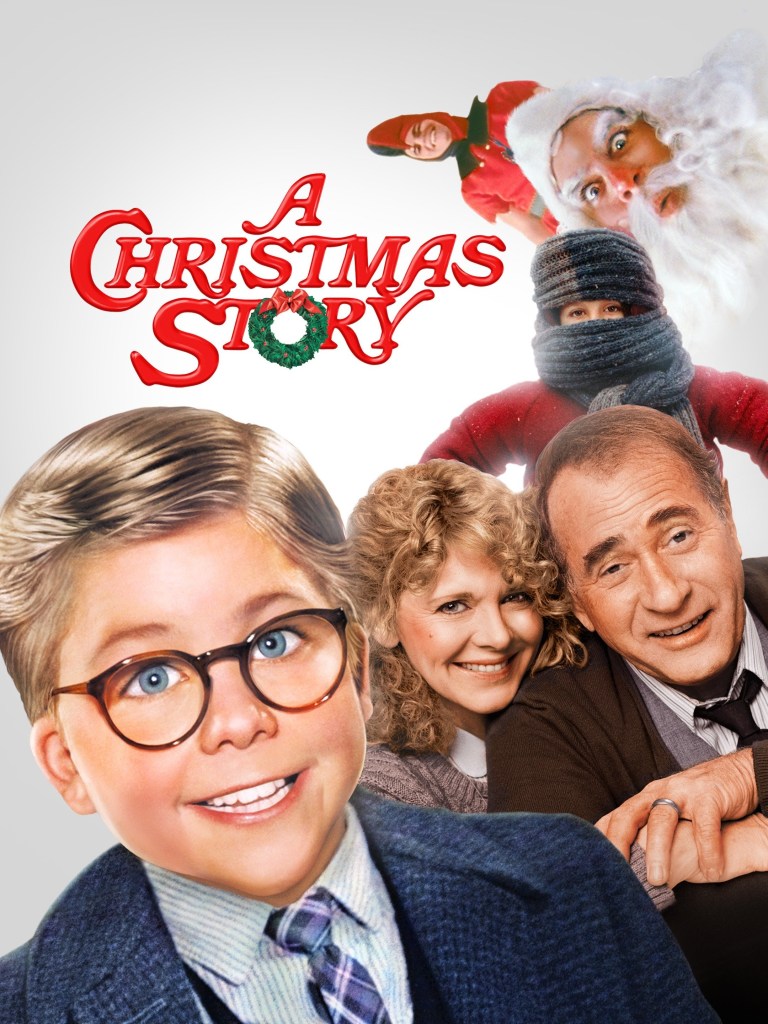
The DVD cover for A Christmas Story features the large, bespectacled, smiling face of Ralphie looking at the viewer in the lower left.  Extending up and to the right from Ralphie are his smiling parents, his brother Randy wrapped up like a tick about to pop, and above Randy, a wild-eyed Santa Claus and his dismissive helper elf.

There is no question that one of the things the movie gets right (for those who love it) is the perfectly balanced tone of wistfulness and wry observation.  Any American who feels a little hankering for the “good old days” sees a beautifully sanitized version of it in the old house on Cleveland Street, and the mythologizing of everything from the toy display in Higbee’s department store corner window to the soft crackle in the voices on the radio.  Ralphie’s world is one adrift in time—in part because it sits neatly between a Depression that’s mostly past and a war that hasn’t yet filled the papers with death and loss, but also just in part because it is the world of a nine year old’s memories.  There is a simplicity to the world we see through those eyes that Shepherd captures beautifully.  But Shepherd’s good, too, at reminding us how deeply we feel the highs and lows of life as a child, as his narrator spins out phrases like, “in our world, you were either a bully, a toady, or one of the nameless rabble of victims.”  The amused notes in his voice as he narrates extend to us a gentle ironic distance from the events—we can both sympathize with Ralphie’s indignant feeling that “mothers know nothing about marauders creeping through the snow,” while chuckling as adults who know that Ralphie’s mom actually has a pretty accurate sense of how “important” it is that he get a Red Ryder BB gun (which is to say, it’s not at all important).  This keenly honed voice that ties events together, offers us context, and interprets the otherwise inscrutable aims and intentions of 9 year old Ralphie is the movie’s secret sauce, and it goes well with everything, including an adult’s deeper understanding of how Ralphie’s mother might have felt about the “major award”—at one point, Shepherd comments, “my mother was trying to insinuate herself between us and the statue,” and the grin we hear on the other side of his microphone tells us how to feel about the passive aggressive battle that emerges around the electric red light district that her husband insists on displaying to the neighborhood in the front room’s picture window.

A consistent theme the film explores is the way a child’s life unfolds at the mercy of powers too great to be controlled, with which we are in constant effort to appease and to cajole in the hopes of catching a break.  Ralphie’s kid brother Randy can’t even walk to school unaided, once his mother has bundled him so tightly that, in Randy’s iconic whine, “I can’t put my arms down!”  His mother, wearily, simply retorts, “you’ll put your arms down when you get to school” and shoves her helpless kindergartener out into the snow to be absent-mindedly looked after by his gun-obsessed older brother.  Ralphie’s friend Flick can’t seem to buy a break—a sequence of childhood dares, culminating in the unstoppable force that is a triple dog dare, leaves his tongue stuck to a flagpole at recess, abandoned even by his closest friends.  Later, he’s left behind again, sacrificed to Scut Farkas and Grover Dill to experience man’s inhumanity to man.  Poor Schwartz, of course, has his own scene in which to cry “UNCLE!” as his arm twists, and moreover is the target of capricious (if technically accurate) accusations in Ralphie’s desperate attempt to deflect blame for a poorly timed F-bomb.  Ralphie himself feels perpetually thwarted by every adult in his life, and lives in fear of violence that’s not just the Old West outlaws of his fevered imagination, given his daily sprint to escape random acts of harm at the hands of the local bullies, not to mention his fear of total “destruction” by The Old Man after Ralphie finally snaps in a flurry of thrown punches and hurled obscenities.  Again, the narrator’s irony lets us choose how deeply to feel any of this—do we chuckle at Ralphie running from Farkas, or do we remember painfully those kids from our own childhood who wielded violence as a weapon in the spaces where they could get away with it?  Maybe we do both.

But the film’s primary interest is materialism, and it’s where I think our cultural memory of this motion picture sells it a little short, thematically.  Ralphie’s whole world revolves around his desire for the Red Ryder BB gun—it’s the first thing we hear him mumbling about when we meet him, and it’s certainly still his monomaniacal fixation at the movie’s end.  Materialism isn’t just for Ralphie, though: as I mentioned earlier, The Old Man is tangling with it also.  One of the first things we learn about The Old Man is Ralphie’s solemn commentary that “some men are Baptists; others Catholics; my father was an Oldsmobile man.”  The beloved retail good as an object of worship is what both of them are contending with, and it’s reinforced by everything that surrounds them.  Like, we might largely remember Ralphie’s teacher as an obstacle to his materialism, one of many adults who responds to his Red Ryder enthusiasm by calmly stating to him, “you’ll shoot your eye out.”  But if we reflect on it, she’s told the whole class to “write a theme: ‘What I Want for Christmas.’”  The materialism, in other words, goes all the way to the top.  We are being presented the holiday primarily as an opportunity to express desires and have those desires fulfilled.  On Christmas morning, surrounded by gifts, all four members of the Parker family “plunge into the cornucopia quivering with desire and the ecstasy of unbridled avarice,” as the narrator remembers it.

That’s why I think the movie has something to say, because, having established the central importance of material satisfaction, Shepherd undercuts it throughout the film’s final act.  One of the movie’s most haunting lines, if we can lift it away from the glossy, warm Christmas feelings that surround it and hear it for what it is, is the adult Ralph telling us, “sometimes at the height of our revelries, when our joy is at its zenith, when all is most right with the world, the most unthinkable disasters descend upon us.”  The Bumpuses’ dogs, for instance, in this movie are not really neighborhood dogs—we never see the Bumpus family, for one thing, and the dogs do not exist as actors in the film with any perceivable motives or desires.  They simply appear at the worst possible moment, like the hands of Fate.  They portend ill.  The dogs emerge from the world outside the story to remind the characters within that we are all at the mercy of forces we cannot contain—this isn’t a childhood experience, it’s a human one.  We laugh at the dogs because, in their tongue-lolling destruction, we come face-to-face with the absurdity of the things that rob us of tangible joys.  The material world in A Christmas Story is both satisfying and fleeting.  We can admire our major award but, sooner or later, it’s going to break.  The gun of our imagination is a happier (and less painful) experience than the gun of reality.  We can taste the roasted turkey but we will not get to sit at the banquet table and eat it.  A Christmas Story can, at times, drift into the moral landscape of Ecclesiastes: all is vanity, it seems to say.  Nothing lasts.

And yet.  The experience of all this doesn’t seem to have wounded Ralphie permanently—to the contrary, the narrator reminds us at times how he walks away wiser from his losses.  As the film draws to a close, what the characters have been given, really, is a deeper understanding of what it is that really matters to them.  Ralphie’s world of imagination gives him more delight than the corporeal things he’s been expecting to enhance that world.  His parents’ love for each other, snuggled beside one another as “Silent Night” plays on the radio, supplies a peace neither of them have felt all movie long.  The family’s Christmas dinner (which does, alas, include a joke or two that are insensitive, though not outlandishly so) is not what they planned for, but they’ll remember it for much longer than the one they would have eaten.  I don’t want to turn this movie into Citizen Kane—it is a funny, nostalgic romp through midcentury American suburban childhood, and it’s more cohesive as a collection of stories that give us Jean Shepherd’s perspective on the world than it is anything else.  But I think part of why we can watch it over and over, and so many of us do, is that underneath the hood of its effective aesthetics and its very quotable one-liners, this is a movie that has something to tell us about ourselves, and about Christmas.

I Know That Face: Perhaps obviously, several of these performers reprise their roles almost 40 years later, when Peter Billingsley, R. D. Robb, and Scott Schwartz return in the same roles in 2022’s A Christmas Story Christmas as adult versions of Ralphie, Schwartz, and Flick (yes, it’s wild, but the actor who plays Flick is surnamed Schwartz, which surely causes some kind of confusion on set).  Billingsley has a short acting career but one that’s heavily Christmas-inflected: he’s a ticket agent in Four Christmases, an uncredited “Ming Ming” in Elf, which is one of those modern “classics” I have to cover here someday, and amusingly in his very first role back in 1978 he had appeared as “child at Christmas party” in If Ever I See You Again.  Robb goes on to voice Miguel in 1985’s He-Man and She-Ra: A Christmas Special, while Schwartz, after trying to make a career out of being an adult film star, appears as Ronald in A Wrestling Christmas Miracle, which looks….I’m going to say, “horrible”?  They’re not the only returning characters, either: Zack Ward, who plays the yellow-eyed bully, Scut Farkas, returns in that role in A Christmas Story Christmas also, with a career about as Yuletide-infused as Billingsley’s.  Ward appears as David Briggs in A Christmas in Vermont (I’ve made this joke before, but streaming fans, seriously, are there fifty of these?) and as Dave in 2nd Chance for Christmas.

That Takes Me Back: The number of things this movie could make a person nostalgic for is exhausting, so I just jotted down some observations along the way: I’m sure you have your own lists!  Ralphie’s parents have twin beds in their bedroom, which are kind of a funny nod to the past, to me, since I think of that as the 1950s sitcom concession to morality expectations for broadcasters.  Were real married couples in the 1930s routinely sleeping in twin beds, or is this a case where an adult Ralphie’s memories of his family are getting overlaid with his media impressions of days gone by?  It’s wild to think that there was a time we might have had 3rd graders reading Silas Marner: post-pandemic, I’m not even sure we can get college freshmen to read George Eliot, though I suppose we can get them to ask ChatGPT to pretend they did.  Young people may think it’s comedic exaggeration but I can affirm: that’s about how many electric plugs we used to cram on the same outlet—old houses really were like this, and we were ridiculously reckless with extension cords into extension cords.  I do remember drinking Ovaltine once, I think, maybe at my grandparents, though even then, it was a novelty, something I was doing mostly because I had grown up watching A Christmas Story and I wondered what it tasted like.  Do kids today still cry “uncle” when they’re under duress and trying to tap out, or has that gone the way of Ovaltine?  Oh, and lastly, I definitely have long childhood memories of someone needing to “play Santa” and distribute gifts for opening (though “Santa” is not what we called it, I feel like?  Though what else would we have said?).

I Understood That Reference: Obviously, the one Christmas media figure who matters in this story is that jolly old elf himself, as Ralphie realizes when exclaiming, “Santa!  I’ll ask Santa!”  After that point, of course, there’s emphasis on seeing Santa in the parade and inside Higbee’s, though we don’t get a ton more Santa mythology—Ralphie seems to have a more mercenary perspective on Saint Nick.


Holiday Vibes (10/10): As always, my rating here is influenced by how I’ve experienced this movie, and again, it’s the literal soundtrack of Christmas Eve to me: even holiday movies I love more than this one are not “more holiday” to me than this.  Even if you don’t have that background, though, this is a film about a thoroughly American Christmas—tree haggling, parade going, gift lists and appeals to Santa, the decoration of a tree and the preparation of Christmas dinner.  The holiday is, as adult Ralphie observes early on, the high point of “the kid year” and the movie treats it as such.

Actual Quality (9/10): It’s a very effective movie, given what it wants to do.  There are elements I wish it would explore more deeply—the fixation on the Red Ryder BB gun is perfectly honest but it becomes dramatically a little boring in the last half of the movie, and I’d rather find out about lots of other memories instead.  Mostly, though, it’s just a delivery mechanism for nostalgia, but a nostalgia seen through the lens of an experienced humorist who knows how not to make it so sentimental that it becomes tedious.  Instead there’s a slight countercultural undercurrent, the suggestion of sympathy with some of the more scoundrelly (and less squeaky clean) sides of all these characters, that lets us both enjoy the memories and smirk at the ways we can identify with people who really aren’t even a little bit perfect.  I know it’s not for everyone but it still, after all these years, works for me.

Party Mood-Setter?  I mean, it is absolutely a movie you can put on in the background while celebrating almost any kind of holiday event.  This is not just because it’s marathoned on Christmas every year, or at least I assume it still is, but I’m sure those experiences help add to the feeling that it works as a soundtrack.  The film is also episodic and very quotable, so that we can enjoy it very much on the surface level as we walk by, leaning in for a couple of minutes for favorite scenes or lines, and then ducking out since, after all, we know where it’s going.

Plucked Heart Strings?  Nobody involved with this film expected us to get tearful, and it sure doesn’t happen.  Even if you agree with me that the movie’s exploring the edges of the darker truths about being a human being and the ways we are at the universe’s mercy, it’s doing that through humor and detachment that blunts much possibility of deeply felt emotion.

Recommended Frequency: I can’t count how many times I’ve seen this one: I basically have it committed to memory.  And it still is a lot of fun to watch, when I do.  It’s not quite an every year movie for me, anymore, but there’s nothing quite like it, and I’m sure I’ll see it many more times in my life.  And if I did end up seeing it every single Christmas from now on, there’s no way I would get tired of it: it’s A Christmas Story.  It’s part of the holidays.

You’ve got lots of ways to watch this one: are you a Disney+ or Hulu subscriber, or maybe HBO Max?  If you still pay for cable (and heck, millions of Americans still do, it seems?), TNT or TBS will show it to you for free.  You can rent it from basically any service, of course, or buy it on disc from Barnes and Noble.  Though if you just want to check it out at your library, that’s exactly what you should do: there are almost 2,500 libraries with a copy on their shelves, according to Worldcat.  I hope you’ll track it down, one way or another!

Black Nativity (2013)

Review Essay

It’s often the case at Film for the Holidays that I’m criticizing (if not lambasting) some movie that other people really love, sometimes a lot of people.  Yesterday’s salvo at Scrooged, for instance, presumably ruffled at least a few feathers: that movie has its fans, and I get that I might have irritated some of them with my reading of it.  So sometimes it’s good for me instead, I think, to try to make the case for a movie that most people don’t like very much, since I don’t just want to seem like a guy taking potshots.  Certainly that’s the context of today’s post, in which I really had a good experience watching Kasi Lemmons’s adaptation of the Langston Hughes play Black Nativity, a film that seems to have left audiences and critics alike feeling disappointed at its mediocrity.  I’ll confess, I’m not sure I get why people disliked it, and I’ll do my best at least to explain what it is that moved me about the film.

This movie adaptation takes the Hughes original—a retelling of the original narrative of Jesus’ birth through the lens of the Black experience in America and richly infused with gospel music—and encases it in a new narrative written for the screenplay, the story of a fatherless boy named Langston, growing up on the streets of Baltimore.  When he and his mother, Naima, are about to face eviction from their home, Langston is packed off via Greyhound bus to New York City, where the grandfather he doesn’t know presides over a thriving Black church in the heart of Harlem.  Langston doesn’t understand a lot of the context of his life: who was his father, anyway, and where’d he go?  Who are his grandparents, and why have they been estranged from his mother for so long?  How can he, a boy on the cusp of manhood, stand up for himself and his mother, and provide the home he knows they both need—can he, in fact, do that at all?  And, speaking of context, what does it mean to him and to those around him to be Black Americans at this point in history—why is he named Langston, and what does the legacy of the civil rights era mean to people living generations in its wake?  It’s a film trying to do and say a lot…and I think it succeeds.

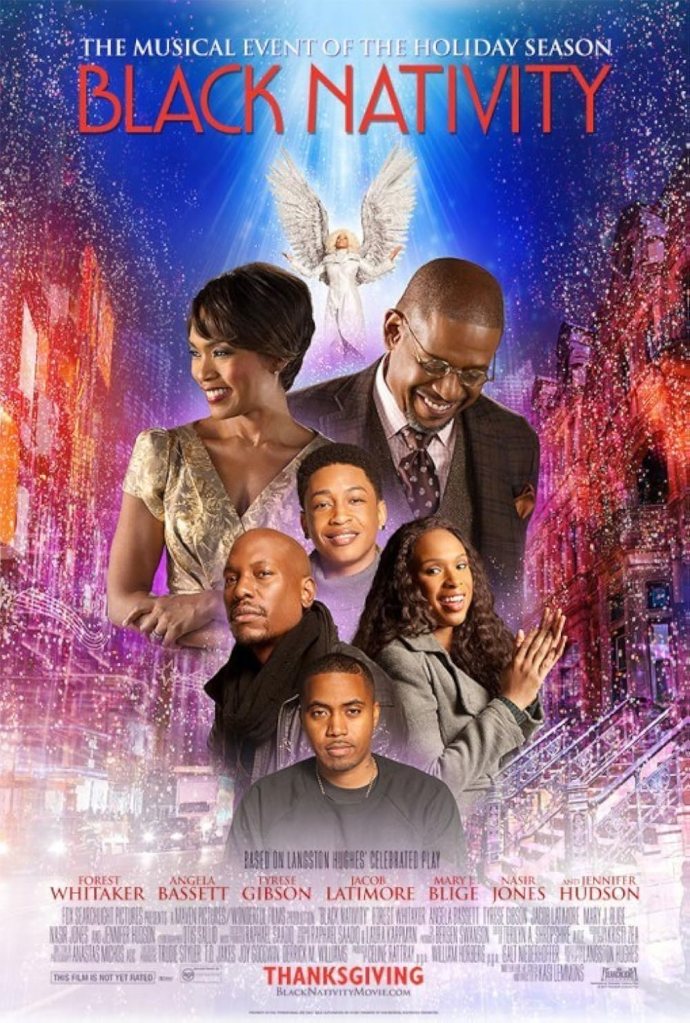
The poster for Black Nativity calls it "The Musical Event of the Holiday Season".  The six main cast members all appear, superimposed on each other, in a column in the center of the poster, flanked on either side by colorful, snowy New York City streets.  Above them, in a dark blue night sky, a light shines down on an angel with her wings outspread over them all.

One of the ways it succeeds is by building a lot of thoughtful complexity into the conflicts between characters.  As Langston goes unwillingly out of Baltimore via bus, we get to see his mother Naima (played by the multi-talented Jennifer Hudson) singing about the challenges of parenting that she keeps navigating because she believes in him more than she believes in herself, while also seeing his POV, in which he assumes his mother thinks of him as an obstacle and a burden, sent away to relieve herself of a problem.  The duality of that parent/child misunderstanding is going to be revisited, of course, when we eventually contend with the much more deeply embedded divides between Naima and her parents (Forest Whitaker and Angela Bassett—friends, if this movie fails its audience, it’s sure not for lack of on-screen talent), and by then we’ve got this lens to help us anticipate that neither side sees the whole story.  And even the parents’ side is complicated—a simpler, less thoughtful movie would likely give us a couple upset at their runaway daughter, waiting for her to apologize to them for all the grief they put her through.  But here, when Langston starts to get some answers out of his grandparents, his Grandma Aretha says that they’re waiting for Naima to forgive them.  And when he painfully confronts them about their absence from his life, almost shouting, “What kind of parents are you?” he hears the pain in their own experience, in the words of the reply: “We’re the broken-hearted kind.”  This is a family so haunted by regret and so walled in by grief that they don’t know how to stop hurting each other, yet they also clearly have the capacity to understand that this isn’t a case of the right and the wrong—at least Langston’s grandparents get it on some level from the beginning, and he and his mother are on a journey towards understanding.  As Aretha says, herself, at a later moment, “We’re so human.  We’ve all done things.  That’s between us and God.”  Is that an acceptance of blame, though, or an evasion of it?  Given her tone and her body language, I see Langston’s grandmother as accepting the reality of what she’s done wrong; her husband’s a more complicated guy, maybe in part because as a minister he’s a little more liable to moralize or try to explicate some ethical truth, but I also see him owning some part of the harm he’s done.  When I compare this family and their emotional landscape to the much better reviewed A Christmas Tale, which I wrote about a few days ago, I don’t know—I just find this film a lot more thoughtful, and more willing to believe in our capacity to understand ourselves and each other, which is what I want this time of year, maybe.

Some of the elements in the movie, I’ll acknowledge, are a little too simplified for the sake of the screenplay: Langston’s arrest right after his arrival in New York City feels implausible even for a justice system that’s biased against Black suspects, given what we and the characters in that scene can clearly observe, and the connections he makes with the criminal side of NYC, both in the jail cell and then persisting on the sidewalks of Harlem once he’s free, might be a little too sanitized and convenient.  The setup, though, is meant to keep Langston poised between pathways in life.  Is he going to be a young man who’s proud of his heritage or one who’s ready to sell his birthright for a bowl of pottage, to use an analogy his grandfather, Reverend Cobbs, would appreciate?  Is he going to walk down the sidewalk to the church where he’s the beloved (if wayward) grandson of a family he isn’t sure he belongs in, or to the street corner where, if he plays his cards right, he can pick up the weapon or the illegal goods that maybe can make him the cash he needs to halt eviction proceedings?  Everywhere he goes, from a jail cell to a pawn shop to the front pew of Holy Resurrection Baptist Church, he is confronted by not only his legacy, but what his legacy means to generations of older Black men who are putting a burden of expectation on him that he’s not sure he wants (or is able to carry).  I’m sure there’s a lot to this context I don’t understand as a guy who hasn’t lived Langston’s life (or Reverend Cobbs’s), but what I could understand of it had a lot of power.  I’ll also accept that musicals are hard for a lot of modern audiences, especially musicals set in the real world—it can be a strange juxtaposition between gritty life in the street and a character singing their feelings, and if that’s part of what people reacted to negatively, well, I get it even if I think the musical elements are good more often than they are cheesy.

The movie reaches its high point on Christmas Eve, when Reverend Cobbs insists on Langston accompanying his grandparents to church.  From the pulpit at Holy Resurrection, we develop a deeper understanding of what Reverend Cobbs means to his community, as he begins to expound on the story of Jesus’ birth, “according to my brother Luke.”  Langston falls into a bit of a reverie here—a dream? A daydream?—and his dream sequence consists of elements of the original Hughes play, staged dramatically all around Langston as though the events of the gospels were happening in the streets of Harlem.  The young pregnant woman his grandfather tried to help with a little money is the Virgin Mary; the crook he met in jail has a makeshift tent in an alleyway that Langston pleads for him to share so that the baby can be born.  We get an angel and a promise, and as song and dance start to involve all of these characters, even Langston, in the narrative, the events and the words combine to present one of the movie’s basic thematic claims: that Christmas is about a baby who came to put right a world broken by sin, and what “sin” means here is the weight of having done things you regret, things that hurt others and left their mark on you too.  From that perspective, we all need the opportunity for a renewal that hardly ever comes back around to lives that missed their chance at it the first time.  This is a deeply religious claim about the metaphysics of salvation, of course, but it’s also a simple secular truth that in each new generation—the birth of Maria’s baby, the birth of Langston to Naima—there is a chance of healing where there once was harm.  And it’s so overwhelming an experience for Langston that it shakes him right out of his pew.  He won’t believe in redemption when he lives in such an unredeemed family; he can’t accept grace in the world if it’s so obvious there isn’t grace for him and his mom.  He sprints out the doors of the church into the cold of a Christmas Eve night in New York City, alone.

And even if this movie’s not as good as I think it is, I’m not going to spoil for you what happens then.  Black Nativity has a lot to say about it not being too late for any of us, if we’re willing to tell the truth, not just about the hurt done to us but the ways we’ve hurt others.  We can be failures by plenty of society’s metrics without being unredeemable—in fact, I’d say this is a film that argues there’s no such thing as “unredeemable.”  And an act of unexpected mercy can re-order not just one life, but the lives of many.  Sure, there are ways that some of the film’s final confrontations are too clean, too simple.  Family is messy, and so is the kind of sin that several characters bring to each other to acknowledge, to accept, to make amends for, and the movie pretends for our sake that it won’t be all that messy in the end if we can be grateful for what we have.  I don’t think that’s true enough to the story this film has been telling.  I’d say that, far more than “be grateful,” the message we need echoed back to us in the end is that, yes, broken people break those around them.  But it is only people who can be authentic in their brokenness who will have the capacity to bring the kind of healing we all need.  Regardless, though, the end credits roll on a Black church in the heart of Harlem, a community that knows a thing or two about injustice and hope and dreams deferred, where the choir and congregation are on their feet singing about the troubles of the world and what’s coming to end them all.  It’s an exhilarating feeling, for this audience member, anyway.  I hope it will be for you, too.

I Know That Face: Forest Whitaker, here playing Reverend Cobbs, Langston’s grandfather, was of course a different kind of distant grandfather as Jeronicus in Jingle Jangle: A Christmas Journey, which I covered last year.  Tyrese Gibson, who plays Tyson (or “Loot”) in this film, appears in the role of “Bob” in The Christmas Chronicles: Part Two, the second in a series of Kurt Russell / Goldie Hawn Santa Claus movies that, I suspect, I will have to surrender to and watch at some point.

That Takes Me Back: There’s a pay phone in this motion picture….and it WORKS.  I wonder if 2013 is nearly the last year you could put a working pay phone in a movie and not have it feel like a period piece.  It sure took me back to having to carry around 35 cents in case I needed to call home.  Oh, and one of the ways Langston learns something about his mother is that, when he gets to his grandparents, Naima’s room is full of CDs she left behind her, which express her musical taste (and how young she must have been when she left).  I wonder how a modern movie would handle that….stumbling into your mom’s teenage Spotify playlists?

I Understood That Reference: This is the most elaborate / stylized “original Christmas” story I’ve seen in a movie – Joseph and Mary, the innkeeper, the stable, an angel speaking to shepherds in the field, etc., but all of it transformed by this gospel fantasia lens into the story as Langston understands it.  That’s certainly the Christmas tale that Black Nativity is in conversation with, as the title makes no disguise of.


Holiday Vibes (7.5/10): We don’t get a ton of “holiday gathering at the family home” stuff, since this family’s in such a weird place, but New York City at Christmas is a pretty powerful energy all of its own, and for anybody who like me grew up with church experiences at Christmas being pretty formative, the experience at Holy Resurrection Baptist Church is very resonant.  It’s good at evoking the time of year in lots of ways.

Actual Quality (9/10): Like I said, not a whole lot of people agree with me on this one, but I’m sticking with my own experiences here, and I thought this was a really powerful film.  Some wobbles here and there, as noted above, but overall I felt really moved by the characters’ relationships to each other, I enjoyed the gospel music thoroughly, and I think if you’re either someone whose experience of Christmas is similar to the Cobbs family (lots of praying and singing) or if you at least can be culturally curious about the experience of Christmas in the Black American church as an outsider, I think this movie has a lot to say about how those spaces can and ideally should give life to people.  2025 has been a rough year and I’ll take the hope I’m given.

Party Mood-Setter?  I’m leaning no, since so much of it is more emotional and intense than I’d normally look for in a background movie, but it’s also true that one of the movie’s big strengths is its gospel soundtrack and you can get plenty of joy out of that just letting it play in the background, I bet.

Plucked Heart Strings?  I’ve got to admit: I was genuinely caught off-guard by the movie more than once, with a moment that felt emotionally real in a way I was not expecting.  I was tearful by the end, and my guess is that lots of people might feel similarly moved: the emotions being tapped into here felt pretty universal to me, though as I’ve noted, apparently this is not a well-reviewed movie, so there’s something I’m missing (or something others are).

Recommended Frequency: I’d say that this is one I’d love to work into an annual rotation, and certainly one I think you should return to regularly, especially if you’re someone for whom the original story of Christmas “from brother Luke” is a meaningful part of your holiday experience.

Subscribers to Peacock can watch this one ad-free, and if you are happy to watch it with ads, our old standby, Tubi, has got your back again.  All the usual places will rent you a streaming copy for about four bucks, and ten dollars will get you a Blu-ray/DVD combo pack at either Amazon or Walmart (Barnes and Noble didn’t have it when I checked).  Worldcat says you public library users have options, though: about 700 libraries hold it on disc.

Meet Me in St. Louis (1944)

Review Essay

Part of the fun of the Film for the Holidays experience, for me, is finally sitting down to watch a movie I have been meaning on some level to watch for years, only to find that it’s not quite what I was expecting.  Sure, sometimes this is a negative experience, but more often it’s a neutral or positive one as I find myself recalibrating my expectations on the fly: it’s more interesting, at least, to be surprised.  In the case of 1944’s movie musical, Meet Me in St. Louis, I was expecting to be mostly dialed in for the star power of the incomparable Judy Garland, and don’t get me wrong, Miss Show Business is here and as fabulous as any of us would expect.  But sometimes in these holiday films, you get kind of fascinated by a truly charismatic supporting player—they’re not always even in sync with the rest of the cast or screenplay, but they’re so undeniably magnetic that you find yourself leaning in every time they’re on screen.  Think Dan Levy as Abby’s flamboyant friend John in Happiest Season.  Anyway, there’s a performance like that in Meet Me in St. Louis, and it tickled me.

Let’s handle the central story of the motion picture first, though—this is the story of the Smith family, and in some ways it’s an almost Austenesque premise wherein the oldest girls, Rose and Esther, are both pretty keen to land a guy (and grappling with some societal hurdles and conventions to do so) while maneuvering around a difficult parent (here, Mr. Alonzo Smith, their father).  It’s also a story about turn-of-the-century American optimism—St. Louis as a city “on the grow” about to welcome the whole world to the Louisiana Purchase Exposition, a place western enough that the big cities back east are a different country you can only reach by means of echoing long-distance phone lines but also connected enough that kids from the local high school head to the elite universities of the Atlantic Seaboard pretty routinely.  And it’s at least attempting to also be a story about the pressures on a lower middle class family: Mr. Smith’s worried enough about money that he’s willing to uproot the family to make a big move for his work, but not so worried about money that he can’t change his mind about that, at least in theory.  The film doesn’t really land this last punch, I’m afraid, since the family hardly ever seems low income (given their pretty lavish digs in a lovely neighborhood, with the girls expecting to head off to college, and Mr. Smith’s professional standing as a lawyer), and this is a problem since a lot of the conflict in the story hinges on the idea that the Smiths are so in need of the promotion/raise that they’re willing to throw away a whole lot of happiness in order to get it.  Sensible plots aren’t exactly the hallmark of the Golden Age Hollywood musical, and it’s probably fair to say that most people are being drawn here for that mix of MGM talent and Tin Pan Alley songwriting that make for a bit of a sensory extravaganza.  But I still think we can do a little better than this.

The poster for "MGM's Meet Me in St. Louis" features overlapping portraits of several young people (two teenage girls, a younger girl, and a teenage boy), along with the credits for the main cast.  The only tagline reads "Glorious Love Story with Music".

In some ways the movie’s a bit more grown up than you might expect: both Rose and Esther Smith are pretty savvy about boys.  Esther (the character Judy Garland plays) at one point informs her big sister that “I’m going to let John Truett kiss me tonight.”  When Rose chides her, saying, “Men don’t want the bloom rubbed off,” Esther quips back, “I think I have too much bloom.  Maybe that’s the trouble with men.”  These ladies know a thing or two about the need to attract a fellow’s attentions without, shall we say, overindulging either themselves or the fellow in the process.  And of course it’s the 1940s, so the film’s going to ask us to play along with romanticizing things like a young man getting passionate enough that he grabs a young woman and kisses her, no permission sought: the fact that we know very well it’s what she wants doesn’t really make the moment 100% fun, from my perspective, but maybe I’m being too much of a wet blanket about it.  Nobody in this film manages to seem like a bad person for more than about five minutes (and only for the sake of creating just enough conflict to keep the story humming along).  When the meanest character in your motion picture is *checks notes* a devoted father who thinks he needs to relocate his family for their economic well-being, well, the stakes are pretty low.

I teased you a little up-front, though, with my claim that the show here is stolen by a high charisma supporting cast member, and I need to deliver the goods, so here it is: Margaret O’Brien, the child actress, is incredibly compelling as “Tootie” Smith, the youngest of the family’s five kids.  We’re introduced to Tootie having wandered away from the family home to help deliver ice on a horse-drawn wagon, entertaining the delivery man between stops by discussing her plans for the burial and mourning of one of her dolls who she plans to have “die” later that day—as she tells him, the doll has four fatal diseases, “and it only takes one.”  Later, on Halloween, we follow her through the neighborhood in an era predating the “or treat” option: Tootie’s all tricks, all the time, and her idea of a trick is on the level of stealing lawn furniture to add it to a bonfire, throwing flour at neighbors in an act of mock assassination, and, most memorably, the attempt to derail a double-decker streetcar by placing a hastily prepared mannequin on the tracks.  She is a menace to society, and I love her.  Admittedly, Tootie’s also young enough to be scared of the mayhem she’s capable of, but I think that only adds to the impressiveness of the mischief she accomplishes in one brief night out.  She’s endlessly quotable and really my big complaint of the film’s second half is that it spends way too much time worrying about getting Esther and John’s romance sorted out (over, it has to be said, the most comically miniscule of hurdles) and far too little time letting me watch Tootie, I don’t know, pursue a career as a juvenile arsonist or weigh the pros and cons of poisoning her grade school teacher or whatever other kinds of sheer chaos she is probably up to, off screen.

Now, here’s where I probably ought to admit a certain amount of favoritism at work here, or at least my predisposition to cheer for spunky kids like Tootie Smith in St. Louis in 1903.  Two of my great-grandparents were small town Missouri children in 1903-1904: my great-grandfather Warren was a scamp (injuring his hand as a 12 year old in an “accidental revolver discharge”…lord knows what Warren’s parents were doing at the time) and my great-grandmother Opal, who I will always and only ever think of as “Nana”, was a bright and brave woman all her life.  In 1904, the year of the Exposition, Opal was a 9 year old living in Lewistown, Missouri: at 150 miles from St. Louis, she was too far away to get to go to the Fair with her father and grandmother, but her dad gave Opal and her younger sister Nellie the consolation prize of a trip to Quincy, Illinois (about 30 miles away) to see Barnum and Bailey’s Circus that summer.  It was pretty easy for me to enjoy this 1900s peek into a Missouri family’s life, sanitized and historically inaccurate as I know much of it is, since it let me muse just a little about what it might have been like for Opal and Warren to hear tales of the World’s Fair or play a prank on Halloween.  If you feel any kind of connection or kinship to this part of the country or that era of history, I bet this will work a little better for you, too.

And of course, what this movie does best of all is its music, which I haven’t really touched on.  It’s a mix of songs: I’d never heard “The Boy Next Door” before but Judy Garland can make anything sound like a classic the moment she gets started.  I was familiar with the chorus of “The Trolley Song”—and I bet many of you, too, know “Clang! Clang! Clang! went the trolley”—probably from the Looney Tunes or some similar source.  And I could certainly sing all of this movie’s biggest hit and the one that pulls it squarely to Christmas (yes, don’t worry, I haven’t forgotten the conceit of this blog): Esther, in an attempt to soothe the fragile and frantic emotions of an agitated Tootie, pulls her little sister into her arms and sings, “Have Yourself a Merry Little Christmas.”  We get about 25 minutes of Christmas out of the film, but it’s a climactic 25 minutes, coming as it does at a point where the family’s preparing to move to New York, and treating the holiday as a huge final farewell—one last dance, one last tree in the front room, one last chance to maybe see if that John kid can get his act together and propose.  At its best, it’s a perfect Golden Age holiday sequence—red and green gowns that dazzle the eye, a real humdinger of an emotional song performed beautifully, and a finish that affirms love and family and togetherness in the way we want all our holiday flicks to end.  It’s just not always able to hold onto that perfection, since some of the machinations of the plot at the end are creaky, and while the song is beautiful and in Judy’s confident hands it packs an emotional heft out of the gate, its lyrics are sometimes a strange fit for the moment and the characters involved.  The movie works, but it doesn’t work as well as it wants to believe it does.  What it does do, aided so much by the energy of Judy Garland and Margaret O’Brien, is give us the Smiths as a convincing and loving family, whose holiday celebration is genuinely joyful to look in on, and at this time of year, what else do we really want?

I Know That Face:  We just saw Tom Drake of course, who here is Esther’s beau, John Truett, when he appeared as Pat Dingle, a similarly fresh-faced boy next door, in The Great Rupert.  Margaret O’Brien, one of the last surviving child stars of the 1940s and the adorably gremlin “Tootie” Smith in this film, has voice acting roles in Elf Sparkle Meets Christmas the Horse and Elf Sparkle and the Special Red Dress (playing Mrs. Claus in the latter), as well as portraying Mrs. Foxworth in This Is Our Christmas.  And Margaret also plays Beth March in 1949’s Little Women—a film that, much like this one, incorporates a significant Christmas sequence even though it’s not exactly a “holiday movie”—and she’s not alone, since the March parents in that version of Little Women are played by Leon Ames and Mary Astor, the same actors portraying her parents in this movie, while Harry Davenport, who’s Tootie’s grandfather in this film, appears in the Alcott adaptation as Dr. Barnes.

That Takes Me Back:  This film’s set so long ago that it’s not so much making me nostalgic for things I remember as it makes me curious about things that maybe my grandparents or great-grandparents would have been nostalgic for.  Would the making of your own household ketchup have been such an engrossing enterprise back then, as it seems to be in the opening scenes?  Did people really tie ribbons in bows around the necks of housecats back then?  I associate this more with animated Disney films, in part because most of the cats I have known would have declared a vendetta against anyone subjected them to such indignities, and yet there the bow is on Tootie’s cat.  As I mentioned earlier, the film gives me a glimpse of a Halloween full of tricks only, and honestly, the chaos and vandalism is overwhelming enough that I can understand the citizenry of St. Louis getting together after Halloween 1903 and agreeing to the new “tradition” of trick-or-treating as a kind of public safety measure.  Anyone who knew Tootie Smith would have gotten to work the next day in an attempt to invent the fun size candy bar.  Oh, and there’s some shenanigans involving a dance card, which made me wonder when the end of the dance card era was (and why it ended).

I Understood That Reference:  Tootie’s waiting up for Santa Claus, but of course he won’t show up until she’s asleep.  How will he find the family next year in New York, though?  Gosh darn it, Tootie, you’re too dang cute sometimes.  When you’re not feeling murderous, that is.


Holiday Vibes (4.5/10): As noted above, the final half hour or so of the film really does a pretty good job of realizing an emotionally resonant and colorfully delightful Christmas holiday.  The addition to the canon of a now-ubiquitous holiday song has to count for something here, too.  But the score can only get so high before I say, hang on a second, the vast majority of the running time unfolds without even any reference to a winter holiday.  The score of 4.5 is probably generous, all things told, but like all my numerical scores, it’s to be taken with a grain of salt.

Actual Quality (8/10): At its best, this is a lot of fun—a couple of great songs, a lovely Christmas tableau, a charming performance from a child actress.  At its worst, it’s super forgettable: some of the music isn’t all that catchy, there’s so little conflict of any real consequence, and the film’s biggest questions as we get to the third act are a mixture of problems that will clearly be resolved with ease and problems that barely seem like problems.  The plot’s not strong enough to be a selling point, but it doesn’t give itself over into spectacle quite enough to get away with a weak story the way that other films frankly do (the plot of White Christmas, for instance, isn’t better than the plot of Meet Me in St. Louis, but that movie finds way more ways to captivate an audience and let the plot take a back seat).  Shaking all that up, this ends up a B/B- of a movie for me as an artistic product (even if I felt a little more charitable towards it, as a viewer).

Party Mood-Setter?  There’s not quite enough Christmas in the film to work for this purpose.  But it’s so gentle and full of nostalgia that I don’t think it would particularly distract you if you did turn it on.

Plucked Heart Strings?  I mean, I was not expecting this, but I really did find myself getting emotional at the Christmas gathering: the love of the people involved, and their gratitude for each other, got to me on some level.

Recommended Frequency:  I’d say that Meet Me in St. Louis is a film that, if you watched it for a few Christmases in a row, would become “a Christmas movie” just as much as a lot of other films that are not set primarily at Christmas but have some key Christmas scenes—in the vein of It’s A Wonderful Life or White Christmas in that way.  I’m not sure it’s quite great enough for me to make that effort, but it’s more than good enough for a viewing and it’s one I will absolutely watch again, as much for the old-time nostalgia of it as for the holiday elements.

As with so many other films this year, you can watch this (with ads) on Tubi. It’s rentable on streaming from almost all the places you might think to pay to rent it, too.  The Blu-ray is cheaper than the DVD at Barnes and Noble, if you know you want to own it, and Worldcat will help you find it in over 1,800 libraries worldwide.

The Nightmare Before Christmas (1993)

Review Essay

It’s kind of funny that The Nightmare Before Christmas lingers in the public consciousness far more as a Halloween movie than a Christmas movie, despite the fact that (with the exception of the opening scene) the film is really entirely about the late December and not the late October holiday.  In a way, we make the same error in understanding that the denizens of Halloween Town do when Jack persuades them to celebrate Christmas—thinking that this experience should be primarily about the expansion of the empire of Halloween’s cultural material into Christmas rather than respecting Christmas as having a value of its own as an entirely different kind of celebration.  If we look at the film itself more closely, to the extent that it’s about either holiday (and I’m about to admit some doubts on that front), it’s much more a film about Christmas and what it means, even if sometimes it’s speaking by means of its silence.  The movie is a fitting subject, therefore, for the work done here at Film for the Holidays.

The initial premise of the movie is simple enough: the cultural (if not political) leader of Halloween Town, Jack Skellington, the Pumpkin King, concludes the celebration of Halloween one October 31st with a sense of depression and malaise.  He’s tired of “the same old thing” and wants to rejuvenate his sense of identity by finding whatever it is he’s missing right now in merely putting on a more-or-less perfect Halloween celebration once a year.  His sense of longing is echoed by another resident of Halloween Town, Sally, a stitched-together undead young woman who was created to serve the needs (never fully explicated) of the local mad scientist, Dr. Finkelstein.  Sally wants independence from that life and some kind of connection with Jack, but she is both unsure how to get free and unsure how Jack might respond to an overture.  When Jack fortuitously stumbles into Christmas Town via a tree-shaped door in the woods, he comes away certain that the cultural conquest of Christmas by Halloween Town will pose exactly the kind of thrilling challenge that will invigorate him again, whereas Sally’s deeply worried about the whole endeavor, foreseeing disaster if Jack pursues this path.

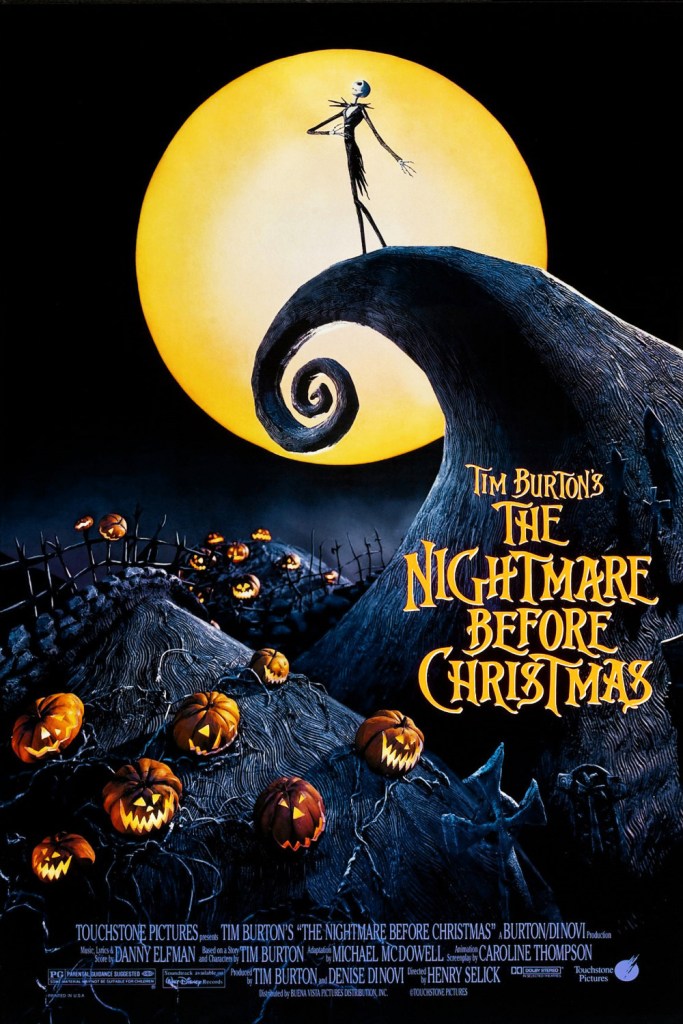
The poster for The Nightmare Before Christmas features Jack Skellington, the Pumpkin King, standing atop a strange curlicue hill, backlit by the full moon.  Below him are many ominous looking jack-o'-lanterns strewn across a cemetery and along a rickety wooden fence.

The film’s successful communication of the creepy delights of Halloween Town (realized, of course, both by Henry Selick’s amazing talents as an animator and by maybe the best score Danny Elfman ever composed, which would be saying something) is, I think, part of how we come to mistake the message of this movie.  It would be easy, if you haven’t seen it in years or only know it through cultural osmosis, to think that the thesis of Nightmare is that Christmas would be cooler/edgier/more awesome if it had a lot of ghouls and frights and toys with teeth, etc., and Jack Skellington & Co. basically save Christmas by making it hip again.  Those weird juxtapositions of Christmas cozy and Halloween horror are the really memorable moments in this motion picture, unquestionably.  But the message is in fact completely the opposite: Jack sucks at doing Christmas.  The residents of Halloween Town create a Christmas that is so chaotic and stressful that worldwide panic ensues, capped off by a military assault on Jack and his (undead?) flying “reindeer”.  Jack is so cavalier about the wellbeing of his Yuletide counterpart, “Sandy Claws” (as the Halloweenians call him), that he leaves the security of “Sandy” to three known juvenile delinquents whose primary allegiance is to the one genuinely bad person in Halloween Town, a sociopath named Oogie Boogie, who proceeds to subject an innocent and panicked Santa Claus to abuses designed to culminate in his murder.  I don’t mean to “spoil” a 30-year-old classic that surely almost all of my readers have seen at some point in their lives, but the final outcome of all this is certainly not a newly Halloweenized Christmas, but to the contrary a sense that the two holidays belong very much in their respective corners.  This is a story about the importance of a world with BOTH Halloween and Christmas, and of knowing which side of that line to be on.

And that’s what’s always going to be at issue in a project proceeding from the brilliant though often one-track mind of Tim Burton, who generates this film’s original story and acts as producer.  Burton is good at celebrating outsiders (and, despite all his successes and riches, at playing the role of the “outsider” himself) but usually he considers it impossible for them to make peace with the society Burton finds both appalling and weirdly appealing.  Edward Scissorhands does not find himself integrated into the world around him, any more than Lydia Deetz finds a way to be happy in the world away from the Maitland house.  I get the sense that Burton privately thinks Jack’s Christmas is in fact more fun than the real one, but also genuinely believes that it’s just not plausible that Jack’s version would catch on among the “normies” who want to find something pleasant in their stocking rather than something lethal.  We are allowed to visit Burton’s Halloween Town and admire its delights, but only he and his stable of outcasts are going to find it a happy place to settle down.

You may not think this a very fair take about a film you love—though, to be clear, I’ve watched this movie happily dozens of times, and I can sing along with it in numerous places, so it’s not a film I dislike!  I just think that, viewed through the lens of the holidays it purports to have something to say about, Nightmare’s message in the end is that Christmas people should do their thing and Halloween people theirs.  Jack maybe has a renewed sense of vigor at the end of the story, but it’s only a vigor that he ought to apply to making Halloween better, rather than dabbling in something else.  This was a film about people initially feeling hollow, aimless, wistful, and in the end, it’s arguing that they can be shaken back to life through a shared sense of crisis, but that probably they should have left well enough alone to begin with.  That’s the only sense I can make of the Sally subplot, in which she has a vision, argues for what ought to happen, and then is vindicated almost completely by what occurs.  Sally was right, and Jack should have listened—as another character tells him at the film’s conclusion, in fact.  Some kind of freedom is possible (as experienced by most of our characters, by the end), but we also need to know where home is, and not to wander too far from it, whether that home is the picket-fenced suburbs or the iron-fenced cemetery.  And what IS the Christmas that Jack doesn’t really understand?  It’s snowfall.  It’s nice toys.  It’s a predictable and cheerful celebration in which nothing strange or unexpected happens.  Not exactly the most ringing endorsement of a holiday, especially from a movie that has taken such delight in depicting the truly macabre people who make up the population of Halloween Town.

Luckily, I also don’t think that we’re forced to accept the messages art gives us without any agency of our own.  We can argue that the characters (and the screenplay) misread this situation, and that other, better outcomes were possible.  Part of the magic of Jack’s big number, “What’s This,” is that there is actually something profoundly wonderful about stepping outside the boundaries of your life and seeing something new.  I can’t explain why Burton wanted to make a movie that argues Jack shouldn’t ever step through the door into Christmas Town again, but I can at least make the case, for myself, that I think Jack knew a lot more about Christmas’s power than he seems to implement when it comes down to celebrating the holiday, and I would have been glad to see a movie give him (and Christmas) more credit for already having a lot on the ball.  After all, when he pitches Christmas at the town meeting, he seems to come from the point of view that the holiday isn’t much like Halloween at all—he’s constantly deflecting weird inquiries and at one point he basically breaks the fourth wall to tell us in the audience that he anticipated that he would have to ham up the relatively innocent figure of “Sandy Claws” to make Christmas sound intense enough to get people’s attention.  Why he forgets all this in practice for the next half hour of the movie is not really something I can explain.  Furthermore, I’m not sure it’s true: Christmas is a much spookier holiday than Burton gives it credit for being.  Its most famous modern tale is a ghost story.  Its original narrative is a story of terror (one of the characters appearing in every nativity set is an angel whose opening line is “Do not be afraid!”) and murder (Herod and the slaughter of the innocents) and squalor (both the stable and the shepherds).  It is neither a neat nor a tidy holiday—it’s only the sanitized commercial version of Christmas that seems that way, and it’s a disappointment, I think, that Burton didn’t apply his considerable talents to unearthing something more vital in it than he did.

It is a very mild disappointment, though.  The more I break this movie down, yeah, I can sure pick the plot and premise apart, but I don’t particularly enjoy doing that.  My critique of its missed opportunities is honest, and I think it’s a valid assessment of the film we’re given.  But more than critiquing it, I want to enjoy it, and I do: I find Jack charming and the residents of Halloween Town amusing and I sing along happily with almost every zany musical number.  In the end, the experience of the art has to matter as much as the analysis of it, right?  Anyway, it’s a movie that gives a lot to a lot of people, and I’m one of them, and if you’ve not seen it before (or not in a while) I hope I’ve steered you to it in a way that will help you both delight in it and engage with it thoughtfully.

I Know That Face: William Hickey voices the decrepit, predatory Dr. Finkelstein here—he’s Clark’s Uncle Lewis in National Lampoon’s Christmas Vacation, which I covered with criticism in a post on the blog last year, and in a 1987 television movie called A Hobo’s Christmas he plays a character named (well, surely nicknamed) Cincinnati Harold.  Ken Page, who in this film provides his memorable bass voice for Oogie Boogie, appears as Dwight in 1990’s The Kid Who Loved Christmas, an emotionally heavy television drama with an all-star cast of Black performers.  Paul Reubens, who made such a career out of playing charming oddballs and who voices Lock (one of “Boogie’s Boys”) in this film, shows up again as a voice actor in the direct-to-video Beauty and the Beast: The Enchanted Christmas, in which Reubens plays Fife, a piccolo who plays turncoat against the villain at a crucial moment.  Most famously, of course, Reubens plays his character of Pee-wee Herman in lots of settings, including as the titular star of 1988’s Christmas at Pee-wee’s Playhouse, and, bizarrely, as a performer in the 1985 Bryan Adams music video, “Reggae Christmas”.  Yikes.  Lastly, Catherine O’Hara voices Sally in this movie; she’s familiar to most of us from lots of other projects, but in the holiday realm in particular, she plays Christine Valco in 2004’s Surviving Christmas, as well as the aging character actress Marilyn Hack in For Your Consideration, a Christopher Guest film that ultimately is at least Thanksgiving-adjacent.  Oh, and of course she is Kevin’s frantic but seemingly not-that-attentive mother Kate in both Home Alone (which I will cover someday on this blog) and Home Alone 2: Lost in New York (which features a cameo appearance by one of the worst Americans of all time, so I probably am going to skip it for the rest of my life).

That Takes Me Back: It would be hilarious if I spotted elements from life in the demented chaos of Halloween Town that reminded me of growing up in the suburbs outside of Seattle, but no, I’m afraid the delirious world of Tim Burton / Henry Selick didn’t spark anything nostalgic for me.

I Understood That Reference: Jack skims A Christmas Carol and a book called Rudolph, as he seeks “a logical way to explain this Christmas thing”.  He later divides chestnuts by an open fire, in an echo of “A Visit From St. Nicholas.”


Holiday Vibes (4/10): This is a film with a ton of talk about Christmas and preparations for it, as well as some of its actual celebration, and Santa Claus (ahem, sorry, Sandy Claws) is a major supporting character, so it’s not nothing!  But as I note above, the movie’s intentions here definitely seem to carry it away from much real engagement with Christmas and towards the emotional journey of the main characters (and their realization, in the end, that Christmas isn’t for them).  So, it’s doing some of what we look for, but it’s missing a lot.

Actual Quality (9/10): Again, separate from the message and however we feel about it, this is an incredibly well made film: a great voice cast, great music, great stop-motion animation.  Sure, I have some mild irritation at the Burton of it all, but even there, I admire a lot of what Burton’s capable of as a filmmaker.  I’ve just come to find his stuff a little empty and self-aggrandizing over the years, and while there’s still some gems in his filmography, there’s fewer “10s” in there than I used to think, at least in my opinion.  Even if Burton’s wrong about Christmas, though, he knows how to make a compelling story, and so do all the other artists who worked on this.

Party Mood-Setter?  If this feels like the holidays to you, absolutely: the songs invite you to sing along and the story’s lightweight enough that you don’t need to focus at all.  But if it’s not “holiday” enough for you, I think it’s a little too weird a presence to be in the background.

Plucked Heart Strings?  I’m sure some people feel a deep resonance with Sally (and delight that she gets Jack at the end) but I don’t think anybody here is fully realized enough to make an emotional response happen for me.

Recommended Frequency: Oh, this is annual at some point in my household—whether in October, November, or December—and we all know the words to at least most of the songs.  If it isn’t for you yet, it’s worth trying to add it to your holiday rotation, in my opinion.  Proceed with a little caution, though, about what the movie’s really trying to persuade you to believe.

If you want to give the movie a whirl, it’s on Disney+, of course, since Disney paid for it in the first place.  It can be rented anywhere you think of renting a streaming film, and several versions are available on disc at your Barnes & Noble.  But there’s no need to pay for it: hundreds of libraries, according to Worldcat, carry this one on disc.

Miracle on 34th Street (1947)

Review Essay

Folks, welcome back for another season of holiday movies and musings: it was such fun last year to share some media experiences (both the sublime and the ridiculous…and whatever the heck Ghosts of Girlfriends Past was) with so many of you, and if you’re new to Film for the Holidays, a special welcome to you!  As a reminder, these film reviews will be appearing once a day like clockwork from now through the morning of Christmas Eve.  You can just remember to pop back here to see them, or click that floating Subscribe button you hopefully see somewhere on your screen to receive the posts via email.  All of last year’s categories for notes and ratings are sticking around this season, which I hope will help you both figure out how (or if) to add some films to your holiday experiences and encourage you to explore some titles not even on this year’s list.  With all that said, let’s get on with the review of this truly classic motion picture.

My approach to Miracle on 34th Street is definitely influenced by the fact that I know it to be the #1 Christmas movie on the recommendation list constructed by Connie Willis.  Willis is one of my favorite authors of all time, on any subject but especially on the subject of Christmas, which she has used extensively as a setting for short stories for decades now, and her passion for this particular movie in the various Christmas anthologies she’s edited is unrivaled.  I had the chance to talk with Willis this summer (on many subjects, including the subject of holiday movies), and since then I’ve been asking myself how I would rank Miracle, myself, as someone who absolutely grew up with this film as an annual tradition, but who I think never had quite the same passion for it that its true fans express.  The conclusion I’ve come to is that the movie is essentially a perfect object in that it achieves exactly what it sets out to accomplish, and my only issue with it is that the thing I go to holiday media to hear isn’t quite what it sets out to say.

What’s the nature of this perfect object, first of all, if somehow I’m talking to a reader who’s never seen this film?  The premise is both simple and silly once you write it all down: Miracle on 34th Street posits that, by the mid-1940s, Kris Kringle (Santa Claus) is living in an old folks’ home in Long Island, taking regular jaunts into New York City to breathe some fresh air, harass shop assistants who are trying to dress their windows for the holiday season, and give pointers to performing Santas as he meets them in the street.  Our story begins when, having exposed an unfit Santa on a float in the Macy’s Thanksgiving Day Parade, Kris is hired by Doris Walker, a hard-working single mother and Macy’s employee, to not only take part in the parade but to work the “photos with Santa” line inside their flagship store on West 34th Street in the middle of bustling midtown Manhattan.  Kris immediately busies himself with improving the lives of basically everyone he encounters, from Alfred, who sweeps up the locker rooms in the Macy’s employee changing area, to Peter, a kid who wants a fire truck that squirts water but which he will promise only to use in the backyard, to Peter’s mother who, let’s face it, seems like a lady near the end of her rope.  Most centrally, Kris’s goal is to convince both Doris, an incredibly hard-boiled divorcee who has seemingly learned to shut out all hope or faith from her live, and Doris’s daughter Susan, a child raised on such pure common sense that the concept of an “imagination” is unfamiliar to her, to believe in him.  In this, he has the enthusiastic help of Doris and Susan’s neighbor, a bright young lawyer named Fred Gailey who’s hot for Doris and sweet to Susan, and who is at least willing to play along with Kris’s eccentric notion that he is the real, the one and only, Santa Claus.  Wild stuff.

This is the poster for the theatrical release of the movie, Miracle on 34th Street.  The background is bright yellow.  From the left and right sides of the poster, the lead actors, Maureen O'Hara and John Payne, face each other, smiling.  Between their faces but far more distant in the background is the image of Natalie Wood as Susan being embraced by Edmund Gwenn as Kris Kringle.

The story as presented feels like it might make a sweet children’s movie—believe in Santa, young folks, and all will be well—but Miracle manages a deeper level of resonance than that, and I think a big portion of the credit clearly goes to the incomparable Edmund Gwenn in the role of Kris Kringle.  Gwenn, who wins an Academy Award for the performance, seems to have been born to play Santa Claus, with a warmly smiling and almost cherubic face (if cherubs could grow beards), and perhaps the perfect voice for the part: both cheerful and chiding, he manages to hold a tone that sounds constantly ready to celebrate niceness but also unhesitant to let the naughty know they’ve really stepped in it.  It’s that balancing act, a Santa Claus who seems capable not only of genial indulgence but also of genuine moral candor and outright confrontation of the unworthy, that transforms the film into something robust.  There’s a wisdom to this Kris Kringle that seems to take at least a note or two from the character’s ancient roots in the stories of Saint Nicholas of Myra, a countercultural force, a figure whose principles are more important than his presents.  Though he does love giving the perfect present.

In some ways, Gwenn’s perfection in the role is a liability: it is so easy to believe this man to be Santa Claus that Doris and Susan Walker (Doris especially) can seem to be dragging their heels needlessly.  Natalie Wood’s Susan is a genuinely charismatic performance by a child actress.  She has the range to not only emote successfully on screen, but even to play the part of a child who cannot act, as she does when she fumbles slightly her attempts to pretend to be inviting Fred Gailey to Thanksgiving dinner, or struggles to convincingly play a make-believe monkey.  So I think to some extent she sells us on Susan as a real kid who would wrestle with the problem—a child who is so indoctrinated against Santa Claus that believing in him might spark an identity crisis.  She also gets the slightly easier task of being the first of the two Walkers to open up to the possibility of Kris’s telling the truth, in famous scenes where she tests the reality of his beard or listens in as he effortlessly switches to speaking Dutch to offer greetings to a recently adopted refugee.  Maureen O’Hara’s Doris has to be the rigid one, and it’s no criticism of O’Hara when I say that it does become just a little difficult to believe in a woman who refuses to let a primary schooler read fairy tales or pretend to be an animal for fun: I think that’s a challenge for the (admittedly Oscar-winning) screenplay, which has somehow to make this premise work, and if it’s stretched a little thin there, well, at some point we have to accept that this is a movie about Santa Claus and not a hard-hitting realistic drama.

The message of Miracle is, as I’ve noticed revisiting it as an adult, surprisingly complicated in its politics.  The film seems to wear its anticapitalist leanings on its sleeve: you notice even as a kid that Kris courageously stands up for sending parents to get toys from other stores, and as you get older, perhaps you pick up on the fact that Macy and Gimbel only embrace the idea because they realize it’ll turn even more of a profit, and not out of any real belief in the ideal.  Alfred, the sweetly naive custodian, observes mournfully early on in the film that these days the worst of the “isms” floating around the world is “commercialism”.  It’s all “make a buck, make a buck,” even in his native Brooklyn, he laments.  Fred Gailey throws away his job for the sake of a higher principle, and Judge Harper risks his chances at re-election for the sake of his own principles (somewhat different from Fred’s).  And yet.  This is also a movie that never really takes Macy or Gimbel to task—to the contrary, you’ll come away from the movie feeling a great deal of sentimentality and even sweetness in connection with “Mr. Macy”, a person who did not exist (at least, not in 1947, by which time no Macy had owned the company for over half a century).  It’s a movie that treats the material desires of its characters as laudable: nobody is ever told that the “real meaning of the holiday” is something other than getting the right present, and even the movie’s final climactic moment of awe-struck belief is something only occurring because a character thinks she’s just been “given” an extraordinarily expensive “gift” (that others will have to work rapidly behind the scenes to actually buy for her).  This is a movie about faith, yes, and love, but it’s one that has no problem assuming that these things can co-exist happily with thriving post-war American commercialism and not encounter the slightest trace of a conflict.  This is odd for an American holiday movie: we just don’t tend to think about it because for most of us we can’t remember a time when this movie wasn’t a Christmas classic.

To be clear, I am in sympathy with this film’s moral compass to a large extent.  The truly odious Sawyer, who at the film’s start is an industrial psychology staffer for Macy’s, is a monster measured along any possible axis: narcissistic, cruel, misogynist, selfish, and vindictive.  Violence may not be the answer but I can’t claim to be disappointed when Kris Kringle beats him over the head with an umbrella.  Kris is a huge proponent of learning to love not only yourself but those around you, whether it’s getting Susan to realize that she can connect with the kids playing in the courtyard or opening Doris up to the idea that romance hasn’t passed her by forever.  I like that: who wouldn’t (other than Mr. Sawyer)?  And the movie is a huge believer in accidental grace, which I love as an undercurrent: good things happen despite people’s intentions rather than because of them.  Doris Walker and Mr. Shellhammer hire a Santa Claus thinking he’ll be good for business, not for their hearts.  Macy and Gimbel help beleaguered parents as a marketing scheme.  Even the movie’s most famous sequence, the arrival at the courthouse of an endless stream of letters to Santa Claus that win Kris’s freedom, is of course the self-interested action of two overwhelmed postal employees who have realized it’s a pretty slick solution to an overcrowded warehouse.  This is a truth about the world, and the ways in which goodness manages to survive even among people who are not trying in any particular way to be good.  It makes me smile.

I know this review’s running long, and it’s a holiday weekend, so I’ll stop here, though I could say a lot more about this film: it’s a rich text and there’s a lot to find (and like) in it!  To me, again, the movie undeniably does what it sets out to do basically perfectly—you wouldn’t think that you could merge a fantasy about Santa Claus working in a department store with a surprisingly high-minded courtroom drama, but it works incredibly well.  I think what ultimately leaves me just short of calling the movie a masterpiece is my sense that its message isn’t quite profound enough for me.  When Kris tells Fred, early on, that “those two [Doris and Susan Walker] are a couple of lost souls, and it’s up to us to help them,” that feels really true in my heart.  And it’s weird to realize, at the end of the story, that they accomplish this by means of Fred dating Doris (I’m sure he’s a nice guy, but how is this “saving her soul”?) and Kris persuading Doris by means of his sincerity and Susan by means of an incredibly unlikely gift that he’s the real Santa Claus.  They have learned to be a little less hard-headed about the world, but not in a way that feels inspiring to me, let alone soul-restored.  It’s a sweet movie, a holiday treat, and I could watch Edmund Gwenn chew bubble gum or sing a song about Sinterklaas any day of the week and be happy about it.  But it’s not a fable that speaks to my heart at quite its resonant frequency.  If it does that for you though, dear reader, I am genuinely and unreservedly delighted for you, and I’m certainly happy to celebrate it as a worthwhile member of the Christmas motion picture canon here at the start of the FFTH season.

I Know That Face: Jerome Cowan, who in Miracle appears as the district attorney, Mr. Mara, plays the role of Fred Collins in 1950’s Peggy, a movie set around the Tournament of Roses Parade that rings in the new year in Southern California.  Percy Helton, who here performs uncredited as a Santa Claus so inebriated that he’s pulled off the Thanksgiving Day parade float, makes a similarly uncredited appearance as a train conductor in another midcentury holiday classic, White Christmas, which I covered last year on the blog.  And Alvin Greenman, memorable in his uncredited role as the sweet and simple young Alfred, is the only member of the 1947 film’s cast to appear in the 1994 remake: in that movie, he plays a doorman (also named “Alfred”).

That Takes Me Back: It’s a little wild when Doris tells Shellhammer that she won’t miss the parade since she can see it from her apartment building: this is near the very end of the era in which a person could not watch the parade on television (it was first televised locally in New York City the year after this film was released, and has been televised nationally since 1953).  I think of these parades so much as a television spectacle that it’s kind of amazing to consider the decades in which they were an in-person only event.  Susan saves her chewing gum overnight, which is kind of amazing to me: I remember doing that as a kid, but gum is such a cheap commodity that I’d never think of doing it now.  I wonder if it’s just my age that affects this (or my income), or if this is something nobody does anymore?  Would a modern kid relate at all to the song “Does Your Chewing Gum Lose Its Flavour (On The Bedpost Overnight)”?

I Understood That Reference: In terms of references to other Christmas stories or media, obviously this movie is chock full of Santa lore.  There are references to the North Pole, of course, and Kris Kringle’s next of kin on his employment card consist of all eight reindeer (including the accurately spelled “Donder”).  Donder’s name will be permanently altered in the public memory in just two years after the release of the song “Rudolph the Red-Nosed Reindeer,” which refers to him as “Donner”.  Rudolph’s omission from a Santa film is probably also a “That Takes Me Back” moment really—though the character of the scarlet-snouted reindeer who guides Santa’s sleigh had been created back in 1939, it’s not until a 1948 cartoon short and the 1949 song that he springs into the limelight so completely that he’ll be inextricably tied to Santa from then on.


Holiday Vibes (9/10): From the parade that (for many of us) kicks off the holiday season to a party with not one but two Santa Clauses dispensing gifts next to an enormous and lavishly decorated tree, this movie touches on so many aspects of the season (busy department stores, children making lists of desired gifts, etc.).  And, as with a few other true classics, I just think this film is so embedded in my memory that even its less Christmassy elements are associated with the season somehow, from Mrs. Shellhammer and her triple-strength martinis to Fred Gailey’s facts about the United States Postal Service.  It maybe doesn’t hit on every single element I’d look for in a holiday movie but it does really well on this front.

Actual Quality (9/10): And again, I don’t want to be mistaken: it’s doing a great job on the “quality” front, as well.  Despite my critiques, I think it’s a really well-crafted piece of entertainment, and one with a lot of heart—it more than deserved three Academy Awards and a Best Picture nomination, and it’s a worthy addition to the list of films that we treat as more or less mandatory to be shown and shared at Christmastime.  That scene where the mail shows up at the courthouse is thrilling every time.

Party Mood-Setter?  A film so familiar to so many of us more or less HAS to work in this setting—especially because it’s a movie with key moments you can check in for and then a lot of fairly low-key scenes that work fine in the background of cookie decorating or catching up with old friends.  It’s better if you pay full attention but it is very pleasant company if that’s all you’re after.

Plucked Heart Strings?  I’d say we get close, in a moment or two, where Doris’s faith in Kris is sincere and that’s moving, but it’s more a fantasy story than it is one that wants a lot of sincere heartfelt emotion.

Recommended Frequency: Oh, come on now, you know this is an every year kind of movie, or at least it sure is for me.  If you’ve somehow made it this far in life without seeing it, it’s time to dive in.  If you haven’t watched it since you were a kid, I think you’ll find it bigger than you remember: how much you find yourself connecting with the themes it advances will obviously vary, but I think it’s a movie that rewards re-watching, and I hope you’ll give it your time this holiday season.

Luckily for you, it should be fairly easy to watch Miracle on 34th Street.  Right now, it appears to be streaming for subscribers on Hulu, Disney+, and Amazon Prime Video.  If you want to rent a streaming copy, it looks like Google, Apple, and Fandango at Home would all be happy to help you out (for a small price).  Barnes & Noble will gladly sell you a copy on Blu-ray or DVD, and Worldcat’s data suggests that nearly every conceivable library system has access to a copy if you just want to borrow one.

The Muppet Christmas Carol (1992)

Review Essay

There was a time, I think, when it was countercultural to argue that the best adaptation of Charles Dickens’s A Christmas Carol was a version presented by the Muppets, but I see it often enough now that I think it’s become a kind of shared wisdom, at least among the Xennial generation I’m a part of.  Some of you arrive at this post already persuaded, but for the rest of you, I hope I can bring you at least closer to that perspective, since I fully agree with it.  In fact, I’d go a step further and say that anytime I meet someone who unabashedly loves this film, they’re always someone I feel an immediate kinship with, and I’ve not yet been disappointed — indeed, I’ve got a couple of friendships that were essentially cemented by the existence of this movie and our love for it.

There are some widely held and expressed sentiments about this film that I’m going to note as givens at the outset.  It is largely agreed that the genius of this film is located in Michael Caine’s performance as Scrooge, and specifically his consistently treating every Muppet on screen seriously — there is never a wink at us, or a sense that he’s hamming it up for the sake of an imagined children’s audience.  The songs in this musical version of the story are all written by the great Paul Williams, already beloved by Muppet fans for his composition of “Rainbow Connection” that provided the soaring emotional finale to The Muppet Movie and well established as a gifted songwriter for many films and bands in the 1970s and 1980s.  What’s more, Williams himself had undergone a redemptive awakening perhaps not that different from Scrooge’s — overcoming profound struggles with substance abuse in the years immediately before writing the songs for this film.  I think there’s no question that the maturity of adult experience people like Caine and Williams are bringing to a movie underpinned by the ageless antics of the Muppets creates the blend that those of us who love the film are looking for.  We want the fun of Rizzo shrieking “Light the lamp, not the rat! Light the LAMP, NOT THE RAT!!!” but we also want to hear the haunted fear in Scrooge’s voice as Christmas Past is about to show him a painful memory he doesn’t want to face.  We want a movie that trusts the child in us with adult regrets and adult redemption.

The poster for The Muppet Christmas Carol depicts Ebenezer Scrooge in a top hat with a cane, walking towards us down the middle of an empty snowy street, while above him in the snowy sky we can see multiple members of the Muppet cast, including Gonzo, Kermit, Fozzie, and Miss Piggy, smiling and looking in our direction.

I think an underrated element in this movie’s success is the decision to present the story via the medium of Gonzo as Charles Dickens.  Everyone has a favorite Muppet (other than Kermit, whom we all adore), and mine’s Gonzo, that delightful eccentric, so I’ll admit to some bias.  But the advantage of Gonzo’s Dickens, first of all, is the preservation of the narration in the original — he can address the audience directly, saying that Scrooge is as solitary as an oyster, or that as he enters the vision of his childhood he is conscious of a thousand odors.  These aren’t lines you hear in any other adaptation that I know of, but the script trusts that Gonzo’s evocative delivery (and the visuals on screen) will help convey the story’s original strangeness and lyricism even to an audience younger than it was ever intended to speak to.  I mean, look at that opening — after a little comic patter with Rizzo, when his friend tells him to tell the story, Gonzo looks right at us and says, “The Marleys were dead, to begin with.  As dead as a door-nail.”  Sure, we’ve doubled the Marleys for the sake of our Muppet casting.  But otherwise, this is where the original story begins — before we even hear that there’s such a person as Ebenezer Scrooge, we understand that this is a story about the dead….well, people who are dead, to begin with.  The resurrections in this story are at first ghostly, of course, when we meet Jacob and Robert Marley, but ultimately it is the person inside Ebenezer Scrooge who will be restored to life.

Another thing that allows the movie to hew closer to the original than you would expect is that the Muppets can leaven the harshness of some moments with comedy — I bet this drives some people crazy, but to me, it’s a wonderful balancing act.  When the rat bookkeepers respond to Scrooge’s threats about the coal by singing “Heat wave! This is my island, in the sun!”, sure, it’s an element of goofiness Dickens didn’t depict (and a line my family quotes to each other all through the year).  But it also lightens the mood enough that when Scrooge tells his “dear nephew” Fred that he thinks people who celebrate Christmas should be buried with a stake of holly through their hearts, Caine can play the vicious language of the novella straight.  Rizzo will comment on this occasionally, even, when it’s getting intense — I love the moment where he asks Gonzo, “Hey, that’s scary stuff, should we be worried about the kids in the audience?” only to be answered with, “Nah, this is culture.”  There’s where the winks belong — not in Scrooge’s performance, as Caine was wise enough to understand, but with the wisecracking Muppets, always a bit childlike to adults and always a bit adult to children, who are reassuring us that we can handle this.  And we can.

I know this is going to be too long, but I feel like I have to gush about how they present every element here.  The reveals of the Spirits are, at each turn, handled basically perfectly: the burst of divine light that terrifies Scrooge as Past appears, then the warmer, gentler light from the next room that lures and invites him to join the feast with Present, and lastly the overwhelming of the fog as it envelopes him and pulls him into the future he doesn’t want to face with Yet to Come.  The film does a lot with Dutch angles — presenting certain shots as askew or out of balance to convey the mood — that I think are really effective.  Scrooge is at a precarious angle as the Marleys arrive, but their distance shots are presented as flat and even: they are grounded, even as ethereal spirits, in a way he is not.  There’s a little bit askew in the initial visit to the Cratchits with Present, but the return to that street with Yet to Come is astonishingly out of balance, as befits a scene where Scrooge is about to confront the painful truths he’ll find there.

Ultimately this is an adaptation interested in love’s power.  Thankfully Disney finally fixed a long-standing problem, giving us back the film’s original cut with Belle’s sad song, “The Love is Gone”…sure, you can only watch it if you’re one of the people who know you need to go to Disney+ and then into “Extras” to pick the actual full version, but I know it and now so do you.  For so many years, Disney had shied away from the power of that song — it was seen as too sad, too heavy for a kids movie starring puppets.  Again, though, that’s its power: the song convicts Scrooge to a depth we might not have expected, and can be moved by.  He had love and he turned away from it — not just love, but generosity, given that Belle’s lyrics suggest that she’s releasing him to pursue the “adventure” that calls Scrooge with an “unknown voice”.  But Scrooge knows the truth — no adventure pulled him away from Belle, only the black hole of selfishness and greed that has pulled him away from all human contact.  When the young Scrooge turns and abandons her there on the bridge, Caine’s older Scrooge steps in his place, and it’s heartbreaking to hear him doubling her vocals in that final verse — is he saying the things he knew even then?  Or is he finally discovering who she was, and who he was, in listening to her at last?  Regardless, it seems to unlock something in him that the movie explores more deeply thereafter: if, as Present tells him, wherever you find love it feels like Christmas, perhaps this explains why Scrooge has not been able to understand Christmas (or love) all these years.  He’s cut himself off from that kind of experience, and he’s awakened to it most by Tiny Tim, a child laboring under heavier burdens than Scrooge has known, but someone who has a peace Scrooge has never found before.  Tim sings about the love he sees around him, and his openness to that loving world, and it makes Scrooge aware of the path he’s finally able to choose.  And Scrooge’s ultimate acceptance of love, and willingness to show love, is why we need “The Love is Gone” in the movie, because when in the final scene it is reimagined and offered to us in a new light, we hear “The Love We’ve Found” sung by the whole cast — the melody that had been an expression of loss and grief is now also the melody of light and peace.

I Know That Face: Steven Mackintosh, who plays Scrooge’s “dear nephew” Fred here, plays the supporting role of Henry in Lost Christmas, a film in which Eddie Izzard portrays a mysterious man who has some kind of quasi-magical power to find missing things.  Michael Caine, who of course is this movie’s Ebenezer Scrooge, plays quite a different role as Elliot, an unfaithful husband, in Hannah and Her Sisters, a film that is deeply tied to two Thanksgiving celebrations.  And you may be familiar with a number of members of our main cast from other holiday media: Kermit the Frog who here plays Bob Cratchit, Miss Piggy who plays his wife Emily Cratchit, Fozzie Bear who here plays Fozziwig, and many of the other Muppet supporting cast members, have appeared in such works of holiday media as John Denver and the Muppets: A Christmas Together, It’s a Very Merry Muppet Christmas Movie, and Lady Gaga & the Muppets’ Holiday Spectacular.

Spirit of Christmas Carol Present: Again, what I find enriching about this adaptation of the original novella is how much of the language it preserves, including turns of phrase that you’d think would be too archaic to work for a modern audience.  But from Gonzo’s opening lines about the Marleys to his final comment about Scrooge having become “as good a friend, as good a master, and as good a man as the good old city knew,” the production commits to it.  And I’ll call out one very particular element present here that you might not expect from the novella — it is in fact true to the original that, when Christmas Past leaps from one point early in Scrooge’s schooling to a later Christmas, Scrooge literally watches the room crumble and decay around him at high speed, so the comical entropy bursting around Gonzo and Rizzo (including the loss of Shakespeare’s nose) is in fact totally on point.

Spirit of Christmas Carol Absent: I appreciate the emotion this production applies to Scrooge’s encounter with his younger self, but I do wish it had kept in his conversation with Fan, his sister, since I do think that adds a lot to the importance of his relationship to Fred.  And while I love the Christmas Present sequences we do get, I do think there’s something lost in the production skipping the more aggressive travelogue as Scrooge is taken to all sorts of heartwarming Christmas scenes.  


Christmas Carol Vibes (9.5/10): I know, I know, Charles Dickens didn’t envision Bob Cratchit as a talking frog, but let’s face it, this film does an impressive job of presenting us a more-vivid-than-life Victorian London, with some pretty incredible costuming for all cast members (I love Rizzo’s outfit, and frankly, young adult Scrooge is a cad to Belle but that coat he’s wearing is phenomenal).  The commitment to the use of Dickens’s language is high, and Caine’s performance as Scrooge in particular is so committed that I think there’s no question that the themes Dickens wanted to explore are largely present here.  It’s very hard to get a 10 here just because the original novella is so distinctive — I don’t think I can imagine the Muppets successfully portraying Ignorance and Want at the end of the Christmas Present sequence, and I don’t blame them therefore for not attempting it — but this makes me think about the Dickens story at great length.

Actual Quality (10/10): Look, this is subjective, but I promise, I’ve at least been systematic about it.  There’s a website called Flickchart that just shows you two movies and asks you to pick which one you prefer, and it keeps track over time.  Over the years, I have rated my preferences for 1,085 movies at Flickchart.  The Muppet Christmas Carol ranks 4th on my all time list.  So, I can’t possibly imagine what it’s like not to love this movie.  Every inch of it fills me with positive emotions, I love every single casting decision, I can sing along with every word on the soundtrack album (which has a couple of songs that didn’t make the film), and I and my wife quote this film at each other basically all year long.  I think it’s the best Muppet movie ever made and it might also be the best holiday movie ever made, and it’s certainly such a good combination of the two that I love it unrelentingly.  If you don’t feel the same way, well, I’m glad you came along for the ride anyway!

Scrooge? There are a lot of successful versions of Ebenezer Scrooge, but I do feel like Michael Caine is probably my favorite.  When we first meet him, he’s largely filmed from a Muppet eye level, which makes Scrooge loom — he’s ominous here, and imposing.  Caine is just old enough to feel like a man full of regrets but still young enough to have a great deal of vitality.  He’s talked in interviews about trying to base his portrayal in Wall Street tycoon types, and that’s the right energy: he reminds us of the kind of rich man we see at work in society around us, and that’s what Scrooge is meant to do.  And I have to emphasize how sensitively I think the production draws out the emotions in Scrooge’s story.  For instance, it might be easy to miss it, but in the sequence at his countinghouse, Scrooge really loses it at one point.  Fred’s talk of falling in love seems to have awoken Scrooge’s most desperate anger — an acting/directing decision that makes perfect sense given Scrooge’s painful memories of all he lost with Belle — and Scrooge tries to rip Fred’s wreath apart before throwing it violently at the little caroler.  Watch Caine’s expression and body language in the moment just afterwards: his Scrooge seems to feel awkward about having lost control, even regretful, as though he is becoming aware that there’s this rage in him he doesn’t really understand.  Shortly afterwards, when he extends the tiny generosity to his staff of giving them Christmas Day off, they burst forth in gratitude to him, and it makes him so angry he shouts furiously at them to stop it.  He’s someone who is pained by love, not comforted by it, and his only way to handle it is to lash out to keep the world at bay.  It’s a lovely level of nuance to add to the arc Scrooge takes in this story, giving us this insight into his character from early on.

Supporting Cast? Gosh, I love this film.  Okay, so, to be more precise, I think Kermit as Cratchit is such perfect casting: it was inevitable, sure, but that doesn’t diminish how well it works.  The “One More Sleep Til Christmas” number (paired with the penguins’ skating party) is so perfect, pairing the childllike enthusiasm and the childlike innocent hope of Cratchit in a way that really warms the film after Scrooge’s relentless bitterness.  Kermit singing that last verse and then the beautiful shot of him at full height, looking up at the night sky, makes me misty-eyed every time.  I’ve already talked about Gonzo, but let’s give it up for Rizzo — it’s hard to be comic relief for Gonzo the Great, who is already comedy gold, but Rizzo takes the chaos up to the next level, eating apples to drive up scarcity, screaming in terror as they arc through the sky (and through the timespace continuum), cracking wise to Mr. Dickens about literature.  If I had a nickel for every time my wife or I said the phrase, “well, hoity-toity Mr. Godlike Smartypants,” I wouldn’t be rich but I’d be surprisingly well off.  And the humans are no slouches here: I love the good cheer and the cheeky grin of Steven Mackintosh as Fred, and his young wife Clara as portrayed by Robin Weaver does a lot in a little time.  I am always astonished to be reminded that the actress playing Belle, Meredith Braun, had essentially no screen acting career (one TV movie and four individual episodes in television series over the course of 26 years).  She was an accomplished stage actress, with several notable credits on the West End, so it’s not shocking that she’s great, but again, much like Robin Weaver’s performance, I think what’s remarkable here is just how much she does with almost no time at all.  She and Caine, between them, make us believe he’s still haunted by her, and that’s a real achievement.  And because if I don’t mention her she would karate chop me through a brick wall, let me just say that while Miss Piggy’s Emily Cratchit is, assuredly, more aggro and sassy than anything envisioned by Charles Dickens, that energy brings a lot of helpful spice to a household that might (between Bob’s essential sweetness and Tiny Tim’s near saintly demeanor) be otherwise too cloying.

Recommended Frequency? If my family watches only two films between Thanksgiving and Christmas, The Muppet Christmas Carol is going to be one of them…and honestly, we might watch it twice before watching most other holiday films once.  I think if you’ve never seen it you have to try it, and if it’s been a while you should give it another go.  It’s a wonderful adaptation and well worth your time.

Okay, so, again, the way you’re going to watch this is to go to Disney+, but you’re not playing the standard version there: you’ve got to select “Extras” and pick the full-length version from that menu, since otherwise you miss out on Belle’s big song.  There are people getting ready to write comments right now about how the movie in fact works better without the song, and I know who you are, folks, and you are wrong about this.  Lovely people, but wrong.  You can rent the movie from lots of places online if you’re not a Disney+ subscriber, but I’ve got to warn you: as far as I know, you will be renting the version of the movie without Belle’s song.  The only way to get the full version of the movie on disc is to buy the DVD from 2005 (“Kermit’s 50th Anniversary Edition”) and NOT the Blu-ray from 2012, which is a real failure on Disney’s part — come on, folks, re-release the Blu-ray with the complete version and take my money.  Anyway, Barnes & Noble will sell you the 50th Anniversary Edition on DVD, which is good, but it’s not remastered like the Disney+ version is.  And of course it’ll be a real crapshoot with library copies to see what you get, but any version of this movie is better than not seeing it at all: Worldcat says over 2,000 libraries carry a copy.  Good luck!

Jack Frost (1998)

Review Essay

There’s this hack comedy quality just oozing from Jack Frost from the jump — it’s hard to say what it is exactly.  Could it be that the main character is actually named Jack Frost, which we know because he’s a musician in a group called the Jack Frost Band, which we can see displayed prominently behind him, while he sings the lounge lizardiest version of “Frosty the Snowman” I’ve ever heard?  And in the audience an enthusiastic record company exec literally places a cellphone call and tells the person on the other end to “listen to this”, holding the phone up pointed at the stage like someone whose only image of a great concert is from Back to the Future?  Oy.  We haven’t even met the child actors yet, and this is already so painfully a mediocre ‘90s family movie, which, as a kid who grew up in the ‘90s, I sure have a deep experience of as a milieu.

Because yes, on the one hand, this is a story about magic — about a child who resurrects his dead father in the body of a snowman by means of an unexpectedly magical harmonica and then the dad can learn some Lessons about Parenting and the Value of Family.  But it’s also a movie that’s picking through ideas cut out of other, better-but-still-not-amazing ‘90s movies, and deciding to shove all the schoolyard snow bullies and ridiculously self-important children’s fantasy into the film it can manage to hold.  Our main child character, Charlie Frost, is a hero, smart and friendly and skilled, and his only enemies in life are the dumbest and most mindlessly aggressive of meathead elementary schoolers — squinting, scowling menaces who use the word “twerp” like it’s going out of style and prioritize actions that will cause emotional harm since they have no ambitions in life beyond being screenplay villains.

The movie poster for Jack Frost features a huge snowman in a top hat and red scarf with an eerie, menacing grin on his face, looming in the background behind and above the title of the film and the movie's principal cast members, Michael Keaton, Kelly Preston, and Joseph Cross, plus an adorable dog. It was the 90s.

Part of what’s exhausting about the movie — and I’m sure it’s partially because I’m not a kid anymore, I’m a parent, and I see these things differently now — is that in the cinema of the 1990s, few things were worse than a parent whose job was important or demanding enough that they couldn’t devote 100% of their time to teaching their kid how to play hockey or bake cookies.  I mean, Keaton as Jack Frost is not that bad a parent — he’s curious about his kid, he’s been thinking about him while he was away, he prioritizes time with the kid the moment he’s home, including playful midnight snowman building, etc.  Sure, he makes a promise he couldn’t keep, but it just feels like a pretty minor sin in the grand scale of things — but the movie subsequently punishes him by killing him off, and then restoring him to life solely so that he can learn how important it is to self-destructively indulge every wish Charlie has.  Am I reading too much into a screenplay that didn’t honestly think that hard about this?  Sure, I suppose — you can expect more of this kind of overthinking on other films too, I suspect!  I just think that the film already had a pretty massive idea here in the snowman that’s a resurrected human being — lashing that kind of elemental magic to a story this pedestrian just seems so foolish and tedious.

I mean, surely there’s a limit to how many butt jokes you can make in a film and expect to be taken seriously.  Add to that the fact that they take advantage of a major character who’s a snowman to make multiple PG-acceptable (apparently) BALLS jokes?  Like, I guess that’s what a snowman’s constituent elements are — they’re balls?  What am I even talking about anymore?  And the screenwriters know how hack this movie is, since early on in his second, crystalline existence, we even hear Michael Keaton comment on how bad a joke it is that a man named Jack Frost became a snowman after death.  I have to say, fellas, it doesn’t make it less goofy and ill-advised to have you acknowledge it.  But “goofy and ill-advised” are the constant drumbeat of this movie — at one point, Jack Frost tells Charlie, “you da man!” To which his son replies “no, YOU da man!”  To which Jack replies….can you guess?  “NO, I’m da SNOWman!”  I was shocked there wasn’t a laugh track.  Later in the movie, a character says to Jack and his son that “a snowdad is better than no dad.”  That’s a line so howlingly awful that my wife and I have been saying it to each other at every opportunity, ever since I accidentally made her watch this with me.

I will say, though, that I think it’s possible the movie is hampered by factors external to the script — any movie reliant on the naturalism of its child acting performance is likely to have a really rough go of it unless it’s very lucky with casting.  In this one, for instance, Joseph Cross was a kid with some talent — he’s grown up to be a very solid performer in the films I’ve seen, at least.  But as a child actor in Jack Frost, he’s pretty rough — and he’s acting opposite an animatronic/early CGI snowman effect that on the one hand is pretty incredible for the technology at the time, but on the other hand is still pretty limited in its ability to convey Keaton’s emotion and energy.  The movie’s best on-camera performer (once Keaton’s trapped inside Frosty) is Kelly Preston as his wife, but the film’s so engrossed in Jack Frost’s need to fix his allegedly terrible parenting that it pays really no attention to his relationship with his wife, and as a result she’s far too sidelined.  Essentially, I’m arguing, the screenplay was doing no favors of any kind to the movie in the first place, but the premise worked against its ability to put compelling performances on the screen — maybe there are folks out there who feel nostalgia about this (or can still marvel at the snowman: again, it’s honestly pretty cool as a practical effect), but for me, it’s just a reminder of all the ways a movie can go wrong.

I Know That Face: Michael Keaton, of course the leading role here as Jack Frost, is also the title character in Batman Returns — a film that, like Die Hard, is set at Christmastime and has Christmas elements, but was never marketed in that way, yet now it’s amusingly contrarian to claim it’s one of your favorite Yuletide movies.  Hey, you do you.  Andrew Lawrence, who plays Tuck Gronic (one of Charlie’s hockey teammates), voices T.J. Detweiler on Recess Christmas: Miracle on Third Street, as well as directing and co-starring in Mistletoe Mixup, a holiday romance flick involving a couple of other Lawrence brothers, to boot.  Lastly, Mark Addy, who plays Mac MacArthur, the improbably British man who is somehow also a local retail employee in this tiny Colorado mountain town, appears as “Ass” in The Flint Street Nativity, a television movie from Great Britain in which adult actors portray children acting in a school Christmas play.  Ugh, heaven help me, I am intrigued: what a bonkers premise.

That Takes Me Back: Man, the ‘90sness of the film was such a nostalgic rush that picking out individual elements was a bit difficult, ironically.  Things I noticed in particular included the kid needing a bag full of “Game Boy batteries” for his trip to the cabin, him having a lava lamp on his bedside table (what was it about the ‘90s and lava lamps? Did we have some technological leap forward in lava lamps in that era?), snowboarding being treated as something new and edgy, and lastly, having actual independent radio stations where there’s a live local DJ talking to you.  That last one’s sad.

I Understood That Reference: Frosty the Snowman, of course, looms large over this film — it’s the only piece of Christmas media I detected, but we do get a double dose, both of the song (oozing with lounge singer charm) and later a glimpse of the animated Rankin/Bass television special itself in all its tacky glory.


Holiday Vibes (3.5/10): Jack Frost himself, of course, is a figure who doesn’t really play into any particular holiday pantheon, and this snowman phenomenon doesn’t really play with either the Jack Frost mythology or the idea of Christmas’s magic.  Though the film takes place around the idea of celebrating Christmas, honestly the movie is so busy being a ‘90s kids’ comedy full of bullies and butt jokes that there’s not all that much holiday energy on display?  It’s about as Christmassy as any film set in December in the United States, which is to say, a bit, but not that much.

Actual Quality (3.5/10): Surely I’ve already given you enough commentary on this — it’s a bad movie.  All the good things about it are Michael Keaton trying his best under pretty dire conditions (he’s badly miscast as a relaxed lead singer in a band, and the snowman’s lamentable dialogue has already been referenced) plus a decent adult supporting cast (Preston and Addy have talent, to be sure), and a snowman effect that’s genuinely impressive (while also being creepy and chunky, especially when viewed from the vantage point of 2024).  All of that adds up to a film that still really lacks any reason for existing, let alone for taking 100 minutes of your evening.  If you’re not already pretty deeply nostalgic for this, watch the trailer and you’ll know all that you need to.

Party Mood-Setter? No.  At least I can’t imagine a party that would be enhanced by it — there’s so many better family films that have both better quality and more holiday energy.

Plucked Heart Strings? No!  It’s honestly kind of incredible that a movie about a dad dying on Christmas Day, and then being restored to half-life only to then basically die on Christmas Day…again…somehow never once made me feel emotionally invested, but it really didn’t.  The movie’s tone (and everything else about it) works relentlessly against this.

Recommended Frequency: NO.  Just, no.  If you didn’t already form an attachment to this movie at a young age, I would steer you to so many other, better movies.  I’m not really thrilled I watched the whole thing, and I definitely won’t be touching it again.

Well, friends, if you have cable television (I know, I know, it’s 2024, but SOME of you statistically must still have it!), TNT will stream this to you for free.  You can buy or rent a digital copy from all the usual places — YouTube, Google Play, AppleTV, etc.  Amazon, in addition to renting it to you on Prime, would sell you a DVD copy or, astonishingly, a copy on VHS, of all things.  But, don’t?

Scrooge (1935)

Review Essay

Welcome to the first of these A Christmas Carol adaptation reviews, which will appear on the blog each Sunday.  I’m sure any of us who love Christmas movies have a favorite Carol, and part of what inspired me to start this project in the first place was my own affection for a couple of particularly wonderful Christmas Carol adaptations.  As you’ll see below, the categories and scoring system will work somewhat differently than the regular reviews, which I hope you’ll enjoy as a little variation.  I’ll note, too, that this story is so universally well known, and the details I want to talk about stretch so fully through the film, that these Christmas Carol film reviews will be MUCH higher on spoilers.  To me, talking about Scrooge’s redemption arc is about as much of a “spoiler” as telling someone the Titanic is going to hit an iceberg and sink (apologies if that just ruined James Cameron’s film for you), but I wanted you to be forewarned about that approach.  Okay, on with the show.

For my first Christmas Carol on the blog, I just had to go with the oldest feature film version of the story that has sound (I’ll probably take on a silent film version someday, if this blog persists beyond this first quixotic holiday season).  There’s more than one version of the 1935 Scrooge, though, so to be clear, I watched the movie in its original full length version, in black and white: there’s a shorter, colorized version of this film that was created a few years later for American school children, and that’s the one you’ll more frequently see on streaming services.  Whichever one you watch (I’ve seen both versions), the surviving print of this film is in bad shape, with lots of cracks and pops, and a wobbly and sometimes fuzzy or murky image.  Someday we need a nice, clean version (which I know we now have the digital tools to create), but goodness knows when one will be produced — the free market has no shortage, after all, of Christmas Carol movies!

A poster for the 1935 film, Scrooge, the title of the film is written in large red letters. Just below it, Ebenezer Scrooge glares off to his left under long white eyebrows. Beneath Scrooge we see Fred and Clara, and beside and above him (and the title) is Bob Cratchit, carrying Tiny Tim on his back.

There’s a definite attempt at realism in this version of the story — the band playing in the street outside Scrooge & Marley is just as out of tune as one would have been in real life, I’m sure, and inside the office itself we see that Scrooge’s desk and work look very little different from Bob Cratchit’s, as might well have been the case for someone as dedicated to miserhood as Ebenezer was.  The portrayal of Scrooge by Seymour Hicks is much more infirm and physically shaky: he seems both closer to the grave and more frail (and less intimidating) than in a lot of other approaches I’ve seen.  But being less imposing doesn’t make him less malicious: to the contrary, this adaptation is a lot more personal in his jabs at Bob, asking him about his family before reminding him of how painful it would be to lose his salary.

We see a little more of a montage after the end of the workday than sometimes appears in a Carol — scenes evoking lots of Christmas energy and spirit, including the Lord Mayor’s Christmas toast to the Queen which I think I’ve never seen in another Carol.  Also this version does show us Scrooge eating dinner in a tavern (alone, and dining on a pretty meager feast), which further extends the passage of time before the supernatural invades the plot.  I’d say the integration of the supernatural here is, in fact, a bit shaky — Scrooge doesn’t react aloud to the Marley doorknob effect, so that any viewer unfamiliar with the story (there have to be a few of them left in the world, don’t there?) wouldn’t really know what’s up.  He’s silent, too, in searching the house, which nevertheless he does do on camera, and slowly — arguably suspense is building for the audience, but to me this dragged a bit.  A really fun choice, though, is made in depicting Marley as invisible — Scrooge can see him, but we can’t.  So we see Scrooge’s horrified response to a ghost we only hear, and we watch as the camera pans slowly as though following Marley around the room — it’s eerie, and probably a lot more effective at spooking us than whatever practical “ghost” effect they might have tried would be.

Less successful, to me, are the depiction of the three spirits: Christmas Past is neither diminutive nor someone who pulls him to the window, and Christmas Present is neither large nor quite jovial enough, for my taste.  (Yet to Come is harder to screw up, and this film’s shadowy depiction was fine, I thought.)  It was odd to see a Carol that doesn’t show any of Scrooge as a younger man, but Christmas Past jumps only to him as a middle-aged moneylender, foreclosing on some poor people and enraging his fiancee (Scrooge’s childhood isn’t in EVERY adaptation, but is there another one that, like this film, also skips Fezziwig’s party?).  Unfortunately, as I’ll observe at more length below, this takes away a little of the film’s power.  

The Christmas Present section is more successful, to me — the Cratchit family antics are joyful and ring true, and I think there’s something novel and plausible here about Bob’s comments to his wife about Tiny Tim (which suggest to me a man who’s just unnerved enough by some of his little son’s words that he worries about him). Let’s face it, Tiny Tim’s a soul so old that any parent might find him a challenge, which this adaptation leans into, making his “God bless us, every one” into less an exuberant cheer and more a wistful hope.  The adaptation does manage a nice if brief version of the montage through a lot of nameless folks keeping Christmas in their way, before installing us at Fred’s.  The scene just does carry off the explanation of why Fred doesn’t resent Scrooge, but I’m afraid it doesn’t linger long enough to convey the real fun of that gathering, to me.

The Yet to Come sequence, as I mentioned earlier, does a fine job with the shadowy Ghost, but much of the rest of it feels a little off to me.  The ragpicker scene is weirdly staged, seemingly due to the director’s conviction that it would be a lot more unsettling (and less dull) than I found it, and we get a glimpse of an unidentified dead body (Scrooge’s, surely) that doesn’t pay off.  The Cratchit family scene is as affecting as always, but the graveyard scene that follows is tonally very weird: the music sounds like an action sequence as opposed to a heartbreaking revelation, and Scrooge’s wrestling with the spirit feels both forced and aimless.  Also a bit rote is Scrooge’s joy at the finale, though it’s fun to see Hicks transform his Scrooge into someone with a bit more energy.  I’d wish for a Christmas Day a little lighter on “business” — there’s too much to-do with how exactly to order and deliver a turkey — and heavier on the emotional journey he’s made, but his connection with Fred and Clara gets there, in the end.  And I do love any Carol that leaves in a little of Scrooge having fun at Bob’s expense, so I was pleased to see it here, and Hicks does a fine job as the reformed Scrooge “playing” at being cantankerous.  Scrooge joining the Cratchits at church is, I think, another singular element in this adaptation, and it’s where it concludes.

I Know That Face: There’s not a lot of connections to be made here (that I can find), but I think it’s really remarkable that Seymour Hicks, who of course plays the title character here, had somehow also played Ebenezer Scrooge over two decades earlier, in the 1913 short film entitled Scrooge.  If I ever do watch a silent film version of A Christmas Carol, maybe that’s the one I should pick.

Spirit of Christmas Carol Present: This section, which celebrates the inclusion of elements from the novella that are often cut out, could be long for any traditional adaptation like this one, but I’ll just note a couple of highlights.  I always like Martha Cratchit hiding playfully from her dad, and I think this adaptation pulls off the fun in that scene (and all it implies about Cratchit family fun) really well.  And I think the montages were unusually and marvelously inclusive of the story’s smaller details — I’m thinking especially of the Lord Mayor (who, again, is in a single sentence early in the story) toasting Queen Victoria and then, much later, Christmas Present taking Scrooge to a Christmas celebration at a lighthouse (which comprises a slightly longer and lovely scene in the book). 

Spirit of Christmas Carol Absent: This section, which denounces foolish exclusions from the original written version of the story, could be equally long here.  I’ll just note in particular that the loss of both Scrooge’s boyhood and Fezziwig messes up the story pretty fiercely — Dickens does a fine job in just a couple of scenes to establish that Scrooge is a man profoundly affected by the trauma of his lonely upbringing (and probably a harsh, if not abusive, father), and that he nevertheless once had the capacity to at least enjoy Christmas generosity when it was doled out by someone as relentlessly merry as his master, Fezziwig.  The idea that within this withered old miser there’s both a child who can be healed and a reveler ready to dance a jig is hard enough to sustain WITH those two scenes, and it’s basically impossible to envision without having either one.


Christmas Carol Vibes (8.5/10): Any attempt at a “straight” adaptation is going to score pretty high, and I’ll admit, especially when I consider the practical limitations of both sound recording and visual effects in this mid-1930s, I think this really captures the vibe of the book well for big portions of its running time.  Sure, I am frustrated with choices in the Christmas Past section (and I think a couple choices in Yet to Come are just weird), but when I think of all the ways this story’s been scrambled and reconfigured and borrowed from, I think this is a solid entry in the long list of Christmas Carol adaptations.  That list’s long enough, though, that there’s plenty to be mentioned above this one in terms of connection with the story, too.

Actual Quality (7.5/10): I mean, I’m still trying to cut this film some slack for its era, but I can’t deny — the quality of the print exacerbates the problems with the film’s already murky and sometimes aimless visual language.  I’ll talk about the actors below, but I’ll just say that in general there’s good but not great work being done here; the screenplay has some strange omissions (and welcome additions, to be sure), and the direction is really mannered and sometimes much too stiff.  It hangs together as a film due to the power of this story, which is so good it’s almost impossible to make something bad out of it, but the seams show throughout.

Scrooge?

Every Carol adaptation depends a lot on its version of Scrooge, so what of this one?  Well, Seymour Hicks plays the bitter, warped old man better than the reformed saint, who feels more deranged than human — I fear that Hicks, who by this time had been playing the role on stage for more than thirty years, had just aged to the point that it was tough to have the full range the part really demands.  But it’s not a bad performance by any stretch, and you can see the seeds of later performers here without question: some of Hicks’s physical gestures and line readings are very clearly either being borrowed or being given an homage by later actors, and that’s praise of a meaningful kind.

Supporting Cast?

The movie is brief enough and lingers enough in weird moments that only a couple of actors in the cast really get the chance to leave an impression.  Robert Cochran’s Fred is pretty successful as a guy you can believe would honestly both invite his awful uncle to dinner and laugh about it when the old goat doesn’t turn up.  Donald Calthrop as Bob Cratchit is a little more limited, but there’s a sweetness and a piety to him here that works within this particular adaptation — he’s less timid than some other Cratchit performances, too, so he’s not an outlier in that sense.  I do think it’s a bit of a mark against the rest of the cast that they just don’t linger — I really ought to have strong feelings about either Christmas Past or Present, and to have something to say about Tiny Tim, or Mrs. Cratchit, or Marley, all of which are often really memorable turns in other films.  I do blame some of this on the screenplay, but only some of it.

Recommended Frequency?

The 1935 film Scrooge is absolutely worth a one time watch, especially if you love A Christmas Carol — it’s laying some groundwork that I do think you’ll see in a lot of later versions, especially with the character of Scrooge himself.  But it’s hard to find a good quality version of the film, and even at its full length it feels a bit choppy and hasty — I’d be very surprised if it was anyone’s favorite version of the story.  I am willing to think, though, that a couple of its scenes just might be the best versions of those particular moments from the story: if you’re a big enough fan of the tale, this one would be an important element in getting a “completionist” perspective on it.

Finding the original black and white version of this film streaming is a little challenging.  Tubi has the shorter, colorized version, as do both Pluto and Plex.  (If you don’t know those three free services, by the way, they’re a great source of more obscure and older films — yes, with ad breaks, but they’ve got to pay bills somehow, and you can spend the ad breaks re-reading my review in delighted awe.  Okay, or you can just use that time to go down rabbit holes in IMDB; that’s what I’d do, honestly.)  Even Amazon Prime has the shortened, colorized version.  The only place I found the black and white original cut of the film was on YouTube — for those of you who are fastidious about copyright protection, you can be comforted that, to the best of my knowledge, the movie has fallen into the public domain.  You can buy the black and white original on DVD, too, from Amazon, and my hope is that some libraries carry the DVD, but Worldcat is down right now, so I can’t post a link to give you more information about that (I’ll update this whenever I next get the chance).

Jingle Jangle: A Christmas Journey (2020)

Review Essay

I’ll acknowledge at the outset that most Christmas films that latch onto our hearts (to any degree) are films we encountered via childhood — our own, the childhood of those around us, or the child that lingers within as we age.  I say that just because I’m about to be a little gentler to this movie than I suspect it may deserve, but that’s because it’s a film I have only ever seen in the company of my delightful kid, for whom it is a “Christmas classic” at this point because she’s seen it annually for about as long as she can remember.  Also, that first year that she and I watched it together, it was the pandemic year — we’d been largely confined to our house for months and months, and the holidays ahead of us were about to be conducted really entirely on Zoom.  So the exuberance and the physicality of this film landed a little more soundly, for me, because I was feeling that vulnerability and sadness that the pandemic brought with it — I was ready to feel like a kid alongside her.

Exuberance and physicality are really the hallmarks of Jingle Jangle, a Netflix film that attempts that trickiest of endeavors — creating a new fairy tale, something that feels like you’ve heard it all your life even though you never have before.  The two undeniably powerful things about the movie are its costumes and its production design: every single moment you’re watching, the screen is popping with vibrance and detail and a charisma that can’t be denied.  Even if you don’t love the movie you’re watching, I find it really hard to believe you wouldn’t want to walk down that street, or into that toy shop.  It’s a world worth seeing, then, and one that’s both tapping into an old school Victorian Christmas spirit and turning it upside down with the diversity of its humanity, and with the not-very-Victorian energy of modern pop and hip hop music and dance.

Movie poster for Jingle Jangle: A Christmas Journey.  Journey, the film's child star, is a young Black girl in the foreground, smiling in a red coat and standing with arms wide and looking upward. Behind her left shoulder is a floating gold robot with large eyes. In the background,the crowded shelves of an eccentric toy store are visible.

I know, I know, it’s the third paragraph and I haven’t touched the plot yet — well, folks, the plot’s the piece of the movie I have the hardest time defending.  I mentioned the “new fairy tale” idea earlier, and I think that’s the best way to understand the movie — so much of it really wouldn’t make sense in a realistic world where there’s any consistency at all, but the logic of fairyland is famously a little less reliable.  Here’s the premise: Jeronicus Jangle, a brilliant toy inventor, has a wife and child and a great life, until one day, after achieving his greatest invention yet, his assistant (Gustafson) who feels overlooked and neglected steals both the invention and Jeronicus’s book of inventions and creates a brand new toy empire.  Jeronicus is ruined, and soon loses everything — his store’s a shambles, his wife dies, he alienates his brilliant inventor daughter.  But then HER daughter, a girl named Journey who is an inventor herself, decides to go visit her grandfather for Christmas basically unannounced.  Will the chipper enthusiasm and open-hearted love of a little girl warm the bitter old man’s heart?  Will Gustafson’s theft of Jangle’s inventions finally come back to haunt him?  Will there be a singing widowed postal worker who serenades Jeronicus on the daily with her three backup singers chiming in like Gladys Knight and the Pips?  Uh….yeah, yes is the answer to all three of those questions.  Jingle Jangle is kind of a wild ride sometimes.

So, basically everything about the plot really is cuckoo bananas — there’s just no reasonable way Gustafson could have gotten away with his theft when Jeronicus could simply have reported it, nor is there any real explanation other than “it happened” for how Jeronicus suddenly was unable to remember or recreate literally any of the inventions he’d come up with previously, let alone create anything new.  And sure, I could excuse those elements as “magical” except this is ALSO a script that later treats the theft of inventions as something the local constabulary treats really seriously with the administration of swift justice.  That same script wants me to believe that Jeronicus was unable to make any good inventions at all after Gustafson’s betrayal….except for the single exception of an adorable flying, talking robot that puts basically all his other ideas to shame.  Again, I guess, magic?  I don’t know — there’s also a massive logical flaw in the frame tale that surrounds this fairy story, but I really don’t want you to think about the plot that much, it’s not what the movie’s for.

The movie’s for so many other things — the aforementioned brilliant costumes, props, and sets.  Some really excellent acting performances show up on screen: I mean, sure, this isn’t the best work ever by either Forest Whitaker or Keegan-Michael Key but the two of them are fun to watch even when they’re working with a pretty basic script.  The music, with John Legend doing some co-writing and Usher showing up for the end credits, is definitely an asset, also.  And there’s just no denying that, in a genre that tends to skew lily white, there’s something truly fantastic about seeing a full cast of Black performers — major roles, minor ones, extras — in outlandishly lovely Victorian costume on snowy cobbled streets, showing off their skills as dancers and singers and overall performers.  White kids have gotten to grow up watching Danny Kaye and Vera-Ellen in White Christmas, after all, or the showy musical performances in the 1970 adaptation of Scrooge, and it makes me glad that other kids can grow up seeing folks who look like themselves and their families, spreading some holiday cheer.  Heck, I’m glad my White kid is getting that opportunity – that Christmas joy for her will be a more multicultural and multiracial experience than the world my generation grew up with.  I wouldn’t just give a pass to any film that came along with a diverse cast, to be sure, but there’s more than enough good things going on here for me to be willing not to think too hard about how exactly the story unfolds.

I Know That Face: Hugh Bonneville, one of the few non-Black performers in the main cast, appears as Mr. Delacroix here (sort of investor in / landlord for Jeronicus, it seems?), and also appears as the narrator in Silent Night: A Song for the World, a kind of docudrama re-enacting the writing of the Christmas hymn.  Lisa Davina Phillip, who for me steals every scene she’s in as the postwoman Ms. Johnston, also appears as Auntie Valerie in Boxing Day, a romantic comedy in which a British writer brings his American fiancee home to the UK for Christmas to meet his eccentric family (stay tuned for more on that one).  And Anika Noni Rose, who here plays the adult daughter of Jeronicus, appeared as a choir member back in 2004 in Surviving Christmas, the film in which an unpleasant billionaire hires a family to spend the holiday with him. Hoo boy, it’s hard not to make some political commentary about that one, but it’s only day two of the blog, maybe I can let some pitches go by, eh?

That Takes Me Back: A child’s reference to “The Jangleater 2000” took me back to when calling something a “2000” sounded futuristic and cool — what do kids say these days?  3000, maybe, since Buddy gets to be the Buddy 3000?  Also, this movie takes place at a time when rich and powerful people could still be held accountable by the legal system….oh, sorry, is that too dark for you? Guess James couldn’t hold it back after all: look, folks, it’s 2024, I can’t pretend not to be paying attention to the world, even if the goal here is more escapism than activism.

I Understood That Reference:  In the film’s prologue, before she spins her (highly unlikely) story, Grandma’s asked by one of her unnamed grandchildren if she’ll read them The Night Before Christmas, though she deflects the request since “it’s time for a new story”.  (Okay, Grandma, I’m picking up the subtext of race in that remark, and you’re right — that’s what I like about this movie, that instead of retreading the old Christmas tales, it’s presenting something different.)


Holiday Vibes (7.5/10): While the story is less about Christmas and more about the fantastical adventures of Journey, this has so many of the 19th Century trappings that, between A Christmas Carol and Currier & Ives lithographs, we associate with nostalgic holiday celebrations and wintry scenes of yore — mechanical toys and rich Victorian costuming and horses clopping along on cobblestones, etc.  This will press plenty of festive buttons, if you’re coming to it looking for those feelings.

Actual Quality (7.5/10): Again, the plot is bonkers: we cannot think about it at all.  But plot’s not the only thing a movie is made of.  If I just focus on the settings and costumes, the music and the acting, the overall feel of this movie?  I’m having a very fun time with it — and if I’m watching it alongside my 5th grader, add at least a full point to this rating, you know?  I know the film’s got plenty of issues, but I’m so darn glad it exists.

Party Mood-Setter? This is a perfect role for this movie to play, since at the low level of attention of “it’s on while we’re wrapping presents” or what have you, all the movie’s best stuff is still going to shine through aggressively, and the weaknesses of its overall structure are going to be less visible.  I’d highly recommend giving it a try in that setting.

Plucked Heart Strings? I think for a child audience, it might land the punches it wants to throw.  As an adult viewer, the plot ends up being silly enough that I can’t really take the problems of Jeronicus (or anybody else) seriously enough to feel actually tearful, but I certainly care about the characters, and that’s a testament to the things that are working here.

Recommended Frequency: This is an annual movie for me, in part because it’s one of my daughter’s top 5 holiday movies of all time (I asked her for a ranking).  I think it easily offers enough in the way of charm and color and energy to be worth it every year, and with each passing year, I get more accustomed to its weird plot, so that the ways in which it doesn’t work are less noticeable or problematic for me now. Again, I think you should give it a whirl, and I think it’s fine if it’s just something you’ve put on in the background while you construct a Yule log out of gingerbread or make homemade eggnog or whatever fun holiday practices you engage in.

This time around, there’s only one place I can steer you: if you want to watch Jingle Jangle: A Christmas Journey, as a Netflix movie, it is unavailable on any streaming service or rental/purchase service other than Netflix itself.