Beyond Tomorrow (1940)

Review Essay

Beyond Tomorrow is very much a film of its era, which means that I suspect it’ll land very differently for different folks, more so than usual.  If you’re a fan of standard-issue 1940s movies to the extent that you even admire their quirks – the relatively stationary camera in most scenes, the forced Transatlantic accent, the aggressively sentimental orchestral scores, etc. – then there’s plenty to appreciate here.  If you find most of that stiff and stagey, well, this may not be such a “forgotten classic” for you.  I lean in favor of appreciating 1940s filmmaking, so for me this was a fun movie to encounter, at least as an object to examine and analyze.

There’s a strange A Christmas Carol quality to the setup in Beyond Tomorrow – it’s the night of Christmas Eve, we’ve got multiple rich old guys and a couple of people who work for them, we’re about to see three ghosts on screen, and the movie’s ultimately interested in questions surrounding whether or not a life can be redeemed and a mistake put right.  And yet it’s not really structured in imitation of Dickens at all: in the long run, it’s the rich old men who, for the most part, are teaching a lesson rather than understanding one, and it’s the simple, humble young working class couple they come into contact with who have something to learn.

The movie poster for Beyond Tomorrow shows three old men in tuxes in the background, toasting towards the movie title and a young man and woman kissing each other.  The tagline reads "A picture so far off the beaten track -- so beautiful in its theme of life 'beyond tomorrow'... so full of rich human hope and love and desire that it merits attention as the outstandingly different attraction of the season!"

The first half of this film is where almost all its best moments live.  It’s bursting with holiday energy, a montage of wreaths and bustling shoppers and a big old house getting ready for Christmas Eve dinner.  For a film of its era, it’s at least nodding in the direction of diversity – the all-white cast, anyway, encompasses folks speaking with lilts and brogues that run the gamut from English patrician to Texas buckaroo, from Russian emigre to Irish blarney.  There’s something nicely cosmopolitan about the energy, and the setup is cheerfully Christmassy, as the three old guys realize they’re running out of friends (in part because, as we learn, one of them has recently been in some kind of ethical or criminal scandal, and basically everybody but his two closest buddies has deserted him, and therefore all three of them).  That’s not what’s Christmassy, of course – the holiday vibes here come when the three of them place a bet, tossing three wallets into the snow out their window, with nothing inside but ten dollars and their three business cards.  Two of them are sure humans are good and will return the wallets with money intact; the third is at least allegedly misanthropic enough to believe they won’t, but you sense right away that it’s mostly bluster.  The film’s charmingly open about its philosophy – a character says out loud “There are no strangers on Christmas Eve” – and the outcome’s a lovely dinner with two young people, Jimmy and Jean, who are young and single and attractive and talented….exactly the sort of people who it’s most difficult to imagine finding themselves without a place to go on Christmas Eve, but whatever, this is a holiday fantasy and it’s fun.

At first it seems like we’re probably being set up for the old guys acting as a kind of three-headed Cyrano for Jimmy, but instead they all die in a plane crash.  Yeah, sorry, that was abrupt and spoilery, but a) it’s the movie’s actual premise, even if it arrives 35 minutes in, so I couldn’t figure out how to talk about the movie without acknowledging it, and b) it’s that abrupt in the movie too.  After that, this is actually a moral fable, as Jimmy turns the money and encouragement he got from the three old guys into the kind of A Star Is Born quandary that Hollywood loves – it turns out that being a celebrity means encountering unscrupulous people (especially, of course, she-devil women who want to lure you to the dark side).  Jean’s job is to be sad about things in general but not to talk too much about it.  The three old ghosts are allegedly here to help sort things out, but they seem to have almost no power over the living, and in any case the rules of the afterlife seem to slowly interfere with the possibility that they’ll be able to do much of anything at all.  I won’t spoil the ending but also if you think you know how this will end, I bet you’ll be at least partly right.  It’s a 1940s moral fable: it’s not trying to surprise you much.

And to be clear, it’s a very 1940s film in ways that will rightly bother some people – I think the only sign of a person of color is a single Black taxi driver who is at least given a generous tip from the one person who found a wallet and didn’t return it.  The old Englishman, Chadwick, says some truly appalling things about colonialism and how nice it is for the world that the United Kingdom conquered so much of it – he has other good qualities, but oof, that one conversation’s rough.  The cinematography (and writing) of the era doesn’t lend itself to naturalism, which means that depicting grief on screen doesn’t hit all that hard (Jimmy and Jean’s mourning the loss of the old guys never really resonates, though a couple of other characters manage to convey real loss, at least in a moment or two).  And, yeah, as aforementioned, the whole “Jimmy may get lured to his ruin by the sexuality of an eeeeevil woman” is pretty bad in terms of what it implies about the genders – there’s no sense that this woman might have any complexity (she’s called “soulless” at one point, not as an insult but as an implicitly “accurate” description), and there’s also no sense that Jimmy bears literally any moral responsibility for, you know, being a grown adult man who’s entertaining the idea of cheating on his fiancee.

If you’re not up for that kind of thing, I get it.  I get enough out of the movie’s first half to be able to let the second half stumble along past me, but I’ll admit, the messages I want to take away from the film are not probably the principal messages the filmmakers wanted to convey.  To me, this is a tale about generosity and the possibility of a Christmas peace being so pervasive that it can remake not just moments but lives.  I don’t have much interest in what it goes on to say, either about men and women, or about “young people these days”, or even about fame and fortune (though the movie’s probably not completely wrong to be wary of them): there’s one good thing about the 1940s, though.  They keep their feature films short.  If you like it, it’s breezy fun, and if you don’t, it’s over fast. 

I Know That Face: There’s surprisingly little overlap here with the prominent Christmas classics of the 30s, 40s, and 50s – I was expecting someone to have played a bit part in Miracle on 34th Street or to have been in a crowd scene in It’s a Wonderful Life.  Still, though, there’s some interesting intersections with more holidays-adjacent movies.  Alex Melesh, playing Josef the Russian butler, had played a waiter in The 3 Wise Guys, which is a flick co-written by Damon Runyon that opens on Christmas Day, with later climactic and culminating events on subsequent Christmases – not one I’ve seen (yet).  Harry Carey, who plays the curmudgeonly George Melton, starred as Bob Sangster in the original 1916 silent film The Three Godfathers, and the remake 3 Godfathers in 1948 is actually dedicated to him – both films are Westerns that pull some elements of the Magi from the Christmas story into the tropes and conventions of that genre, and tomorrow, in fact, I’ll be reviewing a movie that’s (very) loosely inspired by them.  And two cast members appear in different Little Women adaptations: Little Women famously opens at Christmas, and basically every adaptation of the novel involves some fairly prominent holiday scenes as a result.  From the Beyond Tomorrow cast, C. Aubrey Smith (the aging Brit, Chadwick, here) plays Mr. Laurence in the 1949 adaptation of Alcott’s novel, and Jean Parker (Jean Lawrence, the sweet young romantic interest here) plays Beth March in the 1933 adaptation.

That Takes Me Back:  Again, this is such a 1940s film – there would be plenty to call attention to, much of it both nostalgic and yet also not exactly fondly recalled, you know?  I mean, there’s an old-fashioned zing to the sight and sound of fingers tapping furiously at a typewriter, but of course here (as often, in the old days) it’s a bunch of nameless women taking dictation while one or more important old white dudes talk, and then they’re out of the way before we can learn anything about them.  It’s a reminder, I guess, of the ways that technology has leveled certain things about the world, even as it in many other ways hasn’t.  More pleasantly, I did enjoy the old school vibe of these senior citizens drinking Tom and Jerrys, a classic holiday 19th century punch that really doesn’t get much play these days (but maybe it should? If you’re drinking one tonight, let me know in the comments).  Also, one method by which exposition is delivered is a montage of images from a handwritten daily diary, and it reminded me of diary entries and letters I’ve seen from my own family from earlier decades, where just noting things they did that day was commonplace.  And sure, in a way, it’s what we do with social media, except it’s also not, you know?  Overall, if you want to glide back in time, Beyond Tomorrow will gladly take you there, but whether or not you like what you find will vary widely.

I Understood That Reference: Despite the setup being, as I noted above, something like a forgotten Dickens novella or an O. Henry short story, as far as I could tell there wasn’t a mention of any classic Christmas tales or figures of any kind.


Holiday Vibes (5/10):  It’s just all so front-loaded – if somehow the whole film could have taken place on Christmas Eve and Christmas Day, they really had it working.  I felt like I was at a celebration worth attending, and I was mostly enjoying the old fellows in the room while trying not to pay too much attention to the occasional racist remark….some of you are saying “hey, uh, that is actually just how Christmas with my family goes,” so it’s hitting the mark there.  I liked the messaging, too, around belief in humanity’s capacity for good, etc.  It’s just that the film wanders away and never really comes back to it – in the end it didn’t feel as Christmassy as I was expecting from the opening scenes.

Actual Quality (5.5/10):  I mean, it’s hard to pick a number here.  The Jimmy and Jean plot is so rough: she has so little agency, and weirdly, so does he?  But the three old guys, there’s really something there – the power of friendship, the desire to see people happy, etc.  It sucks that their version of the afterlife is a lot kinder to the most vocally racist of the trio than it is to the guy who’s challenging his colonialist paternalism, though.  I get some good feelings from some scenes later on in the film that do carry some emotional heft about the question of being ready to go, or what you’ll find on the other side.  But the film hasn’t really set up the rules or expectations of the afterlife in a way that the audience can follow.  Ultimately it’s both an underbaked film about ghosts and letting go of the Earth, and an underbaked 1940s romance.  I wish it had been courageous enough to do one of them well (ideally the first of those options).

Party Mood-Setter?  I think no, overall – there’s just not enough holiday here.  Though since the movie’s best stuff happens early, and after that you really only want to pay attention to the big splashy moments, it could work for a gathering where you just kind of want to be able to tune out over time, or chuckle occasionally at the ways it gets increasingly weird and outdated?

Plucked Heart Strings?  Okay, so, hear me out – I became genuinely emotional when one of the old guys got ready to step into the beyond, and suddenly out of the shadows emerged a dead loved one, who died too young, years before.  So, is this a great or even a good film?  I am (clearly) not making that argument.  But I can’t deny, there was a moment (and maybe one other, even closer to the film’s end) where I felt really moved.  The premise has power.  This is one of those 1940s films that really deserves a thoughtful remake.

Recommended Frequency:  Honestly, unless the 1940s stuff I’ve mentioned is just too likely to trigger bad reactions for you, I’d suggest you watch it once, sometime when you haven’t got anything else to do.  The premise and some of the acting/writing do enough that thinking about what you’re liking (and what’s not working) is honestly really interesting, I think, and again, you’ll get enough of a holiday kick from the first half that you’ll enjoy thinking back on that dinner table (while you look up a recipe for Tom and Jerrys).  I think once is all I’ll ever bother with, but I’m glad I did.
If you’d like to watch Beyond Tomorrow, Amazon Prime is streaming a colorized version with ads (it’s their Freevee service), and if you’d rather watch ads on a non-Bezos-related site, this old movie is available almost everywhere on free ad-supported services like Tubi and Pluto and Plex (and more).  Tubi and Plex are showing the original black and white version, and Pluto’s is in color.  You can, if you find ads too tedious, pay to rent it at Amazon Prime, Fandango, or Apple TV, and Amazon will also sell you a DVD version if this is one you want to own.  It’s on DVD in libraries, too, of course – more than a couple hundred, according to Worldcat.
Boxing Day (2021)

Review Essay

It might be easy to feel like all the good holiday film premises have already been made: as this blog will make clear, there’s no shortage of “Christmas movies” for consumption.  But I think one thing that’s easy for at least some of us to forget is how restricted the storytelling base has been for a long time: the pool of people getting the opportunity to screenwrite, direct, and star in movies has been limited in this country to a fairly white crowd (and not just white Americans, but white Americans from certain demographic categories of geography, class, etc.).  Boxing Day, then, is a great reminder of how a pretty ordinary premise — a dude is bringing his new loved one to meet his family at the holidays but uh oh there’s some unexpected secrets to be revealed! — can take on some new life and offer a meaningfully different experience when the directing, writing, and performances are coming from a cultural space that’s been underrepresented.  Here, Aml Ameen takes us right inside the world of Black British-Caribbean people in London, and the extended networks of family and friendship that tie them together, and the result is a pretty charming (though, again, fairly simple) piece of holiday entertainment.

Again, the writing isn’t really where the film’s breaking ground, at least on the level of the big plot elements.  This is the story of Melvin, a newly-successful Black author, who’s returning semi-triumphant to his hometown of London at Christmas to promote his new book, accompanied by his lovely African-American girlfriend (practically-but-not-technically fiancee) Lisa who’s never been there before.  It’s also the story of Georgia, Melvin’s childhood sweetheart but now ex, who (we learn early in the film) got left in the lurch when Melvin fled the family drama across the ocean — and Georgia (or “Gigi” as she’s mostly referred to) has spent the intervening years becoming a massive pop star while remaining incredibly close to Melvin’s family.  But in a larger sense it’s a whole family wrestling with change — can we move on from Mom and Dad getting divorced, can we accept new partners if they’re not British (or not Black?), can we accept that the next generation thinks and acts differently than we did, etc.  Melvin’s having changed in ways they didn’t expect (or welcome) is just the catalyst for a lot of bigger conversations that are had — some of them resolved and some not so much.  That’s all right, I think: family is often messy, and the film’s reasonably honest about that.

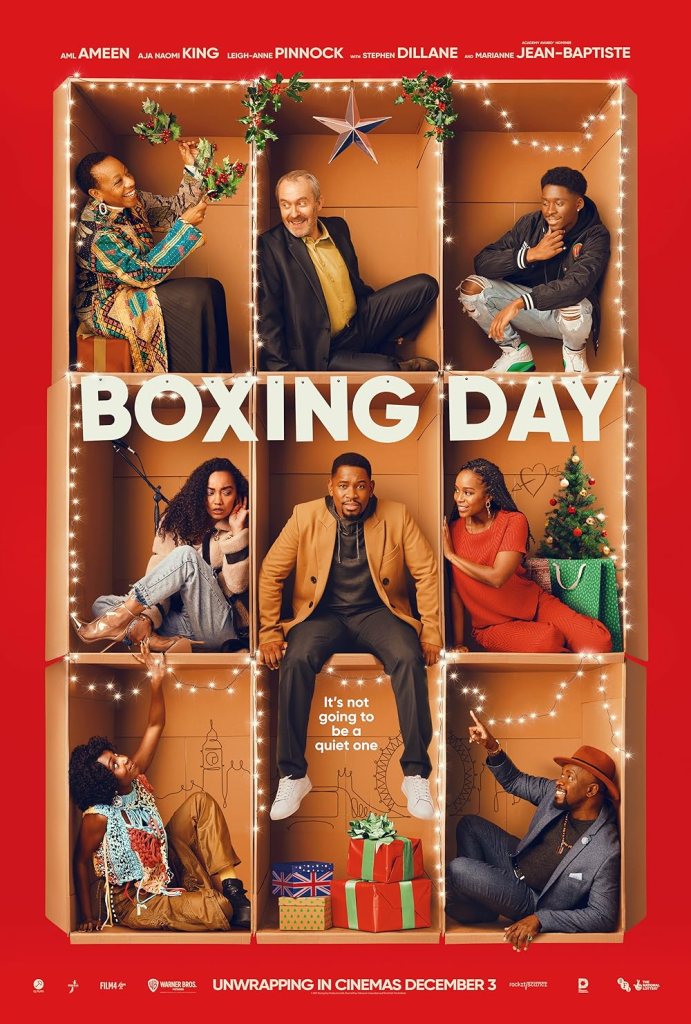
The poster for Boxing Day carries the tagline, "It's not going to be a quiet one". Visually, eight members of the primary cast are arranged in a 3x3 grid of open cardboard boxes, each one in their own box like the opening of the Brady Bunch. The 9th box, at bottom center, is filled with gifts, one of which bears the Union Jack flag emblem.

A lot of what’s fun about the film, for me, is just seeing into the context of a family very unlike mine, and lives unlike mine.  Whether it’s Gigi and Melvin’s sister (nicknamed, I swear, “Boobsy”) playfully arguing about how their different skin tones are perceived, or Melvin’s brother Josh in a fight with his cousin Joseph over who gets to flirt with the alluring Alison, or just Melvin’s “auntie” Valerie — who, to be honest, I have no clue whether she’s his actual aunt or his mom’s cousin or just some lady from the block — shouting about how he doesn’t need an American, she’ll find him a good Jamaican church girl?  You just feel immersed in someplace that I sure hope and expect is authentic, given that the writer/director’s coming from that world.  And honestly, it was a fun place to visit — a holiday gathering that felt alive and lively even when it was uncomfortable.

There’s no denying that at times the film creaks a little — production values can feel a little more like a TV movie at times, and not all the cast was quite experienced or steady enough to make their scenes pop.  The script, too, can be a bit rushed, so that sometimes key pieces of information slip by too fast, or I find myself watching a scene without 100% understanding who’s who here, and what they’re here to do.  The tone of it carries it through, though, and I liked that the script avoided the really hack moves you might otherwise have expected.  A big Hollywood film, for instance, might have had Lisa act out in dumb ways when she realizes her fiancee’s ex is essentially Ariana Grande — had her try to climb out a bathroom window and get stuck, maybe, or sabotage the ex in some way that backfires, etc.  Instead, Lisa just settles into the social space, giving as well as she gets when talk is lively, and slipping in slightly more barbed words via innocent-seeming asides when she can’t help but take a swipe (or riposte in response to one).  It’s what a real person might do, in other words, and when it blows up (as it inevitably would) it feels more honest.  In the end there’s some movie magic, of course, but I liked that for the most part the film wanted me to just believe in these characters rather than go for a cheap joke it could use in a trailer.

Characters grow up a little quickly here, but the movie needs them to, and in any case, I felt like the movie’s message in part was that nobody here was all that messed up in the first place, really.  Sometimes people are more ready to be responsible or tolerant than even their loved ones would guess; sometimes people are better able to move on, or to accept other people moving on, than they’d have even thought was true of themselves.  We know what kind of movie we’re in, of course, from the very beginning.  And what’s a holiday film for, after all, if not to persuade us that our natures do in fact have better angels, and that sometimes we listen to them?  In a December like the one many Americans are living through in 2024, a message like that might be more than a little necessary: I was glad to get it, myself.

I Know That Face: One delightful surprise here was that Lisa Davina Philip (who plays Auntie Valerie here) is the same actress who played the widow-seeking-widower postwoman Ms. Johnston in Jingle Jangle — she’s putting down absolutely scene-stealing performances in both movies, but the roles are so different that I literally didn’t realize the two actresses were the same person until IMDB told me so.  You can see my thoughts about Jingle Jangle on that blog post.  Claire Skinner (who plays Caroline, who is Gigi’s mother and Shirley’s good friend) played Madge Arwell, one of two title characters in the Doctor Who Christmas special, “The Doctor, The Widow and the Wardrobe.”  And lastly, Marianne Jean-Baptiste (who plays Shirley here) is Veronica in New Year’s Day, a movie in which two teenage boys complete a lot of dangerous dares on the titular day — and yeah, I guess that film is a stretch as a “holiday movie”, but New Year’s Day is undeniably a holiday in the wintertime so I think it should count.

That Takes Me Back: This movie’s too recent yet to really take me back to any particular nostalgic sight or sound….it sure won’t be long, though, before it’s reminding me of the good old days of 2021, huh?  It felt of its moment, anyway, and we’ll see how that feels, in time.

I Understood That Reference: Lisa has fun teasing Melvin a bit about his Britishness, which comes out in a couple of A Christmas Carol quips as she says “Damn, Scrooge!” and “Good luck, Tiny Tim!” to him on different occasions.  At one point, in the background, someone playing Santa nearly falls over at Shirley and Richard’s amateur Christmas theatrical, which as far as I can tell from the glimpses we get is a very strange nativity play, its own Christmas story of course.  And lastly, a guy standing in the street while music plays, showing one after another the set of cue cards that spell out a message of love….that just has to be a Love Actually reference, doesn’t it?  


Holiday Vibes (8/10): In terms of strict depiction of “American classic Christmas”, maybe this doesn’t hit every mark.  But in terms of bringing us into multiple lively and socially complex family spaces in the context of holiday traditions, this is firing on all cylinders — there’s no question that the movie does a lot to bring me the feeling of visiting family at this time of year.  It’s a different enough family experience from what most of my envisioned audience would encounter that I think it’s not quite to the apex of my imagined ideal, but it’s unquestionably a solidly holiday flick.

Actual Quality (8/10): So, with a lot of holiday films, there’s this balancing act between your emotional and your intellectual reaction to the film (this is true for me, anyway), and I think that’s certainly the case here.  My assessment of the film’s quality, then, is to say it’s good but not great: there’s an honesty to the writing on the level of dialogue, but the plot is a little goofily over the top at times, and the uneven range of acting experience and skill in a very classically indie movie cast means that some scenes are great and others have a harder time engaging my attention.  It’s not award-worthy work, but it’s definitely solid film-making.

Party Mood-Setter?  The film’s got great energy and some quotable moments, and if you and a bunch of your youngish adult friends are getting together to have cocktails and decorate sugar cookies or do a secret Santa exchange I can easily imagine this on the TV at a low volume for you to pay a low, casual level of attention to.  

Plucked Heart Strings?  Hmmm.  I can imagine a couple of moments later in the film being emotionally resonant, since the script is often handling something real about family, and if that’s intersecting with your particular experiences of family, I think the authenticity could get to you.  I didn’t feel those moments myself, though, and I’m hesitant to give it the nod on the basis of my guessing how others might react.

Recommended Frequency?  I mean, I’ve seen it only once, but this feels like it could be an every year movie for me.  It’s warm and sweet and silly in just the right kinds of ways: it makes me feel like I’m eavesdropping on a family I’ll never be a part of but would get a kick out of joining for a potluck.  As I said earlier, there’s a gap here — I can tell you intellectually what’s not totally working about the movie.  But I liked it a lot on that emotional level, and I think if you give it a try, it would probably win you over in that same way, and I hope you give it a chance.

Amazon Prime will show this to you, if you’re subscribed, and if not, Tubi will show it to you for free (with ads).  As far as I can tell, the film had such a limited (and UK focused) release that there’s either no DVD/Blu-ray copy available anymore, or it never really had a release on this side of the Atlantic.  As a result, this may be a rare film that won’t be accessible via your local library, but it couldn’t hurt to ask, in my opinion.

Scrooge (1935)

Review Essay

Welcome to the first of these A Christmas Carol adaptation reviews, which will appear on the blog each Sunday.  I’m sure any of us who love Christmas movies have a favorite Carol, and part of what inspired me to start this project in the first place was my own affection for a couple of particularly wonderful Christmas Carol adaptations.  As you’ll see below, the categories and scoring system will work somewhat differently than the regular reviews, which I hope you’ll enjoy as a little variation.  I’ll note, too, that this story is so universally well known, and the details I want to talk about stretch so fully through the film, that these Christmas Carol film reviews will be MUCH higher on spoilers.  To me, talking about Scrooge’s redemption arc is about as much of a “spoiler” as telling someone the Titanic is going to hit an iceberg and sink (apologies if that just ruined James Cameron’s film for you), but I wanted you to be forewarned about that approach.  Okay, on with the show.

For my first Christmas Carol on the blog, I just had to go with the oldest feature film version of the story that has sound (I’ll probably take on a silent film version someday, if this blog persists beyond this first quixotic holiday season).  There’s more than one version of the 1935 Scrooge, though, so to be clear, I watched the movie in its original full length version, in black and white: there’s a shorter, colorized version of this film that was created a few years later for American school children, and that’s the one you’ll more frequently see on streaming services.  Whichever one you watch (I’ve seen both versions), the surviving print of this film is in bad shape, with lots of cracks and pops, and a wobbly and sometimes fuzzy or murky image.  Someday we need a nice, clean version (which I know we now have the digital tools to create), but goodness knows when one will be produced — the free market has no shortage, after all, of Christmas Carol movies!

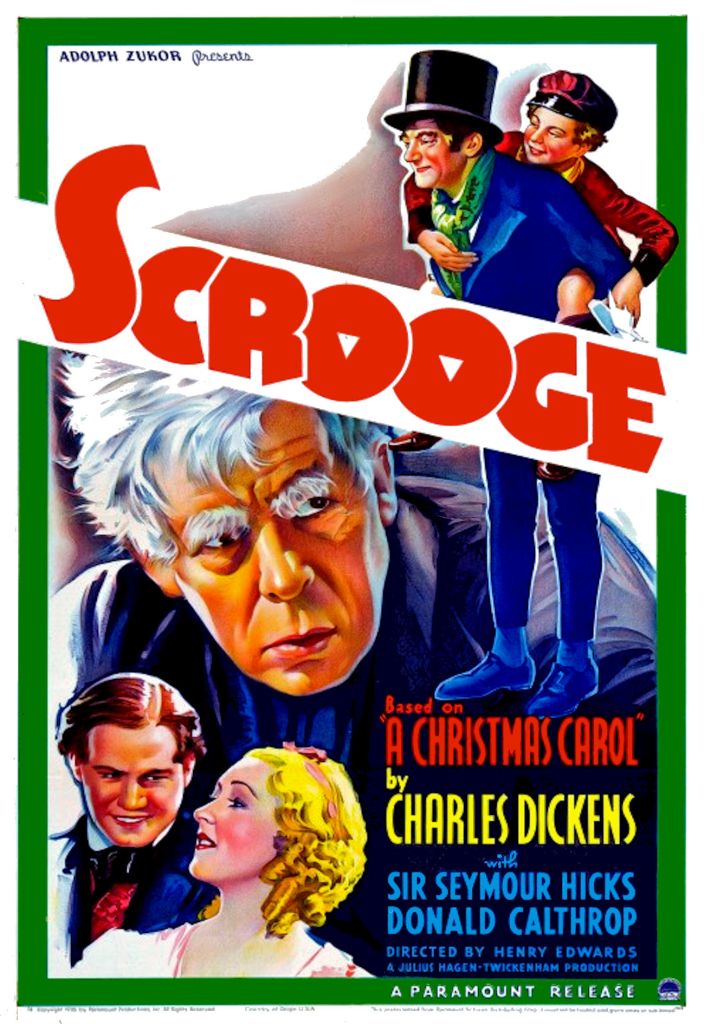
A poster for the 1935 film, Scrooge, the title of the film is written in large red letters. Just below it, Ebenezer Scrooge glares off to his left under long white eyebrows. Beneath Scrooge we see Fred and Clara, and beside and above him (and the title) is Bob Cratchit, carrying Tiny Tim on his back.

There’s a definite attempt at realism in this version of the story — the band playing in the street outside Scrooge & Marley is just as out of tune as one would have been in real life, I’m sure, and inside the office itself we see that Scrooge’s desk and work look very little different from Bob Cratchit’s, as might well have been the case for someone as dedicated to miserhood as Ebenezer was.  The portrayal of Scrooge by Seymour Hicks is much more infirm and physically shaky: he seems both closer to the grave and more frail (and less intimidating) than in a lot of other approaches I’ve seen.  But being less imposing doesn’t make him less malicious: to the contrary, this adaptation is a lot more personal in his jabs at Bob, asking him about his family before reminding him of how painful it would be to lose his salary.

We see a little more of a montage after the end of the workday than sometimes appears in a Carol — scenes evoking lots of Christmas energy and spirit, including the Lord Mayor’s Christmas toast to the Queen which I think I’ve never seen in another Carol.  Also this version does show us Scrooge eating dinner in a tavern (alone, and dining on a pretty meager feast), which further extends the passage of time before the supernatural invades the plot.  I’d say the integration of the supernatural here is, in fact, a bit shaky — Scrooge doesn’t react aloud to the Marley doorknob effect, so that any viewer unfamiliar with the story (there have to be a few of them left in the world, don’t there?) wouldn’t really know what’s up.  He’s silent, too, in searching the house, which nevertheless he does do on camera, and slowly — arguably suspense is building for the audience, but to me this dragged a bit.  A really fun choice, though, is made in depicting Marley as invisible — Scrooge can see him, but we can’t.  So we see Scrooge’s horrified response to a ghost we only hear, and we watch as the camera pans slowly as though following Marley around the room — it’s eerie, and probably a lot more effective at spooking us than whatever practical “ghost” effect they might have tried would be.

Less successful, to me, are the depiction of the three spirits: Christmas Past is neither diminutive nor someone who pulls him to the window, and Christmas Present is neither large nor quite jovial enough, for my taste.  (Yet to Come is harder to screw up, and this film’s shadowy depiction was fine, I thought.)  It was odd to see a Carol that doesn’t show any of Scrooge as a younger man, but Christmas Past jumps only to him as a middle-aged moneylender, foreclosing on some poor people and enraging his fiancee (Scrooge’s childhood isn’t in EVERY adaptation, but is there another one that, like this film, also skips Fezziwig’s party?).  Unfortunately, as I’ll observe at more length below, this takes away a little of the film’s power.  

The Christmas Present section is more successful, to me — the Cratchit family antics are joyful and ring true, and I think there’s something novel and plausible here about Bob’s comments to his wife about Tiny Tim (which suggest to me a man who’s just unnerved enough by some of his little son’s words that he worries about him). Let’s face it, Tiny Tim’s a soul so old that any parent might find him a challenge, which this adaptation leans into, making his “God bless us, every one” into less an exuberant cheer and more a wistful hope.  The adaptation does manage a nice if brief version of the montage through a lot of nameless folks keeping Christmas in their way, before installing us at Fred’s.  The scene just does carry off the explanation of why Fred doesn’t resent Scrooge, but I’m afraid it doesn’t linger long enough to convey the real fun of that gathering, to me.

The Yet to Come sequence, as I mentioned earlier, does a fine job with the shadowy Ghost, but much of the rest of it feels a little off to me.  The ragpicker scene is weirdly staged, seemingly due to the director’s conviction that it would be a lot more unsettling (and less dull) than I found it, and we get a glimpse of an unidentified dead body (Scrooge’s, surely) that doesn’t pay off.  The Cratchit family scene is as affecting as always, but the graveyard scene that follows is tonally very weird: the music sounds like an action sequence as opposed to a heartbreaking revelation, and Scrooge’s wrestling with the spirit feels both forced and aimless.  Also a bit rote is Scrooge’s joy at the finale, though it’s fun to see Hicks transform his Scrooge into someone with a bit more energy.  I’d wish for a Christmas Day a little lighter on “business” — there’s too much to-do with how exactly to order and deliver a turkey — and heavier on the emotional journey he’s made, but his connection with Fred and Clara gets there, in the end.  And I do love any Carol that leaves in a little of Scrooge having fun at Bob’s expense, so I was pleased to see it here, and Hicks does a fine job as the reformed Scrooge “playing” at being cantankerous.  Scrooge joining the Cratchits at church is, I think, another singular element in this adaptation, and it’s where it concludes.

I Know That Face: There’s not a lot of connections to be made here (that I can find), but I think it’s really remarkable that Seymour Hicks, who of course plays the title character here, had somehow also played Ebenezer Scrooge over two decades earlier, in the 1913 short film entitled Scrooge.  If I ever do watch a silent film version of A Christmas Carol, maybe that’s the one I should pick.

Spirit of Christmas Carol Present: This section, which celebrates the inclusion of elements from the novella that are often cut out, could be long for any traditional adaptation like this one, but I’ll just note a couple of highlights.  I always like Martha Cratchit hiding playfully from her dad, and I think this adaptation pulls off the fun in that scene (and all it implies about Cratchit family fun) really well.  And I think the montages were unusually and marvelously inclusive of the story’s smaller details — I’m thinking especially of the Lord Mayor (who, again, is in a single sentence early in the story) toasting Queen Victoria and then, much later, Christmas Present taking Scrooge to a Christmas celebration at a lighthouse (which comprises a slightly longer and lovely scene in the book). 

Spirit of Christmas Carol Absent: This section, which denounces foolish exclusions from the original written version of the story, could be equally long here.  I’ll just note in particular that the loss of both Scrooge’s boyhood and Fezziwig messes up the story pretty fiercely — Dickens does a fine job in just a couple of scenes to establish that Scrooge is a man profoundly affected by the trauma of his lonely upbringing (and probably a harsh, if not abusive, father), and that he nevertheless once had the capacity to at least enjoy Christmas generosity when it was doled out by someone as relentlessly merry as his master, Fezziwig.  The idea that within this withered old miser there’s both a child who can be healed and a reveler ready to dance a jig is hard enough to sustain WITH those two scenes, and it’s basically impossible to envision without having either one.


Christmas Carol Vibes (8.5/10): Any attempt at a “straight” adaptation is going to score pretty high, and I’ll admit, especially when I consider the practical limitations of both sound recording and visual effects in this mid-1930s, I think this really captures the vibe of the book well for big portions of its running time.  Sure, I am frustrated with choices in the Christmas Past section (and I think a couple choices in Yet to Come are just weird), but when I think of all the ways this story’s been scrambled and reconfigured and borrowed from, I think this is a solid entry in the long list of Christmas Carol adaptations.  That list’s long enough, though, that there’s plenty to be mentioned above this one in terms of connection with the story, too.

Actual Quality (7.5/10): I mean, I’m still trying to cut this film some slack for its era, but I can’t deny — the quality of the print exacerbates the problems with the film’s already murky and sometimes aimless visual language.  I’ll talk about the actors below, but I’ll just say that in general there’s good but not great work being done here; the screenplay has some strange omissions (and welcome additions, to be sure), and the direction is really mannered and sometimes much too stiff.  It hangs together as a film due to the power of this story, which is so good it’s almost impossible to make something bad out of it, but the seams show throughout.

Scrooge?

Every Carol adaptation depends a lot on its version of Scrooge, so what of this one?  Well, Seymour Hicks plays the bitter, warped old man better than the reformed saint, who feels more deranged than human — I fear that Hicks, who by this time had been playing the role on stage for more than thirty years, had just aged to the point that it was tough to have the full range the part really demands.  But it’s not a bad performance by any stretch, and you can see the seeds of later performers here without question: some of Hicks’s physical gestures and line readings are very clearly either being borrowed or being given an homage by later actors, and that’s praise of a meaningful kind.

Supporting Cast?

The movie is brief enough and lingers enough in weird moments that only a couple of actors in the cast really get the chance to leave an impression.  Robert Cochran’s Fred is pretty successful as a guy you can believe would honestly both invite his awful uncle to dinner and laugh about it when the old goat doesn’t turn up.  Donald Calthrop as Bob Cratchit is a little more limited, but there’s a sweetness and a piety to him here that works within this particular adaptation — he’s less timid than some other Cratchit performances, too, so he’s not an outlier in that sense.  I do think it’s a bit of a mark against the rest of the cast that they just don’t linger — I really ought to have strong feelings about either Christmas Past or Present, and to have something to say about Tiny Tim, or Mrs. Cratchit, or Marley, all of which are often really memorable turns in other films.  I do blame some of this on the screenplay, but only some of it.

Recommended Frequency?

The 1935 film Scrooge is absolutely worth a one time watch, especially if you love A Christmas Carol — it’s laying some groundwork that I do think you’ll see in a lot of later versions, especially with the character of Scrooge himself.  But it’s hard to find a good quality version of the film, and even at its full length it feels a bit choppy and hasty — I’d be very surprised if it was anyone’s favorite version of the story.  I am willing to think, though, that a couple of its scenes just might be the best versions of those particular moments from the story: if you’re a big enough fan of the tale, this one would be an important element in getting a “completionist” perspective on it.

Finding the original black and white version of this film streaming is a little challenging.  Tubi has the shorter, colorized version, as do both Pluto and Plex.  (If you don’t know those three free services, by the way, they’re a great source of more obscure and older films — yes, with ad breaks, but they’ve got to pay bills somehow, and you can spend the ad breaks re-reading my review in delighted awe.  Okay, or you can just use that time to go down rabbit holes in IMDB; that’s what I’d do, honestly.)  Even Amazon Prime has the shortened, colorized version.  The only place I found the black and white original cut of the film was on YouTube — for those of you who are fastidious about copyright protection, you can be comforted that, to the best of my knowledge, the movie has fallen into the public domain.  You can buy the black and white original on DVD, too, from Amazon, and my hope is that some libraries carry the DVD, but Worldcat is down right now, so I can’t post a link to give you more information about that (I’ll update this whenever I next get the chance).