Review Essay
Folks, here’s the thing about The Family Man. It’s somehow 12 different movies you’ve seen before and it’s none of them at all. It’s A Christmas Carol and It’s A Wonderful Life and Groundhog Day and Big and 13 Going On 30, but it’s also really not like any of those movies in so many key ways that you should probably forget I just mentioned them. It’s a film that, for me, gets some things so right and then fumbles the ball in such weirdly unexpected ways that it’s maybe one of the hardest films I’ve had to reach a numerical rating for, since it’s incredibly hard to reduce this motion picture to a single number (of any magnitude) without feeling like I’m only describing some of the movie I had in front of me. If you’ve seen it, I really wonder what you think of it, and if you haven’t, I’ll work at avoiding spoiling the ending but you may want to take it in before I ramble on about it. In the end, there’s one element at work inside The Family Man that does kind of explain all of it—its genius at its best and its wobbliness at its worst. And that element is a man we’ve come to know (and love?) under the stage name Nicolas Cage.
It’s probably at about this point that you want to tap my shoulder and say, “James, you still haven’t told us literally anything about this movie?” Okay, okay: on the one hand, this is a film with such a clear central premise that it should be easy to summarize. It seems like a classic tale about the road not taken: Jack, a thirty-something Manhattan high finance whiz got where he is in life by leaving behind him a stable girlfriend, Kate, whose goals were more altruistic. But a Christmas miracle suddenly places him in the world where he made the other choice—waking up in bed with his wife Kate on Christmas morning, with loud young kids and a needy dog and in-laws crashing through the front door. And then of course he’d like to escape this bad dream he’s having, but instead he’s got to live his way through it until….well, the “until” is part of this movie’s mystery and either its ultimate success or its failure. But the basic structure of a body swap / life swap / alternate timeline movie in which the fancy big city guy learns something as he stumbles through life in the suburbs is largely going to show up on screen in the way you’re expecting, at least for the movie’s long and chaotic second act. The third act, on the other hand, is unexpected in ways I’m really not sure about—maybe it’s a strength of the movie or maybe it’s a weakness that it didn’t really arrive at its outcomes in one of the ways I’d expect films of this kind to work. I really don’t want to spoil it, so I may have to leave that judgment to you.
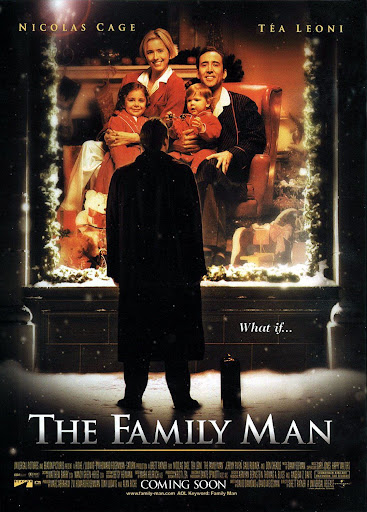
Back to Nic Cage, though, and the reason this film is both really good and not really successful in landing the punches it wants to. Cage is an astounding, generational talent: there’s nobody like him, and he does things nobody else can do, which is not to say he’s the finest actor working but he may be one of the most irreplaceable. He’s on screen for nearly the entire running time of the movie, since this alternate universe switcheroo is one that effectively he alone is conscious of, so it’s his experience we’re tracking. Given that fact, Cage’s fundamental watchability is hugely important—he makes everything from his character’s frustration to his character’s delight feel energized, even thrilling, as he takes the roller coaster ride of a man trying to figure out how he feels about this new life he’s been dropped into. Even when the movie’s probably taking too long to complete the roller coaster ride (and it starts to feel a little pedestrian), you know Cage is capable of anything, and you keep your eyes on him. As the character of Jack works out who he is, not as a balance sheet but as a person, he starts to understand why a man with his financial genius “settled” for the life of a suburban dad. At its best, the film is both funny and heartfelt, as Jack navigates the sometimes outlandish silliness of his new world and discovers who he really cares about, and, maybe more importantly, discovers what it means to care about them.
And what makes all this not quite work, in my opinion, or at least not quite work in the ways that all-time great multiverse movies like Groundhog Day work, is that Jack is too compelling from the very beginning of the story. The scenes we see of him on Christmas Eve prior to the dimensional shift are of a man who, sure, is a little arrogant and flighty in his personal relationships, a man maybe too used to the opera and fine whiskey and out of touch with “everyday life”. But he’s also really happy? And he’s not even a cruel person, that we see—sure, he’s in a world of high finance and mergers, etc., but there’s no obvious ways he’s complicit in ethical violations, and he’s upbeat and funny with his coworkers in ways that feel basically positive. It’s not a bad life; to the contrary, it feels like a guy who’s figured out how to live at the top in ways he’s pretty fulfilled by. Even if we consider the inciting incident that drags him to a new plane of existence, it’s not something he did wrong—to the contrary, he risks his own life pretty needlessly, since he could have remained an “innocent bystander”, but instead he steps forward to try to de-escalate a potentially lethal confrontation at the cash register of the shop he’s in, only to learn that the dangerous criminal is actually an angel. Or something…honestly, the movie’s pretty bad at explaining the metaphysics of why this switch-up even happens or what qualified Jack for the experience. Don Cheadle just smiles and tells Jack to remember he did this to himself, but what does that even mean? Anyway, the result of all this is that we never really understand why we should be rooting for Jack not to go back to the life he came from, other than that Tea Leoni is hot (I mean, no arguments there), and that we know that in a Hollywood movie we’re supposed to be rooting for marriage and the suburbs and 2.3 children and a car in every garage, etc. And knowing why we would be rooting for the suburbs is pretty darn important in a movie that is about really nothing else.
One of the other problems, fundamentally, is that the movie starts like it’s shot out of a cannon. We literally know nothing about the Jack/Kate relationship prior to the breakup other than them standing at the airport gate in 1987 with her telling him she’s got a premonition he shouldn’t fly to London for his internship, and him telling her it’s ludicrous for her to ditch law school and him to ditch the internship. It’s the only glimpse we’ll see of the relationship he left behind, and as a result, I just think it’s hard to invest myself fully in believing that clearly this young grad student should have listened to his girlfriend’s weird dream logic rather than continue to pursue a career he clearly thrives in. And then once you start to lean on the logic of the movie, it does break down a bit…maybe most importantly, why is it true that Jack has to give up all his dreams and opportunities, whereas Kate still gets to go to law school (she’s an underpaid lawyer for a nonprofit in the “future” of the movie) and practice her craft, and the house and the life near her parents and all the rest of it are clearly the things she values in life. Why are her values more important than his? Again, if the movie made him an obvious monster at the outset—a selfish, cruel man who uses his gifts to oppress other folks—then it might be a simplistic moral fable but at least I would understand why Kate = good and Jack = bad. As it is, the film’s values feel unfortunately like the echo of a ‘90s movie that presumes we know who the good and bad guys are without needing to actually make the case.
The holidayness of the movie is tough to calculate: again, I know that messages about family, etc., are often associated with this season of the year, but given how weird the movie’s ethics are, I’m not sure how much I want to credit it with having a meaningful message in that regard. The magic of Christmas Eve / Christmas morning is definitely central to the film’s opening and closing sequences, but in the middle it’s just January in New Jersey, and given how detached from reality Jack is (either because of his palatial life as a wealthy financier, or because it’s Christmas Day and he woke up in the wrong house in someone else’s underpants and he’s frantically trying to put it all together) we don’t get a ton of Christmas celebration to lean into. Add in the vagueness of the character Cheadle plays, who could easily have been more explicitly made an angel or an elf or Santa Claus or anything you like, and we lose even more chances to ground this experience in something more explicitly Yuletide.
I think in the end, this is a movie that feels like maybe it hooked Hollywood producers as a great premise, and then between that point and the final cut, neither the screenwriters (Diamond and Weissman, a partnership also responsible for….yikes, Evolution and Old Dogs, okay, some of this movie’s problems are making more sense now) nor the director (Brett Ratner, DOUBLE yikes, that man’s Wikipedia page has a whole section devoted to “sexual assault allegations”) figured out how to make it really work. And the more I’m looking at what I just found out about the three guys involved, yeah, their struggle to tell a magical, nuanced tale about love and family life is maybe just a bit more explicable. But here’s the thing: that premise is still really powerful. And Cage and Leoni are probably just about perfect casting for a movie like this, in this era. The second act may sag, and the third act may have a couple of unexpected curves in it, but ultimately their performances keep me hooked on the film, maybe in part because they make Jack and Kate alive enough that I don’t care too much about the screenplay not justifying why I should be rooting for them to be together again. I just want these two people who are clearly passionate about each other to be together again. That’s the kind of thing a movie can do, and this one does it well enough that it may be my most memorable takeaway.
I Know That Face: Saul Rubinek, who here plays the generally nebbish Alan Mintz, appears as Mr. Green in 2005’s Santa’s Slay, in which Mr. Claus is a demon who lost a bet with an angel. Jeremy Piven, who in this film is Jack’s suburban buddy Arnie, plays the titular father in 2020’s My Dad’s Christmas Date, which sure sounds like a winner from the title, eh? Nicolas Cage, Jack himself of course, was the surprising choice to voice Jacob Marley in a widely panned British adaptation of the classic story in 2001’s animated Christmas Carol: The Movie. And Don Cheadle, here portraying “Cash” (an angel?), is of course well known for his role in the MCU as Colonel James Rhodes, including in the film Iron Man 3, which is acclaimed by the Die Hard crowd as yet another action movie that counts as a Christmas flick….and yes, by the forgiving standards of this very blog, I have to give it to them. It counts.
That Takes Me Back: As a real fan of the paper map (who, yes, acknowledges that Google Maps has made everything simpler), I did love the chaos of Jack having to fumble with a paper map while driving his way around chaotically, like we used to. It was nostalgic, too, to see a CRT monitor the size of a destroyer on his office desk, not to mention a checkbook with a bunch of entries for deposits and withdrawals in its register. I wonder…do we even teach students to “balance a checkbook” in Home Economics these days, and if so, why? Lastly, I couldn’t help but think of September 11th and all that’s changed since—certainly when I got a brief and shocking glimpse of the Twin Towers in an establishing shot (like we always used to do when filming New York City in the 1990s), and also when I watched a character making that old movie classic, the impulsive sprint to the gate at the airport, which now of course is simply impossible.
I Understood That Reference: Other than one character’s quip, “Santa Claus, you’re half an hour late,” I didn’t spot anything.
Holiday Vibes (4/10): As I note above, there’s not enough Christmas in the screenplay, or on screen, to really make this movie feel like Christmas to me. But it’s in there enough that I can see this being a movie this time of year for some folks, and certainly any movie involving magic and snowfall has to get at least an extra half point, doesn’t it?
Actual Quality (8/10): Like I said at the outset, this movie defies numbers. I could watch Cage prancing and singing around his enormous walk-in closet for 45 minutes but that doesn’t make this movie a 10, you know? As it is, I’m trying to split the difference between my remaining really engaged with this movie throughout and my having a ton of notes about the ways I would have improved the film, given a chance.
Party Mood-Setter? Probably not? It’s hard to explain how weirdly intense the movie is—Jack’s outbursts are a lot to handle, even though I can generally track where they’re coming from. Not really background fare.
Plucked Heart Strings? There’s a moment or two that felt pretty authentic, but I’d be surprised if the film brought anybody to tears. The complicated combination of the multiverse angle and therefore the weird emotional truth/falsity of these moments makes it harder to relate to than it would otherwise have been, I think.
Recommended Frequency: I have to be honest: I feel like I’ll watch it again, although I think there are other films that cover this kind of material better. There’s something to this movie, and maybe after another watch or two, I’ll understand better what, if anything, it means to me?
If you’d like to watch The Family Man yourself, right now you’ve got some options. Subscribers to Peacock or to Amazon Prime will have an easy time. You can rent it from all the usual streaming services, and Barnes and Noble will sell you the film on Blu-ray or DVD. Public library users, Worldcat assures me you can snag this one from over 1,600 libraries in its database, so hopefully there’s a handy copy near you. Happy viewing to you!