Tokyo Godfathers (2003)

Review Essay

Right off the bat, I just have to admit — Tokyo Godfathers is surely one of the more potentially polarizing “holiday films” I’ve watched for this project.  The essential premise — three homeless people on the streets of Tokyo find an abandoned infant in a pile of trash on Christmas Eve night and disagree about what to do about it — is wild by the standards of the genre, almost too wild for a filmmaker to seriously attempt to portray it on screen.  You can envision, though, Hollywood entrusting the movie to some safe director and screenwriter who turn it into a gentle comedy about how hard it is to change a diaper on a park bench, I guess.  In the hands of Japanese auteur Satoshi Kon, however, Tokyo Godfathers presents an anime vision that is simultaneously much more realistic and much more fantastic than that, and in the process achieves some incredible moments of artistry.

The realism is where this film is most likely to lose a viewer, if it’s going to — our three protagonists are Gin, a miserable middle-aged alcoholic driven to the streets via more than one kind of addiction; Hana, a trans woman under basically constant criticism and threat from a society full of people that won’t accept her for who she is; and Miyuki, a teenager on the run for months now from her middle class home, about which she doesn’t want to talk and towards which she has no intention of returning.  The three of them live in genuine squalor, a ramshackle construction of cardboard and odds and ends, and the world around them is relentlessly hostile.  The movie pulls no punches, literally — we see the violence of the streets (especially violence directed at the homeless by bored, moneyed young men), we hear the coarse and sometimes vicious language of the streets, and we fully encounter the desperation of the streets as people with no resources and few options try to work out their own issues without totally tearing apart the lives of every other human they touch.  Yeah, yeah, I know — it doesn’t sound much on the surface like a Christmas story.
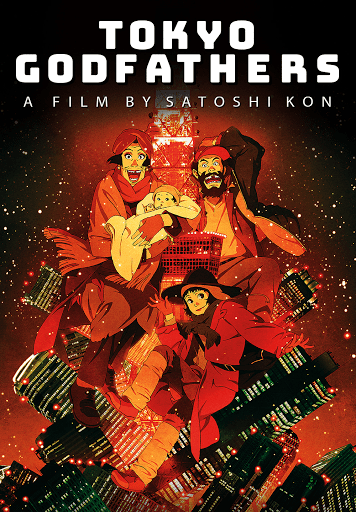
The movie poster for Tokyo Godfathers: A Film by Satoshi Kon. In the background, Tokyo skyscrapers tumble at strange angles in a dark, reddish light. In the foreground, the three main characters, Hana, Gin, and Miyuki, look directly at us. Hana smiling joyously as she holds the baby Kiyoko; Gin screaming in fear as he holds his hat on his head with one hand; and Miyuki, enigmatically grinning as she gestures to both sides, as though dancing.

Unless we consider the first Christmas story — a couple on the streets, no place to lay their heads but a barn, a child born amid squalor.  That might seem a stretch to you, but the film is transfixed by the divine, opening on a Tokyo church service in which Hana is moved to ecstasy contemplating the Christmas message of hope to the poor even as, right next to her, Gin scowls and grumbles as he observes all the ways that message doesn’t seem to touch the life he’s living.  Hana — whose own understanding of herself as a trans woman is so complex (she at one point says proudly, in response to someone calling her a “mistake”, “I am a mistake made by God”) — is the catalyst for the movie’s action, since when they discover a child in the trash while scrounging, the other two want to give the baby to the police immediately, but Hana throws herself protectively into action, insisting that this is her chance to be a mother.  She wants one day — Christmas day — to experience God’s miracle for her, the child she never thought she could have.  And the other two (who, in their very tortured and sometimes torturing ways, love Hana) relent.  What a strange miracle, you can see them both thinking.  And both the strangeness and the miracles persist.

Hana names the baby “Kiyoko”, inspired by a phrase from the carol “Silent Night” — the name will matter by the movie’s end, but at first it feels like just another inscrutable nod to Christmas itself.  Something about the baby provokes all three of the main characters into introspection, and sharing more of their life before homelessness and what drove them here.  And before too long, they settle on a plan — Hana wants to bring the baby back to its mother directly (it was found with a key to a bus station locker that they see as their first clue) to confront her and see whether or not she’s worthy of the child.  So, off across Tokyo they go, and the movie never totally slows down again after that — at least one of them is almost always running somewhere.

And my earlier mention of miracles is an honest use of the word — somewhere amid the gritty reality of this Tokyo, we repeatedly encounter the impossible.  A resource available right when it’s needed; help from an unlikely friend; the perfect gust of wind; even the miracle of pain or harm bringing one of them exactly to the place they needed to go.  As Hana repeatedly observes, there does seem to be something divine about little Kiyoko, in whose presence something like peace just might prevail on earth (well, for a broad definition of “peace”).  We even get the exchange between Hana and an embittered Gin, in which she tells him “Kiyoko is God’s messenger: we are her servants.”  To which Gin replies, “Unpaid servants, then, paying for a father’s sins.”  This is the tension surrounding the Christmas message, I feel like, or at least that’s the tension this film wants to explore — it’s easy to see the wondrousness of a blessing falling into the life of one impoverished, but then you have to reckon with what Gin’s observing.  Why is he here in the first place, in need of blessing, and what’s he going to have to go through to get it?  It hardly seems fair.

This is the remarkable thing about Tokyo Godfathers.  In a movie full of obscenities and street violence, gang assassinations and car crashes and substance abuse, what the film seems most interested in is beauty, harmony, and hope.  Hana’s haikus, when she speaks them, appear as calligraphy on the screen.  Beethoven’s 9th Symphony repeatedly drifts into the background, so that when at a climactic moment in the screenplay suddenly we and the characters both hear over the radio the triumphant chorus of the Ode to Joy, it doesn’t feel forced, it feels like a celebration the film itself has been building towards.  The film’s about the ways people trick themselves, and the mistakes we make in trying to fix things.  It’s about the pain of honesty, and its power.  It’s about Christmas’s promise and the ways we feel it lets us down.  As two characters observe to each other, late in the film — one says, “God must be busy this time of year.”  And the other says, “Better once a year than never.”  

I Know That Voice: For animated films, the only “familiar” performers will be voice actors, of course — the voice cast of the Japanese original film are not, as far as I can tell, folks who ever appeared in another film involving Christmas.  But the dubbed GKIDS release of the movie might be the one you’d see — and they did a great job with the voice casting for the dub, including a couple of trans actresses to play the trans roles, which I’m glad about and curious about (I only had access to the original with subtitles, so I haven’t heard the dubbed cast).  If you do watch the dubbed version, you might hear Kari Wahlgren as the voice of Kiyoko, the baby, and recognize that she also voices Jojo in both Christmas Chronicles movies, and both Dorothy and Ozma in Dorothy’s Christmas in Oz.  Crispin Freeman (the voice here of Ishida, Miyuki’s policeman father) also voices the character of Fabian Menkle in Scooby-Doo! Haunted Holidays.  And finally Gloria Garayua (the voice of Maria, the Hispanic woman who connects with Miyuki despite their not speaking the same language) later plays the live action role of Daphne in Christmas Staycation, a 2020 pandemic Christmas movie set entirely on Zoom — that feels like one I’ll have to try, one of these days, just for the novelty of it.

That Takes Me Back: The early scenes where there’s more focus on the “trash” surroundings inhabited by the main characters give us a number of glimpses of throwback items.  Hana, for instance, has a boombox in her corner of their little cardboard home, though as I recall we never hear it played.  We do see them rely multiple times on access to a pay phone, initially to call the “hostess club” they find out about from the materials in the locker.  It’s wild watching someone looking at a photograph and trying to figure out where it was taken, without them just being able to open up Google Street View to check if they’re correct — literally running up and down streets in a neighborhood trying to figure out what vantage point you need for a specific view.  Lastly, I did spot a copy of Star Wars on VHS, which in 2003 is already at least slightly outmoded, and now seems like another world entirely.

I Understood That Reference: You know, a bit surprisingly for a film set so far outside the boundaries of the usual holiday film, there’s at least a couple of references to classic Christmas tales.  I mean, most significantly, there’s a fully-fledged Christmas pageant at the church in the opening scene — we hear some lines from it spoken aloud, and perhaps our glimpses of the three Magi adoring the Christ child help prefigure what’s ahead for us.  And this is more of a stretch I guess, but early on in the film, Gin jokes that Santa Claus may have made off with the baby when he and Miyuki wake to find that Hana’s run away with the kid — the notion of Santa showing up not to leave gifts but to steal a baby was amusing enough that I made a note of it, and it’s fun to see characters a long ways from Santa’s cultural home base still using him for that kind of purpose.


Holiday Vibes (3/10): It’s really hard to grade the “holiday vibe” of something so far from the usual, but the opening scene is very classically Christmas, and the film keeps playing with imagery from the Christmas story (and thematic allusions) in ways that maybe were subtle, but that I kept picking up on.  In other words, in strictly literal terms this is probably closer to a 1 or 1.5, just barely any on-screen holiday stuff to latch on to.  But in terms of giving me Christmas feeling, well, it’s doing more than you can see — enough that it’s hard to score, but 3/10 feels right to me.

Actual Quality (9/10): The experience of watching the film directly is more challenging — at least for me as someone not familiar with Kon’s visual style, which is really aggressive and not at all like the kinds of Japanese animation I’m more familiar with (Miyazaki and Takahata).  Also the setting is so gritty and often grim that I was feeling a lot of things as the film went by and I didn’t always find myself connecting fluidly to what was happening on screen in the moment.  But this is one of those films that gets under your skin — I keep thinking about it, and the film improves the more I reflect on its use of symbolism and the ways the characters sprang to life and how the progression of the plot unfolded things at just the right pace, etc.  I do think there are some places where it’s just a little too operatic or melodramatic for me — I enjoy the surrealism but it’s hard to dial it in just right.  But I liked it a whole lot.

Party Mood-Setter?  Ha!  I cannot imagine this being just an “on in the background” kind of movie — love it or hate it, you won’t really be able to take your eyes off it (unless you’re turning it off).  I’m recommending it, sure, but not for this.

Plucked Heart Strings?  It’s a yes for me — there’s real emotion in what a couple of the characters go through.  Don’s style is not to dwell on those moments, so unlike a lot of other films, my guess is you won’t feel the emotion as strongly in the moment as you will when you look back on the movie and reflect about it.  

Recommended Frequency: A really tough call — the movie is intense enough (and weird enough) that I wouldn’t always be in the mood for it.  But there’s no denying its quality, for me.  I’d say this is one I will revisit over the years as I age, hoping to find new things in it: at first I thought it wouldn’t likely be an “every year” movie for me, but the longer I think about it, the more I want to engage with it again, and soon.  As long as the intensity of the film (and its bold, disruptive animation style) doesn’t put you off, I think you should definitely give it a watch, and if you tried it a long time ago but haven’t gone back, I really think you should.

If you decide to take my advice and watch Tokyo Godfathers, you’ve got options for viewing it: Amazon Prime will show it to subscribers, and you can watch it free (with ads) from Tubi, Pluto, or the Roku Channel. All the usual places will rent it to you, too.  As far as I can tell, all the streaming copies are the original Japanese audio performances with subtitles (which is how I watched it), but if you’re looking for a dubbed version, I believe the Blu-ray copy available at Amazon (and anywhere else that sells movies on disc) has the English audio track that GKIDS created.  The movie’s good enough that I may acquire myself a permanent copy this year — if so, I’ll report back.  This is a movie less widely held in American libraries, but Worldcat says there are 31 copies on disc out there, and maybe one of them is near you — worth a look, if that’s your preferred method of movie watching!
Boxing Day (2021)

Review Essay

It might be easy to feel like all the good holiday film premises have already been made: as this blog will make clear, there’s no shortage of “Christmas movies” for consumption.  But I think one thing that’s easy for at least some of us to forget is how restricted the storytelling base has been for a long time: the pool of people getting the opportunity to screenwrite, direct, and star in movies has been limited in this country to a fairly white crowd (and not just white Americans, but white Americans from certain demographic categories of geography, class, etc.).  Boxing Day, then, is a great reminder of how a pretty ordinary premise — a dude is bringing his new loved one to meet his family at the holidays but uh oh there’s some unexpected secrets to be revealed! — can take on some new life and offer a meaningfully different experience when the directing, writing, and performances are coming from a cultural space that’s been underrepresented.  Here, Aml Ameen takes us right inside the world of Black British-Caribbean people in London, and the extended networks of family and friendship that tie them together, and the result is a pretty charming (though, again, fairly simple) piece of holiday entertainment.

Again, the writing isn’t really where the film’s breaking ground, at least on the level of the big plot elements.  This is the story of Melvin, a newly-successful Black author, who’s returning semi-triumphant to his hometown of London at Christmas to promote his new book, accompanied by his lovely African-American girlfriend (practically-but-not-technically fiancee) Lisa who’s never been there before.  It’s also the story of Georgia, Melvin’s childhood sweetheart but now ex, who (we learn early in the film) got left in the lurch when Melvin fled the family drama across the ocean — and Georgia (or “Gigi” as she’s mostly referred to) has spent the intervening years becoming a massive pop star while remaining incredibly close to Melvin’s family.  But in a larger sense it’s a whole family wrestling with change — can we move on from Mom and Dad getting divorced, can we accept new partners if they’re not British (or not Black?), can we accept that the next generation thinks and acts differently than we did, etc.  Melvin’s having changed in ways they didn’t expect (or welcome) is just the catalyst for a lot of bigger conversations that are had — some of them resolved and some not so much.  That’s all right, I think: family is often messy, and the film’s reasonably honest about that.

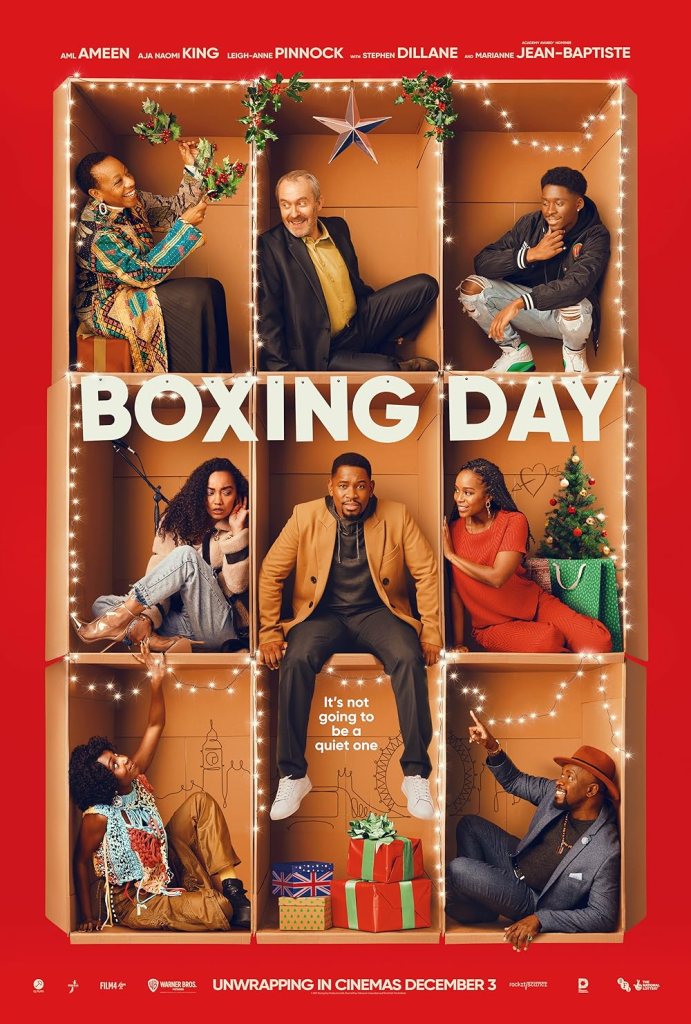
The poster for Boxing Day carries the tagline, "It's not going to be a quiet one". Visually, eight members of the primary cast are arranged in a 3x3 grid of open cardboard boxes, each one in their own box like the opening of the Brady Bunch. The 9th box, at bottom center, is filled with gifts, one of which bears the Union Jack flag emblem.

A lot of what’s fun about the film, for me, is just seeing into the context of a family very unlike mine, and lives unlike mine.  Whether it’s Gigi and Melvin’s sister (nicknamed, I swear, “Boobsy”) playfully arguing about how their different skin tones are perceived, or Melvin’s brother Josh in a fight with his cousin Joseph over who gets to flirt with the alluring Alison, or just Melvin’s “auntie” Valerie — who, to be honest, I have no clue whether she’s his actual aunt or his mom’s cousin or just some lady from the block — shouting about how he doesn’t need an American, she’ll find him a good Jamaican church girl?  You just feel immersed in someplace that I sure hope and expect is authentic, given that the writer/director’s coming from that world.  And honestly, it was a fun place to visit — a holiday gathering that felt alive and lively even when it was uncomfortable.

There’s no denying that at times the film creaks a little — production values can feel a little more like a TV movie at times, and not all the cast was quite experienced or steady enough to make their scenes pop.  The script, too, can be a bit rushed, so that sometimes key pieces of information slip by too fast, or I find myself watching a scene without 100% understanding who’s who here, and what they’re here to do.  The tone of it carries it through, though, and I liked that the script avoided the really hack moves you might otherwise have expected.  A big Hollywood film, for instance, might have had Lisa act out in dumb ways when she realizes her fiancee’s ex is essentially Ariana Grande — had her try to climb out a bathroom window and get stuck, maybe, or sabotage the ex in some way that backfires, etc.  Instead, Lisa just settles into the social space, giving as well as she gets when talk is lively, and slipping in slightly more barbed words via innocent-seeming asides when she can’t help but take a swipe (or riposte in response to one).  It’s what a real person might do, in other words, and when it blows up (as it inevitably would) it feels more honest.  In the end there’s some movie magic, of course, but I liked that for the most part the film wanted me to just believe in these characters rather than go for a cheap joke it could use in a trailer.

Characters grow up a little quickly here, but the movie needs them to, and in any case, I felt like the movie’s message in part was that nobody here was all that messed up in the first place, really.  Sometimes people are more ready to be responsible or tolerant than even their loved ones would guess; sometimes people are better able to move on, or to accept other people moving on, than they’d have even thought was true of themselves.  We know what kind of movie we’re in, of course, from the very beginning.  And what’s a holiday film for, after all, if not to persuade us that our natures do in fact have better angels, and that sometimes we listen to them?  In a December like the one many Americans are living through in 2024, a message like that might be more than a little necessary: I was glad to get it, myself.

I Know That Face: One delightful surprise here was that Lisa Davina Philip (who plays Auntie Valerie here) is the same actress who played the widow-seeking-widower postwoman Ms. Johnston in Jingle Jangle — she’s putting down absolutely scene-stealing performances in both movies, but the roles are so different that I literally didn’t realize the two actresses were the same person until IMDB told me so.  You can see my thoughts about Jingle Jangle on that blog post.  Claire Skinner (who plays Caroline, who is Gigi’s mother and Shirley’s good friend) played Madge Arwell, one of two title characters in the Doctor Who Christmas special, “The Doctor, The Widow and the Wardrobe.”  And lastly, Marianne Jean-Baptiste (who plays Shirley here) is Veronica in New Year’s Day, a movie in which two teenage boys complete a lot of dangerous dares on the titular day — and yeah, I guess that film is a stretch as a “holiday movie”, but New Year’s Day is undeniably a holiday in the wintertime so I think it should count.

That Takes Me Back: This movie’s too recent yet to really take me back to any particular nostalgic sight or sound….it sure won’t be long, though, before it’s reminding me of the good old days of 2021, huh?  It felt of its moment, anyway, and we’ll see how that feels, in time.

I Understood That Reference: Lisa has fun teasing Melvin a bit about his Britishness, which comes out in a couple of A Christmas Carol quips as she says “Damn, Scrooge!” and “Good luck, Tiny Tim!” to him on different occasions.  At one point, in the background, someone playing Santa nearly falls over at Shirley and Richard’s amateur Christmas theatrical, which as far as I can tell from the glimpses we get is a very strange nativity play, its own Christmas story of course.  And lastly, a guy standing in the street while music plays, showing one after another the set of cue cards that spell out a message of love….that just has to be a Love Actually reference, doesn’t it?  


Holiday Vibes (8/10): In terms of strict depiction of “American classic Christmas”, maybe this doesn’t hit every mark.  But in terms of bringing us into multiple lively and socially complex family spaces in the context of holiday traditions, this is firing on all cylinders — there’s no question that the movie does a lot to bring me the feeling of visiting family at this time of year.  It’s a different enough family experience from what most of my envisioned audience would encounter that I think it’s not quite to the apex of my imagined ideal, but it’s unquestionably a solidly holiday flick.

Actual Quality (8/10): So, with a lot of holiday films, there’s this balancing act between your emotional and your intellectual reaction to the film (this is true for me, anyway), and I think that’s certainly the case here.  My assessment of the film’s quality, then, is to say it’s good but not great: there’s an honesty to the writing on the level of dialogue, but the plot is a little goofily over the top at times, and the uneven range of acting experience and skill in a very classically indie movie cast means that some scenes are great and others have a harder time engaging my attention.  It’s not award-worthy work, but it’s definitely solid film-making.

Party Mood-Setter?  The film’s got great energy and some quotable moments, and if you and a bunch of your youngish adult friends are getting together to have cocktails and decorate sugar cookies or do a secret Santa exchange I can easily imagine this on the TV at a low volume for you to pay a low, casual level of attention to.  

Plucked Heart Strings?  Hmmm.  I can imagine a couple of moments later in the film being emotionally resonant, since the script is often handling something real about family, and if that’s intersecting with your particular experiences of family, I think the authenticity could get to you.  I didn’t feel those moments myself, though, and I’m hesitant to give it the nod on the basis of my guessing how others might react.

Recommended Frequency?  I mean, I’ve seen it only once, but this feels like it could be an every year movie for me.  It’s warm and sweet and silly in just the right kinds of ways: it makes me feel like I’m eavesdropping on a family I’ll never be a part of but would get a kick out of joining for a potluck.  As I said earlier, there’s a gap here — I can tell you intellectually what’s not totally working about the movie.  But I liked it a lot on that emotional level, and I think if you give it a try, it would probably win you over in that same way, and I hope you give it a chance.

Amazon Prime will show this to you, if you’re subscribed, and if not, Tubi will show it to you for free (with ads).  As far as I can tell, the film had such a limited (and UK focused) release that there’s either no DVD/Blu-ray copy available anymore, or it never really had a release on this side of the Atlantic.  As a result, this may be a rare film that won’t be accessible via your local library, but it couldn’t hurt to ask, in my opinion.

Jingle Jangle: A Christmas Journey (2020)

Review Essay

I’ll acknowledge at the outset that most Christmas films that latch onto our hearts (to any degree) are films we encountered via childhood — our own, the childhood of those around us, or the child that lingers within as we age.  I say that just because I’m about to be a little gentler to this movie than I suspect it may deserve, but that’s because it’s a film I have only ever seen in the company of my delightful kid, for whom it is a “Christmas classic” at this point because she’s seen it annually for about as long as she can remember.  Also, that first year that she and I watched it together, it was the pandemic year — we’d been largely confined to our house for months and months, and the holidays ahead of us were about to be conducted really entirely on Zoom.  So the exuberance and the physicality of this film landed a little more soundly, for me, because I was feeling that vulnerability and sadness that the pandemic brought with it — I was ready to feel like a kid alongside her.

Exuberance and physicality are really the hallmarks of Jingle Jangle, a Netflix film that attempts that trickiest of endeavors — creating a new fairy tale, something that feels like you’ve heard it all your life even though you never have before.  The two undeniably powerful things about the movie are its costumes and its production design: every single moment you’re watching, the screen is popping with vibrance and detail and a charisma that can’t be denied.  Even if you don’t love the movie you’re watching, I find it really hard to believe you wouldn’t want to walk down that street, or into that toy shop.  It’s a world worth seeing, then, and one that’s both tapping into an old school Victorian Christmas spirit and turning it upside down with the diversity of its humanity, and with the not-very-Victorian energy of modern pop and hip hop music and dance.

Movie poster for Jingle Jangle: A Christmas Journey.  Journey, the film's child star, is a young Black girl in the foreground, smiling in a red coat and standing with arms wide and looking upward. Behind her left shoulder is a floating gold robot with large eyes. In the background,the crowded shelves of an eccentric toy store are visible.

I know, I know, it’s the third paragraph and I haven’t touched the plot yet — well, folks, the plot’s the piece of the movie I have the hardest time defending.  I mentioned the “new fairy tale” idea earlier, and I think that’s the best way to understand the movie — so much of it really wouldn’t make sense in a realistic world where there’s any consistency at all, but the logic of fairyland is famously a little less reliable.  Here’s the premise: Jeronicus Jangle, a brilliant toy inventor, has a wife and child and a great life, until one day, after achieving his greatest invention yet, his assistant (Gustafson) who feels overlooked and neglected steals both the invention and Jeronicus’s book of inventions and creates a brand new toy empire.  Jeronicus is ruined, and soon loses everything — his store’s a shambles, his wife dies, he alienates his brilliant inventor daughter.  But then HER daughter, a girl named Journey who is an inventor herself, decides to go visit her grandfather for Christmas basically unannounced.  Will the chipper enthusiasm and open-hearted love of a little girl warm the bitter old man’s heart?  Will Gustafson’s theft of Jangle’s inventions finally come back to haunt him?  Will there be a singing widowed postal worker who serenades Jeronicus on the daily with her three backup singers chiming in like Gladys Knight and the Pips?  Uh….yeah, yes is the answer to all three of those questions.  Jingle Jangle is kind of a wild ride sometimes.

So, basically everything about the plot really is cuckoo bananas — there’s just no reasonable way Gustafson could have gotten away with his theft when Jeronicus could simply have reported it, nor is there any real explanation other than “it happened” for how Jeronicus suddenly was unable to remember or recreate literally any of the inventions he’d come up with previously, let alone create anything new.  And sure, I could excuse those elements as “magical” except this is ALSO a script that later treats the theft of inventions as something the local constabulary treats really seriously with the administration of swift justice.  That same script wants me to believe that Jeronicus was unable to make any good inventions at all after Gustafson’s betrayal….except for the single exception of an adorable flying, talking robot that puts basically all his other ideas to shame.  Again, I guess, magic?  I don’t know — there’s also a massive logical flaw in the frame tale that surrounds this fairy story, but I really don’t want you to think about the plot that much, it’s not what the movie’s for.

The movie’s for so many other things — the aforementioned brilliant costumes, props, and sets.  Some really excellent acting performances show up on screen: I mean, sure, this isn’t the best work ever by either Forest Whitaker or Keegan-Michael Key but the two of them are fun to watch even when they’re working with a pretty basic script.  The music, with John Legend doing some co-writing and Usher showing up for the end credits, is definitely an asset, also.  And there’s just no denying that, in a genre that tends to skew lily white, there’s something truly fantastic about seeing a full cast of Black performers — major roles, minor ones, extras — in outlandishly lovely Victorian costume on snowy cobbled streets, showing off their skills as dancers and singers and overall performers.  White kids have gotten to grow up watching Danny Kaye and Vera-Ellen in White Christmas, after all, or the showy musical performances in the 1970 adaptation of Scrooge, and it makes me glad that other kids can grow up seeing folks who look like themselves and their families, spreading some holiday cheer.  Heck, I’m glad my White kid is getting that opportunity – that Christmas joy for her will be a more multicultural and multiracial experience than the world my generation grew up with.  I wouldn’t just give a pass to any film that came along with a diverse cast, to be sure, but there’s more than enough good things going on here for me to be willing not to think too hard about how exactly the story unfolds.

I Know That Face: Hugh Bonneville, one of the few non-Black performers in the main cast, appears as Mr. Delacroix here (sort of investor in / landlord for Jeronicus, it seems?), and also appears as the narrator in Silent Night: A Song for the World, a kind of docudrama re-enacting the writing of the Christmas hymn.  Lisa Davina Phillip, who for me steals every scene she’s in as the postwoman Ms. Johnston, also appears as Auntie Valerie in Boxing Day, a romantic comedy in which a British writer brings his American fiancee home to the UK for Christmas to meet his eccentric family (stay tuned for more on that one).  And Anika Noni Rose, who here plays the adult daughter of Jeronicus, appeared as a choir member back in 2004 in Surviving Christmas, the film in which an unpleasant billionaire hires a family to spend the holiday with him. Hoo boy, it’s hard not to make some political commentary about that one, but it’s only day two of the blog, maybe I can let some pitches go by, eh?

That Takes Me Back: A child’s reference to “The Jangleater 2000” took me back to when calling something a “2000” sounded futuristic and cool — what do kids say these days?  3000, maybe, since Buddy gets to be the Buddy 3000?  Also, this movie takes place at a time when rich and powerful people could still be held accountable by the legal system….oh, sorry, is that too dark for you? Guess James couldn’t hold it back after all: look, folks, it’s 2024, I can’t pretend not to be paying attention to the world, even if the goal here is more escapism than activism.

I Understood That Reference:  In the film’s prologue, before she spins her (highly unlikely) story, Grandma’s asked by one of her unnamed grandchildren if she’ll read them The Night Before Christmas, though she deflects the request since “it’s time for a new story”.  (Okay, Grandma, I’m picking up the subtext of race in that remark, and you’re right — that’s what I like about this movie, that instead of retreading the old Christmas tales, it’s presenting something different.)


Holiday Vibes (7.5/10): While the story is less about Christmas and more about the fantastical adventures of Journey, this has so many of the 19th Century trappings that, between A Christmas Carol and Currier & Ives lithographs, we associate with nostalgic holiday celebrations and wintry scenes of yore — mechanical toys and rich Victorian costuming and horses clopping along on cobblestones, etc.  This will press plenty of festive buttons, if you’re coming to it looking for those feelings.

Actual Quality (7.5/10): Again, the plot is bonkers: we cannot think about it at all.  But plot’s not the only thing a movie is made of.  If I just focus on the settings and costumes, the music and the acting, the overall feel of this movie?  I’m having a very fun time with it — and if I’m watching it alongside my 5th grader, add at least a full point to this rating, you know?  I know the film’s got plenty of issues, but I’m so darn glad it exists.

Party Mood-Setter? This is a perfect role for this movie to play, since at the low level of attention of “it’s on while we’re wrapping presents” or what have you, all the movie’s best stuff is still going to shine through aggressively, and the weaknesses of its overall structure are going to be less visible.  I’d highly recommend giving it a try in that setting.

Plucked Heart Strings? I think for a child audience, it might land the punches it wants to throw.  As an adult viewer, the plot ends up being silly enough that I can’t really take the problems of Jeronicus (or anybody else) seriously enough to feel actually tearful, but I certainly care about the characters, and that’s a testament to the things that are working here.

Recommended Frequency: This is an annual movie for me, in part because it’s one of my daughter’s top 5 holiday movies of all time (I asked her for a ranking).  I think it easily offers enough in the way of charm and color and energy to be worth it every year, and with each passing year, I get more accustomed to its weird plot, so that the ways in which it doesn’t work are less noticeable or problematic for me now. Again, I think you should give it a whirl, and I think it’s fine if it’s just something you’ve put on in the background while you construct a Yule log out of gingerbread or make homemade eggnog or whatever fun holiday practices you engage in.

This time around, there’s only one place I can steer you: if you want to watch Jingle Jangle: A Christmas Journey, as a Netflix movie, it is unavailable on any streaming service or rental/purchase service other than Netflix itself.