The Lion in Winter (1968)

Review Essay

It has been suggested (not unfairly) by some of this little blog’s faithful readers that I don’t have much sympathy for mean-spirited movies.  My relatively harsh reviews for films like National Lampoon’s Christmas Vacation, Mixed Nuts, and most recently Scrooged do seem to bear that out: I didn’t respond well to the tone of any of those films, which all felt to me like they were dragging me in unwillingly as an audience member to participate in some downward-punching humor.  Well, I didn’t place this film on the slate for this year thinking that it would offer a counterargument: in truth, I’d never seen it, and in my head I had imagined it would provide a little more solemnity, a perhaps slightly stiff historical drama to give some restraint to this final weekend before Christmas and the end of the blog season.  Well, boy, was I wrong…but the fiery, aggressive, and (yes) mean-spirited film I got gave me a lot to delight in.  I’ll see if I can explain why.

The premise of The Lion in Winter (a film adapting a stage play of the same name) consists of complicated family politics unfolding at a difficult Christmas gathering…only, unlike most films of this kind, the gathering occurs in a medieval castle (Chinon, in what is now France, for the Christmas feast in 1183), and the family’s internal politics govern the control of most of Western Europe.  The family in question is that of Henry II, one of the Plantagenet kings of England, who by might and savvy and deft diplomacy had maneuvered himself to such heights that by this Christmas, he styles himself the Angevin Emperor: at the age of 50, he is a man who knows that his time grows short, and his legacy needs to be provided for.  “I’ve built an empire,” he says early on, “and I must know that it is going to last.”  Now that his eldest son is dead, he’s left with three potential heirs, and he invites all of them (Richard, Geoffrey, and John) to Chinon for the feast, knowing each of them thinks they can plot their way to the crown as his successor.  Invited, too, is the boys’ mother, Henry’s rich and powerful queen Eleanor of Aquitaine, whom he has kept imprisoned in Salisbury Tower for many years now as he’s followed his heart in pursuit of other women: Eleanor may be here as a temporarily paroled prisoner, but she is still Henry’s equal as a politician and a schemer.  Henry will, of course, have his mistress there, too: young Alais is her own complication, since she’s formally betrothed to Richard, but Henry has no intention of giving her up.  Alais’s half-brother, though, the teenage King of France, Philip, will be at this gathering also, and he intends to force the matter of her marriage or else demand her dowry back from Henry.  And you thought your family’s Christmas dinner conversations took place on thin ice, eh?

You might think, upon reading this still-insufficiently-detailed summary, that this will be far too complicated a web to make sense of as a viewer (especially if you’re not really up on your 12th Century politics) and that could be true for some, I’m sure.  But I think the film works far better than you’d expect for a couple of key reasons, and the first is the strength of the acting.  When you put Henry II and Eleanor of Aquitaine in the hands of Peter O’Toole (then at the height of his powers as an energetic British leading man) and Katharine Hepburn (nearing the end of her dominance as a midcentury actress, but still capable of enormous screen presence at any moment, as proven when she wins her fourth Academy Award for this role), you give the audience a real gift: even when we can’t follow every detail of every double-cross, the sound and fury of these characters bears us along with the plot like a boat adrift in a flooding river.  Add in a brilliant supporting cast—maybe none of them more scintillating than a young Anthony Hopkins as the brash juggernaut, Richard, whom we know best by his nickname, “the Lionheart”—and almost any dialogue would ring out like dueling swords.
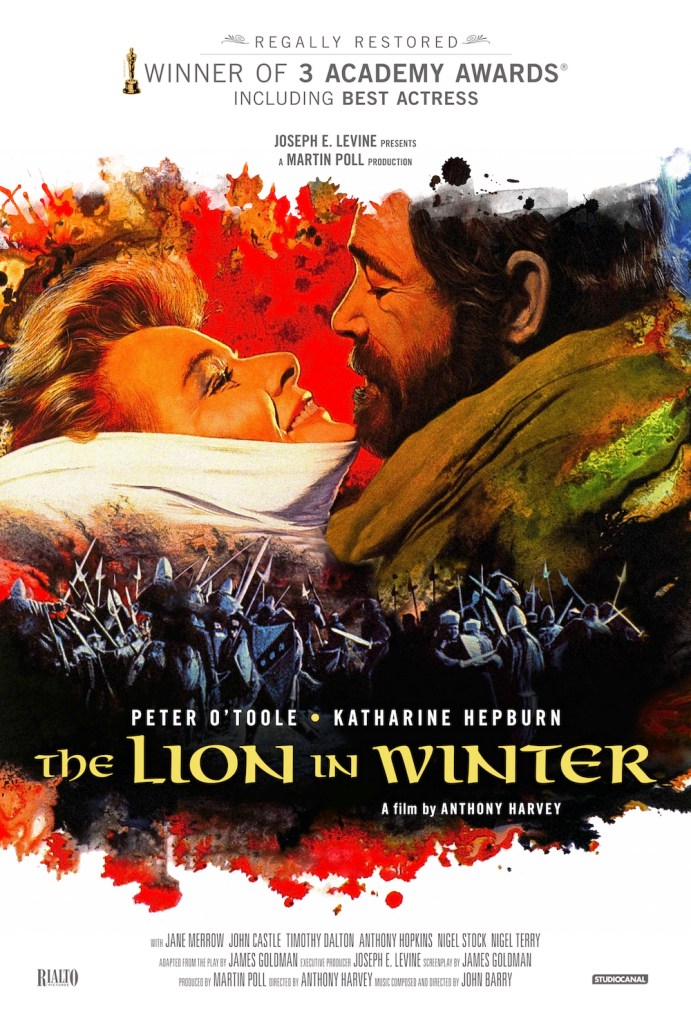
The poster for The Lion in Winter depicts Katharine Hepburn, clutched closely to himself by a bearded Peter O'Toole: she looks up at him beaming a smile that could be sweet delight or poisonous malice, while he narrows his eyes looking down at her, whether in love or in contempt.  Below them, we see the painted image of two medieval armies in pitched battle, and behind the couple and this battle, the poster is splotched abstractly with a red paint that suggests blood.

It’s not just “any” dialogue, though: the screenplay (also Academy Award winning) is full of the most poetically intense exchanges, written for the heightened surreality of the theatrical stage, so much so that on film it borders on camp (and might topple over the edge into ridiculousness in the hands of any less gifted cast).  I wrote down dozens of quotations as I watched, and will share examples to give you a taste of what I mean: at one point, Richard, goaded into fury by his whinging little brother John (who grows up into the tyrannical King John of the Robin Hood legends), whips out a dagger and chases John around Eleanor’s bedroom, seemingly intent on murdering his brother then and there.  John screams out to his mother for help, exclaiming in apparent shock that Richard’s got a knife, to which his mother exasperatedly flings back, “of course he has a knife; he’s always got a knife: we ALL have knives!  It’s 1183, and we’re barbarians!”  At another moment, Eleanor’s reminiscing about her first husband, King Louis VII of France, and how she accompanied him on crusade—she recalls, “I dressed my maids as Amazons and rode bare-breasted halfway to Damascus. Louis had a seizure, and I damn near died of windburn… but the troops were dazzled.”  Did I say it “borders on camp”?  Maybe I should correct that: it takes place deep inside camp’s territory.  The writing’s not just fireworks, though: sometimes there’s a quiet weight in it that reveals a character’s inner wisdom.  Henry, at one point, defends his latest conniving by saying, “I’ve snapped and plotted all my life. There’s no other way to be alive, king, and fifty all at once.”  Later, in a crisis, when Richard insists that whatever comes he won’t drop to his knees and beg, Geoffrey mocks his brother, saying, “You chivalric fool… as if the way one fell down mattered.”  And Richard eyes Geoffrey, as if from a height his brother cannot touch, and replies, “When the fall is all there is, it matters.”

How is it that I can laugh at the soap opera of this maddening family, and a Christmas gathering in which the vast majority of the words flung between them are harsh, or cruel, or insincere, or condescending, or deceitful….and often more than one of those at a time?  Again, I think the strength of the acting and the writing help: the worst insults carry the humor a little better when they’re delivered through really high art, I suspect.  But I think it’s also that these people and their problems are so remote from me and mine: I can comprehend (after having played enough hours of Crusader Kings 3) a world in which people have these problems, betrothals lasting decades because they’re complicated feudal land arrangements, and marriages that are annulled decades after the fact but only if you effectively own the Pope, but that’s not the kind of thing I have to maneuver while eating Christmas dinner.  Moreover, every single character on screen is just that—they are self-consciously characters.  Eleanor and Henry are playing roles, roles that change at a moment’s notice depending on who’s in the room and what they want, and these children raised by them (Alais included) have learned to play the game too or else have learned how to benefit from it.  Almost none of these words draw blood because the combatants are too scarred from decades of dueling, and everyone knows that this morning’s enemy may be your ally (or at least the mutual enemy of a more dangerous foe) by day’s end.  Every bridge still up between these people was built for the sake of burning.  If you watch this film, you’ll hear people saying some of the worst things they can think of—Eleanor and Henry, in particular, are gifted at this—and only you can know if that’s the kind of thing you can let yourself enjoy as a spectacle.  I found that, more often than not, I could, and did.

I like, too, the way the movie gives us just enough to keep these characters straight: the three princes, for instance, are all introduced to us while fighting, in three quick, nearly wordless scenes.  The economy of it from a screenwriting perspective is impressive.  John (“Johnny” as Henry calls him) is dueling his indulgent father, who easily bests this teenager who seems to have no plan at all in life but to swing wildly, trusting that his father won’t hurt him really.  Richard, on the other hand, we see at a joust, effortlessly tossing his opponent to the ground like Marshawn Lynch in Beast Mode, and then moving with a swift and apparent ruthless purpose to take his life before something interrupts: we perceive that Richard is a man of action, a fellow who likes to run directly ahead and trust his strength to carry him through obstacles.  Geoffrey, then, we see perched high above a beach where his men are stationed secretly: he is never in any danger, and with a few swift hand signals to knights waiting below, he springs a trap he’d clearly set long in advance.  He is cold and cunning, a strategist who if given time can get an advantage on his opponent, and who will never ever expose himself to risk.  We’re only a handful of minutes in and we can already see the ways this family will find themselves at each other’s throats, with a kingdom up for grabs.  As Henry himself later comments, “they may snap at me, and plot… and that makes them the kind of sons I want.”  He loves the battles he fights with these young men, and he looks forward to them with a relish that suggests the energy of this conflict is what keeps him young, himself.

I know I haven’t touched on the holiday elements of the film much, but to be honest, despite the feast of Christmas being the ostensible reason for them all to be here (especially King Philip of France, and Henry’s prisoner queen, Eleanor), it comes up very little.  It provides a context for some good japes—”What shall we hang, the holly, or each other?” made me laugh—and there are moments when both Henry and Eleanor make reference to religion, and sometimes even elements of Christmas itself, to clarify something about their purpose, but they’re momentary flashes at most.  This is a story about power: “power is the only fact,” says Henry, though as the movie unfolds, we learn that there are other “facts” besides power that Henry struggles to understand.  Among them is love, though it’s love in a lot of guises, few of them deeply sentimental.  Eleanor’s seemingly deep attachment to Henry (much like his own strange, strained attachment to both Eleanor and Alais) is hard to parse: how much of it is performed for the sake of getting what she (or he) wants, and how much of it is honest?  How real are Alais’s feelings, either—the girl seems passionate, but is it a passion for the crown, for the chance to bear sons to a king, or is it love for that aging king, himself?  Surprisingly, maybe the sincerest expression of love we see in the whole film is an expression of same-sex affection: Richard the Lionheart, we learn in a couple of key scenes, is a man who loves another man, and as Richard is maybe the least subtle or deceitful of all the people in Chinon Castle this Christmas, I found it hard to interpret the things he says as being anything less than true, often painful feeling.  For 1968, it was genuinely unexpected to encounter a gay character on screen, not to mention a character who in every other way seems to avoid the kind of stereotypes that would have then been commonly believed about gay men.

I could keep talking about this film for a long while—there are so many splashy scenes to comment on, so many lines of deliciously wicked repartee to quote—but I doubt that really serves you as a reader.  If by now I’ve persuaded you to try the film, you’ll get more fun out of these things happening without my advance notice, and if you’re pretty sure it’s not for you, you should probably not be subjected further to my secondhand version.  It’s probably just as polarizing a film as A Christmas Tale, which I wrote about earlier this year—shockingly similar, in fact, since in this film as in that French arthouse picture, we get a son asking his mother why she doesn’t love him, and we get to hear her complicated answer—but it’s just that somehow in this situation I “get” the film, in a way that I never “got” the other one.  It’s not that this film is historically accurate, to be clear: none of this happened.  These people existed, in one form or another, and they were almost certainly all schemers and plotters who played politics with each others’ lives, but they didn’t have a Christmas at Chinon Castle, in 1183 or at any other time.  The resolution we get from the film’s final act is a resolution that deepens our understanding of these characters, but it’s not giving us much sense of what would happen next in a tumultuous era in medieval history.  The truths that The Lion in Winter has to tell are truths about people, and the ways we lie to ourselves and each other to get what we think we want.

I Know That Face: Peter O’Toole, here the larger-than-life Henry II, appears later in his career as an elderly artist mentor named Glen in Thomas Kinkade’s Christmas Cottage, and lends his voice to Pantaloon, a toy soldier general, in 1990’s animated film, The Nutcracker Prince.  John Castle, who in this film portrays the cold, scheming Prince Geoffrey, shows up in 2013 in one episode of the TV series A Ghost Story for Christmas as John Eldred.  Nigel Stock, Henry II’s loyal servant William Marshal, plays Dr. Watson in a 1968 British TV episode of a Sherlock Holmes series, “The Blue Carbuncle,” which is the Holmes mystery set at Christmas (Star Wars fans may enjoy that Peter Cushing, Grand Moff Tarkin, plays the great detective in this episode).  Anthony Hopkins, an electric presence in this early career-making role as Richard the Lionheart, at nearly the end of his career turns up as an aging and violent king—King Herod the Great—in the 2024 television movie Mary.  He’s also an often-forgotten presence as the unseen narrator in the Jim Carrey How the Grinch Stole Christmas, which I’ll review here in the final days of this blog season.  And of course blog readers will need little reminder of Katharine Hepburn’s other holiday performances, but in case you do, here she is obviously the Eleanor of Aquitaine, the most skillful of schemers, but we’ve seen her recently as Bunny Watson in 1957’s Desk Set, and as I remarked at the time, she also appears as Cornelia Beaumont in the 1994 TV movie One Christmas, which I kind of doubt will make it to FFTH anytime soon, and as Jo March in 1933’s Little Women, which I think stands a slightly better chance (though it’s undeniably less of a “holiday movie” per se).

That Takes Me Back: Haha, despite the jokes sometimes told by young people about my advancing age, no, I am not nostalgic for the High Middle Ages.  I mean…given my personality, I suppose I kind of am.  But I don’t have anything here I can point at, saying, “can you believe they’re chanting in plainsong, haha, remember the days before polyphonic harmony?”

I Understood That Reference: At one point, Eleanor slips into Alais’s room and hears her singing a carol—she praises the young woman’s singing as the only thing that keeps the castle from feeling “like Lent”, and goes on to comment that, growing up, she was so conscious of the earthly king’s power (as opposed to God’s) that when she was little she was never sure if Christmas was the birthday of the King of Heaven or of her Uncle Raymond.  Shortly thereafter, Henry steps back inside the castle, having stood outside on the ramparts for a while and looked up at the great sea of stars in the night sky, and comments, “What eyes the wise men must have had, to see a new one in so many?  I wonder, were there fewer stars then?  It is a mystery.”


Holiday Vibes (2.5/10): As I mention above, we know it’s Christmas, but very little celebration occurs: I’d expected a Christmas mass or a big feast, but the events of the story either skip or preclude such gatherings, and as a result, though we do see wrapped presents and hear a little talk of the holiday, it’s not much at all to go on.

Actual Quality (8.5/10): This is a big, loud, well-acted and well-written royal soap opera.  It’s probably about the best version of such a thing I can imagine, but it’s also not really high art.  I found a lot of it fun, some of it confusing, and at least a few moments were pretty uncomfortable—especially when characters find ways to hurt one another that really do cut to the bone.  I mostly loved the fireworks, though, and honestly, so do these characters.  Eleanor and Henry are like bitter athletic rivals, who at the end of their careers can take some delight not just from their own remaining talent but from seeing it still burning in their ancient foe: game does not always respect game, maybe, but here, these competitors are happier when they’re getting as well as they give, for the sake of the sport.

Party Mood-Setter?  It’s either too complicated to follow or too involving to watch: I don’t think I could leave it on the background of a gathering, though I guess maybe I could be decorating Christmas cookies while laughing at the banter between these spoiled princes and their seasoned warrior parents.

Plucked Heart Strings?  Not even Eleanor herself, I think, has any idea how many of her tears are real, if any, and though Alais is badly treated by Henry, in time we see her true colors as a schemer, too.  Maybe a person with a very particular romantic history could find themselves leaning in and feeling Eleanor’s attachment to Henry in spite of it all, but it doesn’t resonate for me.  If I can feel it in any part of the film, I think it is in Richard, and what little we are shown of a love he knows must remain a secret.

Recommended Frequency: It’s a lot of fun, but there’s so little Christmas content here that I really think this is best left for whatever time of year you feel like picking it up, especially because it’s not just that we’re missing much in the way of references to the holiday, but because I feel like most of the thematic content runs counter to the best holiday narratives we’ve got to work with.  It’s just out of step with the season, I feel like, though if you feel like trying it out once to see if a wintry medieval castle is close enough to the holiday spirit for you, I don’t think there’s any harm in it.

There doesn’t seem to be any free streaming option for watching The Lion in Winter, but you can rent it from all of the usual streaming services, it appears: pick your favorite.  Or, of course, you can get it on disc: Barnes and Noble would be happy to sell you a copy, obviously.  The easiest approach, though, might just be to trust your local public library—Worldcat promises that over two thousand libraries have a copy of this on the shelves, and my guess is that of all the “holiday” movies I review here, this one might not be in quite as high demand at this time of year.  If ever you watch it, I hope you can get the entertainment out of it that I was able to find.
Black Nativity (2013)

Review Essay

It’s often the case at Film for the Holidays that I’m criticizing (if not lambasting) some movie that other people really love, sometimes a lot of people.  Yesterday’s salvo at Scrooged, for instance, presumably ruffled at least a few feathers: that movie has its fans, and I get that I might have irritated some of them with my reading of it.  So sometimes it’s good for me instead, I think, to try to make the case for a movie that most people don’t like very much, since I don’t just want to seem like a guy taking potshots.  Certainly that’s the context of today’s post, in which I really had a good experience watching Kasi Lemmons’s adaptation of the Langston Hughes play Black Nativity, a film that seems to have left audiences and critics alike feeling disappointed at its mediocrity.  I’ll confess, I’m not sure I get why people disliked it, and I’ll do my best at least to explain what it is that moved me about the film.

This movie adaptation takes the Hughes original—a retelling of the original narrative of Jesus’ birth through the lens of the Black experience in America and richly infused with gospel music—and encases it in a new narrative written for the screenplay, the story of a fatherless boy named Langston, growing up on the streets of Baltimore.  When he and his mother, Naima, are about to face eviction from their home, Langston is packed off via Greyhound bus to New York City, where the grandfather he doesn’t know presides over a thriving Black church in the heart of Harlem.  Langston doesn’t understand a lot of the context of his life: who was his father, anyway, and where’d he go?  Who are his grandparents, and why have they been estranged from his mother for so long?  How can he, a boy on the cusp of manhood, stand up for himself and his mother, and provide the home he knows they both need—can he, in fact, do that at all?  And, speaking of context, what does it mean to him and to those around him to be Black Americans at this point in history—why is he named Langston, and what does the legacy of the civil rights era mean to people living generations in its wake?  It’s a film trying to do and say a lot…and I think it succeeds.

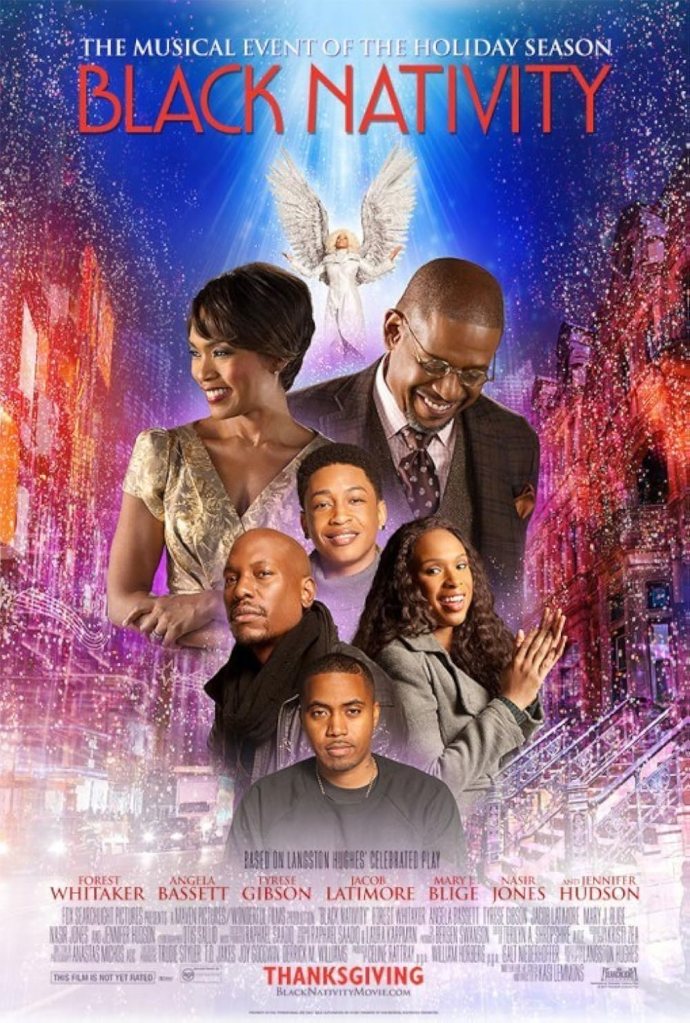
The poster for Black Nativity calls it "The Musical Event of the Holiday Season".  The six main cast members all appear, superimposed on each other, in a column in the center of the poster, flanked on either side by colorful, snowy New York City streets.  Above them, in a dark blue night sky, a light shines down on an angel with her wings outspread over them all.

One of the ways it succeeds is by building a lot of thoughtful complexity into the conflicts between characters.  As Langston goes unwillingly out of Baltimore via bus, we get to see his mother Naima (played by the multi-talented Jennifer Hudson) singing about the challenges of parenting that she keeps navigating because she believes in him more than she believes in herself, while also seeing his POV, in which he assumes his mother thinks of him as an obstacle and a burden, sent away to relieve herself of a problem.  The duality of that parent/child misunderstanding is going to be revisited, of course, when we eventually contend with the much more deeply embedded divides between Naima and her parents (Forest Whitaker and Angela Bassett—friends, if this movie fails its audience, it’s sure not for lack of on-screen talent), and by then we’ve got this lens to help us anticipate that neither side sees the whole story.  And even the parents’ side is complicated—a simpler, less thoughtful movie would likely give us a couple upset at their runaway daughter, waiting for her to apologize to them for all the grief they put her through.  But here, when Langston starts to get some answers out of his grandparents, his Grandma Aretha says that they’re waiting for Naima to forgive them.  And when he painfully confronts them about their absence from his life, almost shouting, “What kind of parents are you?” he hears the pain in their own experience, in the words of the reply: “We’re the broken-hearted kind.”  This is a family so haunted by regret and so walled in by grief that they don’t know how to stop hurting each other, yet they also clearly have the capacity to understand that this isn’t a case of the right and the wrong—at least Langston’s grandparents get it on some level from the beginning, and he and his mother are on a journey towards understanding.  As Aretha says, herself, at a later moment, “We’re so human.  We’ve all done things.  That’s between us and God.”  Is that an acceptance of blame, though, or an evasion of it?  Given her tone and her body language, I see Langston’s grandmother as accepting the reality of what she’s done wrong; her husband’s a more complicated guy, maybe in part because as a minister he’s a little more liable to moralize or try to explicate some ethical truth, but I also see him owning some part of the harm he’s done.  When I compare this family and their emotional landscape to the much better reviewed A Christmas Tale, which I wrote about a few days ago, I don’t know—I just find this film a lot more thoughtful, and more willing to believe in our capacity to understand ourselves and each other, which is what I want this time of year, maybe.

Some of the elements in the movie, I’ll acknowledge, are a little too simplified for the sake of the screenplay: Langston’s arrest right after his arrival in New York City feels implausible even for a justice system that’s biased against Black suspects, given what we and the characters in that scene can clearly observe, and the connections he makes with the criminal side of NYC, both in the jail cell and then persisting on the sidewalks of Harlem once he’s free, might be a little too sanitized and convenient.  The setup, though, is meant to keep Langston poised between pathways in life.  Is he going to be a young man who’s proud of his heritage or one who’s ready to sell his birthright for a bowl of pottage, to use an analogy his grandfather, Reverend Cobbs, would appreciate?  Is he going to walk down the sidewalk to the church where he’s the beloved (if wayward) grandson of a family he isn’t sure he belongs in, or to the street corner where, if he plays his cards right, he can pick up the weapon or the illegal goods that maybe can make him the cash he needs to halt eviction proceedings?  Everywhere he goes, from a jail cell to a pawn shop to the front pew of Holy Resurrection Baptist Church, he is confronted by not only his legacy, but what his legacy means to generations of older Black men who are putting a burden of expectation on him that he’s not sure he wants (or is able to carry).  I’m sure there’s a lot to this context I don’t understand as a guy who hasn’t lived Langston’s life (or Reverend Cobbs’s), but what I could understand of it had a lot of power.  I’ll also accept that musicals are hard for a lot of modern audiences, especially musicals set in the real world—it can be a strange juxtaposition between gritty life in the street and a character singing their feelings, and if that’s part of what people reacted to negatively, well, I get it even if I think the musical elements are good more often than they are cheesy.

The movie reaches its high point on Christmas Eve, when Reverend Cobbs insists on Langston accompanying his grandparents to church.  From the pulpit at Holy Resurrection, we develop a deeper understanding of what Reverend Cobbs means to his community, as he begins to expound on the story of Jesus’ birth, “according to my brother Luke.”  Langston falls into a bit of a reverie here—a dream? A daydream?—and his dream sequence consists of elements of the original Hughes play, staged dramatically all around Langston as though the events of the gospels were happening in the streets of Harlem.  The young pregnant woman his grandfather tried to help with a little money is the Virgin Mary; the crook he met in jail has a makeshift tent in an alleyway that Langston pleads for him to share so that the baby can be born.  We get an angel and a promise, and as song and dance start to involve all of these characters, even Langston, in the narrative, the events and the words combine to present one of the movie’s basic thematic claims: that Christmas is about a baby who came to put right a world broken by sin, and what “sin” means here is the weight of having done things you regret, things that hurt others and left their mark on you too.  From that perspective, we all need the opportunity for a renewal that hardly ever comes back around to lives that missed their chance at it the first time.  This is a deeply religious claim about the metaphysics of salvation, of course, but it’s also a simple secular truth that in each new generation—the birth of Maria’s baby, the birth of Langston to Naima—there is a chance of healing where there once was harm.  And it’s so overwhelming an experience for Langston that it shakes him right out of his pew.  He won’t believe in redemption when he lives in such an unredeemed family; he can’t accept grace in the world if it’s so obvious there isn’t grace for him and his mom.  He sprints out the doors of the church into the cold of a Christmas Eve night in New York City, alone.

And even if this movie’s not as good as I think it is, I’m not going to spoil for you what happens then.  Black Nativity has a lot to say about it not being too late for any of us, if we’re willing to tell the truth, not just about the hurt done to us but the ways we’ve hurt others.  We can be failures by plenty of society’s metrics without being unredeemable—in fact, I’d say this is a film that argues there’s no such thing as “unredeemable.”  And an act of unexpected mercy can re-order not just one life, but the lives of many.  Sure, there are ways that some of the film’s final confrontations are too clean, too simple.  Family is messy, and so is the kind of sin that several characters bring to each other to acknowledge, to accept, to make amends for, and the movie pretends for our sake that it won’t be all that messy in the end if we can be grateful for what we have.  I don’t think that’s true enough to the story this film has been telling.  I’d say that, far more than “be grateful,” the message we need echoed back to us in the end is that, yes, broken people break those around them.  But it is only people who can be authentic in their brokenness who will have the capacity to bring the kind of healing we all need.  Regardless, though, the end credits roll on a Black church in the heart of Harlem, a community that knows a thing or two about injustice and hope and dreams deferred, where the choir and congregation are on their feet singing about the troubles of the world and what’s coming to end them all.  It’s an exhilarating feeling, for this audience member, anyway.  I hope it will be for you, too.

I Know That Face: Forest Whitaker, here playing Reverend Cobbs, Langston’s grandfather, was of course a different kind of distant grandfather as Jeronicus in Jingle Jangle: A Christmas Journey, which I covered last year.  Tyrese Gibson, who plays Tyson (or “Loot”) in this film, appears in the role of “Bob” in The Christmas Chronicles: Part Two, the second in a series of Kurt Russell / Goldie Hawn Santa Claus movies that, I suspect, I will have to surrender to and watch at some point.

That Takes Me Back: There’s a pay phone in this motion picture….and it WORKS.  I wonder if 2013 is nearly the last year you could put a working pay phone in a movie and not have it feel like a period piece.  It sure took me back to having to carry around 35 cents in case I needed to call home.  Oh, and one of the ways Langston learns something about his mother is that, when he gets to his grandparents, Naima’s room is full of CDs she left behind her, which express her musical taste (and how young she must have been when she left).  I wonder how a modern movie would handle that….stumbling into your mom’s teenage Spotify playlists?

I Understood That Reference: This is the most elaborate / stylized “original Christmas” story I’ve seen in a movie – Joseph and Mary, the innkeeper, the stable, an angel speaking to shepherds in the field, etc., but all of it transformed by this gospel fantasia lens into the story as Langston understands it.  That’s certainly the Christmas tale that Black Nativity is in conversation with, as the title makes no disguise of.


Holiday Vibes (7.5/10): We don’t get a ton of “holiday gathering at the family home” stuff, since this family’s in such a weird place, but New York City at Christmas is a pretty powerful energy all of its own, and for anybody who like me grew up with church experiences at Christmas being pretty formative, the experience at Holy Resurrection Baptist Church is very resonant.  It’s good at evoking the time of year in lots of ways.

Actual Quality (9/10): Like I said, not a whole lot of people agree with me on this one, but I’m sticking with my own experiences here, and I thought this was a really powerful film.  Some wobbles here and there, as noted above, but overall I felt really moved by the characters’ relationships to each other, I enjoyed the gospel music thoroughly, and I think if you’re either someone whose experience of Christmas is similar to the Cobbs family (lots of praying and singing) or if you at least can be culturally curious about the experience of Christmas in the Black American church as an outsider, I think this movie has a lot to say about how those spaces can and ideally should give life to people.  2025 has been a rough year and I’ll take the hope I’m given.

Party Mood-Setter?  I’m leaning no, since so much of it is more emotional and intense than I’d normally look for in a background movie, but it’s also true that one of the movie’s big strengths is its gospel soundtrack and you can get plenty of joy out of that just letting it play in the background, I bet.

Plucked Heart Strings?  I’ve got to admit: I was genuinely caught off-guard by the movie more than once, with a moment that felt emotionally real in a way I was not expecting.  I was tearful by the end, and my guess is that lots of people might feel similarly moved: the emotions being tapped into here felt pretty universal to me, though as I’ve noted, apparently this is not a well-reviewed movie, so there’s something I’m missing (or something others are).

Recommended Frequency: I’d say that this is one I’d love to work into an annual rotation, and certainly one I think you should return to regularly, especially if you’re someone for whom the original story of Christmas “from brother Luke” is a meaningful part of your holiday experience.

Subscribers to Peacock can watch this one ad-free, and if you are happy to watch it with ads, our old standby, Tubi, has got your back again.  All the usual places will rent you a streaming copy for about four bucks, and ten dollars will get you a Blu-ray/DVD combo pack at either Amazon or Walmart (Barnes and Noble didn’t have it when I checked).  Worldcat says you public library users have options, though: about 700 libraries hold it on disc.

Let It Snow (2019)

Review Essay

I know it might bother this film’s fans to hear me say it, but the premise of 2019’s Let it Snow is essentially a time-compressed, teenage Love Actually.  Several different plot lines are all arcing and criss-crossing through spaces very close to each other, and in some cases there are connections between characters we didn’t expect.  The movie’s not really a comedy in a “ha ha” sense, but there’s certainly some funny moments.  In the end we realize that, again, much like Love Actually, the film-makers think that the right closing narration over the right piece of music will make it feel profound.  And maybe it does?  I want to be clear, too: I’m one of those people the Internet loves to hate…I actually enjoy the 2003 holiday romantic comedy anthology film, Love Actually.  So I’m not trying to criticize Let It Snow by saying that it’s got a familiar and almost comically overstuffed lineup of relationship scenarios—the couple that doesn’t know they belong together but they do.  The couple where he’s worshipped her from a-near and she’s oblivious.  The couple who would be great together if one of the girls was willing to step out of the closet and admit she likes girls.  The couple that are almost certainly about to break up and it’s a question of who gets there first.  We get expressions of family love, of the love between friends.  And we have one truly unhinged character who’s seemingly mostly in the movie to be comic relief and/or a plot device to keep things on the rails.  If you’re watching this movie, get ready for narrative whiplash (and be ready to take some notes to keep things straight).

The premise of the film—to the extent that I can call it a “premise”—is that there’s something magical about snow falling, and this particular snowy Christmas Eve in a small Illinois town is going to be chock full of magic.  It’s a stretch, to be sure: it’s not like snow is rare in this town, or like this is an unusually monumental amount of snowfall, etc. (it’s enough to temporarily halt a train, but everything else about the snowfall felt like a pretty standard Great Plains storm to me).  Nobody wished upon a snowflake, as far as I can tell, or cast a spell.  It feels mostly like an excuse to make the title make sense, and maybe to explain why so many unlikely events coincide in this film to knock over the correct dominos to make everything turn out okay.  I know it may feel like a spoiler to tell you things are going to work out, but I have to say, it’s baked deeply into this movie’s DNA that things are going to work out.  Unlike Love Actually (and I promise, this is my last comparison to that film), the screenplay here doesn’t really have the courage for genuinely broken hearts: the only main character left unpartnered at the end of this story is a person whose story clearly is happier ending up solo, despite the fact that basically every single relationship in the movie’s a long shot to succeed.  I can imagine that feeling triumphant, reassuring, or sweet, but to me it had more the feeling of being predestined.  I was glad for all these kids but the unreality of it left me feeling a little disconnected from the world of the film.

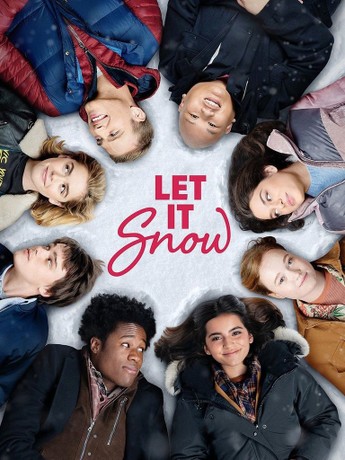
The promotional image for Let It Snow features the title hovering in the center of the image over a snowy background. Surrounding it, eight young people of diverse identities and orientations are lying down, some of them looking at each other and some of them looking directly at the camera / at us.

The film has some things going for it: several of its young stars show up with real skill to deliver on screen (in particular, Kiernan Shipka’s an old pro at her young age, between years on Mad Men and starring in the Sabrina the Teenage Witch reboot), and the movie’s soundtrack is absolutely loaded with well-curated tracks that fit into yet another of my Yuletide interests, songs that are technically holiday music without being “holiday music”.  While I found the character of “Tinfoil Woman” a little TOO obviously the invention of a Hollywood screenplay—I don’t care how quirky your small town is, there’s no way it is constantly being circled by a community-minded conspiracy theory freak whose truck can navigate even the snowiest of streets for the sake of rescuing helpless teenagers—any film that can have Joan Cusack in it is better off for the inclusion, and I was glad she was here.  I was also glad that the film didn’t try to diagnose or “fix” Tinfoil Woman—she’s on her own journey, and that’s not what this movie is about.  Another pleasant surprise was the fact that JP, the jock Angie’s got a crush on (who, therefore, stands in the way of Tobin, Angie’s best friend, dating Angie), is not a jerk or a heel, but instead is an attractive, sweet, funny, self-assured guy who treats Tobin almost as well as he treats Angie.

The headwind all of those strengths are trying to walk into, though, is a motion picture that, at the level of screenplay, editing, and direction, is just trying to do too much too fast at too many levels of emotion.  Rom-coms usually have the problem that everything in the script could be fixed rapidly if they just said one obvious true thing to each other that the screenplay works hard to keep them from saying.  Let It Snow, alas, has way too many plotlines and every single one of them hinges on something the characters obviously should say and almost certainly would say in real life, but don’t until the third act for dramatic reasons.  And the need to race through things can force weird exchanges, where characters who JUST had a magical moment together need to suddenly forget all about it so there can be a new conflict, or where characters say really awful, almost unforgivable things to each other because we need to communicate “someone just tried to burn a bridge in this relationship” with great efficiency.  Again, all of this haste just pushes me into checking out of emotional engagement with the film, despite the fact that there’s a lot of potential for genuine emotion in these teenagers and their tensions with family/friends.  Like, I know by now I ought to have run through the various major named characters and their deals, but there’s such a surplus of major characters, all of whom have deals, that I’m not sure how to do it well.

The movie is also weighed down with quirks, from a restaurant called Waffle Town that’s missing its W, leading multiple people to refer to it as “affle town,” to a character whose attempt to shave his chest leaves him with a comically bleeding nipple that’s a talking point for the entire running time of the film, to, uh, did I mention this small town has a resident they all call “Tinfoil Woman” who just drives circles around town in the snow looking to be a good Samaritan and who is also somehow a rambling lunatic?  We get an ecumenical, interfaith holiday pageant (between this and Single All the Way, what is with modern movies and the aversion to just staging a straightforward Christmas nativity play?  Hey Hollywood, everybody knows it’s Jesus’s birthday, I promise, it’s not going to offend your viewers if a small town on Christmas Eve includes a handful of people briefly engaged in sincere religious observance) that a character refers to as “one of the best, most insane things I have ever seen”.  A waitress tries to win over the girl of her dreams by serving up something called a “Quaffle Waffle”.  The quirk is off the charts.

What it comes down to for this movie (and for, I’m sure, dozens of other movies in this particular streaming-friendly subgenre of “small town holiday rom-coms with a lot of quirk and some cute young talent”) is the question of what you’ve come to the movie in search of.  If you want cute people in cute places whose problems, however serious on paper, end up being almost adorable themselves given how easily/fully they’re resolved by the time the end credits roll, this movie has you covered.  If you were hoping for something that covered fewer relationships with more depth, or that had found a way to make this premise into something deeper than a “be the real you, and people will love you for it” afterschool special, Let It Snow is going to let you down to some extent.  I had a very pleasant time when I was just admiring Kiernan Shipka’s elfin smile or appreciating the endless charisma of Shameik Moore as a stranded pop musician.  I had a more confounding time trying to keep up with what the movie wanted me to feel (and asking myself if I felt it), or trying to understand why a character was doing any of the things they were doing (other than “because the script said so”).  Not every movie needs to be an Oscar winner to be worthwhile, at this or any other time of year, so I certainly understand the value of a work like Let It Snow.  I just also can’t pretend that it soars to heights it didn’t take me to.  Three cheers for the diversity of the casting/storytelling here, though, and I hope that the talents who put this film together aim someday at getting something more substantial made, since I think we had a lot of the ingredients we needed for a modern classic.

I Know That Face: Isabela Merced, who’s here in one of the many leading roles as Julia, a bright girl with an edge and a chance to go to college but there’s this family thing, see, etc., appeared as a fictionalized version of herself in the 2015 television movie, the Nickelodeon Ho Ho Holiday Special.  Kiernan Shipka, who in this film plays the totally chill girl Angie (or “the Duke”) who would be in danger of Manic Pixie Dream status if she had more screen time, appears as Gryla in the 2024 Santa Claus heist movie, Red One.  And of course Joan Cusack, whose performance as “Tinfoil Woman” basically rescues a character the screenplay had set up for failure, is a well seasoned vet on the silver screen: she voices Mrs. Krum in the charming animated Santa movie, Klaus, and earlier in her career she’s the voice of the Lead Elf in Arthur Christmas.  She plays Agnes in The Christmas Train, a TV movie about…oh, come on, it’s all there in the title.  She’s the villainous Miss Rachel Bitterman in 2002’s It’s a Very Merry Muppet Christmas Movie.  I’m probably missing other qualifying credits, too: she’s Joan Cusack, she’s in dozens of movies, almost always in supporting parts, and in my experience she is absolutely always great.  I’m glad she was here.

That Takes Me Back: This 2019 movie about teenagers didn’t make me nostalgic for anything in particular, but at the speed that teenage subcultures change, I assume that a more plugged-in young person would find a lot here that feels positively ancient.

I Understood That Reference: Jesus makes a brief appearance at the all-inclusive world pageant—again, briefer than you might expect on his own holiday but that’s not what this movie wanted to show—and the wise men keep making occasional appearances due to Tobin’s costuming decisions which, like much of the film, remain at least somewhat confusing to me.


Holiday Vibes (8.5/10): Though it’s a movie that’s more about young love than it is the particular hurdles of holiday living, we still get a ton of Yuletide hijinks, from the kooky pageant to Julie bringing Stuart home for her family’s Christmas Eve observance.  Add in a magical snowfall and it’s checking a lot of the necessary boxes here: you’ll feel that seasonal glow, I’m certain.

Actual Quality (7.5/10): To some extent, Let It Snow is a movie where the parts are greater than the whole.  If I think just about an individual character moment or line of dialogue, I can start to convince myself that this was a really solid rom-com.  It’s only by stepping back slightly and asking myself if I was really invested in the film and if it holds together as a coherent story that I realize I was a lot more checked out from it than I have been from the better films I’ve seen for FFTH blog posts.  I think this is a fair rating (from my own perspective), but I think the holiday fluffiness of this movie means that the mileage will vary a lot (and, as seen below, it depends a little on what you want out of a movie watching experience).

Party Mood-Setter? This is 1,000% what this movie is for.  Checking in and out of the movie while not necessarily caring that much who’s who or what’s allegedly happening means you can coast on the attractive and bubbly cast, the solid soundtrack, and the moments of genuine humor.  If you’re baking some cookies or just want to throw something on in the background of a gathering to entertain people who have sat down at the edge of it for a moment, this is absolutely going to do the trick.

Plucked Heart Strings? There are moments, especially the ones involving Julie and her mom, that have genuine emotion: they don’t pack as much of a punch due to the pacing (and just the challenge of being invested in storylines that are mostly pre-engineered for resolution) but I can imagine feeling a catch in your throat as you watch, even if I didn’t experience it.

Recommended Frequency: This is another split the difference movie for me: I am sure I could go my whole life without watching it again as a dramatic work, but I am also sure I will not go my whole life without seeing it again, because it’s too perfect at filling that “let’s put on a holiday movie while we address Christmas cards or trim the tree” niche that folks want.  If you’re someone who does a lot of that, this may be an every year movie for you: for me, my guess is it’ll pop up now and then, in years where I’m a little more invested in those at-home holiday vibes.

Let It Snow is another of these streamer-exclusive films: Netflix made it, and if you want to watch it, you’ve got to go to Netflix.  If you go looking for DVD copies, either at a store or at your library, you are only going to find copies of the 2013 Hallmark movie Let It Snow starring TV holiday perennial Candace Cameron Bure (seriously, the woman’s been in a minimum of 17 Christmas movies, none of which are currently in the queue here at FFTH, for the record).  Whichever snow-themed holiday rom-com you’re seeking out, have fun with it!

Single All the Way (2021)

Review Essay

I’m going to open with the caveat that this is a movie living on the outskirts of a massive holiday movie industry that is absolutely serving a big and happy audience, and that I am not a part of that audience.  I’m not trying to get in anybody’s way as they consume the delightful fluff of Lifetime/Hallmark/Netflix Christmas flicks (and yes, diehards, I know that there are real tonal and stylistic differences between these channels/streamers when it comes to holiday media), and honestly, I’ve seen so few of them that even calling them “fluff” is probably unfair since if there’s some non-fluff in there, I wouldn’t know it.  My guess is that the movie I’m talking about today will work a lot better for folks who receive the tropes of the TV/streamer holiday romantic comedy like a warm hug.  For me, this is something less successful, but I’ll try to be generous where I can be.  That said, good grief, does Single All the Way feel like an extended Christmas episode for a cheesy sitcom that doesn’t exist.

The fundamental setup of the movie is trite but not necessarily doomed at the outset: Peter is a guy born in New Hampshire who escaped to the high-fashion world of models and marketing in Los Angeles years ago.  He’s headed back home to his small town for Christmas, accompanied by long-time best friend and roommate Nick who just dumped his trash fire of a boyfriend.  Peter’s family are (delightfully and not at all expectedly to me, given other films of this kind) really accepting of his identity as a gay man, even if they seem pretty clueless about LGBTQ+ folks in general.  So this isn’t a trek back home to the closet, as in Happiest Season, which I did genuinely appreciate.  But instead, alas, it’s a trip home to a family desperate to get Peter hitched to somebody—initially to his mom’s spinning instructor, James, via blind date, but then the family rapidly shifts to urgent, manic match-making maneuvers in an attempt to get Peter and Nick to fall for each other, despite their never having had any apparent romantic chemistry or tension in years of living together.  It’s a surprisingly exhausting experience, and if you think you know where it will end, yeah, you sure do.  Regardless of whether the ending makes any sense for these characters.

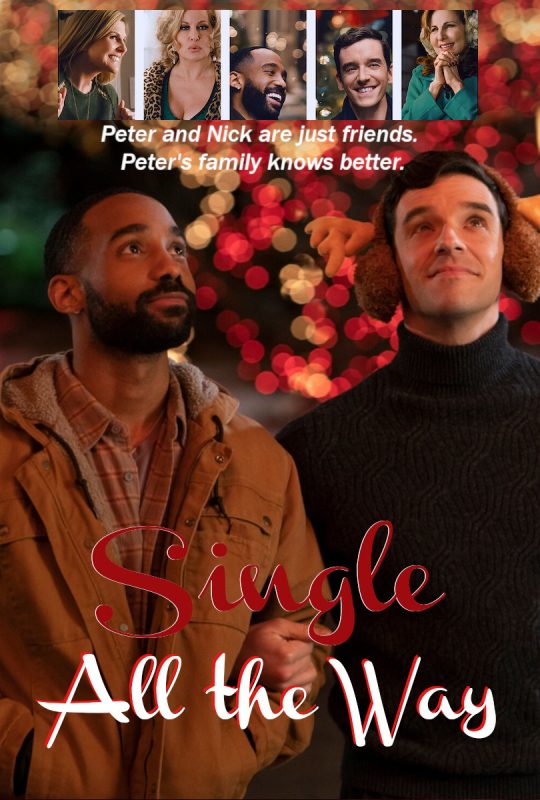
A promotional poster for Single All the Way depicts two men in their late 20s or early 30s standing together in the middle, looking upwards and smiling.  The man on the left is a Black man with short hair and beard; the man on the left is a clean-shaven white man wearing large earmuffs. Above them are five inset portrait photographs, two of them photos of the two men and the other three images of smiling middle-aged white women. The tagline reads "Peter and Nick are just friends. Peter's family knows better."

The tone of all this is, as I mentioned up top, really sitcom.  Like, really, really sitcom.  Jack from Will & Grace could wander into almost any of these scenes and not be totally out of place.  I don’t know at what point my eyes permanently rolled out of my head at the dialogue—I think I made it through “don your gay apparel” without collapsing, and I gritted my teeth through someone quipping that HGTV was the “Homosexual Gay Network”, but when someone described themselves as a “FOMO-sexual”, I was done.  And I want to emphasize that I love a good sitcom, so this isn’t me sniffing that the movie isn’t dark or artsy enough for me.  But the tone is so often broad and silly that it becomes incredibly hard to be invested in the emotional wellbeing of these characters when suddenly the screenplay expects me to take them seriously as people with hopes and dreams and baggage.  The antics they get up to—blind date hijinks for Peter, lots of home improvement work by Nick helping Peter’s father (since Nick works for Taskrabbit and he is really inspired by how Taskrabbit allows him to connect with and help others, and being a Taskrabbit at Christmas is almost like being a TaskElf, hahaha, hey, have I mentioned yet that Nick works for Taskrabbit and he feels kind of directionless in New Hampshire unless he’s working like a Taskrabbit?)—are incredibly mild. I’ll give it to this movie that, unlike Happiest Season, the goofiness is often less unhinged, but that also just means that the scenes are often a lot less memorable.  I’ve already forgotten a lot of the story beats within this movie’s second act.

There are things to praise here, to be clear, beyond my enthusiasm for a holiday movie that gives us a diverse cast (not just several key gay characters, but also at least a little welcome racial diversity for a movie set in New Hampshire).  Insane as both the characters they’re playing are, Kathy Najimy and Jennifer Coolidge (Peter’s mother and aunt) were kind of born to play sisters and to some extent they each make the other seem more realistic as a human being by being adjacent.  Coolidge as Aunt Sandy, the deranged megalomaniacal director of Jesus H. Christ, the town’s non-sectarian Christmas pageant, can at her best make even the wildest, most flailingly awkward moments seem plausible…she is not always at her best in this film, even so, but nobody could have done more to keep at least one of the movie’s toes on the ground where the pageant subplot is concerned.  Kathy Najimy as Peter’s mom….well, I have been to too many farmer’s markets to doubt the existence of people who buy kitschy, folksy, and at least allegedly funny wall decor, and Kathy is 100% landing the plane as a woman who would purchase a framed cross-stitch that says “Sleigh Queen”.  If you chuckled at that, friend, this is a movie you should check out.  The plan briefly entertained by Peter to pretend that he and Nick are dating (as a smokescreen to save himself from the blind date his mother’s going to send him on) dies a quick and fairly painless death more or less on arrival, which was a relief in the moment, at least.  And the best performance in the movie, bar none, is Luke Macfarlane as James, the spinning instructor for Peter’s mother, “Christmas Carol” (yes, that’s the name every character in this movie calls her, friends: how are you feeling about it, right now?), and also of course Peter’s blind date.  The character of James comes across as nuanced, thoughtful, patient: he undermines every likely stereotype, and he seems like a genuinely good dude with whom Peter might have built some really good chemistry, maybe even was initially building that chemistry.  I think this works against the film, to some extent, since it makes the ways Peter treats/mistreats James on his way to his destined-by-the-screenplay relationship with Nick even harder to enjoy when James is not only sympathetic but someone who feels more real, more human than our main character.

The overall arc of the film, really, was just too hard for me to enjoy: we’re asked to join all of Peter’s family in rooting for them to destroy his budding romance with James (based on a blind date his own mother started) and figure out how to basically force Peter and Nick to realize that they’re “perfect for each other”, by which I mean Peter’s dad who loves Nick’s handyman skills and a couple of teenage nieces who think it would be, like, sooooo cute if Peter and Nick dated and…well, you get the drift.  This isn’t a movie that’s figured out how to get these best friends to fall in love with each other by any means other than having a bunch of family members bashing them together like two Ken dolls they’re playing with.  I get that it’s supposed to be silly and sweet, but I don’t know: I was not in the mood for this movie’s brand of romance, and the whole thing ended up feeling almost offensive, as though the gay main characters were paper dolls being puppeted around by straight people who are, yes, “accepting” of their identity, but also not really treating them like people with their own desires and needs in relationships.  But honestly, using a word like “offensive” about Single All the Way would be inappropriate: this isn’t a movie that’s working hard enough in any direction to really mean the things it’s saying.  Like, this is a movie that wants us to nod along with a character claiming that if the town’s Christmas pageant is peppy enough, maybe it can “go on tour” after Christmas Day.  It wants us to accept that the highest powered marketing executives in the country would insist on an emergency photo shoot occurring on Christmas Eve at a moment’s notice….but they’re fine if the images produced are just iPhone snapshots in the woods, featuring whatever random local hunks are willing to pose in a hat and coat.  It’s never, ever mean-spirited, and as the queer main cast members are seemingly comfortable with what they’re appearing in, I wouldn’t tell you not to watch it.  I just think that, ultimately, this is not a script or a film that respects its characters in the ways I was looking for—the final scenes of revelation and admiration between Peter and Nick imply a greater psychological depth than has been developed for either of them.  The movie thinks it’s a story about self-discovery, but I experienced it much more as a story of social engineering, in which a family’s acceptance can also become a fenced yard in which your identity becomes a convenient way to pigeonhole you.  As always, though (and especially for films in this particular subgenre), your mileage may vary.

I Know That Face: Luke Macfarlane (as aforementioned, here he’s James, Peter’s incredibly attractive blind date) is an absolute veteran of TV Christmas movies, having appeared in at least NINE of them, including as Edward Ferris in 2019’s Sense, Sensibility and Snowmen, and as Chris, Santa Claus’s alleged son, in 2023’s Catch Me If You Claus.  I’ll give it to this subgenre: the movie titles are hilariously corny.  Barry Bostwick (here playing Peter’s genial father) is no stranger to the holiday circuit, himself, appearing in at least five such films, including 2017’s Christmas in Mississippi and 2019’s Christmas in Louisiana—the mind boggles at the potential for 48 sequels (more, even, if we throw in D.C., Puerto Rico, and Guam).  Add in Kathy Najimy (again, Peter’s well-meaning and overbearing mother), a member of the cast of at least four different holiday movies, including her appearance as Kim in 2013’s A Madea Christmas, and this little cast covers a remarkable breadth of the sizable collection of 21st Century TV movies that depict this special time of year.

That Takes Me Back: As a 2021 release, this movie’s too recent for any real nostalgia, of course, but someday the relentless Taskrabbit and Instagram references will be dated as hell.

I Understood That Reference: Kris Kringle shows up in the end credits song, and of course, thanks to Aunt Sandy’s lunatic obsession with a Christmas pageant that I will remind you again is titled Jesus H. Christ, we get a weirdly elaborate nativity scene on screen, since the movie can think of no more natural way to tie Peter and Nick together than forcing them to help out with the pageant before Aunt Sandy’s ego crushes every single participating child.  


Holiday Vibes (9.5/10): I have to hand it to this movie, it captures the feeling of a particular holiday energy, embodied by the kind of person who sees a framed poster in a country store that says “Nice Until Proven Naughty” and thinks, “That would be perfect for my entryway.”  And basically everything about the film once we reach New Hampshire is pretty Christmassy—snow and merriment and pageants and a countdown hanging on the wall that reminds passers-by to be good for St. Nick.  It’s generating plenty of holiday vibes, that’s for sure.

Actual Quality (6/10): As for the quality, on the other hand, this movie suffers.  Now, is it truly awful?  I can’t say that.  There are some fun performances and the movie’s pretty relaxing as a watch, as long as you don’t think too hard (as I clearly did) about the ethics of how this family is treating their visiting adult son/brother/uncle.  But is it good?  I struggle to even call it “fine”, given what I’m looking for in a movie: there’s just not enough ‘there’ there.  It’s a film that leans on the worst tropes in romantic comedy, for me, and (with my apologies) I just don’t think most of the cast is talented enough to really hold my attention: better actors might have saved some of this writing, but the two main characters here in particular are pretty bland, for me.

Party Mood-Setter?  Oh, 100%, especially if you’re at a party where those gathered will enjoy a little bit of eye candy from the hot men posing for the camera at multiple points throughout.  Sure, I think it’s empty calories, but that means that a party or a cookie baking afternoon is a potentially great venue for a movie that, if nothing else, fully lands the plane of “cute gay guys having a lovely white Christmas in small town New England”.

Plucked Heart Strings?  You’d have to find both Peter and Nick much more effectively realized as characters than I do to feel that lump in your throat as they finally confess their love for each other.  I guess I can imagine that reaction, even though I didn’t have it, but I don’t want to make you any promises!

Recommended Frequency: For a movie I didn’t like, honestly, this is maybe where I’d be gentlest: I can even imagine watching this one again, since I’ll acknowledge that I may just have been in too grouchy or critical a mood the first time around.  Most romantic comedies have premises that are at least a little unsettling or weird in the ethics department if you break them down far enough.  That said, I don’t know that I would ever seek it out again: there’s a lot of films out there, and this one missed me on too many levels for me to think it has much of a chance of warming my heart.  But if it sounds interesting to you, I think it’s well worth a try: you’ll decide early on if it’s really your style.

If you’d like to do just that, Single All the Way is one of those Netflix-produced movies that is really only available on the Netflix platform.  I see a couple DVD copies available from sketchy looking websites, which I assume are pirated, but other than that I can’t really give you options for renting it, buying it on disc, or securing it from your local library.  Apologies!  I try to stick mostly with films that we have a wider array of options to access, and I’ll try to get back to that array of options later this week.

Nothing Like the Holidays (2008)

Review Essay

I feel like there’s a fine line to walk when you’re writing an “awkward family gathering for the holidays” movie. It can be easy to load up the gathering with a bunch of profound emotional revelation that feels almost unbearably intense, or conversely to turn the family scenes into such broad, slapstick comedy that the people involved no longer feel human. (Or, if you’re Happiest Season, you flip back and forth between the two like a yo-yo: it’s not a bad movie, as I said last year, but it sure can be a tough hang.)  In the case of Alfredo De Villa’s Nothing Like the Holidays, alas, we encounter yet another film that hasn’t quite worked out this balancing act.  But there’s some fun to be had along the way, here and there.

The premise of Nothing Like the Holidays is part of what drew me to it—this is a film about a Puerto Rican family living on Chicago’s west side (Humboldt Park, to be precise) in the late Aughts.  It’s sold as a movie about immigrant culture and American pride; about the violence of the city and of the world beyond it; about the ways we keep secrets from each other and what it takes to finally be honest.  It seemed more than a little bit like the kind of movie I, as a former resident of Chicago (in the early ‘Teens) and a proud one, would really love to trumpet to you all here in 2025, at the end of a series of months in which the city has been under attack by its own national government’s forces.  But this is, first and foremost, a blog where I talk to you about movies and how they work (or don’t), and I have to be honest.  This one mostly doesn’t.

The DVD cover of the movie Nothing Like the Holidays looks like a framed photograph that is tied up with a red ribbon and bow.  Nine cast members are all posed and smiling at the camera as though a family photograph is being taken.  The title appears above their faces, and below them on the ribbon is the tagline "They're just a typical American family. Minus the typical."

The movie’s power comes out of the gate hot, early on: we’re welcoming home an Iraq war vet, Jesse Rodriguez.  His brother and sister, Mauricio and Roxanna, are excited to see him…but in all honesty they’re probably more preoccupied with their own baggage than with helping Jesse through what’s clearly a painful transition back into civilian society.  They all have complicated relationships to their parents, the cheerful though muted Edy and his acidic, glowering wife Anna, but then they have complicated relationships with everybody: Mauricio with his very-not-Puerto Rican wife Sarah; Roxanna with long-time friend of the family Ozzy (who’s cute but maybe too much trouble); Jesse with his old flame (and Roxanna’s best friend) Marissa.  And things spiral outwards—Sarah’s tough relationship to her in-laws, Ozzy’s desire for revenge on the man who murdered his brother, etc.—to the point where it would have been hard for a really brilliantly written screenplay to fully pay all these things off, and this is, alas, not a really brilliantly written screenplay.  But again, before all of these tangled webs are woven, the film seems strong—it’s about Jesse and his relationship to this home he’s been away from in such a bleak place.  It’s about the color and the sound and the life here in Humboldt Park that’s really winning me over from the opening shots, as I see some things I recognize about a city I came to love in my time there.  If what you want most is that kind of cultural immersion, with music and architecture, food and domino games, all adding up to giving you the feeling of a place and a time, the movie is going to deliver the goods to some extent.

The challenge is that, authentic as the streets sometimes feel, these main characters often end up seeming less than authentic, like caricatures written by folks who don’t really know Humboldt Park.  Sarah plays the white outsider so fully that sometimes it feels like she’s never met Mauricio’s family, even though the text of the film makes it clear she knows them all pretty well.  The explosive relationship between Edy and Anna seems to have been written for the convenience of the screenplay but not anyone’s actual human life.  Somehow the violence of the streets is both too intense—it’s hard to make sense of why Ozzy, based on everything else we know about him, seems so committed to the violent murder of the guy he spotted in the park—and also too muted, since if that IS how people like Ozzy live, it seems like it should have affected far more of the people in this story than give any evidence of their having been impacted.  Most dialogue feels less like it’s revealing qualities of character, and more like it’s setting up the next set of dominos just in time to be knocked over so that the plot can move forward.  It’s hard to pin down what a character cares about or wants, other than maybe Jesse and his father Edy (the two best performances, for me), since the things characters say and do are for the script’s convenience and not emerging from their own desires.  And even those two have their struggles at conveying clear motivation: Edy, for instance, spends most of the movie claiming he’s going to chop down the tree in their yard to “improve the view”…but, this is Humboldt Park, Edy.  You don’t have a view of ANYTHING other than other people’s houses.  Chopping down a gorgeous old deciduous tree isn’t improving your view: it’s taking away your view of the tree.  So, does the movie know that, and this is a crazy distraction Edy’s using to deflect attention from himself?  Or did they actually think this was logical?  It’s so hard to know.

I think part of what’s tough about ensemble holiday movies is that somehow you have to avoid being a caricature while successfully being a memorable character.  In this film, when characters aren’t going over the top, often I feel like they’re underplaying moments too much: even if the person they’re playing would in real life struggle to emote to those around them, an actor has to do more to connect us to the moment as an audience, or we will lose contact with the movie entirely.  The big reveals that eventually unfold in the movie run into these same problems: too often they’re either not supported by how the character has been behaving, or they’re so outlandish that it strains credibility to think of any normal person or family coming to grips with them.  The movie clearly wants an ending in which I (and the rest of the audience) feel comfort that things worked out for these people.  But I don’t know them well enough to know that…and I don’t like half of them enough to care if it does “work out” for them.  And I’m not even really sure that it DID work out, you know?  They end up in new places by the end of the movie, but it’s hard to know how much better it is for any of them.

What else did I like, looking back?  The depiction of the parranda as a vibrant cultural tradition in Humboldt Park is pretty cool even if it arrives out of nowhere.  Sarah, once she loosens up (and drinks a little), draws some good things out of the family around her and helps create some of the more meaningful conversations in the film.  The stretches where everyone’s not standing in a room being mean and aggressive to each other are all at least indicative of the kind of film this might have been in someone else’s hands.  And when is Alfred Molina not fun?  I mean, to be clear, Molina is not Puerto Rican, which is one very fair criticism to make about the casting.  But he’s so enjoyable to watch on screen.  Ultimately I think what I appreciate most about the story is the character of Jesse and the growth he achieves, particularly in relationship to his father.  For all that the movie’s an ensemble, the one arc that makes any sense as a narrative is his.  But I also never really felt like the film could take the time to do his life experiences justice, which therefore limits how much character development is really possible.  File this one among the other holiday movies I really wanted to like but couldn’t quite get there.

I Know That Face: Alfred Molina, the Rodriguez family patriarch, elsewhere performs as the voice of Francis Church in the movie Yes, Virginia, and, maybe appropriately (in the light of Yes, Virginia’s message), is later the voice of Santa Claus in an episode of Santiago of the Seas. John Leguizamo, the incredibly stiff and frankly off-putting elder brother Mauricio, voices Sid, of course, in Ice Age: A Mammoth Christmas.  Jay Hernandez, here playing family friend/love interest Ozzy, plays Jessie in A Bad Moms Christmas, which has an incredibly stacked cast.  And Claudia Michelle Wallace, who in this film chews the scenery in a small role as an employee at Edy’s bodega, plays a Child Services Agent in Fred Claus, and follows that up with the role of Mrs. Colvin in Once Upon a Christmas Wish.

That Takes Me Back: This will be nostalgic for nobody else, but when a character gives the driving direction, “Turn on Sacramento,” I’m back in our Albany Park apartment, where on my walk to the nearest L stop (or, later, when taking my infant out for a stroller walk around Ravenswood Manor) I would turn south on Sacramento to cross Lawrence.  We didn’t live that near to Humboldt Park, but Chicago’s flat, extensive grid of streets mean these names cross through all sorts of communities, and it was fun to imagine how closely I was once connected to Edy Rodriguez’s bodega.  Nostalgia, too, was there for me, and maybe you too, to see the era of the flip-phone at its height: wild to me now, in an age where phones get larger and larger as they become the one true screen for all entertainment and productivity, that we once prized making these devices as compact and tiny as possible.  And I won’t call it nostalgic, but it was sobering to get this plain a reminder of the Iraq war, and the devastating effects that lingered after that conflict: it’s hard not to think of the conflicts around the world today (some of which we perpetuate needlessly, as a country) and the toll they’ll leave in their wake.

I Understood That Reference: Santa appears, as he does in many a holiday film: there’s a Santa suit worn by Spencer and a brief dialogue exchange about “Black Santa”. Later in the film, Christmas’s religious underpinnings surface when, having brought a priest to the family’s dinner table in an attempt to settle some of the internal conflicts, a character asks the priest, “How about a little sermon about Jesus being born so we can be forgiven for our sins?”  


Holiday Vibes (9/10): I cannot deny that this film really makes the holidays present – these are characters going through a very painful, hostile version of the more widely-experienced challenge of occupying space at the holidays with family members you rarely see or haven’t seen in years.  The decorations, the food, the energy of the city, the passive aggression from a mom who wants grandkids, the heightened strain on an interracial marriage…it all tracks as the holidays to me, even if it’s a lot more intense and uneasy than holiday memories of mine.  If you want a Christmas movie, it is showing up.

Actual Quality (6/10): I really wrestle with how high to rank this film: I wanted to love a Chicago Christmas movie so badly this year, especially one with such a diverse cast, set in a neighborhood that has been under siege by taxpayer-financed agents of violence for months now. (You may disagree with that characterization: respectfully, if you do, you may not always love the blog this year.  I live in a borderline authoritarian state and if I feel like acknowledging and challenging it, I’m gonna.)  Anyway, as I said earlier in this review, in the end, what this blog is mostly about is the experience of these movies for me, and I can’t pretend I had a good time with this one: it was really uneven.  There are some hilarious lines of dialogue and some pretty heavy but resonant scenes where characters are unpacking some tough baggage.  The movie surrounding all that, though, too often felt silly when it needed to be serious, and flat when it needed to be funny, and the total effect was to make me feel restless.  I can imagine someone getting more out of the movie than I did, but not enough that I can call it even “good”.

Party Mood-Setter? Part of what sucks here is I wish you could just put it on for the vibes of Humboldt Park at Christmas, with the parranda and all the rest, but the tone of the family arguments is so bitter and so often unresolved that I just don’t think it would be all that fun to have on in the background of holiday merriment.

Plucked Heart Strings? It’s definitely a film that wants to get you to that emotional space where you feel for Jesse (who has gone through some serious PTSD-triggering horror in Iraq) and maybe also for the parents in their separate distresses, but for me the characters are too badly served by the screenplay for me to really feel the emotion with them.  I was never close to misty-eyed, though some folks (especially people with their own Iraq memories, or people close to people who have that background) might.

Recommended Frequency: I can’t imagine watching it again.  There’s a great film to be made out of material like this, but I think it needs a screenwriting team that actually knows the place—this is what sets a film like Boxing Day, which is written by someone from the community being shown, apart from this more generically Hollywoodized version of a family in an ethnic/cultural enclave.

If you’re curious to see if you’ll enjoy it more than I did, it looks like this December you can stream Nothing Like the Holidays on Tubi, Fandango at Home, or the Roku Channel for free—all of them are ad-supported, of course.  It’s available for rent at all the usual places (pretty cheap at some of them, too: YouTube and Google Play are offering it for about $2 as of this writing), the DVD is inexpensive also, and almost 900 libraries worldwide hold a copy.

Carol (2015)

Review Essay

One thing I’ve enjoyed about this blog project this year — along with getting to share things with you, and hear some of your comments back — is that I’ve tried to push myself to watch a wider range of movies than I normally would have watched.  Sure, there’s lots of romantic comedies in the list, since that’s such a dominant element in the holiday genre (such as it is), but it’s been interesting to see the other uses Christmas can be put to.  That’s certainly true of Carol, which I think is arguably the best film I watched for this project on an artistic level while also not being the kind of movie I normally think of this time of year at all.

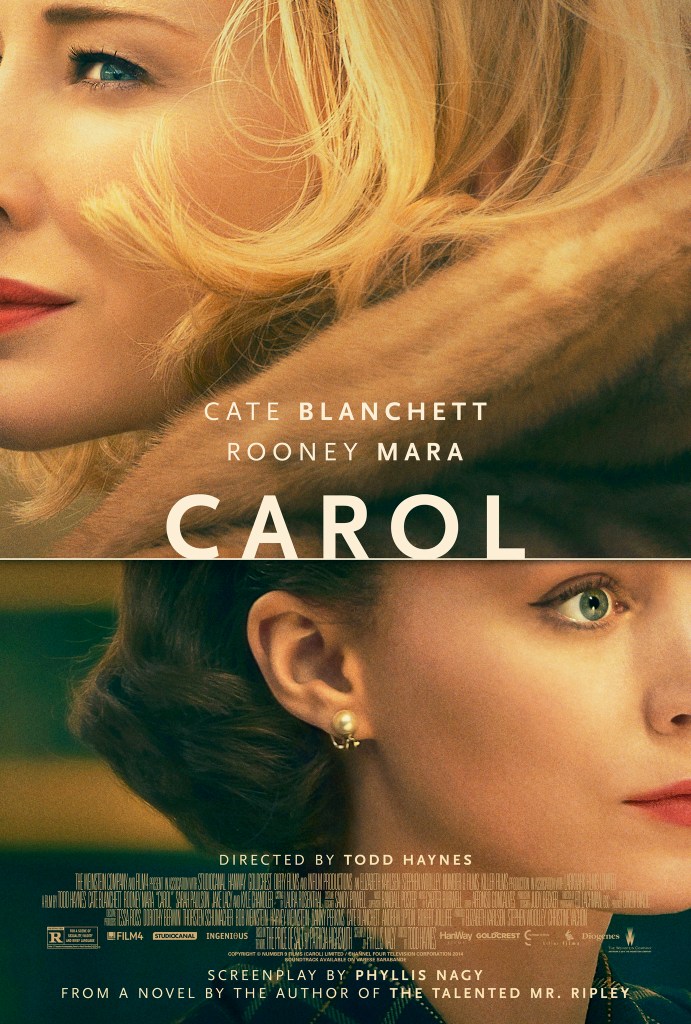
Carol begins in medias res: we know that a slightly older woman named Carol is at a table with a young woman named Therese, and that there’s something between them that feels tightly wound, and somehow also fragile.  A young man disrupts whatever their conversation had been, and they part, but the camera work and the editing helps emphasize for us that Therese is in a reverie, pulling her attention away from those around her and into the memories of meeting and knowing Carol.  There’s no easy way to summarize this, so I’m going to miss a lot in this initial stage setting in saying simply that Therese is a shopgirl who met Carol, a wealthy mother looking for a Christmas gift for her child.  It’s the 1950s — Christmas 1952, if I’m not mistaken — and for that reason it’s hard at first to know….are these women flirting with each other, or is this just awkward small talk?  But then the film pursues their relationship and slowly opens up to us that these are in fact two lesbians — one of them out to a handful of people in her life, the other maybe not even fully out to herself yet.  And, in that historical moment, this is incredibly precarious — Therese risks the relationships she has already built in her life (including a boyfriend).  Carol risks her ability to even see her child, let alone act as her child’s parent.  They run the risks anyway.

The poster for the movie "Carol" primarily features the two major actors -- in the top half, we see a partial view of Cate Blanchett's head and face in profile as Carol, and in the bottom half, we see a partial view of Rooney Mara's head and face in profile as Therese.

So much of the movie is about the question of whether a woman gets to have an identity that is her own: from the beginning, we watch Therese disappearing, whether under an obligatory Santa hat at work or into the vacant stare of dissociation I see as she tries to reckon with a boyfriend, Richard, who has big plans for her that don’t inspire her at all.  Carol lives a little larger, but she’s constantly forced to push back — when her estranged husband, Harge, makes a reference to “Cy Harrison’s wife” she almost instinctively mutters “Jeannette” as if to say, “she doesn’t belong to Cy, or anybody else, you know”.  Speaking of names, Therese is almost always referred to by her boyfriend as “Terry” — it’s only with Carol that she can count on hearing her real name, almost as though she’s not herself unless she’s with Carol.

And the film is also about the journey to find a space where you can be yourself.  The journey is internal, sure, but there’s a pretty substantial journey undertaken in the film’s second act, as Carol and Therese drive west, escaping into the American interior like so many people in fact and in fiction, over the years.  As they travel — initially as innocently as any two friends, but gradually opening up to the possibility of intimacy — the world slips by them and it’s maybe a little reminiscent of Remember the Night, except here both women are running away from their homes and not towards them.  What will redefine them is not the loving context of family and community, but individuality and agency.  The scene in which they finally have sex — and to be totally clear with you, dear reader, this is very explicit sex as you would expect from an R-rated drama, in case that’s not your holiday movie style — comes as a relief because you get the sense that you’re finally watching these people be authentic and unguarded.  It’s a haunted sex scene, to be clear, because even as they’re in each other’s arms, we know that neither the 1950s nor the legal system adjudicating whether or not Carol gets to have contact with her daughter are going to let this be as easy as it feels in that moment.  The relief they’re feeling is impermanent, and they know it; so do we.

The journey takes place at Christmas, and that’s where this film intersects with this blog.  Sure, it qualifies the moment Therese puts on a Santa hat at Frankenberg’s, but there’s more than that in the use of this holiday.  Carol and Therese’s first conversation deals with Christmas, at least a little — Carol loves it but also feels incapable, referencing how she always overcooks the turkey.  I think the movie, as it unfolds, makes it clear that the turkey line is just cover for Carol’s fears of being inadequate as a mother (and perhaps as a wife): that the reason Christmas doesn’t achieve that looked-for perfection is because of something she’s getting wrong as a homemaker.  Later, Carol fends off multiple invitations to friends at Christmas, as it becomes clearer that she needs her own space…a space into which she’s going to bring Therese, though.  Christmas works here as a catalyst for action — Harge and Carol, for instance, fight about Christmas but it’s not about Christmas, of course, any more than most fights at Christmas are about the holiday.  Christmas, meanwhile, threatens Therese a little, since she realizes she’s about to be treated as “family” by Richard’s family, and she doesn’t want to feel the inevitability of that — not yet and maybe not ever.  She’d probably have run off with Carol any day of any week, but it being Christmas is even more of an inducement for her.

So much depends, in a film this contained and zoomed in, on the performances of the primary actors, since there are no huge set pieces here, no sweeping plot devices, to distract us.  And the film has been wisely entrusted to Cate Blanchett as Carol and Rooney Mara as Therese.  Carol is the most impossible of the roles — a woman established enough in a comfortable life to be proud and also wounded enough by the confines of that life to be vulnerable.  We have to believe her when, on more than one occasion, she chooses someone else’s happiness over her own, whether or not she’s right about them — whether or not they deserve it.  That Blanchett manages it is no surprise to anyone who’s ever seen her in anything, of course: I remember being blown away by her performance in Elizabeth, watching that movie on VHS from a Canadian video store back in grad school (talk about nostalgia), and the many times I’ve seen her since, she’s been uniformly wonderful (even in otherwise mediocre material).  But I think there’s still something especially wonderful about her work in Carol, since there’s absolutely no special effects here to enhance her performance, and she has to face some tough emotions pretty directly on screen: it works.  Mara’s task as Therese is to be believable as a young woman discovering that her ambiguity about her life isn’t some fundamental personality trait, but rather a reaction to trying to live as someone other than who she is.  Her awakening to herself and to Carol is a liberation, but it’s navigated in the slow and sometimes difficult way that such journeys of self-discovery often take.  And Mara’s really successful, I think, at not letting her portrayal become too cloying — really, both she and Blanchett give us characters who have sides that are not easy to warm up to.  They’re not afraid to be human, and to invite our empathy without having to be saintly enough to earn it.

A lot happens in this film, and particularly in its final act, that I just have to leave to you as a viewer.  It’s too nuanced and powerful a movie to spoil, even though it’s also not really a movie with a plot that’s relying on twists or tricks to keep you hooked.  A lot of careful choices are made here by the director, by the actors, and by the screenwriter, that wring every drop of potential intensity out of the smallest interactions.  When characters are betrayed, it hits hard.  When they suffer or submit, it burdens me as an audience member.  And the ending I get is not at all what I expected or had thought I was hoping for, but the way it resolves ultimately feels perfect to me, almost inevitable.  There’s a sense of hope and of possibility, for me, that rounds out the subtle Christmastide feelings of the film into something that strikes the right emotional note.

I Know That Face: Jake Lacy, who here plays Therese’s unfortunate boyfriend Richard, appears as Joe in Love the Coopers, a film about a massive Christmas family reunion that was released the same fall as Carol.  Kevin Crowley, here playing Fred Haymes, Carol’s lawyer, appears as Liam in the TV movie Country Christmas Album which is exactly what it sounds like, and has a bit part as Dr. Franklin in another TV movie, The Christmas Spirit, about a woman in a coma who appears in spirit form to persuade her community to something something look there’s a lot of holiday movies and I have definitely not seen them all.  Sarah Paulson, here playing Carol’s devoted ex, Abby, has several holiday flicks under her belt: she stars as Emily in the Lifetime movie A Christmas Wedding, she plays Beth, the mother of a terminally ill 8 year old, in Hallmark’s November Christmas, and she is Grace Schwab in one of the segments of the anthology film New Year’s Eve.  And Cate Blanchett, starring here in the title role, was once the uncredited voice of a “Mysterious Woman” in Eyes Wide Shut, which is also a critically acclaimed adaptation of a mid-20th century written work that takes us to a series of New York City gatherings at Christmas time, and is far, far more sexually explicit than even Carol is.  I’m not saying it’ll never make the blog, but it’s not on the list for this year (or next, I think).

That Takes Me Back: I know this kind of shopping does still exist, but it’s been years since I engaged in the bustle of department store shopping at Christmas.  I enjoyed the throwback feeling of a big decorated showcase space and the busy energy of the retail floor.  Less appealing but certainly just as indicative of a bygone era was all the smoking indoors, all over the place, often in furs — the look and feel of the movie works with those 1950s symbols pretty successfully.  I am too young to really feel a connection to the idea of a shared phone in the apartment hallway, but it sure reminds me of shows and books I encountered, growing up, and just the idea of a phone being in a place, and needing to go to that place to use the phone, is nostalgic.  Oh, and in further technological notes, I’ll say that I do love a cash register that goes “ding” when the cashier pulls a lever, and I love anything called an “icebox,” especially one operated by a handle in the door.  

I Understood That Reference: There’s very little sense of holiday media here, but Carol promises her daughter at one point that she won’t let Santa’s elf give her daughter’s presents away to another girl.


Holiday Vibes (5/10): In the movie’s first half, there’s a fair amount of this — as mentioned, Santa hats on the department store employees and discussions about turkeys, and then there’s handwritten note tags on gifts and home decorations.  The use of seasonal colors, especially red, in the costuming is not at all subtle, and conveys a little about how the characters change (or don’t). By comparison with some films that are much more widely considered to be Christmas classics, honestly, this one holds up pretty well as committing to Christmas as a relevant setting for at least the movie’s initial work, even if the holiday recedes from view over time.

Actual Quality (9.5/10): This is a very, very good movie — Haynes is a gifted director and I love a Carter Burwell score, and the underlying story comes from an underappreciated and notable midcentury talent in the author Patricia Highsmith.  As I’ve mentioned, too, the acting performances are really extraordinarily good: the movie earned every Oscar nomination it got, and was probably robbed of more than one statuette.  Now, is it for you?  Dear reader, I can’t know that: some of us are up for intense, often sad R-rated romantic dramas at this time of year and others of us wouldn’t touch them with a ten-foot pole.  But if you think you might be in the former category, I really can’t say enough about how good a movie this is artistically.  It’s worth your time.

Party Mood-Setter?  If you’ve brought a shop clerk home and are hoping to take things “to the next level” then I guess so, but otherwise, haha, no of course not, this is an incredibly moody, melancholy, and sexual movie that isn’t going to pair very well with decorating the Christmas tree.

Plucked Heart Strings? You can’t help but feel emotionally connected to both Carol and Therese, even though the film’s management of itself is such that every emotion is somewhat muted, and I’d expect that most viewers won’t be reduced to tears.  I found myself still feeling the movie’s emotional landscape after it was over, but it never caught me so by surprise that I was choked up, except perhaps for a single moment near the very end.

Recommended Frequency: It’s a great movie and it has some really vivid holiday moments, but it’s also such an intense viewing experience that I don’t think I’ll be rushing back to it every year.  This is great film-making, though, with thoughtful acting and direction and writing and outstanding costuming by Sandy Powell (who has multiple Oscars) and a wonderful score by Carter Burwell (who SHOULD have multiple Oscars), and if anything I’ve said about it here makes it seem like something you’d enjoy, I think you should go for it.  Just go in knowing this isn’t about hot chocolate and mistletoe and Santa laughing like a bowl full of jelly — both the movie’s highs and lows are just working in an entirely different register than the typical holiday movie.

If you’d like to watch Carol, Netflix will show it to subscribers for free.  You can rent the title via streaming service from basically all the big ones, as usual, and Amazon will gladly sell it to you on disc (though if you’re anywhere that there are striking workers in its path, I encourage you not to cross those lines digitally, and to find the disc elsewhere, such as Barnes & Noble).  And I don’t know what it is about Carol, but this film is available in even more libraries than White Christmas — over two thousand of them, according to Worldcat, so check this one out on disc from your local library for free, and enjoy it with my compliments.

Christmas in the Clouds (2001)

Review Essay

I try not to make these reviews especially academic — I’d rather talk here just as a fan of holiday movies.  But I think I should probably acknowledge that, as someone who researches representation in media (children’s picture books, specifically) and who also is working on a long-running research project into the lives of indigenous people (students at a boarding school in the 1890s-1900s, specifically), I probably come to this particular movie just a little more likely to want to say something about what this work means, separate from how fun or engaging it is as a work of media on its own.  In all honesty, I’m sure my first encounter with this film, a couple of years ago, was motivated by my wanting to find authentic representation of Native American lives in a holiday movie, and it was one of the first titles I added to the list when I decided to attempt this blog project this year.  But enough about James’s context as a viewer: what, exactly, is Christmas in the Clouds?

The thing about this movie is, it’s hard to answer that question.  Like, this is a movie about Ray and Tina’s confused relationship, in which Tina thinks she’s falling for the man who’s been her unseen long-distance flirty pen pal for the last few months, while Ray thinks he’s falling for the undercover travel guide writer whose rating might determine the survival of the ski resort he’s managing on his reservation.  But it’s also a movie about Joe, Ray’s dad, who badly wants to replace his dilapidated old Chevrolet Apache with a brand new Jeep Cherokee, if he can manage to win the reservation’s big bingo contest the night before Christmas Eve.  And it’s also a movie about O’Malley, the drunk white curmudgeon who is the ACTUAL travel guide writer and wants to reconnect with his estranged daughter, and about Phil who’s chasing snow bunnies, and about a little kid who’s lost the mouse she decorated with colorful war paint, and, and, and.  It’s a LOT.

The poster for "Christmas in the Clouds" depicts a Christmas tree covered in large bauble ornaments, each of which displays one or two actors from one of the movie's many subplots. In the foreground, Graham Greene as Earl the chef has his feet up as he leans back to read a Native American romance novel.

At its best, the film is a celebration of native identity and diversity — the opening narration tells us bluntly that “this story’s about now-a-days Indians” and those are the threads in this movie I really love.  I love Ray’s pride in his work, which at one point spills into a pep talk to his employees about how their nation built the place, and the people who own and run it are native, and they deserve the best — which includes getting a better rating in the travel guide than some white corporate ski resort down the road.  I love all the glimpses of what life is like on the rez — the front desk manager’s immersion in ridiculously over the top romance novels starring a kind of indigenous Fabio, and the scenes of multi-generational families gathering at the bingo hall, and the ways in which children and families intersect with the business of running a resort because there’s a sense that the whole community is invested in this place.  I’m grateful that the film doesn’t present stereotypes to us like I’ve seen in other works about native people – we don’t get any stoic warriors or alluring princesses here, and the only person struggling with alcohol addiction is a flabby old white guy.  It feels like a fun space to be in.  I wish it was a little more precise about the native nation we’re working with — I have never felt it was specific enough, though I’ve seen other reviewers claim the characters are supposed to be Apache (I think they may be getting confused by Joe’s old truck).  Given the setting, though, and the fact that the credits thank the people of the Uintah and Ouray Reservation, I think the most plausible in-fiction answer is that these people are connected with one of the bands of the Ute nation — it was great to see from the credits, at least, how engaged the production was with native organizations, since again, it often felt successful to me on that front.

Where it struggles…well, let’s start with the inexperienced writer/director, Kate Montgomery.  Kate’s a white woman, and though she obviously approached this work with a desire to be supportive of native stories and performers (almost the entire cast, as far as I can tell, is Native American) she’s also an outsider.  More importantly, as far as I can tell, this is the one screenplay she ever wrote — at least the only one that was ever produced — and I think that just limits how well she’s actually going to evoke the world she’s trying to portray.  The actual plot feels borrowed from so many other movies — secret pen pals from The Shop Around the Corner, and a ski resort with no snow as the holidays approach from White Christmas, and a misidentified undercover VIP at the hotel from an admittedly very funny episode of Fawlty Towers, and an unlikely buddies in bed together scene from Planes, Trains, and Automobiles, etc.  There are flashes of funny insight here — writing a role for the incredibly talented Graham Greene to play Earl, the vegetarian native chef who’s a wizard with eggplant but absolutely does not want to cook buffalo or venison no matter how much they need to impress a travel guide, for instance, was an amusing idea.  But often the writing feels just a little forced.  I think there’s some inexperience in the cast, also, and there are times when there’s just not a lot of energy on screen — the people talking are generally nice people and you’re rooting for them, but some combo of the camera work and the editing and the writing and the performance is leaving it a little flat.

Another result of her inexperience, I’d argue, is just that some scenes needed one more take — I’m sure this was a movie put together on a shoestring budget, but virtually every line by M. Emmet Walsh, the white travel writer and by far the most experienced actor in the cast, is so hammy that either he was refusing to take her corrections or she didn’t realize how odd the contrast would be between his cartoonish expressions and gestures and the much more composed, natural performances of basically every other actor she’s got.  Maybe I shouldn’t blame Montgomery — I just feel a bit disappointed, sometimes, when I can feel the movie losing my engagement a little while I’m leaning in and ready to enjoy it.  And I don’t know who’s responsible for casting here, but I’ll admit, I was seriously bummed to find out that the leading lady here, the character of Kristina Littlehawk (a Mohawk woman, in the script), is being played by Mariana Tosca, a woman of Greek descent.  I mean, Mariana’s pretty and charismatic, but the whole point here is representation: come on, you know?  Irene Bedard is right there.  Or Kimberly Norris-Guerrero?  And heck, it could have been any number of other native actors whose names I wouldn’t know — this is a tiny indie film and there’s no way Mariana Tosca was a name they needed on the poster.  Again, I’m not criticizing her performance at all: I just wish that in a movie whose biggest raison d’etre is presenting native holiday movie stories with a native cast, the romantic lead was part of that experience.

But don’t let me talk you out of trying this movie, especially if you’re the kind of person who enjoys the Hallmark/Netflix/Lifetime holiday movie experiences — I think this film is working in that TV world of giving us some attractive people and a goofy but charming setup and a lovely setting.  Nobody watching The Christmas Prince 6 is there to see Oscar-nominated acting performances — you’re there to get the same joys folks get out of all sorts of other media we usually call “guilty pleasures” but I’d argue there’s no need for us to feel guilty (and hopefully we don’t).  There are more than a few scenes in this movie where we know exactly what’s going to happen — like, when an employee asks “are all the guests out of their rooms, because I need to turn off the hot water for a second”, we know that a guest is, unbeknownst to the staff, slipping back into their room for a shower, right?  And you’re either going to roll your eyes at it or you’re going to giggle with delight — in the same way that some people love the moment in every James Bond movie when someone asks him his name or what he wants to drink and we already know the answer, and some people don’t.

The rom-com premise here mostly holds together, I think — it could have gotten very weird when Tina learns late in the film that her flirty pen pal wasn’t Ray at all, but his father Joe (I promise, this is no spoiler, the audience has been in on this since the movie’s opening scenes), but it just doesn’t, and I think the characters have convinced me that that’s how it would actually happen.  Truthfully, in a film that’s tying up a few too many bows neatly for my taste, the ways in which the Tina and Ray misunderstandings unfold in the final act are in fact surprisingly successful: I criticized Montgomery’s writing enough earlier that I should be direct here in saying she definitely didn’t choose the easy or obvious moments in the end, and I was really pleased by it.  There’s a lot of tension in the middle portion of the movie, though, and at times it does feel mostly like narrative contrivance that’s keeping everyone from saying the words that would actually fix things.  My experience with the film is definitely a roller coaster, with plenty of ups and downs.

One more element that I think is important to mention is the music, because it’s great.  From the opening moments, we’re hearing music by native artists — it helps establish a sense of place really effectively.  Even later in the film, when we’re hearing instrumental adaptations of more familiar holiday music, the arrangements are noticeably unfamiliar — all of them composed and performed by a native musician.  And when the end credits roll and I hear Keith Secola singing NDN Karz (a song I discovered a couple of years ago when I was assisting a friend with a native music playlist for a history course he was teaching), well, I’m smiling pretty wide.  I love the ways this movie takes me somewhere new, while delivering something pretty standard in terms of the actual dot-to-dot details of its primary plot.

I Know That Face: Well, to dispose of him reasonably quickly, we will all recognize the face of the white alcoholic travel writer: M. Emmet Walsh, who’s playing Stewart O’Malley, has been in so many things I’ve seen, and as far as holiday media go, you might recognize him as Walt Scheel from Christmas with the Kranks.  The native cast members have seemingly had fewer holiday media opportunities — native performers get fewer opportunities in general, based on all I’ve read and seen about Hollywood’s interactions with them — but I was delighted to learn that Rita Coolidge (who plays Ramona, the front desk person, here) is the voice of Melissa Raccoon in The Christmas Raccoons. (If you did not grow up on The Raccoons on CBC like I did, well, you missed something.)  And speaking of Canadian television, we cannot fail to note that Graham Greene (the pained but proud vegetarian chef named Earl), among his many roles on screens large and small, appears in 27 episodes of The Red Green Show as Edgar K. B. Montrose, including “It’s a Wonderful Red Green Christmas”, and appears as Colin Reid in the TV movie, A Beachcombers Christmas.  I dimly remember the Beachcombers from my Canadian TV-watching youth, and I have a much more comprehensive knowledge of (and affection for) Red Green and his crew — if you don’t know it, well, I’m pulling for you.  We’re all in this together.  Keep your stick on the ice.

That Takes Me Back: I liked that at check-in for the hotel, the desk attendants were handling paper reservation cards, and handing over an actual physical key for the hotel room: sure, it’s handy to use my phone as a key these days, but it was fun to remember what a hotel was like when I was young.  I did think that pen pals who actually write each other letters in the mail in 2001 was pretty wild — this wasn’t that long ago, and it feels to me like even a few years later, it would have seemed totally implausible.  After all, this movie is already a couple of years after the AOL conversations in You’ve Got Mail.  And I had to smile at the use of the “funny papers” as simple Christmas wrapping for presents, in one scene, since these days most people would be far more likely to have wrapping paper around their house than they would have access to the comics section of a physical newspaper.  Times really do change.

I Understood That Reference: The movie has a lot going for it, but I didn’t notice any references to Christmas stories or characters: Christmas in general, as you’ll see immediately below, was downplayed a bit by this script.


Holiday Vibes (3.5/10): It only really begins to feel like Christmas in the final half hour, though it does really ramp up that energy abruptly then to include gifts and carols and gatherings that boosted this rating substantially.  Prior to that point, we get some good background hotel decor at times, but not much else.  The movie’s many plots are already busy enough without trying to add too much Christmas pressure to them, I think.

Actual Quality (7.5/10): It’s hard to separate the pleasant quality of a representative native cast and setting from the moderately hackish quality of a lot of the screenplay and direction.  This is a film made with great intentions and not quite enough skill to land the plane they’ve decided to fly in.  I feel like a 7.5 is about right in terms of me being honest with myself — much better than the worst stuff I’ve watched for this blog, but not as strong as the good rom-coms I’ve watched.  I’ve seen this film called “a Lifetime holiday movie but with a bigger production budget” and that doesn’t feel inaccurate — and as I noted earlier, I think that what it’s actually offering is going to be plenty appealing to an audience that’s looking for it.

Party Mood-Setter? Honestly I think this might be great for this kind of situation — the strengths of the setting and the music will still come across well if you’re slightly distracted while it’s on, and you can lean in or tune out as you like to the various plots as they appear and disappear.  The film’s a pretty solid PG, too, so I think for most families it would be fine in the background (just one scene where Ray and Tina are waking up together, and it’s still coming across as pretty demure even then).

Plucked Heart Strings? I mean, honestly, no.  The stakes are pretty low here — the resort isn’t about to close unless things work out, Tina and Ray are looking for love but not in dire straits, etc. — and therefore any happy endings we get are pleasant but not exactly material that makes you tearful with joy.  That’s no criticism, either — the film set out to be pleasant company and I think it does achieve that goal.

Recommended Frequency: I can’t really imagine making this an annual holiday tradition unless something about the reservation setting really grabs you, but I have gotten enough good things out of it the two times I’ve seen it that I would certainly watch it again some day.  For me I think it’ll be one I turn to now and again as a change-of-pace movie that reminds me there are a lot more stories to tell about the holidays.  But I hope that, in the long run, enough native artists get the chance to make something in this cultural space that I can spend my time watching newer (and better) movies than this at the holidays that still achieve the kind of representation that matters, to me.

You can pretty easily watch Christmas in the Clouds if you’re so inclined: it’s available on ad-supported streamers like Tubi and Pluto and The Roku Channel.  It’s also available on Amazon Prime, but only with ads for some reason, so being a subscriber won’t help you dodge those (if you follow that link, the movie description’s in Spanish for some reason, at least on my screen, but I checked and the audio track appears to be in English).  If you’d like it on DVD, Amazon will sell you one for less than $6, and Worldcat tells me over 400 libraries worldwide have one to lend you.  If you’re like millions of Americans and you go in for TV movie romantic comedies each December, I really think this one could be your thing, and I hope you give it a try if so!

Happiest Season (2020)

Review Essay

I’ve tried my best to avoid spoiling the final acts of movies here at Film for the Holidays, but it’s going to be tougher than usual in this review, since so much of what I think works best about this film happens in its final third.  I’m committed to not giving up all this movie’s secrets, though, so if you come away from it thinking, “I still don’t get why he likes this movie,” I hope you can trust that there’s some depths in its final minutes that I couldn’t talk about.  Happiest Season is uneven, like many of the romantic comedies I’ve watched for this year, but when it’s on its game, it has an incredible power.

I’m not even sure, honestly, if this is a “rom-com” — our central couple in Happiest Season are already comfortably paired up when the story opens as they visit a “candy cane lane”, with Christmas enthusiast Harper trying hard to hype up the holiday to a somewhat guarded Abby, though it’s clear from the beginning that Abby at least loves how much Harper loves it.  It only really becomes a comedy about relationships as the film progresses, and it becomes clear that all was not as happy here as it at first seemed — or maybe rather, all was happy once, but the act of going home for Christmas unravels to some extent a relationship that had once been closely knit.  Because, of course, Harper and Abby are a sweet young lesbian couple…and Harper, who wants Abby home with her for Christmas, is (unbeknownst to Abby, initially) still in the closet at home.  So, this isn’t a story about falling in love.  This is a story about whether your love is something you can be open about…and about the somewhat funny but more frustrating and sad experience of having to pretend to be someone you’re not in order to win the chance to be the person you’ve always been.  Is that confusing?  Well, Happiest Season is a little confusing, at times.

The poster for "Happiest Season" features the main cast members, posed in a photo inside a picture frame which is hanging slightly askew.  All of them are smiling except for Mackenzie Davis as Harper, who looks glassy-eyed and worried.  Underneath the title, the tagline appears: "This holiday, come out and meet the family."

I think part of the confusion, for me, is that the film is trying to sandwich together really painful (if sometimes painful and funny) realities about life as a closeted adult with the kind of over-the-top goofball comedy of the agonies of being around your partner’s weird family and childhood friends for the holidays.  The realities about the closet really work: it’s so clear from the beginning that Harper both thinks she can earn her parents’ acceptance and love if she closets herself just a little longer and understands that in fact that’s not really true at all and that the idea of being who she is at home terrifies her almost as much as it would terrify her parents if they ever figured it out.  Abby’s road is so hard to walk — as someone who clearly hasn’t hidden herself from anyone in years, the act of hiding becomes exhausting fast.  She has to start asking herself if Harper’s so good at hiding from her family that maybe she’s been hiding from Abby too….maybe, even, that she’s more hidden around Abby than around her family?  This is a bittersweet movie, then, but one that’s got my attention.  The problem is that it is grafted onto the broadest possible comedy: this family isn’t just performatively happy at Christmas (like many families are), the dad is running for office and it is in fact imperative that everyone self-consciously perform happiness this Christmas at an endless string of semi-public social engagements.  Harper’s sisters aren’t just weird and competitive: one is so weird it feels like she only is allowed to speak to other humans for a week at Christmas, and the other is so competitive that she can grab Harper in a WWE wrestling move and we don’t find it surprising.  It’s not just awkward being back around your partner’s childhood friends who know stories you don’t: Harper literally has not one ex in her orbit but two, one her secret lesbian soulmate from high school and the other the boy her parents always figured their straight daughter would marry someday, and she ends up hanging out with the latter at the world’s most garishly overbearing sportsbar that’s literally called “Fratty’s”.  The script is worried we won’t get it and therefore piles on the awkward until the situation can barely hold up underneath it.

The way I survive the movie’s long second act as a viewer, then, is by latching on to some really good acting work that’s showing up on screen. Kristen Stewart was much maligned back when everyone thought she was just the awkward vampire girl in the Twilight movies, but I think by now most folks know she’s a real talent: in Happiest Season, she owns the screen with incredible poise and calm, almost like a young Jodie Foster (speaking of folks who had to stay closeted publicly into their adult years).  Another incredibly successful performance is Abby’s best friend John, a flamboyantly gay man played by Dan Levy — on the page, he really shouldn’t work, since he switches back and forth so freely between acts of outrageous stupidity/goofiness and moments of incredible candor and insight, but I don’t know what to tell you.  Levy is really, really good at both sides of this, ultimately selling me on John as a gay man who masks the pain of his past with comedic patter that feels like something out of a Will & Grace episode, but who is ready at any moment to draw back the curtain and reveal enough of the truths he’s earned by living to help pull somebody else (in this case, Abby) out of the flames.  I wish the film established his depth a little earlier, but there’s no question he comes into his own as it progresses.  And the other brilliant light in the supporting cast is, as should come as no surprise, the effortlessly deadpan Aubrey Plaza playing Riley, Harper’s high school lesbian girlfriend who got not just dumped but outed by Harper in a desperate but selfish act of self-preservation.  Plaza is always wry and compelling, in my experience, as a performer — she knows how to be both cool and genuine in the same moment, which is hard to achieve — and as Riley she is given a part that somehow isn’t a corny caricature, unlike literally everyone else from Harper’s hometown.  Instead, she gets to play this nuanced, wounded but still walking young woman who’s never fully escaped the social ostracism she faced as a teenager but also has never fully achieved the kind of exit velocity she’d need to exit the gravity well of this Stepford town with its white elephant gift exchanges and ladies who lunch and a single, lively drag bar that seems like the only place to have any fun at all.  The movie could definitely use some more of Riley and John at the expense of Harper’s weird family, whose screentime seems to mostly consist of flailing attempts at humor that land only intermittently, for me.

As I said up front, there’s a lot I want to say about the final third of this movie, but I’m going to try to steer around most of it so you can experience this film on your own terms.  In the end, the tug of war I’m describing above, which kept pulling me into this film and then knocking me back out again, is finally and powerfully resolved by the movie pushing in all its chips on being honest and authentic and a little painful in facing what it’s like to come out (and what it’s like to bear the burden of being kept in the closet by the person you love).  Characters start to get a handle on themselves, a handle on how the things they’ve been saying or doing have affected other people without them knowing it, and a handle on the question of what it means to be a part of a family (whether that’s a couple in love or a collection of parents and kids sharing a holiday together).  Not everyone grows up in the ways or at the speeds you want them to, and not every resolution is satisfying, but I have to be honest — I cry at Happiest Season, every time I watch it, because it does achieve the agonizing truth of all of these things at once in a couple of powerfully written and delivered speeches by characters who are finally opening the doors to themselves.  The movie’s ultimate commitment to saying what it means rather than trying to fit into some imagined Hollywood formula is maybe a bit too late for this to be a great motion picture, but that doesn’t mean that the moment itself isn’t great.  Because it is, every time, for me.

As is often the case here at FFTH, I’m left pondering what a Christmas movie is about, and what it’s supposed to be about.  Here, I think the movie is about the second chances in life — those we give and those we get, even when we’re giving them to the undeserving or getting them while being undeserving ourselves.  It’s about the ways in which we apologize inadequately because we can’t understand the harm we’ve done, and how even an inadequate apology builds enough of a bridge for understanding to cross it.  It’s about love — and the difference between love as an exhibition for the audience you think is watching and love as the desperate and daring act of selfless devotion that it has to be if it’s going to do anything worthwhile in our hearts.  Those things resonate, for me, as Christmas messages — tied to the best Christmas stories I know, and to the underlying power of the feast I celebrate at Christmas — and therefore Happiest Season, in the end, sticks its landing, no matter how many minor deductions it received from the judges while it was spinning in mid-air.

I Know That Face: Aubrey Plaza, who here plays Riley Johnson, Harper’s first girlfriend, previously voiced the role of Grumpy Cat in Grumpy Cat’s Worst Christmas Ever — a movie that, I am informed by a relative, may be one of the most unsuccessful things ever committed to film, but surely we can’t blame Aubrey for that: the project is astoundingly ill-conceived at takeoff.  Mary Steenburgen, here playing Harper’s painfully superficial and tightly-wound mother, Tipper, is a veteran of television and movies: for the holidays, she’s been Maggie in Zoey’s Extraordinary Christmas (a Roku Channel movie, I am informed), she played Marilyn (one of the quartet of divorced parents being visited) in Four Christmases, and back in the 1980s, she was Ginny Grainger, a cynical mother learning the meaning of the holiday in Disney’s One Magic Christmas.  And Victor Garber, who here plays Harper’s ambitious politician father, Ted, has been in everything, of course: in terms of holiday fare, he voices Fluffy in Bob’s Broken Sleigh, he’s Taylor in Call Me Claus (a TV movie in which somehow Whoopi Goldberg has to become Santa Claus), he is the voice of the never-seen “Irate Neighbor” in the painful “comedy” Mixed Nuts, about which I have already probably written too much, and lastly he is Greg (Tom Hanks’s brother-in-law) in Sleepless in Seattle, a film whose inciting incident, of course, is a long appearance by a widowed father on a nationally syndicated radio call-in show on Christmas Eve.

That Takes Me Back: There’s not much here to be taken back to, it’s so recent.  My guess, though, is that a lot of the suburban sheen of Harper’s hometown is going to feel more and more painfully “early 2020s” over the years ahead.

I Understood That Reference: It’s a Wonderful Life is playing at the Guthrie Theater downtown — seemingly every year, which seems both plausible and like a nice tip of the cap from this film to a movie that was even more interested in second chances, etc.  And Santa Claus is making multiple appearances here, including references in conversation with the twins, a mention in the crowd participation song from the drag queens, and a plastic Santa being wielded as a blunt implement in a sister fistfight.  Oh, and Abby, very early in the story, accidentally bodyslams an inflatable Frosty the Snowman by falling off the roof onto him.  The film is a lot of things, but it’s never subtle.

Holiday Vibes (9.5/10): This movie really hits almost all the notes I could expect it to, from the glitter of a competitively decorated neighborhood to the agony of gift exchange, from the strain of trying to cooperate in the taking of the perfect family group photo to the cringe-inducing tedium of finding yourself at a holiday party with your partner where you know no one and are almost instantly abandoned.  The only reason I’m not stacking it up at a 10 is that Harper’s family are so over the top bizarre in some scenes that I think it takes me out of the moment a little and diminishes the reality I’m otherwise feeling.

Actual Quality (8/10): It is so hard to rate this film — the scenes involving Harper’s sisters (or, to a lesser extent, her parents) are excruciating enough often enough that I fidget while sitting through them.  But then I’m back in a scene showing me Kristen Stewart and Dan Levy or Aubrey Plaza, and everything is firing on all cylinders.  Enduring the movie’s roughest middle patches ends up being worthwhile, since the finish connects for me.  But what does that mean, in score terms?  I could argue this up a little and down a little, and I ended up trying to split the difference.

Party Mood-Setter? The tonal shifts would make this impossible, I think — at its goofiest it could be on in the background while you did something else, but you’d feel weird and sad trying to go on with mundane Christmas activities when characters start opening themselves up to each other tearfully as the film progresses.

Plucked Heart Strings? As I’ve already said, I can’t deny what this movie does to me.  It hits like a truck.

Recommended Frequency: I don’t think I would watch it every year, but I’m glad I’ve seen it, and I know I will watch it again.  I do think it’s strained a little by needing to break new ground here, though, and to some extent I’d rather hope for more inclusive Christmas movies that are a little better managed in terms of tone and intention.  I think this one opens the door for other kinds of storytelling that trust the audience just a touch more, but regardless of the films that follow it, there’s no question it achieves some moments that stick with you, and for that reason alone I would encourage you to make it a film you visit at least now and then at Christmas time.

Happiest Season is easily streamed if you’re a subscriber to Disney+ or Hulu. Sadly, though, that’s about the only way to view it, that I know of — it doesn’t appear to be rentable from any other service, and I can’t find a DVD of it in the English language that’s not an Australian regional disc that won’t play on most American setups.  Worldcat claims to know of disc copies in 90ish libraries, but I’m not sure those are any more playable in most systems in the United States.  If you don’t have Disney+ or Hulu, I think it’s worth a try geting a hold of one, though, if you can!

Mixed Nuts (1994)

Review Essay

I have a pretty broad taste in movies, but I’ll admit, I tend to be a bit less forgiving of mean-spirited fun — I think this is what sank my National Lampoon’s Christmas Vacation viewing experience (at least, that’s what I think I perceived in the movie: I know opinions vary!), and I think it’s also at work here in my reaction to Mixed Nuts, a Nora Ephron comedy that for me almost entirely seems out of touch with a sense of humor, unusually for her.  There are a couple elements to this movie that I’m genuinely impressed by, and we’ll get there, but I figure I should show my cards up front in acknowledging that this is another holiday movie that really didn’t work for me.

I feel like I can see a little more of what Ephron wanted to do here than in some other failed Christmas flicks — the premise of “behind the scenes at a suicide hotline on Christmas Eve” feels poised to deliver some really searingly bleak but on-point humor, maybe some wicked satire of the holidays, possibly even some rays of hope.  And the cast is absolutely stacked — I mean, when a mid-90s movie has Parker Posey showing up for essentially two scenes in a bit part as a hostile rollerblader (paired with Jon Stewart of all people), it’s a pretty impressively talented roster top to bottom.  Steve Martin in the lead role, too, seems like good casting — after all, he played a bitter, misanthropic dude who grows as a person at the holidays alongside John Candy in Planes, Trains & Automobiles.  So, with all that going for it, why don’t I think this works?

The poster for the movie Mixed Nuts features Steve Martin in a Santa hat looking directly at the viewer: he is also wearing a tuxedo, and the rest of the cast is depicted sitting together on his white shirt front.  The tagline appears on his lapel: "'Twas the night before Christmas and all through the house, the only creatures stirring were a transvestite, a homicidal Santa, a serial killer, the staff of a suicide helpline, and one very crazy pregnant woman."

So much of it — and this is surprising given the strength of the cast — comes down to the acting performances, but they’re so off nearly across the board that I think Ephron must have been giving some bad direction to the ensemble as a whole.  A lot of scenes devolve rapidly into “everyone shouts over each other while wildly waving their arms” in a way that suggests we’ll find this comedic.  But those elements are only the symptoms of a farce — they’re not its causes.  If we don’t understand a character’s motivations well enough — or if the gestures they’re wildly performing don’t feel legible enough in communicating their desire to do something (or get someone else to do it) — it’s just sound and fury, signifying nothing.  It only achieves the comic mania of a farce when we DO sympathize with the characters’ mindsets enough that we feel their urgency, their panic, and their embarrassment, and to do that means to get to know them as people.  For most of the running time here — running time that includes evictions and someone trapped in an elevator, theft and vandalism and suicide, and I haven’t even gotten to the bizarre violence/crime of the movie’s third act — the characters do not emerge as people to me, and therefore all of the events that seem like they ought to feel significant never really land.  Ephron’s no fool, and therefore she must know how a farce works, which is why the film in its final act presents the ensemble to us as though we’ve emotionally connected to them: it’s just that, honestly, I didn’t.  They come across as caricatures far more than as characters.  I understand very little about what drives almost any of them, including Steve Martin as Philip, who somehow is allegedly the center of this story despite feeling barely there.

What does work here?  Well, when doesn’t Madeline Kahn work?  She’s great in everything, and even in an underwritten role here as the acidic and sometimes shrewish Mrs. Munchnik, she makes both her quips and her quandaries funny enough and human enough that I did connect with her (even when — maybe especially when — she’s being really, really mean to Philip, who does after all seem to deserve it).  Astonishingly for any 1990s movie, the other character who really works for me here is a trans woman, Chris, played by a young Liev Schreiber.  Schreiber seems to have a big leg up on the rest of the movie here, in that he portrays Chris as a human with some inherent dignity, with a marginalized identity that deserves to show up in a way that respects her as a person.  To be clear, the script and the direction don’t really get it at all — more than once, the film tries to treat Chris’s trans identity as something humorous in a “can you believe it, this MAN is going to dance with this TRANS person” sort of way.  But Schreiber’s performance is so committed that to me, in those moments, we don’t get a joke — we just see Chris, absorbing or deflecting those moments, dealing with how she’s treated in ways that are sometimes funny but almost always compelling.  Even in her greater flights of fancy, she doesn’t come across as unmoored the way the other characters generally do, to me, because she feels real — really flustered, really exhilarated, really open to both her own novelty and the novelty of the people surrounding her.  Sure, today I’d want to see the role in the hands of an actual trans actress, but I can’t fault Liev for putting his energy fully into making the role work.  And I can’t believe I’m saying this, but my last praise goes to a young Adam Sandler of all people.  As naive young Louie, he’s initially attracted to Rita Wilson as Catherine (who is, alas, predestined by the screenplay to fall for Philip, as far as I can tell only because he’s the main character), but Louie shifts gears to Chris partway through the movie, and it’s undeniably sweet — he’s the one character who as far as I can tell always refers to her with a female pronoun, and who takes her feelings seriously.  A movie that had centered the two of them more could honestly have been something kind of special, and it’s wild that I’m arguing a 1994 comedy would have been more mature and thoughtful by focusing more on Adam Sandler’s romance with a trans woman, given both Sandler’s 90’s oeuvre and the horrifying transphobia of that era, but here we are.

I do get that the film is supposed to be ironic, but I just don’t really understand what the point of the irony is (or even, at times, whether there’s any irony at all).  The central characters run a terrible suicide hotline, because (as is evident from its opening scenes) the people who work there are absolutely not emotionally stable themselves, and Philip in particular is so incapable of compassion (until the script suddenly forces him to be) that it’s clear he’d be the last person you wanted to talk with in a crisis.  Is that really ironic as opposed to just being plausibly (if lamentably) true?  And half of these characters don’t work for the hotline at all — Juliette Lewis and Anthony LaPaglia, for instance, are insufferable as a young couple who absolutely should not be in love, let alone having a baby, and yet the movie treats their getting past their fundamental mismatch (and past threats of lethal domestic violence: ugh) as some kind of romantic triumph.  In general, the film seems to be more elated than unsettled by human cruelty and misery, and that’s a bizarre place to reside in a Christmas comedy. I don’t know, maybe I’m supposed to hate most of these characters?  I’m really baffled by Ephron’s intentions here.  In the end, the screenplay’s attempts to persuade me that this is all some big, inspiring message about Christmas and loneliness just leaves me feeling like this was either a first draft that needed a lot more work, or it’s one of those ideas that only makes sense as a pitch, but once you flesh it out, it’s just too hard to land an idea this complicated in a movie that’s both entertaining and moving.  Honestly, I wanted so badly to make this movie make sense that I re-watched it, figuring it would land differently once I knew what to expect….but nope.  It is what it is, even if I still can’t really tell you what it is.

I Know That Face: Well, as aforementioned, Steve Martin (here the protagonist director of the hotline, Philip) is of course well known to us as Neal Page from Planes, Trains & Automobiles.  Anthony La Paglia (who here is Felix, the deadbeat crooked artist with a gun and an attitude problem) played the role of a British Flyer in Kenny & Dolly: A Christmas to Remember.  Rita Wilson (here playing Catherine, the mousy love interest also working at the hotline) is Liz Langston in Jingle All the Way, and she’s also Suzy in Sleepless in Seattle, a much better Ephron movie which of course uses a Christmas Eve call-in show as the catalyst for its central romantic pairing.  Lastly, Adam Sandler (who in Mixed Nuts plays Louie, the guitar-playing sweetie of both Catherine and Chris) ultimately voices multiple roles in Eight Crazy Nights, his animated Hanukkah movie, which I really ought to put in the rotation next year (don’t you think?).

That Takes Me Back: It’s funny to realize this, but the idea of a fruitcake as an iconically unwelcome gift is such a ‘90s trope: like, at the time, it was just a joke everybody told, but looking back now, I’m realizing how incredibly tired a comedic setup it is?  It does still make me nostalgic, though, for the laugh-tracked holiday memories of my media environment as a kid.  Given the phone hotline as a setting, we get some fun phone stuff — one character tells another to “click the little phone thing like this” and I realized my kid may never understand those little switches on an old phone (or the reason we use the phrase “hang up” in the first place).  At another point, someone fires off as a semi-devastating verbal snipe that “I didn’t want to tell you this over the phone; I wanted to FAX you… but you don’t even HAVE a FAX.”  Imagine, not having a fax machine.  Oh, and while rollerblading still exists as a pastime, I think the hipness of rollerblading, especially as a way of signaling you’re in SoCal and things are cool and different here, is definitively a ‘90s feeling, and one I didn’t really know would hit me with nostalgia until it did.

I Understood That Reference: One character quotes the final lines of A Visit From St. Nicholas as a withering exit line, right before someone else stumbles through the door with a gun.  I know it sounds a little like I’m just describing National Lampoon’s Christmas Vacation, and actually, now that I’m noting that, maybe that’s a reference here also, if very subtly, to that film’s closing scenes?  It’s so hard to know.


Holiday Vibes (4/10): There’s certainly some Christmas energy around the edges of this movie, and more than a little fussing about one particular item of holiday decor, but mostly the movie ends up being about the holiday things the characters aren’t doing and aren’t experiencing?  I might be a little too harsh here given that I also didn’t like this movie much, but I don’t know — I just think it wasn’t important to Ephron that the film depict Christmas experiences in particular, and in any case the cast is largely made up of characters who are dissociated from traditional Christmas festivities, which is the premise of much of the plot.

Actual Quality (3.5/10): I can’t emphasize enough — I’m really disappointed I can’t like this more.  I think Ephron’s usually a great writer, and between her screenplay and this cast, I went into my first viewing of this just certain I was going to at least admire something about it.  As I alluded to above, it was SO awful that I decided later I might have been in a weird mood, or set too many expectations on it, so I re-watched it end-to-end to see if I couldn’t salvage something.  And I think it was worse the second time.  If it wasn’t for Liev Schreiber and Adam Sandler, I think I might call this one worse than Jack Frost and I cannot believe that’s a phrase I’m capable of writing.  If you like this, I would genuinely, thoroughly love to hear why in the comments.

Party Mood-Setter? I mean, there’s no way.  The vibes of almost every scene are antithetical to whatever holiday mood you could be attempting to create, and the plot is weird enough that this is not a movie it’s easy to check in and out of.  If you’re going to put it on at all, I think you actually need to be watching it.

Plucked Heart Strings?  To me, all of the attempts at emotion at the end are basically doomed to failure by a script that had built zero of the bridges needed to get here, so no, I think this isn’t going to give you whatever goosebumps or tears or chills you might be seeking.  And I have to say, even though I’m defending some good acting work here from Liev, Chris as a character is written so that I can connect with her on some level, but there’s not enough here for me to feel her struggle since the movie doesn’t understand her really at all.  A film that took her seriously (and cast a trans actress in the role) might maybe have gotten me there, but as it is, it’s only me taking her seriously (and Liev, and, again, astonishingly, Adam Sandler as Louie). 

Recommended Frequency?  Gang, I’ve watched it twice and that’s enough for one lifetime.  I don’t really recommend watching it even once.  But it feels so much like a movie that SHOULD work that if anything I’m talking about here makes you think I’m missing it, I would absolutely welcome a counternarrative in the comments, if you decide to watch it yourself.  Don’t do it, though.  There’s way too much good holiday media available for you to waste an evening on Mixed Nuts.

Is it weird to transition straight from that appeal to telling you how to spend an evening watching Mixed Nuts?  It’s probably weird.  Anyway, for a change, this movie is only available on Peacock — I think that’s the first time I’ve linked to them (by the way folks, if it’s not obvious, my links in these paragraphs aren’t to the service in general, but they take you straight to the film itself).  You can pay to rent it if you want from literally all the places I would think of — Amazon Prime, Google Play, Apple TV, YouTube, and Fandango — and Amazon will sell you the DVD.  And this film somehow is everywhere on disc in the land of public libraries: Worldcat records well over 500 libraries with a copy.  So, somebody must like it…and maybe that somebody is you (if so, cheers to you and I’m sure Nora Ephron thanks you).

Merry Christmas, Mr. Lawrence (1983)

Review Essay

There will be other films in this blog project that I describe as more intense, serious, or challenging than what we think of on average as a “holiday movie”, but I can’t emphasize enough: Merry Christmas, Mr. Lawrence is the most difficult movie to watch of anything I’ve seen in this very loosely defined genre, and while I think the film has a lot to recommend it, I don’t particularly encourage you to watch it at this time of year.  Though maybe you’re looking for something unexpected, and if so, this movie (starting with its innocent, seemingly cheerful title) is a real bait and switch from the get-go in a way that’s undeniably compelling and also deeply unsettling.

The movie orbits around a small handful of men encountering one another in a Japanese POW camp in World War II.  Our primary characters are Japanese officers who show varying levels of compassion and cruelty to the prisoners in their charge, and British prisoners who show varying levels of capacity to understand and communicate with their captors.  I do hear you asking, “James, you’re sure this is a Christmas movie?”  But yeah, it is, on some level — the title’s no throwaway, at least.  Maybe the movie’s most surprising act of mercy occurs on Christmas Day, with a character explicitly identifying his reasoning as being connected to the holiday.  And the phrase “Merry Christmas, Mr. Lawrence,” is spoken not once but twice: the gap between those two moments in every respect, from power dynamic to emotional intent to camera angle and edit, is huge and meaningful, with the line’s second appearance coinciding with the film’s final scene and argument.  Die Hard is a Christmas movie, after all, but where that action film revels in the more traditional Hollywood use of stylized and sanitized violence to provide a palette from which the hero can paint, this arthouse war movie devotes itself to an unflinching and grim depiction of what violence really looks like, especially when the object of violence is essentially powerless to resist.  If Christmas is about redemption, about hope, about light shining in the dark, this movie seems to say, what is it about humanity that needs those things — what is it about humanity that strives to oppose them?

The poster for Merry Christmas Mr. Lawrence features the tagline "Java, 1942 -- A Clash of Cultures, A Test of the Human Spirit" on the left, and drawings of the faces of five of the movie's stars, clustered around an unsheathed sword, on the right.

I wouldn’t want anyone to go into this film without being forewarned, too — a lot of its interest is in masculinity (especially mid-20th century Japanese ideas about masculinity) and therefore the film often depicts both homeroticism and homophobia, with crude and cruel violence done to men who are apparently in violation of its code.  It might easily seem to the viewer like it’s a condescending white Euro-American attack on Japan, since a lot of the script puts critique of Japanese society in the mouths of the British prisoners.  But this is a film co-written and directed by a Japanese film-maker, Nagisa Oshima, who was known for his daring and sometimes controversial films that criticized what he saw in society around him — in other words, what we’re seeing is a Japanese man’s film about his own nation, and the world he grew up in, as he understood it. When the movie knocks arguments about  “honor” or the idea that suicide by sword (which we see, vividly and graphically, on screen) might be the only way to restore one’s manhood and dignity, this is Oshima’s arm taking the swing.

But this isn’t just a film about Japan.  Oshima (and his collaborators) have infused it with a lot of things — David Bowie (at perhaps the height of his considerable physical charisma) plays the main character of Jack Celliers with so much pathos that it’s not hard at all to see the Christ imagery that surrounds him (starting with those “J.C.” initials), including being chained in a crucifixion pose at one point, and later in the film engaging in a dialogue with the camp’s commander, Yonoi, that so deeply parallels the confrontation between Jesus and the Roman governor, Pontius Pilate, that this started to feel more like an Easter film than a Christmas movie.  There are other moments of Christ imagery, too, that I think would spoil too much to mention here.  And, to consider another of its angles, so much of the film is interested in power — the “commanding officer” of the British POWs is a man named Hicksley, but he cannot speak Japanese while another POW, the titular Mr. Lawrence, can.  Which means that when there are delicate matters to discuss or negotiate, it’s often Lawrence talking with Commander Yonoi, or Sergeant Hara, and not Hicksley.  Or, to take another example, it’s obvious from the moment we see Yonoi meet Jack Celliers that the Japanese officer nearly collapses with desire at the sight of a man that lovely.  So, when Yonoi tries to assert his (very real) power over Celliers as the camp’s senior military official, and Celliers starts to realize how dangerous it would be for Yonoi to be discovered as gay (and, too, how much Yonoi wants on some level to protect and even win over Celliers)?  In either of these situations, who’s actually in control?

I’ve said a lot about the film and yet I intentionally haven’t revealed much about it — there’s a lot packed into the relatively brief days depicted in the movie, and I wouldn’t want to spoil it for someone ready for the intensity it offers.  As a guy raised on somewhat less realistic and more “plucky” POW movies from the mid-20th Century, I went into this viewing experience expecting something with a little more humor, more moments of triumph.  But even the movie’s kindnesses and mercies are tinged with loss and fear.  As were the war’s, I expect, for the men who on both sides were called upon to do violence to one another.  Those moments of gentle connection are still there, though — if you are ready for the film’s violence and for the characters’ often callous treatment of gay men, all through it I think there are instances of real compassion and insight.  Whatever we want to argue the “Christmas message” is, I think it cannot be too far from this film’s central claims about the corruptibility of power, about the idea that love is more enduring than the forces that seek to blot it out, about the possibility for mercy and the power it wields.  That’s why, to me, this movie belongs here, and why, though I would never advise someone to add it to their Christmas mix, its words and images loom in the shadows of these long winter nights for me, in ways that I think do add meaningfully to my thinking about why humans make these festivals of light on the darkest days of our year.

I Know That Face: Jack Thompson (who here plays the British POWs’ commanding officer, Hicksley) later appears as Bandy in 2007’s December Boys, a film set on a Christmas vacation trip for four orphans in the Australian outback.  And of course David Bowie (the charismatic Jack Celliers, here) is closely associated with Christmas for many of us from his performance singing “The Little Drummer Boy” on television with Bing Crosby in 1977. But we may also remember Bowie from another holiday context, since it’s his filmed introduction that appeared before the incredibly lovely animated short film The Snowman when it was shown to American audiences (in 1982, the year prior to this film’s release), replacing the introduction offered to British viewers by Raymond Briggs, the author of the original picture book that the film’s based on (since apparently it was assumed Americans wouldn’t know or care about Briggs).

That Takes Me Back: Nothing here really takes me back anywhere, thank goodness: the few scenes in this film that occur outside a POW camp depict similarly abusive/oppressive spaces, and there wasn’t anything really for me to hang my hat on for nostalgia.  I was reminded, at times, of conversations with my WWII veteran grandfather, who served in the Pacific, and whose most haunted memories were of the liberation of POW camps at the end of the war.  But that’s not really what this category is for.

I Understood That Reference: A drunken Japanese officer’s act of mercy is, he says, his way of playing “Father Christmas” — a strange twist on a familiar childhood image, and one that I think heightens my sense that Christmas means something to the filmmaker, Oshima, that he is trying to work with as a part of this film’s thematic material.


Holiday Vibes (0.5/10): I mean, again, I think if we pay close attention, on a deep level there’s a message here that’s resonant with the holiday.  But I have to be honest: the movie’s violence is so gutting and gripping that it’s very hard to have that experience in the moment — if you want a movie with holiday vibes, this ain’t it.

Actual Quality (8.5/10): I wouldn’t call this a lost masterpiece (as some do), but the film is extraordinarily powerful for much of its running time.  I think there are moments where the sequence of events (and their causation) is a little too murky, and I think fundamentally it loses its way a little bit in the final 5-10 minutes — even though I like some individual lines at the closing, overall I think the movie wants to argue it’s made a case that I don’t think it really has.  But the acting and the music are really tremendously successful, and a lot of the writing and direction lives up to that standard.  If you’d normally watch an intense arthouse movie from the 1980s, I think this one should definitely go on your list of things to consider.

Party Mood-Setter? I mean, you saw what I wrote earlier, I’m guessing, about how the movie depicts a man committing suicide by sword on screen?  If you’re throwing a party that this would set the tone for, just playing in the background, I don’t want to be invited.

Plucked Heart Strings? Truthfully, yes, assuming you can hang in there with the movie: the fate of more than one of its characters is both bleak and heart-wrenching, but I think no one’s final outcome is devoid of meaning (that is, this isn’t just suffering for suffering’s sake).  If you’re watching this, you’d want to be ready for a real emotional ride.

Recommended Frequency: To be totally honest, I doubt I will be in the mood for this any holiday season: it’s just too far from where I want to go with my December media consumption.  But I might watch this film again, since I think it’s undeniably well made.  It’s just very grim, and I would be really selective about when I watched it and who I watched it with.  Speaking to you, though, if you’ve time and attention enough for it right now and it’s calling you on some level, as I said above, there’s a Christmas narrative here, mostly subtext and very challenging.  And if it doesn’t sound like the kind of film you can stomach, I get it, and this blog is fortunately full of all sorts of alternative options!

If you decide to take on the intensity of Merry Christmas, Mr. Lawrence, the only ways to stream it that I know of are either to be a subscriber to the Criterion Channel or else to rent it from Amazon Prime. The folks at Amazon will also sell you the movie on disc.  Honestly, I push libraries all the time, but this particular movie is maybe most readily available from us librarians — Worldcat says well over 500 libraries hold it on disc, including (I bet) a public library somewhere near you.