Disney’s A Christmas Carol (2009)

Review Essay:

Of all the adaptations of Dickens’s iconic novella, I think it’s possible that the Robert Zemeckis-directed, motion-capture animated, Jim-Carrey-as-Scrooge-and-also-half-the-cast movie I’m writing about today has the widest possible gap between how I ought to feel and how I end up feeling.  This movie has so much going for it: Zemeckis clearly wants to vividly realize 1840s London while not shying away from the creepier and more unsettling elements in the frightening ghost story that A Christmas Carol can and arguably even “should” be, in the right hands.  Zemeckis committed early on to a really faithful adaptation, and it’s certainly true that the film’s dialogue is often lifted right out of Dickens, and that it depicts some moments and scenes so obscure that even my beloved Muppets didn’t attempt them.  I’ve loved more than a few Robert Zemeckis movies, over the years, and while Carrey can be an acquired taste, I’ve loved him in enough films that a Jim Carrey star vehicle is, if anything, a plus in my book.  It all sounds fantastic to me.  And yet.  This film is a disaster of epic proportions, as far as I’m concerned.  It’s unpleasant to look at, unevenly paced to the point of putting the audience through theatrical whiplash, and ultimately it feels dramatically and emotionally inert in the moments where it most needs to inspire feeling.  I can’t believe a movie with this much going for it is this unendurably awful.

So much of this film’s problem is in the animation, which was lambasted even at the time for feeling well below the standard needed for a movie made on a $200 million budget.  My notes from the movie’s opening sequences include phrases like “this feels like a DVD main menu” and “for a video game cutscene, the animation is okay.”  These are not the kind of plaudits $200 million dollars ought to buy you.  One of the big challenges with the technology Zemeckis was using is that he could get close enough to a depiction of the actor’s real faces that they no longer seem like animation…but not so close that they feel real.  The result is that when someone like Scrooge’s nephew Fred enters, I can’t see either an actor or a character: I see the undead, shambling form of a Colin Firth clone, stumbling out of the uncanny valley and onto the screen with eyes as cold and lifeless as a supermarket fish.  The animation handles physical structures a lot more successfully—my favorite shot in the whole movie occurs very early on as the camera swoops up from Scrooge at street level to fly from his office in Whitechapel over the City of London towards St. Paul’s.  It’s evocative and immersive and a cool way to situate me in London and in that moment in time.  But of course A Christmas Carol is a movie about the heart, about people and the way we learn to care about them as people.  If your movie’s aesthetics are so tortured that I cringe every time a character fully faces the screen, you are kicking me out of the parts of the movie you really need me to lean into.

The poster for Disney's A Christmas Carol depicts, at the bottom, a busy London street decorated for Christmas in the mid-19th Century.  Hovering above the street scene (and the movie's title) is the looming figure of Ebenezer Scrooge, backlit by the full moon, wearing a top hat and coat, along with a long red scarf. His withered hand holds a candlestick, which, if you look closely, depicts the eerie face of the Ghost of Christmas Past in the candle's flame.

There’s a knock-on effect from the animation style, too, since one of the arguments Zemeckis always made in favor of mo-cap animation is that it allows you to cast a brilliant actor in more than one part, even allowing someone to share the screen with themselves naturally.  There may be ways to do this skillfully, but here I think it almost always hurts the viewing experience.  I get that you CAN make it so that Gary Oldman (an acclaimed and award-winning actor) not only plays the role of Bob Cratchit but also of his son, Tiny Tim, but…why?  Gary’s a talented fellow, but even if he wasn’t miscast as Cratchit (and I think he really is), seeing the features of his middle-aged face dimly recognizable on the elfin features of seven year old Tiny Tim is ghastly and unsettling.  The original plan had been to let Oldman voice the role of Tim also, but my understanding is the result was so unsuccessful that at the last minute they swapped in child actors to speak the lines.  And I’ll admit that there’s something kind of interesting about letting Jim Carrey play Scrooge at every age…but casting him as all three Spirits, also?  And then having Carrey, an actor never known or celebrated for his accent work, learn three DIFFERENT British accents to differentiate Scrooge from Christmas Past and Christmas Present, none of them skilfully or naturally achieved?  You’re making problems for yourself that you didn’t even need to create, Robert.  What on earth are you doing?

There are things for me to praise in even this shambolic a production, and I’ll pause for a paragraph to try to do so.  As I mentioned, Zemeckis does want to keep in the unsettling elements in Dickens’s novella, and I like the ones he includes for the most part—the ghosts Scrooge sees as Marley leaves him, haunted by their inability to help those in need.  The scrawny, almost inhuman forms of Ignorance and Want, clutching to the robes of Christmas Present at the end of that sequence.  Some of the shadow work with Yet to Come is pretty effectively creepy, too.  And honestly, Carrey may be one of the better Scrooges I’ve seen dancing around on Christmas morning: it’s maybe the only point in the movie that Jim seems to be relaxing and letting some of his silliness onto the screen, which to me is what you pay the man millions of dollars to achieve.  After an hour of listening to a guy sound like he’s white-knuckling his way through every line, looking at a pronunciation guide so that he keeps his Yorkshire accent and his Irish brogue from blending into each other, it’s a relief to feel like Carrey can breathe out for a moment and just cavort in his weightless, rubber band animated body.

The weightless, rubber band quality’s a problem, of course, but it’s a problem for a lot of CGI animation of the era.  It disrupts your ability to connect with a scene when it’s suddenly apparent that what you’re looking at has no mass or substance.  The greater problem here is the weightlessness of the camera also, and therefore what Zemeckis does with it.  He feels like a director so excited for all the things mo-cap could do that live-action couldn’t do that he never stopped to ask himself why he would choose to do it.  Like, you CAN have Christmas Yet to Come chase Scrooge through the streets of London in a hearse pulled by demon horses until Scrooge magically shrinks (mechanism unexplained) so that he can scamper down drain pipes to safety…but why are you doing that?  You can make it so that, when you have Scrooge attempt to “snuff out” the light atop Christmas Past’s head (a moment that, I have to acknowledge, does occur in the book….sort of, though Zemeckis’s Christmas Past doesn’t look at all like the character Dickens described), the spirit and extinguisher turn into a fireworks rocket that zooms Scrooge helplessly into the night air above London before he plummets to his “death”, waking up by hitting the hard wooden floor of his bedroom…but should you?  A lot of these sequences are elaborate and lengthy with impossible camera moves, and they add nothing at all to the story…but taking the time and energy to animate them means that other things are left undeveloped, like the relationships of any of these characters to each other.  For a movie that professes to be a “faithful adaptation”, there’s no emotional fidelity here: it’s hard to believe that Scrooge cares about any of the people he’s seeing, since most of the scenes fly by quickly in order to set up the next strangely paced setpiece.

I could write about the movie’s wobbles for pages and pages, but I’ll try to focus on a couple of examples that tell maybe the whole story of what falls apart here.  Zemeckis makes the strange (and, to me, inexplicable) choice of having almost all of the Christmas Present sequence unfold with Scrooge and the spirit sitting in his room, looking through a transparent floor at scenes the spirit shows him.  For a movie that otherwise is maybe too immersive (dragging me down drainpipes, etc.), the decision not to immerse Scrooge in these scenes more fully when they are literally the joyous encounters with humanity that break open his heart in this classic and beloved story is baffling.  It leaves us, in a sense, watching Scrooge and Christmas Present watch something on their own screen: no wonder the characters and their experiences end up feeling emotionally remote.  And while the opening aerial shot of London is pretty impressive, in later scenes I often felt like establishing shots were panning across landscapes that had been copy-pasted, with identical houses or windows repeated over and over.  It wouldn’t take much work to help me see even a set of genuinely architecturally identical row houses as having some character and life of their own, but the movie doesn’t think it needs to do the work.  And that’s really how Zemeckis treats the Dickens elements in his script, too: he thinks he can copy and paste chunks out of the novella without thinking about how, in the medium of film, he has work to do to bring them to life, to give them character, even, yes, adding your own interesting flourishes in an attempt to help communicate the themes of this story to the audience that’s come looking for them.  It’s a big world and there’s someone out there who loves this film—maybe even you—and if so, I think it will only be because they can get past the animation itself, and find underneath it the really good bones of Dickens’s original novella.  That’s the beauty of even a bad Christmas Carol adaptation, and it’s about all the beauty I’m finding here, I’m afraid.

I Know That Voice and Possibly That Hideous Simulacrum of a Face: Part of Zemeckis’s shtick with this film, again, is casting actors in multiple parts because he could, so the cast is surprisingly small given the length of the credits.  Daryl Sabara, who plays five credited roles (including two different carolers and Peter Cratchit), has a voice we might recognize from when, at a younger age, he fills the central role in The Polar Express, another haunting mo-cap animated film from the fevered brain of Robert Zemeckis—a role titled simply “Hero Boy” in the credits of that film.  Sabara’s a real veteran of varied types of seasonal projects, in fact: he voices Tommy in Scooby-Doo: 13 Spooky Tales – Holiday Thrills and Chills, and he appears in the music video for Meghan Trainor’s Christmas song, “My Kind of Present,” due to the fact that Sabara is in fact Trainor’s husband in real life.  Julian Holloway, who in this movie appears as “Fat Cook”, “Businessman #3,” and “Portly Gentleman #2” (which I believe is a speaking role, soliciting Scrooge for funds), had a long career, mostly on British television.  I know Holloway from a few episodes of the unjustly forgotten series about a 1940s radio station, Remember WENN, but I don’t believe he made a Christmas episode there—he is, however, a voice in Toot and Puddle: I’ll Be Home for Christmas, and as one of the repertory cast of actors who seem to have appeared in almost every installment of the long-running Carry On… series, he has a couple of small roles in the 1973 British TV special, Carry On Christmas.

I know, I know, I’m wasting your time with actors you barely hear and films you’ve never heard of: isn’t that the fun of this section, though?  I just sat through Robert Zemeckis’s body horror holiday screamfest—let a man have a little fun, okay?  All right fine, let’s deal with the big guns.  Cary Elwes, who here is credited with five parts but is probably most recognizable as “Portly Gentleman #1” is of course a reliable hand in a fair number of holiday films, including Last Train to Christmas, A Castle for Christmas, and Black Christmas, as well as a small part in the Garry Marshall anthology film New Year’s Eve.  Whether you wanted to recognize him or not, you had to come to terms with the eerie visage of Colin Firth in the role of nephew Fred.  Firth, as you may well know, plays Jamie the writer and bumbling romantic in Love Actually, and while it would barely qualify even by my relaxed definition at FTTH, I do think I should mention that the King’s radio Christmas address plays a small but important part in The King’s Speech, in which Firth of course stars as King George VI.  And of course our star, Jim Carrey, appearing in no less than EIGHT separate credited roles in this animated monstrosity, is the green title character in Dr. Seuss’s How The Grinch Stole Christmas, which will make an appearance on the blog later this year.

Spirit of Christmas Carol Present: Whatever else I say about it, I certainly think it’s important to acknowledge that the screenplay includes a number of things most adaptations omit, including young Ebenezer’s conversation with his sister Fan, the quirky finale to the Christmas Past sequence in which Scrooge “snuffs out” the Spirit (or attempts to), and as aforementioned the haunting encounter near the end of the Christmas Present sequence involving the gaunt children, Ignorance and Want.

Spirit of Christmas Carol Absent: Despite its apparent commitment to detail, there are some moments I wish the film would have included (or rather, I’d wish it if I didn’t find the film hard to watch): we get his estrangement from Belle but not his later vision of her as a happily married woman. The Cratchit sequence in the Yet to Come portion of the movie is missing the longer conversation Bob has regarding the generosity of Scrooge’s nephew and the job secured for Peter, his son. And while in the novella, Christmas Present takes Scrooge through a really wonderful montage of happy Christmas scenes, this motion picture doesn’t take the time to do it (which is a real shame, since honestly that kind of thing is probably the best deployment of the Zemeckis animation approach’s strengths).


Christmas Carol Vibes (10/10): I don’t think I can fairly ding this thing in both categories for its utter inability to connect me to the emotions of the original story, so I’m leaving those deductions for the quality score.  And in terms of “how fully does this present the original Dickens work,” I just can’t fault the intentions of the thing: Zemeckis wants to bring as much as possible off of the page and onto the screen, and it’s a remarkably comprehensive representation of the text.  The streets of London feel pretty glorious on the rare moments we’re in them to any useful purpose, and had Zemeckis cracked the mo-cap animation thing, maybe it could have been a really great visualization of the novella.

Actual Quality (4.5/10): Zemeckis didn’t crack the mo-cap animation thing.  And honestly even if he had, I have concerns here: bad casting choices, bad pacing (the opening scene at Marley’s coffin feels interminable), and bad instincts regarding when to innovate and when not to go an inch beyond the text of the Dickens original.  It’s not morally reprehensible, and I have to acknowledge that there’s more talent on the screen here than with a couple of last year’s really lamentable films, so I’m leaving it a notch above the worst stuff I’ve watched for FFTH.  But it’s not much better than those movies are, and I struggled to finish it on my one viewing.

Scrooge? Badly miscast, poor Jim Carrey just can’t land the accents he’s being asked to land, especially given cartoonish choices made about his voice and appearance (at least partly if not wholly by the director) that limit his ability to seem grounded in the reality of the film.  He’s best at Scrooge’s giddiness, but he spends most of his time shaking his way through simulations of emotions he can’t really convey, whether that’s a limitation of his skills as an actor or just the medium he’s trying to apply them in.  I’d rather not blame him as an actor, though, other than for the hubris of agreeing to all the parts Zemeckis wanted him to play: it would have been hard enough to get him ready to play any one of the roles he’s cast in, and there’s no sense here that anybody tried hard enough.  Honestly, I wish they’d executed a swap on set: I think Oldman could have handled Scrooge and the Spirits with greater skill, and I can see Jim’s more elastic and youthful face being at least a little less creepy on Tiny Tim (and that energy being a better fit for light-hearted Bob Cratchit than Gary Oldman is).

Supporting Cast? Again, these were surprising flops: Firth and Oldman are experienced and gifted actors, but neither of them really settles into the roles they’re given, likely in part because the technology is standing in the way of their full range of expression (I assume).  Firth doesn’t convey any real sense of who Fred is—larger than life or just lively; sweet-tempered or simple—and to the extent that I understand Oldman’s attempts at Cratchit, I’d say he was trying to play him like Scrooge’s nervous heir more than like the clerk we know pretty well from other versions.  If either of them were trying to do something creative and new, it’s getting lost somewhere in the digital sauce.  I’d say the best performance on screen might well be Bob Hoskins as Fezziwig, and that’s because Fezziwig (both in the novella and even more so here) is really written as a cartoon character, so that his outlandish behavior and his elastic face and body feel correct in his surroundings on screen.

Recommended Frequency? It’s so disturbing, folks.  It’s so incredibly disconcerting.  It’s also so faithful to many of the original scenes on a basic structural level that I ought to get a kick out of it, but the faces are creepy to look at, and every non-Dickens move the screenplay makes is a mistake, and the role of Scrooge is so central to the story that miscasting it gives away half of what little hope remained for success.  I’d try it once at most, if I were you, and with low expectations even then: you’ll know inside of ten minutes whether you’re more comfortable with the animation work than I am.

Obviously if you decide to give it a whirl, this Disney movie is only streaming for free on Disney+, though I was surprised to learn that it’s available for rent from basically every outlet you’d think of renting from.  Maybe they’re still trying to pay off that $200,000,000 budget.  If you want to buy it on disc, you can, and if you want to check it out at your local library, it looks like a couple thousand of them own it (and my guess is that, in most of them, it’s still on the shelf for checkout right now, even at Christmastime).  Have as much fun as you can, and if you’re not having fun, get out early.

The Great Rupert (1950)

Review Essay

As holiday movies go, The Great Rupert is maybe one of the goofiest possible examples: it’s hard for me, at least, to imagine a more gobsmacking summary than “stop-motion animated squirrel shoves a miser’s money through a hole in the wall, leading to a miraculous influx of wealth into the hands of an impoverished family whose circus act no longer draws a crowd.”  Like, who even pitched this to a producer?  What screenwriter generated this material?  And, maybe most importantly…is it any good?  Well…look, even at its weakest, we’ve got to give the movie this.  It is the second greatest Christmas movie ever made to feature a rodent in a starring role (in this house, we give Rizzo the Rat his laurels for an impeccable supporting performance in The Muppet Christmas Carol), and a diversion that’s really unlike anything else you could possibly dial up on your television at this time of year.  But let’s dig in a little, to see if I can say anything more definitive on the subject.

The centrally important feature of the film, storywise, is less a performing member of the family Sciuridae and more a cheaply converted carriage house that shares a wall with the Dingle family home.  The Dingles rent the carriage house out to people needing the least expensive lodging imaginable (since, no matter how cheap the rent, the place is only barely worth it).  The carriage house is, at the film’s beginning, occupied by Joe Mahoney, an old vaudeville star who’s sure the dancing squirrel, Rupert, is his ticket back to relevance in the world of entertainment.  His attempts to sell the act to talent agent Phil Davis are unsuccessful, though, and ultimately Joe cannot pay his rent to the scowling Mr. Dingle and is forced to vacate the premises, leaving Rupert in a park to fend for himself while Mahoney hits the road in an attempt to make a little cash.  As he leaves town, Joe crosses paths with some old friends: the Amendolas.  Louie Amendola, with his wife and a teenage daughter, is at about the end of his own rope as an entertainer, and is down to a little pocket change.  Mahoney tips him off to the vacancy at Dingle’s carriage house, where he reckons the Amendolas might get away without paying rent for a few months, anyway, like he did.  They might not have been successful in leasing the place, though, if not for their meeting Dingle’s son Pete, who takes one look at the lovely young Rosalinda Amendola and decides to bend his dad’s rule about insisting on rent in advance from the next tenant.  Returning to the carriage house, too, is a disgruntled Rupert, who found life in the park intolerable and who plans to take up residence in a little cranny in the wall adjoining both the Dingle residence and the Amendola’s new digs, where he’s been storing acorns for a rainy day.  The dramatis personae, at this point, are basically in place, and the story that unfolds is, in a weird sense, almost inevitable.

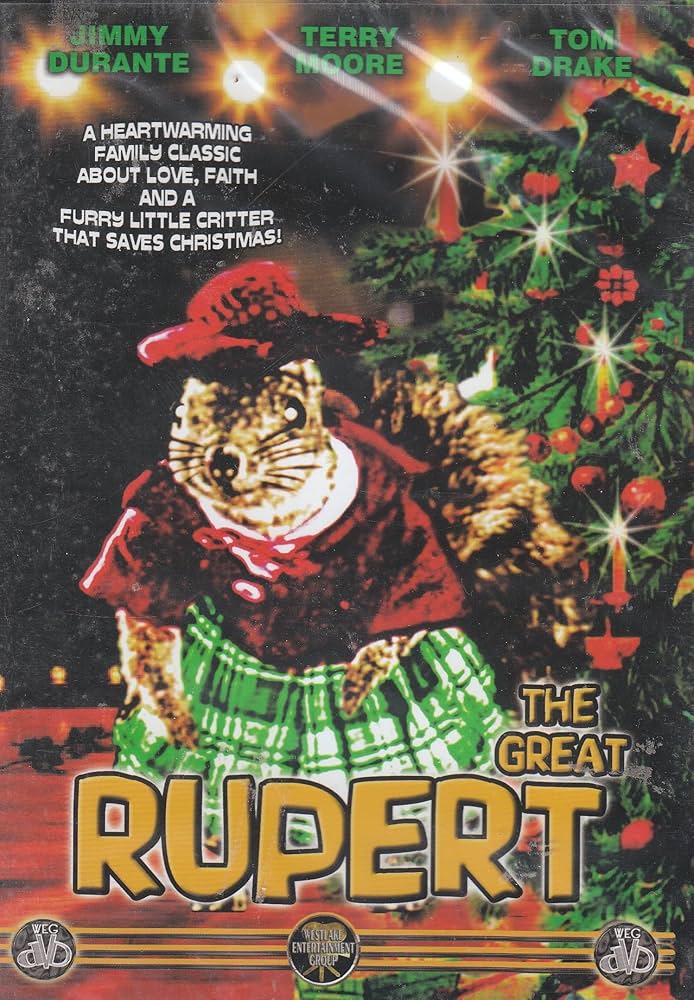
The DVD cover for The Great Rupert depicts an eerie-looking stuffed squirrel, dressed in a red hat and sweater and a green-and-white skirt, standing near a Christmas tree and looking at the viewer.  Above his head reads the tagline: "A heartwarming family classic about love, faith and a furry little critter that saves Christmas!"

The crucially important story element here is also one solidly grounded in these events having taken place on Christmas Eve, cementing this film’s claim as a work associated with the holiday.  The Amendolas lack the kind of funds to give themselves even a meager Christmas feast (Louie is reduced to haggling in the street for a “Christmas tree” that’s barely a scraggly branch stood on end), and poor Rosalinda’s shoes don’t fit but her parents can’t afford to replace them.  The Dingles, meanwhile, have come into sudden and shocking wealth: the father, Frank Dingle, has invested in a mine that finally came through, and the checks are going to roll in once a week from now on, it seems.  Frank’s wife, Katie, wants to get to church to offer prayers of gratitude, but Frank wants to get to the bank instead—he doesn’t trust anybody with his money, not even his wife, and he decides to create a secret stash of cash inside his bedroom wall, where he will shove the money he gets from cashing his weekly check.  These two situations combine for a moment that is somehow both funny and emotionally resonant, as the devout Mrs. Amendola prays to God for just a little money to get her daughter some new shoes, with a choir singing a carol outdoors somewhere in the background, and then Rupert the squirrel, agitated by the sudden appearance of a bunch of money being shoved into his acorn cubby by an unwitting Frank Dingle, kicks the bills out the other side of his nest so that money appears to fall from heaven like snowflakes into the amazed, outstretched hands of Mrs. Amendola.  It’s a Christmas miracle.  Well, “miracle.”  After that, the movie leaves Christmas behind, really not to return at all, but that’s not unusual for a film I’m covering here at FTTH, after all.

The story from that point forward is really bananas, and the final act is completely implausible in every respect—law enforcement investigations halt because the officers just seem to have gotten bored, every unexpected loss is made good by an equally surprising act of generosity, and every longshot chance a person could bet on all come in at once, paying off in the most spectacular fashion.  Any one of these happy accidents or coincidences might have worked as a “see, there is some good in the world” finale, but all of them at once leave the movie feeling either naive or surreal.  Nobody here is quite real enough to have an emotional center we can really sympathize with (other than maybe Mrs. Amendola, whose devout prayers and later moral qualms about asking God for so much money felt authentic, to me), and the quality of the acting and editing overall certainly feels a lot more like a very long episode of a 1950s television sitcom than it does a feature film.  If you love happy endings, though, and really never fuss about how plausible or logical they might be, this finish could work for you.

The titular performing squirrel is another element here that is likely to be divisive.  On the one hand, the special effect of Rupert is really remarkably successful for a film that’s clearly in every other way a low-to-moderate budget production design, a B movie.  George Pal, the movie’s producer, was an Oscar-nominated animator making the transition to live-action with The Great Rupert, and I can confirm that there’s a fluidity and a personality to the animated stop motion of the squirrel that’s impressive.  On the other hand, Rupert and his antics often live fully in the uncanny valley, where his capering to concertina music while dressed in a kilt, for instance, is more unsettling than endearing.  The rigid face of the squirrel (a model I hope is an artistic creation rather than a taxidermied real squirrel with articulated limbs) is such a strange juxtaposition to his energetically flailing limbs.  Rupert’s role in the story is key but small, and therefore the sudden emphasis on him in the movie’s final few minutes is unexpected and a little destabilizing.  You couldn’t do this film without him, but doing the film with him creates a really odd energy sometimes.

I think the thing I wrestle with in The Great Rupert is that I feel I should be tickled pink by it, when I think about its parts.  I ought to be up for a hammy, confident comedic portrayal of Louie Amendola by Jimmy Durante, an icon of his era.  I’m the kind of person who enjoys a solid message in favor of community and fraternity—Frank Dingle’s a villain (to the extent the movie has one) because he rejects his wife’s feeling that the money ought to be spent, and Louie Amendola’s a hero (to the extent the movie has one) because he uses his money to make as many people happy as possible, from his family in need of a Christmas dinner to local entrepreneurs in need of a cash infusion to refugees in Europe displaced by WWII in need of shoes.  I tend to appreciate plot conceits in these “holiday movies” that rely to at least some extent on the religious content of Christmas as a feast—even though we know Mrs. Amendola’s miracle is directly caused by Rupert and not Jesus, there’s an undeniable feeling of grace in the scene that makes it seem like maybe a divine hand is working through the frankly lunatic chaos of Frank Dingle and a cashed check and a hole in the wall and a circus rodent falling like dominos to drop money into her hands at the moment she needs it most.  I’d like to be a booster of this movie…but it’s just too flimsy an enterprise, somehow both slight and overwritten.  It’s never really clear what the movie’s central story even is—Louie Amendola vs. Frank Dingle? Pete’s dream of romancing Rosalinda? Joe Mahoney’s hopes for squirrel stardom?—and none of them are really given the space they need.  It’s a propulsive little movie, that packs a lot of both situation and comedy into its running time, and I would never look down my nose at anybody who says they just plain like it.  It’s cheerful as cotton candy, after all, even when the scenes on film really ought to be pretty serious or even sad—without exception, this screenplay knows how to manufacture happy endings, and it refuses to be stopped.

I Know That Face: Tom Drake, the handsome but penniless musician Pete Dingle, had appeared earlier as John Truett in 1944’s Meet Me in St. Louis, a movie you’ll see covered here on the blog in just a couple of days.  Terry Moore, here playing literal girl next door Rosalinda Amendola, is incredibly still acting today, in her late 90s; the only other holiday-related appearance I know of is a recent short film, 2021’s Evie Rose, in which she plays the 100 year old title character, celebrating Christmas with her teenage best friend.  Of course Jimmy Durante, the generous Louie Amendola, has the unmistakable voice that younger generations might only know from him singing “Frosty the Snowman” on the soundtrack of the Rankin-Bass television program by the same name.  And we have to doff our cap to Christmas perennial Sara Haden – underutilized here as the put-upon Katie Dingle, she’s appeared in other such holiday classics as The Shop Around the Corner (as Flora the shopgirl), which I blogged about last year, and The Bishop’s Wife (as Mildred Cassaway, secretary to the Bishop), a holiday film with a premise almost as strange as this one, though much less whimsical, and one I hope to cover, perhaps next year.

That Takes Me Back: You know, the whole idea of a circus feels stranger and stranger, the older I get—I grew up with them as a cultural experience that I and almost every kid I knew had had at some point, but my daughter’s never seen a circus and I wonder if she ever will (other than Cirque du Soleil).  A movie that’s relying on us having multiple households of circus performers interacting (despite us basically never seeing a circus on screen) is pretty throwback.  Oh, and cashing checks at the bank where everybody can see how much money you’re getting is a reality that on the one hand does seem perfectly normal to me, but it’s also something that I doubt a Gen Z kid would think of as even plausible.  “You mean literally everyone in line at the bank would just hear talk out loud about exactly how much money you just put in your pocket?”  “Yep.”

I Understood That Reference: Louie Amendola refers on multiple occasions to “Old Saint Nick,” a benevolent figure who wouldn’t forget the family.  All they needed was an address (as he exclaims) for the generous fella from the North Pole to show up with gifts all round.


Holiday Vibes (6/10): So, probably the most centrally important scene in this movie involves a snowy Christmas Eve, a choir singing “Adeste Fideles” in the distance, a woman’s devout prayer to God on behalf of her family for some generosity on such an important holiday, and then, once her prayer’s granted, a truly effusive Christmas Day full of trees and tinsel, merriment and music at the landlord’s piano, etc.  A movie that leaned a little harder into all that would score nearly perfectly.  As it is, these scenes fade into the background and the movie’s not even all that interested in making itself feel “like Christmas” to some extent, so the rating falls somewhere in the middle of the seasonal bell curve.

Actual Quality (6/10): I’d love to give higher praise, but this is a movie I’ve tried to enjoy three times in the last five years, and each time I get to the end feeling like I was either rolling my eyes or checking my watch about as much as I was having a genuinely good time.  It’s a gentle movie and it’s not going to bother basically anybody in the room, even if it fails to engage them.  The jokes mostly don’t land, but the music is lively at least, and Rupert’s….well, Rupert is Rupert, and you’ll either love him or find him unsettling.  It’s sure not my worst movie of the year, but I also really can’t tell you it’s any good, artistically.

Party Mood-Setter? It’s just not quite holiday enough to convince me it’s a great idea. But it’s certainly going to evoke that late 1940s vibe that feels like “the holidays” to a lot of folks, and it’s not going to confuse or bother you if your attention drifts in and out as it’s on in the background.  Maybe if you’re out of other options?

Plucked Heart Strings?  You know, weirdly, yes, there’s something moving about Mrs. Amendola’s prayer, and about her moral quandaries afterwards about whether it’s even right to keep asking for money they don’t desperately need.  Queenie Smith, who got her acting training at the Metropolitan Opera in New York City, manages to convey a lot of pathos in a pretty small role. Even Louie’s generosity is sometimes pretty heart-warming.  The main romance is, to me, pretty flat stuff, but I think the Amendolas as people shuttling from rags to riches would give you a little of that holiday glow.

Recommended Frequency: All in all, I think it’s just worth watching once.  You’ll figure out right away if it’s not your thing or if it’s going to become a secret favorite.  My returns to it have been, I think, unnecessary: I could have trusted my first impression of the movie, and I doubt I’ll see it again.  If I do give it another go, years hence, it’ll be me looking to spend time with the emotional journey of the Amendolas again: the movie’s heart is better than its humor.

The rights holders for The Great Rupert clearly have zero concern about oversaturating the market.  It is available from Tubi, Plex, Pluto, The Roku Channel, Sling TV, and something called Xumo, all of them ad-supported streams for free.  Amazon Prime’s got it ad-free, if you’re a member, as does MGM+.  You can pay to rent it, if you really want to, from Fandango at Home, or Apple TV.  You’ll notice that a few of these services list it as A Christmas Wish which was the title given to it when a colorized version was released for sale in the 2000s (presumably they knew that would sell more discs than something called The Great Rupert).  Barnes and Noble will sell you a DVD version for about ten bucks, and Worldcat reports that maybe a couple hundred libraries have it on disc. (Ask your librarian, though—it looks like the movie was added to some anthologies held by many libraries, so it may be there in a multi-disc case that has a generic name like “Holiday Collector’s Set”.)

Tokyo Godfathers (2003)

Review Essay

Right off the bat, I just have to admit — Tokyo Godfathers is surely one of the more potentially polarizing “holiday films” I’ve watched for this project.  The essential premise — three homeless people on the streets of Tokyo find an abandoned infant in a pile of trash on Christmas Eve night and disagree about what to do about it — is wild by the standards of the genre, almost too wild for a filmmaker to seriously attempt to portray it on screen.  You can envision, though, Hollywood entrusting the movie to some safe director and screenwriter who turn it into a gentle comedy about how hard it is to change a diaper on a park bench, I guess.  In the hands of Japanese auteur Satoshi Kon, however, Tokyo Godfathers presents an anime vision that is simultaneously much more realistic and much more fantastic than that, and in the process achieves some incredible moments of artistry.

The realism is where this film is most likely to lose a viewer, if it’s going to — our three protagonists are Gin, a miserable middle-aged alcoholic driven to the streets via more than one kind of addiction; Hana, a trans woman under basically constant criticism and threat from a society full of people that won’t accept her for who she is; and Miyuki, a teenager on the run for months now from her middle class home, about which she doesn’t want to talk and towards which she has no intention of returning.  The three of them live in genuine squalor, a ramshackle construction of cardboard and odds and ends, and the world around them is relentlessly hostile.  The movie pulls no punches, literally — we see the violence of the streets (especially violence directed at the homeless by bored, moneyed young men), we hear the coarse and sometimes vicious language of the streets, and we fully encounter the desperation of the streets as people with no resources and few options try to work out their own issues without totally tearing apart the lives of every other human they touch.  Yeah, yeah, I know — it doesn’t sound much on the surface like a Christmas story.

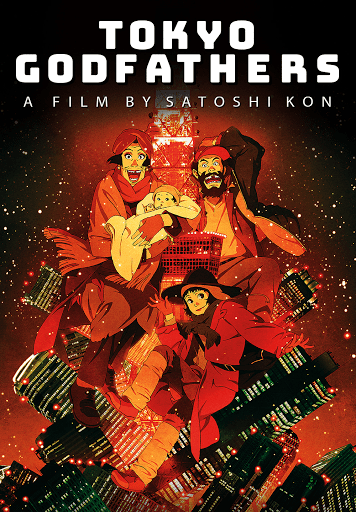
The movie poster for Tokyo Godfathers: A Film by Satoshi Kon. In the background, Tokyo skyscrapers tumble at strange angles in a dark, reddish light. In the foreground, the three main characters, Hana, Gin, and Miyuki, look directly at us. Hana smiling joyously as she holds the baby Kiyoko; Gin screaming in fear as he holds his hat on his head with one hand; and Miyuki, enigmatically grinning as she gestures to both sides, as though dancing.

Unless we consider the first Christmas story — a couple on the streets, no place to lay their heads but a barn, a child born amid squalor.  That might seem a stretch to you, but the film is transfixed by the divine, opening on a Tokyo church service in which Hana is moved to ecstasy contemplating the Christmas message of hope to the poor even as, right next to her, Gin scowls and grumbles as he observes all the ways that message doesn’t seem to touch the life he’s living.  Hana — whose own understanding of herself as a trans woman is so complex (she at one point says proudly, in response to someone calling her a “mistake”, “I am a mistake made by God”) — is the catalyst for the movie’s action, since when they discover a child in the trash while scrounging, the other two want to give the baby to the police immediately, but Hana throws herself protectively into action, insisting that this is her chance to be a mother.  She wants one day — Christmas day — to experience God’s miracle for her, the child she never thought she could have.  And the other two (who, in their very tortured and sometimes torturing ways, love Hana) relent.  What a strange miracle, you can see them both thinking.  And both the strangeness and the miracles persist.

Hana names the baby “Kiyoko”, inspired by a phrase from the carol “Silent Night” — the name will matter by the movie’s end, but at first it feels like just another inscrutable nod to Christmas itself.  Something about the baby provokes all three of the main characters into introspection, and sharing more of their life before homelessness and what drove them here.  And before too long, they settle on a plan — Hana wants to bring the baby back to its mother directly (it was found with a key to a bus station locker that they see as their first clue) to confront her and see whether or not she’s worthy of the child.  So, off across Tokyo they go, and the movie never totally slows down again after that — at least one of them is almost always running somewhere.

And my earlier mention of miracles is an honest use of the word — somewhere amid the gritty reality of this Tokyo, we repeatedly encounter the impossible.  A resource available right when it’s needed; help from an unlikely friend; the perfect gust of wind; even the miracle of pain or harm bringing one of them exactly to the place they needed to go.  As Hana repeatedly observes, there does seem to be something divine about little Kiyoko, in whose presence something like peace just might prevail on earth (well, for a broad definition of “peace”).  We even get the exchange between Hana and an embittered Gin, in which she tells him “Kiyoko is God’s messenger: we are her servants.”  To which Gin replies, “Unpaid servants, then, paying for a father’s sins.”  This is the tension surrounding the Christmas message, I feel like, or at least that’s the tension this film wants to explore — it’s easy to see the wondrousness of a blessing falling into the life of one impoverished, but then you have to reckon with what Gin’s observing.  Why is he here in the first place, in need of blessing, and what’s he going to have to go through to get it?  It hardly seems fair.

This is the remarkable thing about Tokyo Godfathers.  In a movie full of obscenities and street violence, gang assassinations and car crashes and substance abuse, what the film seems most interested in is beauty, harmony, and hope.  Hana’s haikus, when she speaks them, appear as calligraphy on the screen.  Beethoven’s 9th Symphony repeatedly drifts into the background, so that when at a climactic moment in the screenplay suddenly we and the characters both hear over the radio the triumphant chorus of the Ode to Joy, it doesn’t feel forced, it feels like a celebration the film itself has been building towards.  The film’s about the ways people trick themselves, and the mistakes we make in trying to fix things.  It’s about the pain of honesty, and its power.  It’s about Christmas’s promise and the ways we feel it lets us down.  As two characters observe to each other, late in the film — one says, “God must be busy this time of year.”  And the other says, “Better once a year than never.”  

I Know That Voice: For animated films, the only “familiar” performers will be voice actors, of course — the voice cast of the Japanese original film are not, as far as I can tell, folks who ever appeared in another film involving Christmas.  But the dubbed GKIDS release of the movie might be the one you’d see — and they did a great job with the voice casting for the dub, including a couple of trans actresses to play the trans roles, which I’m glad about and curious about (I only had access to the original with subtitles, so I haven’t heard the dubbed cast).  If you do watch the dubbed version, you might hear Kari Wahlgren as the voice of Kiyoko, the baby, and recognize that she also voices Jojo in both Christmas Chronicles movies, and both Dorothy and Ozma in Dorothy’s Christmas in Oz.  Crispin Freeman (the voice here of Ishida, Miyuki’s policeman father) also voices the character of Fabian Menkle in Scooby-Doo! Haunted Holidays.  And finally Gloria Garayua (the voice of Maria, the Hispanic woman who connects with Miyuki despite their not speaking the same language) later plays the live action role of Daphne in Christmas Staycation, a 2020 pandemic Christmas movie set entirely on Zoom — that feels like one I’ll have to try, one of these days, just for the novelty of it.

That Takes Me Back: The early scenes where there’s more focus on the “trash” surroundings inhabited by the main characters give us a number of glimpses of throwback items.  Hana, for instance, has a boombox in her corner of their little cardboard home, though as I recall we never hear it played.  We do see them rely multiple times on access to a pay phone, initially to call the “hostess club” they find out about from the materials in the locker.  It’s wild watching someone looking at a photograph and trying to figure out where it was taken, without them just being able to open up Google Street View to check if they’re correct — literally running up and down streets in a neighborhood trying to figure out what vantage point you need for a specific view.  Lastly, I did spot a copy of Star Wars on VHS, which in 2003 is already at least slightly outmoded, and now seems like another world entirely.

I Understood That Reference: You know, a bit surprisingly for a film set so far outside the boundaries of the usual holiday film, there’s at least a couple of references to classic Christmas tales.  I mean, most significantly, there’s a fully-fledged Christmas pageant at the church in the opening scene — we hear some lines from it spoken aloud, and perhaps our glimpses of the three Magi adoring the Christ child help prefigure what’s ahead for us.  And this is more of a stretch I guess, but early on in the film, Gin jokes that Santa Claus may have made off with the baby when he and Miyuki wake to find that Hana’s run away with the kid — the notion of Santa showing up not to leave gifts but to steal a baby was amusing enough that I made a note of it, and it’s fun to see characters a long ways from Santa’s cultural home base still using him for that kind of purpose.


Holiday Vibes (3/10): It’s really hard to grade the “holiday vibe” of something so far from the usual, but the opening scene is very classically Christmas, and the film keeps playing with imagery from the Christmas story (and thematic allusions) in ways that maybe were subtle, but that I kept picking up on.  In other words, in strictly literal terms this is probably closer to a 1 or 1.5, just barely any on-screen holiday stuff to latch on to.  But in terms of giving me Christmas feeling, well, it’s doing more than you can see — enough that it’s hard to score, but 3/10 feels right to me.

Actual Quality (9/10): The experience of watching the film directly is more challenging — at least for me as someone not familiar with Kon’s visual style, which is really aggressive and not at all like the kinds of Japanese animation I’m more familiar with (Miyazaki and Takahata).  Also the setting is so gritty and often grim that I was feeling a lot of things as the film went by and I didn’t always find myself connecting fluidly to what was happening on screen in the moment.  But this is one of those films that gets under your skin — I keep thinking about it, and the film improves the more I reflect on its use of symbolism and the ways the characters sprang to life and how the progression of the plot unfolded things at just the right pace, etc.  I do think there are some places where it’s just a little too operatic or melodramatic for me — I enjoy the surrealism but it’s hard to dial it in just right.  But I liked it a whole lot.

Party Mood-Setter?  Ha!  I cannot imagine this being just an “on in the background” kind of movie — love it or hate it, you won’t really be able to take your eyes off it (unless you’re turning it off).  I’m recommending it, sure, but not for this.

Plucked Heart Strings?  It’s a yes for me — there’s real emotion in what a couple of the characters go through.  Don’s style is not to dwell on those moments, so unlike a lot of other films, my guess is you won’t feel the emotion as strongly in the moment as you will when you look back on the movie and reflect about it.  

Recommended Frequency: A really tough call — the movie is intense enough (and weird enough) that I wouldn’t always be in the mood for it.  But there’s no denying its quality, for me.  I’d say this is one I will revisit over the years as I age, hoping to find new things in it: at first I thought it wouldn’t likely be an “every year” movie for me, but the longer I think about it, the more I want to engage with it again, and soon.  As long as the intensity of the film (and its bold, disruptive animation style) doesn’t put you off, I think you should definitely give it a watch, and if you tried it a long time ago but haven’t gone back, I really think you should.

If you decide to take my advice and watch Tokyo Godfathers, you’ve got options for viewing it: Amazon Prime will show it to subscribers, and you can watch it free (with ads) from Tubi, Pluto, or the Roku Channel. All the usual places will rent it to you, too.  As far as I can tell, all the streaming copies are the original Japanese audio performances with subtitles (which is how I watched it), but if you’re looking for a dubbed version, I believe the Blu-ray copy available at Amazon (and anywhere else that sells movies on disc) has the English audio track that GKIDS created.  The movie’s good enough that I may acquire myself a permanent copy this year — if so, I’ll report back.  This is a movie less widely held in American libraries, but Worldcat says there are 31 copies on disc out there, and maybe one of them is near you — worth a look, if that’s your preferred method of movie watching!