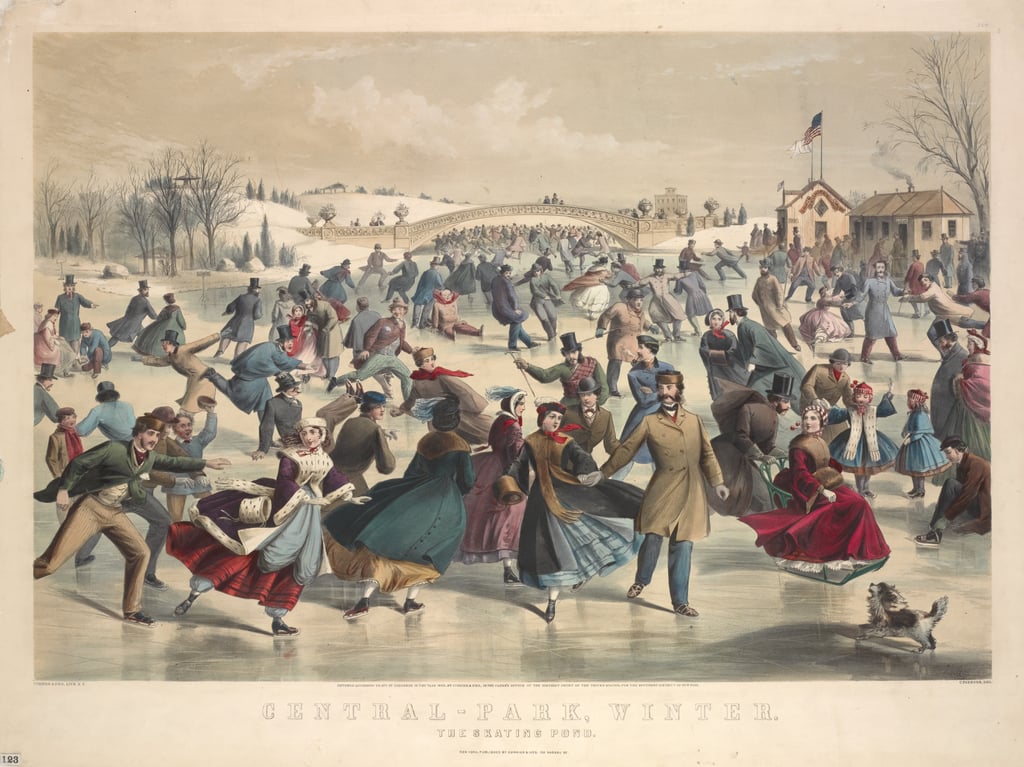
Bell, Book and Candle (1958)

Review Essay

The definition of a “Christmas film” is always negotiable — yes, Die Hard fans, I know you’re still out there, and no, I won’t be covering Bruce Willis and his machine gun, at least not in 2024 — and that’s certainly true here.  My general rule is that if Christmas is a key setting for more than a few minutes of the movie, it ought to count, and this film, which opens on a snowy scene with Jingle Bells playing in the background as people carry trees down a New York City sidewalk, really has to count.  But as I’ll discuss, it’s among the less seasonally oriented flicks I’ll cover here at Film for the Holidays.

The initial premise is more traditionally rom-com than anything else — stiff middle-aged publisher Shep (played by Jimmy Stewart) lives upstairs from “exotic” art dealer Gill (played by Kim Novak).  She thinks he’s attractive, he’s polite but has a fiancee, and she….well, she’s a witch, and one or two little spells couldn’t hurt, could they?  If it sounds like a Bewitched prequel, it basically is: that series was created after this film came out, by Columbia who released this movie in the first place.  And I’d love to tell you this movie charmed me as much as episodes of Bewitched did, once upon a time.  But it didn’t really land for me — and the reason I think the movie doesn’t work was honestly a real surprise to me.
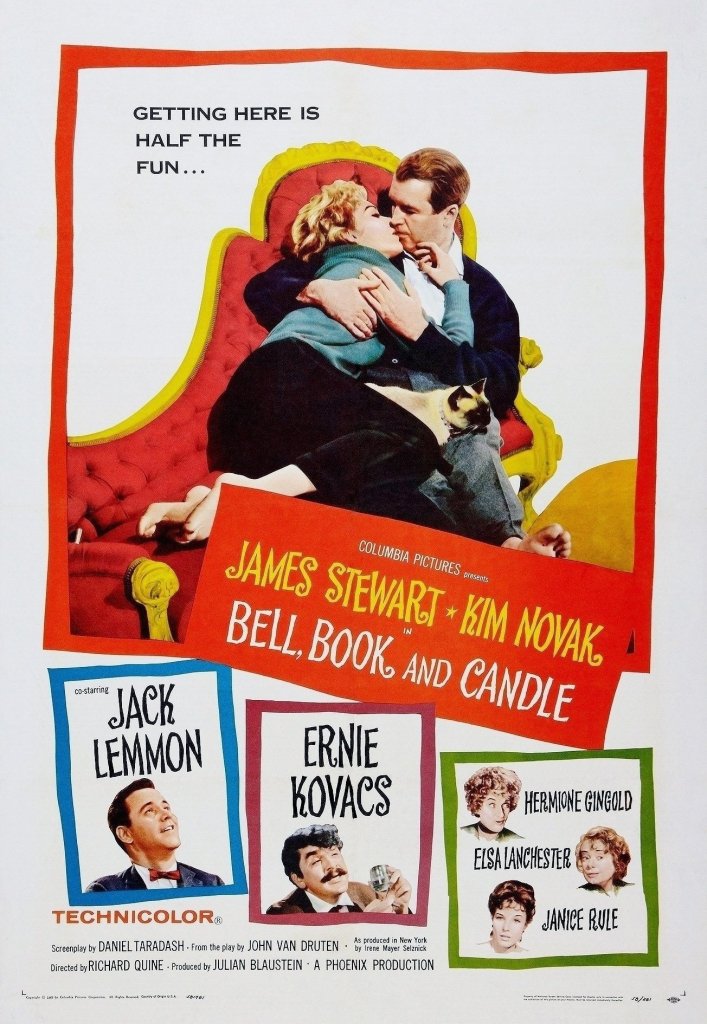
The movie poster for Bell, Book and Candle offers the tagline "Getting here is half the fun". The top half of the poster features Jimmy Stewart and Kim Novak, barefoot on a chaise longue, embracing, with a Siamese cat sitting atop them both. The bottom half is divided into multiple boxes announcing the supporting cast: Jack Lemmon, Ernie Kovacs, Hermione Gingold, Elsa Lanchester, and Janice Rule.

First off, though, quite a few individual elements here do work.  I love the late 1950s aesthetic — sure, the 1940s classics really established the genre of the holiday movie, but as a kid growing up in the late 20th Century, it was the 1950s that seemed to have created the Christmas look I think we were all nostalgic for, less wartime optimism and more the shimmer of the postwar boom.  Kim Novak as Gill is sensational most of the time — sultry and alluring in ways the ‘40s films wouldn’t really have let her be, and clearly presented as “daring” (Novak is barefoot basically the whole movie, which felt both avant-garde and playfully flirtatious, given that it’s New York City in December and her ground floor retail establishment can’t be all that warm).  Her brother, Nicky, is played by a really dazzlingly talented young Jack Lemmon, who pulls off a range from simpleton to scheming and makes the character feel coherent throughout — sure, it’s a comedic performance, but that doesn’t make his skill LESS impressive.  If anything, it’s a bit more impressive that he’s applying so much talent to a role that’s honestly not very consistently or compellingly written, on the page.  The two of them are on screen much of the movie’s running time, and thank goodness for that, since they’re usually doing something worth watching.

The big problem here — and I can’t believe I’m saying this — is that I think Jimmy Stewart’s performance is a distracting mess.  Now, Stewart’s one of the finest American actors of his generation, if not ever: I love his work in It’s A Wonderful Life, and if anything he’s even better in The Shop Around The Corner, both of them iconic holiday films and likely to be coming soon to a blog near you.  Here, though, everything about his presentation of the character goes weird from the beginning.  Stewart’s not helped by the fact that he looks all of the 50 years old he is when this movie comes out, and Kim Novak is very 25 — sometimes there’s a chemistry between them, but much more often you just really wish each of them would find someone their own age.  (And yes, folks, I know they’re also in a romance in Vertigo — I’m not telling you anything about that movie, I’m just telling you what I think doesn’t work about this one.)  Shep is written really oddly: at times he seems naive (his calm response to finding a strange old woman inside his locked apartment is very odd) but at other times he feels almost rakish, talking about the Kinsey Report with Gill when he barely knows her, or telling his secretary he wants her to have the negligee he had ordered for his fiancee.  And fundamentally, the thing Shep needs to pull off is the feeling that we’re watching a man gradually become unsettled, even haunted, by the feeling that his own emotions and thoughts have been invaded by magical compulsion, and that he’s so horrified by the thought that he decides to run away from his brand new fiancee who….well, who looks and acts like a sultry Kim Novak who’s half his age.  Stewart, to me, just doesn’t land the plane at all — his attempts to convey pretty simple experiences like “allergic to cats” or “scared of witchcraft” feel like awkward flailing by someone in Drama 101.  I can’t really explain why it’s not working, since Stewart clearly knows how to act (he was, I think undeniably, among the finest performers of his generation) — I can only think either that he felt the script was beneath him enough that he decided to ham it up, or else that maybe he felt a little embarrassed that they were casting him as a 25 year old’s love interest, and his feelings of unease or awkwardness emerged in his performance as a result.

The film has other issues, to be sure.  My notes as I was watching remarked on multiple occasions about pretty terrible sound editing — there’s a LOT of ADR (where an actor re-records their lines in the sound booth, after the fact), and it’s just not mixed well, so that it doesn’t sound like the actor is talking naturally in the room we see them in, but instead they sound like they’re in a recording booth talking directly into a microphone.  The script’s silliness is sometimes hard to follow: for instance, a character promises to keep a secret, but then almost immediately is handing out information left and right, and the film never seems to present it as a flub-up or subversion of the promise.  The movie struggles too, I think, to convey what tone we’re supposed to be picking up on: is this light-hearted or spooky?  Is Gillian basically well intentioned or basically self-serving?  And to be clear, I think intentional ambiguity in a movie is just fine: really good, even.  But there were too many moments for me where this felt less like conscious ambiguity and more like carelessness, or else honest confusion.

As a holiday film, well, I’ll give it a rating below, but I’ll admit, after the first 35 minutes or so, we leave Christmas in our wake completely, other than a scene in which kids are throwing snowballs and skating (which felt holiday-adjacent to me?).  And even in that first half hour, these are people who don’t seem all that interested in Christmas — we’re given some traditional music here, but these adults don’t seem to have gatherings to attend, last minute gifts to buy, etc.  They spend Christmas Eve in a nightclub without seemingly a care in the world.

Ultimately the film’s got fun moments where it cheekily gets close to breaking the “code” for films at the time — one bold line of dialogue occurs when Shep tells a character, late in the movie, that Gill is a witch, and the character replies “A witch?  Shep, you just never learned to spell.”  Which is maybe the classiest (and possibly only, in 1958) way you could call a character a….well, it starts with a b.  Again, though, it can’t ever really commit to a tone, since I think the whole premise leaves us caught between seeing Gill’s bewitching of Shep as lighthearted fun and a deep betrayal, and it’s just a bit too hard to square those things no matter how you squint at them.  So the fun, for me at least, is intermittent, and the lasting impression is more confused than classic when I think about the movie as a whole.  Scene by scene, or line by line, though?  There’s some real gems in this one when remembered in that way, and it’s a flirtatiously fun changeup to throw into the catalog of holiday films I’m taking on here.

I Know That Face: Obviously, Jimmy Stewart who plays Shepherd Henderson in this film is better known to Christmas movie fans as the star of Frank Capra’s classic It’s A Wonderful Life or of the less-famous but also brilliant The Shop Around the Corner — most of us probably see his face every single Christmas season, perhaps multiple times.  And Elsa Lanchester, the mischievous Aunt Queenie here, plays Matilda the housekeeper in the household of the Broughams in another half-forgotten mid-century Christmastime film, The Bishop’s Wife.

That Takes Me Back: This “takes me back” even farther than I was alive to see, but I was charmed that we don’t just see characters using a rotary phone, but we hear them referencing a phone number that begins with a word.  I’m tempted to start handing out my office extension on campus as “HArrison Six Two”.  A less appealing hit of nostalgia came along with the sight of someone smoking casually indoors (as Merle does at the Zodiac) — I was describing to my daughter just a few weeks ago how the world used to have things called “smoking” and “non-smoking” sections, a thing she can’t really envision.  And I don’t know that this is actually a throwback, but the work “negligee” feels SUPER old-fashioned to me for some reason.  If you all are constantly talking about negligees, I mean, a) I bet you throw a great party, and b) clearly you and I are having some of your most boring conversations (my apologies).  Oh, and I chuckled at the line, “A typewriter: I’ve got to get a typewriter.”

Sadly, I didn’t find that this film yielded anything at all in the I Understood That Reference category; better luck next time, maybe.


Holiday Vibes (2/10): This was a fun film to include on the blog, and it does come up as a “holiday movie” on some lists, but as noted above, the actual festive content is really brief, and we don’t even really get much of a “Christmas” for the film’s one Christmas Eve sequence.  If you’re someone who likes to think broadly about what counts as a holiday movie, it’s not like there’s nothing here for you….but there’s not a whole lot here for you.

Actual Quality (7/10): Bell, Book and Candle is a movie I wish I could recommend with more enthusiasm, since there’s undeniably some worthwhile things to enjoy here.  I have the feeling it’s one I’ll rewatch in a few years, thinking maybe I judged it too harshly….and find myself saying again “ah, right, it just doesn’t work as a romance”.  I do think that almost everything around the romance DOES work, and for that reason I hate to be so down about it.  But in a romantic comedy, if the romance ain’t working, I don’t know that the film has anywhere to go in the end.

Party Mood-Setter?  I mean, if you’re having a flirty, fun, fifties shindig this holiday season, throw Kim and Shep on the screen and don’t pay that much attention, maybe?  But honestly it’s got to be a “No” since what this question is asking is, can this background a festive holiday gathering, and here I don’t think it’s anywhere close to being enough of a holiday vibe.

Plucked Heart Strings?  There’s emotion on screen, but I don’t feel pulled in by any sentiment — Gill is certainly going through it, especially late in the film, but I never found myself feeling anything along with her.  Again, I think the tone is the challenge here, since it’s not clear to me who’s wronged who, or how, or even if anybody’s really been wronged at all, and the main characters became just a little too caricatured along the way for me to connect deeply with them like this.

Recommended Frequency? Look, if you’ve seen it and it didn’t win you over, I’m definitely not here to tell you to put it on this December.  But if you’ve never seen it, honestly, I think you could give it a go for Kim and Jack: Novak and Lemmon are really on their game here, and even if the film is only “fine” overall, I doubt you’ll regret getting to see the movie’s best scenes and lines. As for me, having seen it once already, I do think this will be a once a decade kind of movie for me — if it’s more than that for you, though, I’m delighted and hope you have fun in the fifties!

You can stream Bell, Book and Candle if you’re an Amazon Prime member, and Tubi will play it for you for free (with ads).  It can, of course, be rented from most of the usual places online.  Amazon will sell it to you on Blu-ray, or DVD, or VHS (is VHS making a comeback, folks, and nobody told me?).  And as always, I encourage you to make use of your local library: mine has the movie on DVD, at least, and I bet yours will too.
Jack Frost (1998)

Review Essay

There’s this hack comedy quality just oozing from Jack Frost from the jump — it’s hard to say what it is exactly.  Could it be that the main character is actually named Jack Frost, which we know because he’s a musician in a group called the Jack Frost Band, which we can see displayed prominently behind him, while he sings the lounge lizardiest version of “Frosty the Snowman” I’ve ever heard?  And in the audience an enthusiastic record company exec literally places a cellphone call and tells the person on the other end to “listen to this”, holding the phone up pointed at the stage like someone whose only image of a great concert is from Back to the Future?  Oy.  We haven’t even met the child actors yet, and this is already so painfully a mediocre ‘90s family movie, which, as a kid who grew up in the ‘90s, I sure have a deep experience of as a milieu.

Because yes, on the one hand, this is a story about magic — about a child who resurrects his dead father in the body of a snowman by means of an unexpectedly magical harmonica and then the dad can learn some Lessons about Parenting and the Value of Family.  But it’s also a movie that’s picking through ideas cut out of other, better-but-still-not-amazing ‘90s movies, and deciding to shove all the schoolyard snow bullies and ridiculously self-important children’s fantasy into the film it can manage to hold.  Our main child character, Charlie Frost, is a hero, smart and friendly and skilled, and his only enemies in life are the dumbest and most mindlessly aggressive of meathead elementary schoolers — squinting, scowling menaces who use the word “twerp” like it’s going out of style and prioritize actions that will cause emotional harm since they have no ambitions in life beyond being screenplay villains.

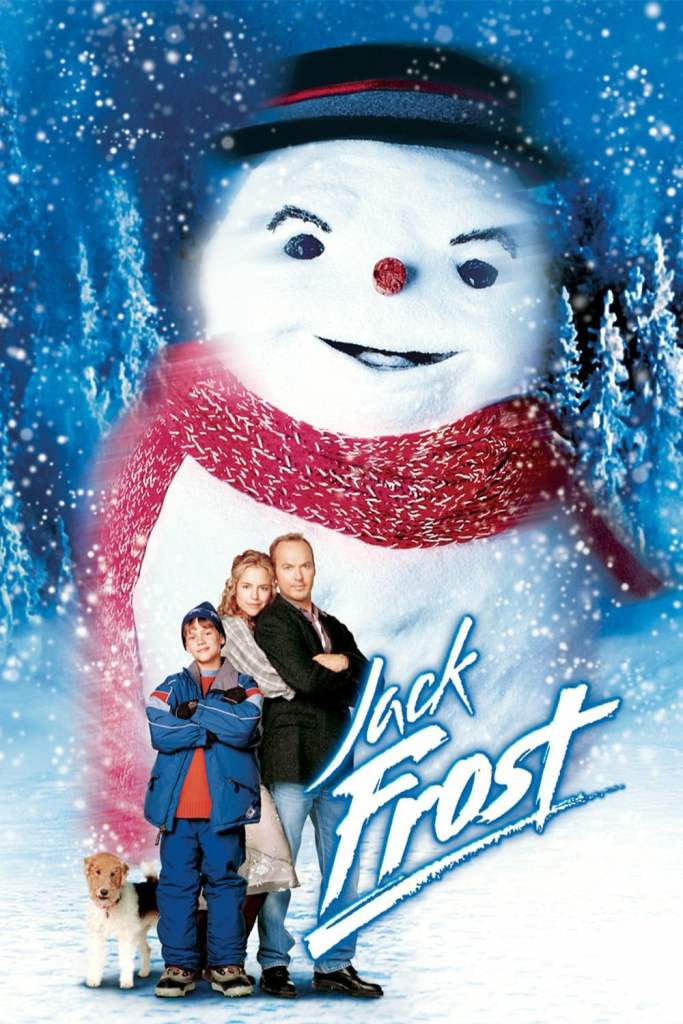
The movie poster for Jack Frost features a huge snowman in a top hat and red scarf with an eerie, menacing grin on his face, looming in the background behind and above the title of the film and the movie's principal cast members, Michael Keaton, Kelly Preston, and Joseph Cross, plus an adorable dog. It was the 90s.

Part of what’s exhausting about the movie — and I’m sure it’s partially because I’m not a kid anymore, I’m a parent, and I see these things differently now — is that in the cinema of the 1990s, few things were worse than a parent whose job was important or demanding enough that they couldn’t devote 100% of their time to teaching their kid how to play hockey or bake cookies.  I mean, Keaton as Jack Frost is not that bad a parent — he’s curious about his kid, he’s been thinking about him while he was away, he prioritizes time with the kid the moment he’s home, including playful midnight snowman building, etc.  Sure, he makes a promise he couldn’t keep, but it just feels like a pretty minor sin in the grand scale of things — but the movie subsequently punishes him by killing him off, and then restoring him to life solely so that he can learn how important it is to self-destructively indulge every wish Charlie has.  Am I reading too much into a screenplay that didn’t honestly think that hard about this?  Sure, I suppose — you can expect more of this kind of overthinking on other films too, I suspect!  I just think that the film already had a pretty massive idea here in the snowman that’s a resurrected human being — lashing that kind of elemental magic to a story this pedestrian just seems so foolish and tedious.

I mean, surely there’s a limit to how many butt jokes you can make in a film and expect to be taken seriously.  Add to that the fact that they take advantage of a major character who’s a snowman to make multiple PG-acceptable (apparently) BALLS jokes?  Like, I guess that’s what a snowman’s constituent elements are — they’re balls?  What am I even talking about anymore?  And the screenwriters know how hack this movie is, since early on in his second, crystalline existence, we even hear Michael Keaton comment on how bad a joke it is that a man named Jack Frost became a snowman after death.  I have to say, fellas, it doesn’t make it less goofy and ill-advised to have you acknowledge it.  But “goofy and ill-advised” are the constant drumbeat of this movie — at one point, Jack Frost tells Charlie, “you da man!” To which his son replies “no, YOU da man!”  To which Jack replies….can you guess?  “NO, I’m da SNOWman!”  I was shocked there wasn’t a laugh track.  Later in the movie, a character says to Jack and his son that “a snowdad is better than no dad.”  That’s a line so howlingly awful that my wife and I have been saying it to each other at every opportunity, ever since I accidentally made her watch this with me.

I will say, though, that I think it’s possible the movie is hampered by factors external to the script — any movie reliant on the naturalism of its child acting performance is likely to have a really rough go of it unless it’s very lucky with casting.  In this one, for instance, Joseph Cross was a kid with some talent — he’s grown up to be a very solid performer in the films I’ve seen, at least.  But as a child actor in Jack Frost, he’s pretty rough — and he’s acting opposite an animatronic/early CGI snowman effect that on the one hand is pretty incredible for the technology at the time, but on the other hand is still pretty limited in its ability to convey Keaton’s emotion and energy.  The movie’s best on-camera performer (once Keaton’s trapped inside Frosty) is Kelly Preston as his wife, but the film’s so engrossed in Jack Frost’s need to fix his allegedly terrible parenting that it pays really no attention to his relationship with his wife, and as a result she’s far too sidelined.  Essentially, I’m arguing, the screenplay was doing no favors of any kind to the movie in the first place, but the premise worked against its ability to put compelling performances on the screen — maybe there are folks out there who feel nostalgia about this (or can still marvel at the snowman: again, it’s honestly pretty cool as a practical effect), but for me, it’s just a reminder of all the ways a movie can go wrong.

I Know That Face: Michael Keaton, of course the leading role here as Jack Frost, is also the title character in Batman Returns — a film that, like Die Hard, is set at Christmastime and has Christmas elements, but was never marketed in that way, yet now it’s amusingly contrarian to claim it’s one of your favorite Yuletide movies.  Hey, you do you.  Andrew Lawrence, who plays Tuck Gronic (one of Charlie’s hockey teammates), voices T.J. Detweiler on Recess Christmas: Miracle on Third Street, as well as directing and co-starring in Mistletoe Mixup, a holiday romance flick involving a couple of other Lawrence brothers, to boot.  Lastly, Mark Addy, who plays Mac MacArthur, the improbably British man who is somehow also a local retail employee in this tiny Colorado mountain town, appears as “Ass” in The Flint Street Nativity, a television movie from Great Britain in which adult actors portray children acting in a school Christmas play.  Ugh, heaven help me, I am intrigued: what a bonkers premise.

That Takes Me Back: Man, the ‘90sness of the film was such a nostalgic rush that picking out individual elements was a bit difficult, ironically.  Things I noticed in particular included the kid needing a bag full of “Game Boy batteries” for his trip to the cabin, him having a lava lamp on his bedside table (what was it about the ‘90s and lava lamps? Did we have some technological leap forward in lava lamps in that era?), snowboarding being treated as something new and edgy, and lastly, having actual independent radio stations where there’s a live local DJ talking to you.  That last one’s sad.

I Understood That Reference: Frosty the Snowman, of course, looms large over this film — it’s the only piece of Christmas media I detected, but we do get a double dose, both of the song (oozing with lounge singer charm) and later a glimpse of the animated Rankin/Bass television special itself in all its tacky glory.


Holiday Vibes (3.5/10): Jack Frost himself, of course, is a figure who doesn’t really play into any particular holiday pantheon, and this snowman phenomenon doesn’t really play with either the Jack Frost mythology or the idea of Christmas’s magic.  Though the film takes place around the idea of celebrating Christmas, honestly the movie is so busy being a ‘90s kids’ comedy full of bullies and butt jokes that there’s not all that much holiday energy on display?  It’s about as Christmassy as any film set in December in the United States, which is to say, a bit, but not that much.

Actual Quality (3.5/10): Surely I’ve already given you enough commentary on this — it’s a bad movie.  All the good things about it are Michael Keaton trying his best under pretty dire conditions (he’s badly miscast as a relaxed lead singer in a band, and the snowman’s lamentable dialogue has already been referenced) plus a decent adult supporting cast (Preston and Addy have talent, to be sure), and a snowman effect that’s genuinely impressive (while also being creepy and chunky, especially when viewed from the vantage point of 2024).  All of that adds up to a film that still really lacks any reason for existing, let alone for taking 100 minutes of your evening.  If you’re not already pretty deeply nostalgic for this, watch the trailer and you’ll know all that you need to.

Party Mood-Setter? No.  At least I can’t imagine a party that would be enhanced by it — there’s so many better family films that have both better quality and more holiday energy.

Plucked Heart Strings? No!  It’s honestly kind of incredible that a movie about a dad dying on Christmas Day, and then being restored to half-life only to then basically die on Christmas Day…again…somehow never once made me feel emotionally invested, but it really didn’t.  The movie’s tone (and everything else about it) works relentlessly against this.

Recommended Frequency: NO.  Just, no.  If you didn’t already form an attachment to this movie at a young age, I would steer you to so many other, better movies.  I’m not really thrilled I watched the whole thing, and I definitely won’t be touching it again.

Well, friends, if you have cable television (I know, I know, it’s 2024, but SOME of you statistically must still have it!), TNT will stream this to you for free.  You can buy or rent a digital copy from all the usual places — YouTube, Google Play, AppleTV, etc.  Amazon, in addition to renting it to you on Prime, would sell you a DVD copy or, astonishingly, a copy on VHS, of all things.  But, don’t?

Scrooge (1935)

Review Essay

Welcome to the first of these A Christmas Carol adaptation reviews, which will appear on the blog each Sunday.  I’m sure any of us who love Christmas movies have a favorite Carol, and part of what inspired me to start this project in the first place was my own affection for a couple of particularly wonderful Christmas Carol adaptations.  As you’ll see below, the categories and scoring system will work somewhat differently than the regular reviews, which I hope you’ll enjoy as a little variation.  I’ll note, too, that this story is so universally well known, and the details I want to talk about stretch so fully through the film, that these Christmas Carol film reviews will be MUCH higher on spoilers.  To me, talking about Scrooge’s redemption arc is about as much of a “spoiler” as telling someone the Titanic is going to hit an iceberg and sink (apologies if that just ruined James Cameron’s film for you), but I wanted you to be forewarned about that approach.  Okay, on with the show.

For my first Christmas Carol on the blog, I just had to go with the oldest feature film version of the story that has sound (I’ll probably take on a silent film version someday, if this blog persists beyond this first quixotic holiday season).  There’s more than one version of the 1935 Scrooge, though, so to be clear, I watched the movie in its original full length version, in black and white: there’s a shorter, colorized version of this film that was created a few years later for American school children, and that’s the one you’ll more frequently see on streaming services.  Whichever one you watch (I’ve seen both versions), the surviving print of this film is in bad shape, with lots of cracks and pops, and a wobbly and sometimes fuzzy or murky image.  Someday we need a nice, clean version (which I know we now have the digital tools to create), but goodness knows when one will be produced — the free market has no shortage, after all, of Christmas Carol movies!

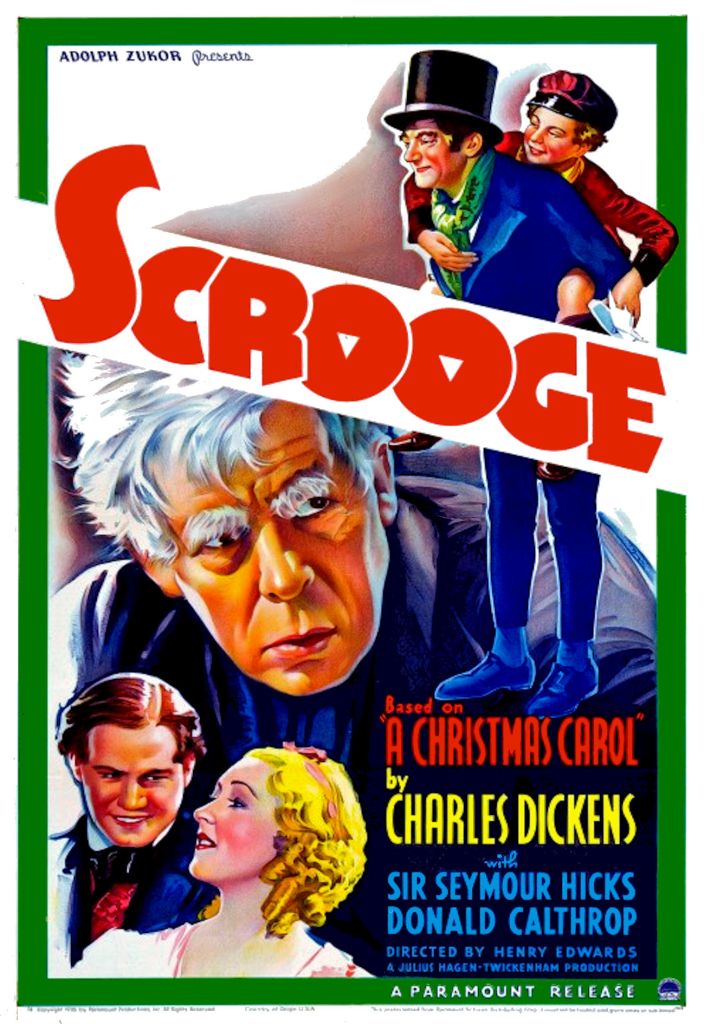
A poster for the 1935 film, Scrooge, the title of the film is written in large red letters. Just below it, Ebenezer Scrooge glares off to his left under long white eyebrows. Beneath Scrooge we see Fred and Clara, and beside and above him (and the title) is Bob Cratchit, carrying Tiny Tim on his back.

There’s a definite attempt at realism in this version of the story — the band playing in the street outside Scrooge & Marley is just as out of tune as one would have been in real life, I’m sure, and inside the office itself we see that Scrooge’s desk and work look very little different from Bob Cratchit’s, as might well have been the case for someone as dedicated to miserhood as Ebenezer was.  The portrayal of Scrooge by Seymour Hicks is much more infirm and physically shaky: he seems both closer to the grave and more frail (and less intimidating) than in a lot of other approaches I’ve seen.  But being less imposing doesn’t make him less malicious: to the contrary, this adaptation is a lot more personal in his jabs at Bob, asking him about his family before reminding him of how painful it would be to lose his salary.

We see a little more of a montage after the end of the workday than sometimes appears in a Carol — scenes evoking lots of Christmas energy and spirit, including the Lord Mayor’s Christmas toast to the Queen which I think I’ve never seen in another Carol.  Also this version does show us Scrooge eating dinner in a tavern (alone, and dining on a pretty meager feast), which further extends the passage of time before the supernatural invades the plot.  I’d say the integration of the supernatural here is, in fact, a bit shaky — Scrooge doesn’t react aloud to the Marley doorknob effect, so that any viewer unfamiliar with the story (there have to be a few of them left in the world, don’t there?) wouldn’t really know what’s up.  He’s silent, too, in searching the house, which nevertheless he does do on camera, and slowly — arguably suspense is building for the audience, but to me this dragged a bit.  A really fun choice, though, is made in depicting Marley as invisible — Scrooge can see him, but we can’t.  So we see Scrooge’s horrified response to a ghost we only hear, and we watch as the camera pans slowly as though following Marley around the room — it’s eerie, and probably a lot more effective at spooking us than whatever practical “ghost” effect they might have tried would be.

Less successful, to me, are the depiction of the three spirits: Christmas Past is neither diminutive nor someone who pulls him to the window, and Christmas Present is neither large nor quite jovial enough, for my taste.  (Yet to Come is harder to screw up, and this film’s shadowy depiction was fine, I thought.)  It was odd to see a Carol that doesn’t show any of Scrooge as a younger man, but Christmas Past jumps only to him as a middle-aged moneylender, foreclosing on some poor people and enraging his fiancee (Scrooge’s childhood isn’t in EVERY adaptation, but is there another one that, like this film, also skips Fezziwig’s party?).  Unfortunately, as I’ll observe at more length below, this takes away a little of the film’s power.  

The Christmas Present section is more successful, to me — the Cratchit family antics are joyful and ring true, and I think there’s something novel and plausible here about Bob’s comments to his wife about Tiny Tim (which suggest to me a man who’s just unnerved enough by some of his little son’s words that he worries about him). Let’s face it, Tiny Tim’s a soul so old that any parent might find him a challenge, which this adaptation leans into, making his “God bless us, every one” into less an exuberant cheer and more a wistful hope.  The adaptation does manage a nice if brief version of the montage through a lot of nameless folks keeping Christmas in their way, before installing us at Fred’s.  The scene just does carry off the explanation of why Fred doesn’t resent Scrooge, but I’m afraid it doesn’t linger long enough to convey the real fun of that gathering, to me.

The Yet to Come sequence, as I mentioned earlier, does a fine job with the shadowy Ghost, but much of the rest of it feels a little off to me.  The ragpicker scene is weirdly staged, seemingly due to the director’s conviction that it would be a lot more unsettling (and less dull) than I found it, and we get a glimpse of an unidentified dead body (Scrooge’s, surely) that doesn’t pay off.  The Cratchit family scene is as affecting as always, but the graveyard scene that follows is tonally very weird: the music sounds like an action sequence as opposed to a heartbreaking revelation, and Scrooge’s wrestling with the spirit feels both forced and aimless.  Also a bit rote is Scrooge’s joy at the finale, though it’s fun to see Hicks transform his Scrooge into someone with a bit more energy.  I’d wish for a Christmas Day a little lighter on “business” — there’s too much to-do with how exactly to order and deliver a turkey — and heavier on the emotional journey he’s made, but his connection with Fred and Clara gets there, in the end.  And I do love any Carol that leaves in a little of Scrooge having fun at Bob’s expense, so I was pleased to see it here, and Hicks does a fine job as the reformed Scrooge “playing” at being cantankerous.  Scrooge joining the Cratchits at church is, I think, another singular element in this adaptation, and it’s where it concludes.

I Know That Face: There’s not a lot of connections to be made here (that I can find), but I think it’s really remarkable that Seymour Hicks, who of course plays the title character here, had somehow also played Ebenezer Scrooge over two decades earlier, in the 1913 short film entitled Scrooge.  If I ever do watch a silent film version of A Christmas Carol, maybe that’s the one I should pick.

Spirit of Christmas Carol Present: This section, which celebrates the inclusion of elements from the novella that are often cut out, could be long for any traditional adaptation like this one, but I’ll just note a couple of highlights.  I always like Martha Cratchit hiding playfully from her dad, and I think this adaptation pulls off the fun in that scene (and all it implies about Cratchit family fun) really well.  And I think the montages were unusually and marvelously inclusive of the story’s smaller details — I’m thinking especially of the Lord Mayor (who, again, is in a single sentence early in the story) toasting Queen Victoria and then, much later, Christmas Present taking Scrooge to a Christmas celebration at a lighthouse (which comprises a slightly longer and lovely scene in the book). 

Spirit of Christmas Carol Absent: This section, which denounces foolish exclusions from the original written version of the story, could be equally long here.  I’ll just note in particular that the loss of both Scrooge’s boyhood and Fezziwig messes up the story pretty fiercely — Dickens does a fine job in just a couple of scenes to establish that Scrooge is a man profoundly affected by the trauma of his lonely upbringing (and probably a harsh, if not abusive, father), and that he nevertheless once had the capacity to at least enjoy Christmas generosity when it was doled out by someone as relentlessly merry as his master, Fezziwig.  The idea that within this withered old miser there’s both a child who can be healed and a reveler ready to dance a jig is hard enough to sustain WITH those two scenes, and it’s basically impossible to envision without having either one.


Christmas Carol Vibes (8.5/10): Any attempt at a “straight” adaptation is going to score pretty high, and I’ll admit, especially when I consider the practical limitations of both sound recording and visual effects in this mid-1930s, I think this really captures the vibe of the book well for big portions of its running time.  Sure, I am frustrated with choices in the Christmas Past section (and I think a couple choices in Yet to Come are just weird), but when I think of all the ways this story’s been scrambled and reconfigured and borrowed from, I think this is a solid entry in the long list of Christmas Carol adaptations.  That list’s long enough, though, that there’s plenty to be mentioned above this one in terms of connection with the story, too.

Actual Quality (7.5/10): I mean, I’m still trying to cut this film some slack for its era, but I can’t deny — the quality of the print exacerbates the problems with the film’s already murky and sometimes aimless visual language.  I’ll talk about the actors below, but I’ll just say that in general there’s good but not great work being done here; the screenplay has some strange omissions (and welcome additions, to be sure), and the direction is really mannered and sometimes much too stiff.  It hangs together as a film due to the power of this story, which is so good it’s almost impossible to make something bad out of it, but the seams show throughout.

Scrooge?

Every Carol adaptation depends a lot on its version of Scrooge, so what of this one?  Well, Seymour Hicks plays the bitter, warped old man better than the reformed saint, who feels more deranged than human — I fear that Hicks, who by this time had been playing the role on stage for more than thirty years, had just aged to the point that it was tough to have the full range the part really demands.  But it’s not a bad performance by any stretch, and you can see the seeds of later performers here without question: some of Hicks’s physical gestures and line readings are very clearly either being borrowed or being given an homage by later actors, and that’s praise of a meaningful kind.

Supporting Cast?

The movie is brief enough and lingers enough in weird moments that only a couple of actors in the cast really get the chance to leave an impression.  Robert Cochran’s Fred is pretty successful as a guy you can believe would honestly both invite his awful uncle to dinner and laugh about it when the old goat doesn’t turn up.  Donald Calthrop as Bob Cratchit is a little more limited, but there’s a sweetness and a piety to him here that works within this particular adaptation — he’s less timid than some other Cratchit performances, too, so he’s not an outlier in that sense.  I do think it’s a bit of a mark against the rest of the cast that they just don’t linger — I really ought to have strong feelings about either Christmas Past or Present, and to have something to say about Tiny Tim, or Mrs. Cratchit, or Marley, all of which are often really memorable turns in other films.  I do blame some of this on the screenplay, but only some of it.

Recommended Frequency?

The 1935 film Scrooge is absolutely worth a one time watch, especially if you love A Christmas Carol — it’s laying some groundwork that I do think you’ll see in a lot of later versions, especially with the character of Scrooge himself.  But it’s hard to find a good quality version of the film, and even at its full length it feels a bit choppy and hasty — I’d be very surprised if it was anyone’s favorite version of the story.  I am willing to think, though, that a couple of its scenes just might be the best versions of those particular moments from the story: if you’re a big enough fan of the tale, this one would be an important element in getting a “completionist” perspective on it.

Finding the original black and white version of this film streaming is a little challenging.  Tubi has the shorter, colorized version, as do both Pluto and Plex.  (If you don’t know those three free services, by the way, they’re a great source of more obscure and older films — yes, with ad breaks, but they’ve got to pay bills somehow, and you can spend the ad breaks re-reading my review in delighted awe.  Okay, or you can just use that time to go down rabbit holes in IMDB; that’s what I’d do, honestly.)  Even Amazon Prime has the shortened, colorized version.  The only place I found the black and white original cut of the film was on YouTube — for those of you who are fastidious about copyright protection, you can be comforted that, to the best of my knowledge, the movie has fallen into the public domain.  You can buy the black and white original on DVD, too, from Amazon, and my hope is that some libraries carry the DVD, but Worldcat is down right now, so I can’t post a link to give you more information about that (I’ll update this whenever I next get the chance).

Jingle Jangle: A Christmas Journey (2020)

Review Essay

I’ll acknowledge at the outset that most Christmas films that latch onto our hearts (to any degree) are films we encountered via childhood — our own, the childhood of those around us, or the child that lingers within as we age.  I say that just because I’m about to be a little gentler to this movie than I suspect it may deserve, but that’s because it’s a film I have only ever seen in the company of my delightful kid, for whom it is a “Christmas classic” at this point because she’s seen it annually for about as long as she can remember.  Also, that first year that she and I watched it together, it was the pandemic year — we’d been largely confined to our house for months and months, and the holidays ahead of us were about to be conducted really entirely on Zoom.  So the exuberance and the physicality of this film landed a little more soundly, for me, because I was feeling that vulnerability and sadness that the pandemic brought with it — I was ready to feel like a kid alongside her.

Exuberance and physicality are really the hallmarks of Jingle Jangle, a Netflix film that attempts that trickiest of endeavors — creating a new fairy tale, something that feels like you’ve heard it all your life even though you never have before.  The two undeniably powerful things about the movie are its costumes and its production design: every single moment you’re watching, the screen is popping with vibrance and detail and a charisma that can’t be denied.  Even if you don’t love the movie you’re watching, I find it really hard to believe you wouldn’t want to walk down that street, or into that toy shop.  It’s a world worth seeing, then, and one that’s both tapping into an old school Victorian Christmas spirit and turning it upside down with the diversity of its humanity, and with the not-very-Victorian energy of modern pop and hip hop music and dance.

Movie poster for Jingle Jangle: A Christmas Journey.  Journey, the film's child star, is a young Black girl in the foreground, smiling in a red coat and standing with arms wide and looking upward. Behind her left shoulder is a floating gold robot with large eyes. In the background,the crowded shelves of an eccentric toy store are visible.

I know, I know, it’s the third paragraph and I haven’t touched the plot yet — well, folks, the plot’s the piece of the movie I have the hardest time defending.  I mentioned the “new fairy tale” idea earlier, and I think that’s the best way to understand the movie — so much of it really wouldn’t make sense in a realistic world where there’s any consistency at all, but the logic of fairyland is famously a little less reliable.  Here’s the premise: Jeronicus Jangle, a brilliant toy inventor, has a wife and child and a great life, until one day, after achieving his greatest invention yet, his assistant (Gustafson) who feels overlooked and neglected steals both the invention and Jeronicus’s book of inventions and creates a brand new toy empire.  Jeronicus is ruined, and soon loses everything — his store’s a shambles, his wife dies, he alienates his brilliant inventor daughter.  But then HER daughter, a girl named Journey who is an inventor herself, decides to go visit her grandfather for Christmas basically unannounced.  Will the chipper enthusiasm and open-hearted love of a little girl warm the bitter old man’s heart?  Will Gustafson’s theft of Jangle’s inventions finally come back to haunt him?  Will there be a singing widowed postal worker who serenades Jeronicus on the daily with her three backup singers chiming in like Gladys Knight and the Pips?  Uh….yeah, yes is the answer to all three of those questions.  Jingle Jangle is kind of a wild ride sometimes.

So, basically everything about the plot really is cuckoo bananas — there’s just no reasonable way Gustafson could have gotten away with his theft when Jeronicus could simply have reported it, nor is there any real explanation other than “it happened” for how Jeronicus suddenly was unable to remember or recreate literally any of the inventions he’d come up with previously, let alone create anything new.  And sure, I could excuse those elements as “magical” except this is ALSO a script that later treats the theft of inventions as something the local constabulary treats really seriously with the administration of swift justice.  That same script wants me to believe that Jeronicus was unable to make any good inventions at all after Gustafson’s betrayal….except for the single exception of an adorable flying, talking robot that puts basically all his other ideas to shame.  Again, I guess, magic?  I don’t know — there’s also a massive logical flaw in the frame tale that surrounds this fairy story, but I really don’t want you to think about the plot that much, it’s not what the movie’s for.

The movie’s for so many other things — the aforementioned brilliant costumes, props, and sets.  Some really excellent acting performances show up on screen: I mean, sure, this isn’t the best work ever by either Forest Whitaker or Keegan-Michael Key but the two of them are fun to watch even when they’re working with a pretty basic script.  The music, with John Legend doing some co-writing and Usher showing up for the end credits, is definitely an asset, also.  And there’s just no denying that, in a genre that tends to skew lily white, there’s something truly fantastic about seeing a full cast of Black performers — major roles, minor ones, extras — in outlandishly lovely Victorian costume on snowy cobbled streets, showing off their skills as dancers and singers and overall performers.  White kids have gotten to grow up watching Danny Kaye and Vera-Ellen in White Christmas, after all, or the showy musical performances in the 1970 adaptation of Scrooge, and it makes me glad that other kids can grow up seeing folks who look like themselves and their families, spreading some holiday cheer.  Heck, I’m glad my White kid is getting that opportunity – that Christmas joy for her will be a more multicultural and multiracial experience than the world my generation grew up with.  I wouldn’t just give a pass to any film that came along with a diverse cast, to be sure, but there’s more than enough good things going on here for me to be willing not to think too hard about how exactly the story unfolds.

I Know That Face: Hugh Bonneville, one of the few non-Black performers in the main cast, appears as Mr. Delacroix here (sort of investor in / landlord for Jeronicus, it seems?), and also appears as the narrator in Silent Night: A Song for the World, a kind of docudrama re-enacting the writing of the Christmas hymn.  Lisa Davina Phillip, who for me steals every scene she’s in as the postwoman Ms. Johnston, also appears as Auntie Valerie in Boxing Day, a romantic comedy in which a British writer brings his American fiancee home to the UK for Christmas to meet his eccentric family (stay tuned for more on that one).  And Anika Noni Rose, who here plays the adult daughter of Jeronicus, appeared as a choir member back in 2004 in Surviving Christmas, the film in which an unpleasant billionaire hires a family to spend the holiday with him. Hoo boy, it’s hard not to make some political commentary about that one, but it’s only day two of the blog, maybe I can let some pitches go by, eh?

That Takes Me Back: A child’s reference to “The Jangleater 2000” took me back to when calling something a “2000” sounded futuristic and cool — what do kids say these days?  3000, maybe, since Buddy gets to be the Buddy 3000?  Also, this movie takes place at a time when rich and powerful people could still be held accountable by the legal system….oh, sorry, is that too dark for you? Guess James couldn’t hold it back after all: look, folks, it’s 2024, I can’t pretend not to be paying attention to the world, even if the goal here is more escapism than activism.

I Understood That Reference:  In the film’s prologue, before she spins her (highly unlikely) story, Grandma’s asked by one of her unnamed grandchildren if she’ll read them The Night Before Christmas, though she deflects the request since “it’s time for a new story”.  (Okay, Grandma, I’m picking up the subtext of race in that remark, and you’re right — that’s what I like about this movie, that instead of retreading the old Christmas tales, it’s presenting something different.)


Holiday Vibes (7.5/10): While the story is less about Christmas and more about the fantastical adventures of Journey, this has so many of the 19th Century trappings that, between A Christmas Carol and Currier & Ives lithographs, we associate with nostalgic holiday celebrations and wintry scenes of yore — mechanical toys and rich Victorian costuming and horses clopping along on cobblestones, etc.  This will press plenty of festive buttons, if you’re coming to it looking for those feelings.

Actual Quality (7.5/10): Again, the plot is bonkers: we cannot think about it at all.  But plot’s not the only thing a movie is made of.  If I just focus on the settings and costumes, the music and the acting, the overall feel of this movie?  I’m having a very fun time with it — and if I’m watching it alongside my 5th grader, add at least a full point to this rating, you know?  I know the film’s got plenty of issues, but I’m so darn glad it exists.

Party Mood-Setter? This is a perfect role for this movie to play, since at the low level of attention of “it’s on while we’re wrapping presents” or what have you, all the movie’s best stuff is still going to shine through aggressively, and the weaknesses of its overall structure are going to be less visible.  I’d highly recommend giving it a try in that setting.

Plucked Heart Strings? I think for a child audience, it might land the punches it wants to throw.  As an adult viewer, the plot ends up being silly enough that I can’t really take the problems of Jeronicus (or anybody else) seriously enough to feel actually tearful, but I certainly care about the characters, and that’s a testament to the things that are working here.

Recommended Frequency: This is an annual movie for me, in part because it’s one of my daughter’s top 5 holiday movies of all time (I asked her for a ranking).  I think it easily offers enough in the way of charm and color and energy to be worth it every year, and with each passing year, I get more accustomed to its weird plot, so that the ways in which it doesn’t work are less noticeable or problematic for me now. Again, I think you should give it a whirl, and I think it’s fine if it’s just something you’ve put on in the background while you construct a Yule log out of gingerbread or make homemade eggnog or whatever fun holiday practices you engage in.

This time around, there’s only one place I can steer you: if you want to watch Jingle Jangle: A Christmas Journey, as a Netflix movie, it is unavailable on any streaming service or rental/purchase service other than Netflix itself.

The Holiday (2006)

Review Essay

The Holiday’s a Nancy Meyers film through and through — and if you’re someone who knows those movies (What Women Want; Something’s Gotta Give; the 1990s Father of the Bride reboot films, which she screenwrote), you know a little bit about what you’re in for.  Lush interiors, especially really lavishly appointed kitchens; romantic/comedic dialogue that owes a zippy debt to Nora Ephron even if it’s rarely quite as stylishly composed; a willingness to take the emotion of a scene more than a little over the top.  This movie hits those marks reliably, and as a result is, to me, both reliably entertaining for a big chunk of its runtime and also a little too artificial and hollow to really land the punches it’s swinging for.

The premise is simple enough — Cameron Diaz’s Amanda and Kate Winslet’s Iris are both on serious rebounds after painful romantic fallouts that have left them questioning their own identities.  They find each other via a wonderfully hokey of-its-2006-era home swap website, and agree that Amanda will spend Christmas in a charming Surrey cottage while Iris spends her Christmas in a sprawling SoCal McMansion, buffeted by the Santa Ana winds.  They’re hoping not to find love, of course, which is why it’s so convenient when Iris’s brother Graham (played by Jude Law) drops in to find Amanda unexpectedly in residence at the cottage, and when Amanda’s ex’s buddy, Miles (played by a charmingly baby-faced Jack Black), shows up to retrieve some things and encounters an unanticipated English woman on holiday.  The rest….well, you know the rest, probably, though there’s a twist or two I won’t reveal.

The film poster for the movie, The Holiday, featuring the names and faces of the movie's four principal actors, Cameron Diaz, Kate Winslet, Jude Law, and Jack Black.

The film’s at its best when it’s not trying to advance the primary plot, which is Diaz and Law falling in love — two incredibly attractive humans at basically the height of their Hollywood stardom, but underwritten in ways I’ll get to in a moment.  The absolute best pairing in the movie, by contrast, is actually Kate Winslet’s Iris and her new neighbor, a frail old screenwriter who was big in the mid-20th Century but now gets lost walking down the street – a man named Arthur, played spiritedly by Eli Wallach, who was 91 at the film’s release.  Iris and Arthur are incredible pals, and his not-so-secret desire to lift her self-esteem and make her see herself as a sassy screwball heroine with “gumption” is maybe the sweetest part of the film – both romantic and comedic without being rote.  Meyers’s eye for exterior shots, especially in the English countryside, is really excellent, so there’s a lot of cinematic beauty here to enjoy at times when all we’re seeing is establishing shots or montages.

The two main pairings are underserved by the film in different ways.  Winslet and Black are honestly very cute together – Miles is a sweet, decent fellow who, when the “Jack Black” within him is dialed down to 85% or lower, is impossible not to like, and Winslet’s character is developed really successfully (I think the emotional richness of the Arthur subplot helps her a ton in this regard, plus Iris is just given a more sympathetic situation in the screenplay to begin with).  The problem with their subplot is that it’s given short shrift by a movie that’s more interested in Diaz and Law — Miles and Iris get a couple of really nice scenes together, but that’s about it, and the romance as a result feels a little hasty.  The challenge with Amanda and Graham, meanwhile, is connecting with them: Graham’s character has the biggest twist, and while the revelation we get about him really adds substance to his character, it’s also hard to reconcile all the pieces of the guy we’ve been introduced to with the person he apparently is?  Jude Law is, again, so hot in 2006 that even this straight dude can appreciate the man’s cheekbones, but in some ways that makes him harder to see as anything but a movie star in the spotlight.  And poor Cameron Diaz is handed, in Amanda, a character who never really feels like a person to me — she’s all screenwriting quirks and problems, and most of the moments that are meant to provide emotional depth for her end up seeming flat or unrealistic to me.  Diaz has been good in other things, but here I think the material’s not strong enough to let her succeed, or else maybe she’s not quite strong enough (unlike Winslet) to elevate it.  Maybe both.  There are still, for sure, some good moments for Diaz and Law, especially later in the film where we’re seeing a life that’s a lot less artificial and flashy.  In the end, though, I found myself rolling my eyes or checking my watch too often when one or both of them was on screen.

I Know That Face: In this category, there’s a couple of people with fun crossovers into holiday movie territory.  The aforementioned Eli Wallach, Amanda/Iris’s charming elderly next door neighbor Arthur, narrated The Gift of the Magi in 1958 — a TV movie you probably didn’t see, unless you were around in 1958, I’m guessing — and appeared as a character named Behrman in a segment called “The Last Leaf” in another TV movie, O. Henry’s Christmas, that, yeah, you probably didn’t see unless you were watching television in 1996 (I was, but I don’t remember this one: you can apparently watch a terrible transfer of the whole thing on YouTube right now).  Arthur’s Hanukkah buddy, Ernie, is played by Bill Macy (no, not William H. Macy….an older actor who, I presume, is part of the reason there’s an “H.” in William H. Macy, given Screen Actors Guild rules about having distinctive working names) who also plays a character named Doo-Dah in Surviving Christmas, yet another semi-forgotten 2000s holiday flick, and one I’ve never seen.  Shannyn Sossamon, who plays Miles’s crappy girlfriend Maggie, turned up in 2021’s High Holiday, which is apparently a movie about a family Christmas dinner in which someone slips weed into the salad dressing so that everyone (including her right wing politician father) will get blazed and say their true feelings out loud?  Sounds ghastly…I guess maybe someday I’ll watch it and find out.

That Takes Me Back: I have to say, there’s a number of slices of classic mid-2000s life here.  Iris’s job is writing wedding columns for a British newspaper, and while we get only glimpses of her older word-processing software in use, the fact that she’s working in old school journalism at all feels quaint these days.  At one point Amanda’s awful ex shouts at her, “You sleep with your BlackBerry.”  Can’t get more 2006 than that.  Iris is carrying a BlackBerry around, too, sending emails on it from the plane (prior to takeoff, we assume).  When Amanda searches for vacation homes to escape to, she types in a simple keyword search and gets actual functional Google results with no ads or promoted posts cluttering things up: talk about things we didn’t appreciate until they were gone.  And one of the most charming and funny and ultimately sad scenes for Iris and Miles unfolds as they peruse a video store stocked with every kind of film on DVD — I miss those places all the time anyway, but especially when I’m trying to track down forgotten holiday films.

I Understood That Reference: I wish there was anything of this kind to dwell on here, but somehow in a film that’s at least partially obsessed with classic Hollywood films and movies with great music (thanks to the careers of Arthur and Miles respectively, and their effusive personalities), no holiday-themed media ever comes up in the film’s screenplay, even in passing.  It’s a real missed opportunity.


Holiday Vibes (5/10):  I don’t want to seem ungrateful: after all, Meyers opens the movie at an office holiday party, and the soundtrack is chock full of Christmas bops, including multiple people singing to us about a merry little Christmas and Motown singers walking in a winter wonderland.  But the film’s not all that interested in Christmas other than as set dressing — there’s no family Christmas gathering on either side of the pond, only a couple of painful gift exchanges, and as the movie progresses, the sound’s less Motown and more Imogen Heap (which is not a complaint: I love Imogen Heap).  None of these people seem to be living lives in which ordinary Christmas activities are really part of the routine — it would have made sense to have a “frantic shopping for Christmas gift” section, or a “my homesickness is assuaged by this particular Christmas memory or moment that feels familiar” but it’s not in the cards.

Actual Quality (8/10):  It’s a solid Nancy Meyers movie with a great cast — there’s more than enough great set design and good cinematography, and some lovely people to watch fall in love on screen.  Hard to be disappointed in that.  It still drags at times, as noted, in the Amanda/Graham sections, and I found myself wondering how awesome it would be to just have a film about Iris — an English fish out of water in Southern California for Christmas, simultaneously finding herself loving and being loved by two sweet fellows, an elderly Hollywood widower who’s surely being reminded of the love of his life and a teddy bear of a film composer with an impish grin who’s on the rebound himself.  That film, I think, had real 9 or 9.5 out of 10 potential, especially with Winslet, Wallach, and Black in the main roles.  As it is, it’s a solid B- of a film, for me.

Party Mood-Setter?  To me, no — it’s too sexual for Christmas with the kids but not sexy enough for a more flirtatious party of young adults.  It’s playful enough and cinematic enough at times to get closer to qualifying, especially with those lush Nancy Meyers interiors, but fundamentally it’s a movie that needs your whole attention, and that wants to deliver most of its message through scenes that are at least a little poignant.  Not great for inconsistent attention while you’re doing something else.

Plucked Heart Strings?  This one is much closer, for me, but it’s still a no — the movie invests most of its big emotional arc in Cameron Diaz as Amanda, which again I think is not really working on either a screenplay or an acting level.  If you do get misty-eyed at this film, I think it’ll be out of sympathy for Kate Winslet’s Iris, whom she makes a human being with genuine pain in her life that she needs to triumph over.  I can see it — it just didn’t happen for me.

Recommended Frequency:  This is definitely a “now and then, in the right mood” film, from my perspective.  There’s not enough here to make it a perennial classic, especially because, ironically, the actual holiday content in a film called The Holiday is a bit thin.  But it’s also more than watchable enough, especially (as I’ve made pretty plain) the to-me-superior subplots involving Iris, for me to imagine putting it on again in the future, now and then, when I’m in the mood to see particular moments or a particular acting performance again.

You can find The Holiday streaming on Amazon Prime, or for rent at the usual places (AppleTV, Google Play, Fandango at Home, etc.). You could pick up the Blu-ray (or DVD) at Amazon pretty inexpensively, it looks like. And of course I will always recommend you check at your local library: according to Worldcat, there are thousands of copies waiting out there for you! As will always be true here, I earn nothing from any links I’m providing: they’re just here as a courtesy. If you give the movie a go, I hope you’ll leave your thoughts in the comments!

Film for the Holidays blog post structure

Most blogs have routines they observe in terms of how they structure posts, both for the convenience of readers and to assist blog authors in keeping themselves on the tracks, so to speak, and this blog is no exception. As noted in a previous post, I’ve got a set of things I’ll be doing in each movie’s review here, and I wanted them to be clear from the beginning.

First of all, every post will begin with a brief review essay from me tackling how I think the movie works, what it made me think of, where its themes resonated with me and where I think it fell short. There’s no real format for this, and it will vary over time and in reaction to different kinds of movies. These will inevitably spoil some portions of the movie’s early going, but I’ll try to avoid giving everything away — more negative reviews I expect will likely reveal more plot details, but even there I’ll try not to reveal too much, and in more positive reviews I think you can count on me wanting to leave the movie with plenty of secrets for you to enjoy.

After the initial review essay’s done, I’ll take on the following sections — first of all, I will try with each blog post to offer three recurring features for each film, though not every movie will supply material for each of these:

  • I Know That Face: Who in this film is someone you might recognize from another holiday movie?  This might not be possible in every single film, but whenever I can, I’ll try to call attention to it – especially folks in much more supporting roles who might otherwise be overlooked.
  • That Takes Me Back: Half the fun of old holiday movies, for me, are the moments when you see or hear things that bring you back to the past somehow, whether it’s days you know from your childhood or things you’ve only ever seen in a Currier and Ives lithograph.  I won’t spotlight every single element of a movie that’s nostalgic, especially ones that are set a long time ago (or were filmed a long time ago), but I’ll try to call attention to moments or scenes that really hit that note for me.
  • I Understood that Reference: Holiday media is so internally referential that, where I can, I want to call attention to times in a movie when you’re hearing a reference to other stories or films that are also holiday themed.  It’s fun to think of the ways in which the characters in these films actually know the genre they’re also appearing in.

After those features are handled, I’ll always conclude with some simple scoring/tallying elements for each film. I’m not trying to create an overall set of rankings here, but I do feel like it’s useful to talk about the ways in which any holiday movie might be measured, depending on what you’re going to the movie to get.

  • Holiday Vibes: On a scale from 1 to 10, how much does this tap into the feeling of the season?  This can take many forms – traditional story elements, iconic moments (Santa’s lap, lighting the tree, family gathered at the dinner table), emotional beats that connect to holiday celebration for many of us, etc.  The category’s totally separate from any sense of quality, so a higher score here only means that it puts me (James) more in a holiday frame of mind or lends me as a viewer a more definitively holiday vibe – not necessarily that I think it’s doing this with artistic skill, etc.
  • Actual Quality: Again, a scale of 1 to 10, how great is this as a work of art?  How good a movie did I just watch?  A totally subjective judgment here, based on my (James’s) own ideas about what makes something worthwhile/enjoyable.
  • Party Mood-Setter: Is this a good choice for a movie to leave on in the background while you’re baking cookies or decorating the tree or hosting a little holiday get-together, given that this is how many of us interact with holiday movies at least some of the time?  I’d like to treat this as a simple “yes/no” question, but I expect I’ll usually be qualifying my answer to some extent.
  • Plucked Heart Strings: On balance, is this likely to make your eyes well up with tears, either out of overwhelming joy or devastating sadness (both of them classic holiday moods)?  Again, this is totally subjective, and I’ll at least try to treat it as a simple “yes/no” toggle.
  • Recommended Frequency: James offers a final suggestion, that may run anywhere from “never sit down to watch even part of this” through “this belongs in your rotation every year”, based on all the above.

Every post will conclude with me supplying the most accurate hyperlinks I can offer to where you can legally access a copy of the film to watch for yourself, if you’d like. Accurate, at least, as of the time I scheduled the post, though I’ll try to maintain those links periodically so they remain useful. Again, as previously noted, I get no money from any service or site I’m linking to, so follow those links based on your own preferences for who to do business with, etc. I strongly encourage you, too, to make use of your local library’s media collection, since for many of you, these films are available on disc (or via a library streaming service like Hoopla) for free!

There may, over time, be other ways of writing about these films that emerge, but at least for the 2024 season, I think you can expect me to stick to these structures. I’m hoping they make it fun for you to read and think about holiday movies you know well, as well as films you’ve never even heard of. Certainly my aim is to give you a real buffet table of possibility here, and to share both some films I’ve loved as well as some films that either confused or bothered me. Thanks for stopping by Film for the Holidays — I hope you’ll enjoy what I’m doing enough to make this a regular stop this season (and I encourage you to sign up for the post by email, using the subscription option, if you find that more convenient). You’ll see the first film arrive on Friday: until then, happy holidays to you!

What is Film for the Holidays?

A rural snow-covered scene with a couple in horse-drawn sled riding down the road towards the viewer; a stone bridge lies before the sled in the foreground; a church is visible in the distant background. The scene on either side features bare trees covered lightly in snow, with a pale sunrise or sunset sky behind them.

Welcome to the newest blog project by James Rosenzweig, Film for the Holidays, a holiday film retrospective that will post one new film each day between Thanksgiving and Christmas. In this post I’ll detail some simple things about the project, which I hope will persuade you that it’s worth reading, but if there’s anything I don’t answer, please feel free to ask in the comments. Now, without further ado:

Why are you doing this?
This is a question my wife asks me pretty regularly, so I figure I should start with it. I am in general someone who turns things into blog projects: any of you who are veterans of my efforts to read every Pultizer Prize winning novel in chronological order, or to read and appreciate the works of J.R.R. Tolkien (both The Lord of the Rings and the adaptation in The Rings of Power), or to make weird sandwiches from the 1920s (admit it, you’re starting to understand my wife’s perspective here) will know that I just generally like to write reflectively about experiences I’m having, even if the likely audience is small. And I’m also someone who has long been really fascinated by the “holiday movie” as a genre: for years now, I’ve had a steady rotation of classics I always watch, but I’m always looking for “new” movies (even though most of them are of course pretty old) and I try out several of them every year. At some point, I realized that I’d taken in enough curious or strange or forgotten holiday movies that it would be fun to share my thoughts about these things in general with others. I sketched out some plans, wrote up some sample posts, and ended up deciding that I thought it would be worth trying to do this. I’ve never written film criticism, and I won’t pretend to come to the work with any deep academic training in it, but I think I’m a good enough writer at this point to keep you entertained. We’ll see about that, won’t we?

Is this just going to end up unfinished like most of your blog projects?
Okay, first of all, wow, rude question. But also, fair question! I did worry about that, when I first started thinking about this — I didn’t want this experience to be unsatisfying for readers. So, I’ll make you as much of a promise as a free blog can make: you’re getting 26 film blog posts here in 2024. One will drop every morning from the day after Thanksgiving until Christmas Eve. I’ve been planning this out for months now, I’ve got a ton of blog posts at least mostly drafted, and there’s a scheduling tool in WordPress (the tool I’m using here) so things should go smoothly. Whether or not I return in 2025, well, I guess it’ll depend to some extent on whether any of you read these things and/or enjoy them enough to say so. If not, surely I’ll end up blogging about something else. I have the sickness.

What will these posts be like?
You’ll find that every post on Film for the Holidays has a similar structure: I’ll detail this in a post in a couple of weeks, just prior to the reviews themselves launching. My plan is that these posts will both give you a broad overview reaction to the film (like any movie review site might offer) while also offering some quirky elements, like letting you know that the maid in that one scene will play Mrs. Claus in a different holiday movie 25 years later, or giving you my take on whether or not I think the movie would work as background media while you and your friends decorate sugar cookies. They’ll probably be wordy, based on literally everything I have ever written, including the post you are reading. But I hope you’ll find that the words are worth your time, or else that having a bunch of little sections makes it easy for you to skim when you want to.

What counts as a holiday movie to you, huh?
All right, Die Hard fans, I see you revving up to come at me in the comments. Look, nobody knows what a holiday movie is, really — everyone can agree that, say, It’s a Wonderful Life and Home Alone are “holiday movies” but there’s lots of tough cases out there. For Film for the Holidays, I’ve decided to be as broad-minded as possible: if a movie is explicitly set at or near Christmas (or any other winter holiday, but I have to be honest, the celebration of Christmas as either a secular or religious holiday is central to most of this genre — I’m keen to find non-Christmas examples though, so don’t be shy about sharing Hanukkah and Winter Solstice and Kwanzaa movies in the comments), and if there’s anything at all in the movie that seems to reference the celebration, I’m counting it. So, yes, Die Hard counts, as will a lot of other movies you wouldn’t think of as “holiday”. My preference is to lean more into movies that are actually working with the celebration of a holiday and/or trying to create those holiday vibes, but I also want there to be a real mix of films represented here. Over the 26 days, you’re going to see films from every decade since the 1930s; you’ll see comedies and dramas, war movies and musicals, hits and flops and films you’ve never heard of in your life. My hope is there’ll be at least a couple real favorites for you in the mix, as well as a couple you want to try out for yourself.

Are you selling these movies, or trying to earn any money off of us?
Nope! At least, not right now, and I can’t really imagine doing so. I’m going to make sure every film’s blog post supplies you with information about how to acquire it, though. Just know that if I’m linking you to a site that sells the film on physical media, I make no money from the sale, and if I’m telling you about a streaming service that carries the movie, again, there’s no kickback to me. If you decide to find the movie somewhere else (especially at your local library), you have my enthusiasic support. Down the road, if anything about this ever changes, I will be 100% transparent about it.

Are you taking suggestions?
So, as I noted earlier, I’ve already pre-scripted most of the 2024 slate, and to be honest, the few posts I haven’t written yet, I do know exactly what films are scheduled. But a) I’d love to keep doing this in 2025, and b) I just am fascinated by holiday movies in general, so if you’ve got suggestions, share them with me! Half the fun of writing about things I care about is getting to hear from other people who care about the same things.

Okay, you’ve sold me…so, what, I have to remember to come to this blog every day?
Not necessarily! I would love to be a part of your daily holiday routine, of course: if instead of doom-scrolling your social media of choice, you come here to escape into an awesome (or awful) holiday movie, I’m happy to provide a space in which to do that. But if you look over on the right edge of your screen near the top of this post, you ought to see a blue Subscribe button (let me know if you don’t). That’ll sign you up for an emailed copy of every post, straight to your inbox. And of course you don’t need to treat this as a daily obligation! Pop in now and then, and just read the posts that look interesting to you. Come by just on Sundays for my A Christmas Carol feature (yep, a different Christmas Carol adaptation every week), which is set up somewhat differently from the post structure I mentioned above. Forget I exist entirely and roam other corners of the Internet to your heart’s content, only to remember this site in six months: it’ll be here.

All right, that’s surely more than you wanted to read about a blog that doesn’t exist yet. I hope you’ll be back, though, when the blog kicks off on the morning of November 29th with 2006’s The Holiday, a romantic comedy featuring Cameron Diaz, Jude Law, Kate Winslet, and Jack Black, with a title so generically perfect for this blog that I figured it had to be the right place to start. See you then!

Hello, world

As the years roll forward, it’s probably increasingly weird for a blog to begin with a “hello, world” post — a practice that seems so late 20th Century to me, or to date to the Aughts at the latest. But here I am, just testing out this blog’s template/formatting/etc. with a simple post, promising there is more to come. This 2024 holiday season, expect this blog to be populated once a day (if all goes well) with reviews of holiday movies, classic and cult, merry and macabre, nostalgic and novel. I am interested in the art form of the holiday movie, in the ways holidays do and don’t show up on our screens, and in the attachments we form over the years to media that become somehow part of the family in ways that even the most popular and best-beloved media at any other time of year don’t seem to become.

I hope it’ll be amusing, surprising, sometimes sweet, and perhaps even insightful. We’ll see what comes! Thanks for peeking at this, in the meanwhile.