Mixed Nuts (1994)

Review Essay

I have a pretty broad taste in movies, but I’ll admit, I tend to be a bit less forgiving of mean-spirited fun — I think this is what sank my National Lampoon’s Christmas Vacation viewing experience (at least, that’s what I think I perceived in the movie: I know opinions vary!), and I think it’s also at work here in my reaction to Mixed Nuts, a Nora Ephron comedy that for me almost entirely seems out of touch with a sense of humor, unusually for her.  There are a couple elements to this movie that I’m genuinely impressed by, and we’ll get there, but I figure I should show my cards up front in acknowledging that this is another holiday movie that really didn’t work for me.

I feel like I can see a little more of what Ephron wanted to do here than in some other failed Christmas flicks — the premise of “behind the scenes at a suicide hotline on Christmas Eve” feels poised to deliver some really searingly bleak but on-point humor, maybe some wicked satire of the holidays, possibly even some rays of hope.  And the cast is absolutely stacked — I mean, when a mid-90s movie has Parker Posey showing up for essentially two scenes in a bit part as a hostile rollerblader (paired with Jon Stewart of all people), it’s a pretty impressively talented roster top to bottom.  Steve Martin in the lead role, too, seems like good casting — after all, he played a bitter, misanthropic dude who grows as a person at the holidays alongside John Candy in Planes, Trains & Automobiles.  So, with all that going for it, why don’t I think this works?

The poster for the movie Mixed Nuts features Steve Martin in a Santa hat looking directly at the viewer: he is also wearing a tuxedo, and the rest of the cast is depicted sitting together on his white shirt front.  The tagline appears on his lapel: "'Twas the night before Christmas and all through the house, the only creatures stirring were a transvestite, a homicidal Santa, a serial killer, the staff of a suicide helpline, and one very crazy pregnant woman."

So much of it — and this is surprising given the strength of the cast — comes down to the acting performances, but they’re so off nearly across the board that I think Ephron must have been giving some bad direction to the ensemble as a whole.  A lot of scenes devolve rapidly into “everyone shouts over each other while wildly waving their arms” in a way that suggests we’ll find this comedic.  But those elements are only the symptoms of a farce — they’re not its causes.  If we don’t understand a character’s motivations well enough — or if the gestures they’re wildly performing don’t feel legible enough in communicating their desire to do something (or get someone else to do it) — it’s just sound and fury, signifying nothing.  It only achieves the comic mania of a farce when we DO sympathize with the characters’ mindsets enough that we feel their urgency, their panic, and their embarrassment, and to do that means to get to know them as people.  For most of the running time here — running time that includes evictions and someone trapped in an elevator, theft and vandalism and suicide, and I haven’t even gotten to the bizarre violence/crime of the movie’s third act — the characters do not emerge as people to me, and therefore all of the events that seem like they ought to feel significant never really land.  Ephron’s no fool, and therefore she must know how a farce works, which is why the film in its final act presents the ensemble to us as though we’ve emotionally connected to them: it’s just that, honestly, I didn’t.  They come across as caricatures far more than as characters.  I understand very little about what drives almost any of them, including Steve Martin as Philip, who somehow is allegedly the center of this story despite feeling barely there.

What does work here?  Well, when doesn’t Madeline Kahn work?  She’s great in everything, and even in an underwritten role here as the acidic and sometimes shrewish Mrs. Munchnik, she makes both her quips and her quandaries funny enough and human enough that I did connect with her (even when — maybe especially when — she’s being really, really mean to Philip, who does after all seem to deserve it).  Astonishingly for any 1990s movie, the other character who really works for me here is a trans woman, Chris, played by a young Liev Schreiber.  Schreiber seems to have a big leg up on the rest of the movie here, in that he portrays Chris as a human with some inherent dignity, with a marginalized identity that deserves to show up in a way that respects her as a person.  To be clear, the script and the direction don’t really get it at all — more than once, the film tries to treat Chris’s trans identity as something humorous in a “can you believe it, this MAN is going to dance with this TRANS person” sort of way.  But Schreiber’s performance is so committed that to me, in those moments, we don’t get a joke — we just see Chris, absorbing or deflecting those moments, dealing with how she’s treated in ways that are sometimes funny but almost always compelling.  Even in her greater flights of fancy, she doesn’t come across as unmoored the way the other characters generally do, to me, because she feels real — really flustered, really exhilarated, really open to both her own novelty and the novelty of the people surrounding her.  Sure, today I’d want to see the role in the hands of an actual trans actress, but I can’t fault Liev for putting his energy fully into making the role work.  And I can’t believe I’m saying this, but my last praise goes to a young Adam Sandler of all people.  As naive young Louie, he’s initially attracted to Rita Wilson as Catherine (who is, alas, predestined by the screenplay to fall for Philip, as far as I can tell only because he’s the main character), but Louie shifts gears to Chris partway through the movie, and it’s undeniably sweet — he’s the one character who as far as I can tell always refers to her with a female pronoun, and who takes her feelings seriously.  A movie that had centered the two of them more could honestly have been something kind of special, and it’s wild that I’m arguing a 1994 comedy would have been more mature and thoughtful by focusing more on Adam Sandler’s romance with a trans woman, given both Sandler’s 90’s oeuvre and the horrifying transphobia of that era, but here we are.

I do get that the film is supposed to be ironic, but I just don’t really understand what the point of the irony is (or even, at times, whether there’s any irony at all).  The central characters run a terrible suicide hotline, because (as is evident from its opening scenes) the people who work there are absolutely not emotionally stable themselves, and Philip in particular is so incapable of compassion (until the script suddenly forces him to be) that it’s clear he’d be the last person you wanted to talk with in a crisis.  Is that really ironic as opposed to just being plausibly (if lamentably) true?  And half of these characters don’t work for the hotline at all — Juliette Lewis and Anthony LaPaglia, for instance, are insufferable as a young couple who absolutely should not be in love, let alone having a baby, and yet the movie treats their getting past their fundamental mismatch (and past threats of lethal domestic violence: ugh) as some kind of romantic triumph.  In general, the film seems to be more elated than unsettled by human cruelty and misery, and that’s a bizarre place to reside in a Christmas comedy. I don’t know, maybe I’m supposed to hate most of these characters?  I’m really baffled by Ephron’s intentions here.  In the end, the screenplay’s attempts to persuade me that this is all some big, inspiring message about Christmas and loneliness just leaves me feeling like this was either a first draft that needed a lot more work, or it’s one of those ideas that only makes sense as a pitch, but once you flesh it out, it’s just too hard to land an idea this complicated in a movie that’s both entertaining and moving.  Honestly, I wanted so badly to make this movie make sense that I re-watched it, figuring it would land differently once I knew what to expect….but nope.  It is what it is, even if I still can’t really tell you what it is.

I Know That Face: Well, as aforementioned, Steve Martin (here the protagonist director of the hotline, Philip) is of course well known to us as Neal Page from Planes, Trains & Automobiles.  Anthony La Paglia (who here is Felix, the deadbeat crooked artist with a gun and an attitude problem) played the role of a British Flyer in Kenny & Dolly: A Christmas to Remember.  Rita Wilson (here playing Catherine, the mousy love interest also working at the hotline) is Liz Langston in Jingle All the Way, and she’s also Suzy in Sleepless in Seattle, a much better Ephron movie which of course uses a Christmas Eve call-in show as the catalyst for its central romantic pairing.  Lastly, Adam Sandler (who in Mixed Nuts plays Louie, the guitar-playing sweetie of both Catherine and Chris) ultimately voices multiple roles in Eight Crazy Nights, his animated Hanukkah movie, which I really ought to put in the rotation next year (don’t you think?).

That Takes Me Back: It’s funny to realize this, but the idea of a fruitcake as an iconically unwelcome gift is such a ‘90s trope: like, at the time, it was just a joke everybody told, but looking back now, I’m realizing how incredibly tired a comedic setup it is?  It does still make me nostalgic, though, for the laugh-tracked holiday memories of my media environment as a kid.  Given the phone hotline as a setting, we get some fun phone stuff — one character tells another to “click the little phone thing like this” and I realized my kid may never understand those little switches on an old phone (or the reason we use the phrase “hang up” in the first place).  At another point, someone fires off as a semi-devastating verbal snipe that “I didn’t want to tell you this over the phone; I wanted to FAX you… but you don’t even HAVE a FAX.”  Imagine, not having a fax machine.  Oh, and while rollerblading still exists as a pastime, I think the hipness of rollerblading, especially as a way of signaling you’re in SoCal and things are cool and different here, is definitively a ‘90s feeling, and one I didn’t really know would hit me with nostalgia until it did.

I Understood That Reference: One character quotes the final lines of A Visit From St. Nicholas as a withering exit line, right before someone else stumbles through the door with a gun.  I know it sounds a little like I’m just describing National Lampoon’s Christmas Vacation, and actually, now that I’m noting that, maybe that’s a reference here also, if very subtly, to that film’s closing scenes?  It’s so hard to know.


Holiday Vibes (4/10): There’s certainly some Christmas energy around the edges of this movie, and more than a little fussing about one particular item of holiday decor, but mostly the movie ends up being about the holiday things the characters aren’t doing and aren’t experiencing?  I might be a little too harsh here given that I also didn’t like this movie much, but I don’t know — I just think it wasn’t important to Ephron that the film depict Christmas experiences in particular, and in any case the cast is largely made up of characters who are dissociated from traditional Christmas festivities, which is the premise of much of the plot.

Actual Quality (3.5/10): I can’t emphasize enough — I’m really disappointed I can’t like this more.  I think Ephron’s usually a great writer, and between her screenplay and this cast, I went into my first viewing of this just certain I was going to at least admire something about it.  As I alluded to above, it was SO awful that I decided later I might have been in a weird mood, or set too many expectations on it, so I re-watched it end-to-end to see if I couldn’t salvage something.  And I think it was worse the second time.  If it wasn’t for Liev Schreiber and Adam Sandler, I think I might call this one worse than Jack Frost and I cannot believe that’s a phrase I’m capable of writing.  If you like this, I would genuinely, thoroughly love to hear why in the comments.

Party Mood-Setter? I mean, there’s no way.  The vibes of almost every scene are antithetical to whatever holiday mood you could be attempting to create, and the plot is weird enough that this is not a movie it’s easy to check in and out of.  If you’re going to put it on at all, I think you actually need to be watching it.

Plucked Heart Strings?  To me, all of the attempts at emotion at the end are basically doomed to failure by a script that had built zero of the bridges needed to get here, so no, I think this isn’t going to give you whatever goosebumps or tears or chills you might be seeking.  And I have to say, even though I’m defending some good acting work here from Liev, Chris as a character is written so that I can connect with her on some level, but there’s not enough here for me to feel her struggle since the movie doesn’t understand her really at all.  A film that took her seriously (and cast a trans actress in the role) might maybe have gotten me there, but as it is, it’s only me taking her seriously (and Liev, and, again, astonishingly, Adam Sandler as Louie). 

Recommended Frequency?  Gang, I’ve watched it twice and that’s enough for one lifetime.  I don’t really recommend watching it even once.  But it feels so much like a movie that SHOULD work that if anything I’m talking about here makes you think I’m missing it, I would absolutely welcome a counternarrative in the comments, if you decide to watch it yourself.  Don’t do it, though.  There’s way too much good holiday media available for you to waste an evening on Mixed Nuts.

Is it weird to transition straight from that appeal to telling you how to spend an evening watching Mixed Nuts?  It’s probably weird.  Anyway, for a change, this movie is only available on Peacock — I think that’s the first time I’ve linked to them (by the way folks, if it’s not obvious, my links in these paragraphs aren’t to the service in general, but they take you straight to the film itself).  You can pay to rent it if you want from literally all the places I would think of — Amazon Prime, Google Play, Apple TV, YouTube, and Fandango — and Amazon will sell you the DVD.  And this film somehow is everywhere on disc in the land of public libraries: Worldcat records well over 500 libraries with a copy.  So, somebody must like it…and maybe that somebody is you (if so, cheers to you and I’m sure Nora Ephron thanks you).
Fitzwilly (1967)

Review Essay

As it opens, it’s not entirely clear what kind of film you’re watching in Fitzwilly – a jaunty, peppy score bounds along as we take in a perfectly professional and focused household staff at work in maintaining a grand New York mansion.  Sure, it seems a little strange at moments: the 1960s aren’t exactly the hey-day of old money socialites, and there’s something weirdly knowing, almost conspiratorial about the way our title character, the household’s butler, addresses us straight to camera.  But it takes a few minutes for the premise to emerge…it also takes a few minutes for it to become clear that it’s the Christmas season, but by now I hope readers at Film for the Holidays are accustomed to my broadly inclusive take on the holiday film.

What is Fitzwilly about, you might ask?  Well, there really are two films here, one of which makes sense commercially and one of which really doesn’t.  The commercial film is a light-hearted romantic comedy starring two well-known and loved television performers: Dick Van Dyke (overflowing, as always, with charm and a kind of spry delight) as Fitzwilly, a bright young butler, meets Miss Juliet Nowell (a Christmas pun, I suspect), a graduate student and recently hired secretary to Fitzwilly’s employer, Miss Vickie.  Juliet, played by Barbara Feldon (better known as the knockout member of the spy tandem in a sitcom called Get Smart), quickly finds herself at odds with Fitzwilly – some of it has to do with the other half of this film (which I’ll get to), but some of it is pretty standard rom-com fare.  She finds him overbearing, he finds her impertinent; they both come to realize the other is pretty special; she thinks he should aim higher in life than being a butler and he takes offense.  Their dialogue isn’t Shakespeare (Beatrice and Benedick they ain’t), but it’s lively and sometimes pointed, and there’s a real spark between the two of them.  Feldon and Van Dyke are both fun to just watch in action, and there’s a world in which they made a very by-the-numbers romantic comedy that has nothing at all to do with Christmas and I never saw it.

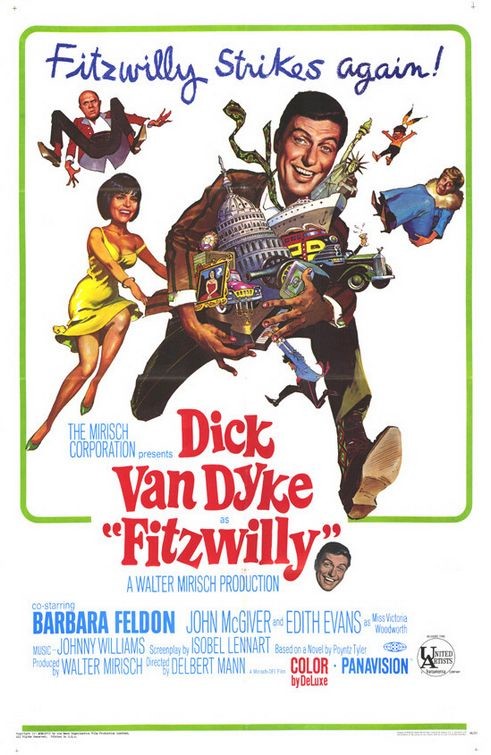
The poster for Fitzwilly features, at its top, the tagline "Fitzwilly strikes again!"  Beneath it, a smiling Dick Van Dyke leaves cast members strewn in his wake as he runs toward us, carrying in his arms a luxury car and a cruise ship and works of art, including the Statue of Liberty: the sense is that he's stealing the entire world.

Here in the real world, though, a very different thing is happening, as we realize before the film is ten minutes old: Fitzwilly is the story of how an efficient brigade of servants in an upper class household operate a secret and successful thieving ring, right under the noses of their employer, the local constabulary, and the New York City elite social scene.  Fitzwilly himself is the ringleader and mastermind – when he was a child, Miss Vickie took him under her wing, and when her father died and Fitzwilly discovered the aging socialite was left destitute (unbeknownst to her), he decided the knowledge of it would kill the woman.  Instead, far simpler (ha!) for him to coordinate an elaborate black market operation out of the house’s basement, ripping off major retailers and funneling the profits into Miss Vickie’s accounts just in time to ensure her bills are always paid.  They funnel the hottest items in their hands to an outlet in Philadelphia – St. Dismas Thrift Shoppe, to be precise, named cheekily for the “good thief” who was crucified next to Christ in the gospels.  They have to keep Miss Vickie in the dark, so he encourages her every eccentricity, especially if it either takes her out of the house (leading her absurd Platypus Troop of knock-off Boy Scouts) or sequesters her upstairs in her office (composing Inquire Within, her demented dictionary for people who cannot spell – as Miss Vickie herself says to Juliet, “when it is done, children and illiterates like you will rise from ignorance”).  Such a criminal conspiracy clearly can’t last forever without discovery…and it is, more to the point, badly imperiled by the arrival of a nosy young secretary who realizes early on that something doesn’t smell right about the situation in the house.  Hijinks ensue.

And in the background of all this, Christmas is under way – wreaths are on doors and trees are being set up.  An elaborate side scheme emerges in which Fitzwilly and the servants agree to lavishly furnish another family’s vacation home, skimming the profits for their own purposes, just in time for a good old-fashioned Florida Christmas.  The glitz of a technicolor red and green mid-60s holiday really pops on the screen, whenever it gets the chance, even if none of these people are really thinking much about Christmas.  Much, that is, until a series of setbacks makes a highwire Christmas Eve robbery – a heist that requires the speed and secrecy we associate with Santa Claus himself – more or less mandatory.  What a truly, truly bizarre plot.

For the sake of you, a potential viewer, I have to acknowledge that the plot really does strain the audience’s confidence (if not patience) throughout.  Money is coming in and out so often – with so many dollar amounts in the air – that it is very hard to understand how far ahead or behind they are: this is a problem in the third act, since the whole explanation for a high risk robbery sequence rests on the servants having their backs to the wall, financially.  Some capers are problematic (I understand that in 1967 they might still have been making weirdly racist mannequins of African tribal people for shopping displays, but maybe they didn’t need to be in the film) and others are just incredible in the oldest sense of that word (in no bar in America at any time could you get wildly enthusiastic men betting large sums of money on their certainty that Delilah cut Samson’s hair in the Bible’s book of Judges, let alone so widely and reliably that it was a guaranteed money-making endeavor).  But I have to acknowledge also that in some ways it doesn’t matter all that much – we’re watching because we want to see the main characters canoodle a little; we want to see if their elaborate, Ocean’s-Eleven-with-a-heart-of-gold heist can actually work; we want to see how they’ll all get out of this without going to jail.  And it’s not like I’m going to tell you how it all ends, but I think I can tell you that the film’s third act is consistent with the rest of it – if you’re liking it you’ll like it, I’m guessing, and if you aren’t it’s not going to salvage itself.

In a way, the whole film is designed to create a sense of dangerous allure, but defanged in a way that makes it totally safe.  Dick Van Dyke can play a master thief and even scoundrel, except he’s doing it with the best of intentions and hurting almost nobody but insurance companies.  Barbara Feldon can play a slightly slinky, even sexy young woman without the plot ever taking us too close to something that would be uncomfortable to watch with your grandmother in the room.  It’s done something sort of similar to Christmas as a backdrop, I’m afraid – there’s the sense that big Christmas celebrations need to come off with success, but we never really feel them as stakes.  Christmas might have provided an opportunity to explore things like charity or miraculous intervention, but the feast never really touches the key events of the story (other than, for instance, making sure there were many shoppers present on the day they need to knock over the department store and run away with cash).  Even the music is defanged – the peppy score I mentioned earlier?  It’s composed and arranged by a young Johnny Williams…yes, THAT John Williams, whose music memorably and powerfully enlivens pop culture properties from Star Wars to Indiana Jones to Harry Potter.  And, it’s fine.  But not really very special.  With apologies, Fitzwilly, that’s a reasonable assessment of you as a film, holistically.

I Know That Face: This cast is full of holiday performers: Barbara Feldon (the brightly inquisitive Miss Juliet Nowell) voices Patti Bear in The Bear Who Slept Through Christmas.  Dick Van Dyke (the titular Fitzwilly) plays an angel in Buttons: A Christmas Tale and narrates The Town Santa Forgot.  John McGiver (Albert, the servant with a troubled conscience) voices the Mayor in the Rankin-Bass Twas the Night Before Christmas.  A very young Sam Waterston (here playing the young chauffeur Oliver – I’m telling you, it’s a stacked cast and crew) appears in Hannah and Her Sisters, a film that is bookended by Thanksgiving celebrations.  Edith Evans (the indomitable Miss Vickie) was of course the Ghost of Christmas Past in Scrooge, which I reviewed just last Sunday – she’s far better here.  And John Fiedler (the nervous music store employee, Moron Dunne, who makes a truly inadvisable arrangement with Fitzwilly in disguise) has a long track record as a voice actor in the Hundred Acre Wood: he’s Piglet’s voice in, among other things, Winnie the Pooh: A Very Merry Pooh Year and A Winnie the Pooh Thanksgiving, not to mention Winnie the Pooh and Christmas Too.  Beyond his voice career, too, Fiedler played the role of Vollenhoven in the first film adaptation of Hans Brinker and the Silver Skates, a story brimful with allusions to Dutch Christmas customs, as the primary events take place throughout a holiday season.  

That Takes Me Back: This is going to be a little inconsistent, since I rolled my eyes at the drudgery of being a typist for those three old men in Beyond Tomorrow, but something about the vibe of this movie and maybe also Miss Vickie’s energy gave me a certain nostalgia for the era when a typist was someone you needed to hire.  I know it wasn’t actually glamorous, but it still took me back in a way that felt more pleasant this time around.  At one point there’s a significant plot moment centered around an enormous and incredibly expensive Xerox machine: just the sight of that massive brick of an appliance and how they’ll get it to work feels wild to me – what a different era.  Miss Vickie’s dedicated work on Inquire Within does make me long somewhat for a dictionary as a physical book to be consulted – what a lovely time to be alive. Oh, and it was such a sweet return to the simplicity of a society in which someone could be enchanted by the world-altering allure of a color TV set.

I Understood That Reference: In a film this elusive about its Christmas material, there’s less than I would have liked, but we do hear Fitzwilly saying, “On the night before Christmas when all through New York, large lumps of money are bouncing like cork…” as he cooks up their biggest heist, which is a fun parody of A Visit from St. Nicholas.  And then later, mid-heist, we hear someone shout, “Hey, they went thattaway, Scrooge!” to a police officer on the street as misdirection.


Holiday Vibes (3/10): For a film that has Christmas squarely in its sights for almost the whole running time (due to its connection to various schemes) it doesn’t deliver very much at all that felt like the holidays, to me, beyond some attractive backdrops.  If you’re looking for immersion in those cozy feelings (or even less comfortable vibes that do still go along with the holidays, awkward family visits and such), this isn’t really the film for you.

Actual Quality (7.5/10): The plot arcs are probably the film’s weakest point, and unfortunately, the movie is constructed in such a way that we really needed a tight script to make it work.  There’s too much business to take care of (and too little character development, with a couple of exceptions) for me to feel really invested in it.  I do enjoy watching Van Dyke and Feldon pull off some romantic chemistry together, and some of the scenes from 60s New York (finally a more fully multi-ethnic space on screen than the older holiday flicks manage, even if it still has a long way to go) did feel inviting to me.  Well, and who wouldn’t enjoy thinking about getting to be Robin Hood at least briefly, tricking and cheating and stealing but all of it for a wholesome cause?  In the end, it does seem like a C+ movie to me, but it’s a C+ movie with some upside.

Party Mood-Setter? I can’t really imagine this working (it’s got too many little twists and turns for inattentive viewing), though I also doubt it would be too distracting, since the events of the story don’t come across as all that urgent given how the narrative unfolds.

Plucked Heart Strings? There really aren’t any at all – but the film’s not trying for it either. The film’s about the fun side of a rom-com far more than it is about sincere emotional resonance.

Recommended Frequency: Fitzwilly is a very slight little thing – you’d be fine never having seen it, but if you’re the kind of person who’ll enjoy seeing Barbara Feldon and Dick Van Dyke lure each other into some passionate embraces, it’s not a bad way to spend an evening.  And if you’d like to just see this bizarre plot unfold at least once, I do think it’ll amuse you enough to see it through to the end.  I would say that, having now seen it twice for the blog, I’ll probably see it again at least one more time in my lifetime, but I’m not rushing back to it.

To try out Fitzwilly, this year, the easy way is to stream it free (with ads) on Pluto, unless you’re a subscriber to Screenpix, which is a premium add-on at Amazon Prime and the Roku Channel and lots of other places, showing older movies for a modest monthly fee (I am not).  You can rent it on Fandango at Home, too.  You can, of course, buy it on DVD (or Blu-ray, which surprised me a little) at Amazon, and according to Worldcat a few more than a hundred libraries have it for you on disc.

A Midwinter’s Tale (1995)

Review Essay

On the face of it, there’s little reason to think of any of William Shakespeare’s plays as holiday fare — sure, Twelfth Night name-drops the celebration of Epiphany in its title, but the holiday makes no appearance in the text.  So when I tell you that Kenneth Branagh’s black-and-white arthouse dramedy indie film, A Midwinter’s Tale (titled In the Bleak Midwinter in the UK), nearly persuades me that Hamlet is as much a work of Christmas drama as Die Hard is, I do expect some pushback.  But that’s only because you (probably) haven’t seen the movie yet.  Because you haven’t yet come face to face with Joe, the play’s forlorn, neurotic, desperate director, as he turns to his rag-tag cast of community theater actors and admits, very much in the style of the Bard’s existentially depressed Danish prince, saying “As the Yuletide season takes us in its grip, I ask myself, what is the point in going on with this miserable, tormented life?”  And then, slowly but astonishingly, he gets his answer, much of it mediated through the experience of staging Hamlet itself.  I think this is a Christmas story most of us need, and yet one we rarely get.

Don’t get me wrong — so much of this film is a comedy, and a comedy that is pitched directly at anybody who’s ever been a theater kid for even a single high school semester, since so much of what the script finds funny is the embarrassingly human ways everyone from stars to bit players to techies behaves in proximity to even the smallest, most underfunded attempts to put anything on the stage.  Weird warmup exercises, arguments over billing, bizarre character choices, chaotic dress rehearsals: it’s all here.  The premise is one part Muppet Show and one part A Chorus Line — Joe is an actor/director who’s had his chances and they’ve come to nothing, so he’s hanging all his belief in art and humanity and himself on the possibility of staging an avant-garde production of Hamlet in a crumbling church in the English village he grew up in and ran away from, on Christmas Eve evening no less, in order to raise enough money to keep the building from being knocked down by a developer.  He’s going to try to pull it off with a band of ludicrously panicky and self-doubting performers, none of whom he can afford to pay really (despite his implied promises to the contrary), driving them all off into the countryside himself in his dilapidated old car.  “With live people in it?” he’s asked incredulously, early on.  “With actors in it,” Joe replies, “there IS a difference.”

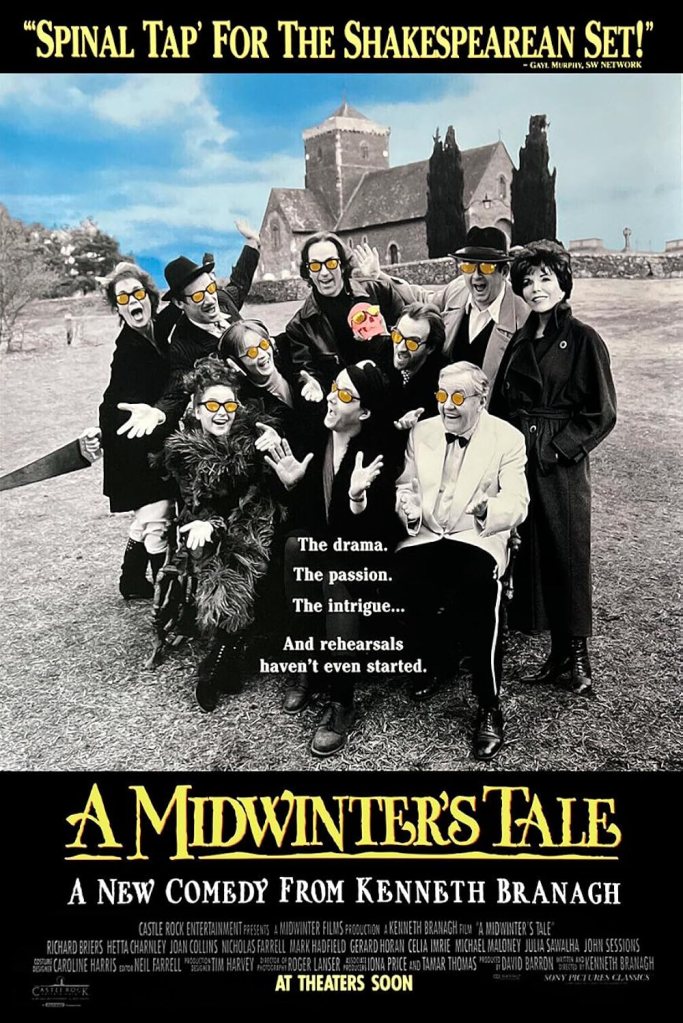
The poster for A Midwinter's Tale features the cast crowded together on the lawn in front of an old stone English church: they are gesturing wildly to the camera and all are wearing yellow-tinted glasses.  Above them appears the review quote "Spinal Tap for the Shakespearean Set!" and in front of them appears the movie's tagline, "The drama. The passion. The intrigue... And rehearsals haven't even started."

It’s that kind of self-deprecating, joking tone that pervades this affair.  It’s shot with restraint by the normally egotistical Branagh (I mean, love him or hate him, Kenneth’s self-regard has a gravitational field the size of a dwarf planet) who in a rare move doesn’t even cast himself in the film, though the actors on screen are a wonderfully talented collection of folks, more than a couple of whom will be very recognizable to anybody who enjoys British movies and/or television.  After a cringe-inducingly funny collection of audition scenes, Joe’s selected his ensemble and the cast relocates to the old church which will serve not only as their theater but also as their living quarters for the last couple of weeks of December.  We get to know what it is about each of these people that makes them self-deluded enough to join this absurd enterprise, and what it is about each of them that makes them vulnerable while they’re doing it.  And it’s not about Christmas at all, in part because every single one of these people is running from the kind of stability that would give them somewhere better to be on Christmas Eve than working effectively as a volunteer playing five bit parts in Hamlet to an audience that’s likely to be largely (if not entirely) plywood standees.  But also it’s exactly about Christmas, because it’s about the connections you find when you’re not looking for them, it’s about the ability to find something larger than yourself to care about when you’re scared of who it is you are or have become, and maybe most of all it’s about the kind of grace that human beings in all their bustling, silly foolishness badly need yet so rarely manage to find.  In the meltdown I quoted from in the first paragraph, at another point, Joe shouts at the cast, overwhelmed in the knowledge of his grief that he’s failed them and they’ve failed him and all of them have failed Shakespeare and the village church, “It’s Christmas Eve, for Christ’s sake, you should all be with your families!”  Only to have the person he maybe has failed the most say back to him, “We’re WITH our family!”  That’s the kind of dramatic gesture only an actor could make, maybe, in such a way that it’s both not true at all and also it’s deeply, deeply true.  Made true by saying it, even, perhaps.

The script makes fools of each of them, individually, but it also denies nobody their moment to say something genuine and loving.  Even the most seemingly horrible member of the cast — a proud, bitter homophobic old Shakespearean named Henry, played with flair by the immensely talented Richard Briers — has the capacity for warmth.  In fact, what we see in him over the course of the play is maybe its greatest argument for our capacity to be redeemed, since Henry’s growth is pretty profound: he goes from sneering contemptuously to rushing with compassion to support someone in pain, and we can see on screen what it is that’s changing him as this unfolds.  Now, managing that tone may be where it loses some of you — it’s hard to switch gears between chuckling at someone’s antics and holding your breath as that same person admits some private burden they’ve been carrying this whole time.  But to me, again, that’s the Christmas magic of A Midwinter’s Tale, because that very balancing act, it seems to me, looms as a presence in most of the holiday’s best art — Scrooge’s malicious glower transformed into gleeful generosity; George Bailey’s suicidal panic giving way before Clarence’s angelic whimsy; the madcap comic antics side-by-side with the painfully real deprivations of the Herdmans in The Best Christmas Pageant Ever.

Ultimately, A Midwinter’s Tale is an argument about art — as Hamlet relentlessly breaks down each of the performers, one of them observes to Joe that “Shakespeare wasn’t stupid”.  That, in fact, he has as much to say about grief, about fear, about family and friendship, about the human condition now as he ever did.  Not because of all the humans who ever lived only one kid from Stratford-upon-Avon ever figured us out, I think, though maybe Branagh would make that argument.  But to me it’s more that the film argues that, by giving themselves to an enduring work of art, the people involved come away from it greater than they were before.  That the sacrifice of making something — even if it’s only for themselves; maybe especially if it’s only for each other — isn’t a subtractive experience but an additive one.  Sharing this film with all of you is one part of why I wanted to write a blog called Film for the Holidays, because I think the additive possibilities of art are pretty potent this time of year, and I’m hoping at least a couple of you find this film works for you the way it works for me.  And even if it doesn’t, I hope you at least get some laughter out of it, and a smile or two at the (too-neatly-wrapped-up) ending — I watch it every December, and I never grow tired of it, myself.

I Know That Face: This is a stacked cast of British character actors, and therefore this crew has done a lot of fun Yuletide appearances on screen.  Michael Maloney (who plays the play’s director as well as its star, Joe) played Bob Cratchit in a 2000 TV movie version of A Christmas Carol.  Richard Briers (the aforementioned Henry Wakefield, a self-described “miserable old git”), as his final role, voiced Mouse in Mouse and Mole at Christmas Time, and had previously voiced Rat in Mole’s Christmas, a TV adaptation of The Wind in the Willows.  Nicholas Farrell (who plays the many-roled and many-accented Tom) appeared as none other than Ebenezer Scrooge in the 2022 A Christmas Carol: A Ghost Story, as well as being the Duke of Glenmoire in Christmas in the Highlands.  And, in a fun cross-over, Mark Hadfield (who plays Vernon, part actor and part ticket seller) is in another Kenneth Branagh film, Belfast, playing George Malpass who, within that film, is playing Ebenezer Scrooge…opposite John Sessions (who in A Midwinter’s Tale plays Terry, the gay actor presenting Queen Gertrude in drag): Sessions in Belfast appears as Joseph Tomelty, who interacts with George Malpass’s Scrooge playing the role of Jacob Marley (in what ended up Sessions’s final screen credit).

That Takes Me Back: It’s fun to have this look back at the very end of the era in which you’d take out a newspaper advertisement for a casting call — I have to assume, at least, that by the turn of the century these things were mostly digital.  I just had to call the year 2000 “the turn of the century”, folks: that one stings.  Anyway, other nostalgic stuff here: well, as I’ve remarked before, payphones are incredibly nostalgic, and I can’t imagine there are as many great dramatic possibilities these days in films as there were when you could put a group of people in an unfamiliar setting and force them to hike multiple blocks just to use the phone.  In one of the movie’s pointed arguments about community versus commerce (which is yet another Christmas-adjacent angle I just didn’t have room for in the review essay), a character comments that kids these days care about Mighty Morphin Power Rangers.  And kids did, back then!  It’s funny to reflect on the fact that Hamlet’s clinging to the edges of our pop culture more effectively than the Power Rangers do these days — the characters could have used that perspective in the argument in question, I think.

I Understood That Reference: There’s not a ton here that intersects Christmas tales in particular, but at one point Margaretta, the agent who very reluctantly put up just enough money for this production to keep the cast from starving, suggests Joe could contact Santa Claus for some cash when he comes to her appealing for more funding.  I chuckled, anyway.  Oh, and this doesn’t really count, but this came out the year after The Muppet Christmas Carol: I highly doubt Branagh intended a nod at that film rather than at the Muppet Show “let’s save the place” esprit de corps of the movie he was making, but I’ll admit, when I see two members of the cast huddled in their church lodgings under matching Statler and Waldorf comforters they seem to have pulled out of a rummage sale bin, a) I want those comforters for myself, badly, and b) I do think of Jacob and Robert Marley, this time of year.


Holiday Vibes (3/10): I mean, in literal terms, I should probably set this even lower — despite the Christmas Eve timing of the performance, neither Hamlet nor anything around it is specifically holiday themed.  I do just think that, as I argue in the review, this is a film that in fact is very concerned with the things we think about and reflect on in the holiday season.  And by now I’ve watched this so many Decembers that it just feels like Christmas to me, so my real number’s at least a couple points higher, and I can easily imagine that for many of you, your real number might end up a point or two lower.

Actual Quality (9/10): I can’t tell you this is a perfect film, even if it’s one of my favorites to watch this time of year.  The ending is a little too rushed and has a couple of weird loopholes, and any 1990s comedy is going to have at least a couple of jokes that make you uneasy (though I do think this movie mostly deals pretty critically with the problematic things characters say).  So much of it works, though — a brilliantly talented cast getting to play both the comedy of throwing together a production of Hamlet and the painful drama of that play itself and also the feelings it stirs up in those performing and watching.  I really think it’s wonderful, and I think you might find you like it, if you give it a chance.

Party Mood-Setter?  Haha, do I think you should just throw this monochromatic indie dramedy on in the background while you’re making ornaments?  No, I don’t think it would work in that setting for anybody other than me (though I would show up at your house, take one glance at the screen, and announce “now, THIS is a PARTY”).

Plucked Heart Strings? I can only answer this for myself, and for me, yes, it gets to me.  It’s much more a comedy than a sentimental film — at least, in terms of run time there’s far more comedic material than there is sentimental/serious, and in my own memory of the film is far more of laughing than misting up.  But there are a couple of scenes that are so poignant — I don’t see how they could go by without affecting you a little, and they sure do affect me.

Recommended Frequency?  For me, again, this movie is in the rotation every single year, without fail.  Would it carry that same holiday weight for you?  I hope so, but I can easily imagine this is more of a curio for a lot of folks — a once every few years movie, maybe even a “just once is enough” movie.  If I get a vote, though, I’m sticking that movie into your catalog of holiday films and encouraging you to watch it when I come over.

If somehow I’ve persuaded you to give this one a go, sadly, here’s where I tell you there’s no free streaming version available to you: you can rent it on Amazon Prime or Apple TV, though, if you’d like to stream it.  You can own it on DVD, like I do, or on Blu-ray, like I now want to do after discovering they made a Blu-ray version sixty seconds ago when I Googled this, by purchasing it on Amazon or elsewhere.  And it’s more widely available than you might think via the library: Worldcat, at least, reports over 200 libraries have it on disc, if you’d like to try it out for free.

Merry Christmas, Mr. Lawrence (1983)

Review Essay

There will be other films in this blog project that I describe as more intense, serious, or challenging than what we think of on average as a “holiday movie”, but I can’t emphasize enough: Merry Christmas, Mr. Lawrence is the most difficult movie to watch of anything I’ve seen in this very loosely defined genre, and while I think the film has a lot to recommend it, I don’t particularly encourage you to watch it at this time of year.  Though maybe you’re looking for something unexpected, and if so, this movie (starting with its innocent, seemingly cheerful title) is a real bait and switch from the get-go in a way that’s undeniably compelling and also deeply unsettling.

The movie orbits around a small handful of men encountering one another in a Japanese POW camp in World War II.  Our primary characters are Japanese officers who show varying levels of compassion and cruelty to the prisoners in their charge, and British prisoners who show varying levels of capacity to understand and communicate with their captors.  I do hear you asking, “James, you’re sure this is a Christmas movie?”  But yeah, it is, on some level — the title’s no throwaway, at least.  Maybe the movie’s most surprising act of mercy occurs on Christmas Day, with a character explicitly identifying his reasoning as being connected to the holiday.  And the phrase “Merry Christmas, Mr. Lawrence,” is spoken not once but twice: the gap between those two moments in every respect, from power dynamic to emotional intent to camera angle and edit, is huge and meaningful, with the line’s second appearance coinciding with the film’s final scene and argument.  Die Hard is a Christmas movie, after all, but where that action film revels in the more traditional Hollywood use of stylized and sanitized violence to provide a palette from which the hero can paint, this arthouse war movie devotes itself to an unflinching and grim depiction of what violence really looks like, especially when the object of violence is essentially powerless to resist.  If Christmas is about redemption, about hope, about light shining in the dark, this movie seems to say, what is it about humanity that needs those things — what is it about humanity that strives to oppose them?

The poster for Merry Christmas Mr. Lawrence features the tagline "Java, 1942 -- A Clash of Cultures, A Test of the Human Spirit" on the left, and drawings of the faces of five of the movie's stars, clustered around an unsheathed sword, on the right.

I wouldn’t want anyone to go into this film without being forewarned, too — a lot of its interest is in masculinity (especially mid-20th century Japanese ideas about masculinity) and therefore the film often depicts both homeroticism and homophobia, with crude and cruel violence done to men who are apparently in violation of its code.  It might easily seem to the viewer like it’s a condescending white Euro-American attack on Japan, since a lot of the script puts critique of Japanese society in the mouths of the British prisoners.  But this is a film co-written and directed by a Japanese film-maker, Nagisa Oshima, who was known for his daring and sometimes controversial films that criticized what he saw in society around him — in other words, what we’re seeing is a Japanese man’s film about his own nation, and the world he grew up in, as he understood it. When the movie knocks arguments about  “honor” or the idea that suicide by sword (which we see, vividly and graphically, on screen) might be the only way to restore one’s manhood and dignity, this is Oshima’s arm taking the swing.

But this isn’t just a film about Japan.  Oshima (and his collaborators) have infused it with a lot of things — David Bowie (at perhaps the height of his considerable physical charisma) plays the main character of Jack Celliers with so much pathos that it’s not hard at all to see the Christ imagery that surrounds him (starting with those “J.C.” initials), including being chained in a crucifixion pose at one point, and later in the film engaging in a dialogue with the camp’s commander, Yonoi, that so deeply parallels the confrontation between Jesus and the Roman governor, Pontius Pilate, that this started to feel more like an Easter film than a Christmas movie.  There are other moments of Christ imagery, too, that I think would spoil too much to mention here.  And, to consider another of its angles, so much of the film is interested in power — the “commanding officer” of the British POWs is a man named Hicksley, but he cannot speak Japanese while another POW, the titular Mr. Lawrence, can.  Which means that when there are delicate matters to discuss or negotiate, it’s often Lawrence talking with Commander Yonoi, or Sergeant Hara, and not Hicksley.  Or, to take another example, it’s obvious from the moment we see Yonoi meet Jack Celliers that the Japanese officer nearly collapses with desire at the sight of a man that lovely.  So, when Yonoi tries to assert his (very real) power over Celliers as the camp’s senior military official, and Celliers starts to realize how dangerous it would be for Yonoi to be discovered as gay (and, too, how much Yonoi wants on some level to protect and even win over Celliers)?  In either of these situations, who’s actually in control?

I’ve said a lot about the film and yet I intentionally haven’t revealed much about it — there’s a lot packed into the relatively brief days depicted in the movie, and I wouldn’t want to spoil it for someone ready for the intensity it offers.  As a guy raised on somewhat less realistic and more “plucky” POW movies from the mid-20th Century, I went into this viewing experience expecting something with a little more humor, more moments of triumph.  But even the movie’s kindnesses and mercies are tinged with loss and fear.  As were the war’s, I expect, for the men who on both sides were called upon to do violence to one another.  Those moments of gentle connection are still there, though — if you are ready for the film’s violence and for the characters’ often callous treatment of gay men, all through it I think there are instances of real compassion and insight.  Whatever we want to argue the “Christmas message” is, I think it cannot be too far from this film’s central claims about the corruptibility of power, about the idea that love is more enduring than the forces that seek to blot it out, about the possibility for mercy and the power it wields.  That’s why, to me, this movie belongs here, and why, though I would never advise someone to add it to their Christmas mix, its words and images loom in the shadows of these long winter nights for me, in ways that I think do add meaningfully to my thinking about why humans make these festivals of light on the darkest days of our year.

I Know That Face: Jack Thompson (who here plays the British POWs’ commanding officer, Hicksley) later appears as Bandy in 2007’s December Boys, a film set on a Christmas vacation trip for four orphans in the Australian outback.  And of course David Bowie (the charismatic Jack Celliers, here) is closely associated with Christmas for many of us from his performance singing “The Little Drummer Boy” on television with Bing Crosby in 1977. But we may also remember Bowie from another holiday context, since it’s his filmed introduction that appeared before the incredibly lovely animated short film The Snowman when it was shown to American audiences (in 1982, the year prior to this film’s release), replacing the introduction offered to British viewers by Raymond Briggs, the author of the original picture book that the film’s based on (since apparently it was assumed Americans wouldn’t know or care about Briggs).

That Takes Me Back: Nothing here really takes me back anywhere, thank goodness: the few scenes in this film that occur outside a POW camp depict similarly abusive/oppressive spaces, and there wasn’t anything really for me to hang my hat on for nostalgia.  I was reminded, at times, of conversations with my WWII veteran grandfather, who served in the Pacific, and whose most haunted memories were of the liberation of POW camps at the end of the war.  But that’s not really what this category is for.

I Understood That Reference: A drunken Japanese officer’s act of mercy is, he says, his way of playing “Father Christmas” — a strange twist on a familiar childhood image, and one that I think heightens my sense that Christmas means something to the filmmaker, Oshima, that he is trying to work with as a part of this film’s thematic material.


Holiday Vibes (0.5/10): I mean, again, I think if we pay close attention, on a deep level there’s a message here that’s resonant with the holiday.  But I have to be honest: the movie’s violence is so gutting and gripping that it’s very hard to have that experience in the moment — if you want a movie with holiday vibes, this ain’t it.

Actual Quality (8.5/10): I wouldn’t call this a lost masterpiece (as some do), but the film is extraordinarily powerful for much of its running time.  I think there are moments where the sequence of events (and their causation) is a little too murky, and I think fundamentally it loses its way a little bit in the final 5-10 minutes — even though I like some individual lines at the closing, overall I think the movie wants to argue it’s made a case that I don’t think it really has.  But the acting and the music are really tremendously successful, and a lot of the writing and direction lives up to that standard.  If you’d normally watch an intense arthouse movie from the 1980s, I think this one should definitely go on your list of things to consider.

Party Mood-Setter? I mean, you saw what I wrote earlier, I’m guessing, about how the movie depicts a man committing suicide by sword on screen?  If you’re throwing a party that this would set the tone for, just playing in the background, I don’t want to be invited.

Plucked Heart Strings? Truthfully, yes, assuming you can hang in there with the movie: the fate of more than one of its characters is both bleak and heart-wrenching, but I think no one’s final outcome is devoid of meaning (that is, this isn’t just suffering for suffering’s sake).  If you’re watching this, you’d want to be ready for a real emotional ride.

Recommended Frequency: To be totally honest, I doubt I will be in the mood for this any holiday season: it’s just too far from where I want to go with my December media consumption.  But I might watch this film again, since I think it’s undeniably well made.  It’s just very grim, and I would be really selective about when I watched it and who I watched it with.  Speaking to you, though, if you’ve time and attention enough for it right now and it’s calling you on some level, as I said above, there’s a Christmas narrative here, mostly subtext and very challenging.  And if it doesn’t sound like the kind of film you can stomach, I get it, and this blog is fortunately full of all sorts of alternative options!

If you decide to take on the intensity of Merry Christmas, Mr. Lawrence, the only ways to stream it that I know of are either to be a subscriber to the Criterion Channel or else to rent it from Amazon Prime. The folks at Amazon will also sell you the movie on disc.  Honestly, I push libraries all the time, but this particular movie is maybe most readily available from us librarians — Worldcat says well over 500 libraries hold it on disc, including (I bet) a public library somewhere near you.

Remember the Night (1940)

Review Essay

Remember the Night is another of these 1940s films, and one that would merit a nearly unreserved positive recommendation if not for a few minutes’ worth of totally unnecessary and irrelevant-to-the-plot racial material.  In this case, just to be up front about it, we have a Black servant in a couple of scenes at the beginning of the film who’s either a savvy man pretending to be a fool, or else just a character written as a foolish Black servant: either way, too, his employer treats him pretty condescendingly.  It’s certainly not the worst racism of the era on film, but it doesn’t need to be that to be uncomfortable and even unsettling.  As always, I don’t mean to make excuses for the media of the past, and if for you that kind of material is a deal-breaker, I respect it and wouldn’t want to waste your time.  But if you’re someone who can enjoy a film while deploring that kind of element, I think you’ll find this one has artistic value that’s worth appreciating.

The first ten minutes of the movie were its least successful (to me) so I do recommend hanging in there — not only do they feature most of the racial element I just mentioned, but they also largely feature people who aren’t our leading actors, and in particular a tedious, egotistical lawyer whose blathering on is a little tough to sit through without impatience (even though, to be clear, the movie knows he’s tedious — part of the point is that he’s long-winded and short on substance).  Those minutes, though, establish the premise: that a woman shoplifter is, thanks to the skillful maneuvering of the DA assigned to prosecute her, about to spend Christmas behind bars waiting for an expert witness in her trial.  He feels a little badly about the maneuver, enough that he arranges for her to get out on bond.  But through a mixup, they find themselves in a car together, driving into the American Midwest to both of their family homes for the holiday.  Elaborate, sure, but also a very solid basis for a romantic comedy to unfold.

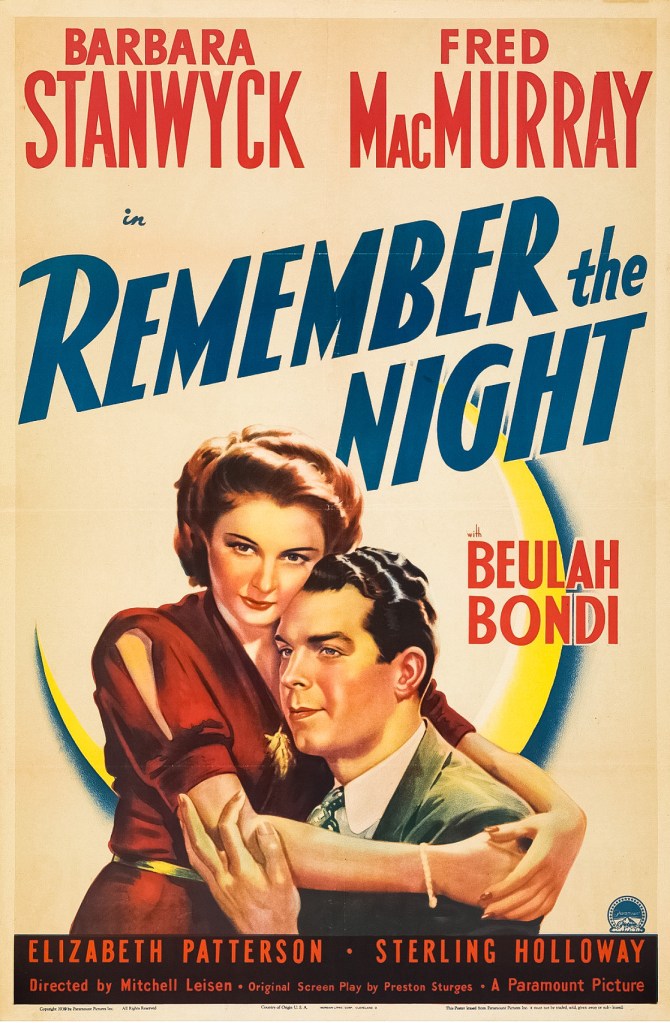
The poster for Remember the Night features Barbara Stanwyck on the right in a red dress, standing next to Fred MacMurray (who is dressed in a dark suit and tie) and placing her arms around him.

And the setting is brought really to life by the fantastic casting of the two lead roles.  Fred MacMurray always was a chameleon, able to project such a range from sweet naivete to hard criminal purpose — I grew up with him as the sort of ideal Disney dad in films like The Shaggy Dog or The Absent-Minded Professor, but in this film, he’s excellent at managing the tougher balancing act of playing John “Jack” Sargent, a kindly smalltown fella who made good as one of the savviest minds in the New York City DA’s office.  But here even Fred’s considerable talent is really getting blown out of the water by Barbara Stanwyck at basically the height of her powers — and she’s not just acting the hell out of the role, but she’s doing it in absolutely classic Edith Head costumes while speaking words out of a Preston Sturges screenplay (Sturges, for the unfamiliar, basically invents and achieves the apex of the screwball romantic comedies of the late ‘30s and early ‘40s that we now think of as classic Hollywood).  Here, as Lee Leander, she has to run the gamut from exhibiting the kind of brassy self-confidence that’s helped her survive as a con and a thief for basically her whole adult life to the kind of fragile self-doubt that emerges as the fearful center around which she’s erected that facade to avoid confronting the pain of her upbringing.  It’s an incredible performance, good enough to make me wonder why I’d never heard anyone talk about this film.

The funny thing about the film — given the fairly ridiculous premise and the snappy dialogue that Sturges is known for — is how naturalistic it so often is.  Whether it’s moments where we hear Jack and Lee connecting over some shared memories of small town Indiana life, or the way Lee seems to shrink and tighten up with every mile she gets closer to home, there’s something honest about the emotions the two actors are working with — they don’t feel like they’re falling in love because of some machination in the script.  They feel like they’re falling in love because it was meant to be — they almost feel like a couple that had been in love the whole time, and it’s only the movie that’s catching up to them.  It’s pretty magical.

The magic of the film is less Christmassy than other films on this blog — to some extent by design, since really the film only feels like Christmas in two places.  Either it’s the hyper-commercialized high street shopping of a bustling New York City, or else it’s the cornpone, apple-bobbing at a rummage sale, country Christmas energy of Jack’s hometown Indiana village.  Everywhere else doesn’t seem to have the spirit at all, almost like it wasn’t Christmas anywhere else, really.  That journey from Christmas to Christmas — from the one where Lee’s an operator who is never on the wrong foot, to the one where her defenses are laid bare and her authenticity can unfold in the softer light of home — is central, I think, to the movie’s thematic message.  And I like how the film works in that way, but it hurts the holiday score a little, there’s no doubt.

In the end, it’s a film about love — love from the moment Jack realizes what he needs to do for Lee, just out of compassion for another human (and not yet thinking of romance), to the final….well, I won’t spoil it for you.  And there’s so many kinds of love at work in this film — not just their love for each other at its best, but also the ways their love for each other trips the other person up or interferes with their designs, like it’s an O. Henry short story.  There’s love here from family — both love that builds up and a love that can feel closed off.  Even just the gentle moment of two elderly sisters, one a widow and the other a spinster, kissing each other on the cheek cheerfully as the clock strikes midnight on New Year’s Eve.  There’s such remarkable strength, too, fueled by that love, and none of it stronger or more remarkable than what we see in Stanwyck’s performance as Lee in the film’s final act.  She’s the best.

I Know That Face: There are SO many options here, it’s embarrassing, so I’ll pick just a few.  Now, she’s not exactly inconspicuous, so I don’t want to dwell on her, but it would be silly not to remember that Barbara Stanwyck goes on to be Ann Mitchell in Meet John Doe, which reaches its climactic moments at Christmas, not to mention Elizabeth Lane in the by-now classic Christmas in Connecticut.  But there’s other faces here you’ll recognize, and a voice too — the mothers in this film both have spots in other ‘40s Christmas flicks.  Georgia Caine, Lee’s horrible mother, plays the minor role of Mrs. Johnson in The Miracle of Morgan’s Creek — another film culminating at Christmastime (and another Preston Sturges film).  More memorably, Beulah Bondi, who here plays Jack’s much kinder yet still complicated mother, will be very familiar to many of us as George Bailey’s mother in the totally iconic It’s a Wonderful Life.  And lastly, a voice — because Willie, the oddball servant in the Sargent home in Indiana, is portrayed by Sterling Holloway, of all people.  Holloway’s utterly distinctive voice is best known to you as Winnie the Pooh, or the voice narrating Lambert the Sheepish Lion or The Little House or Ben and Me or any of dozens of other Disney short films, so much so that it’s hard for me to accept that that’s the voice of a regular person and not a cartoon character.  Anyway, Holloway voices someone called Northwind in an animated TV movie called Tukiki and His Search for a Merry Christmas.

That Takes Me Back: Again, the 1940s films are generally an endless source of nostalgic elements and moments, but here’s a few that stuck out to me.  I loved the moment early on when they’re reading a paper map while trying to manage detours in the middle of the night: I remember both the confusion and the exhilaration of that kind of navigating, which I was usually pretty good at, and it’s a bit of a shame that at this point GPS and a smartphone have taken over about 99% of that kind of human travel guidance.  And then they haul out sandwiches wrapped in waxed paper — other than for crafting, I can’t think of the last time I used waxed paper, but it reminded me of my grandmother making sandwiches to take somewhere (I’m not sure this memory happened more than once or twice).  And then later on, the “down home” Indiana Christmas involves both stringing popcorn for the Christmas tree, and bobbing for apples — the popcorn garland in particular is such a delightful glimpse of the much simpler Christmas trees of days past, and it made me smile to see the string on the tree in the background in a later scene.

I Understood That Reference: I know, I know, this is a weird category to include when it’s so often empty, but I think that in itself is interesting — it would have been easy, I think, for Sturges to incorporate some elements of Christmas stories (indeed, of THE Christmas story) here, and so it’s at least a little interesting to me that he doesn’t.


Holiday Vibes (4.5/10): So, as mentioned above, a lot of the film doesn’t really feel like Christmas — not the courtroom scenes, and almost all the travel from New York to Indiana seems to pass through towns and houses where no one is getting ready for Christmas at all.  I do think there’s some thematic reason for it, so it’s not a critique of the film, but it does also consolidate the film’s holiday vibes into a pretty tight 25-30 minutes in Jack’s childhood home.  As you can likely tell, I like this movie a lot, but I don’t think its evocation of Christmas is one of its strongest elements — I can easily see myself watching it at another time of year without it feeling out of place.

Actual Quality (9/10): I really enjoyed this movie, coming to it with almost no preconceptions at all.  Sure, the opening ten minutes are both a little tedious and more than a little racially problematic: there’s no getting around it, and if you bail on the movie then, I get it.  But after that, from costume to script to two stellar lead performances (and a couple of really great turns from the supporting cast, as well), this is a romantic comedy that’s really hitting all the moves the genre does best.  Stanwyck is electric on film and MacMurray’s wonderfully subtle and loyal, and the two of them together manage both the surreality of the quick banter old Hollywood romance AND the reality of the emotional roller coaster two people might ride by falling in love in this way.  If you like a good romantic comedy, I think you’ll love it, and if you usually find romantic comedies either squirm-inducing or silly, I think this is the kind of film that might make you say, “well, okay, THAT one is admittedly a solid movie”.

Party Mood-Setter? I mean, I would like to tell you no — as romantic comedies go, it’s leaning more on realistic emotion than on quips, so it’s a film that rewards your full attention and that might be hard to connect with if it’s just on in the background. But the film’s pretty great at conveying the combo of 40s nostalgia and fabulous Edith Head costumes, so if you want to do the movie a bit of an injustice and treat it as occasional eye candy, I think it could work in the background.  I just also think that, when you’re really paying attention to it, it’s so good and human that it deserves the spotlight and I’m hoping you’ll give it center stage.

Plucked Heart Strings? For sure — I got genuinely choked up more than once, basically always at moments where Stanwyck as Lee really successfully conveys the feeling of a woman who’s never been given any tenderness or compassion in life experiencing the sudden shock of someone’s loving care.  Especially because, at first, that’s all it is — not Jack trying to woo her, but just Jack (and later his family) seeing a person in need and reaching out to support her like it was the most natural thing in the world….because it is, to them.

Recommended Frequency: Oh man, this one feels like a candidate for “every year” to me; it’s certainly one I want to own so I can keep it in my regular rotation, and I feel like it’s a film that will reward future viewings.  I think if the film as I’ve described it sounds appealing to you, it’s one to schedule for yourself this very holiday season: don’t delay!

Shockingly (to me) the only place I can find Remember the Night streaming right now is on Plex, the ad-supported free streaming service that shows up in this paragraph pretty frequently. It doesn’t look to me like it can be rented anywhere, though, which is unusual.  It’s purchasable in a variety of media formats, though, on Amazon (and elsewhere I’m sure), if you’re willing to wait for delivery of physical media (and willing to trust me that it’s worth owning).  And as always, try your local library — Worldcat tells me that there are hundreds of libraries with a copy on DVD.

Scrooge (1970)

Review Essay

In gearing up to create Film for the Holidays, one of the things I resolved to do early on was to spread out and cover at least one film from every decade in the “talkie” film era if I could.  This is a simple enough task for every decade but one: the 1970s are an extraordinarily holiday-free zone.  I couldn’t tell you if it was the oil crisis or stagflation or the Watergate scandal, etc., but something seems to have knocked the holiday spirit right out of Western filmmaking.  Take a gander at Wikipedia’s list of Christmas films (and I sure wish you would: goodness knows I’ve spent enough time there in the last year) and you’ll find that the list of theatrical releases amounts to a handful of horror movies, a Norwegian fairy tale classic that’s basically unavailable outside Norway, and a Santa Claus bank heist filmed in Canada (okay, that one sounds pretty interesting to me).  I’ll admit, 1970s TV movies do try to fill in that gap a bit, but still, I was trying to stick mostly to theatrical releases here and I was feeling stuck, until I remembered that Scrooge was released in 1970: I’ve always been fascinated by this particular version of A Christmas Carol, and I’m delighted to get the chance to unpack both what I think it does really wonderfully and what I think it really fumbles.

Scrooge is, if you’re unfamiliar, a musical adaptation — not the only such adaptation of Carol, of course, but the first musical film version I know of.  And it’s one that seems tailor made for me as a viewer: the screenplay and music are by Leslie Bricusse, a talented British composer who created the music and lyrics for 1967’s Doctor Dolittle (a film I have loved since childhood even though I will admit its every flaw to you) and 1971’s Willy Wonka and the Chocolate Factory (a film I have loved since childhood and which I would gladly and spiritedly defend as being nearly flawless).  You’d also know his work from James Bond songs like “Goldfinger” or “You Only Live Twice” — Bricusse is a pro, in other words, and that should set this film up for success.  Add in Albert Finney, a marvelously charismatic actor, in the title role, and some seasoned British pros in the other roles (most notably the wonderful Alec Guinness as Jacob Marley), and I always end up thinking, “wait, do I love this movie?”  But then I rewatch it, and remember, oh right: I don’t love it.  I don’t hate it!  But I don’t love it.  Let’s try and sort out why, shall we?

The movie poster for Scrooge features the tagline "What the dickens have they done to Scrooge?" arcing above a crowded street scene in Victorian London, with a dancing Scrooge in the foreground, looking directly at us.

First, let’s give Scrooge credit for some things it gets very right: A Christmas Carol is a ghost story.  Much of the time, though, the ghost experiences are more thrilling than they are chilling, and while I enjoy those versions, I really admire Bricusse and company leaning into the creepiness of this story.  From opening titles that carry a sort of eerie Edward Gorey quality to the (mostly invented for this version) sequence in which Jacob Marley flies Ebenezer through the ghostly skies above London to the (totally invented for this version) plummet of Scrooge into literal Hell at the end of the Yet to Come experience, this movie often achieves something at least uncomfortable if not unsettling.  And yet another thing this version gets right is an investment in joyful characters — the Cratchit children, in particular, get more of the spotlight here (thanks in part to the early segment in which they accompany their cheerily elfin father through the streets of London doing last minute Christmas shopping).  I like the sweetness of the moments we get with the Cratchits, and I think the film at least sometimes accomplishes something really moving by juxtaposing such light-heartedness with the sort of nightmarish threat that lurks in Scrooge’s experiences.  Also, while the casting of Albert Finney as Scrooge is more than a little strange — at 34, surely he’s about the youngest actor to play Scrooge in any production outside of a high school or collegiate setting — I’ll get to my larger assessment of him in a later section.  Here in my list of the film’s strengths, I do just want to note that Finney’s undeniably talented and energetic, and I think he’s giving this character a lot of spark and liveliness, which is very watchably compelling in a number of scenes.

The film does a lot to displace Scrooge’s experiences into more cinematic spaces, and I’m not sure that always works: seeing him bedevil debtors in the streets does drive home his malice, but it also creates scenes that just don’t feel as true to the original novella, to me.  I can’t imagine men collecting for charity chasing an elderly man down the sidewalks after he’s turned them down; I also can’t really follow what we’re supposed to understand about his relationship to these scamp urchins who taunt him in the streets.  While we sympathize with them, I expect, they’re also not really winningly kind or charming themselves, and the movie doesn’t develop them as characters enough to clarify why they’re getting so much screen time.  Later in the movie, Christmas Past shows him this lush springtime picnic with Isabel Fezziwig (since in this version it’s the boss’s daughter he falls for), and while it’s a compelling visual, it also makes no sense to me at all: isn’t the logic of the ghosts that they only have access to Christmas Days, those past, those yet to come, or the one we’re experiencing at present?  It sort of felt like they wanted to broaden the landscape for Finney to inhabit, but again, I just don’t think it adds more than it detracts from the immersion.

And I’ve been putting off saying this, but it really has to be acknowledged: this is one of the least hummable musicals I’ve ever encountered.  I have seen Scrooge at least five times in my life, probably more than that, and yet if asked to sing more than a line of any of its songs, I think there’s only one of them that sticks (I’ll get to it in a moment).  I’m not sure what Bricusse, who has a track record of writing some very memorable songs, was thinking with numbers like “I Hate People” and “December the 25th”, but they rarely manage to get beyond serviceable melodic moments that are far too easily forgotten.  The one really successful song, which includes a full-energy dance choreography through the streets of London, is ”Thank You Very Much”, but even that song fits so strangely into the story — the song, in which Scrooge joins with lusty enthusiasm, is actually being sung by Scrooge’s many debtors after his death, “thanking” him for dying and setting them free from his oppressive control.  Scrooge, though, totally ignorant of what the song is about, treats the whole number as a delightful lark, maybe even as a chance to revel in the feeling that he can start to envision himself thanking people openly?  It’s a strange scene, where we as an audience can appreciate the awful but profound irony of Scrooge gleefully capering amid the throng, loudly and unknowingly singing a song about how wonderful it is that he’s dead.  What a macabre film.  Anyway, when the most hummable, toe-tappable song in your musical is an ironic celebration of the main character’s death, I would argue that the musical probably missed a chance or two to connect, but there’s no accounting for taste, and I bet one of you loves this soundtrack: I wish I could agree, since I sure do love Bricusse’s other work.

Ultimately, I think this is the challenge Scrooge poses those of us who love A Christmas Carol — it’s a whole that’s somehow a bit less than the sum of its parts.  Conceptually, it seems like it could deliver the best Dickens has to give us, both in terms of dialing up the horror elements in the story and in terms of sweetening the sentimental moments with song.  But I’d argue that in fact it gets out of step with itself enough that often the points in the narrative that most need chills are lacking in them, and the most soaring musical phrases don’t sit very neatly on the story beats that ought to feel emotionally overwhelming.  I think my ultimate conclusion is that Bricusse simply wasn’t inspired by this material the way he was by Hugh Lofting’s characters, or Roald Dahl’s novel: whether it’s because Dickens’s story is too iconic, or perhaps just a fallow period for Bricusse between other, more engaging projects, he couldn’t get a hold of this one, and the resulting script and soundtrack feel like a first draft more than a final one.  I’m glad it exists, and I do return to it, hoping each time to get something I’m sure is in there somewhere — so far, though, I’ve always been wrong about that.

I Know That Face: Edith Evans, who here I feel isn’t really well cast or written as the Ghost of Christmas Past, is a central and to me successful figure as the rich old Miss Victoria Woodworth in Fitzwilly, which I’ll cover elsewhere here on the blog.  Also appearing in Fitzwilly (uncredited in that film as Mr. Cotty) is Laurence Naismith, who here is the giddily dancing Mr. Fezziwig.  And Geoffrey Bayldon, who in Scrooge plays the astonished Pringle, the owner of the toy shop Scrooge visits on Christmas Day, later plays Jacob Marley himself on the final episode of the British television series Hallelujah! — an episode entitled “A Goose for Mrs. Scratchitt” that, as far as I can understand it, loosely adapts A Christmas Carol.

Spirit of Christmas Carol Present: I do like that Scrooge sees ghosts abroad in London at the end of his Marley confrontation.  It’s much different in the book than it is here, of course, and to me that diminishes the success of its inclusion, but as I keep saying, I admire the ambition here of working more of that paranormal content into this adaptation.  And I am always enthusiastic when a Carol adaptation remembers to include Ebenezer’s sister coming to school to bring him home to a kinder Father; who, the ghost reminds us, is Fred’s mother.  I found a lot of the Christmas Past sequence in this version really flat (whether Evans was directed to be detached or whether the writing just wasn’t there for her, I don’t think her performance ultimately works), but the film’s calling attention to Scrooge’s painful upbringing, along with the feeling that there was joy to be had, and love too, in the family he’s distanced himself from, is an important elevation of a couple of lines in the novella that I find really significant.  Lastly, the confrontation we get between Scrooge and Isabel as she leaves him is really very close to the book, in terms of the dialogue itself — adaptations often don’t know how to wrap things up between the two of them, if they bother to do it at all, and I liked the commitment here to the original Dickens text.

Spirit of Christmas Carol Absent: There’s a fair amount missing in this version, in part because they wanted to develop the Cratchit family differently: as a result of that intention, Bob and Tim haven’t been to church prior to their coming home for Christmas Present, nor is there a Martha in the family, waiting to surprise her father.  As I noted, I do like the family dynamic we get, but there’s no denying they’ve gone well off the characters as Dickens presents them.  And the Yet to Come sequence is much altered, without the same scenes making him aware of a recent death — after all, if he knew more about the death, there’s no way he would sing along gaily and obliviously to “Thank You Very Much” — and the segment concludes with a totally original plummet to Hell along with some grisly conversation there.  Marley reappears at that point, to offer some pointed and stinging commentary back in Ebenezer’s direction.  As someone who’s seen plenty of Carol adaptations, I did find the novelty interesting, but I have to be honest: tonally, I just don’t think it works, and it muddies more than a little the arc that Scrooge is on by the film’s end.


Christmas Carol Vibes (8.5/10): Without question, this film does a lot to capture the spirit of the original for long sequences, and its commitment to creating a visual spectacle of Victorian London certainly succeeds at times, but there are enough unusual departures here that, as more or less “straight” adaptations of A Christmas Carol go, this one’s a bit further from the mark.  If you want the Carol experience, this will certainly deliver a lot of what you’re looking for, but I doubt it’ll be The Christmas Carol for almost any viewer: if that’s you, I’d love to hear from you in the comments.

Actual Quality (7.5/10): It’s really hard to answer this, but I think that fundamentally this is an adaptation of A Christmas Carol that gains little and loses more than it gains in monkeying with the underlying narrative.  And on top of that, I think this is a musical that, purely as a musical, just doesn’t drop enough great songs into your ears as you take it in.  A not-musical-enough musical that’s also a not-christmas-carol-enough Christmas Carol…but it’s good enough that I keep going back to it hoping it’ll deliver on either or both fronts?  I don’t know — that feels like a film that got about ¾ of the way up the mountain, to me, and that’s where I’ll mark it.

Scrooge?

As Ebenezer Scrooges go, I found this portrayal to be a very affected performance, which often feels like it’s playing up his frailty and his unwillingness to be affected by anything other than booze.  Finney’s charismatic, but either the writing or acting damage things a little here, and honestly, I wonder if it’s not simply the fact that they’ve cast a man in his 30s to play an elderly miser?  Under the circumstances, perhaps either a caricature of outrageous frailty or else a doddering drunkard were the only ways he felt really comfortable playing a role twice his age.  Certainly Finney is a good actor in general, and I think in the late 1990s (with a stronger script) might have been an excellent Scrooge, but this particular intersection of performer and material doesn’t really land the plane, for me.

Supporting Cast?

I’d call the performances across the rest of the cast very uneven, personally — as already noted, I think the Cratchits really work, anchored by some fine performances from Bob and Tiny Tim, in particular.  But, also as already noted, the Ghost of Christmas Past feels to me like she doesn’t want to be there.  And, maybe most astonishingly, Jacob Marley as performed by Alec Guinness is so incredibly bizarre, it’s hard to pay attention to the script.  Guinness uses these strange, inhuman gestures in a portrayal so outlandish and attention-grabbing, I was most reminded of John Cleese as the conjurer “Tim” in Monty Python and the Holy Grail.  I’ll grant him this: he presents a Marley who would freak almost anybody out, but it ends up being distracting (and, with apologies to Sir Alec, if you’re casting for a role in a musical, you need an actor who can sing, and to my ears that is not true of Guinness).  It’s harder to judge Tom Jenkins and some of the other minor roles that don’t appear in other adaptations since they’re invented here, but I do think most of those go fairly well.

Recommended Frequency? For me, as I’ve noted, it’s a once in a while choice — this definitely isn’t in my top two or three Christmas Carols, and a person only has time for so many of them in any given December.  But there are undeniably good things about this version, and some undeniably singular elements in it: when I do revisit it, I can invest myself in enjoying these things, or at least appraising them thoughtfully enough that I think the movie was worth my time.  If you’ve not seen it in the last decade, you should give it a whirl sometime.

Tokyo Godfathers (2003)

Review Essay

Right off the bat, I just have to admit — Tokyo Godfathers is surely one of the more potentially polarizing “holiday films” I’ve watched for this project.  The essential premise — three homeless people on the streets of Tokyo find an abandoned infant in a pile of trash on Christmas Eve night and disagree about what to do about it — is wild by the standards of the genre, almost too wild for a filmmaker to seriously attempt to portray it on screen.  You can envision, though, Hollywood entrusting the movie to some safe director and screenwriter who turn it into a gentle comedy about how hard it is to change a diaper on a park bench, I guess.  In the hands of Japanese auteur Satoshi Kon, however, Tokyo Godfathers presents an anime vision that is simultaneously much more realistic and much more fantastic than that, and in the process achieves some incredible moments of artistry.

The realism is where this film is most likely to lose a viewer, if it’s going to — our three protagonists are Gin, a miserable middle-aged alcoholic driven to the streets via more than one kind of addiction; Hana, a trans woman under basically constant criticism and threat from a society full of people that won’t accept her for who she is; and Miyuki, a teenager on the run for months now from her middle class home, about which she doesn’t want to talk and towards which she has no intention of returning.  The three of them live in genuine squalor, a ramshackle construction of cardboard and odds and ends, and the world around them is relentlessly hostile.  The movie pulls no punches, literally — we see the violence of the streets (especially violence directed at the homeless by bored, moneyed young men), we hear the coarse and sometimes vicious language of the streets, and we fully encounter the desperation of the streets as people with no resources and few options try to work out their own issues without totally tearing apart the lives of every other human they touch.  Yeah, yeah, I know — it doesn’t sound much on the surface like a Christmas story.

The movie poster for Tokyo Godfathers: A Film by Satoshi Kon. In the background, Tokyo skyscrapers tumble at strange angles in a dark, reddish light. In the foreground, the three main characters, Hana, Gin, and Miyuki, look directly at us. Hana smiling joyously as she holds the baby Kiyoko; Gin screaming in fear as he holds his hat on his head with one hand; and Miyuki, enigmatically grinning as she gestures to both sides, as though dancing.

Unless we consider the first Christmas story — a couple on the streets, no place to lay their heads but a barn, a child born amid squalor.  That might seem a stretch to you, but the film is transfixed by the divine, opening on a Tokyo church service in which Hana is moved to ecstasy contemplating the Christmas message of hope to the poor even as, right next to her, Gin scowls and grumbles as he observes all the ways that message doesn’t seem to touch the life he’s living.  Hana — whose own understanding of herself as a trans woman is so complex (she at one point says proudly, in response to someone calling her a “mistake”, “I am a mistake made by God”) — is the catalyst for the movie’s action, since when they discover a child in the trash while scrounging, the other two want to give the baby to the police immediately, but Hana throws herself protectively into action, insisting that this is her chance to be a mother.  She wants one day — Christmas day — to experience God’s miracle for her, the child she never thought she could have.  And the other two (who, in their very tortured and sometimes torturing ways, love Hana) relent.  What a strange miracle, you can see them both thinking.  And both the strangeness and the miracles persist.

Hana names the baby “Kiyoko”, inspired by a phrase from the carol “Silent Night” — the name will matter by the movie’s end, but at first it feels like just another inscrutable nod to Christmas itself.  Something about the baby provokes all three of the main characters into introspection, and sharing more of their life before homelessness and what drove them here.  And before too long, they settle on a plan — Hana wants to bring the baby back to its mother directly (it was found with a key to a bus station locker that they see as their first clue) to confront her and see whether or not she’s worthy of the child.  So, off across Tokyo they go, and the movie never totally slows down again after that — at least one of them is almost always running somewhere.

And my earlier mention of miracles is an honest use of the word — somewhere amid the gritty reality of this Tokyo, we repeatedly encounter the impossible.  A resource available right when it’s needed; help from an unlikely friend; the perfect gust of wind; even the miracle of pain or harm bringing one of them exactly to the place they needed to go.  As Hana repeatedly observes, there does seem to be something divine about little Kiyoko, in whose presence something like peace just might prevail on earth (well, for a broad definition of “peace”).  We even get the exchange between Hana and an embittered Gin, in which she tells him “Kiyoko is God’s messenger: we are her servants.”  To which Gin replies, “Unpaid servants, then, paying for a father’s sins.”  This is the tension surrounding the Christmas message, I feel like, or at least that’s the tension this film wants to explore — it’s easy to see the wondrousness of a blessing falling into the life of one impoverished, but then you have to reckon with what Gin’s observing.  Why is he here in the first place, in need of blessing, and what’s he going to have to go through to get it?  It hardly seems fair.

This is the remarkable thing about Tokyo Godfathers.  In a movie full of obscenities and street violence, gang assassinations and car crashes and substance abuse, what the film seems most interested in is beauty, harmony, and hope.  Hana’s haikus, when she speaks them, appear as calligraphy on the screen.  Beethoven’s 9th Symphony repeatedly drifts into the background, so that when at a climactic moment in the screenplay suddenly we and the characters both hear over the radio the triumphant chorus of the Ode to Joy, it doesn’t feel forced, it feels like a celebration the film itself has been building towards.  The film’s about the ways people trick themselves, and the mistakes we make in trying to fix things.  It’s about the pain of honesty, and its power.  It’s about Christmas’s promise and the ways we feel it lets us down.  As two characters observe to each other, late in the film — one says, “God must be busy this time of year.”  And the other says, “Better once a year than never.”  

I Know That Voice: For animated films, the only “familiar” performers will be voice actors, of course — the voice cast of the Japanese original film are not, as far as I can tell, folks who ever appeared in another film involving Christmas.  But the dubbed GKIDS release of the movie might be the one you’d see — and they did a great job with the voice casting for the dub, including a couple of trans actresses to play the trans roles, which I’m glad about and curious about (I only had access to the original with subtitles, so I haven’t heard the dubbed cast).  If you do watch the dubbed version, you might hear Kari Wahlgren as the voice of Kiyoko, the baby, and recognize that she also voices Jojo in both Christmas Chronicles movies, and both Dorothy and Ozma in Dorothy’s Christmas in Oz.  Crispin Freeman (the voice here of Ishida, Miyuki’s policeman father) also voices the character of Fabian Menkle in Scooby-Doo! Haunted Holidays.  And finally Gloria Garayua (the voice of Maria, the Hispanic woman who connects with Miyuki despite their not speaking the same language) later plays the live action role of Daphne in Christmas Staycation, a 2020 pandemic Christmas movie set entirely on Zoom — that feels like one I’ll have to try, one of these days, just for the novelty of it.

That Takes Me Back: The early scenes where there’s more focus on the “trash” surroundings inhabited by the main characters give us a number of glimpses of throwback items.  Hana, for instance, has a boombox in her corner of their little cardboard home, though as I recall we never hear it played.  We do see them rely multiple times on access to a pay phone, initially to call the “hostess club” they find out about from the materials in the locker.  It’s wild watching someone looking at a photograph and trying to figure out where it was taken, without them just being able to open up Google Street View to check if they’re correct — literally running up and down streets in a neighborhood trying to figure out what vantage point you need for a specific view.  Lastly, I did spot a copy of Star Wars on VHS, which in 2003 is already at least slightly outmoded, and now seems like another world entirely.

I Understood That Reference: You know, a bit surprisingly for a film set so far outside the boundaries of the usual holiday film, there’s at least a couple of references to classic Christmas tales.  I mean, most significantly, there’s a fully-fledged Christmas pageant at the church in the opening scene — we hear some lines from it spoken aloud, and perhaps our glimpses of the three Magi adoring the Christ child help prefigure what’s ahead for us.  And this is more of a stretch I guess, but early on in the film, Gin jokes that Santa Claus may have made off with the baby when he and Miyuki wake to find that Hana’s run away with the kid — the notion of Santa showing up not to leave gifts but to steal a baby was amusing enough that I made a note of it, and it’s fun to see characters a long ways from Santa’s cultural home base still using him for that kind of purpose.


Holiday Vibes (3/10): It’s really hard to grade the “holiday vibe” of something so far from the usual, but the opening scene is very classically Christmas, and the film keeps playing with imagery from the Christmas story (and thematic allusions) in ways that maybe were subtle, but that I kept picking up on.  In other words, in strictly literal terms this is probably closer to a 1 or 1.5, just barely any on-screen holiday stuff to latch on to.  But in terms of giving me Christmas feeling, well, it’s doing more than you can see — enough that it’s hard to score, but 3/10 feels right to me.

Actual Quality (9/10): The experience of watching the film directly is more challenging — at least for me as someone not familiar with Kon’s visual style, which is really aggressive and not at all like the kinds of Japanese animation I’m more familiar with (Miyazaki and Takahata).  Also the setting is so gritty and often grim that I was feeling a lot of things as the film went by and I didn’t always find myself connecting fluidly to what was happening on screen in the moment.  But this is one of those films that gets under your skin — I keep thinking about it, and the film improves the more I reflect on its use of symbolism and the ways the characters sprang to life and how the progression of the plot unfolded things at just the right pace, etc.  I do think there are some places where it’s just a little too operatic or melodramatic for me — I enjoy the surrealism but it’s hard to dial it in just right.  But I liked it a whole lot.

Party Mood-Setter?  Ha!  I cannot imagine this being just an “on in the background” kind of movie — love it or hate it, you won’t really be able to take your eyes off it (unless you’re turning it off).  I’m recommending it, sure, but not for this.

Plucked Heart Strings?  It’s a yes for me — there’s real emotion in what a couple of the characters go through.  Don’s style is not to dwell on those moments, so unlike a lot of other films, my guess is you won’t feel the emotion as strongly in the moment as you will when you look back on the movie and reflect about it.  

Recommended Frequency: A really tough call — the movie is intense enough (and weird enough) that I wouldn’t always be in the mood for it.  But there’s no denying its quality, for me.  I’d say this is one I will revisit over the years as I age, hoping to find new things in it: at first I thought it wouldn’t likely be an “every year” movie for me, but the longer I think about it, the more I want to engage with it again, and soon.  As long as the intensity of the film (and its bold, disruptive animation style) doesn’t put you off, I think you should definitely give it a watch, and if you tried it a long time ago but haven’t gone back, I really think you should.

If you decide to take my advice and watch Tokyo Godfathers, you’ve got options for viewing it: Amazon Prime will show it to subscribers, and you can watch it free (with ads) from Tubi, Pluto, or the Roku Channel. All the usual places will rent it to you, too.  As far as I can tell, all the streaming copies are the original Japanese audio performances with subtitles (which is how I watched it), but if you’re looking for a dubbed version, I believe the Blu-ray copy available at Amazon (and anywhere else that sells movies on disc) has the English audio track that GKIDS created.  The movie’s good enough that I may acquire myself a permanent copy this year — if so, I’ll report back.  This is a movie less widely held in American libraries, but Worldcat says there are 31 copies on disc out there, and maybe one of them is near you — worth a look, if that’s your preferred method of movie watching!

Beyond Tomorrow (1940)

Review Essay

Beyond Tomorrow is very much a film of its era, which means that I suspect it’ll land very differently for different folks, more so than usual.  If you’re a fan of standard-issue 1940s movies to the extent that you even admire their quirks – the relatively stationary camera in most scenes, the forced Transatlantic accent, the aggressively sentimental orchestral scores, etc. – then there’s plenty to appreciate here.  If you find most of that stiff and stagey, well, this may not be such a “forgotten classic” for you.  I lean in favor of appreciating 1940s filmmaking, so for me this was a fun movie to encounter, at least as an object to examine and analyze.

There’s a strange A Christmas Carol quality to the setup in Beyond Tomorrow – it’s the night of Christmas Eve, we’ve got multiple rich old guys and a couple of people who work for them, we’re about to see three ghosts on screen, and the movie’s ultimately interested in questions surrounding whether or not a life can be redeemed and a mistake put right.  And yet it’s not really structured in imitation of Dickens at all: in the long run, it’s the rich old men who, for the most part, are teaching a lesson rather than understanding one, and it’s the simple, humble young working class couple they come into contact with who have something to learn.

The movie poster for Beyond Tomorrow shows three old men in tuxes in the background, toasting towards the movie title and a young man and woman kissing each other.  The tagline reads "A picture so far off the beaten track -- so beautiful in its theme of life 'beyond tomorrow'... so full of rich human hope and love and desire that it merits attention as the outstandingly different attraction of the season!"

The first half of this film is where almost all its best moments live.  It’s bursting with holiday energy, a montage of wreaths and bustling shoppers and a big old house getting ready for Christmas Eve dinner.  For a film of its era, it’s at least nodding in the direction of diversity – the all-white cast, anyway, encompasses folks speaking with lilts and brogues that run the gamut from English patrician to Texas buckaroo, from Russian emigre to Irish blarney.  There’s something nicely cosmopolitan about the energy, and the setup is cheerfully Christmassy, as the three old guys realize they’re running out of friends (in part because, as we learn, one of them has recently been in some kind of ethical or criminal scandal, and basically everybody but his two closest buddies has deserted him, and therefore all three of them).  That’s not what’s Christmassy, of course – the holiday vibes here come when the three of them place a bet, tossing three wallets into the snow out their window, with nothing inside but ten dollars and their three business cards.  Two of them are sure humans are good and will return the wallets with money intact; the third is at least allegedly misanthropic enough to believe they won’t, but you sense right away that it’s mostly bluster.  The film’s charmingly open about its philosophy – a character says out loud “There are no strangers on Christmas Eve” – and the outcome’s a lovely dinner with two young people, Jimmy and Jean, who are young and single and attractive and talented….exactly the sort of people who it’s most difficult to imagine finding themselves without a place to go on Christmas Eve, but whatever, this is a holiday fantasy and it’s fun.

At first it seems like we’re probably being set up for the old guys acting as a kind of three-headed Cyrano for Jimmy, but instead they all die in a plane crash.  Yeah, sorry, that was abrupt and spoilery, but a) it’s the movie’s actual premise, even if it arrives 35 minutes in, so I couldn’t figure out how to talk about the movie without acknowledging it, and b) it’s that abrupt in the movie too.  After that, this is actually a moral fable, as Jimmy turns the money and encouragement he got from the three old guys into the kind of A Star Is Born quandary that Hollywood loves – it turns out that being a celebrity means encountering unscrupulous people (especially, of course, she-devil women who want to lure you to the dark side).  Jean’s job is to be sad about things in general but not to talk too much about it.  The three old ghosts are allegedly here to help sort things out, but they seem to have almost no power over the living, and in any case the rules of the afterlife seem to slowly interfere with the possibility that they’ll be able to do much of anything at all.  I won’t spoil the ending but also if you think you know how this will end, I bet you’ll be at least partly right.  It’s a 1940s moral fable: it’s not trying to surprise you much.

And to be clear, it’s a very 1940s film in ways that will rightly bother some people – I think the only sign of a person of color is a single Black taxi driver who is at least given a generous tip from the one person who found a wallet and didn’t return it.  The old Englishman, Chadwick, says some truly appalling things about colonialism and how nice it is for the world that the United Kingdom conquered so much of it – he has other good qualities, but oof, that one conversation’s rough.  The cinematography (and writing) of the era doesn’t lend itself to naturalism, which means that depicting grief on screen doesn’t hit all that hard (Jimmy and Jean’s mourning the loss of the old guys never really resonates, though a couple of other characters manage to convey real loss, at least in a moment or two).  And, yeah, as aforementioned, the whole “Jimmy may get lured to his ruin by the sexuality of an eeeeevil woman” is pretty bad in terms of what it implies about the genders – there’s no sense that this woman might have any complexity (she’s called “soulless” at one point, not as an insult but as an implicitly “accurate” description), and there’s also no sense that Jimmy bears literally any moral responsibility for, you know, being a grown adult man who’s entertaining the idea of cheating on his fiancee.

If you’re not up for that kind of thing, I get it.  I get enough out of the movie’s first half to be able to let the second half stumble along past me, but I’ll admit, the messages I want to take away from the film are not probably the principal messages the filmmakers wanted to convey.  To me, this is a tale about generosity and the possibility of a Christmas peace being so pervasive that it can remake not just moments but lives.  I don’t have much interest in what it goes on to say, either about men and women, or about “young people these days”, or even about fame and fortune (though the movie’s probably not completely wrong to be wary of them): there’s one good thing about the 1940s, though.  They keep their feature films short.  If you like it, it’s breezy fun, and if you don’t, it’s over fast. 

I Know That Face: There’s surprisingly little overlap here with the prominent Christmas classics of the 30s, 40s, and 50s – I was expecting someone to have played a bit part in Miracle on 34th Street or to have been in a crowd scene in It’s a Wonderful Life.  Still, though, there’s some interesting intersections with more holidays-adjacent movies.  Alex Melesh, playing Josef the Russian butler, had played a waiter in The 3 Wise Guys, which is a flick co-written by Damon Runyon that opens on Christmas Day, with later climactic and culminating events on subsequent Christmases – not one I’ve seen (yet).  Harry Carey, who plays the curmudgeonly George Melton, starred as Bob Sangster in the original 1916 silent film The Three Godfathers, and the remake 3 Godfathers in 1948 is actually dedicated to him – both films are Westerns that pull some elements of the Magi from the Christmas story into the tropes and conventions of that genre, and tomorrow, in fact, I’ll be reviewing a movie that’s (very) loosely inspired by them.  And two cast members appear in different Little Women adaptations: Little Women famously opens at Christmas, and basically every adaptation of the novel involves some fairly prominent holiday scenes as a result.  From the Beyond Tomorrow cast, C. Aubrey Smith (the aging Brit, Chadwick, here) plays Mr. Laurence in the 1949 adaptation of Alcott’s novel, and Jean Parker (Jean Lawrence, the sweet young romantic interest here) plays Beth March in the 1933 adaptation.

That Takes Me Back:  Again, this is such a 1940s film – there would be plenty to call attention to, much of it both nostalgic and yet also not exactly fondly recalled, you know?  I mean, there’s an old-fashioned zing to the sight and sound of fingers tapping furiously at a typewriter, but of course here (as often, in the old days) it’s a bunch of nameless women taking dictation while one or more important old white dudes talk, and then they’re out of the way before we can learn anything about them.  It’s a reminder, I guess, of the ways that technology has leveled certain things about the world, even as it in many other ways hasn’t.  More pleasantly, I did enjoy the old school vibe of these senior citizens drinking Tom and Jerrys, a classic holiday 19th century punch that really doesn’t get much play these days (but maybe it should? If you’re drinking one tonight, let me know in the comments).  Also, one method by which exposition is delivered is a montage of images from a handwritten daily diary, and it reminded me of diary entries and letters I’ve seen from my own family from earlier decades, where just noting things they did that day was commonplace.  And sure, in a way, it’s what we do with social media, except it’s also not, you know?  Overall, if you want to glide back in time, Beyond Tomorrow will gladly take you there, but whether or not you like what you find will vary widely.

I Understood That Reference: Despite the setup being, as I noted above, something like a forgotten Dickens novella or an O. Henry short story, as far as I could tell there wasn’t a mention of any classic Christmas tales or figures of any kind.


Holiday Vibes (5/10):  It’s just all so front-loaded – if somehow the whole film could have taken place on Christmas Eve and Christmas Day, they really had it working.  I felt like I was at a celebration worth attending, and I was mostly enjoying the old fellows in the room while trying not to pay too much attention to the occasional racist remark….some of you are saying “hey, uh, that is actually just how Christmas with my family goes,” so it’s hitting the mark there.  I liked the messaging, too, around belief in humanity’s capacity for good, etc.  It’s just that the film wanders away and never really comes back to it – in the end it didn’t feel as Christmassy as I was expecting from the opening scenes.

Actual Quality (5.5/10):  I mean, it’s hard to pick a number here.  The Jimmy and Jean plot is so rough: she has so little agency, and weirdly, so does he?  But the three old guys, there’s really something there – the power of friendship, the desire to see people happy, etc.  It sucks that their version of the afterlife is a lot kinder to the most vocally racist of the trio than it is to the guy who’s challenging his colonialist paternalism, though.  I get some good feelings from some scenes later on in the film that do carry some emotional heft about the question of being ready to go, or what you’ll find on the other side.  But the film hasn’t really set up the rules or expectations of the afterlife in a way that the audience can follow.  Ultimately it’s both an underbaked film about ghosts and letting go of the Earth, and an underbaked 1940s romance.  I wish it had been courageous enough to do one of them well (ideally the first of those options).

Party Mood-Setter?  I think no, overall – there’s just not enough holiday here.  Though since the movie’s best stuff happens early, and after that you really only want to pay attention to the big splashy moments, it could work for a gathering where you just kind of want to be able to tune out over time, or chuckle occasionally at the ways it gets increasingly weird and outdated?

Plucked Heart Strings?  Okay, so, hear me out – I became genuinely emotional when one of the old guys got ready to step into the beyond, and suddenly out of the shadows emerged a dead loved one, who died too young, years before.  So, is this a great or even a good film?  I am (clearly) not making that argument.  But I can’t deny, there was a moment (and maybe one other, even closer to the film’s end) where I felt really moved.  The premise has power.  This is one of those 1940s films that really deserves a thoughtful remake.

Recommended Frequency:  Honestly, unless the 1940s stuff I’ve mentioned is just too likely to trigger bad reactions for you, I’d suggest you watch it once, sometime when you haven’t got anything else to do.  The premise and some of the acting/writing do enough that thinking about what you’re liking (and what’s not working) is honestly really interesting, I think, and again, you’ll get enough of a holiday kick from the first half that you’ll enjoy thinking back on that dinner table (while you look up a recipe for Tom and Jerrys).  I think once is all I’ll ever bother with, but I’m glad I did.
If you’d like to watch Beyond Tomorrow, Amazon Prime is streaming a colorized version with ads (it’s their Freevee service), and if you’d rather watch ads on a non-Bezos-related site, this old movie is available almost everywhere on free ad-supported services like Tubi and Pluto and Plex (and more).  Tubi and Plex are showing the original black and white version, and Pluto’s is in color.  You can, if you find ads too tedious, pay to rent it at Amazon Prime, Fandango, or Apple TV, and Amazon will also sell you a DVD version if this is one you want to own.  It’s on DVD in libraries, too, of course – more than a couple hundred, according to Worldcat.

National Lampoon’s Christmas Vacation (1989)

Review Essay

Ugh, this one’s going to get me in trouble.  Okay, fair warning’s warranted here, since there are a few Christmas movies that a ton of other people think of as “classic” or “traditional” that I think are….well, I think are mediocre, if not flat-out bad.  And wow, is National Lampoon’s Christmas Vacation one of them: I had never seen it before watching it for this blog, and so alas I had to make this discovery as an adult and in real time while I scribbled down notes.  So, if hearing about this film from the perspective of somebody who was dismayed and surprised by how much it did NOT work for him is going to bother you, this is probably a post to skip, since I’ll be honest about how this one struck me as an audience member.  Obviously, this is no judgment on anybody’s holiday spirit (or taste in film) if you disagree with me!

Okay, for everybody who’s staying, let’s roll on: if you’re unfamiliar (or have forgotten), the premise of NLCV is really incredibly simple.  A man named Clark Griswold, living in the suburbs of Chicago, is trying to engineer the perfect family Christmas — decorations, guests, presents, the whole nine yards.  And the universe, in big and small ways, from his terrible overbearing boss to his terrible overbearing family to every atom and microcosm within a ten block radius of his house, seemingly, wants to ensure that nothing of the kind will occur.  It’s a premise I can imagine working.  But boy howdy, does it NOT work for me.

The poster for National Lampoon's Christmas Vacation depicts an artistic rendering of Chevy Chase, dressed as Santa Claus, levitating off of his snowy rooftop due to the electricity coursing through his body from an improperly shielded strand of Christmas lights.  The tagline promises, "Yule crack up!"

There’s a ton of humor coming at you in NLCV — broad physical performances and also a ton of scripted jokes from John Hughes, a man who wrote plenty of movies I liked a lot better (including a couple of pretty iconic holiday films).  I think part of the struggle for me was that it was really hard for me to locate the movie’s tone: is this a silly, Three Stooges-esque film to watch with a bunch of kids laughing at cartoonish sight gags?  Or is it a much more adult movie that’s best watched without anybody under the age of 13 in the room?  Is Clark Griswold a kind of indestructible Wile E. Coyote, or a naive Christmas-loving simpleton, or a sleazy yet clumsy asshole, or a sympathetic and downtrodden protagonist?  The answer is….kind of all of them?  Whichever one of them allows for a quick gag or an attempt at humor in the moment is who he is for the 30 seconds surrounding the gag.  Because my sense of this Hughes script is that it’s not written out of much real interest in the characters or the setting: instead, it strings together a series of sketches in which a loosely consistent cast of characters sets up joke after joke (no matter how painfully unfunny….or painful and unfunny….they often are) and then moves on to the next scene.  Is this a Christmas Monty Python and the Holy Grail?  If so, I can only wish that the members of Python had given this script a quick once-over, since the wit and intelligence of Grail’s writing are how it gets away with an otherwise probably unworkable structure.

Casting Chase as the center of the film is truly puzzling, to me — Chevy’s a guy who made a career out of portraying a condescending, snide prick who, at best, you can’t help but admire for his slick skill.  And this makes him a really weird choice for someone you’re asking to land the plane as a world-weary everyman who just wants to recreate the feeling of one classic childhood Christmas morning.  There’s a truly uncanny element to his performance sometimes, too, that weirdly resembles Johnny Depp’s performance as Willy Wonka twenty years later — that manic open-mouthed grin, the detached fifty-yard stare, the sense of utter dissociation from at least half of what’s going on around him most of the time.  Wonka, though, is written in that film as a troubled freak, a character in need of growth and self-awareness who only achieves it after first confronting his own demons on some level: love it or hate it, it was a choice, and it imbued that character with some kind of dramatic or emotional weight.  I don’t know what Clark Griswold’s deal is, and I’m not sure the script does either.  He sure doesn’t confront anything about himself, or grow even a little, and if he was meant to be nothing but a punchline that would be fine, but I felt like the movie kept trying to make me empathize with him.  Maybe Chase was once a little more personally appealing than I find him now, but to me, a Christmas movie with Chevy as its star has to be one in which I’m rooting AGAINST him, not for him.

I’m not going to say that nothing in the movie worked for me — there were some moments of mayhem that did feel real (as opposed to either tired or else feverish), and as a guy who spent some happy Christmases in Chicago, I did love the glimpses of the city dressed up for the holiday.  I could have used a lot more of that.

Otherwise, watching this movie genuinely felt like a chore to me from about the 45 minute point onward: almost every joke in this film is either announced with a fanfare and an elaborate overture, or else it’s beaten to death with ruthless excess, and in either case, it just wrings what little fun I was going to have out of the moment.  And to be clear, part of what makes this dreary is just the waste of talent — it’s an impressive cast and a famously gifted screenwriter, and somehow I just feel like nobody’s being asked to do anything near their level of talent.  Julia Louis-Dreyfus’s skill as a comedienne is wasted on a minor and unhinged role as an operatically mean-spirited neighbor, E.G. Marshall’s knack for playing a cantankerous old man is here reduced to such a one-note performance that he might as well be a cardboard cutout in the scenes he appears in, etc.

I think part of what makes it hard to use the cast well is that, as designed, it’s difficult for me to make any sense of what this film is supposed to be.  Satire of the Christmas movie genre?  Broad slapstick comedy, but with enough profanity and sex jokes that it’s for adults and not kids?  Black comedy about the horrors of suburbia?  It could have been any of those things and I’m still not sure it wasn’t trying to be.  My guess is, if it works for you, it’s one of those things, but I’ll be darned if I can figure out which of them it would be.  The one thing the movie fully commits to communicating is how painfully awful it is to share Christmas with literally any member of your spouse’s immediate family….it’s a slightly atonal message to make central to your holiday movie, but it’s a message of some kind to start with.  But I can’t say it felt either keenly insightful or bleakly hilarious about this particular kind of social agony, and without achieving either of those, I’m left puzzled about how this could be a classic in annual rotation on cable channels.  I’m sure some of you will tell me (I hope politely, but I guess I did just say a lot of rude things about this movie) in the comments.

I Know That Face: The cast, as aforementioned, is stacked, but I’ll choose a few Yuletide crossovers from some of the lesser-known names.  Diane Ladd, perhaps best known for parts in 1970s classics like Chinatown and here playing one of many thankless roles as Clark’s mother, appeared in Christmas TV movies in 2018 and 2020: she’s Grandma Frances, whose heirloom ornaments are the missing McGuffin in Christmas Lost and Found, and she’s Nana in Charlie’s Christmas Wish, a Christmas movie about a veteran and a dog, so I’d rate that as having about 100% likelihood of getting a “Yes” for Plucked Heart Strings in a FFTH review, if it ever got one.  Brian Doyle-Murray, who you’ve seen in a lot of things (I think of Groundhog Day first, but you might easily be thinking of anything from Caddyshack to JFK to Wayne’s World) and who in this took on the thankless role of Clark’s horrible employer, has of course picked up spots in a couple of recent TV movies of his own: he plays a fellow surnamed Holliday in 2014’s Christmas Under Wraps and 2022’s A Cozy Christmas Inn, as well as appearing as Noel Nichols in 2015’s The Flight Before Christmas, a Christmas romantic flick that looks like a classic example of the Only One Bed trope, if that’s your thing.  Lastly, Sam McMurray plays Bill, Clark Griswold’s office pal — he might be a bit less recognizable to you (though to me he was instantly familiar from his role as the slimeball mattress king, Lester Leeman, in the aggressive beauty pageant satire, Drop Dead Gorgeous) but he’s still an actor with a ton of supporting credits over the years.  Sam McMurray offers at least a little variation on this category’s frequent theme of recent Netflix/Hallmark fare: he played Herman Munster, of all people, in the 1996 television movie, The Munsters’ Scary Little Christmas, and IMDB says he voices an unnamed character in Recess Christmas: Miracle on Third Street, a direct to video Christmas anthology movie from 2001 based on the Saturday morning cartoon series, Disney’s Recess.  What a rich tapestry the holiday movie “genre” is, eh?

That Takes Me Back: I have to be honest — I found the movie so alternately distasteful and boring that it was hard to fixate on the nostalgia material on offer, of which there was surely a fair amount.  Probably the most nostalgia-inducing slices here had to do with the light display — whether we’re talking the cumbersome string of lights (a modern Clark would have gone with one of those laser projection doohickeys and saved a ton of fuss) or the fact that serial wiring meant that in the old days one bulb being unscrewed could prevent the whole string from lighting up, or just the chaos of nine hundred plugs plugged into other plugs (which I feel power strip / surge protectors have now functionally put an end to).  I wonder if the tension of getting the perfect light display will rapidly fade from Christmas movie trope expectations now that there are so many simple ways to coordinate really dazzling light displays?

I Understood That Reference: There were a couple of nods to more iconic (and artistically successful) media products in NLCV: early in the film, Rusty’s watching the end of It’s a Wonderful Life (“teacher says, every time a bell rings”) right as the doorbell starts ringing, which to me implied that a bunch of angels were being made, or else It’s a Wonderful Life was being mocked….as always with this film, it’s slightly hard to tell.  And very late in the movie, Clark recites The Night Before Christmas for the family on Christmas Eve, right before a character arrives with his kidnapping victim and the movie changes tone another three times in three minutes.


Holiday Vibes (8.5/10):  Look, there’s no question that basically the entire film is about things that are closely tied to holiday experiences, from painful family gatherings (hopefully rarer and less painful for most of us than what the Griswolds endure) to light displays to figuring out how to keep the magic of Santa alive for children.  Whatever else the film is, in my opinion, not doing right in its attempt to be a Christmas classic, it’s making serious efforts here on the vibes front.  Why only 8.5 out of 10, then, you might ask?  To me the film is a letdown by being unrealistic in a bad way — I don’t mind an unrealistic happy Christmas, since half of what we’re chasing every year is a mirage of the perfect holiday we’ll never achieve.  But this isn’t a holiday experience that makes me want to immerse myself in it — to the contrary, I found the viewing experience so off-putting that it dimmed my Christmas enthusiasm by more than a little.  I didn’t identify with the bad feelings; I just wanted to escape them.  Any movie that’s doing that can’t really reach the heights of a 10/10.  I mean, I think an artfully constructed bad Christmas that’s reminiscent of painfully real holiday memories could win me over (in the right mood), but whatever else this movie is, it’s not that.

Actual Quality (3/10):  I know, folks, I know, it’s a John Hughes movie and it’s full of great comedy stars and some of you grew up on this movie, and honestly, you can have it.  It’s competently made in terms of editing/set direction, and there are elements of good performances in spite of the script, but there’s just too many other complaints to offer, all of which I have already offered above.  This is, as always, not meant as an “objective” measure of the movie’s effectiveness for all viewers — just a loud wail of honest regret from yours truly, a deeply disappointed audience member.

Party Mood-Setter? Probably not.  I mean, this really isn’t for little kids, and it’s not for most grandparents either (the grandparents I had, anyway!).  The one thing I would say in its favor on this front is that I think a lot of the sight gags and slapstick would play better if it was something I was just catching a glimpse of as I moved around hanging ornaments, etc.  If you’re with a crowd that likes this movie already or if they don’t mind the edgier elements in the story, I can see it working as a background piece, especially on low volume.

Plucked Heart Strings? Haha, not even a little bit.  The film goes for sincerity about once every half hour as part of its cavalcade of tones, etc., but none of those moments came close to landing actual emotional connection, let alone tears, for me.

Recommended Frequency:  I’m never watching it again.  You’re welcome to, if somehow this sounds appealing (or if it’s an old favorite of yours).  If it’s your first time, my guess is you’ll either be more or less instantly aware of whether it’s your kind of movie or not.  If it’s a perennial classic for you, more power to you: I’ll just leave the room if you put it on, but that’s why most houses have more than one room.  If you haven’t seen it and you do want my advice, there are SO many other films to enjoy this holiday season — find another one, on this blog or elsewhere, and give it a whirl instead.

To stream this movie, as of right now, it looks like your easiest options are either Hulu or Max, if you subscribe to either one.  If you’re a cable subscriber, it looks to me like TBS will stream it for you, also.  You can pay to rent it at all the usual places (Amazon Prime, Google Play, Apple TV, Fandango, etc.), and if you like this movie a lot more than I do, it’s pretty cheaply available on Blu-ray or DVD at Amazon.  And as always, don’t forget about your local libraries!  Worldcat tells me there are copies of NLCV on DVD, available for checkout from 750 libraries — cheers to them all, and best of luck to you if you give this one a spin!

Boxing Day (2021)

Review Essay

It might be easy to feel like all the good holiday film premises have already been made: as this blog will make clear, there’s no shortage of “Christmas movies” for consumption.  But I think one thing that’s easy for at least some of us to forget is how restricted the storytelling base has been for a long time: the pool of people getting the opportunity to screenwrite, direct, and star in movies has been limited in this country to a fairly white crowd (and not just white Americans, but white Americans from certain demographic categories of geography, class, etc.).  Boxing Day, then, is a great reminder of how a pretty ordinary premise — a dude is bringing his new loved one to meet his family at the holidays but uh oh there’s some unexpected secrets to be revealed! — can take on some new life and offer a meaningfully different experience when the directing, writing, and performances are coming from a cultural space that’s been underrepresented.  Here, Aml Ameen takes us right inside the world of Black British-Caribbean people in London, and the extended networks of family and friendship that tie them together, and the result is a pretty charming (though, again, fairly simple) piece of holiday entertainment.

Again, the writing isn’t really where the film’s breaking ground, at least on the level of the big plot elements.  This is the story of Melvin, a newly-successful Black author, who’s returning semi-triumphant to his hometown of London at Christmas to promote his new book, accompanied by his lovely African-American girlfriend (practically-but-not-technically fiancee) Lisa who’s never been there before.  It’s also the story of Georgia, Melvin’s childhood sweetheart but now ex, who (we learn early in the film) got left in the lurch when Melvin fled the family drama across the ocean — and Georgia (or “Gigi” as she’s mostly referred to) has spent the intervening years becoming a massive pop star while remaining incredibly close to Melvin’s family.  But in a larger sense it’s a whole family wrestling with change — can we move on from Mom and Dad getting divorced, can we accept new partners if they’re not British (or not Black?), can we accept that the next generation thinks and acts differently than we did, etc.  Melvin’s having changed in ways they didn’t expect (or welcome) is just the catalyst for a lot of bigger conversations that are had — some of them resolved and some not so much.  That’s all right, I think: family is often messy, and the film’s reasonably honest about that.

The poster for Boxing Day carries the tagline, "It's not going to be a quiet one". Visually, eight members of the primary cast are arranged in a 3x3 grid of open cardboard boxes, each one in their own box like the opening of the Brady Bunch. The 9th box, at bottom center, is filled with gifts, one of which bears the Union Jack flag emblem.

A lot of what’s fun about the film, for me, is just seeing into the context of a family very unlike mine, and lives unlike mine.  Whether it’s Gigi and Melvin’s sister (nicknamed, I swear, “Boobsy”) playfully arguing about how their different skin tones are perceived, or Melvin’s brother Josh in a fight with his cousin Joseph over who gets to flirt with the alluring Alison, or just Melvin’s “auntie” Valerie — who, to be honest, I have no clue whether she’s his actual aunt or his mom’s cousin or just some lady from the block — shouting about how he doesn’t need an American, she’ll find him a good Jamaican church girl?  You just feel immersed in someplace that I sure hope and expect is authentic, given that the writer/director’s coming from that world.  And honestly, it was a fun place to visit — a holiday gathering that felt alive and lively even when it was uncomfortable.

There’s no denying that at times the film creaks a little — production values can feel a little more like a TV movie at times, and not all the cast was quite experienced or steady enough to make their scenes pop.  The script, too, can be a bit rushed, so that sometimes key pieces of information slip by too fast, or I find myself watching a scene without 100% understanding who’s who here, and what they’re here to do.  The tone of it carries it through, though, and I liked that the script avoided the really hack moves you might otherwise have expected.  A big Hollywood film, for instance, might have had Lisa act out in dumb ways when she realizes her fiancee’s ex is essentially Ariana Grande — had her try to climb out a bathroom window and get stuck, maybe, or sabotage the ex in some way that backfires, etc.  Instead, Lisa just settles into the social space, giving as well as she gets when talk is lively, and slipping in slightly more barbed words via innocent-seeming asides when she can’t help but take a swipe (or riposte in response to one).  It’s what a real person might do, in other words, and when it blows up (as it inevitably would) it feels more honest.  In the end there’s some movie magic, of course, but I liked that for the most part the film wanted me to just believe in these characters rather than go for a cheap joke it could use in a trailer.

Characters grow up a little quickly here, but the movie needs them to, and in any case, I felt like the movie’s message in part was that nobody here was all that messed up in the first place, really.  Sometimes people are more ready to be responsible or tolerant than even their loved ones would guess; sometimes people are better able to move on, or to accept other people moving on, than they’d have even thought was true of themselves.  We know what kind of movie we’re in, of course, from the very beginning.  And what’s a holiday film for, after all, if not to persuade us that our natures do in fact have better angels, and that sometimes we listen to them?  In a December like the one many Americans are living through in 2024, a message like that might be more than a little necessary: I was glad to get it, myself.

I Know That Face: One delightful surprise here was that Lisa Davina Philip (who plays Auntie Valerie here) is the same actress who played the widow-seeking-widower postwoman Ms. Johnston in Jingle Jangle — she’s putting down absolutely scene-stealing performances in both movies, but the roles are so different that I literally didn’t realize the two actresses were the same person until IMDB told me so.  You can see my thoughts about Jingle Jangle on that blog post.  Claire Skinner (who plays Caroline, who is Gigi’s mother and Shirley’s good friend) played Madge Arwell, one of two title characters in the Doctor Who Christmas special, “The Doctor, The Widow and the Wardrobe.”  And lastly, Marianne Jean-Baptiste (who plays Shirley here) is Veronica in New Year’s Day, a movie in which two teenage boys complete a lot of dangerous dares on the titular day — and yeah, I guess that film is a stretch as a “holiday movie”, but New Year’s Day is undeniably a holiday in the wintertime so I think it should count.

That Takes Me Back: This movie’s too recent yet to really take me back to any particular nostalgic sight or sound….it sure won’t be long, though, before it’s reminding me of the good old days of 2021, huh?  It felt of its moment, anyway, and we’ll see how that feels, in time.

I Understood That Reference: Lisa has fun teasing Melvin a bit about his Britishness, which comes out in a couple of A Christmas Carol quips as she says “Damn, Scrooge!” and “Good luck, Tiny Tim!” to him on different occasions.  At one point, in the background, someone playing Santa nearly falls over at Shirley and Richard’s amateur Christmas theatrical, which as far as I can tell from the glimpses we get is a very strange nativity play, its own Christmas story of course.  And lastly, a guy standing in the street while music plays, showing one after another the set of cue cards that spell out a message of love….that just has to be a Love Actually reference, doesn’t it?  


Holiday Vibes (8/10): In terms of strict depiction of “American classic Christmas”, maybe this doesn’t hit every mark.  But in terms of bringing us into multiple lively and socially complex family spaces in the context of holiday traditions, this is firing on all cylinders — there’s no question that the movie does a lot to bring me the feeling of visiting family at this time of year.  It’s a different enough family experience from what most of my envisioned audience would encounter that I think it’s not quite to the apex of my imagined ideal, but it’s unquestionably a solidly holiday flick.

Actual Quality (8/10): So, with a lot of holiday films, there’s this balancing act between your emotional and your intellectual reaction to the film (this is true for me, anyway), and I think that’s certainly the case here.  My assessment of the film’s quality, then, is to say it’s good but not great: there’s an honesty to the writing on the level of dialogue, but the plot is a little goofily over the top at times, and the uneven range of acting experience and skill in a very classically indie movie cast means that some scenes are great and others have a harder time engaging my attention.  It’s not award-worthy work, but it’s definitely solid film-making.

Party Mood-Setter?  The film’s got great energy and some quotable moments, and if you and a bunch of your youngish adult friends are getting together to have cocktails and decorate sugar cookies or do a secret Santa exchange I can easily imagine this on the TV at a low volume for you to pay a low, casual level of attention to.  

Plucked Heart Strings?  Hmmm.  I can imagine a couple of moments later in the film being emotionally resonant, since the script is often handling something real about family, and if that’s intersecting with your particular experiences of family, I think the authenticity could get to you.  I didn’t feel those moments myself, though, and I’m hesitant to give it the nod on the basis of my guessing how others might react.

Recommended Frequency?  I mean, I’ve seen it only once, but this feels like it could be an every year movie for me.  It’s warm and sweet and silly in just the right kinds of ways: it makes me feel like I’m eavesdropping on a family I’ll never be a part of but would get a kick out of joining for a potluck.  As I said earlier, there’s a gap here — I can tell you intellectually what’s not totally working about the movie.  But I liked it a lot on that emotional level, and I think if you give it a try, it would probably win you over in that same way, and I hope you give it a chance.

Amazon Prime will show this to you, if you’re subscribed, and if not, Tubi will show it to you for free (with ads).  As far as I can tell, the film had such a limited (and UK focused) release that there’s either no DVD/Blu-ray copy available anymore, or it never really had a release on this side of the Atlantic.  As a result, this may be a rare film that won’t be accessible via your local library, but it couldn’t hurt to ask, in my opinion.