The Silent Partner (1978)

Review Essay

Last year, I commented in my review of the Albert Finney musical Scrooge that I’d selected it in part because the 1970s have a dearth of holiday feature films, and that if I wanted to cover at least one movie from each decade from the 1930s to the 2020s, one of my few other options was “a Santa Claus bank heist filmed in Canada.”  Well, it’s a new year and I need a new 1970s representative lined up, so here we go, folks.  A couple of readers last year encouraged me to give this one a try, and I appreciate them steering me to something very different artistically, since I’m enjoying exploring the scope of what a “holiday movie” might be.  But be forewarned—this film’s very graphic, both sexually and violently, and it’s the violence (and often the sexual violence) of this film that ultimately made it too tough a viewing experience for me to enjoy it much.

There’s plenty of reason why The Silent Partner seems at the outset like a potential hidden gem—in addition to just the amusing nature of the premise of a Santa Claus bank robbery, I notice right away that our main character, the timid bank teller Miles Cullen, is played by Elliott Gould back in his undeniable leading man era, and one of his colleagues is played by a young, fresh-faced John Candy.  So far so good, right?  Add to that the fact that, as I eventually realize, the crooked Santa is being portrayed by the famously talented Christopher Plummer (in an admitted lull in his long and illustrious career) and it just seems like this film should pop off the screen.  The film’s great at evoking the 1970s by just capturing the era as it was—big hair and earth tones, the smoky haze of the air anywhere indoors adding a slightly dreamlike quality—and as a guy who grew up just a few years later, a lot of the imagery made me nostalgic for the media of my youth, at least initially.  I was hopeful.

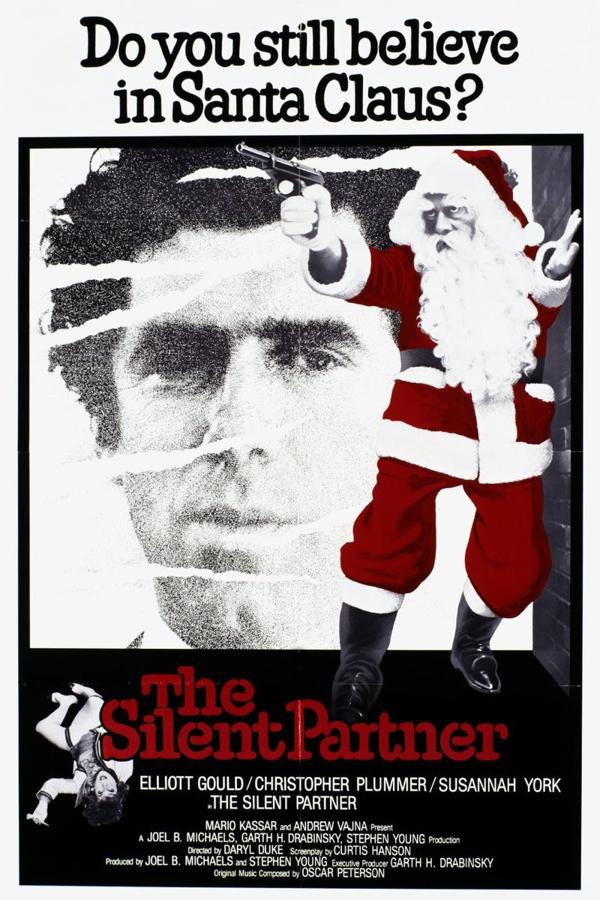
The poster for The Silent Partner depicts a faded, creased black and white photograph of the face of Elliott Gould as Miles Cullen, in front of which we see superimposed Christopher Plummer in a full body red-and-white Santa costume, brandishing a revolver.  Above them appears the tagline "Do you still believe in Santa Claus?" Below them, next to the film's title and major credits, the small black and white image of a collapsed (murdered?) woman is lying at the bottom left corner of the poster.

The plot is engaging also, in the first act, when the dominos are aligning.  Through a slightly implausible set of occurrences, Miles Cullen realizes that there’s a Santa Claus who intends to rob his mall bank branch, and who specifically plans to come in right after a major retailer has dropped a huge wad of Christmas cash off as a deposit.  Planning in advance, he arranges to hide the cash in his lunchbox, so that the Santa robber will walk off with a MUCH smaller heist, while taking the heat for the thousands in missing cash that Cullen will pocket.  The robber can’t complain to anybody, of course, given his criminal liability, and thus Cullen will slip away laughing with the perfect crime.  The only thing Cullen hasn’t thought about is that the crook under that Santa costume, a hardened tough named Reikle, is absolutely ruthless enough to hunt him down and cause no end of pain and suffering in pursuit of getting the cash he knows Cullen screwed him out of.  At that point, it’s a cat and mouse game: Reikle can’t kill Cullen until he knows where the cash is, and Cullen can’t escape Reikle because he isn’t really capable of the kind of violence it takes to permanently rid yourself of a guy like that once you’ve stolen “his” money.

To some extent, your ability to have a good time watching this movie will depend on your patience with a cast of characters who are, almost without exception, neither charming nor interesting.  Cullen’s sad sack bank teller desperately wants a woman, and he’s surrounded by people having a ton of semi-fulfilling sex, including a lucky-in-love John Candy—moreover, the environment at the bank is so sexually charged that one of his fellow tellers is a young woman walking around in a tight shirt that says “bankers do it with interest”, a walking HR problem if HR had meaningfully existed in 1978.  Anyway, I’d love to tell you that rooting for Cullen feels like I’m pulling for the underdog, but somehow Gould’s portrayal of Cullen never felt appealing to me: he’s sleazy, he’s selfish, he hides a fair amount of misogyny under his “nice guy” exterior, and ultimately he risks way too much danger (and not just for himself) in pursuit of an amount of cash he himself admits isn’t really life-changing.  I want him to “win” because Reikle is a monster, and because I know the screenplay has Cullen set up as the hero, but knowing that the movie wants me to think of Cullen as the hero ends up becoming an unsettling experience, since for me, men like Cullen are guys I don’t identify with and don’t want to.  And I don’t think the movie is at all self-aware in wanting to explore Cullen’s flaws, though others might see it differently.  The same goes for basically every character in the film, other than Reikle, a character the movie’s working overtime to present to us as evil incarnate since that justifies everybody else’s actions (to some extent).

It’s Reikle and the world around him that moves this film from an unsettling watch for me into a really upsetting one.  We see multiple acts of violence committed by Reikle against partly or fully nude women, at least one of whom is a sex worker, as he expresses his frustration and his dominance by hurting them.  And “hurting” is too gentle a word—I don’t want anybody to be as unaware as I was, going into this movie, that one of the scenes involves the violent decapitation of a woman using the broken glass side of a fish tank.  I’m obviously familiar with the fact that horror movies traffic in this kind of outlandish violence all the time, and maybe it doesn’t sound all that intense to you, but speaking as a guy who generally doesn’t watch movies like that, it was an incredibly tough scene to sit through.  I think part of the sourness of all this is that I consistently felt the sex and violence were exploitative and not communicative.  The woman Reikle murders exists only to be hot enough to have sex with Cullen, and then fragile enough for Reikle to destroy so that he can get back at Cullen, and then important enough to Cullen that he’s motivated by that killing to really ruin Reikle once and for all.  But she’s not a person with her own ideas or angle that I can decipher—she’s not a character in this story the way Reikle and Cullen are.  I won’t tell anybody they can’t find purpose in the horror of this movie at its most violent, but I couldn’t find it, and I couldn’t really give myself a reason in retrospect why most of the events of the film had happened, other than to engineer either naked women or gruesome violence (or both) onto the screen I was watching.  I’ve handled both sexuality and violence really sympathetically here with regard to past films, too, in Carol and Merry Christmas, Mr. Lawrence, so I’m confident it’s not that I’m automatically stuffy or Puritanical about what belongs in a holiday movie.  I just want these choices to matter, especially when they’re exposing performers to really vulnerable or even potentially degrading moments on screen, and it’s troubling to me when I think that they’re not being treated with respect.

In the end, I’d say that the film also lets me down by never really knowing what story it’s telling.  Cullen at the outset is this nebbishy nobody, someone so harmless that his boss reliably uses him as “cover” by having Cullen bring the boss’s girlfriend to the Christmas party so that the boss’s wife doesn’t figure things out.  And yet at some point a switch flips and he’s openly defying a murderous criminal, tailing him home down dark streets and setting up elaborate schemes to entrap him.  It’s just not clear why or how he knows how to do any of this, and if he was Kevin McAllister in Home Alone I would shrug and say, this is a child’s fantasy, who cares how Kevin knows to do these things?  But this isn’t a child’s fantasy, and it’s too bleak to be a satisfying grownup fantasy (for this adult viewer, anyway…I could believe this is the fantasy of some Reddit incel but the less I think about that, the better).  As a result, I don’t know how I’m supposed to understand who Cullen is or what he’s doing, which is a problem in a film that’s 100% about this guy’s triumphs and travails.  Reikle, too, is weirdly underwritten: I can’t tell you whether Plummer was playing him as con man or as unhinged megalomaniac or as sadistic freak, and my sense is that the director wasn’t giving him much help to find the character either.  I get the feeling that the filmmakers were most motivated by creating something for the male gaze—hot women and gritty violence and in the end the guy that everybody discounted (especially the women!) was the cleverest of them all and gets to both engineer some violence and have a hot woman, maybe even more than one.

I Know That Face: Christopher Plummer (here playing Reikle, our primary villain) narrates a Claymation short film in 1998 called The First Christmas, and in 1990 narrates two other holiday films, namely Madeline’s Christmas and The Little Crooked Christmas Tree.  Plummer also appears as Scrooge in 2017’s The Man Who Invented Christmas, which maybe someday I’ll add to my rotation of Christmas Carol adjacent films.  Indeed, Dickens makes a lot of intersections with members of this cast: Susannah York, for instance, (here portraying the much put-upon Julie) plays Mrs. Cratchit in the George C. Scott adaptation of A Christmas Carol from 1984.  Ken Pogue, whose familiar weathered face appears in this film as Detective Willard, is a veteran of multiple Christmas outings: he’s Hank Fisher in 2009’s A Dog Named Christmas, Dr. Norman Ferguson in 2000’s The Christmas Secret, and back in the day he was Jack Latham in 1979’s An American Christmas Carol, in which Henry Winkler plays the miser Benedict Slade under a massive amount of old-age makeup.  Most of all, though, you (like me) will have spotted a very young and unexpectedly trim John Candy who here is in the minor supporting role as the bank clerk Simonsen, but who we will all well remember as Del Griffith, the shower curtain ring salesman from the 1987 Thanksgiving movie, Planes, Trains, and Automobiles, as well as, of course, Gus Polinski, the Polka King of the Midwest, in 1990’s Home Alone.

That Takes Me Back: Everything about the bank situation for Miles Cullen was so reminiscent of days gone by (for me): some of you out there have safety deposit boxes, but I haven’t opened one in decades.  I can’t remember the last time I was counting out a cash deposit at the bank….maybe back when I ran the staff soda machine at the high school I taught at?  And I also can’t remember the last time I handled carbon paper, despite it being everywhere in my youth.  Oh, and while this is less specific, I just have to say, every single coat I saw on the Canadian extras roaming around whatever mall this was filmed at reminded me of the coats I was buying in the late 1980s from the local thrift store: I don’t know why it was the winter coats, in particular, that felt nostalgic to me, but it was.  Maybe it’s that I didn’t have much occasion as a 10 year old boy to wear a tight t-shirt that said “bankers do it with interest”.

I Understood That Reference: I’ll give it to The Silent Partner: Santa Claus is all over this movie, both cheerfully and violently.  It’s really the one successful holiday element in an otherwise not at all Christmassy movie.  I wouldn’t say the film deals much in the details of the various Santa legends, but maybe that’s for the best.


Holiday Vibes (3/10): It’s all about those mall scenes—ringing bells and Santa outfits, decorations up at the bank, etc.  But they’re done with pretty early on, and once the initial heist takes place, we’re fast-forwarding well beyond the holiday season and not headed back there.  Christmas is a bit player here, and since it occurs at the beginning instead of at the end of the film, I think it loses even a little more weight in terms of impact.

Actual Quality (3.5/10): There’s something interesting about the plot machinations here—Cullen’s creativity in solving his problems is interesting, and while neither Gould nor Plummer is really given a great role to play, they’re both talented enough to elevate at least some of the scenes into something more gripping and memorable.  For me, though, that’s about where it stops: in the end I don’t think the plot or the characters make enough sense on their own terms, and I’m sure not excited about the ways this story is being presented.  It feels far more hackish and less purposeful than I was hoping for.

Party Mood-Setter?  Haha, dear reader, I hope you are not throwing any parties in which a violent decapitation would seem like chill background media.  If you’re watching this movie at a gathering, I think it must be because this is a film you want to pay full attention to.

Plucked Heart Strings?  I mean, there’s emotion in the horrifying acts of violence against women here, but that’s not really what I’m talking about in this category.  Ultimately those women aren’t made real enough by the script to be people I’m moved by.  I’m just upset, and that’s not the kind of emotion you’re reaching for from a holiday film, or at least that’s how I feel about it.

Recommended Frequency: I’m really not sure how to recommend this movie, which I doubt I will ever watch again—it will work for audiences that are ready for it, but I’m not entirely sure who that is.  I think it might well work better as a horror thriller than it does in any kind of Christmas context, but if you like a Santa slasher movie (and I know many such films exist), this is probably one for you to try.  Good luck with it.

If, despite my warnings, you’re up for a viewing experience with this film, it can be rented from most of the big players in streaming land for a few dollars.  You can buy it on Blu-ray if you’re really sure this is your thing, though I might suggest a quick try at your local library first (Worldcat says about 300 libraries have it on disc) to see if you’re really sure it’s worth owning.  And if you’re in line at the bank in front of a guy in a Santa costume, I say, why not offer to let him go ahead of you?

The Family Man (2000)

Review Essay

Folks, here’s the thing about The Family Man.  It’s somehow 12 different movies you’ve seen before and it’s none of them at all.  It’s A Christmas Carol and It’s A Wonderful Life and Groundhog Day and Big and 13 Going On 30, but it’s also really not like any of those movies in so many key ways that you should probably forget I just mentioned them.  It’s a film that, for me, gets some things so right and then fumbles the ball in such weirdly unexpected ways that it’s maybe one of the hardest films I’ve had to reach a numerical rating for, since it’s incredibly hard to reduce this motion picture to a single number (of any magnitude) without feeling like I’m only describing some of the movie I had in front of me.  If you’ve seen it, I really wonder what you think of it, and if you haven’t, I’ll work at avoiding spoiling the ending but you may want to take it in before I ramble on about it.  In the end, there’s one element at work inside The Family Man that does kind of explain all of it—its genius at its best and its wobbliness at its worst.  And that element is a man we’ve come to know (and love?) under the stage name Nicolas Cage.

It’s probably at about this point that you want to tap my shoulder and say, “James, you still haven’t told us literally anything about this movie?”  Okay, okay: on the one hand, this is a film with such a clear central premise that it should be easy to summarize.  It seems like a classic tale about the road not taken: Jack, a thirty-something Manhattan high finance whiz got where he is in life by leaving behind him a stable girlfriend, Kate, whose goals were more altruistic.  But a Christmas miracle suddenly places him in the world where he made the other choice—waking up in bed with his wife Kate on Christmas morning, with loud young kids and a needy dog and in-laws crashing through the front door.  And then of course he’d like to escape this bad dream he’s having, but instead he’s got to live his way through it until….well, the “until” is part of this movie’s mystery and either its ultimate success or its failure.  But the basic structure of a body swap / life swap / alternate timeline movie in which the fancy big city guy learns something as he stumbles through life in the suburbs is largely going to show up on screen in the way you’re expecting, at least for the movie’s long and chaotic second act.  The third act, on the other hand, is unexpected in ways I’m really not sure about—maybe it’s a strength of the movie or maybe it’s a weakness that it didn’t really arrive at its outcomes in one of the ways I’d expect films of this kind to work.  I really don’t want to spoil it, so I may have to leave that judgment to you.

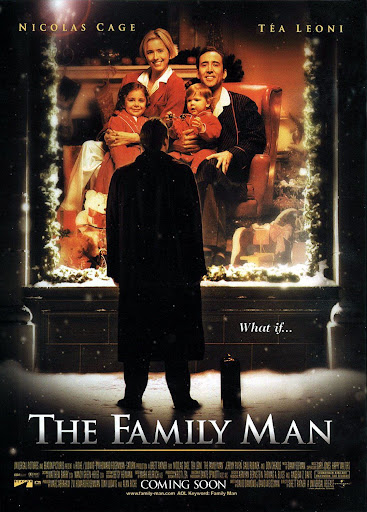
The poster for The Family Man depicts Nicolas Cage from behind as he stands in a trenchcoat on a snowy street with his briefcase on the sidewalk beside him. He is looking in through a large picture window at an image of himself seated in an armchair with Tea Leoni and their kids, cuddling together to post for a family Christmas photograph.  The tagline appearing next to him reads, "What if..."

Back to Nic Cage, though, and the reason this film is both really good and not really successful in landing the punches it wants to.  Cage is an astounding, generational talent: there’s nobody like him, and he does things nobody else can do, which is not to say he’s the finest actor working but he may be one of the most irreplaceable.  He’s on screen for nearly the entire running time of the movie, since this alternate universe switcheroo is one that effectively he alone is conscious of, so it’s his experience we’re tracking.  Given that fact, Cage’s fundamental watchability is hugely important—he makes everything from his character’s frustration to his character’s delight feel energized, even thrilling, as he takes the roller coaster ride of a man trying to figure out how he feels about this new life he’s been dropped into.  Even when the movie’s probably taking too long to complete the roller coaster ride (and it starts to feel a little pedestrian), you know Cage is capable of anything, and you keep your eyes on him.  As the character of Jack works out who he is, not as a balance sheet but as a person, he starts to understand why a man with his financial genius “settled” for the life of a suburban dad.  At its best, the film is both funny and heartfelt, as Jack navigates the sometimes outlandish silliness of his new world and discovers who he really cares about, and, maybe more importantly, discovers what it means to care about them.

And what makes all this not quite work, in my opinion, or at least not quite work in the ways that all-time great multiverse movies like Groundhog Day work, is that Jack is too compelling from the very beginning of the story.  The scenes we see of him on Christmas Eve prior to the dimensional shift are of a man who, sure, is a little arrogant and flighty in his personal relationships, a man maybe too used to the opera and fine whiskey and out of touch with “everyday life”.  But he’s also really happy?  And he’s not even a cruel person, that we see—sure, he’s in a world of high finance and mergers, etc., but there’s no obvious ways he’s complicit in ethical violations, and he’s upbeat and funny with his coworkers in ways that feel basically positive.  It’s not a bad life; to the contrary, it feels like a guy who’s figured out how to live at the top in ways he’s pretty fulfilled by.  Even if we consider the inciting incident that drags him to a new plane of existence, it’s not something he did wrong—to the contrary, he risks his own life pretty needlessly, since he could have remained an “innocent bystander”, but instead he steps forward to try to de-escalate a potentially lethal confrontation at the cash register of the shop he’s in, only to learn that the dangerous criminal is actually an angel.  Or something…honestly, the movie’s pretty bad at explaining the metaphysics of why this switch-up even happens or what qualified Jack for the experience.  Don Cheadle just smiles and tells Jack to remember he did this to himself, but what does that even mean?  Anyway, the result of all this is that we never really understand why we should be rooting for Jack not to go back to the life he came from, other than that Tea Leoni is hot (I mean, no arguments there), and that we know that in a Hollywood movie we’re supposed to be rooting for marriage and the suburbs and 2.3 children and a car in every garage, etc.  And knowing why we would be rooting for the suburbs is pretty darn important in a movie that is about really nothing else.

One of the other problems, fundamentally, is that the movie starts like it’s shot out of a cannon.  We literally know nothing about the Jack/Kate relationship prior to the breakup other than them standing at the airport gate in 1987 with her telling him she’s got a premonition he shouldn’t fly to London for his internship, and him telling her it’s ludicrous for her to ditch law school and him to ditch the internship.  It’s the only glimpse we’ll see of the relationship he left behind, and as a result, I just think it’s hard to invest myself fully in believing that clearly this young grad student should have listened to his girlfriend’s weird dream logic rather than continue to pursue a career he clearly thrives in.  And then once you start to lean on the logic of the movie, it does break down a bit…maybe most importantly, why is it true that Jack has to give up all his dreams and opportunities, whereas Kate still gets to go to law school (she’s an underpaid lawyer for a nonprofit in the “future” of the movie) and practice her craft, and the house and the life near her parents and all the rest of it are clearly the things she values in life.  Why are her values more important than his?  Again, if the movie made him an obvious monster at the outset—a selfish, cruel man who uses his gifts to oppress other folks—then it might be a simplistic moral fable but at least I would understand why Kate = good and Jack = bad.  As it is, the film’s values feel unfortunately like the echo of a ‘90s movie that presumes we know who the good and bad guys are without needing to actually make the case.

The holidayness of the movie is tough to calculate: again, I know that messages about family, etc., are often associated with this season of the year, but given how weird the movie’s ethics are, I’m not sure how much I want to credit it with having a meaningful message in that regard.  The magic of Christmas Eve / Christmas morning is definitely central to the film’s opening and closing sequences, but in the middle it’s just January in New Jersey, and given how detached from reality Jack is (either because of his palatial life as a wealthy financier, or because it’s Christmas Day and he woke up in the wrong house in someone else’s underpants and he’s frantically trying to put it all together) we don’t get a ton of Christmas celebration to lean into.  Add in the vagueness of the character Cheadle plays, who could easily have been more explicitly made an angel or an elf or Santa Claus or anything you like, and we lose even more chances to ground this experience in something more explicitly Yuletide.

I think in the end, this is a movie that feels like maybe it hooked Hollywood producers as a great premise, and then between that point and the final cut, neither the screenwriters (Diamond and Weissman, a partnership also responsible for….yikes, Evolution and Old Dogs, okay, some of this movie’s problems are making more sense now) nor the director (Brett Ratner, DOUBLE yikes, that man’s Wikipedia page has a whole section devoted to “sexual assault allegations”) figured out how to make it really work.  And the more I’m looking at what I just found out about the three guys involved, yeah, their struggle to tell a magical, nuanced tale about love and family life is maybe just a bit more explicable.  But here’s the thing: that premise is still really powerful.  And Cage and Leoni are probably just about perfect casting for a movie like this, in this era.  The second act may sag, and the third act may have a couple of unexpected curves in it, but ultimately their performances keep me hooked on the film, maybe in part because they make Jack and Kate alive enough that I don’t care too much about the screenplay not justifying why I should be rooting for them to be together again.  I just want these two people who are clearly passionate about each other to be together again.  That’s the kind of thing a movie can do, and this one does it well enough that it may be my most memorable takeaway.

I Know That Face: Saul Rubinek, who here plays the generally nebbish Alan Mintz, appears as Mr. Green in 2005’s Santa’s Slay, in which Mr. Claus is a demon who lost a bet with an angel.  Jeremy Piven, who in this film is Jack’s suburban buddy Arnie, plays the titular father in 2020’s My Dad’s Christmas Date, which sure sounds like a winner from the title, eh?  Nicolas Cage, Jack himself of course, was the surprising choice to voice Jacob Marley in a widely panned British adaptation of the classic story in 2001’s animated Christmas Carol: The Movie.  And Don Cheadle, here portraying “Cash” (an angel?), is of course well known for his role in the MCU as Colonel James Rhodes, including in the film Iron Man 3, which is acclaimed by the Die Hard crowd as yet another action movie that counts as a Christmas flick….and yes, by the forgiving standards of this very blog, I have to give it to them.  It counts.

That Takes Me Back: As a real fan of the paper map (who, yes, acknowledges that Google Maps has made everything simpler), I did love the chaos of Jack having to fumble with a paper map while driving his way around chaotically, like we used to.  It was nostalgic, too, to see a CRT monitor the size of a destroyer on his office desk, not to mention a checkbook with a bunch of entries for deposits and withdrawals in its register.  I wonder…do we even teach students to “balance a checkbook” in Home Economics these days, and if so, why?  Lastly, I couldn’t help but think of September 11th and all that’s changed since—certainly when I got a brief and shocking glimpse of the Twin Towers in an establishing shot (like we always used to do when filming New York City in the 1990s), and also when I watched a character making that old movie classic, the impulsive sprint to the gate at the airport, which now of course is simply impossible.

I Understood That Reference: Other than one character’s quip, “Santa Claus, you’re half an hour late,” I didn’t spot anything.


Holiday Vibes (4/10): As I note above, there’s not enough Christmas in the screenplay, or on screen, to really make this movie feel like Christmas to me.  But it’s in there enough that I can see this being a movie this time of year for some folks, and certainly any movie involving magic and snowfall has to get at least an extra half point, doesn’t it?

Actual Quality (8/10): Like I said at the outset, this movie defies numbers.  I could watch Cage prancing and singing around his enormous walk-in closet for 45 minutes but that doesn’t make this movie a 10, you know?  As it is, I’m trying to split the difference between my remaining really engaged with this movie throughout and my having a ton of notes about the ways I would have improved the film, given a chance.

Party Mood-Setter?  Probably not?  It’s hard to explain how weirdly intense the movie is—Jack’s outbursts are a lot to handle, even though I can generally track where they’re coming from.  Not really background fare.

Plucked Heart Strings?  There’s a moment or two that felt pretty authentic, but I’d be surprised if the film brought anybody to tears.  The complicated combination of the multiverse angle and therefore the weird emotional truth/falsity of these moments makes it harder to relate to than it would otherwise have been, I think.

Recommended Frequency: I have to be honest: I feel like I’ll watch it again, although I think there are other films that cover this kind of material better. There’s something to this movie, and maybe after another watch or two, I’ll understand better what, if anything, it means to me?

If you’d like to watch The Family Man yourself, right now you’ve got some options.  Subscribers to Peacock or to Amazon Prime will have an easy time.  You can rent it from all the usual streaming services, and Barnes and Noble will sell you the film on Blu-ray or DVD.  Public library users, Worldcat assures me you can snag this one from over 1,600 libraries in its database, so hopefully there’s a handy copy near you. Happy viewing to you!

The Thin Man (1934)

Review Essay

Here at Film for the Holidays, one of my inexplicable commitments each holiday season has been to commit to watching at least one movie from every decade spanning from the 1930s to the 2020s.  Last year I cheated slightly by making my pick from the 1930s a Christmas Carol adaptation, so it’s only this year that I’m picking something just a little more unusual off of the (relatively small) pile of 1930s holiday flicks.  I am sure some of my readers will have gotten to this movie long before I did, but if perhaps you (like me) have waited until this point in life to check out maybe the first great fictional couple of Hollywood’s sound era, Nick and Nora Charles, well, I think it’s time to give The Thin Man a viewing.  Say what we will about its seasonal content—and I will say it, eventually—there’s no denying that the spark under the hood of this motion picture is the crackle of romantic banter that’s been imitated in a thousand movies, and yet there’s still something fresh and fun about encountering the original article.

Before we can revel in Nick and Nora, though, this is a mystery with a ton of characters to set up, and set them up it does—the Charleses don’t appear until a good ten minutes into this film, which only has a running time of about an hour and a half.  By then, we’ve established a wide array of characters—the brilliant inventor Clyde Wynant, his greedy ex-wife Mimi Jorgensen (and her new husband, a real ne’er-do-well’s ne’er-do-well named Chris), his doting daughter Dorothy, and his creepy son Gilbert (who, had he been born about a century later, would definitely be either a true crime YouTuber or the moderator of a deeply unsettling subreddit).  Wynant, of course, has a wider array of orbiting humans than this—a couple of put-upon employees, among them a secretary named Julia Wolf who seems to have her way with his money (and maybe not just his money, if you catch my drift), a lawyer named MacCaulay who fusses about managing Wynant’s business affairs every time he disappears, a prospective son-in-law named Tommy, and a rival for Julia Wolf’s affections in the form of the most outlandish ‘30s mobster caricature imaginable, the spitfire-talking lowlife Joe Morelli (though there’s at least one other guy lurking around in the shadows, here, whose name we don’t have at first).  I think I still haven’t listed everyone we meet in this story BEFORE we meet our detective, Nick Charles, but maybe that makes sense, since at first there’s no crime to solve….just Clyde Wynant leaving town for a while, mysteriously, having promised his daughter Dorothy to be home by Christmas in time for her wedding, so he can give her away at the altar, angering his ex-wife in the process.  But then the movie hops forward to the dining room / bar / ballroom at New York City’s Hotel Normandie on Christmas Eve, where Dorothy is nervously chatting with her fiancé about how worried she is that her father still hasn’t shown up, and we have ourselves at least some of the makings of a mystery to investigate, though it’s certainly not the film’s most pressing conundrum by the time we really get going.

The poster for the movie, The Thin Man, advertises, at the top, "William Powell, Myrna Loy, in Dashiell Hammett's master mystery".  Below that, we see a man and woman, staring intently into each other's eyes as they each curl their right arm around the other's, and drink a cocktail from a small, clear glass.  The woman's in black with a white collar and black hat; the man is in a black suit with a white collared shirt and striped tie.  Below them, a different auburn-haired woman in a black dress and scarf faces towards the viewer and is looking down and to the viewer's left.

I have to admit, though, and this is me speaking as a big fan of mysteries in general (novels, movies, TV shows: you name it)—the appeal of The Thin Man isn’t really the mystery and its (somewhat creaky) solution.  It’s the effortlessly charming Nick Charles and his vivacious, cheerfully cutting wife, Nora.  The characters and their quippy, booze-soaked repartee seem to have worked in almost every format and setting from Dashiell Hammett’s original novel to later appearances in series written for radio and then television, but it’s really undeniable that the reason “Nick and Nora” still have cultural cachet in the 21st Century, whether we’re talking about a style of martini glass or an infinite playlist, is the film version of these characters as inhabited by William Powell and Myrna Loy.  Powell, a slender, coolly casual presence who, by 1934, has stepped smoothly from silent screen stardom into the talkies with such ease that he’s about to pick up his first of three Academy Award nominations for this movie, is definitely firing on all cylinders, but I’ll be honest and say that his co-star is this movie’s secret sauce.  Myrna Loy in the early 1930s is a kid from Helena who started out grabbing every bit part she could in silent ‘20s films and had mostly graduated to secondary roles as either femme fatales or “exotic” women of color—maybe only 1930’s Hollywood could look at a Montanan woman named Myrna and think “she’s believable as a Chinese villainess, right?”, but think it they did.  Anyway, this is her big swing of the bat, and she hits it out of the park like Ohtani, so fully connecting with audiences that she goes on a run for the rest of the 1930s and 1940s where she plays opposite almost every major male star of the era, not to mention demonstrating such magnetism side-by-side with William Powell that he’ll go on to play opposite her in an incredible THIRTEEN additional movies, including five more outings as Nick and Nora between 1936 and 1947.

I think what’s magical about Nick and Nora is the way they keep us convinced how much they’re in love with each other even while they are pretty verbally ruthless towards each other (and, in fairness, everyone around them, but they’re surrounded by such a cavalcade of rogues and fools that it’s easy to laugh along with the Charleses as they land jokes at the expense of the rest of the characters).  They’re helped to some extent by the fact that The Thin Man is one of the last Hollywood films to come out in a pre-Code environment: it hits the nation’s theaters in late May of 1934, right before the Hays Code takes effect on July 1st of that year, which means that every “morally questionable” element of this film, from its violence to Nick and Nora’s overindulgence in martinis to the not-too-subtle winks in the direction of their life in the bedroom, is allowed to be just a little more salacious.  It mostly does come down, though, to Powell and Loy being that good on screen together—good enough that when Nora accuses Nick a little jealously of his attentions to the starry-eyed young Dorothy, he can protest that, to the contrary, his type is “lanky brunettes with wicked jaws,” and the phrase sounds sweet as molasses.  He can shove an unwilling Nora into a taxi, telling the driver to “take her to Grant’s Tomb” to keep her out of harm’s way, and later, when he faux-innocently asks her how she liked the place, receive her reply of “It’s lovely. I’m having a copy made for you.” with a smile on his face that we genuinely believe.  Most of all, I think what works about the two of them here is that the script successfully makes them a team that completes the work of one good detective—sure, Nick’s the one with the professional experience and seemingly the skill, but it takes Nora’s persistence to get him to engage in the first place, and more than a little of her dogged resilience to get all the pieces to fall into place by the end in just the way Nick needs them.  When he says at one point, “Come on, Dr. Watson, let’s go places,” as he pulls her out the door of their suite, it feels a little less like a jab and a little more like a man starting to admit to himself that his frivolous, rich wife is turning out to be better at this private eye work than he would have thought….though this is Nick and Nora, of course it’s also a jab, and one she’ll hit back over the net at him sooner or later.

But James, I hear you saying….you just keep talking about Nick and Nora.  What about the mystery?  Heck, what about Christmas?  Isn’t this a holiday movie blog?  Look, friends, if you want to know why you should watch The Thin Man, it is 90% Nick and Nora saying things like “The next person that says ‘Merry Christmas’ to me? I’ll kill him.” or “Waiter, please serve the nuts. Sorry, I mean, waiter, please serve the guests the nuts.”  But sure, let’s at least nod at the rest of all this.  The real mystery kicks into gear on Christmas Day, when Mimi Jorgensen goes to try and get some money out of Julia Wolf (since apparently, despite the divorce, Clyde Wynant has been keeping his ex-wife’s household afloat financially, and not just Dorothy and Gilbert) and finds the young woman dead.  Mimi shrieks, she calls the police….and then she surreptitiously pockets something we can’t see off of the body.  What is it?  Time will tell.  Anyway, this triggers a parade of Wynants (and ex-Wynants) to the Charleses’ hotel suite, crashing an incredibly lively, some might say “bacchanalian” Christmas party, as first Dorothy and eventually her mother and her creepy kid brother show up seeking the help of old family friend and semi-retired detective Nick Charles.  From here, the chaos never really stops—the film flips back and forth between Nick interviewing at least one potential suspect and the discovery of either a new body or a new piece of evidence.  It’s not obvious for a big chunk of the running time if this is a mystery involving where the murderous Clyde Wynant could possibly have gone or one involving who killed Clyde Wynant and then framed him for a series of murders: the film will of course tell you by the end, and so there’s no need for me to do so.  To be honest, the mystery isn’t paced particularly well, since we learn some information so early that it doesn’t create a ton of suspense and some fairly key details emerge so late that there’s not much hope of an audience member solving the case through anything beyond a lucky (if semi-educated) guess.  The investigation of one or more crimes serves more as the backdrop that allows Nora to pester Nick (and Nick to infuriate Nora), with just enough twists along the way that your interest is held.  It’s been years since I read Hammett’s original novel, but my memory of it is that it’s slightly better as a mystery than the movie is, but that it also is fundamentally a detective story that is at least 75% about the vibes and not the plot (unlike, say, a Hercule Poirot).  When you get to the final scene where all the suspects are in one room together, sure, you’re looking forward to the resolution of the mystery, but honestly I think most of the fun even then is coming from the cheeky asides Nick and Nora are making to each other at the expense of the folks around them.

As far as Christmas goes, well, we meet Nora in the first place as a woman stumbling back from holiday shopping, who subsequently wakes up with a horrible hangover on Christmas morning, mumbling about the urgency of “trimming that darn Christmas tree”.  I mention Nick and Nora’s anarchic Christmas party earlier in the review, and really it’s the one seasonal element in the whole film: the party is a set piece that lasts long enough to be memorable, but it’s not exactly central to the story, either of the mystery or of Nick and Nora’s relationship.  The party is full of characters we never meet who will never play much of a role in the story beyond creating some nucleation sites for locating a great one-liner, like the fellow who tells Nora, “I think your husband’s great!”  She throws him back that feline smile of hers as she replies, “Well, I’m glad somebody does.”  Near the end of the gathering, as Nora and Nick watch the revelers belting out a very inebriated version of “O Christmas Tree”, she turns to him and says “Oh Nicky, I love you because you know such lovely people.”  And it’s a slam on Nick’s truly depraved social milieu from the rich woman who married him, while also being the bubbling up of genuine admiration from a woman who seems to feel like, after years of ease and wealth out west in California, this return to the seamy, seedy underbelly of Prohibition-era New York City is thrilling on a level she never anticipated.  In the end, though, this is far less a Christmas movie than it is a movie about mobsters who say “yeah, see?” right before pulling out a revolver like a cartoon character trying to threaten Bugs Bunny, or molls who, when they realize they’ve been dating an informant for the cops, burst tearfully out the door rather than remain in a relationship with a stool pigeon.  Not everyone will want this film bellying up to the bar alongside some much more evergreen-bedecked and candy-cane-fueled festive fare, but if you’re inclined to let it in the door, I think you’ll find it (like both Nick and Nora) is a charmer.

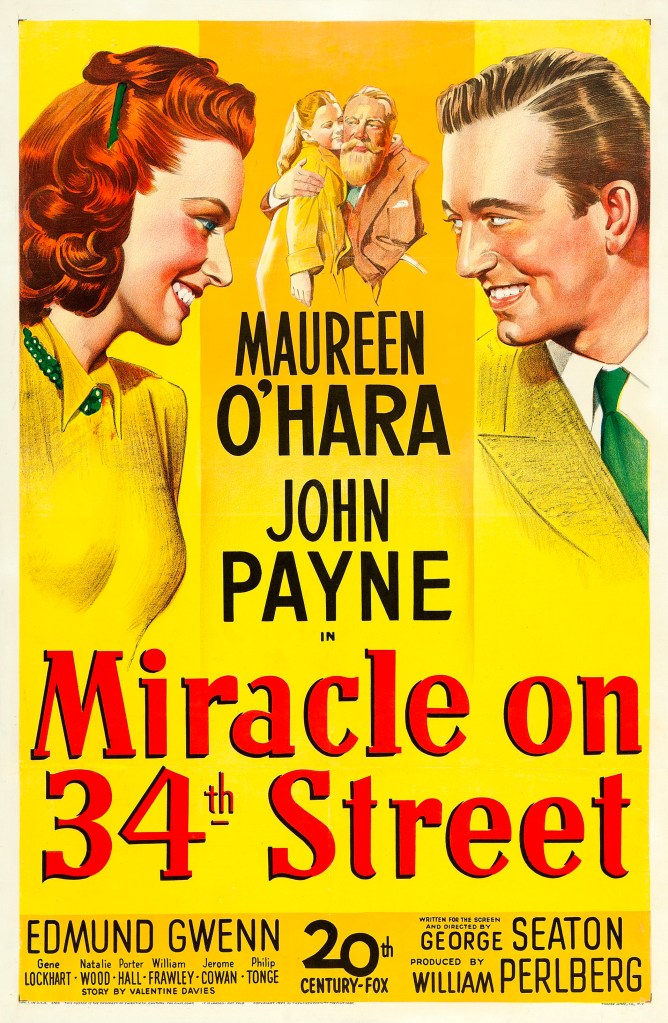
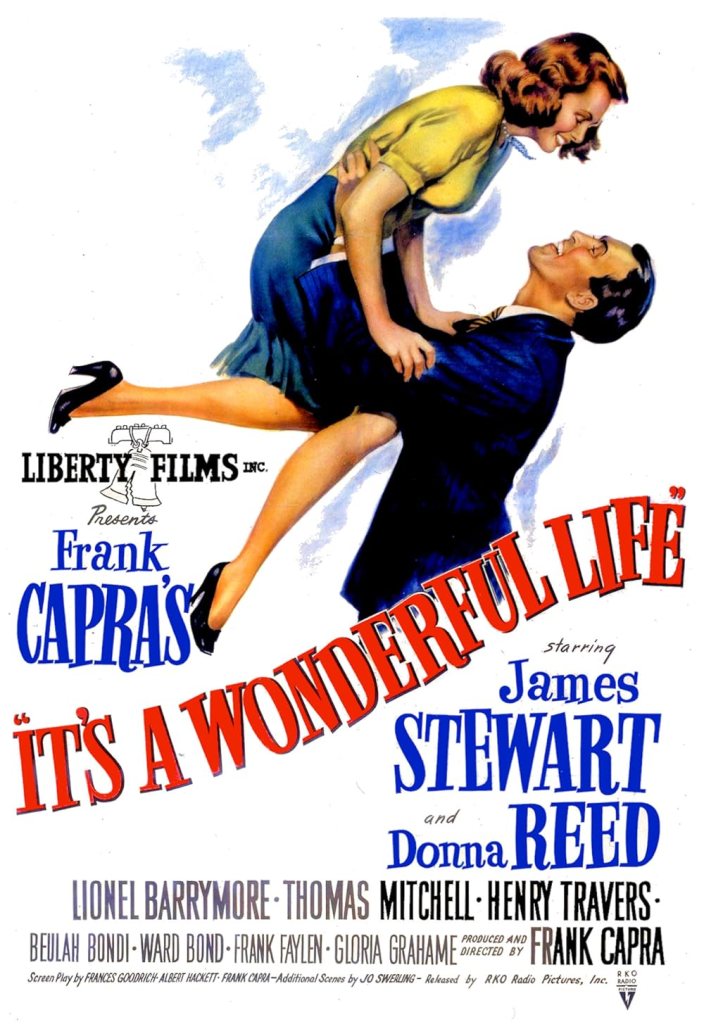
I Know That Face: Porter Hall, here playing MacCaulay, Wynant’s lawyer, appears, of course, in 1947’s Miracle on 34th Street, recently chronicled on this very blog, where he plays Sawyer, the malevolent psychologist who tries to get Kris Kringle locked up at Bellevue.  Edward Brophy, portraying the street tough Joe Morelli in this movie, swaps sides of the law to play a patrolman, Cecil Felton, in 1947’s It Happened on 5th Avenue, which I wrote about last year.  Myrna Loy, irreplaceable here as Nora, will later portray Mrs. Anna Smith in the TV movie version of Meet Me in St. Louis (1959), and at the start of her career she’d been an uncredited slave girl in 1925’s Ben-Hur: A Tale of the Christ, which of course stages the first Christmas in the early going.  And, in a real blink-and-you-might-miss-it appearance, one of the Christmas merrymakers at Nick and Nora’s party is played by an uncredited Charles Williams, who will, much later in a career that was otherwise mostly full of similarly uncredited performances, make his way into a film’s credits as Cousin Eustace, one of the fretful employees at the Bailey Savings & Loan in 1946’s It’s A Wonderful Life, which I covered for you all here last year on Christmas Eve.

That Takes Me Back: When, near the end of the film, Nora hosts a dinner party, it was fun to see her and Nick talking about putting down little name cards at places around the dinner table: maybe there are still some folks out there doing dinners like this (if so, invite me over!), but for me it feels mostly like a pleasant throwback to holiday dinners when I was a kid.  And it doesn’t matter how often it comes up, as it does during Nick and Nora’s Christmas party, but it will never fail to take me back in time when I see a character making a long distance call (especially when, as in this case, it’s clearly part of the joke to think about how wastefully expensive it is).  In a world where we basically never think about “long distance” anymore—so much so that I’m not sure my 12 year old would even know what the phrase means—it’s wild to think of how universal that experience once was.

I Understood That Reference: The only real reference to anything textually Christmassy is a quick back-and-forth quip between (who else?) Nora and Nick, when on Christmas morning she hears a knock at the door.  “Who’s that,” she asks Nick?  And he replies, “Probably Santa Claus.”


Holiday Vibes (2.5/10): As I cover in the review, really we get all of Christmas in just a couple of scenes—Christmas Eve down at the bar/ballroom portion of the Hotel Normandie and then Christmas Day up in Nick and Nora’s hotel suite, neither of them really classic depictions of holiday joy.  I have to give a little bit of credit to the party for at least being so exuberant that it really does feel like every two-bit ex-con and dipsomaniac in the five boroughs has found his or her way to reconnect with Nick Charles this holiday, but ultimately if you want a seasonally festive film experience, this isn’t going to deliver much.

Actual Quality (8.5/10): It’s hard in some ways to really rate the quality of a movie that is all about the energy and dialogue and not really at all about the plot, especially when the movie’s at least pretending to be primarily a mystery, a genre that is ordinarily heavily dependent on a successfully intricate plot.  It all really hangs on how much fun you’re having with Nick and Nora: if you find them more tedious or mean-spirited than I do, this could drop to a 7.5 or a 7 if we’re just judging it on the basis of “how good a detective story is this?”  And if the rat-a-tat of both comic delivery and 1930’s mobster gunfire is the music you love to hear, I can imagine this film climbing to a 9 or higher: Roger Ebert, the noted critic, listed this as one of his “Great Movies” of all time.  I think the fairest assessment is somewhere in the middle of that curve—I didn’t have quite as great a time with this flick as I have with a number of others I’ve reviewed for the blog, but I enjoyed myself, and I think you likely will too.

Party Mood-Setter?  The answer’s definitely “No,” not only because it’s not as “holiday” a movie as you’d really need for a seasonal celebration, but also because it’s so dependent on rapidfire banter and quick turns of phrase that to get the fun out of it, it really needs at least most if not all of your attention.

Plucked Heart Strings?  It’s just not that kind of movie.  The emotional register here is delight at how fun it is to watch Nick and Nora be semi-spitefully in love with each other, not pathos as you get in touch with wistful joy (or deep sadness).

Recommended Frequency: This one definitely rewards rewatching, since the first time through, there’s no way to avoid being mostly caught up in trying to track all the characters to figure out suspects and subplots and red herrings.  Once you’re freed from worrying about the mystery, a second viewing lets you settle in to just enjoy what the movie’s doing best—and I’d say that the end of the movie is what helps cement my certainty that Nick and Nora are actually good together (and genuinely attracted to each other), which altered to some extent my reading of their interactions the second time through the film.  I would definitely tell you to watch this one once, if you haven’t seen it (or haven’t in a long time), though I’ll admit that I think it would work almost as well in June as I find it does in December.

The Thin Man is still a few years away from the public domain, so your free options for streaming it are Tubi or Fandango at Home, both of them ad-supported, of course.  You can pay to rent it digitally from all the places you would normally think to do that.  The film’s widely available on disc, too, of course—just The Thin Man on Blu-ray if you like, or you could pick up all six films if you’re a real Nick-and-Nora-head.  And I’m nearly willing to issue a guarantee that you’ll be able to get the movie at your local library, since Worldcat says there’s over 1,600 libraries with at least one copy of the DVD.  If you want to try this movie out, it won’t be hard to do, and I encourage you to give it a try if it sounds remotely interesting.

Single All the Way (2021)

Review Essay

I’m going to open with the caveat that this is a movie living on the outskirts of a massive holiday movie industry that is absolutely serving a big and happy audience, and that I am not a part of that audience.  I’m not trying to get in anybody’s way as they consume the delightful fluff of Lifetime/Hallmark/Netflix Christmas flicks (and yes, diehards, I know that there are real tonal and stylistic differences between these channels/streamers when it comes to holiday media), and honestly, I’ve seen so few of them that even calling them “fluff” is probably unfair since if there’s some non-fluff in there, I wouldn’t know it.  My guess is that the movie I’m talking about today will work a lot better for folks who receive the tropes of the TV/streamer holiday romantic comedy like a warm hug.  For me, this is something less successful, but I’ll try to be generous where I can be.  That said, good grief, does Single All the Way feel like an extended Christmas episode for a cheesy sitcom that doesn’t exist.

The fundamental setup of the movie is trite but not necessarily doomed at the outset: Peter is a guy born in New Hampshire who escaped to the high-fashion world of models and marketing in Los Angeles years ago.  He’s headed back home to his small town for Christmas, accompanied by long-time best friend and roommate Nick who just dumped his trash fire of a boyfriend.  Peter’s family are (delightfully and not at all expectedly to me, given other films of this kind) really accepting of his identity as a gay man, even if they seem pretty clueless about LGBTQ+ folks in general.  So this isn’t a trek back home to the closet, as in Happiest Season, which I did genuinely appreciate.  But instead, alas, it’s a trip home to a family desperate to get Peter hitched to somebody—initially to his mom’s spinning instructor, James, via blind date, but then the family rapidly shifts to urgent, manic match-making maneuvers in an attempt to get Peter and Nick to fall for each other, despite their never having had any apparent romantic chemistry or tension in years of living together.  It’s a surprisingly exhausting experience, and if you think you know where it will end, yeah, you sure do.  Regardless of whether the ending makes any sense for these characters.

A promotional poster for Single All the Way depicts two men in their late 20s or early 30s standing together in the middle, looking upwards and smiling.  The man on the left is a Black man with short hair and beard; the man on the left is a clean-shaven white man wearing large earmuffs. Above them are five inset portrait photographs, two of them photos of the two men and the other three images of smiling middle-aged white women. The tagline reads "Peter and Nick are just friends. Peter's family knows better."

The tone of all this is, as I mentioned up top, really sitcom.  Like, really, really sitcom.  Jack from Will & Grace could wander into almost any of these scenes and not be totally out of place.  I don’t know at what point my eyes permanently rolled out of my head at the dialogue—I think I made it through “don your gay apparel” without collapsing, and I gritted my teeth through someone quipping that HGTV was the “Homosexual Gay Network”, but when someone described themselves as a “FOMO-sexual”, I was done.  And I want to emphasize that I love a good sitcom, so this isn’t me sniffing that the movie isn’t dark or artsy enough for me.  But the tone is so often broad and silly that it becomes incredibly hard to be invested in the emotional wellbeing of these characters when suddenly the screenplay expects me to take them seriously as people with hopes and dreams and baggage.  The antics they get up to—blind date hijinks for Peter, lots of home improvement work by Nick helping Peter’s father (since Nick works for Taskrabbit and he is really inspired by how Taskrabbit allows him to connect with and help others, and being a Taskrabbit at Christmas is almost like being a TaskElf, hahaha, hey, have I mentioned yet that Nick works for Taskrabbit and he feels kind of directionless in New Hampshire unless he’s working like a Taskrabbit?)—are incredibly mild. I’ll give it to this movie that, unlike Happiest Season, the goofiness is often less unhinged, but that also just means that the scenes are often a lot less memorable.  I’ve already forgotten a lot of the story beats within this movie’s second act.

There are things to praise here, to be clear, beyond my enthusiasm for a holiday movie that gives us a diverse cast (not just several key gay characters, but also at least a little welcome racial diversity for a movie set in New Hampshire).  Insane as both the characters they’re playing are, Kathy Najimy and Jennifer Coolidge (Peter’s mother and aunt) were kind of born to play sisters and to some extent they each make the other seem more realistic as a human being by being adjacent.  Coolidge as Aunt Sandy, the deranged megalomaniacal director of Jesus H. Christ, the town’s non-sectarian Christmas pageant, can at her best make even the wildest, most flailingly awkward moments seem plausible…she is not always at her best in this film, even so, but nobody could have done more to keep at least one of the movie’s toes on the ground where the pageant subplot is concerned.  Kathy Najimy as Peter’s mom….well, I have been to too many farmer’s markets to doubt the existence of people who buy kitschy, folksy, and at least allegedly funny wall decor, and Kathy is 100% landing the plane as a woman who would purchase a framed cross-stitch that says “Sleigh Queen”.  If you chuckled at that, friend, this is a movie you should check out.  The plan briefly entertained by Peter to pretend that he and Nick are dating (as a smokescreen to save himself from the blind date his mother’s going to send him on) dies a quick and fairly painless death more or less on arrival, which was a relief in the moment, at least.  And the best performance in the movie, bar none, is Luke Macfarlane as James, the spinning instructor for Peter’s mother, “Christmas Carol” (yes, that’s the name every character in this movie calls her, friends: how are you feeling about it, right now?), and also of course Peter’s blind date.  The character of James comes across as nuanced, thoughtful, patient: he undermines every likely stereotype, and he seems like a genuinely good dude with whom Peter might have built some really good chemistry, maybe even was initially building that chemistry.  I think this works against the film, to some extent, since it makes the ways Peter treats/mistreats James on his way to his destined-by-the-screenplay relationship with Nick even harder to enjoy when James is not only sympathetic but someone who feels more real, more human than our main character.

The overall arc of the film, really, was just too hard for me to enjoy: we’re asked to join all of Peter’s family in rooting for them to destroy his budding romance with James (based on a blind date his own mother started) and figure out how to basically force Peter and Nick to realize that they’re “perfect for each other”, by which I mean Peter’s dad who loves Nick’s handyman skills and a couple of teenage nieces who think it would be, like, sooooo cute if Peter and Nick dated and…well, you get the drift.  This isn’t a movie that’s figured out how to get these best friends to fall in love with each other by any means other than having a bunch of family members bashing them together like two Ken dolls they’re playing with.  I get that it’s supposed to be silly and sweet, but I don’t know: I was not in the mood for this movie’s brand of romance, and the whole thing ended up feeling almost offensive, as though the gay main characters were paper dolls being puppeted around by straight people who are, yes, “accepting” of their identity, but also not really treating them like people with their own desires and needs in relationships.  But honestly, using a word like “offensive” about Single All the Way would be inappropriate: this isn’t a movie that’s working hard enough in any direction to really mean the things it’s saying.  Like, this is a movie that wants us to nod along with a character claiming that if the town’s Christmas pageant is peppy enough, maybe it can “go on tour” after Christmas Day.  It wants us to accept that the highest powered marketing executives in the country would insist on an emergency photo shoot occurring on Christmas Eve at a moment’s notice….but they’re fine if the images produced are just iPhone snapshots in the woods, featuring whatever random local hunks are willing to pose in a hat and coat.  It’s never, ever mean-spirited, and as the queer main cast members are seemingly comfortable with what they’re appearing in, I wouldn’t tell you not to watch it.  I just think that, ultimately, this is not a script or a film that respects its characters in the ways I was looking for—the final scenes of revelation and admiration between Peter and Nick imply a greater psychological depth than has been developed for either of them.  The movie thinks it’s a story about self-discovery, but I experienced it much more as a story of social engineering, in which a family’s acceptance can also become a fenced yard in which your identity becomes a convenient way to pigeonhole you.  As always, though (and especially for films in this particular subgenre), your mileage may vary.

I Know That Face: Luke Macfarlane (as aforementioned, here he’s James, Peter’s incredibly attractive blind date) is an absolute veteran of TV Christmas movies, having appeared in at least NINE of them, including as Edward Ferris in 2019’s Sense, Sensibility and Snowmen, and as Chris, Santa Claus’s alleged son, in 2023’s Catch Me If You Claus.  I’ll give it to this subgenre: the movie titles are hilariously corny.  Barry Bostwick (here playing Peter’s genial father) is no stranger to the holiday circuit, himself, appearing in at least five such films, including 2017’s Christmas in Mississippi and 2019’s Christmas in Louisiana—the mind boggles at the potential for 48 sequels (more, even, if we throw in D.C., Puerto Rico, and Guam).  Add in Kathy Najimy (again, Peter’s well-meaning and overbearing mother), a member of the cast of at least four different holiday movies, including her appearance as Kim in 2013’s A Madea Christmas, and this little cast covers a remarkable breadth of the sizable collection of 21st Century TV movies that depict this special time of year.

That Takes Me Back: As a 2021 release, this movie’s too recent for any real nostalgia, of course, but someday the relentless Taskrabbit and Instagram references will be dated as hell.

I Understood That Reference: Kris Kringle shows up in the end credits song, and of course, thanks to Aunt Sandy’s lunatic obsession with a Christmas pageant that I will remind you again is titled Jesus H. Christ, we get a weirdly elaborate nativity scene on screen, since the movie can think of no more natural way to tie Peter and Nick together than forcing them to help out with the pageant before Aunt Sandy’s ego crushes every single participating child.  


Holiday Vibes (9.5/10): I have to hand it to this movie, it captures the feeling of a particular holiday energy, embodied by the kind of person who sees a framed poster in a country store that says “Nice Until Proven Naughty” and thinks, “That would be perfect for my entryway.”  And basically everything about the film once we reach New Hampshire is pretty Christmassy—snow and merriment and pageants and a countdown hanging on the wall that reminds passers-by to be good for St. Nick.  It’s generating plenty of holiday vibes, that’s for sure.

Actual Quality (6/10): As for the quality, on the other hand, this movie suffers.  Now, is it truly awful?  I can’t say that.  There are some fun performances and the movie’s pretty relaxing as a watch, as long as you don’t think too hard (as I clearly did) about the ethics of how this family is treating their visiting adult son/brother/uncle.  But is it good?  I struggle to even call it “fine”, given what I’m looking for in a movie: there’s just not enough ‘there’ there.  It’s a film that leans on the worst tropes in romantic comedy, for me, and (with my apologies) I just don’t think most of the cast is talented enough to really hold my attention: better actors might have saved some of this writing, but the two main characters here in particular are pretty bland, for me.

Party Mood-Setter?  Oh, 100%, especially if you’re at a party where those gathered will enjoy a little bit of eye candy from the hot men posing for the camera at multiple points throughout.  Sure, I think it’s empty calories, but that means that a party or a cookie baking afternoon is a potentially great venue for a movie that, if nothing else, fully lands the plane of “cute gay guys having a lovely white Christmas in small town New England”.

Plucked Heart Strings?  You’d have to find both Peter and Nick much more effectively realized as characters than I do to feel that lump in your throat as they finally confess their love for each other.  I guess I can imagine that reaction, even though I didn’t have it, but I don’t want to make you any promises!

Recommended Frequency: For a movie I didn’t like, honestly, this is maybe where I’d be gentlest: I can even imagine watching this one again, since I’ll acknowledge that I may just have been in too grouchy or critical a mood the first time around.  Most romantic comedies have premises that are at least a little unsettling or weird in the ethics department if you break them down far enough.  That said, I don’t know that I would ever seek it out again: there’s a lot of films out there, and this one missed me on too many levels for me to think it has much of a chance of warming my heart.  But if it sounds interesting to you, I think it’s well worth a try: you’ll decide early on if it’s really your style.

If you’d like to do just that, Single All the Way is one of those Netflix-produced movies that is really only available on the Netflix platform.  I see a couple DVD copies available from sketchy looking websites, which I assume are pirated, but other than that I can’t really give you options for renting it, buying it on disc, or securing it from your local library.  Apologies!  I try to stick mostly with films that we have a wider array of options to access, and I’ll try to get back to that array of options later this week.

Carol for Another Christmas (1964)

Review Essay:

At the outset, I’ll remind you that Sundays at FTTH are Christmas Carol days.  Each Sunday, as I did last year, I’ll be bringing you a different adaptation of Dickens’s absolutely timeless classic.  Like last year also, I’m aiming for a mix of versions, some of them more traditional and some more experimental: today’s film, a 1964 television movie entitled Carol for Another Christmas, definitely belongs in the latter camp.  Anyone familiar with The Twilight Zone will immediately recognize the layered depth of a Rod Serling screenplay, as one of the masters of television suspense and speculative fiction creates something uniquely American out of the classic English story.  And you may notice as the film progresses that it feels a lot more cinematic than television movies normally would, especially those of this era: that’s because this is a film directed by four-time Academy Award winner Joseph L. Mankiewicz, director of The Philadelphia Story, of All About Eve, and, maybe most crucially for our purposes, of 1938’s A Christmas Carol, a faithful and widely-beloved adaptation of Dickens’s novella starring Reginald Owen.  Mankiewicz, who never directed another TV movie, knows the right ways to evoke the spirit of the tale even as this version of it does away with almost all of the trappings we normally expect from this story, and what remains here is truly powerful, even unsettling, on a level that I think everyone should watch, and maybe especially every American living in 2025 should.

The premise of this film unfolds in the following way: wealthy American industrialist Dan Grudge is essentially alone in his enormous mansion on Christmas Eve, attended only by a couple of servants who know to steer clear of him in his current bleak mood.  He is mourning, as he seemingly always does, the loss of his beloved son, Marley Grudge, who died serving in WWII on Christmas Eve, 1944, and whose spirit hovers underneath this film even if he does not make himself visible and audible as an apparition in the way we might expect.  A knock at the front door brings a visitor—Dan’s nephew Fred, who mourns his cousin also—and Dan and Fred find themselves immediately at odds as two people who agree on nothing but their fondness for the absent Marley.  Fred is a liberal idealist, someone working for international cooperation and peace, which Dan dismisses as dangerous foolishness.  Grudge thinks the world can go hang itself, and let America take care of Americans…are you getting restless, yet?  Rod Serling’s not going to let you off the hook here, politically—to the contrary, the politics of all this are its point.  Dan acts and speaks like someone who thinks America belongs to him and not to Fred; that, moreover, America needs someone like Dan to protect itself from Fred.  When Fred tries to soften his uncle by wishing him a “merry Christmas,” Dan’s reply is that he is “in no mood for the brotherhood of man.”  Each man is sure that the other one’s ideology will lead to conflict, to global war, to the calamity that threatens the lives of the whole world’s peoples.  And while Fred does not issue any ominous prophecies—much like Dickens’s nephew Fred, he merely leaves with words of compassion and hope—something about the exchange ignites the visitations that will haunt Grudge this night (and haunt him they do).  Fred leaves and Dan suddenly thinks he can see his son’s reflection in a window.  There is a figure who disappears the moment Dan tries to focus on him.  The record player in Marley’s room fires up the Andrews Sisters, whose harmonious glee is suddenly eerie, almost unearthly…only, when Grudge runs upstairs to turn it off, he finds that it is all in his head.  The player is silent.  And then we are in the fog, with him.

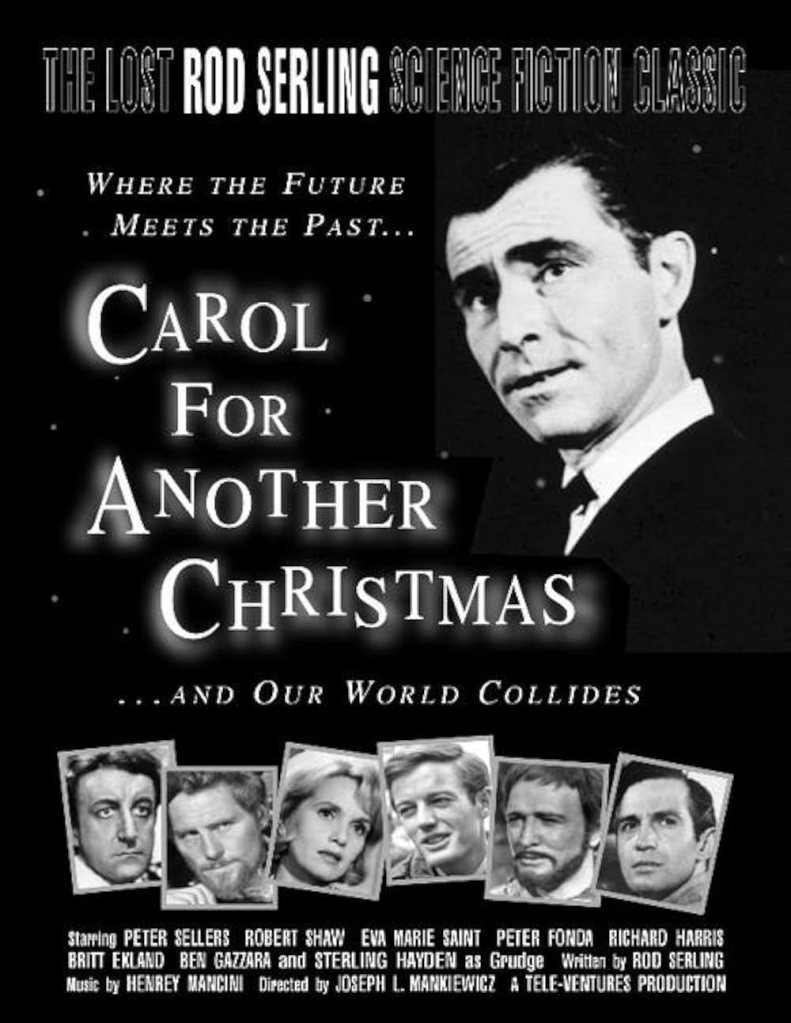
The DVD cover for Carol for Another Christmas is in black and white. At the top it reads "the Lost Rod Serling Science Fiction Classic". Below that, Serling appears on the right half of the image, facing inwards, while the tagline next to him reads, "Where the future meets the past...and our world collides."  Below this, six small portrait photographs stretch across the screen depicting members of the cast.

The Past / Present / Future structure of the story is retained, but each sequence is radically altered from what we know in Dickens.  In the past, Grudge finds himself on a naval transport ship in an endless dark mist-covered ocean, a vessel carrying the bodies of the dead.  The vessel’s pilot is the only other seemingly living soul aboard, played by a young Steve Lawrence in maybe the only dramatic role he ever took, but he’s cast well here.  His youthful face and voice take Dan back to the end of WWI, a war that he’s still angry about as one that killed a bunch of “suckers” we sent to die for democracy.  When the Ghost asks him if Marley was a “sucker”, Dan is startled into understanding the meaning of what he’s been saying.  He backs down a little but struggles to explain what he really thinks, and he and the Ghost argue over what really led to a second global conflict, and what he thinks will keep us from a third.  The solemn, mournful reality of the dead soldiers around them contextualizes everything they say, and ultimately it’s too much for Dan, who leaves the ship, only to find that the Ghost has brought him to his own past more directly….to Dan Grudge, a commander in the U.S. Navy, with his WAVE driver, a young woman named Lt. Gibson, at Hiroshima in September 1945, one month after the bomb fell.  Haunting doesn’t begin to cover how intense and horrifying it is to watch Grudge confront his own memories of the Japanese school girls he encounters there, bandaged and faceless, so wrapped in gauze they resemble mummies, if not the shrouded dead on the transport he just left.  He and Gibson, both profoundly shaken by what they are seeing and hearing, argue over the morality of what has happened here, with Grudge defending the necessity, even the morality, of the A-Bomb, and Gibson demanding that he set aside his “simple arithmetic” and deal with the human cost of the conflagration, even quoting the Bible at him in her desperate attempt to waken him into sharing her outrage.

I don’t want to narrate the whole film to you because I want you to watch it – to encounter it with eyes and ears that are ready for (but not guarded against) what Serling and Mankiewicz are trying to say.  Dan Grudge, in an attempt to escape the horrors of the past, finds his way to the Present and a new Ghost….but only by walking through the doorway at Hiroshima that led into the room where the Japanese children were being housed.  The film rarely misses an opportunity for symbolism of this kind—we can only understand the present by literally walking through the doorway of the horrors committed in the past.  The Ghost of Christmas Present takes Dan to the realities of an America in the 1960s that, my friend, I wish I could tell you did not feel like America in 2025.  It is a sobering and troubling experience to understand how little our society learned from the 1960s, as Dan encounters the world’s needs and is forced to make sense of how little is being done about them.  He and the new Ghost find themselves just as at odds as he was in the Past, with the narrative of a wealthy American man repeatedly wrecking itself on the truth of the reality he has chosen to ignore.  It was powerfully convicting stuff, for me.  And the Future is maybe the most audacious reimagining possible, as a new Ghost leads him into a post-nuclear-conflict America, where the town meeting hall Grudge knows well is now a shattered ruin, inhabited only by the Cult of the Imperial Me, a sect devoted to the “truth” that there is only one person who matters, and it is Me.  The Me at the head of all these disheveled, chattering Mes is played by Peter Sellers at that level of manic, malicious energy that maybe only he could have delivered in 1964—the performance is astonishing, as is the world Serling imagines.  Dan Grudge has to reckon with the chaos and violence of a world in which “looking out for yourself” has become the one watchword of humankind—a hellscape so bleak that, when one character unexpectedly advances the argument that we can have law and ethics and honor and decency because “these things were not destroyed by the bomb”, the appeal is not only laughable to the other survivors, they find the suggestion that humanity can be good so insane that it amounts to treason against the “non-government” of the Me People.  The violent conclusion of this sequence is not visually graphic (this is a TV movie from 1964, after all), but in emotional terms it could hardly be more unsettling.  Grudge is so tormented by what he has seen and heard that he throws himself at the Ghost of Christmas Future’s feet, begging to know what happened to him in this desolate future and whether these events could be altered or whether Fate had already committed the world to this end.  And then he is looking up at the curtains, and the picture of his son Marley.  The bells are ringing.  It is Christmas morning.

In the same way that the film thus far has been a dramatically altered version of the Dickensian events, the conclusion to the film is different also—Grudge is not a gleeful, celebratory presence in this epilogue as much as he is a chastened, bewildered, shaken version of himself, a man still reconstructing his own sense of himself and his world in the unexpectedly gentle morning light.  We do not entirely see beneath his surface, but it is clear from what little he says and does that something has happened to him, and that something is happening to him, still.  Perhaps the same thing that Serling and Mankiewicz hope is happening to us, the viewers, as we reflect on what we have just experienced.  The film offers no easy answers, but the door that Serling holds open to the future is clearly one that assumes Fred has won the argument with Dan about what it will take for the world to live in true and lasting peace.

What, then, is this American Christmas Carol in another guise—who is it for?  My feeling is that it’s for all of us.  In a way, I think Serling has given us what we no longer really encounter in the Dickens versions of this story—a genuinely convicting and unsettling understanding that WE are being haunted by these ghosts also, that the message of peace and brotherhood is not some easygoing “let’s all hug at Christmas” lark but a truly daunting and monumental undertaking that demands more from us than we might ever otherwise be willing to give.  This version of the story, unlike so many others, offers us very little in the way of transformation and hope because Serling does not know from the vantage point of 1964 whether we really will transform ourselves, and therefore cannot offer us too much in the way of encouragement that it will, in fact, all work out for the good.  Speaking from the vantage point of 2025, I think perhaps his reluctance was warranted.  We learned too little from the 20th Century, and much of what we “learned” as a society was, I think, clearly the wrong lesson, something that has led us into what I will euphemistically call our current predicament.  There is an honesty to this version of the story that is not always easy to sit with, but perhaps the time has come again (as it did in 1964) for us to sit with the honesty that art can give us and ask, what next?  What now?  Will we learn, as Scrooge does in the original novella, to let “the Spirits of Past, Present, and Future strive within me,” so that “the shadows of the things that would have been may be dispelled”?  I think we can, and that, muted as it is, this version of the story expresses the kind of hope that we can really believe in—the conviction that all of us, or at least enough of us, may be able to change the course of the future, and bring a better Christmas into being than we would otherwise receive.

I Know That Face:

As I mentioned, the young pop singer Steve Lawrence appears as this film’s version of the Ghost of Christmas Past: later in life, he plays Peter Medoff in The Christmas Pageant.  Eva Marie Saint, who in this movie portrays the ethically convicted WAVE, Lt. Gibson, makes appearances as Martha Bundy in 1988’s I’ll Be Home for Christmas (note: ‘90s kids, this is NOT the Jonathan Taylor Thomas flick you’re thinking of) and as Emma Larson in A Christmas to Remember, and IMDB claims that her first ever film role was in 1947’s TV A Christmas Carol, though it gives no indication of her role (I’m assuming one of the Cratchit kids, most likely?).  And Pat Hingle, the irritatingly (to Grudge) persistent Ghost of Christmas Present, will later play the Bus Driver in One Christmas, and Joe Hayden in Sunshine Christmas.

Spirit of Christmas Carol Present:

This is maybe a weird claim to make (given that he never addresses the film’s “Scrooge” aloud, as the character obviously does in the original), but Marley’s initial ghostly haunting is really incredibly effective here, more so than in many more straight adaptations.  It’s obvious why Grudge would be shaken by the manifestations he hears and sees, and it establishes the basis of the ghost story effectively.  To the extent that the original novella is about giving us an emotionally resonant series of confrontations with Scrooge’s underlying moral sense, this movie is knocking it out of the park: at times, honestly, it’s even more affecting than anything Scrooge undergoes, or maybe I should say that I feel the conviction of it more keenly than I do when Scrooge is the one under the microscope.  In a way, then, this adaptation is faithful to the underlying reality of the original story, even if it gets there by making some pretty radical alterations to the text.  And of course we do get the consistency of our “Scrooge” character waking up on Christmas morning, clutching the curtain that had been Future’s robe.

Spirit of Christmas Carol Absent:

I don’t get into this as much in the review because I’m more excited to talk about what works in this adaptation, but I do have to be honest: there are elements missing from the story that I do think hurt it dramatically to some extent.  The moral weight of the dead Marley doesn’t really pay off in the long run here—there’s just not a lot of things for Dan to make amends for in terms of personal harms done, and therefore we don’t really have the sense on Christmas morning that he has a lot of people to settle up accounts with (other than nephew Fred).  If Grudge’s servant Charles (who does appear in some of the ghostly portion of the movie) is this version’s Bob Cratchit, that story’s been shaved a little too lean to make it work.  We don’t have the same thrill of recognition when Charles shows up, and we don’t see much of a reckoning on Christmas morning, since they just don’t have the same relationship dynamic.  And maybe most importantly, one of the most central planks to any Christmas Carol rendering is the idea that Scrooge has some kind of joy in his past (his love of his sister, and his romance with Belle, even just his genuine joy at the overly festive generosity of his old employer Fezziwig) that he can rediscover and re-awaken within himself, which he does on Christmas morning.  But if Dan Grudge was ever more idealistic, we don’t see it, and I think therefore we are less sure of his transformation than we might otherwise have been.  I think the Past section of this screenplay could have been structured to give us more of an idea that Dan had something to recapture about himself, but either Serling doesn’t really believe that about the American avatar he’s writing, or else he dropped the ball.

Christmas Carol Vibes (6/10): This is a fun adaptation in that it does sit between the really faithful examples and the ones that are borrowing nothing more than a couple of names or moments from the classic story.  We’ve got a rich old guy haunted by someone named Marley and challenged by an idealistic nephew Fred who encounters three ghosts on Christmas Eve and is affected by them – that’s really effective at making it feel like A Christmas Carol.  But the changes to the structure (the loss of the Cratchits in particular as a way of externalizing and dramatizing both the risk and the potential reward of a future that might go one of two ways) and simply the look and feel of the film take it to a very different place.  This is much more comprehensible, in a lot of ways, as a long-form Twilight Zone episode than it is as an adaptation of a work by Charles Dickens.

Actual Quality (9/10): In terms of how much this connected with me as an audience member, I’m probably selling it short.  This was a profoundly affecting viewing experience, and one that I think worked on me in exactly the ways Serling intended it to, so as an act of persuasion (some might call it propaganda, even), it’s a 10/10.  In terms of its quality as a dramatic work, I have to rein it in just a little, since if I stop and think about the loose ends, or the ways the Past/Present/Future sequences do or don’t sync up, I can see ways in which I would improve the film.  A fair amount of the dialogue is not especially realistic, as characters argue more as representatives of an ideology or way of thinking than they do as real people with more subtle understanding of the world (though of course the Ghosts are not “real people” per se, so I think that’s less of an issue in this film than it would be elsewhere).  But the difference between a 9 and a 10 here is not all that material—whether or not this is flawless film-making (I don’t think it is), it’s a movie that is not throwing away its shot, and that matters.  And it’s grown in its power the more I’ve thought about it since watching it, which I think is always the sign of a really good work of art.

Scrooge?  As rich American businessman (and former naval officer) Daniel Grudge, Sterling Hayden is playing a role he’s probably born to play, to some extent.  I’d say that in this work, he’s effective but often one-note as a stern, jaw-clenching expression of America First thinking circa 1964.  His performance is pretty restrained, sometimes so much so that he feels a little limited by the writing, but I think it’s also true that the world around him (both the Ghosts themselves and the theatricality of the visions they present to him) impacts the viewer in a stunning way that’s bound to overshadow almost anyone in the Grudge role.

Supporting Cast?  I have to say, I think that all three ghosts are solidly cast and often riveting when they talk.  It’s hard to say how much of that charisma is in the writing versus in the acting but it may not matter that much: it’s certainly true that that’s where the power is here, dramatically speaking.  Charles and Ruby, Grudge’s servants, are almost wasted in roles that feel like they’re either underwritten or else sequences involving them maybe ended up on the cutting room floor.  And nephew Fred is really effective up front as Grudge’s interlocutor and the advocate for a different future, but man, I wish we got more out of him in the finale—either Serling doesn’t know how to use him to draw Grudge out or he just didn’t think that Fred would have done such a thing on Christmas morning, with the bells calling him to his (presumably liberal mainline) church service and testy Uncle Dan seeming unsettled but not anxious for advice.  

Recommended Frequency?  I think that, if we can stand it, everyone ought to watch this film once, and encounter its artful confrontation of America in the world.  It was tough enough to face that one time that I am not sure when I will do it again, but I know that what upsets me as a viewer is not the film, but my own complacency, my fear that in little ways I am a Daniel Grudge who neither thinks enough nor does enough for people suffering in the world, perhaps because I cannot see them from my dinner table in the way that the Ghost of Christmas Present forces Grudge to see them in his vision.  I think that until the lessons of this particular carol have been learned, not just by me but by American society, it will always be a text to which we must return, to ask ourselves how much closer we are to peace and understanding than we were in 1964; to challenge ourselves to learn even better than Scrooge did what it means to honor Christmas in our hearts and try to keep it all the year.
If you’re persuaded (as I hope you are) to take the time this year to watch Carol for Another Christmas, I’m afraid that it’s exclusively licensed for streaming to HBO Max, which of course some folks subscribe to via Hulu or Amazon Prime.  These days I normally offer DVD/Blu-ray links to Barnes and Noble (given some Amazon business practices many of us, I think very fairly, object to), but only Amazon has a DVD version….and the reviews suggest that the audio and video quality are terrible, so you may not want to drop cash on that.  Even more disappointingly, that appears to be the only version available, held on disc (according to Worldcat) by a mere 11 libraries worldwide.  I would never normally suggest accessing the film in other ways, since usually we have lots of options for access, but under the circumstances, perhaps you’ll be glad to know that there are some small accounts (surely illegally) uploading copies of this film on YouTube…I assume the copyright holders will take action sooner or later and that link will break, but for now, it’s there.  I don’t know where they got their copy, but it doesn’t have the video/audio quality issues folks report about the DVD.

Nothing Like the Holidays (2008)

Review Essay

I feel like there’s a fine line to walk when you’re writing an “awkward family gathering for the holidays” movie. It can be easy to load up the gathering with a bunch of profound emotional revelation that feels almost unbearably intense, or conversely to turn the family scenes into such broad, slapstick comedy that the people involved no longer feel human. (Or, if you’re Happiest Season, you flip back and forth between the two like a yo-yo: it’s not a bad movie, as I said last year, but it sure can be a tough hang.)  In the case of Alfredo De Villa’s Nothing Like the Holidays, alas, we encounter yet another film that hasn’t quite worked out this balancing act.  But there’s some fun to be had along the way, here and there.

The premise of Nothing Like the Holidays is part of what drew me to it—this is a film about a Puerto Rican family living on Chicago’s west side (Humboldt Park, to be precise) in the late Aughts.  It’s sold as a movie about immigrant culture and American pride; about the violence of the city and of the world beyond it; about the ways we keep secrets from each other and what it takes to finally be honest.  It seemed more than a little bit like the kind of movie I, as a former resident of Chicago (in the early ‘Teens) and a proud one, would really love to trumpet to you all here in 2025, at the end of a series of months in which the city has been under attack by its own national government’s forces.  But this is, first and foremost, a blog where I talk to you about movies and how they work (or don’t), and I have to be honest.  This one mostly doesn’t.

The DVD cover of the movie Nothing Like the Holidays looks like a framed photograph that is tied up with a red ribbon and bow.  Nine cast members are all posed and smiling at the camera as though a family photograph is being taken.  The title appears above their faces, and below them on the ribbon is the tagline "They're just a typical American family. Minus the typical."

The movie’s power comes out of the gate hot, early on: we’re welcoming home an Iraq war vet, Jesse Rodriguez.  His brother and sister, Mauricio and Roxanna, are excited to see him…but in all honesty they’re probably more preoccupied with their own baggage than with helping Jesse through what’s clearly a painful transition back into civilian society.  They all have complicated relationships to their parents, the cheerful though muted Edy and his acidic, glowering wife Anna, but then they have complicated relationships with everybody: Mauricio with his very-not-Puerto Rican wife Sarah; Roxanna with long-time friend of the family Ozzy (who’s cute but maybe too much trouble); Jesse with his old flame (and Roxanna’s best friend) Marissa.  And things spiral outwards—Sarah’s tough relationship to her in-laws, Ozzy’s desire for revenge on the man who murdered his brother, etc.—to the point where it would have been hard for a really brilliantly written screenplay to fully pay all these things off, and this is, alas, not a really brilliantly written screenplay.  But again, before all of these tangled webs are woven, the film seems strong—it’s about Jesse and his relationship to this home he’s been away from in such a bleak place.  It’s about the color and the sound and the life here in Humboldt Park that’s really winning me over from the opening shots, as I see some things I recognize about a city I came to love in my time there.  If what you want most is that kind of cultural immersion, with music and architecture, food and domino games, all adding up to giving you the feeling of a place and a time, the movie is going to deliver the goods to some extent.

The challenge is that, authentic as the streets sometimes feel, these main characters often end up seeming less than authentic, like caricatures written by folks who don’t really know Humboldt Park.  Sarah plays the white outsider so fully that sometimes it feels like she’s never met Mauricio’s family, even though the text of the film makes it clear she knows them all pretty well.  The explosive relationship between Edy and Anna seems to have been written for the convenience of the screenplay but not anyone’s actual human life.  Somehow the violence of the streets is both too intense—it’s hard to make sense of why Ozzy, based on everything else we know about him, seems so committed to the violent murder of the guy he spotted in the park—and also too muted, since if that IS how people like Ozzy live, it seems like it should have affected far more of the people in this story than give any evidence of their having been impacted.  Most dialogue feels less like it’s revealing qualities of character, and more like it’s setting up the next set of dominos just in time to be knocked over so that the plot can move forward.  It’s hard to pin down what a character cares about or wants, other than maybe Jesse and his father Edy (the two best performances, for me), since the things characters say and do are for the script’s convenience and not emerging from their own desires.  And even those two have their struggles at conveying clear motivation: Edy, for instance, spends most of the movie claiming he’s going to chop down the tree in their yard to “improve the view”…but, this is Humboldt Park, Edy.  You don’t have a view of ANYTHING other than other people’s houses.  Chopping down a gorgeous old deciduous tree isn’t improving your view: it’s taking away your view of the tree.  So, does the movie know that, and this is a crazy distraction Edy’s using to deflect attention from himself?  Or did they actually think this was logical?  It’s so hard to know.

I think part of what’s tough about ensemble holiday movies is that somehow you have to avoid being a caricature while successfully being a memorable character.  In this film, when characters aren’t going over the top, often I feel like they’re underplaying moments too much: even if the person they’re playing would in real life struggle to emote to those around them, an actor has to do more to connect us to the moment as an audience, or we will lose contact with the movie entirely.  The big reveals that eventually unfold in the movie run into these same problems: too often they’re either not supported by how the character has been behaving, or they’re so outlandish that it strains credibility to think of any normal person or family coming to grips with them.  The movie clearly wants an ending in which I (and the rest of the audience) feel comfort that things worked out for these people.  But I don’t know them well enough to know that…and I don’t like half of them enough to care if it does “work out” for them.  And I’m not even really sure that it DID work out, you know?  They end up in new places by the end of the movie, but it’s hard to know how much better it is for any of them.

What else did I like, looking back?  The depiction of the parranda as a vibrant cultural tradition in Humboldt Park is pretty cool even if it arrives out of nowhere.  Sarah, once she loosens up (and drinks a little), draws some good things out of the family around her and helps create some of the more meaningful conversations in the film.  The stretches where everyone’s not standing in a room being mean and aggressive to each other are all at least indicative of the kind of film this might have been in someone else’s hands.  And when is Alfred Molina not fun?  I mean, to be clear, Molina is not Puerto Rican, which is one very fair criticism to make about the casting.  But he’s so enjoyable to watch on screen.  Ultimately I think what I appreciate most about the story is the character of Jesse and the growth he achieves, particularly in relationship to his father.  For all that the movie’s an ensemble, the one arc that makes any sense as a narrative is his.  But I also never really felt like the film could take the time to do his life experiences justice, which therefore limits how much character development is really possible.  File this one among the other holiday movies I really wanted to like but couldn’t quite get there.

I Know That Face: Alfred Molina, the Rodriguez family patriarch, elsewhere performs as the voice of Francis Church in the movie Yes, Virginia, and, maybe appropriately (in the light of Yes, Virginia’s message), is later the voice of Santa Claus in an episode of Santiago of the Seas. John Leguizamo, the incredibly stiff and frankly off-putting elder brother Mauricio, voices Sid, of course, in Ice Age: A Mammoth Christmas.  Jay Hernandez, here playing family friend/love interest Ozzy, plays Jessie in A Bad Moms Christmas, which has an incredibly stacked cast.  And Claudia Michelle Wallace, who in this film chews the scenery in a small role as an employee at Edy’s bodega, plays a Child Services Agent in Fred Claus, and follows that up with the role of Mrs. Colvin in Once Upon a Christmas Wish.

That Takes Me Back: This will be nostalgic for nobody else, but when a character gives the driving direction, “Turn on Sacramento,” I’m back in our Albany Park apartment, where on my walk to the nearest L stop (or, later, when taking my infant out for a stroller walk around Ravenswood Manor) I would turn south on Sacramento to cross Lawrence.  We didn’t live that near to Humboldt Park, but Chicago’s flat, extensive grid of streets mean these names cross through all sorts of communities, and it was fun to imagine how closely I was once connected to Edy Rodriguez’s bodega.  Nostalgia, too, was there for me, and maybe you too, to see the era of the flip-phone at its height: wild to me now, in an age where phones get larger and larger as they become the one true screen for all entertainment and productivity, that we once prized making these devices as compact and tiny as possible.  And I won’t call it nostalgic, but it was sobering to get this plain a reminder of the Iraq war, and the devastating effects that lingered after that conflict: it’s hard not to think of the conflicts around the world today (some of which we perpetuate needlessly, as a country) and the toll they’ll leave in their wake.

I Understood That Reference: Santa appears, as he does in many a holiday film: there’s a Santa suit worn by Spencer and a brief dialogue exchange about “Black Santa”. Later in the film, Christmas’s religious underpinnings surface when, having brought a priest to the family’s dinner table in an attempt to settle some of the internal conflicts, a character asks the priest, “How about a little sermon about Jesus being born so we can be forgiven for our sins?”  


Holiday Vibes (9/10): I cannot deny that this film really makes the holidays present – these are characters going through a very painful, hostile version of the more widely-experienced challenge of occupying space at the holidays with family members you rarely see or haven’t seen in years.  The decorations, the food, the energy of the city, the passive aggression from a mom who wants grandkids, the heightened strain on an interracial marriage…it all tracks as the holidays to me, even if it’s a lot more intense and uneasy than holiday memories of mine.  If you want a Christmas movie, it is showing up.

Actual Quality (6/10): I really wrestle with how high to rank this film: I wanted to love a Chicago Christmas movie so badly this year, especially one with such a diverse cast, set in a neighborhood that has been under siege by taxpayer-financed agents of violence for months now. (You may disagree with that characterization: respectfully, if you do, you may not always love the blog this year.  I live in a borderline authoritarian state and if I feel like acknowledging and challenging it, I’m gonna.)  Anyway, as I said earlier in this review, in the end, what this blog is mostly about is the experience of these movies for me, and I can’t pretend I had a good time with this one: it was really uneven.  There are some hilarious lines of dialogue and some pretty heavy but resonant scenes where characters are unpacking some tough baggage.  The movie surrounding all that, though, too often felt silly when it needed to be serious, and flat when it needed to be funny, and the total effect was to make me feel restless.  I can imagine someone getting more out of the movie than I did, but not enough that I can call it even “good”.

Party Mood-Setter? Part of what sucks here is I wish you could just put it on for the vibes of Humboldt Park at Christmas, with the parranda and all the rest, but the tone of the family arguments is so bitter and so often unresolved that I just don’t think it would be all that fun to have on in the background of holiday merriment.

Plucked Heart Strings? It’s definitely a film that wants to get you to that emotional space where you feel for Jesse (who has gone through some serious PTSD-triggering horror in Iraq) and maybe also for the parents in their separate distresses, but for me the characters are too badly served by the screenplay for me to really feel the emotion with them.  I was never close to misty-eyed, though some folks (especially people with their own Iraq memories, or people close to people who have that background) might.

Recommended Frequency: I can’t imagine watching it again.  There’s a great film to be made out of material like this, but I think it needs a screenwriting team that actually knows the place—this is what sets a film like Boxing Day, which is written by someone from the community being shown, apart from this more generically Hollywoodized version of a family in an ethnic/cultural enclave.

If you’re curious to see if you’ll enjoy it more than I did, it looks like this December you can stream Nothing Like the Holidays on Tubi, Fandango at Home, or the Roku Channel for free—all of them are ad-supported, of course.  It’s available for rent at all the usual places (pretty cheap at some of them, too: YouTube and Google Play are offering it for about $2 as of this writing), the DVD is inexpensive also, and almost 900 libraries worldwide hold a copy.

Miracle on 34th Street (1947)

Review Essay

Folks, welcome back for another season of holiday movies and musings: it was such fun last year to share some media experiences (both the sublime and the ridiculous…and whatever the heck Ghosts of Girlfriends Past was) with so many of you, and if you’re new to Film for the Holidays, a special welcome to you!  As a reminder, these film reviews will be appearing once a day like clockwork from now through the morning of Christmas Eve.  You can just remember to pop back here to see them, or click that floating Subscribe button you hopefully see somewhere on your screen to receive the posts via email.  All of last year’s categories for notes and ratings are sticking around this season, which I hope will help you both figure out how (or if) to add some films to your holiday experiences and encourage you to explore some titles not even on this year’s list.  With all that said, let’s get on with the review of this truly classic motion picture.

My approach to Miracle on 34th Street is definitely influenced by the fact that I know it to be the #1 Christmas movie on the recommendation list constructed by Connie Willis.  Willis is one of my favorite authors of all time, on any subject but especially on the subject of Christmas, which she has used extensively as a setting for short stories for decades now, and her passion for this particular movie in the various Christmas anthologies she’s edited is unrivaled.  I had the chance to talk with Willis this summer (on many subjects, including the subject of holiday movies), and since then I’ve been asking myself how I would rank Miracle, myself, as someone who absolutely grew up with this film as an annual tradition, but who I think never had quite the same passion for it that its true fans express.  The conclusion I’ve come to is that the movie is essentially a perfect object in that it achieves exactly what it sets out to accomplish, and my only issue with it is that the thing I go to holiday media to hear isn’t quite what it sets out to say.

What’s the nature of this perfect object, first of all, if somehow I’m talking to a reader who’s never seen this film?  The premise is both simple and silly once you write it all down: Miracle on 34th Street posits that, by the mid-1940s, Kris Kringle (Santa Claus) is living in an old folks’ home in Long Island, taking regular jaunts into New York City to breathe some fresh air, harass shop assistants who are trying to dress their windows for the holiday season, and give pointers to performing Santas as he meets them in the street.  Our story begins when, having exposed an unfit Santa on a float in the Macy’s Thanksgiving Day Parade, Kris is hired by Doris Walker, a hard-working single mother and Macy’s employee, to not only take part in the parade but to work the “photos with Santa” line inside their flagship store on West 34th Street in the middle of bustling midtown Manhattan.  Kris immediately busies himself with improving the lives of basically everyone he encounters, from Alfred, who sweeps up the locker rooms in the Macy’s employee changing area, to Peter, a kid who wants a fire truck that squirts water but which he will promise only to use in the backyard, to Peter’s mother who, let’s face it, seems like a lady near the end of her rope.  Most centrally, Kris’s goal is to convince both Doris, an incredibly hard-boiled divorcee who has seemingly learned to shut out all hope or faith from her live, and Doris’s daughter Susan, a child raised on such pure common sense that the concept of an “imagination” is unfamiliar to her, to believe in him.  In this, he has the enthusiastic help of Doris and Susan’s neighbor, a bright young lawyer named Fred Gailey who’s hot for Doris and sweet to Susan, and who is at least willing to play along with Kris’s eccentric notion that he is the real, the one and only, Santa Claus.  Wild stuff.

This is the poster for the theatrical release of the movie, Miracle on 34th Street.  The background is bright yellow.  From the left and right sides of the poster, the lead actors, Maureen O'Hara and John Payne, face each other, smiling.  Between their faces but far more distant in the background is the image of Natalie Wood as Susan being embraced by Edmund Gwenn as Kris Kringle.

The story as presented feels like it might make a sweet children’s movie—believe in Santa, young folks, and all will be well—but Miracle manages a deeper level of resonance than that, and I think a big portion of the credit clearly goes to the incomparable Edmund Gwenn in the role of Kris Kringle.  Gwenn, who wins an Academy Award for the performance, seems to have been born to play Santa Claus, with a warmly smiling and almost cherubic face (if cherubs could grow beards), and perhaps the perfect voice for the part: both cheerful and chiding, he manages to hold a tone that sounds constantly ready to celebrate niceness but also unhesitant to let the naughty know they’ve really stepped in it.  It’s that balancing act, a Santa Claus who seems capable not only of genial indulgence but also of genuine moral candor and outright confrontation of the unworthy, that transforms the film into something robust.  There’s a wisdom to this Kris Kringle that seems to take at least a note or two from the character’s ancient roots in the stories of Saint Nicholas of Myra, a countercultural force, a figure whose principles are more important than his presents.  Though he does love giving the perfect present.

In some ways, Gwenn’s perfection in the role is a liability: it is so easy to believe this man to be Santa Claus that Doris and Susan Walker (Doris especially) can seem to be dragging their heels needlessly.  Natalie Wood’s Susan is a genuinely charismatic performance by a child actress.  She has the range to not only emote successfully on screen, but even to play the part of a child who cannot act, as she does when she fumbles slightly her attempts to pretend to be inviting Fred Gailey to Thanksgiving dinner, or struggles to convincingly play a make-believe monkey.  So I think to some extent she sells us on Susan as a real kid who would wrestle with the problem—a child who is so indoctrinated against Santa Claus that believing in him might spark an identity crisis.  She also gets the slightly easier task of being the first of the two Walkers to open up to the possibility of Kris’s telling the truth, in famous scenes where she tests the reality of his beard or listens in as he effortlessly switches to speaking Dutch to offer greetings to a recently adopted refugee.  Maureen O’Hara’s Doris has to be the rigid one, and it’s no criticism of O’Hara when I say that it does become just a little difficult to believe in a woman who refuses to let a primary schooler read fairy tales or pretend to be an animal for fun: I think that’s a challenge for the (admittedly Oscar-winning) screenplay, which has somehow to make this premise work, and if it’s stretched a little thin there, well, at some point we have to accept that this is a movie about Santa Claus and not a hard-hitting realistic drama.

The message of Miracle is, as I’ve noticed revisiting it as an adult, surprisingly complicated in its politics.  The film seems to wear its anticapitalist leanings on its sleeve: you notice even as a kid that Kris courageously stands up for sending parents to get toys from other stores, and as you get older, perhaps you pick up on the fact that Macy and Gimbel only embrace the idea because they realize it’ll turn even more of a profit, and not out of any real belief in the ideal.  Alfred, the sweetly naive custodian, observes mournfully early on in the film that these days the worst of the “isms” floating around the world is “commercialism”.  It’s all “make a buck, make a buck,” even in his native Brooklyn, he laments.  Fred Gailey throws away his job for the sake of a higher principle, and Judge Harper risks his chances at re-election for the sake of his own principles (somewhat different from Fred’s).  And yet.  This is also a movie that never really takes Macy or Gimbel to task—to the contrary, you’ll come away from the movie feeling a great deal of sentimentality and even sweetness in connection with “Mr. Macy”, a person who did not exist (at least, not in 1947, by which time no Macy had owned the company for over half a century).  It’s a movie that treats the material desires of its characters as laudable: nobody is ever told that the “real meaning of the holiday” is something other than getting the right present, and even the movie’s final climactic moment of awe-struck belief is something only occurring because a character thinks she’s just been “given” an extraordinarily expensive “gift” (that others will have to work rapidly behind the scenes to actually buy for her).  This is a movie about faith, yes, and love, but it’s one that has no problem assuming that these things can co-exist happily with thriving post-war American commercialism and not encounter the slightest trace of a conflict.  This is odd for an American holiday movie: we just don’t tend to think about it because for most of us we can’t remember a time when this movie wasn’t a Christmas classic.

To be clear, I am in sympathy with this film’s moral compass to a large extent.  The truly odious Sawyer, who at the film’s start is an industrial psychology staffer for Macy’s, is a monster measured along any possible axis: narcissistic, cruel, misogynist, selfish, and vindictive.  Violence may not be the answer but I can’t claim to be disappointed when Kris Kringle beats him over the head with an umbrella.  Kris is a huge proponent of learning to love not only yourself but those around you, whether it’s getting Susan to realize that she can connect with the kids playing in the courtyard or opening Doris up to the idea that romance hasn’t passed her by forever.  I like that: who wouldn’t (other than Mr. Sawyer)?  And the movie is a huge believer in accidental grace, which I love as an undercurrent: good things happen despite people’s intentions rather than because of them.  Doris Walker and Mr. Shellhammer hire a Santa Claus thinking he’ll be good for business, not for their hearts.  Macy and Gimbel help beleaguered parents as a marketing scheme.  Even the movie’s most famous sequence, the arrival at the courthouse of an endless stream of letters to Santa Claus that win Kris’s freedom, is of course the self-interested action of two overwhelmed postal employees who have realized it’s a pretty slick solution to an overcrowded warehouse.  This is a truth about the world, and the ways in which goodness manages to survive even among people who are not trying in any particular way to be good.  It makes me smile.

I know this review’s running long, and it’s a holiday weekend, so I’ll stop here, though I could say a lot more about this film: it’s a rich text and there’s a lot to find (and like) in it!  To me, again, the movie undeniably does what it sets out to do basically perfectly—you wouldn’t think that you could merge a fantasy about Santa Claus working in a department store with a surprisingly high-minded courtroom drama, but it works incredibly well.  I think what ultimately leaves me just short of calling the movie a masterpiece is my sense that its message isn’t quite profound enough for me.  When Kris tells Fred, early on, that “those two [Doris and Susan Walker] are a couple of lost souls, and it’s up to us to help them,” that feels really true in my heart.  And it’s weird to realize, at the end of the story, that they accomplish this by means of Fred dating Doris (I’m sure he’s a nice guy, but how is this “saving her soul”?) and Kris persuading Doris by means of his sincerity and Susan by means of an incredibly unlikely gift that he’s the real Santa Claus.  They have learned to be a little less hard-headed about the world, but not in a way that feels inspiring to me, let alone soul-restored.  It’s a sweet movie, a holiday treat, and I could watch Edmund Gwenn chew bubble gum or sing a song about Sinterklaas any day of the week and be happy about it.  But it’s not a fable that speaks to my heart at quite its resonant frequency.  If it does that for you though, dear reader, I am genuinely and unreservedly delighted for you, and I’m certainly happy to celebrate it as a worthwhile member of the Christmas motion picture canon here at the start of the FFTH season.

I Know That Face: Jerome Cowan, who in Miracle appears as the district attorney, Mr. Mara, plays the role of Fred Collins in 1950’s Peggy, a movie set around the Tournament of Roses Parade that rings in the new year in Southern California.  Percy Helton, who here performs uncredited as a Santa Claus so inebriated that he’s pulled off the Thanksgiving Day parade float, makes a similarly uncredited appearance as a train conductor in another midcentury holiday classic, White Christmas, which I covered last year on the blog.  And Alvin Greenman, memorable in his uncredited role as the sweet and simple young Alfred, is the only member of the 1947 film’s cast to appear in the 1994 remake: in that movie, he plays a doorman (also named “Alfred”).

That Takes Me Back: It’s a little wild when Doris tells Shellhammer that she won’t miss the parade since she can see it from her apartment building: this is near the very end of the era in which a person could not watch the parade on television (it was first televised locally in New York City the year after this film was released, and has been televised nationally since 1953).  I think of these parades so much as a television spectacle that it’s kind of amazing to consider the decades in which they were an in-person only event.  Susan saves her chewing gum overnight, which is kind of amazing to me: I remember doing that as a kid, but gum is such a cheap commodity that I’d never think of doing it now.  I wonder if it’s just my age that affects this (or my income), or if this is something nobody does anymore?  Would a modern kid relate at all to the song “Does Your Chewing Gum Lose Its Flavour (On The Bedpost Overnight)”?

I Understood That Reference: In terms of references to other Christmas stories or media, obviously this movie is chock full of Santa lore.  There are references to the North Pole, of course, and Kris Kringle’s next of kin on his employment card consist of all eight reindeer (including the accurately spelled “Donder”).  Donder’s name will be permanently altered in the public memory in just two years after the release of the song “Rudolph the Red-Nosed Reindeer,” which refers to him as “Donner”.  Rudolph’s omission from a Santa film is probably also a “That Takes Me Back” moment really—though the character of the scarlet-snouted reindeer who guides Santa’s sleigh had been created back in 1939, it’s not until a 1948 cartoon short and the 1949 song that he springs into the limelight so completely that he’ll be inextricably tied to Santa from then on.


Holiday Vibes (9/10): From the parade that (for many of us) kicks off the holiday season to a party with not one but two Santa Clauses dispensing gifts next to an enormous and lavishly decorated tree, this movie touches on so many aspects of the season (busy department stores, children making lists of desired gifts, etc.).  And, as with a few other true classics, I just think this film is so embedded in my memory that even its less Christmassy elements are associated with the season somehow, from Mrs. Shellhammer and her triple-strength martinis to Fred Gailey’s facts about the United States Postal Service.  It maybe doesn’t hit on every single element I’d look for in a holiday movie but it does really well on this front.

Actual Quality (9/10): And again, I don’t want to be mistaken: it’s doing a great job on the “quality” front, as well.  Despite my critiques, I think it’s a really well-crafted piece of entertainment, and one with a lot of heart—it more than deserved three Academy Awards and a Best Picture nomination, and it’s a worthy addition to the list of films that we treat as more or less mandatory to be shown and shared at Christmastime.  That scene where the mail shows up at the courthouse is thrilling every time.

Party Mood-Setter?  A film so familiar to so many of us more or less HAS to work in this setting—especially because it’s a movie with key moments you can check in for and then a lot of fairly low-key scenes that work fine in the background of cookie decorating or catching up with old friends.  It’s better if you pay full attention but it is very pleasant company if that’s all you’re after.

Plucked Heart Strings?  I’d say we get close, in a moment or two, where Doris’s faith in Kris is sincere and that’s moving, but it’s more a fantasy story than it is one that wants a lot of sincere heartfelt emotion.

Recommended Frequency: Oh, come on now, you know this is an every year kind of movie, or at least it sure is for me.  If you’ve somehow made it this far in life without seeing it, it’s time to dive in.  If you haven’t watched it since you were a kid, I think you’ll find it bigger than you remember: how much you find yourself connecting with the themes it advances will obviously vary, but I think it’s a movie that rewards re-watching, and I hope you’ll give it your time this holiday season.

Luckily for you, it should be fairly easy to watch Miracle on 34th Street.  Right now, it appears to be streaming for subscribers on Hulu, Disney+, and Amazon Prime Video.  If you want to rent a streaming copy, it looks like Google, Apple, and Fandango at Home would all be happy to help you out (for a small price).  Barnes & Noble will gladly sell you a copy on Blu-ray or DVD, and Worldcat’s data suggests that nearly every conceivable library system has access to a copy if you just want to borrow one.

Film for the Holidays is back in 2025

A Currier and Ives lithograph of an American homestead in winter. On the left, a farmer tends to various animals in a barn. In the center of the image, a man carrying wood, accompanied by his dog, walks near a passing two-horse sleigh occupied by a seated man and woman. On the right, someone is standing in the doorway of a two story yellow farmhouse. The whole scene is blanketed in snow, and the house and barn are surrounded on all sides by leafless trees.

Friends, it’s been a year. And what a year it’s been.

Creating this blog in 2024 was an adventure—I’d started plenty of blog projects ambitiously, but I’d rarely been able to finish what I started. I knew that the world probably didn’t need yet another website devoted to holiday movies, and I wasn’t sure that I’d have anything worth saying about them. But I gave it a go, and so did you: thank you!

I’d been weighing whether or not to return to this work for 2025, since obviously it’s a little daunting to commit again to a couple dozen more movie reviews. But I have to say, it was a lot of fun talking about films people know (and ones they don’t know), and getting some of your reactions. The year 2025 has brought with it a lot of stress and sadness, in my life and in many other people’s lives, and it seems to me that getting to dwell on a bunch more holiday flicks, whether good or bad, would supply some badly-needed escape for me and maybe for you also. So, this is my renewed promise: if you come to this blog looking for it, you’ll see a new movie review every single day from the day after Thanksgiving through Christmas Eve. And if you’d rather get these posts via email, you can subscribe to the blog and WordPress will send them straight to your inbox.

The responses to last year’s post-Christmas survey were really positive and helpful—it turns out everything I’m doing here is working for at least some of you, so my plan is to do it all again (and let you skip past the sections you don’t care about). The collection of films I’ll be reviewing in 2025 has now been posted at the page that lists Films covered this year. You won’t know which day I’m doing which film (in part because that’s a little up in the air, at the outset), but you’ve got the chance to decide to get ahead of me if you want. Just like last year, I’ll be covering films from every decade from the 1930s to the 2020s. I’ll be watching some classics and some forgotten old gems and some things that have been really justly forgotten. Some of the things I watch will barely seem like holiday movies to you, but that’s part of the fun, taking in motion pictures that use the holidays as a backdrop or a transitional phase as well as those that are completely fixated on tinsel and gingerbread and stockings hung by the chimney. The mix is intentionally skewed positively—last year 18 of the 26 films got a 7.5/10 or better in terms of quality—because I feel better praising things than tearing them down, but I promise to make sure to watch at least a few real stinkers since folks do love a negative review (and I get it, I really do!).

I just wanted you to know—the blog is alive and it’s already in progress. Behind the scenes, puns are being refined, actors’ IMDBs are being scoured, and I’m trying to figure out how the heck I can quantify a film’s holidayness on a scale of 1-10. If you had any fun with this last year, welcome back. If you’re new to what I’m up to at FFTH, you can skim the List of previous year’s film ratings to get a broad sense overall, or scroll through the site or use the tags in the right sidebar (on larger screens; on phones it’s probably at the bottom of the page) to read a review or three. I hope you see something you enjoy enough that it’s worth sticking around, or bookmarking it to come back to. Here’s to another year of seasonal fun!

It’s a Wonderful Life (1946)

Review Essay

It’s so hard to talk about It’s a Wonderful Life, since for some of us every single scene is imprinted on our memories from childhood, the strangeness and wonder of this fable about life and hope and worth so indelibly associated with Christmas that it would be very difficult to say anything new or original.  And for others, the film is unfamiliar — a “holiday classic” but one that’s long enough and black-and-white enough that you haven’t picked it up yet, perhaps especially because the movie’s fans tell you it’ll put you through the emotional wringer and that’s not necessarily something we all want to sign up for.  What can I say about a movie many of you have either memorized or else long avoided?  Well, it’s Christmas Eve and I guess there’s no reason to say anything other than what I think and hope it connects with you, wherever you’re coming from.  If you’ve come here to spend any of these important holiday minutes with me, I owe you nothing less.

The premise of this film is well known, I think: a man named George Bailey is shown the world as it would have been without him, as though he was never born, and it transforms him.  And it has something to do with Christmas, though I imagine when folks who’ve not seen it hear these summaries, it’s always a little puzzling what the connection really is.  So, I’ll offer a different way of seeing this film, if that’s all right.  The author of the short story on which this movie is based always acknowledged a debt to Charles Dickens and A Christmas Carol, and I think it’s evident here: the movie’s three great sections are George Bailey’s Past, Present, and a grim vision of what will become of the world without him (though, of course, to be precise, it’s the world as though he had never been).  George is no Ebenezer Scrooge — the real “covetous old sinner” of this piece, Scrooge’s counterpart, is the malevolent spider in his web, Henry F. Potter, whom this film can neither explain nor redeem.  Instead, our attention is on an ordinary man in so many respects, both kind and hot-tempered, both ambitious and loyal, a good man and a flawed one.  We see him at his triumphs and at his most desperate.  And so we learn alongside him as people more able to put ourselves in his shoes than most of us can ever fit into Scrooge’s.  It’s a carol for an American life.

The poster for It's A Wonderful Life shows a painting of Donna Reed held high in the air by a smiling Jimmy Stewart -- they gaze into each other's eyes lovingly.

It carries with it that same background of Christmas religious observance that Dickens employs in his novella: we open on a snowy Christmas Eve in the town of Bedford Falls, and all we know is that behind every closed door and window, simple and heartfelt prayers are being offered for a man named George Bailey, whom we have not yet seen.  And then, in the movie’s weirdest device, we are in some astronomical photograph, as blinking galaxies and stars represent God, Joseph (whether an angel or the adoptive father of Jesus is unclear), and of course, Clarence Odbody, AS2 (Angel, Second Class).  Clarence is tasked with assisting George Bailey out of a terrible condition — far worse than being sick, God observes, George is discouraged.  He is contemplating suicide.  The next hour and a half, then, unfold for Clarence the life of George Bailey, with a particular emphasis on Christmas Eve, 1945, the day of George’s profound despair, as this novice angel tries to “win his wings,” a metaphysical situation that is never really explained further.

I think what must surely be challenging or even off-putting to a new viewer is the character of George Bailey himself — Capra plans to take full advantage of the fact that, as I observed in writing about The Shop Around the Corner, Stewart had developed this screen persona by the 1940s that allowed him to play characters who were irascible and difficult and rude without losing the audience’s trust.  Capra extends that quality down into the boy actor playing the younger version, as from the beginning we understand that George is brash and ambitious and self-confident to a fault…but he’s also wise beyond his years at times, and loyal to his sense of ethics, and always willing to make a sacrifice for someone in need.  It’s why he taunts his kid brother Harry into a daredevil sled ride that forces George to leap into an icy lake to save him.  He’s condescending about coconut and bragging about his membership “in the National Geographic Society” but one glance at a telegram and he realizes his boss is grieving — and he risks anger and even violence to save Gower, the druggist, from his own despair.  Those scenes are hard to watch, but what’s hard to watch in them is what’s most human — some of us have known griefs as profound as Gower’s, a pit so deep we cannot see out of it, in which every human voice wakes further to agony.  Some of us have had to be as brave as George, standing up to someone’s pain knowing it may cause us pain, ourselves — for the sake of helping them, of helping others.  The emotions that come home in the movie’s justifiably famous closing scene are all laid in us here, bit by bit, as George’s life unfolds.  We come to care about the people he cares about, and through them, we care for him.

If you’re a newcomer to this movie, please don’t feel it’s all death and sadness: there’s a liveliness to so much of the film.  We get it from the banter of Bert and Ernie, the policeman and the cab driver (no, despite Internet rumors to the contrary, as far as we know Henson did not name two roommates on Sesame Street for these men).  It shows up in the Bailey home, with criss-crossing dialogue and Harry balancing a pie on his head and Annie, the family’s maid, very rightly referring to the Bailey boys as “lunkheads”.  Even if you’ve never really watched the film, I’m guessing you might know about the Charleston contest, as George and Mary accidentally dance their way into a swimming pool.  What’s great about their flirtations that night is that George is just as complicated as ever, but Mary sees through him to the man he’s going to become.  She’s not planning on “fixing” George Bailey, but she knows better than he does who George Bailey really is.  What I love about the movie, though, is how it weaves its deeper ideas into the fun moments.  Ernie the cabbie is George’s wisecracking friend, but it’s also a loan to him that becomes a rhetorical football between George’s idealism about the common man and Potter’s domineering sneers about the working class’s need to learn “thrift”.  The chaos of that dining room scene at the Baileys surrounds a really serious conversation in which Peter Bailey (who, without knowing it, is having the last conversation he’ll ever have with his son) tries to convey to George what matters in life…and George both knows in his heart his dad is right and doesn’t want to give up his dreams for it anyway.  And of course, George’s relationship to Mary is the hinge on which the whole movie turns, at every step.

I’ve heard complaints about the movie, over the years, about the ways it handles some gender dynamics, and I won’t defend any 1940s movie as wholly innocent of those charges: we just know better now, or at least some of us do.  This is, I should note, still a lot better at giving women agency than much more modern films like Ghosts of Girlfriends Past, but that’s a low bar to clear.  I do think, though, that sometimes those critiques have been misplaced.  For instance (and apologies for spoilers, but so much of this movie’s success is about its final half hour that I cannot avoid them all), Mary Hatch doesn’t end up an “old maid” librarian because the movie’s punishing her for not having George in her life — this is what she’s said from the beginning, telling George at one point very plainly that if it hadn’t been for him, there wasn’t anyone else in town she wanted to marry.  And the movie’s also not arguing that being an “old maid” or a librarian is a fate worse than death — it’s a fate that feels like death to George, because it IS his death.  Or rather, it’s damning proof that Clarence is right, and that this is a world in which he was never born, never did anything, never kissed Mary Hatch Bailey on their wedding night or built a life with her.  It’s not Mary he’s grieving: it’s himself.

I’ve heard complaints also about George’s outbursts at his kids, and certainly I can understand that depending on your own experiences, it may be very painful to watch the movie’s “hero” act so dismissively and harshly to his children, shouting at them and smashing things.  I don’t want to minimize the harm there, but again, I think the movie doesn’t either.  That Christmas Eve, George is facing the ruination of his entire life — he sacrificed everything for the sake of Bedford Falls and the building and loan, and now the business will fail and the town will slip into Potter’s cruel hands and his own family life will be destroyed by scandal and prison, he expects.  He’s barely holding it together until those moments when he’s not holding it together at all.  But I think it’s clear from the ways the children react that this is not the father they know — that they expect support and love from him, and it is a startling betrayal to find those things missing.  That doesn’t make an evening of borderline abusive conduct “okay”, but I think it reframes the situation for us — we have to believe that we’re seeing a man prepare to commit suicide because he believes the world is better off without him.  So he has to wreck himself and that family’s peace enough to have that moment where he’s stammering apologies and trying to command them to restore the home he’s terrified of losing, and his wife and children look at him with such fear that he feels they’ll be happier without him.  It is not the well but the sick who need a doctor, as the Gospels remind us: for George Bailey to be saved, he’s got to realize the harm he’s done.  If you don’t want to roll with that, I get it.  But for those of us willing to take that journey with George, it’s the movie’s power.

I refuse to spoil any more of the movie’s final half hour, much of which plays out like a Twilight Zone episode, but of course it’s a Twilight Zone episode that follows 100 minutes of establishing scenes, so that we know every single minor character on screen and we can feel the depths of George’s confusion and ultimate agony as he explores a world without him in it.  The movie’s values are on its sleeve throughout, and say what we will about Capra, he understood what endangered American freedom and joy.  It’s what endangers it still.  This sequence is an indictment of Potter, and of a society resigned to letting the Potters of the world have their way.  And the whole time, I know, a new viewer will keep saying to themselves, “okay, this is all happening on Christmas Eve.  But where’s this movie that’s supposed to be so holiday-inspirational that it moves me to tears?”

And then you get the ten minutes that either work for you or don’t.  If it’s too sentimental for you, too neatly resolved, too implausible, then I get it.  There are other movies that maybe will kindle hope for you, if hope’s something you’re willing to take from a world that rarely seems to reward it.  For the rest of us, this is where the movie breaks us open.  I watched this film for what I am sure is at least the 40th time this December, preparing for this blog post.  And I wept like a child for most of its final sequence, even though I could also probably recite it to you by heart.  Gratitude is overwhelming like that, I think — when we confront the fact that we can be grateful for life even at its darkest extremes, even when we feel most lost.  And what the film is urgent in reminding us is that we are more loved than we know; there is more joy than we’ve yet found.  No man is a failure who has friends, as Clarence says, which is both glib and profound.  I get that that’s not a comfort to everyone out there, but I hope that the movie’s argument speaks even to those who feel friendless, reminding them that any life has touched so many other lives, and we have given so much more love than pain, those of us who aren’t Potters, at least.  Half the people we see in the film’s finale are not George Bailey’s friends.  They are people who have known the worth of his life, and who are ready to return blessing for blessing.  That’s the Christmas magic of this movie, and the reason that, despite being a film that spends only about half its running time on Christmas Eve and very little of its Christmas Eve time doing anything that feels connected to the holiday, it remains not just a holiday classic, but to many folks THE holiday classic, the film we cannot do without.  It’s so powerful for me that there have been Decembers I couldn’t take watching it, because it would have hit me too hard.  Whether or not it’s that kind of movie for you, I wish you this movie’s sense of gladness and of hope, of joy at being alive, of the discovery of friendship and fellowship in those places in your life you least expected them.  For those preparing for Christmas or Hanukkah tomorrow, or Kwanzaa the next day, or simply preparing for a break in life’s chaos here at the turning of the year, peace to you, and thank you for reading this little blog.

I Know That Face: Henry Travers, who here plays the angel Clarence Odbody, plays the businessman Horace Bogardus in The Bells of St. Mary’s, one of those movies that has a Christmas sequence and is therefore a holiday movie, as well as playing Matey, the brother to Anne Shirley’s landlord, in Anne of Windy Poplars…another movie that has a Christmas sequence and is therefore a holiday movie.  Ward Bond, who here plays Bert the policeman, plays a different kind of cop in 3 Godfathers, a loose Western retelling of the three wise men (and at least partial inspiration for Tokyo Godfathers), in which Bond plays Sheriff Buck Sweet.  And of course we’ve already seen Beulah Bondi, here Mrs. Bailey, in Remember the Night, as well as Jimmy Stewart, here our George Bailey, in both The Shop Around the Corner and Bell, Book and Candle.

That Takes Me Back: As someone who remembers being mesmerized by the spinning of a record on our record player, I love the sight of the phonograph that, while playing, can also turn the spit to roast two chickens on George’s wedding night.  My guess is that my daughter would barely understand the phrase “a long distance telephone call” other than from context clues, and therefore would have absolutely no chance at understanding what it means that Harry’s “reversing the charges”.  Some things have changed a lot since I was young.  This is where I’d normally make a quip about how the movie takes me back to when we held greedy, amoral men with too much money and absolutely no conscience accountable under the law, but in this case there’s nothing at all nostalgic about It’s a Wonderful Life — Potter seemingly will get away with having stolen eight thousand dollars from the Baileys, and go on being the man in Bedford Falls with the most power and capital, even if Harry Bailey is right (as I hope he is) in calling his brother George “the richest man in town,” speaking on a human level.

I Understood That Reference: Speaking of Henry Travers’s filmography (as I was just a moment ago), we see in a couple of shots that The Bells of St. Mary’s is playing at the theater in Bedford Falls that Christmas Eve.  Tommy is, I think, wearing a Santa mask when he tries to scare his father and George in his panic doesn’t know what to do other than hug him frantically…but honestly, I could be misreading it, it’s a weird mask.


Holiday Vibes (7/10): This is another one where there’s no easy rating: give it a 10 and a new viewer will, 45 minutes in, wonder what the heck is so Christmassy about it, but give it some low number and that’ll underplay how powerfully this movie’s scenes and its message have taken up residence in millions of people’s experiences of December and the holidays.  I think a 7 is fair, given that half the film’s on Christmas Eve, and we encounter enough of it (from decorations to music to the movie’s themes) that it’s playing an important role.  Plus the big finish.  Knocks me flat, every time.

Actual Quality (10/10): This film has, for some reason, long had a reputation as being underappreciated by critics, but I don’t think that’s true — sure, a few pieces have knocked it for its sentimentality, but it was nominated for a bunch of Oscars, and in recent years it has placed high on almost every kind of movie list from the organizations that put these things out on both sides of the Atlantic.  For me, it’s absolutely top tier: those of you I’ve made aware of Flickchart are probably asking where this one ranks, and while it’s moved around a little over the years, I think it’s solidly a top 25 movie for me (and it’s currently sitting at #20).  But the movies I love aren’t always the ones I think have the greatest quality, so let me double down here on this movie’s artistry: the cast is tremendous, and the film successfully sweeps us through half a century of American life, touching on the influenza epidemic, the roaring 20s, the crash that started the Great Depression, the second World War, etc., without feeling cheap or cheesy in the ways it uses those contexts.  It is hard to pull off this movie’s intended outcomes, mixing some comic moments with a classic romance featuring two stars but wrapping all of it in one of the most fantastic premises you’ll find in a major Hollywood release of that era.  The fact that it succeeds on all fronts leaves me feeling there’s no way I can dock it even half a point.

Party Mood-Setter? So, it really shouldn’t work in this setting, since the film is complicated and has a pretty wild premise, and then the emotion at the end hits like a truck.  But I’d be lying if I said there weren’t households that know this film so well that it can be a Christmas vibe you’re only half paying attention to — how many of us, indeed, remember Christmas Eves where this movie was just on in the background while our families did other things?  If it works that way for you, though, you’ll already know it: for folks newer to the movie, I wouldn’t recommend using it in that fashion.

Plucked Heart Strings? I know sometimes we say things like “I cried” and mean them only metaphorically, so I want to be clear: I cried human tears while rewatching this.  A lot of them.  Tissues were involved.  I think it may have hit harder because it’s 2024 and I have a lot of feelings about the Potters of the world and the bravery of communities banding together to protect each other from them.  It may also have hit harder just because I was thinking in such detail about the film that its themes really reached me.  But I think it’s also just a movie that does this to people — I ran into a “reaction video” on YouTube about It’s a Wonderful Life, where a woman (I think a Millennial) filmed herself watching it for the first time.  Yeah, I know, I don’t really get this genre of video either, folks, but I was curious.  She got within about 5 minutes of the end and was remarking at how confused she was that her viewers had told her she’d cry at this movie, because it just doesn’t hit like that.  And then she spent the last five minutes in full, heaving sobs as the movie came crashing down around her — it hit her so hard that afterwards, in conversation with her off-screen partner, she tells him she feels so embarrassed by her reaction that she’s not sure if she should post it.  I share all that just to say, I think that’s how this film works.  It surprises us with joy in a way that gets past our defenses.  Maybe it doesn’t hit you like that, but I’d come to it, if you are approaching it for the first time or the first time in a long time, ready to let yourself feel this way.

Recommended Frequency: As I mention above, to me, this is only kept off of the “every single year” list by the fact that it’s powerful enough to be hard to take some years.  It’s still easily a 9 out of 10 years movie for me, and if you’ve not seen it even in just the last few, I’d tell you you’re overdue.  I hope you get a lot of joy out of it.

Before I tell you about where you can watch this movie, I do want to note: this is the last Film for the Holidays movie review of 2024.  It might be the last one ever!  But the day after Christmas, if you want, I’ll be posting a survey here.  It’s intended to get a better understanding of what the blog’s viewers might care about if I was thinking of doing this again — what to keep the same and what to change.  It’ll be very short and obviously totally up to you which questions to answer if any.  But I hope, if you’ve come here at all regularly, you’ll pop back here and tell me what you think: even if what you think is “yeah, James, failed experiment, use your free time for something else”.

If you want to watch It’s a Wonderful Life, you can go very old school and watch it over the air tonight, Christmas Eve, on NBC at 8pm Eastern / 5pm Pacific.  You can stream it on Amazon Prime if you’re a subscriber, or stream it for free (with ads) on the Roku Channel or Plex.  It looks like you can rent it from Google Play or Apple TV or Fandango at Home (as well as Amazon, I expect, if you’re not a Prime subscriber).  This is a classic, folks, and if you want to own it, I think you should — Blu-ray and DVD copies are really inexpensive (in my opinion) at Barnes & Noble right now.  And of course Worldcat assures me it’s in thousands of libraries, so I think you should go check out your local library’s film collection.

If you don’t swing back through here for the survey, folks, it was a delight sharing this journey from Thanksgiving to Christmas with you.  Whatever holidays you are or aren’t celebrating, I appreciate you giving me a little time during a stretch of the year where free time is often hard to come by.  Perhaps I’ll be back in 2025 and so will you, but if either (or both) of us are not, happy film watching to you, and a happy new year regardless!

Joyeux Noel (2005)

Review Essay

I think of all the possible genres for a Christmas movie, a war movie in some respects seems least viable.  Christmas is a holiday that generally provokes Western society to a rare moment of pacifism, whether it’s John and Yoko singing “Happy Xmas (War is Over)” or Stevie Wonder singing the (to me) far superior “Someday at Christmas” or a choir singing the words of Longfellow’s lament in “I Heard the Bells on Christmas Day”.  And so, of course, the best holiday war movie I know presents a story about an unlikely truce, and what it tells us about both Christmas and ourselves.

The premise of Joyeux Noel (or, Merry Christmas, if we want to translate the title) takes us to a particular historical moment: Christmas, 1914, the first of these holidays to be observed in a war that was allegedly planned to be over by then, and which would of course extend over several more bloody years.  We follow the pathways to war of soldiers from three countries — a German tenor opera singer named Sprink, a Frenchman who is son of a major general named Audebert, a pair of Scottish brothers (Jonathan and William) and their parish priest, Father Palmer, and a handful more — as war is declared.  We watch an intense and violent sequence of trench warfare, as one of the Scotsmen (William) falls dead in no man’s land next to his weeping brother.  And then it’s Christmas Eve, and something wondrous happens.

The poster for Joyeux Noel (Merry Christmas) depicts the three commanding officers of the French, German, and Scottish units walking together through the snow, while in the background we see a huge tableau of soliers on both sides in front of a French farmstead in the distance. Above them appears the movie's tagline: "Christmas Eve. 1914. On a World War I battlefield, a Momentous Event changed the lives of soldiers from France, Germany, and England. Based on a true story."

The film’s opening, just to clarify, isn’t just about establishing characters — it’s about the cruelty of war, in which everyone is participating. The film’s very first scene is an intense, almost nightmarish sequence in which we hear one child after another reciting angry, violent propaganda, first in French, then in English, then in German.  Fear and hatred is inculcated from the youngest possible age.  We have seen angry old men on every side, too: a bitter old Frenchman whose home is occupied and who clearly thinks of the Germans as barely human.  A furious Scottish officer who wants to bark the compassion out of every last soldier in his unit since he’s convinced it’ll get them killed.  A series of German officers (and a crown prince) for whom the violence of this war is remote and tactical, a string of words on a page but not a reality to face.  The prospect of understanding here is so hard to believe in.  But the vehicle for overcoming that disbelief is here also, in the form of music.

Music is used to great effect throughout the film, but I want to focus on a couple of uses early in the movie that are among the most moving, I think.  Sprink, the tenor, has been sought out by his lover, the Danish opera singer Anna Sorensen — she has played every card at her disposal to be reunited with him for one night, Christmas Eve, so that they can sing for the crown prince.  As they do so, we see the agony here — her music is undimmed, but he is broken by his experiences at the front, and chokes at first on the words.  It’s only when she turns towards him, and he towards her, that all is resolved: he does not know how to find himself in this music any longer, but he can find himself in her.  And the song they sing, “Bist du bei mir”, is a song whose German lyrics say that death is welcome if we can face it hand in hand with the one we love.  It’s poignant and heartbreaking…and we see it move not just their German audience, but the French couple downstairs.  Music can cross such a boundary.  And then, in the film’s most indelibly beautiful sequence, music crosses the boundary of the war itself: Sprink takes Sorensen to the front with him to sing with his men.  The Germans hear the Scottish bagpipers playing some song they don’t know, and it connects with them somehow.  So, when the bagpipes silence for a moment, Sprink starts to sing the German carol he knows the men on both sides will know — Stille Nacht.  As he sings, suddenly there’s a sound drifting over to him — Father Palmer playing along with Sprink on the bagpipes, and Sprink rises like some kind of angel.  He climbs above the top of the trenches, risking sniper fire from the other side, because his heart is touched by the humanity of the music they are making.  And then the old parson plays Adeste Fideles, and Sprink with a candlelit Christmas tree in one hand and his other hand extended in brotherhood, comes singing across no man’s land.  Even though you know going in that the whole point of the movie is the depiction of the Christmas truces, honestly, the moment is still breathtaking.  We have seen the violence of this war, and we know the risks men on both sides are taking here.  Their shared celebration of Christmas, in whatever language, rises above the level of that conflict, and brings them together.  It’s astonishingly moving.

After a momentary halt, perhaps driven by unease, a deal is struck by the commanding officers on all sides.  The soldiers cross to greet one another with wine and chocolate, to look at each other’s photographs of wives and girlfriends, to use what little they know of German or French or English to connect with each other.  An amusingly brisk argument emerges over the name of the cat who has been slipping back and forth between the German and French lines — to the Germans’ insistence that he’s Felix, Ponchel, the French batman who literally grew up down the road, huffily declares that he’s known this cat for years and his name is NESTOR.  The German lieutenant Horstmayer returns to the French lieutenant Audebert a photograph of his wife, and shares a memory of his honeymoon spent in the town the Frenchman is from.  The symbolism is everywhere here, as they shake hands and smile at one another in a field crowded with the frozen dead, men from both sides who have fallen in recent assaults.  The bells ring in the distance and they realize that churches on either side of the lines are marking midnight: it is Christmas Day.  And Father Palmer, in the Latin that would have been familiar, at least, to Catholics from all three countries, leads the soldiers in a mass held right there in no man’s land, punctuated by Sorensen singing the Ave Maria she had been singing on a German stage the night the war broke out.  Not every man is interested in such things, to be sure, but we see men from every side (including one who, shortly thereafter, identifies himself as Jewish but still touched by the experience) in thoughtful, often tearful prayer.  They look back at one another, as they part afterwards, with glances that suggest real understanding.  They have found kinship where they did not expect to find it, mediated by a holiday all of them were feeling deeply in their hearts that night.

That might seem like I’m giving this whole movie away, but I promise, I’m not.  There’s a lot more to unfold here, both in terms of what kinds of understandings the soldiers on both sides try to arrive at, and in terms of the consequences for soldiers on both sides after the truce is done.  Some powerful moments, including at least one shocking act of violence, remain ahead of you after this midnight mass and the sense of brotherhood it awakens.  In all honesty, I’d fault the pacing here a little — the film struggles a bit with timing and with how much it needs to communicate what’s about to happen.  But the sentimentality of the film, which some reviewers find excessive, I think suits the occasion: these truces really happened.  Soldiers on both sides of the war, that first Christmas, found it easier to understand each other than to go on hating each other.  It didn’t last, sadly.  By 1916 and 1917, no one was interested in such “understandings” any longer.  But I think that doesn’t invalidate the meaning of those connections made in 1914.  We’re capable of better things than we often display.

In all honesty, one of my complaints about the film is that it is too grim about humanity: a fair chunk of the final act consists of every unit’s superior officers imposing some fierce punishments on the men for their having betrayed their cause by having this truce.  Father Palmer, in particular, is excoriated by a furious bishop who puts the exclamation point on his castigation of Palmer by forcing him to listen to a bloodthirsty sermon to a new Scottish regiment that the bishop wants to make sure is ready to go out there and kill Germans without compunction.  But as a matter of fact, this isn’t at all the context of the Christmas truces: no unit or soldier, that I know of, was reprimanded for their participation in the truces, and tens of thousands of soldiers on both sides had participated.  The Pope himself had called for a truce (though neither side listened, not at a national level).  Yes, following that Christmas, clearer lines were drawn about the potential consequences for “fraternizing with the enemy”, but they postdated the truces.  In real life, these men were better understood by their commanding officers than the film shows us — perhaps because the film’s argument, about the gap between combatants who know the violence of war and the leaders for whom it is a game or an abstraction, needs things to be different.  And I have to share one detail that shows how the film’s director was thwarted from making it even more grisly: the aforementioned trench cat was based on a real cat who was caught carrying some papers that had been tied to it (sending messages across the lines).  That real cat was executed by firing squad for treason, in what I can only assume was one of the stupidest and most senselessly violent acts in a war notable for stupidity and senselessness — this occurring, by the way, not at all in connection with the Christmas truces.  Anyway, the director had planned to recreate this scene, but when the time came to film it, literally every extra on the “firing squad” flatly refused to take even pretend shots at the cat.  He was forced to rewrite the script, declaring that the cat had been imprisoned for treason.  So, animal lovers, you can watch this movie with that much comfort on board, at least.

I do have to emphasize, though — this is still an intense movie.  The violence and sexuality (in one scene between Sprink and Sorensen) are on the end of PG-13 that’s much closer to R.  It’s well made — it was, in fact, an Oscar nominee for Foreign Language Film — but I should make a particular note of the language, since the film is shot in the languages these folks would have spoken, and more than half of it is in French or German (with subtitles).  It’s a more challenging watch, then, than a lot of the films I’ve screened for this project.  But I think it’s one that deserves a wider audience than perhaps it gets, and I’m glad I’ve been able to share it with you here as the penultimate film in the 2024 Film for the Holidays season.

I Know That Face: Gary Lewis, who plays the Scottish priest, Father Palmer, here, also appears as the father in Billy Elliot, a film that would just qualify for this blog given a pivotal scene taking place at Christmas time.  And Sir Ian Richardson, who here plays the cruel bishop that sends Palmer out of the church with his lust for war and death, plays the actual character of Death (much nicer than this bishop) as well as voicing the narrator in the TV movie Hogfather, which is set in the Christmas-equivalent-feast of Hogswatch in Terry Pratchett’s Discworld, a film I really should watch next year to see how “holiday” it feels.

That Takes Me Back: There’s not much, thankfully, that here reminds me of anything from my own past, but I was taken back, surprisingly, by Ponchel’s windup alarm clock.  I had a clock that was probably very similar in technology on my nightstand as a kid, and the ringing of the bell that reminds him of coffee with his mother served to remind me of my own family home, growing up.  

I Understood That Reference: I had a slight sense of anticipation that there would be something here about Santa Claus, etc., but as I reflected on it, really the things that tied Christmas celebrations together across these countries were not shared media (if the Scots were thinking of Dickens, the Germans wouldn’t have been…and Pere Noel wasn’t the same person as Father Christmas or Sankt Nikolaus), but shared belief and a shared sense that Christmas ought to find them at home with loved ones.


Holiday Vibes (7/10): So, the trench warfare couldn’t possibly feel less like the holidays.  But I’m hard-pressed to identify a more powerfully evocative celebration of Christmas on film than the ways that music and prayer call these folks together across lines of nationality and hostility: if you want a reminder that, at least in some places and at some times, Christmas has genuinely called humans to remember that we ought to live at peace with one another, in defiance of a world that seeks to divide us, this movie hits it out of the park, and maintains a sense of optimism and brotherhood far longer than other approaches to the Christmas truces might have managed.  No offense to Bing and Danny celebrating Christmas Eve in a war zone at the start of White Christmas, but this one is both more believable and more moving.

Actual Quality (8.5/10): Yes, it’s a sentimental film, and in trying to get its messages across, it plays fast and loose (to take but one example, I’m not clear as to how the majority of German and Scottish Protestants in their ranks would have participated as comfortably in a Latin mass as that scene suggests), but the moments of transcendence are genuinely captivating.  The cast is talented, and the production’s setting is richly realized: we know they’re fighting through French farmland because we can see the remnants of a peacetime life around us everywhere, slowly being ground to dust by the machinery of war.  As I mention in the review, as it goes on, I think it struggles a little to maintain momentum, since the peaks it hits mid-film are so high, but the overall effect is still successful: this is a good movie.

Party Mood-Setter? If you’re doing last minute Christmas wrapping, this is not your jam: even when it’s uplifting or light-hearted, it’s by no means a casual watch.

Plucked Heart Strings? I mean, I am absolutely tearful at the scene where Sprink is singing as he crosses to the Scottish soldiers, Christmas tree in hand.  It’s gorgeous and hopeful and sad.  If you’re watching this and you’re remotely engaging with it, I can’t help but feel you’ll be moved, emotionally.

Recommended Frequency: Even the best holiday war movie is still, of course, a war movie.  I couldn’t watch this every year, and I wouldn’t plan to do so.  I think I’ve seen it three times in the last decade and that feels about right to me: often enough that I remember its message, and not so often that it’s grown too stale or comfortable.  It’s powerful any time of year, of course, so you wouldn’t have to rush to it, but if it didn’t make your list this December, I would certainly suggest you give it a try next year — in the right context and right frame of mind.

If you’re a Paramount+ subscriber — and this is, I think, the first time all December I’ve mentioned that platform — you’re in luck: this is your moment.  For the rest of us, it looks like this film comes with some premium add-on subscriptions on some platforms, and is widely rentable as a streaming title.  In fact, if you have access to a university library, check their streaming offerings: my own university has a streaming license for this movie via an academic film package we subscribe to.  There may be a Blu-ray version, but I’m not sure it’s available for North America: we do definitely have a DVD version, though, which in these times of picket lines at Amazon facilities I am suggesting you acquire via Barnes & Noble (or your preferred disc retailer).  And Worldcat knows of copies in at least 1,500 library systems: it’s well worth a look in your library catalog, then, if you’re interested in it but not enough to pay for it (which I understand).