Scrooged (1988)

Review Essay:

On Sundays at FFTH, I take on adaptations of Charles Dickens’s classic novella, A Christmas Carol.  This year, as with last, I tried to bring in one adaptation of the novella that’s more daring (and diverts more from the original text) in an attempt to see what kinds of interesting art can be made from the underlying structure of the tale.  And much as with last year’s total failure (I found Ghosts of Girlfriends Past almost unendurably awful, as you can see from the review I’m linking to there), Scrooged just really, really doesn’t work for me.  It’s at least a little better in my eyes than the openly misogynistic romantic “comedy” I watched last year, but after multiple tries, I just can’t find much sympathy in me for this approach to the story.  Let’s see if I can unpack where I think it goes wrong.

The premise feels high-concept but workable: instead of withered London moneylender Ebenezer Scrooge, this is the story of a narcissistic creep named Frank Cross, a quintessentially American mid-level manager who aspires to TV executive stardom.  His big swing for the limelight is a star-studded live broadcast of A Christmas Carol, which he wants to make the television event of the century when it airs on Christmas Eve.  Instead, though, he is confronted by the dead form of his former employer, and as he tries to stumble his way through Christmas Eve at the TV studio, he keeps drifting in and out of a warped version of Scrooge’s experience, in which Spirits have been sent to visit and confront him.  The whole thing is bleak right up until it’s very, very sincere, a tonal shift that is just one factor in the film’s primary problem: it hasn’t figured out what kind of movie it intends to be, and that’s pretty important given the attempts it is making to simultaneously produce a fairly straightforward mimicry of the Dickens original while also kind of sending it up by escalating some elements to the level of parody.

The DVD cover for Scrooged features the manic face of Bill Murray, looking directly into your soul with eyes and mouth agape and an intensity that suggests he's just told what he believes to be the funniest joke in existence and he is willing you to laugh at it. Next to the yawning rictus of his unsettling mouth, Murray holds a cigar gingerly between two fingers, waiting for it to be lit by a match held in the skeletal hand of an unseen creature (who appears to be wearing a Santa Claus coat, judging by the cuff of the sleeve).  In the background is an inexplicable full moon, looming above the New York City skyline.

At the beginning of the movie, though, I almost thought they had it worked out.  Cross and his lackeys are screening promos for various movies, and it’s clear: this is the Bah Humbug of 1980s America, in which Christmas is not dismissed, but rather it’s treated so cynically that all sincere sentiment in connection with the holiday has been eradicated.  What’s hard to take from the beginning, though, and never really gets calibrated successfully in my opinion, is the character of Frank Cross as played by Bill Murray: Murray, of course, is responsible for some truly remarkable and successful film performances, but he’s also an actor with a weirdly limited range, especially in the earlier stages of his career.  There’s no question that Cross as a character needs to be unpleasant—he’s Scrooge!—and in that sense, casting Murray to play this pompous, sardonic, condescending, panicky television executive can work, since he’s got the capacity to do that well.  Murray’s impulses as a comedian, though, undermine his performance here as an actor, since he trades in his opportunities to exhibit some kind of character growth for the chances to land quippy one-liners or the perfect smirk.  But it’s not just Bill’s fault: I think the screenplay is also so in love with the idea of all the jokes it can generate out of him in the lead role that it doesn’t give him much of a man to play even if he’d tried harder to do so.  I’ve enjoyed Murray in lots of films, even movies that count on a certain level of cringeworthiness to succeed (What About Bob?, anyone?), but I’ve watched Scrooged multiple times and I’ve never been able to invest myself at all in his performance.  There’s something desperate about it, like an actor who understands the film isn’t quite working while he’s making it, but he can’t figure out how to fix it from the inside.

I think that the film’s sense of humor overall is really where I consistently struggled to figure out what the filmmakers were trying to do.  A Christmas Carol definitely can be funny: Scrooge loves a good wisecrack, and many of the surrounding cast of characters are people in a light-hearted mood.  But the tone of Scrooged is so sour.  The character of Loudermilk is one example: he’s one of Cross’s underlings, who gets dressed down and then fired in the film’s opening minutes.  Thereafter, he keeps reappearing in the film, but almost always just so that there can be some gag in which he is mistreated again, often by Cross (directly or indirectly).  To me, there’s just no sympathy in the film for him: every single joke is punching down at a guy who exists only to be humiliated.  We’re supposed to laugh at how pathetic Loudermilk is, or at least the scenes are shot and edited like comedy sketches, rather than as haunting examples of the way Cross mistreats those under him.  Imagine if A Christmas Carol was designed so that, when Scrooge maliciously refuses coal to Bob Cratchit, we get a reaction shot of Bob turning blue that’s intended to make us laugh at how miserable he is.  Do they know what this story is about?  And Loudermilk’s not even the worst example of this: one of Cross’s many enemies is a woman from the network censorship office who is worried about the “family-friendly” nature of his crass, exploitative, live TV cavalcade, and she seems to exist in the story purely to be abused (often physically) for laughs like she’s one of the Three Stooges.  Except the Stooges are main characters and the audience is expected to root for them, whereas I can only describe the treatment of the network censor as accidentally misogynistic at best (and honestly, it doesn’t feel accidental to me).  The problem extends to the Spirits themselves, whose sense of humor is as mean-spirited as the rest of the movie’s: Christmas Past and Christmas Present are supposed to be here for Scrooge’s welfare, trying to wake in him a less callous and more humane understanding of himself.  I honestly don’t know what the heck the movie thinks it’s up to, but here, the Spirits are tormentors on a level that has nothing really to do with Dickens.  Christmas Past steals from Loudermilk for his own amusement—can we imagine a world in which one of the Spirits steals something from the Cratchits, as a joke at their expense?  Christmas Present seems to have been written as a woman who is simultaneously a sexually adventurous flirt with Cross, a hyperactive toddler he needs to manage, and a comically violent menace whose primary goal is to hurt Frank repeatedly…I have no clue why any of it is happening, other than that someone thought it would be funny.  If it makes you laugh, friend, I’m glad for you but also I don’t think I understand why.

Honestly, the humor is so bleak that I tried to construct an understanding of this movie as essentially a parody of A Christmas Carol.  I wouldn’t have much sympathy with the ethics of a film that thinks the Dickens classic is goody two-shoes nonsense, but I think I would at least find the motion picture interesting as a curiosity: can you persuade us that it’s dramatically satisfying to have an unrepentant Scrooge, surrounded by Spirits who are supposed to reform him but are having more fun being as gleefully mean as he is?  But that’s definitely not what this film is doing.  One reason is that they’ve cast the luminous Karen Allen, a woman who deserves SO much more than this screenplay is giving her, as Claire (the equivalent to Scrooge’s Belle), a dedicated social worker and professional bleeding heart.  It’s clear that the movie wants us to understand that she’s a good person and Frank needs to reform himself to get her back—a prospect as baffling and implausible as the primary relationship dynamic in Ghosts of Girlfriends Past, sure, but it’s the obvious point of the movie nevertheless.  At this point, I think I’ve decided that any Christmas Carol adaptation that wants to give Scrooge romantic happiness at the end is likely doomed to failure: it just requires too forgiving a woman (or else too appealing a Scrooge), and it turns his reform into something he’s doing in order to win a prize rather than a genuine change of heart.  And as I alluded to earlier, this movie is going to end with a sincere (well, sincere except for a final few jokes they couldn’t stop themselves from adding in) expression of holiday sentiment and goodwill from Frank Cross to the world via television broadcast.  A rich and self-satisfied man with no previous holiday spirit to speak of will suddenly lecture millions of viewers at home about their own callousness in watching the TV program he himself created and shoved down their throats….okay, that part actually does seem true to life, let’s give it to the movie.  Anyway, my point is, Scrooged, in trying to be both a black comedy and a soaring ode to virtue, is a film at war with itself, and as a viewer, I wanted to surrender.

What goes well?  Like I said, I think the jokes in the opening scenes are mostly aimed right: the film’s mocking sensationalism and the exploitation of Christmas for media stardom and millions in profits, and I get why the initial pitch for this movie persuaded producers and talent that it could be a great update of A Christmas Carol.  Grace, Cross’s long-suffering servant and our closest Cratchit analogue, has a story with some heart, and my few glimpses of her with her family made me wish I was watching her story instead of Frank’s.  Although I think the Christmas Past spirit is very badly written as a character, at least some of that segment of the movie works, especially Cross’s memories of his relationship with Claire, which feel authentic enough that there’s some real emotion in the break-up, and you can see where a better kind of Frank once existed.  I do think that some of the scare tactics of the ghosts/spirits work effectively (even though—or maybe because—they are pretty disgusting, like the Marley equivalent’s disintegrating body).  And, though here I’m at odds with the motion picture itself, I kind of like the character of Bryce Cummings, an “L.A. slimeball” (to quote Frank) who’s here to threaten Cross’s hold on his job—the screenplay sees him as a villain because he’s Frank’s antagonist and needs to be humiliated in the final act in order to give Frank a happy ending.  But what I liked about Cummings is how mean he is to Frank—in a way, he’s revealing that Cross was never as good at being a big shot as he wanted to be, and given how horrifyingly Frank’s treated everyone else in his life, I loved seeing our Scrooge character squirm for once as someone being thwarted by his competition.  I’m not sure how the movie itself doesn’t get that Cummings isn’t the villain—Scrooge is his own villain.  Whatever process this screenplay went through, I feel sure that too many hands touched it, and the result is an incoherent mess.

In the end, I think part of what I respond to negatively in Scrooged is just that I live in a world run by Frank Crosses, where media moguls (and the ghouls they have made famous) dominate far too much of society, amusing themselves excessively at the expense of people they think of as extras.  If I’m going to see a story about a Frank Cross, I need it to contend with his monstrous capacity for harm in a way that I can make sense of.  The narrative presented by Scrooged, on the other hand, is a chaotic muddle—a film that thinks Frank is funny enough that we can’t help chuckling at his mistreatment of others, but also redeemable enough that he won’t even need to apologize for most of that in order to get us to forgive him.  It wants to satirize an industry that fills our screens with sex and violence and special effects…but one of the consequences of that is a film selling itself to us with a lot of those very elements.  And even the movie at its most noble remains confused: what is the lesson Frank Cross needed to learn?  (His “Marley”—a former network boss named Hayward—is confusing to me.  He arrives neither chained nor haunted by any specific misdeeds, telling Cross to avoid the fate he has suffered as a “worm feast”…but that’s nonsense, since nothing Cross does is going to let him avoid mortality, and the message of A Christmas Carol isn’t “avoid death at all costs” in any case.)  And when/how does Frank Cross learn whatever it is he learns in the noise and mayhem of the events he experiences?  I’m still not sure.  That’s probably one of the most damning reviews I can give of an adaptation of A Christmas Carol: I don’t understand how this Scrooge has been transformed. 

I Know That Face:  Bobcat Goldthwait, who appears here in the astonishingly ill-conceived role of Eliot Loudermilk, plays the role of the Narrator in 2005’s A Halfway House Christmas, which from what I’m seeing online looks like an equally ill-conceived television program.  Alfre Woodard, an iconic performer who’s mostly wasted here in the part of Grace Cooley (the Bob Cratchit analogue), appears later in her career as Wanda Dean, a drug-addicted mother rescued at Christmastime by a drag queen, in 2000’s Holiday Heart.  It will be not at all surprising that Bill Murray (who in Scrooged is of course Frank Cross, the Scrooge-equivalent) appears as himself in the TV special, A Very Murray Christmas, but it might surprise you that the bartender in that program is a role played by David Johansen, who had appeared alongside Murray here as the Ghost of Christmas Past.  And John Houseman, who appears here in his final credited role as a thinly fictionalized version of himself, narrating the live Scrooge television broadcast that Frank Cross is trying to produce, had appeared as Ephraim Adams, the imperious old choirmaster, in 1980’s A Christmas Without Snow.  Houseman also plays a small role—Mr. Wabash, a CIA officer—in 1973’s Three Days of the Condor, a relatively taut thriller that happens to be set around the Christmas holidays (a la Die Hard) and will probably at some point make it onto this blog.

Spirit of Christmas Carol Present:  In fairness, we do get a very creepy undead Marley, and I think Yet to Come’s a good modern American version of the Spirit just in terms of character design.  The rest of the spirit work, as aforementioned, isn’t clicking for me, but I liked these elements and felt they captured something of the Dickens original.

Spirit of Christmas Carol Absent:  It’s surprising to me that nobody comes calling on Cross for donations, like the men who call on Scrooge in the original tale, and it is flat out weird that Marley isn’t burdened by chains or any other symbolism to communicate that he’s specifically suffering for his crimes against humanity.  Sure, Hayward mumbles something about how mankind should be his welfare, but it feels so tacked on to a scene that otherwise communicates nothing about the Hayward-Cross dynamic (as opposed to the depth of that Marley-Scrooge encounter) that I think the movie essentially whiffs on the dialogue itself.  Everything from the appearance in the film of Christmas Yet to Come through to the end credits is very different from the original story, and in a way that saps the story’s power, I think.


Christmas Carol Vibes (6/10): Starting with the title, there’s no way you’ll be confused about this being an adaptation of A Christmas Carol, and given that Frank Cross is trying to produce a much more faithful (in some respects) live version of the story at his TV studio, we do get images of traditional costumes, etc.  Spirits are taking him to the past, present and future, and he becomes sympathetic to the unwell child of his employee.  You know, the pieces are here.  But also, this really doesn’t capture the right tone of the story at far too many points.  If you’re in the mood for A Christmas Carol, I’m not sure this one will resolve a big chunk of that need.

Actual Quality (5/10): There’s a lot of money and talent on the screen here, and at the right moments (a fair proportion of the interactions between Frank and Claire, anytime Grace is center stage, etc.) I could see there was a movie I kind of wanted to watch.  And then everything else happens, and makes me feel foolish for coming back to this film more than once, trying to understand a motion picture that clearly doesn’t understand itself.  It’s an interesting effort in some ways, but it’s also a failed effort, without question.

Scrooge?  Murray’s register as an actor is great in the right roles, but when the writing lets him down, at least in the 1980s I just think he didn’t have the tools it would have taken to escape the problem of being obviously and exhaustingly self-satisfied on screen.  It undermines both sides of the Scrooge experience, in my opinion, even though I’ll admit he persuades me that he is a person other people hate and might love to see dead.  And especially when it’s time to be the reformed Frank Cross, he’s still leaning so hard into this smug, condescending persona that it undermines most of his lines of dialogue in a way that maybe another actor could have sold me on.

Supporting Cast?  I wish there was more for Claire to do, since Karen Allen’s got a lot more range than what’s asked of her, to be a largely trodden-upon do-gooder who in the final scene seems almost like a woman relieved that her abusive boyfriend has forgiven her (rather than a woman who rightly ought to be receiving his apology and weighing whether to forgive HIM).  The Spirits are badly written and directed—I don’t blame David Johansen or Carol Kane, even though I think it’s also true that really they’d be poorly cast as better written versions of the Spirits in most adaptations since their comedic energy is hostile and aggressive in ways that would be hard to calibrate when it comes to this story.  

Recommended Frequency?  I have tried so many times to like this film, given how many talented actors are in it, and given my feeling that there’s got to be a way to tell a good modern American version of the story.  It’s better than last year’s entry (Ghosts of Girlfriends Past), but that bar was ludicrously low, and frankly, I think I’m done trying to understand or appreciate this movie.  Despite its own self-satisfaction at its big swoopy emotional ending, I think the choices of the film-makers end up creating a work that’s almost as sour and bitter as Ebenezer Scrooge.  If they understood how to make a movie that celebrated human connection, compassion, and care, they applied very little of that understanding to huge sections of Scrooged.  An unfortunate miss, and one I won’t be coming back to again.

You might feel very differently, of course, which I respect, so how might you watch Scrooged?  Well, if you subscribe to some of the slightly less well-known streamers—Paramount+, AMC+, MGM+, for instance—you can stream it for free, and you can rent it streaming from all the usual places.  It’s quite inexpensive at Barnes and Noble on disc, and some 1,500 libraries have it for checkout, according to Worldcat, if you’d like to try it without paying (a wise option, in my opinion).  For those of you still waiting for a good, straightforward adaptation of A Christmas Carol, hey—watch this space.  Next Sunday, I should have something for you.

Christmas in Connecticut (1945)

Review Essay

Relationships to films are complicated—today’s entry, Christmas in Connecticut, being a helpful illustration in my own life—since so much depends not just on the contents of the movie itself but on who we are in the moment we’re watching, what we’re prepared to see in a work of art, and what expectations we bring to the experience.  I first watched this film years ago, and found it underwhelming at the time: I was just getting started on this fascination with holiday movies that led to the blog you’re reading, and I think the title (and some of the advance praise I’d read) made me think this would be an instant classic.  When it wasn’t, I set it on the heap of “fine, I guess” films, and I hadn’t re-examined that rating until my recent viewing.  To my pleasant surprise, I found myself really engaged by Christmas in Connecticut, and excited to share it with you all.  I can see both sides of this movie, that’s for sure, and I’ll try to make them both clear by the end.

The premise of the film is absolutely of its era—Jeff Jones, a sailor who survived the sinking of his destroyer, has gotten himself engaged to his nurse, which his buddy convinced him would secure Jeff better hospital food in recovery, and she thinks the only way to get him to want to settle down and get married for real is by having a real down home Christmas.  Her problem is that she and every other member of her social circle is living out of hotels and boarding houses as they contribute to the war effort, so she needs to borrow someone’s Christmas.  She calls in a favor, and Jeff’s signed up to be sent to the perfect celebration taking place on the idyllic Connecticut farm of nationally-famous homemaker Mrs. Elizabeth Lane, whose column about the lavish meals she cooks for her husband is a sensation from coast to coast.  The only problem?  There is no Elizabeth Lane—or rather, there is, but she’s a single gal in a Manhattan apartment who churns out bucolic fiction about a life she’s never lived, with the stories loosely based on a description of a Connecticut farm belonging to John Sloan, a suave architect whose marriage proposals she’s deflected countless times.  To save her job (and her editor’s), since their publisher has no idea her columns are a pack of lies, Lane agrees hastily to marry Sloan, and then fake her way through the perfect Christmas at a home she’s never seen, dealing out meals from a kitchen she has no ability to cook in.  As they arrive at the farmhouse, though, Lane’s not technically married to Sloan yet, which of course is going to create some complications of the heart when she gets a look at the grinning war hero she’s hosting for the holidays.

The poster for Christmas in Connecticut features, below the names of the three stars, a tiny image of Sydney Greenstreet looking down happily on a large central image of Barbara Stanwyck and Dennis Morgan cuddled up together on a rocking chair (she in his lap).  All around them, small red stars bedazzle an otherwise mostly white background.

How well all this works for you is going to depend a lot on your interest in / patience with the particular tropes and style of a 1940s rom-com, an era and genre to which, as experienced readers of the blog will know, I’m pretty susceptible.  Since the first time I watched this movie, I’ve seen a lot more of them, and I think that’s a big factor in my warming up to this movie on a second viewing: I mean, Barbara Stanwyck’s a highlight of anything she’s in, and here she manages the quirky charm of a woman who plans to bluff her way to success with a pair of deuces in her hand just about perfectly.  Even in black and white, her Edith Head costumes are as striking as ever.  More surprising to me is how skillfully Dennis Morgan as war hero Jefferson Jones plays off of her—Morgan’s career was mostly made up of roles where he’s the likeable square who loses the girl to a slightly grittier star (like Humphrey Bogart), but the structure of the screenplay here allows him to play that same naive persona as the star.  In this film, Lane’s already got the attentions of the brandy-drinking sophisticate in John Sloan, but what warms her heart is the corn-fed friendliness of a Midwestern boy who cheerfully offers to bathe and diaper the baby (an infant on loan in a hasty arrangement that is definitely not going to backfire spectacularly on Elizabeth, who holds the child like it’s a radioactive parcel) and spends his after-dinner energy sitting at the piano, warbling out Christmas carols and old love songs in an angelic tenor.  Sloan owns the farm, but Jones is the guy who seems at home there, in the fantasy world Lane never figured she could have (and is only slowly realizing she might want).  Stanwyck and Morgan’s flirtatious and furtive conversations crackle with romance long before it’s clear how they could possibly pair up, since the whole premise of their meeting is that she’s “happily married” and likely to remain so.  They’re fantastic.

The supporting cast are no slouches, either—Lane’s performance of the perfect Christmas is under the microscope thanks to the presence of her domineering publisher, Alexander Yardley, played with gleeful pomposity by Sydney Greenstreet, and she’s only pulling off the illusion of ideal domesticity thanks to the help of Felix Bessenak (“Uncle Felix” as she calls him, to maintain the cover story), the bespectacled Hungarian immigrant who runs a delicious New York City restaurant on the ground floor of the apartment Lane lives in, and who reluctantly agrees to come out to the farm to whip up a Christmas to remember.  Felix is maybe my favorite character (and in a movie starring Barbara Stanwyck, that’s saying something)—like a benevolent trickster spirit, Felix manages to be in the right place at the right time every step of the way to prevent Elizabeth from tying herself down in a marriage he knows she doesn’t really want, and to keep all options open for her to have a happy future.  He’s generous and joyful, while also having a sassy edge to him that plays really well on camera, and after learning the English word “catastrophe”, he takes great delight in declaring any kind of even mild difficulty as a “cat-as-TROAFF” (as he pronounces it).  S. Z. Sakall, who plays the part of Felix, was himself a Hungarian immigrant, and one who had narrowly avoided disaster fleeing his homeland in 1940—several close family members remained there, and died in Hitler’s concentration camps—and knowing that adds a layer of wonder for me as an audience member, watching an immigrant actor who’d known such grief become such an integral and happy part of this quintessentially American story.  Maybe it’s just that it’s 2025, and I feel a special debt these days to refugees and asylum seekers from around the globe who’ve given so much to make my country the vibrant place that it is.

What doesn’t work here?  Well, the thing I struggled with on my first viewing hasn’t really gotten better, and that’s the fact that there’s not all that much of a plot.  It’s obvious from early on that we’re being given an incredibly complicated Rube Goldberg device to orchestrate something pretty simple—Elizabeth and Jeff are going to fall for each other, but in a context where they just can’t really admit that openly, and we get the slightly illicit good time of rooting for Jeff to kiss a “married woman” and/or rooting for Elizabeth to throw herself at a guy she will eventually figure out has a fiancee waiting for him back at the hospital.  As a result, to the extent that we have a plot, it’s a farce, but really great farce requires pretty impeccably tight writing to make the tension wind itself up more and more as scenes progress, and this is a much more languid screenplay than that.  We have to accept a lot of strange coincidences and impulsive choices by characters to generate the necessary narrative energy and reach the resolutions we know we’re rooting for.  I’d also say that it’s a story with very little character development: the changes in any of the people on screen are subtle, from my perspective, and this is more about well-defined characters overcoming the plot obstacles in their path than it is about characters coming to learn something about themselves and grow.  I don’t think that makes a film bad, but if you’re looking for deeper emotional resonance, there won’t be as much here as I think there easily could have been.  And of course, in any film of the era, some of the dialogue is going to be corny: for me the worst example is Jeff trying to dole out advice about “how to rock in a rocking chair” but your mileage may vary.

There’s a lot here to enjoy, though.  For one thing, I applaud any movie of this era that handles race well in even a limited way, and this film gets high marks for its context: in the first act, there are two Black performers with speaking parts, and they’re both depicted positively and without stereotypes (a confident and efficient deliverywoman with a package for Elizabeth, and then an erudite young waiter who informs his boss, Felix, of the definition and Greek etymology of the word “catastrophe”).  Felix, too, really is playing the part of a minority, in this era, and while the movie’s having a little fun with his exclamations of “catastroph!” he’s not the butt of jokes as an outsider—as I noted, to the contrary, he’s almost the film’s ultimate insider, embraced and appreciated for who he is by basically everyone he encounters (other than perhaps Sloan’s Irish housekeeper, Nora).  Sure, I’m praising fairly limited progress on diversity in film, but given that it’s 1945 (and remembering other films of this vintage that I’ve seen) I’m grateful for what’s here.  Also, in terms of gender politics, it’s ahead of its time, or at least I was really pleasantly surprised that nobody in the film shames Elizabeth when it’s revealed she doesn’t really know how to care for an infant or cook.  Jeff’s jumping in to help with the baby is treated as natural and positive—he doesn’t consider it “women’s work,” and the only reason Elizabeth feels uneasy about it is her need to play her persona as Happy Homemaker and not the mere fact of her gender.  It’s hard not to feel affection for basically everyone on screen, and the folks who have done the most to deserve a little comeuppance do get it, though even this movie’s harshest consequences are pretty gentle.  Show up to just spend time with these characters, and you’ll get a good evening at the movies.

I Know That Face: We’ve got to acknowledge out of the gate that this is yet another film starring Barbara Stanwyck, arguably the queen of ‘40s Christmas movies, given her role as the guarded, wounded Lee Leander in Remember the Night, which I covered last year on the blog, and as the savvy, ambitious Ann Mitchell, the reporter to invites America to Meet John Doe, a movie I’ll be covering here before the month is out.  The man playing her alleged husband, John Sloan, in this film is one Reginald Gardner, who’d appeared as the writer Beverly Carlton in 1941’s The Man Who Came to Dinner, a screwball Christmas comedy that’s absolutely on my longlist and which I’m hoping I’ll get to in 2026.  S. Z. Sakall, who in this movie is my beloved “Uncle Felix”, will show up in 1949’s In the Good Old Summertime, a remake of The Shop Around the Corner which I glowingly reviewed last year: he plays Otto Oberkugen, the owner of Oberkugen’s Music Store, in that film, and his name appears in the end credits as “S. Z. ‘Cuddles’ Sakall.”  Maybe everybody loved this guy?  And lastly, I would be falling down on the job if I didn’t help you figure out why Judge Crowthers, who keeps showing up to try to perform a quick at-home wedding ceremony for Sloan and Lane, feels so familiar…I was sure I’d seen him somewhere.  Well, it turns out, that actor, Dick Elliott, makes a brief uncredited appearance the following year in a little movie called It’s a Wonderful Life, in which he is the man sitting on his porch who tells George Bailey to “kiss the girl instead of talking her to death,” before complaining loudly that “youth is wasted on the wrong people”.  What a legend.

That Takes Me Back: Obviously it’s always at least slightly jarring in films set before the 1990s how socially accepted smoking is at all times and in all places, but even so, it was especially wild to me to see Jeff smoking a cigarette in the hospital while being pushed around the recovery ward in a wheelchair.  Times have changed.  Shortly thereafter, Mary Lee, Jeff’s nurse fiancee, manages to secure the favor of a Christmas in Connecticut for her beau by reminding Mr. Yardley that she helped save his granddaughter when she was suffering from measles…a reminder of the past, yes, and also of the disease-riddled future the nation’s Health and Human Services Secretary dreams of at night, but I guess in polite company we’re supposed to pretend that the death and disability of children is just another of those political matters we shouldn’t mention at the Christmas table.  Apologies if it bothers you that I’m bringing it up anyway.  Speaking of things inhumane, it is always a little fascinating to me how luxurious and universally appealing furs were, in this era: I’m not going to throw paint at anybody, and obviously a vintage fur isn’t doing any additional harm on its own (those animals are long gone), but what little I know of the conditions under which mink fur coats were made suggests to me that maybe it’s nice they’re no longer considered the gold standard of wealth.

I Understood That Reference: I didn’t catch any references to any Christmas stories or poems, myself, which is at least slightly surprising.


Holiday Vibes (4.5/10): It is honestly kind of surprising how little holiday content is worked into a film that’s allegedly about giving a man a classic Christmas experience.  But we skip past a lot: we don’t sit for Christmas dinner, we don’t open gifts around the tree, we don’t go caroling, etc.  There’s definitely some pieces that are seasonal, with sleigh rides everywhere (as though the automobile has yet to reach rural Connecticut by 1945) and at least one scene of tree trimming, and a community dance on Christmas evening.  Really the movie’s energy is far less given to the holiday than it is to the mechanics of the plot devices—how to get Elizabeth and Jeff into a room together to flirt unobserved, how to heighten the comedic tension of things that will expose the lies, etc.  I am pretty sure this was a flaw in the movie for me the first time I watched it, since the title seems to promise a totally Yuletide extravaganza, so I’d advise you to keep expectations moderate on this front.

Actual Quality (9/10): So, this isn’t high art, but it is a confection—sweet and lighthearted and designed to gallop us through six crises quickly enough that they don’t inflict much stress.  We know where we’re going, and we get there comfortably.  There are just so many great performers here who can do a lot with even fairly pedestrian dialogue, and the setting couldn’t be more charming, with lavishly furnished 1940s glamour constantly intruded on by wandering cows and the needs of a countryside that’s mostly oriented around doing war work.  I had a great time with it this time around, and even though I know why I didn’t love my first viewing (and why I know some of you likely won’t love it either), I think this is the best assessment of how well the movie’s doing what it’s setting out to do.

Party Mood-Setter?  It’s hard to casually view a farce given the need to understand context in order to follow a lot of each scene’s potential humor, and there’s not quite enough holiday scenery for this to be a great background for a Christmas party or something similar.  If you know it well enough that it’s a film you know well, though, the energy of it is so cheerful that perhaps you could find the right time to throw it on while you’re working on something.

Plucked Heart Strings?  The film’s emotional only to the extent that there’s some pretty great chemistry between Elizabeth and Jeff, but it’s not a film that puts a lump in your throat out of either sadness or joy.  If you want the release of a little tearful delight, I think you’d need a different movie.

Recommended Frequency: Like I said above, it grows on you!  It’s working its way into my rotation, though, now that I think I’ve figured out the ways it works (and the things not to worry about).  I definitely intend to make it a regular (if not annual) part of my holiday viewing.

Christmas in Connecticut is a little frustratingly inaccessible compared to some other films on the slate this year: you can rent it from almost any of the streaming services, but only at the rate of $4.99, which to me is a trifle higher than I like to pay for a streaming rental.  You may want to consider picking up a Blu-ray or DVD copy at Barnes and Noble, given the relative difference in price, honestly—that or just do what I did, and get it on disc from your local library, of which some 1,200+ have it on the shelves, according to Worldcat.  I will say, though, if your only access to it is the streaming rental, I don’t think $5 would be too high a price to pay, if it sounds like your kind of movie: if I hadn’t had it at my local library, I wouldn’t have felt cheated at that amount to have streamed it, myself.

A Christmas Tale (2008)

Review Essay

One of my favorite bands—in fact, if I’m thinking about “bands” as opposed to individual musicians, they’re probably my favorite band—is The Mountain Goats, which has been the primary outlet for the remarkable songwriting talents of one John Darnielle for the last three decades plus.  I mention TMG for a couple of reasons, as I try to figure out how to tackle 2008’s A Christmas Tale, a very French movie about a dysfunctional (and very French) family gathering on the titular holiday.  A good Mountain Goats song often has a lot to say about damage—about what it’s like to be a person who’s been damaged, who carries that damage inside yourself, and about what it’s like to understand your own capacity for damaging others (whether you’re going to explore that capacity actively or not).  A good Mountain Goats song also often has a lot to say about love—about love as it is outside of the storybook, where in our real lives love can be as painful as it is pleasant, as catastrophic as it is consoling…how love (in its myriad forms) is the one source of solace in the restlessness of life but also how the itch of love (in those same myriad forms) can sit uncomfortably under our skin in ways we will never be at peace with.  A great Mountain Goats song is usually about both love and damage.  A Christmas Tale, if it’s working for you, is going to work like a great Mountain Goats song.  The position I’m going to have to advance, alas, is that A Christmas Tale never fully works for me, but I at least respect what it’s attempting—art that is aggressive and polarizing and honest about things that might be hard to hear.

The film comes out of the gate like an accidental firearm discharge—an aging French man, Abel, looks at us straight down the barrel of the camera lens, saying “my son is dead,” and follows it up with a eulogy that clarifies that he has no real intention of mourning the six year old they are laying to rest.  This is not a movie for the faint of heart.  The premise that unfolds thereafter works like so: Joseph, the six year old, died of leukemia after no bone marrow match was found for him.  The parents, Abel and Junon, even had an extra son, Henri, in an attempt to “make” a marrow donor, but it didn’t work.  Now, decades later, all their surviving kids are grown when a new disaster strikes.  Junon is diagnosed with leukemia.  And so now, for a second time, as Christmas approaches, the members of this family must be tested to see if any of them are a match (and, if so, will a family this internally divided, this estranged from itself, knit together sufficiently that Junon will be given the gift her son Joseph never received?).  If you’re thinking, “James, this sounds BRUTAL, why would you watch this,” friend, we try a little of everything here at FFTH.  I wanted to explore another foreign language film this year, and I wanted to see how a Christmas movie tackled genuinely heavy subject matter.  If it’s not for you, I hear you, but stick around to at least learn why this film is somehow not always as raw emotionally as you might think.

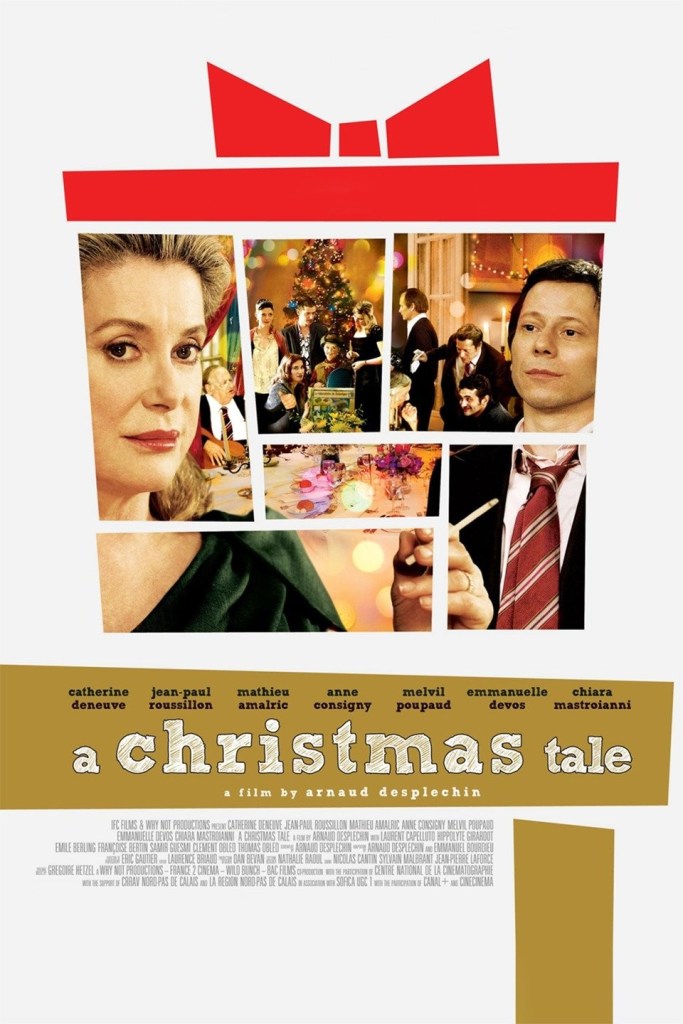
The poster for A Christmas Tale is a photograph of a large family gathering at the dinner table, with a Christmas tree in the background.  The image has been divided by thin white lines that holds characters apart from each other, and the image is topped with a red lid and bow that suggest this is a wrapped present.

One reason I don’t think the movie’s quite such a heavy burden, as an audience member, is that I spent a lot less time grieving for these folks than I did staring at them in puzzled wonder.  Their emotional registers are so differently calibrated from my own, and the kinds of conduct they condone (and engage in) are often really unexpected.  Everyone’s at odds with everyone else, starting with the eldest surviving child, Elizabeth, who’d exiled her brother Henri (yes, “extra” kid, failed marrow donor Henri) from the family years ago in exchange for the money that saved him from ruin, and running all the way to Sylvia, wife to Ivan (the youngest brother—yeah, somehow, after “extra” Henri, Abel and Junon chose to have another kid), a woman who apparently was pursued as an object of potential romantic conquest by at least three members of this extended family and who, spoiler alert, is going to have a dalliance with at least one person she’s not married to before the movie’s over.  And if you’re saying, wait, James, surely Sylvia is not knocking boots behind her husband’s back in one of the bedrooms at her in-laws’ house on Christmas Eve, my answers are a) yeah.  Yeah, she is.  And b) it’s not even clear how much she’s trying to keep things behind her husband’s back.  That was one of the many moments I had, while watching this film, in which I shook my head gently and said, “Those French folks….they are different than I am, aren’t they?”  Virtually everyone in this family has the capacity to go to battle against just about anybody else on screen, and within three minutes they can be kissing each other on the cheek and looking for another bottle of wine to open and share.  The emotional roller coaster doesn’t come to a stop until the end credits roll.

The two most damaged players at the heart of this story are two men who barely know each other at the movie’s start but come to find a weird sense of kinship as it progresses.  One of them is the self-destructive, narcissistic rage monster, Henri, who clearly never had the chance to recover from his knowing from the youngest possible age that he was a failed experiment, a child born to rescue the older brother he could not save.  Everything about Henri—his addictions, his chaotic love life, his aggressive and cruel demeanor—is completely explicable based on all we know about him and two tragic deaths in his past.  His father calls him “Henri Misery” as a nickname, and at one point when Henri asks his mother why she doesn’t love him anymore, she laughs and tells him that she never loved him in the first place.  Here’s the thing, though: they all seem drawn to each other regardless of these cruelties, either because they’re a family that does feel a love they can’t put into words, or else because what holds them all together is some force other than love.  The other significantly troubled family member is Elizabeth’s son, Paul Dedalus, a teenager with a history of mental health issues who’s been hidden away from Henri due to Elizabeth’s totally broken relationship with her brother.  Paul’s having hallucinations, he’s experiencing suicidal ideation, and he’s treated like a fragile china doll by his mother, who expects the family to observe all her rules around keeping him calm and safe.  Henri and Paul, of course, are seemingly the only two members of the family who might be fit candidates for the bone marrow transplant, and so fate throws them together with Junon, their mother/grandmother, as the family argues over who should do it if both of them can (or whether either one or both of them will be disqualified for health reasons).  One of the film’s more moving if inscrutable sections occurs when, on Christmas Eve, it’s only these three members of the family who decide to walk together to midnight mass, despite none of them having given any indication of interest in religious observance previously.

But I’m drowning in this film, friends—I’ve already written so much and I’ve managed to say so little.  I took over a dozen pages of notes while watching this incredibly complicated, layered foreign film and I’m still baffled by half the things I even understood well enough to write.  Every possible combination of characters in this family seems to have its own special energy, whether of kinship and affection or of hostility and struggle (usually both).  There are unsettling moments and eerily calm ones.  At times it feels like a very normal family gathering at the holidays and at times characters speak so mercilessly to each other that you can’t believe they stay under the same roof without one or both of them burning the house down around their ears.  Sometimes conversations involve characters discussing things or taking actions based on knowledge I don’t really understand how they came to possess.  I probably missed something in the flurry of subtitles, but I think it’s also possible the movie intentionally maintains at least a mildly dreamlike state of ambiguity, where things don’t fit together as neatly as I might have expected.

As I suggested at the outset, I’m just not sure this works, even for me, a guy who’s open to art that explores some pretty complicated feelings.  I think it’s one thing for me to try to understand the psyche of a difficult, selfish person in a three minute rock song, and another to watch that person on screen for a couple of hours dealing out unrelentingly vicious commentary at almost everyone he encounters.  I can feel compassion for Henri but I also feel trapped in the room with him, and when I feel that way it’s hard not to see his sister’s side of the story.  I think the director feels a lot more compassion for the parents than I do—parents who, yes, lost a child young, a horror I hope never to understand—given how appallingly and borderline abusively they’ve conducted themselves towards and around their kids ever since.  The film doesn’t seem all that interested in letting the story lead us towards resolution of most of these issues, though, and to the extent that anything gets “resolved” I would say I find the resolutions both implausible and unsatisfying.  Sure, in real life, I bet these people would go on damaging themselves and each other, with no real guard rails in place to hold them back.  But in real life, I wouldn’t stay at their house for several days at Christmas…heck, I probably wouldn’t pick up the phone when they called.  So, why would I watch a movie about them?

And I think that’s the question that you’d have to answer for yourself: could it be that, by watching a deeply dysfunctional French family stumble their way together through the holiday under intense pressure from this urgent medical need, you could maybe process some of your own feelings about both the holiday and your family experiences?  Might you gain a better understanding of some difficult people in your life, or be able to reflect on the ways you’ve abused your own power as it relates to those difficult people?  I bet some of you could, and certainly the critics who reviewed this film seem to have almost universally found it really powerful and moving.  The fact that I wanted that experience and didn’t really get it doesn’t mean that it’s not there to be gotten, after all.  I just think that too often the film struck me as a document that wanted to believe in its own profundity more than it ever managed to express something profound.  Abel at one point quotes a passage from memory—a passage from the works of philosopher Friedrich Nietzsche.  It’s long and complex, and I can imagine it being rich with meaning, but it’s so out of character for him, and seems so unrelated to the other appearances he makes on screen, that it just felt like a director’s affectation.  Affected, too, is the movie’s final moment—an atmospherically lit and shot scene in which a character delivers to camera the final lines spoken by Puck in Shakespeare’s A Midsummer Night’s Dream.  What on earth does Robin Goodfellow or a fairy-laden bucolic comedy have to do with this bitter, wintry French family drama, you might well ask, and that’s sure what I said out loud (I might have raised my voice) at the screen as the end credits rolled.  Like, I’ve just told you the final scene in the movie, but if you stopped six minutes before the movie’s end and tried to guess which of the characters it is who speaks these lines, I bet you’d have no more than a 1 in 10 chance of getting it right, it’s that random.  But I guess it’s “literary” or something.  Anyway, it’s a challenging European art film, with some gruesome medical imagery, frank talk about death, and a little graphic sex—all of those things felt organic to the story, so I’m not complaining about anything being sensationalistic, etc., but I figure it’s good for you to know going in that for a movie called “A Christmas Tale” very little of it will be light-hearted or magical.  Some smart folks have gotten a lot out of it, though, and if you try it yourself, I hope you do too.

I Know That Face: Anne Consigny, who plays the rigid daughter Elizabeth here, appears as Suzy Elisabeth in 2017’s Let It Snow, which is not to be confused with the 2019 Let It Snow that I reviewed three days ago.  And Emmanuelle Devos, who here is Henri’s buxom Jewish girlfriend Faunia, who ducks out of the Christmas celebration to go and not celebrate Hanukkah with her own dysfunctional family, shows up as Beatrice Barand in 2023’s Noël joyeux.

That Takes Me Back: At one point we see family members getting wood from outside and moving it into the house for the fireplace, which was a regular nightly duty as a kid in the wintertime, for me.  I’m happy not to have a wood stove any longer, but there are things I miss about it, and the smell of the woodpile on a cold December evening is among them.  Also at one point one of Abel and Junon’s grandkids appears on screen dressed as a knight for the little impromptu Christmas play they’re staging, which reminds me of a brief and mortifying appearance I made in my church’s Christmas pageant as a child: I was dressed as a knight, and the passing Good King Wenceslas (a church teenager) caught his robe on my cardboard “armor”.  As an adult I know the audience’s laughter wasn’t AT me at all, but as a kid of course it felt like I was the butt of the joke.

I Understood That Reference:  We do catch glimpses of the creche at Abel and Junon’s home, where the grandkids wonder when Jesus will show up.  Slightly later on, Faunia and Henri have a couple of brief exchanges that allude to Christian practice/Jesus as a central figure for the holiday, in connection with Faunia’s identity as a Jewish woman who wants to duck out before Christmas itself is fully under way.


Holiday Vibes (7.5/10): There’s no question that we are fully immersed in a household at Christmas, where things like a big family dinner and a Christmas play occur, not to mention the trip to midnight mass, etc.  But big chunks of the movie take place outside that immediate context, and also Christmas itself is usually sidelined by whatever emotional trauma a character was working through on screen.  Overall, this is a fairly Christmassy movie but not achieving peak levels of holiday.

Actual Quality (7.5/10): It’s very hard to give a fair rating here.  Critics would place this as a 9 or a 9.5, as far as I can tell.  In terms of my moment-to-moment comfort with the film, it played a lot like a 5 or a 5.5, much of the time.  It ages a little better in the days after seeing it than I had expected it to, though, so that I don’t think a 5 would be a remotely fair rating, and I can certainly see the good craftsmanship in it.  I’m splitting the difference then, but I want to acknowledge to you that I think the movie’s pretty polarizing, and that you’ll probably have one experience or the other, rather than a “7.5, fine but nothing special”.

Party Mood-Setter? I mean, I kind of still have no real idea what I watched, so I am reluctant to rule it out, but I don’t think it would work.  It’s just too dense with characters and exchanges and subtext for you to not pay attention to it.  Also, unless you are a speaker of the French language, you’ll have to be reading the subtitles to follow it, which isn’t great for a background movie.

Plucked Heart Strings? You know, it really seems like I should have been emotionally invested, but all these characters are so inscrutable that I couldn’t say I really connected with it at any point in this way.  The meanest things they say to each other would hurt feelings in real life, but if they’re hurting feelings, it’s not usually obvious from the way anyone reacts.

Recommended Frequency: Either I need to not bother watching it again or I need to see it six times so that I can actually follow all the nuances of the dialogue and the intersecting storylines enough to really appreciate it.  I have no idea which of those two things I’m going to do, genuinely.  I think if a complex art house French family drama sounds like your idea of a good time, you should try it, and if it doesn’t, this really isn’t the movie that’s going to convince you to love foreign cinema.

You ought to have easy access to watch the film, if you did want to try it out.  It’s streaming (with ads) on Plex, Philo, and Sling TV.  You can pay to rent it on Apple TV and it looks to me like some streaming services will let you get it via subscription (maybe a subscription to the IFC streaming channel, or Criterion?).  Barnes and Noble will sell it to you on Blu-ray or DVD, if it’s something you love enough to own, and if you’d rather just snag the disc for free at the library, Worldcat suggests you have hundreds of options.

Desk Set (1957)

Review Essay

It’s pretty difficult for a work of mass media to manage the balancing act of being both kitschy and timely.  When it comes to Desk Set, though, there’s this strange fusion at the heart of the movie, where it’s so obviously a throwback with its high-gloss midcentury aesthetics and its notions about women in the workplace and an “electronic brain” the size of a studio apartment…but it’s also a cautionary tale about how tech executives will overpromise and underdeliver, driving employees out of their jobs to replace them with ersatz garbage substitutes that drain the humanity out of work that is meaningfully human.  It couldn’t be more 1957 AND more 2025, at least when viewed through a certain lens.  While I’ll ultimately argue that, in Desk Set, we’re looking at a good and not a great film, I’ll also argue that it’s a movie whose time has once again come round.  And if you haven’t seen it before, friend, I think you’ll be in for a treat.

The setup for Desk Set is fairly simple: high above the streets of New York City, in the offices of the Federal Broadcasting Company, the Research and Reference department operates through the energy and industry of four smart, attractive working women who answer every conceivable telephone inquiry from various FBC studios and personnel with wit and aplomb.  Their leader, Miss Watson (or “Bunny” as plenty of folks call her), is the dynamo who keeps the department humming—she seems to have every possible kind of information at ready recall, and she knows the two story reference stacks of her department like the back of her hand, so that no question can be shouted at her without her knowing exactly what encyclopedic work to consult, or what shelf it’s located on.  The department’s effective and efficient…so, of course, the executives up in the C Suite want to tinker with what isn’t broken, bringing in a “methods engineer”, Mr. Richard Sumner, who winces when he’s referred to as a common “efficiency expert”.  No, Sumner’s here to solve the problems the Research and Reference Department doesn’t have by re-engineering the space for a brand shiny new computer, his “baby”, called EMERAC.  Oh, sure, installing EMERAC will force them to displace most of the books, not to mention the desks where most of these women work….but then, will they be needed anymore, once Sumner’s magical machine starts rattling out answers at the speed of a teletype?  The conflict (along with the identity of its two principal combatants) is obvious.  So are the parallels to 2025, or at least I hope you can see them.  This reference librarian, staring grimly at the looming thunderclouds of a horde of incredibly expensive hallucinating plagiarism machines—sorry, “Generative AI support applications”—sure knows whose side he’s on.  Bunny, you have my sword.

The poster for Desk Set features Spencer Tracy and Katharine Hepburn at the top: Tracy is leaning on a railing, grinning ruefully, while Hepburn leans on the same railing, staring over at Tracy with a beaming smile.  Below their names and the movie title, a smaller inset photo shows the four librarians toasting each other with champagne around a desk, with their stacks of reference books visible behind them.

Why does Desk Set work as well as it does?  Well, for starters, it deploys the perfectly magical chemistry of Katherine Hepburn and Spencer Tracy, in their eighth screen pairing.  Hepburn is basically ideal casting for “Bunny” Watson—at fifty she’s both still an obvious stunner while being visibly old enough to work in the role of a woman nervous both about being made redundant at work and about maybe never getting that marriage proposal she’s been counting on from her boss (Mike Cutler, an arrogant and self-centered junior executive whose appeal to the hypercompetent Miss Watson must, I guess, depend on his flashy good looks).  Hepburn always comes across as smart and quick-witted in any role, and here, as the head of a bustling reference department, she’s the cool and collected jack-of-all-trades that any librarian dreams of being.  In Tracy, the film gets exactly the edge it needs: the character of Sumner could easily come across as oily and self-serving, much like Mike Cutler does, and in the original Broadway play that’s exactly how the character’s written.  But Tracy arrives on screen with the kind of gravitas we might not have expected in the role of, effectively, a gadget salesman, not to mention the kind of agile on-screen chemistry in banter with Hepburn that it’s going to take to make a romance work in the face of an obvious and major obstacle.  In their two sets of very capable hands, Miss Watson is more curious than cold to an obvious interloper in her domain, and Mr. Sumner’s clearly a little more interested in sizing up this remarkable woman than he is in measuring the office for vacuum tube installation.  It’s easy to lean forward and watch two masters of their craft whenever they’re on screen together.

The other thing that definitely works is the David vs. Goliath nature of the plot: we know from the beginning that the women in this office are underdogs, fighting not just the modern fascination with the latest technical advances but also the need of the otherwise useless suits in the penthouse to rationalize why they’re dropping a ton of money on a consultant.  And they’re charming as all get out, from the brassy Peg Costello, who plays not just Bunny’s employee but best friend and can rattle off Ty Cobb’s batting average at the drop of a hat, to the clever young Ruthie Saylor, who’s so keen to impress Miss Watson that a modern remake of Desk Set would have to acknowledge an obvious crush (chaste or no).  We want them to beat the “electronic brain” at its own game, not just to prove how skilled they are but so they can stay together, cracking wise and covering for each other’s mistakes and acting as mutual pals and confidants.  When Bunny Watson tells Peg Costello that, once they’re too “dried up” for dating, they’ll move in together and buy a bunch of cats, Peg instantly fires back, “But I don’t like cats; I like MEN.  And so do you!”  I laughed the genuine laughter of someone who would think Peg was a hoot and a half as a coworker, and I’ll admit, as a professional librarian, surely a little of Desk Set’s appeal is that I would find it endlessly fun to race up and down the spiral stairs of those reference stacks, shouting out the correct spellings for the names of Santa’s reindeer from the upper story.

Yes, Santa—don’t worry, I haven’t forgotten the blog’s one central premise.  Desk Set relies heavily on Christmas as a setting for its second act, in which Bunny’s Christmas gift for Mike Cutler finds an unexpected utility, and in which we then get a series of hijinks and revelations in connection with the FBC’s office Christmas parties that seem to stretch uninterrupted throughout the corporate skyscraper.  From the Reference department’s tree, which is so strewn with honest-to-goodness 1950s tinsel that you can barely see the needles underneath, to Bunny advising Kenny, the office errand boy, on how to hustle the legal department for better Christmas tips, we’re totally immersed in a bustling Manhattan holiday, even if most of the trappings of an ordinary holiday movie aren’t really at work here (no crackling fireplaces, nobody’s visiting anybody’s parents, etc.).  Some Christmas traditions are observed here, though—we get a drunken revelation or two, and one bad (and unsuccessful) marriage proposal, of a sort.  The holiday isn’t the point of the movie, but the ways in which the holiday makes demands of us (and makes us feel demanding of others) are key to advancing the narrative.

I said up front that this is merely a good and not a great film, and I want to make sure I’ve conveyed that that’s true.  Like lots of media of its era, Desk Set has weird politics that sit uncomfortably on 2025, whether it’s Hepburn chanting the Song of Hiawatha with an energy I could have lived without, or the gender dynamics that force the smartest female characters into some of the dumbest poses for the sake of landing a man.  Also, one of the effects of Tracy’s softening Sumner as a character is that the movie loses a little bit of urgency: it’s not just that as audience members we can count on Tracy and Hepburn winding up together, but maybe more importantly, we just don’t get a Richard Sumner who seems like he actually wants to put anybody out of a job anyway.  When, at the Christmas party, Bunny accuses him of being “in love with Emily EMERAC,” it honestly feels weirdly inaccurate, because he’s said very little about EMERAC (and a lot about Bunny Watson) up to that point.  The film’s third act, therefore, struggles a little both with establishing stakes and in working out how to resolve relationships between characters that don’t seem to need a ton of resolution?  The fable we get, in the end, is cheerful but slight, in part because it all feels so unlikely.  This movie is fun but it’s not trying to say a lot.

We don’t always need a lot said, though.  Sometimes it’s more than enough to sit back and enjoy something: enjoy Miss Watson finally choosing herself over a man she’s been chasing for years.  Enjoy Richard Sumner’s helpless smile as he realizes how damn clever this librarian is sitting across from him.  Enjoy both Watson and Sumner as the film dances pretty cheekily close to the boundaries of the Production Code in putting them alone in her uptown apartment in a rainstorm, changing out of their wet things and into bathrobes before having dinner together.  If you give Desk Set a chance—whether it’s this holiday season or just any time of the year you want to believe that human scrappiness and ingenuity will win out over Grok 9.0 or whatever the techbro overlords end up proclaiming as the winner of the GenAI Wars—I bet you’ll come away smiling.  And we need movies like that.

I Know That Face: Joan Blondell, appearing in this film as Bunny’s plucky sidekick, Peg Costello, had appeared in a supporting role in the 1947 movie Christmas Eve, about a woman reuniting with her adopted sons on the titular holiday.  Ida Moore is credited as “Old Lady” but we learn from the girls in Research at one point that she was the iconic FBC mascot back in the 1920s or 1930s—Moore plays Mrs. Feeney, the Bird Lady in 1951’s The Lemon Drop Kid, a Bob Hope flick in which he’s got gambling debts to discharge before Christmas.  And we forget how much Katherine Hepburn, here the indomitable Bunny Watson, really does appear in holiday media throughout her illustrious career: her first big role is Jo March in 1933’s Little Women  which sets its opening act at Christmas, her final credited role is as Cornelia Beaumont in the 1994 television movie One Christmas, and in-between she appears in 1968’s The Lion in Winter (which I’ll cover on this blog later this season) as Eleanor of Aquitaine, as well as playing the role of Linda Seton in the 1938 film Holiday, a screwball comedy that sets key moments on New Year’s Eve.

That Takes Me Back: I mean, obviously, I am nostalgic for reference books in stacks despite working in a building that still has reference books in stacks (not like we used to, though! Ah, the good old National Union Catalog…).  It’s always fun to watch a movie of the right vintage that I catch sight of the iconic AT&T Model 500 telephone: if you’re my age or older, you can’t click on that Wikipedia link and tell me you don’t recognize that profile in a heartbeat.  I know, I know, this movie’s about not getting sentimentally attached to technology and I agree in many senses, but I see that old telephone and I’m an 8 year old, spinning that dial so I can talk to Grandma again.  I do love real tinsel hanging from a Christmas tree—I feel like nowadays we act like garland counts as “tinsel” but they are NOT the same thing and this is apparently a hill I’m at least willing to get badly bruised on.  And, okay, I’m not even slightly nostalgic for Cutler’s particular brand of midcentury chauvinism but it does take me back, I guess, in that every time he opens his mouth I think, “thank goodness for HR departments”.

I Understood That Reference: As alluded to above, one phone call requires Peggy to rattle off the names of Santa’s reindeer, and another of the girls observes that soon they’ll be asked for the complete text of “A Visit from St. Nicholas,” which in fact Bunny does later have to recite.  Later, Sumner stumbles into Watson’s office with questions about A Christmas Carol, which maybe was intended as a more pointed allusion but if it was, I missed the intended meaning.


Holiday Vibes (4.5/10): The Christmas sequence isn’t the big opener or the big finale, so it maybe doesn’t have the same impact, but as I said earlier, there’s a lot of Christmas-related stuff here: gift giving and office parties and references to a ton of Christmas facts and stories.  It’s surprisingly seasonal for a movie that’s really not counting on Christmas at all as an emotional beat (or a source of thematic content).

Actual Quality (8.5/10): It’s a simple enough movie, but Tracy and Hepburn are a delight, and the film stands up on some level for the value of the human despite the allure of the machine.  It’s 2025 and I will take what I can get on that latter front, that’s for sure.  Seriously, it’s a romantic comedy first and foremost, and I’m a guy who is more willing to overlook the wobbles of a rom-com made 20-30 years before I was born than of rom-coms made in the last 2-3 years.  If you feel just the opposite, apply a necessary counterweight to my score in some measure, but even if you do, I would tell you that this one’s still worth your time.

Party Mood-Setter?  I think there’s not quite enough Christmas, and the success of the banter requires a little too much focus from you as an audience member, but honestly the midcentury vibes of the film are nice enough that I can easily imagine just having it on in the background while I was doing something else and finding it pleasant.

Plucked Heart Strings?  No, Hepburn and Tracy are a fun pair, but this isn’t deep romance as much as it is two seasoned combatants realizing they respect and admire each other enough that they’d make a good team.  In some ways that makes it more meaningful than something that’s more openly sentimental, but I really can’t imagine misting up at any point regardless.

Recommended Frequency: I think you’ve got to watch this one once for the Tracy/Hepburn of it, and honestly it might be a better Christmas movie than I’d realized….I just didn’t remember the Christmas sequences from when I watched it 20-25 years ago.  I bet it could make at least a semi-regular rotation and fit in nicely with more traditional members of the Christmas canon—I would take this over Bell, Book and Candle, at least, which I reviewed last year on the blog, and which seems to be the 1950s romantic comedy that every outlet online lists as a forgotten Christmas classic before they think of Desk Set.

Desk Set is surprisingly hard to get a hold of, given the fame of its stars: it’s not streaming for free anywhere, though almost all the major outlets for rental streaming will let you watch it for a few dollars.  The film is so hard to find on disc that I can’t link to Barnes & Noble, which doesn’t stock it: Amazon has only one copy I would call “affordable” and otherwise has either very expensive collector’s DVDs or a European Blu-ray from Spain.  This is one of the best case scenarios, I’d argue, for relying on your local library, since well over a thousand libraries in Worldcat claim to have a DVD copy available for checkout.  Regardless of how you track it down, I hope you enjoy enough of it that you’ll feel it was time well spent.

Bernard and the Genie (1991)

Review Essay

The selection process here at Film for the Holidays is pretty loose: it’s not like we’re being lobbied with gift baskets by streaming services (though Tubi, anything you want to send, I’m here for it), and other than a few very simple rules (1. Cover at least one movie per decade in the talkies era, 2. Every movie needs to have at least one unambiguous scene set at a winter holiday) I don’t really have much to guide me.  I try to come up with a mix of things I’ve seen before and things I haven’t; things I like and things I don’t; different genres and film-making styles, etc.  And along with all of the above, I’m always on the lookout for something that could be a diamond in the rough—some neglected, little-known gem that I can share with you all and add to our collective holiday fun.  That’s why I reached for this BBC production—an early ‘90s British TV vehicle for a young Alan Cumming and a just-hitting-his-prime Rowan Atkinson, along with a big role for Lenny Henry, who’s less famous than the other two fellows but who I’ve thought was hilarious from his early days on Chef! to his recent work on The Lord of the Rings: The Rings of Power.  Throw in that this is a screenplay by Richard Curtis—he of Four Weddings and a Funeral fame, with 4-5 other Christmas-related screenplays under his belt over the course of his career?  It just seemed like the perfect pick to be a surprisingly delightful lark. . . . Well, it ain’t.

The setup of this movie probably should have made me wary from the outset.  Cumming, as Bernard Bottle, is a bumbling young art dealer, fired by his outlandishly narcissistic boss, Charles Pinkworth (Atkinson), for having even raised the possibility of being generous to the senior citizens from whom he’d purchased some paintings that had proved to be hugely profitable at auction.  Bottle stumbles back weepily to his apartment where he learns that his best friend Kevin has been knocking boots with his long-time girlfriend Judy, so he really is at the end of his rope.  He polishes some old lamp he’s found, though, and KABOOM, just one singed testicle later (I’m sorry, but it’s literally what the doctors say when he wakes up), he finds himself in possession of a 2,000 year old genie named Josephus (Lenny Henry), with whom he is only able to communicate because in a moment of terror he shrieks, “I wish we could understand each other” and magically they can now talk freely, despite the language barrier.  The screenplay’s version of the ancient Middle East is so comically stupid that I can’t always tell if it’s offensive or just incoherent—though my guess is most people will find at least some moments and jokes offensive—and the problems of Bernard Bottle are so cartoonish (but also so easily resolved) that it’s not exactly clear how invested we’re supposed to be in his triumphs.

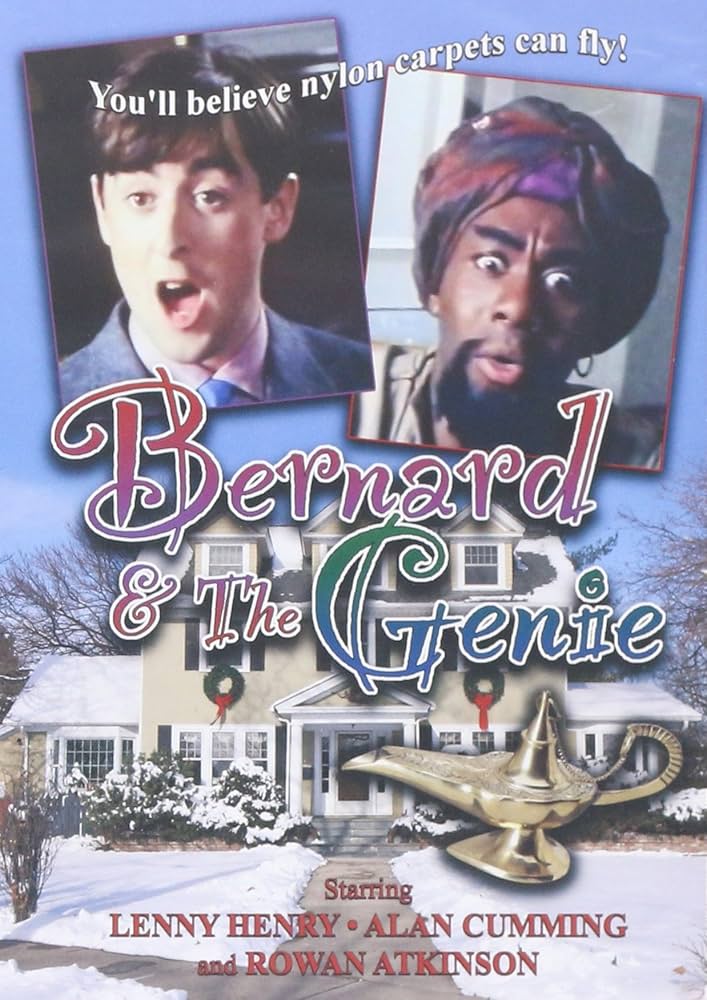
The DVD cover for Bernard and the Genie superimposes the title and a shiny golden oil lamp in front of a generic-looking, snow-covered suburban house that has nothing to do with the movie.  Above the title and house, images of Alan Cumming and Lenny Henry in his genie costume are making surprised faces, next to the tagline, "You'll believe nylon carpets can fly!"

By far the biggest problem with the script, a problem so big that if we just fixed this one element I think the movie’s at least 25% better, is Curtis’s decision to place no real limits on the genie’s power.  Josephus can literally snap his fingers and turn back time by minutes, hours, even days as needed to correct any mistakes he or Bottle might have made.  More seriously, though, the lack of limit extends to the number of wishes.  Bernard Bottle can make an infinite number of wishes.  There’s a reason that basically every wish story you’ve ever heard of extends a small number of wishes (usually three) to the wish-maker, from Aladdin to Darby O’Gill.  It’s just not that interesting to know what I would wish for if I have endless wishes: all pressure is off.  I can fix my house, my car, my job…I can fix the houses, cars, and jobs of anybody I meet, in fact, and I can take revenge on people who’ve wronged me, and I can do something about the world and its problems writ large, without any moment where I have to make a difficult choice.  It turns out that this one element—having only three wishes—is a load-bearing element in these stories, since it places a lot of weight on each individual decision to wish.  It forces the protagonist to learn to solve most of their problems themselves (in order to “save a wish”) and over time, by means of all that learning, our hero becomes, well, heroic.  A world in which Bernard has only three wishes is one in which he is forced to actually grow up, and become something other than a kind of life-sized Charlie Brown, but one with an infinite magic wand.

This is the point in a negative review where I stop and try to catalog the movie’s high points, but there’s not a lot to supply you with.  Lenny Henry, an actor I think has real comedic talent, has clearly been set loose in this role without any restraint from the writing or direction, and as a result his mugging for the camera is exhausting, like a kid running on too many Christmas cookies who you can’t wait to send to bed.  Because anything can happen, none of the chaos feels all that meaningful—like a series of Family Guy sight gags, whole stretches of the film’s second act just become jokes based on the fact that Josephus can do literally anything, from summoning a Big Mac to summoning the Mona Lisa.  Bernard can arrange the arrest of his former best friend on drug charges or transform himself into Bob Geldof or murder a police officer by accident (okay, I guess Mr. Bottle’s lawyer would like me to say “commit manslaughter” instead of “murder”), and all of these things will last for about fifteen seconds, and then anything bad about them can be undone, and anything good about them won’t last since there’s another wish coming.  Curtis’s screenplay is so overstuffed that there are definitely ideas that I think could have been funny in a movie that gave them room to breathe, like Bottle’s apartment having an elevator operator who is a charmingly pathological liar or Josephus having an obsession with the music of Barry White, but it’s the room to breathe that we’re missing.

And when I say overstuffed, I mean it.  I’ve made it to the fifth paragraph of my Bernard and the Genie review and I haven’t yet mentioned that a big chunk of the movie involves Josephus eventually claiming to have been a close personal friend of Jesus Christ, present at everything from the wedding at Cana to the feeding of the five thousand.  That’s the sort of thing that would in any other movie qualify as the singularly bananas story element you can’t wait to unpack, but here, by the time Josephus brings it up, all I could do was smile and shrug.  Sure, Josephus.  Why not?  His friendship with Jesus, who was a really chill guy (he says), supposedly makes him angry about Christmas commercialism, which is not what Jesus was all about (well, okay, that part checks out).  But Josephus makes this claim within a few minutes of him dispensing lottery cash to a guy he thinks deserves it, and doling out a ton of great presents for Christmas, etc., so what exactly is the movie’s anti-commercial message?  I’m not sure.

Okay, let me try a little harder: what can I actually praise here?  There’s something sort of right about Cumming as a naive young fellow counteracted by Atkinson as a brooding, domineering force of malevolence: this could have worked, and it almost does, though the film never comes up with great explanations for why the two characters do what they do.  Cumming as Bernard Bottle is in fact an appealing sad sack—as aforementioned, in a Charlie Brown kind of way—so that I remained a little more hopeful on his behalf than I’ve managed to be in some films where I just can’t care that much about Chevy Chase in Christmas Vacation or Steve Martin in Mixed Nuts.  And there’s a comfortable camaraderie between him and Josephus at times, where it does seem like these two bros would have had a lovely time just hanging out in a London flat wishing for cheeseburgers and one more chance to chat up that Santa’s elf in hot pants that they met earlier in the day.  There’s this funny bit the film does a couple of times where the soundtrack shifts into a song sung by a choir that functions kind of like a Greek chorus, commenting on what’s happening to Bernard in an amusing way, though it’s not deployed consistently enough.  That’s about it.  Oh, wait!  It’s really short.  The premise could definitely have taken up a lot more time, and I was grateful that everyone involved knew to keep this one brief with a plot that doesn’t slow down.

But when you’re praising a movie for only being 70 minutes long, dear reader, not much went well.  And the appalling thing here is just the waste of talent: I know for a fact this collection of people could make better art than this.  A simpler approach—down-on-his-luck art dealer meets a less stereotypical spirit from inside an old lamp who grants him a very limited number of powerful wishes to fix his life problems at Christmastime—with the exact same BBC resources and running time could have been something, if not special, at least amusing as a diversion and remembered with some fondness.  Sometimes less is more, you know?  Someone needed to say that to a young Lenny Henry, for a start, poor fellow.

I Know That Face: Rowan Atkinson, here portraying the villainous Charles Pinkworth, had previously played the various Blackadders in 1988’s Blackadder’s Christmas Carol, and of course will later appear memorably if briefly as Rufus the jewelry salesman in the always controversial Love, Actually.  Kevin Allen, who plays the unfaithful (in I guess more than one sense of the word) “friend” Kevin in this movie, had earlier played a taxi driver in the 1984 short film The Man Who Shot Christmas.  Our hero, Bernard Bottle, is of course the widely-beloved Alan Cumming, who’s in the cast of the 1995 television movie Coping with Christmas, who holds the role of a desk clerk in 1999’s Eyes Wide Shut (which, if Die Hard is a Christmas movie, it surely is also), who voices the titular Cinnamon Bear in the podcast series, The Cinnamon Bear: A Holiday Adventure, and who….wait, what?  Plays Mr. Flaxman, the villainous boss in the REMAKE of Bernard and the Genie, a 2023 Peacock movie titled Genie, starring Melissa McCarthy?  That exists??  Uff da.

That Takes Me Back: It’s a silly little thing, but something about seeing Josephus conjuring up Big Macs for himself in those tan styrofoam containers really took me back to childhood.  It’s not like I ate a ton of Big Macs, but they were in every ad of course, and I definitely remember finally feeling old enough/big enough that instead of ordering a cheeseburger on a rare visit to McDonald’s, I could get a Big Mac.  Very weird, in some ways, to see Big Macs used so prominently in a British production, but maybe McDonald’s was paying for product placement.

I Understood That Reference: Josephus’s talk about Jesus is all focused on him as an adult, so we don’t really get references to the nativity story.  There is plenty of chat about Santa, though—Josephus is surprised to learn that “the chap in the beard” goes around on flying reindeer, and later comments that “Mr. Beardy’s starting to sound like a non-event.”  Josephus ultimately sees himself on some level as having taken over Santa’s job, doling out wishes.


Holiday Vibes (6/10): There’s a surprising amount of Christmas stuff in a movie that didn’t necessarily need it, but that’s just part of the overstuffing, I guess.  From wishing for decorations through arranging for the right presents to the previously mentioned Santa’s helper in hot pants, there sure is a lot of activity around the holiday, even if the biggest story beats really don’t have anything to do with Christmas, per se.

Actual Quality (3.5/10): The movie’s only saved from the worst ratings I’ve handed out by finding ways to be pleasant company: certainly on the level of plot, pacing, performances, there’s a lot to criticize here and not a ton to enjoy.  This is not good work.

Party Mood-Setter?  I don’t know.  I guess in the sense that almost everything in the movie is just a quick gag followed by another quick gag, and another, you could watch it with very intermittent attention and get whatever it’s giving you.  But what it’s giving isn’t exactly cozy or gentle, and depending on which gags you’re checking in for, you might be getting some really uncomfortable jokes about life in the ancient Middle East.  I don’t think I’d use it for this.

Plucked Heart Strings?  There’s something real going on in the friendship of the two title characters, but it’s not going to move you emotionally unless you are way more sensitive to screenplay machinations than I am.

Recommended Frequency: I can’t in good conscience tell you to watch it once.  Part of me wants to watch it again to make sure it’s as bad as I think, and part of me remembers how these rewatches have basically never rescued a movie for me, so why waste even a brief 70 minutes?  I just don’t think this works.

If you’d like to see if I’m wrong about it (totally plausible), this little British TV movie can be streamed from Amazon Prime this December.  I’m not 100% sure if it’s rentable from Amazon if you’re not Prime members (we are, at my house, in part so we can get access to these holiday movies), but no other service seems to have it.  Barnes and Noble is out of copies on DVD, but Amazon has a few to sell, and if you happen to live near one of the 40 libraries in North America that own a copy (just one in the Pacific Northwest, for my local readers), you might be able to borrow the disc for free.  Or, and I’m just throwing this out there, you could just forget about tracking it down and move on to other fare!

Let It Snow (2019)

Review Essay

I know it might bother this film’s fans to hear me say it, but the premise of 2019’s Let it Snow is essentially a time-compressed, teenage Love Actually.  Several different plot lines are all arcing and criss-crossing through spaces very close to each other, and in some cases there are connections between characters we didn’t expect.  The movie’s not really a comedy in a “ha ha” sense, but there’s certainly some funny moments.  In the end we realize that, again, much like Love Actually, the film-makers think that the right closing narration over the right piece of music will make it feel profound.  And maybe it does?  I want to be clear, too: I’m one of those people the Internet loves to hate…I actually enjoy the 2003 holiday romantic comedy anthology film, Love Actually.  So I’m not trying to criticize Let It Snow by saying that it’s got a familiar and almost comically overstuffed lineup of relationship scenarios—the couple that doesn’t know they belong together but they do.  The couple where he’s worshipped her from a-near and she’s oblivious.  The couple who would be great together if one of the girls was willing to step out of the closet and admit she likes girls.  The couple that are almost certainly about to break up and it’s a question of who gets there first.  We get expressions of family love, of the love between friends.  And we have one truly unhinged character who’s seemingly mostly in the movie to be comic relief and/or a plot device to keep things on the rails.  If you’re watching this movie, get ready for narrative whiplash (and be ready to take some notes to keep things straight).

The premise of the film—to the extent that I can call it a “premise”—is that there’s something magical about snow falling, and this particular snowy Christmas Eve in a small Illinois town is going to be chock full of magic.  It’s a stretch, to be sure: it’s not like snow is rare in this town, or like this is an unusually monumental amount of snowfall, etc. (it’s enough to temporarily halt a train, but everything else about the snowfall felt like a pretty standard Great Plains storm to me).  Nobody wished upon a snowflake, as far as I can tell, or cast a spell.  It feels mostly like an excuse to make the title make sense, and maybe to explain why so many unlikely events coincide in this film to knock over the correct dominos to make everything turn out okay.  I know it may feel like a spoiler to tell you things are going to work out, but I have to say, it’s baked deeply into this movie’s DNA that things are going to work out.  Unlike Love Actually (and I promise, this is my last comparison to that film), the screenplay here doesn’t really have the courage for genuinely broken hearts: the only main character left unpartnered at the end of this story is a person whose story clearly is happier ending up solo, despite the fact that basically every single relationship in the movie’s a long shot to succeed.  I can imagine that feeling triumphant, reassuring, or sweet, but to me it had more the feeling of being predestined.  I was glad for all these kids but the unreality of it left me feeling a little disconnected from the world of the film.

The promotional image for Let It Snow features the title hovering in the center of the image over a snowy background. Surrounding it, eight young people of diverse identities and orientations are lying down, some of them looking at each other and some of them looking directly at the camera / at us.

The film has some things going for it: several of its young stars show up with real skill to deliver on screen (in particular, Kiernan Shipka’s an old pro at her young age, between years on Mad Men and starring in the Sabrina the Teenage Witch reboot), and the movie’s soundtrack is absolutely loaded with well-curated tracks that fit into yet another of my Yuletide interests, songs that are technically holiday music without being “holiday music”.  While I found the character of “Tinfoil Woman” a little TOO obviously the invention of a Hollywood screenplay—I don’t care how quirky your small town is, there’s no way it is constantly being circled by a community-minded conspiracy theory freak whose truck can navigate even the snowiest of streets for the sake of rescuing helpless teenagers—any film that can have Joan Cusack in it is better off for the inclusion, and I was glad she was here.  I was also glad that the film didn’t try to diagnose or “fix” Tinfoil Woman—she’s on her own journey, and that’s not what this movie is about.  Another pleasant surprise was the fact that JP, the jock Angie’s got a crush on (who, therefore, stands in the way of Tobin, Angie’s best friend, dating Angie), is not a jerk or a heel, but instead is an attractive, sweet, funny, self-assured guy who treats Tobin almost as well as he treats Angie.

The headwind all of those strengths are trying to walk into, though, is a motion picture that, at the level of screenplay, editing, and direction, is just trying to do too much too fast at too many levels of emotion.  Rom-coms usually have the problem that everything in the script could be fixed rapidly if they just said one obvious true thing to each other that the screenplay works hard to keep them from saying.  Let It Snow, alas, has way too many plotlines and every single one of them hinges on something the characters obviously should say and almost certainly would say in real life, but don’t until the third act for dramatic reasons.  And the need to race through things can force weird exchanges, where characters who JUST had a magical moment together need to suddenly forget all about it so there can be a new conflict, or where characters say really awful, almost unforgivable things to each other because we need to communicate “someone just tried to burn a bridge in this relationship” with great efficiency.  Again, all of this haste just pushes me into checking out of emotional engagement with the film, despite the fact that there’s a lot of potential for genuine emotion in these teenagers and their tensions with family/friends.  Like, I know by now I ought to have run through the various major named characters and their deals, but there’s such a surplus of major characters, all of whom have deals, that I’m not sure how to do it well.

The movie is also weighed down with quirks, from a restaurant called Waffle Town that’s missing its W, leading multiple people to refer to it as “affle town,” to a character whose attempt to shave his chest leaves him with a comically bleeding nipple that’s a talking point for the entire running time of the film, to, uh, did I mention this small town has a resident they all call “Tinfoil Woman” who just drives circles around town in the snow looking to be a good Samaritan and who is also somehow a rambling lunatic?  We get an ecumenical, interfaith holiday pageant (between this and Single All the Way, what is with modern movies and the aversion to just staging a straightforward Christmas nativity play?  Hey Hollywood, everybody knows it’s Jesus’s birthday, I promise, it’s not going to offend your viewers if a small town on Christmas Eve includes a handful of people briefly engaged in sincere religious observance) that a character refers to as “one of the best, most insane things I have ever seen”.  A waitress tries to win over the girl of her dreams by serving up something called a “Quaffle Waffle”.  The quirk is off the charts.

What it comes down to for this movie (and for, I’m sure, dozens of other movies in this particular streaming-friendly subgenre of “small town holiday rom-coms with a lot of quirk and some cute young talent”) is the question of what you’ve come to the movie in search of.  If you want cute people in cute places whose problems, however serious on paper, end up being almost adorable themselves given how easily/fully they’re resolved by the time the end credits roll, this movie has you covered.  If you were hoping for something that covered fewer relationships with more depth, or that had found a way to make this premise into something deeper than a “be the real you, and people will love you for it” afterschool special, Let It Snow is going to let you down to some extent.  I had a very pleasant time when I was just admiring Kiernan Shipka’s elfin smile or appreciating the endless charisma of Shameik Moore as a stranded pop musician.  I had a more confounding time trying to keep up with what the movie wanted me to feel (and asking myself if I felt it), or trying to understand why a character was doing any of the things they were doing (other than “because the script said so”).  Not every movie needs to be an Oscar winner to be worthwhile, at this or any other time of year, so I certainly understand the value of a work like Let It Snow.  I just also can’t pretend that it soars to heights it didn’t take me to.  Three cheers for the diversity of the casting/storytelling here, though, and I hope that the talents who put this film together aim someday at getting something more substantial made, since I think we had a lot of the ingredients we needed for a modern classic.

I Know That Face: Isabela Merced, who’s here in one of the many leading roles as Julia, a bright girl with an edge and a chance to go to college but there’s this family thing, see, etc., appeared as a fictionalized version of herself in the 2015 television movie, the Nickelodeon Ho Ho Holiday Special.  Kiernan Shipka, who in this film plays the totally chill girl Angie (or “the Duke”) who would be in danger of Manic Pixie Dream status if she had more screen time, appears as Gryla in the 2024 Santa Claus heist movie, Red One.  And of course Joan Cusack, whose performance as “Tinfoil Woman” basically rescues a character the screenplay had set up for failure, is a well seasoned vet on the silver screen: she voices Mrs. Krum in the charming animated Santa movie, Klaus, and earlier in her career she’s the voice of the Lead Elf in Arthur Christmas.  She plays Agnes in The Christmas Train, a TV movie about…oh, come on, it’s all there in the title.  She’s the villainous Miss Rachel Bitterman in 2002’s It’s a Very Merry Muppet Christmas Movie.  I’m probably missing other qualifying credits, too: she’s Joan Cusack, she’s in dozens of movies, almost always in supporting parts, and in my experience she is absolutely always great.  I’m glad she was here.

That Takes Me Back: This 2019 movie about teenagers didn’t make me nostalgic for anything in particular, but at the speed that teenage subcultures change, I assume that a more plugged-in young person would find a lot here that feels positively ancient.

I Understood That Reference: Jesus makes a brief appearance at the all-inclusive world pageant—again, briefer than you might expect on his own holiday but that’s not what this movie wanted to show—and the wise men keep making occasional appearances due to Tobin’s costuming decisions which, like much of the film, remain at least somewhat confusing to me.


Holiday Vibes (8.5/10): Though it’s a movie that’s more about young love than it is the particular hurdles of holiday living, we still get a ton of Yuletide hijinks, from the kooky pageant to Julie bringing Stuart home for her family’s Christmas Eve observance.  Add in a magical snowfall and it’s checking a lot of the necessary boxes here: you’ll feel that seasonal glow, I’m certain.

Actual Quality (7.5/10): To some extent, Let It Snow is a movie where the parts are greater than the whole.  If I think just about an individual character moment or line of dialogue, I can start to convince myself that this was a really solid rom-com.  It’s only by stepping back slightly and asking myself if I was really invested in the film and if it holds together as a coherent story that I realize I was a lot more checked out from it than I have been from the better films I’ve seen for FFTH blog posts.  I think this is a fair rating (from my own perspective), but I think the holiday fluffiness of this movie means that the mileage will vary a lot (and, as seen below, it depends a little on what you want out of a movie watching experience).

Party Mood-Setter? This is 1,000% what this movie is for.  Checking in and out of the movie while not necessarily caring that much who’s who or what’s allegedly happening means you can coast on the attractive and bubbly cast, the solid soundtrack, and the moments of genuine humor.  If you’re baking some cookies or just want to throw something on in the background of a gathering to entertain people who have sat down at the edge of it for a moment, this is absolutely going to do the trick.

Plucked Heart Strings? There are moments, especially the ones involving Julie and her mom, that have genuine emotion: they don’t pack as much of a punch due to the pacing (and just the challenge of being invested in storylines that are mostly pre-engineered for resolution) but I can imagine feeling a catch in your throat as you watch, even if I didn’t experience it.

Recommended Frequency: This is another split the difference movie for me: I am sure I could go my whole life without watching it again as a dramatic work, but I am also sure I will not go my whole life without seeing it again, because it’s too perfect at filling that “let’s put on a holiday movie while we address Christmas cards or trim the tree” niche that folks want.  If you’re someone who does a lot of that, this may be an every year movie for you: for me, my guess is it’ll pop up now and then, in years where I’m a little more invested in those at-home holiday vibes.

Let It Snow is another of these streamer-exclusive films: Netflix made it, and if you want to watch it, you’ve got to go to Netflix.  If you go looking for DVD copies, either at a store or at your library, you are only going to find copies of the 2013 Hallmark movie Let It Snow starring TV holiday perennial Candace Cameron Bure (seriously, the woman’s been in a minimum of 17 Christmas movies, none of which are currently in the queue here at FFTH, for the record).  Whichever snow-themed holiday rom-com you’re seeking out, have fun with it!

Meet Me in St. Louis (1944)

Review Essay

Part of the fun of the Film for the Holidays experience, for me, is finally sitting down to watch a movie I have been meaning on some level to watch for years, only to find that it’s not quite what I was expecting.  Sure, sometimes this is a negative experience, but more often it’s a neutral or positive one as I find myself recalibrating my expectations on the fly: it’s more interesting, at least, to be surprised.  In the case of 1944’s movie musical, Meet Me in St. Louis, I was expecting to be mostly dialed in for the star power of the incomparable Judy Garland, and don’t get me wrong, Miss Show Business is here and as fabulous as any of us would expect.  But sometimes in these holiday films, you get kind of fascinated by a truly charismatic supporting player—they’re not always even in sync with the rest of the cast or screenplay, but they’re so undeniably magnetic that you find yourself leaning in every time they’re on screen.  Think Dan Levy as Abby’s flamboyant friend John in Happiest Season.  Anyway, there’s a performance like that in Meet Me in St. Louis, and it tickled me.

Let’s handle the central story of the motion picture first, though—this is the story of the Smith family, and in some ways it’s an almost Austenesque premise wherein the oldest girls, Rose and Esther, are both pretty keen to land a guy (and grappling with some societal hurdles and conventions to do so) while maneuvering around a difficult parent (here, Mr. Alonzo Smith, their father).  It’s also a story about turn-of-the-century American optimism—St. Louis as a city “on the grow” about to welcome the whole world to the Louisiana Purchase Exposition, a place western enough that the big cities back east are a different country you can only reach by means of echoing long-distance phone lines but also connected enough that kids from the local high school head to the elite universities of the Atlantic Seaboard pretty routinely.  And it’s at least attempting to also be a story about the pressures on a lower middle class family: Mr. Smith’s worried enough about money that he’s willing to uproot the family to make a big move for his work, but not so worried about money that he can’t change his mind about that, at least in theory.  The film doesn’t really land this last punch, I’m afraid, since the family hardly ever seems low income (given their pretty lavish digs in a lovely neighborhood, with the girls expecting to head off to college, and Mr. Smith’s professional standing as a lawyer), and this is a problem since a lot of the conflict in the story hinges on the idea that the Smiths are so in need of the promotion/raise that they’re willing to throw away a whole lot of happiness in order to get it.  Sensible plots aren’t exactly the hallmark of the Golden Age Hollywood musical, and it’s probably fair to say that most people are being drawn here for that mix of MGM talent and Tin Pan Alley songwriting that make for a bit of a sensory extravaganza.  But I still think we can do a little better than this.

The poster for "MGM's Meet Me in St. Louis" features overlapping portraits of several young people (two teenage girls, a younger girl, and a teenage boy), along with the credits for the main cast.  The only tagline reads "Glorious Love Story with Music".

In some ways the movie’s a bit more grown up than you might expect: both Rose and Esther Smith are pretty savvy about boys.  Esther (the character Judy Garland plays) at one point informs her big sister that “I’m going to let John Truett kiss me tonight.”  When Rose chides her, saying, “Men don’t want the bloom rubbed off,” Esther quips back, “I think I have too much bloom.  Maybe that’s the trouble with men.”  These ladies know a thing or two about the need to attract a fellow’s attentions without, shall we say, overindulging either themselves or the fellow in the process.  And of course it’s the 1940s, so the film’s going to ask us to play along with romanticizing things like a young man getting passionate enough that he grabs a young woman and kisses her, no permission sought: the fact that we know very well it’s what she wants doesn’t really make the moment 100% fun, from my perspective, but maybe I’m being too much of a wet blanket about it.  Nobody in this film manages to seem like a bad person for more than about five minutes (and only for the sake of creating just enough conflict to keep the story humming along).  When the meanest character in your motion picture is *checks notes* a devoted father who thinks he needs to relocate his family for their economic well-being, well, the stakes are pretty low.

I teased you a little up-front, though, with my claim that the show here is stolen by a high charisma supporting cast member, and I need to deliver the goods, so here it is: Margaret O’Brien, the child actress, is incredibly compelling as “Tootie” Smith, the youngest of the family’s five kids.  We’re introduced to Tootie having wandered away from the family home to help deliver ice on a horse-drawn wagon, entertaining the delivery man between stops by discussing her plans for the burial and mourning of one of her dolls who she plans to have “die” later that day—as she tells him, the doll has four fatal diseases, “and it only takes one.”  Later, on Halloween, we follow her through the neighborhood in an era predating the “or treat” option: Tootie’s all tricks, all the time, and her idea of a trick is on the level of stealing lawn furniture to add it to a bonfire, throwing flour at neighbors in an act of mock assassination, and, most memorably, the attempt to derail a double-decker streetcar by placing a hastily prepared mannequin on the tracks.  She is a menace to society, and I love her.  Admittedly, Tootie’s also young enough to be scared of the mayhem she’s capable of, but I think that only adds to the impressiveness of the mischief she accomplishes in one brief night out.  She’s endlessly quotable and really my big complaint of the film’s second half is that it spends way too much time worrying about getting Esther and John’s romance sorted out (over, it has to be said, the most comically miniscule of hurdles) and far too little time letting me watch Tootie, I don’t know, pursue a career as a juvenile arsonist or weigh the pros and cons of poisoning her grade school teacher or whatever other kinds of sheer chaos she is probably up to, off screen.

Now, here’s where I probably ought to admit a certain amount of favoritism at work here, or at least my predisposition to cheer for spunky kids like Tootie Smith in St. Louis in 1903.  Two of my great-grandparents were small town Missouri children in 1903-1904: my great-grandfather Warren was a scamp (injuring his hand as a 12 year old in an “accidental revolver discharge”…lord knows what Warren’s parents were doing at the time) and my great-grandmother Opal, who I will always and only ever think of as “Nana”, was a bright and brave woman all her life.  In 1904, the year of the Exposition, Opal was a 9 year old living in Lewistown, Missouri: at 150 miles from St. Louis, she was too far away to get to go to the Fair with her father and grandmother, but her dad gave Opal and her younger sister Nellie the consolation prize of a trip to Quincy, Illinois (about 30 miles away) to see Barnum and Bailey’s Circus that summer.  It was pretty easy for me to enjoy this 1900s peek into a Missouri family’s life, sanitized and historically inaccurate as I know much of it is, since it let me muse just a little about what it might have been like for Opal and Warren to hear tales of the World’s Fair or play a prank on Halloween.  If you feel any kind of connection or kinship to this part of the country or that era of history, I bet this will work a little better for you, too.

And of course, what this movie does best of all is its music, which I haven’t really touched on.  It’s a mix of songs: I’d never heard “The Boy Next Door” before but Judy Garland can make anything sound like a classic the moment she gets started.  I was familiar with the chorus of “The Trolley Song”—and I bet many of you, too, know “Clang! Clang! Clang! went the trolley”—probably from the Looney Tunes or some similar source.  And I could certainly sing all of this movie’s biggest hit and the one that pulls it squarely to Christmas (yes, don’t worry, I haven’t forgotten the conceit of this blog): Esther, in an attempt to soothe the fragile and frantic emotions of an agitated Tootie, pulls her little sister into her arms and sings, “Have Yourself a Merry Little Christmas.”  We get about 25 minutes of Christmas out of the film, but it’s a climactic 25 minutes, coming as it does at a point where the family’s preparing to move to New York, and treating the holiday as a huge final farewell—one last dance, one last tree in the front room, one last chance to maybe see if that John kid can get his act together and propose.  At its best, it’s a perfect Golden Age holiday sequence—red and green gowns that dazzle the eye, a real humdinger of an emotional song performed beautifully, and a finish that affirms love and family and togetherness in the way we want all our holiday flicks to end.  It’s just not always able to hold onto that perfection, since some of the machinations of the plot at the end are creaky, and while the song is beautiful and in Judy’s confident hands it packs an emotional heft out of the gate, its lyrics are sometimes a strange fit for the moment and the characters involved.  The movie works, but it doesn’t work as well as it wants to believe it does.  What it does do, aided so much by the energy of Judy Garland and Margaret O’Brien, is give us the Smiths as a convincing and loving family, whose holiday celebration is genuinely joyful to look in on, and at this time of year, what else do we really want?

I Know That Face:  We just saw Tom Drake of course, who here is Esther’s beau, John Truett, when he appeared as Pat Dingle, a similarly fresh-faced boy next door, in The Great Rupert.  Margaret O’Brien, one of the last surviving child stars of the 1940s and the adorably gremlin “Tootie” Smith in this film, has voice acting roles in Elf Sparkle Meets Christmas the Horse and Elf Sparkle and the Special Red Dress (playing Mrs. Claus in the latter), as well as portraying Mrs. Foxworth in This Is Our Christmas.  And Margaret also plays Beth March in 1949’s Little Women—a film that, much like this one, incorporates a significant Christmas sequence even though it’s not exactly a “holiday movie”—and she’s not alone, since the March parents in that version of Little Women are played by Leon Ames and Mary Astor, the same actors portraying her parents in this movie, while Harry Davenport, who’s Tootie’s grandfather in this film, appears in the Alcott adaptation as Dr. Barnes.

That Takes Me Back:  This film’s set so long ago that it’s not so much making me nostalgic for things I remember as it makes me curious about things that maybe my grandparents or great-grandparents would have been nostalgic for.  Would the making of your own household ketchup have been such an engrossing enterprise back then, as it seems to be in the opening scenes?  Did people really tie ribbons in bows around the necks of housecats back then?  I associate this more with animated Disney films, in part because most of the cats I have known would have declared a vendetta against anyone subjected them to such indignities, and yet there the bow is on Tootie’s cat.  As I mentioned earlier, the film gives me a glimpse of a Halloween full of tricks only, and honestly, the chaos and vandalism is overwhelming enough that I can understand the citizenry of St. Louis getting together after Halloween 1903 and agreeing to the new “tradition” of trick-or-treating as a kind of public safety measure.  Anyone who knew Tootie Smith would have gotten to work the next day in an attempt to invent the fun size candy bar.  Oh, and there’s some shenanigans involving a dance card, which made me wonder when the end of the dance card era was (and why it ended).

I Understood That Reference:  Tootie’s waiting up for Santa Claus, but of course he won’t show up until she’s asleep.  How will he find the family next year in New York, though?  Gosh darn it, Tootie, you’re too dang cute sometimes.  When you’re not feeling murderous, that is.


Holiday Vibes (4.5/10): As noted above, the final half hour or so of the film really does a pretty good job of realizing an emotionally resonant and colorfully delightful Christmas holiday.  The addition to the canon of a now-ubiquitous holiday song has to count for something here, too.  But the score can only get so high before I say, hang on a second, the vast majority of the running time unfolds without even any reference to a winter holiday.  The score of 4.5 is probably generous, all things told, but like all my numerical scores, it’s to be taken with a grain of salt.

Actual Quality (8/10): At its best, this is a lot of fun—a couple of great songs, a lovely Christmas tableau, a charming performance from a child actress.  At its worst, it’s super forgettable: some of the music isn’t all that catchy, there’s so little conflict of any real consequence, and the film’s biggest questions as we get to the third act are a mixture of problems that will clearly be resolved with ease and problems that barely seem like problems.  The plot’s not strong enough to be a selling point, but it doesn’t give itself over into spectacle quite enough to get away with a weak story the way that other films frankly do (the plot of White Christmas, for instance, isn’t better than the plot of Meet Me in St. Louis, but that movie finds way more ways to captivate an audience and let the plot take a back seat).  Shaking all that up, this ends up a B/B- of a movie for me as an artistic product (even if I felt a little more charitable towards it, as a viewer).

Party Mood-Setter?  There’s not quite enough Christmas in the film to work for this purpose.  But it’s so gentle and full of nostalgia that I don’t think it would particularly distract you if you did turn it on.

Plucked Heart Strings?  I mean, I was not expecting this, but I really did find myself getting emotional at the Christmas gathering: the love of the people involved, and their gratitude for each other, got to me on some level.

Recommended Frequency:  I’d say that Meet Me in St. Louis is a film that, if you watched it for a few Christmases in a row, would become “a Christmas movie” just as much as a lot of other films that are not set primarily at Christmas but have some key Christmas scenes—in the vein of It’s A Wonderful Life or White Christmas in that way.  I’m not sure it’s quite great enough for me to make that effort, but it’s more than good enough for a viewing and it’s one I will absolutely watch again, as much for the old-time nostalgia of it as for the holiday elements.

As with so many other films this year, you can watch this (with ads) on Tubi. It’s rentable on streaming from almost all the places you might think to pay to rent it, too.  The Blu-ray is cheaper than the DVD at Barnes and Noble, if you know you want to own it, and Worldcat will help you find it in over 1,800 libraries worldwide.

Disney’s A Christmas Carol (2009)

Review Essay:

Of all the adaptations of Dickens’s iconic novella, I think it’s possible that the Robert Zemeckis-directed, motion-capture animated, Jim-Carrey-as-Scrooge-and-also-half-the-cast movie I’m writing about today has the widest possible gap between how I ought to feel and how I end up feeling.  This movie has so much going for it: Zemeckis clearly wants to vividly realize 1840s London while not shying away from the creepier and more unsettling elements in the frightening ghost story that A Christmas Carol can and arguably even “should” be, in the right hands.  Zemeckis committed early on to a really faithful adaptation, and it’s certainly true that the film’s dialogue is often lifted right out of Dickens, and that it depicts some moments and scenes so obscure that even my beloved Muppets didn’t attempt them.  I’ve loved more than a few Robert Zemeckis movies, over the years, and while Carrey can be an acquired taste, I’ve loved him in enough films that a Jim Carrey star vehicle is, if anything, a plus in my book.  It all sounds fantastic to me.  And yet.  This film is a disaster of epic proportions, as far as I’m concerned.  It’s unpleasant to look at, unevenly paced to the point of putting the audience through theatrical whiplash, and ultimately it feels dramatically and emotionally inert in the moments where it most needs to inspire feeling.  I can’t believe a movie with this much going for it is this unendurably awful.

So much of this film’s problem is in the animation, which was lambasted even at the time for feeling well below the standard needed for a movie made on a $200 million budget.  My notes from the movie’s opening sequences include phrases like “this feels like a DVD main menu” and “for a video game cutscene, the animation is okay.”  These are not the kind of plaudits $200 million dollars ought to buy you.  One of the big challenges with the technology Zemeckis was using is that he could get close enough to a depiction of the actor’s real faces that they no longer seem like animation…but not so close that they feel real.  The result is that when someone like Scrooge’s nephew Fred enters, I can’t see either an actor or a character: I see the undead, shambling form of a Colin Firth clone, stumbling out of the uncanny valley and onto the screen with eyes as cold and lifeless as a supermarket fish.  The animation handles physical structures a lot more successfully—my favorite shot in the whole movie occurs very early on as the camera swoops up from Scrooge at street level to fly from his office in Whitechapel over the City of London towards St. Paul’s.  It’s evocative and immersive and a cool way to situate me in London and in that moment in time.  But of course A Christmas Carol is a movie about the heart, about people and the way we learn to care about them as people.  If your movie’s aesthetics are so tortured that I cringe every time a character fully faces the screen, you are kicking me out of the parts of the movie you really need me to lean into.

The poster for Disney's A Christmas Carol depicts, at the bottom, a busy London street decorated for Christmas in the mid-19th Century.  Hovering above the street scene (and the movie's title) is the looming figure of Ebenezer Scrooge, backlit by the full moon, wearing a top hat and coat, along with a long red scarf. His withered hand holds a candlestick, which, if you look closely, depicts the eerie face of the Ghost of Christmas Past in the candle's flame.

There’s a knock-on effect from the animation style, too, since one of the arguments Zemeckis always made in favor of mo-cap animation is that it allows you to cast a brilliant actor in more than one part, even allowing someone to share the screen with themselves naturally.  There may be ways to do this skillfully, but here I think it almost always hurts the viewing experience.  I get that you CAN make it so that Gary Oldman (an acclaimed and award-winning actor) not only plays the role of Bob Cratchit but also of his son, Tiny Tim, but…why?  Gary’s a talented fellow, but even if he wasn’t miscast as Cratchit (and I think he really is), seeing the features of his middle-aged face dimly recognizable on the elfin features of seven year old Tiny Tim is ghastly and unsettling.  The original plan had been to let Oldman voice the role of Tim also, but my understanding is the result was so unsuccessful that at the last minute they swapped in child actors to speak the lines.  And I’ll admit that there’s something kind of interesting about letting Jim Carrey play Scrooge at every age…but casting him as all three Spirits, also?  And then having Carrey, an actor never known or celebrated for his accent work, learn three DIFFERENT British accents to differentiate Scrooge from Christmas Past and Christmas Present, none of them skilfully or naturally achieved?  You’re making problems for yourself that you didn’t even need to create, Robert.  What on earth are you doing?

There are things for me to praise in even this shambolic a production, and I’ll pause for a paragraph to try to do so.  As I mentioned, Zemeckis does want to keep in the unsettling elements in Dickens’s novella, and I like the ones he includes for the most part—the ghosts Scrooge sees as Marley leaves him, haunted by their inability to help those in need.  The scrawny, almost inhuman forms of Ignorance and Want, clutching to the robes of Christmas Present at the end of that sequence.  Some of the shadow work with Yet to Come is pretty effectively creepy, too.  And honestly, Carrey may be one of the better Scrooges I’ve seen dancing around on Christmas morning: it’s maybe the only point in the movie that Jim seems to be relaxing and letting some of his silliness onto the screen, which to me is what you pay the man millions of dollars to achieve.  After an hour of listening to a guy sound like he’s white-knuckling his way through every line, looking at a pronunciation guide so that he keeps his Yorkshire accent and his Irish brogue from blending into each other, it’s a relief to feel like Carrey can breathe out for a moment and just cavort in his weightless, rubber band animated body.

The weightless, rubber band quality’s a problem, of course, but it’s a problem for a lot of CGI animation of the era.  It disrupts your ability to connect with a scene when it’s suddenly apparent that what you’re looking at has no mass or substance.  The greater problem here is the weightlessness of the camera also, and therefore what Zemeckis does with it.  He feels like a director so excited for all the things mo-cap could do that live-action couldn’t do that he never stopped to ask himself why he would choose to do it.  Like, you CAN have Christmas Yet to Come chase Scrooge through the streets of London in a hearse pulled by demon horses until Scrooge magically shrinks (mechanism unexplained) so that he can scamper down drain pipes to safety…but why are you doing that?  You can make it so that, when you have Scrooge attempt to “snuff out” the light atop Christmas Past’s head (a moment that, I have to acknowledge, does occur in the book….sort of, though Zemeckis’s Christmas Past doesn’t look at all like the character Dickens described), the spirit and extinguisher turn into a fireworks rocket that zooms Scrooge helplessly into the night air above London before he plummets to his “death”, waking up by hitting the hard wooden floor of his bedroom…but should you?  A lot of these sequences are elaborate and lengthy with impossible camera moves, and they add nothing at all to the story…but taking the time and energy to animate them means that other things are left undeveloped, like the relationships of any of these characters to each other.  For a movie that professes to be a “faithful adaptation”, there’s no emotional fidelity here: it’s hard to believe that Scrooge cares about any of the people he’s seeing, since most of the scenes fly by quickly in order to set up the next strangely paced setpiece.

I could write about the movie’s wobbles for pages and pages, but I’ll try to focus on a couple of examples that tell maybe the whole story of what falls apart here.  Zemeckis makes the strange (and, to me, inexplicable) choice of having almost all of the Christmas Present sequence unfold with Scrooge and the spirit sitting in his room, looking through a transparent floor at scenes the spirit shows him.  For a movie that otherwise is maybe too immersive (dragging me down drainpipes, etc.), the decision not to immerse Scrooge in these scenes more fully when they are literally the joyous encounters with humanity that break open his heart in this classic and beloved story is baffling.  It leaves us, in a sense, watching Scrooge and Christmas Present watch something on their own screen: no wonder the characters and their experiences end up feeling emotionally remote.  And while the opening aerial shot of London is pretty impressive, in later scenes I often felt like establishing shots were panning across landscapes that had been copy-pasted, with identical houses or windows repeated over and over.  It wouldn’t take much work to help me see even a set of genuinely architecturally identical row houses as having some character and life of their own, but the movie doesn’t think it needs to do the work.  And that’s really how Zemeckis treats the Dickens elements in his script, too: he thinks he can copy and paste chunks out of the novella without thinking about how, in the medium of film, he has work to do to bring them to life, to give them character, even, yes, adding your own interesting flourishes in an attempt to help communicate the themes of this story to the audience that’s come looking for them.  It’s a big world and there’s someone out there who loves this film—maybe even you—and if so, I think it will only be because they can get past the animation itself, and find underneath it the really good bones of Dickens’s original novella.  That’s the beauty of even a bad Christmas Carol adaptation, and it’s about all the beauty I’m finding here, I’m afraid.

I Know That Voice and Possibly That Hideous Simulacrum of a Face: Part of Zemeckis’s shtick with this film, again, is casting actors in multiple parts because he could, so the cast is surprisingly small given the length of the credits.  Daryl Sabara, who plays five credited roles (including two different carolers and Peter Cratchit), has a voice we might recognize from when, at a younger age, he fills the central role in The Polar Express, another haunting mo-cap animated film from the fevered brain of Robert Zemeckis—a role titled simply “Hero Boy” in the credits of that film.  Sabara’s a real veteran of varied types of seasonal projects, in fact: he voices Tommy in Scooby-Doo: 13 Spooky Tales – Holiday Thrills and Chills, and he appears in the music video for Meghan Trainor’s Christmas song, “My Kind of Present,” due to the fact that Sabara is in fact Trainor’s husband in real life.  Julian Holloway, who in this movie appears as “Fat Cook”, “Businessman #3,” and “Portly Gentleman #2” (which I believe is a speaking role, soliciting Scrooge for funds), had a long career, mostly on British television.  I know Holloway from a few episodes of the unjustly forgotten series about a 1940s radio station, Remember WENN, but I don’t believe he made a Christmas episode there—he is, however, a voice in Toot and Puddle: I’ll Be Home for Christmas, and as one of the repertory cast of actors who seem to have appeared in almost every installment of the long-running Carry On… series, he has a couple of small roles in the 1973 British TV special, Carry On Christmas.

I know, I know, I’m wasting your time with actors you barely hear and films you’ve never heard of: isn’t that the fun of this section, though?  I just sat through Robert Zemeckis’s body horror holiday screamfest—let a man have a little fun, okay?  All right fine, let’s deal with the big guns.  Cary Elwes, who here is credited with five parts but is probably most recognizable as “Portly Gentleman #1” is of course a reliable hand in a fair number of holiday films, including Last Train to Christmas, A Castle for Christmas, and Black Christmas, as well as a small part in the Garry Marshall anthology film New Year’s Eve.  Whether you wanted to recognize him or not, you had to come to terms with the eerie visage of Colin Firth in the role of nephew Fred.  Firth, as you may well know, plays Jamie the writer and bumbling romantic in Love Actually, and while it would barely qualify even by my relaxed definition at FTTH, I do think I should mention that the King’s radio Christmas address plays a small but important part in The King’s Speech, in which Firth of course stars as King George VI.  And of course our star, Jim Carrey, appearing in no less than EIGHT separate credited roles in this animated monstrosity, is the green title character in Dr. Seuss’s How The Grinch Stole Christmas, which will make an appearance on the blog later this year.

Spirit of Christmas Carol Present: Whatever else I say about it, I certainly think it’s important to acknowledge that the screenplay includes a number of things most adaptations omit, including young Ebenezer’s conversation with his sister Fan, the quirky finale to the Christmas Past sequence in which Scrooge “snuffs out” the Spirit (or attempts to), and as aforementioned the haunting encounter near the end of the Christmas Present sequence involving the gaunt children, Ignorance and Want.

Spirit of Christmas Carol Absent: Despite its apparent commitment to detail, there are some moments I wish the film would have included (or rather, I’d wish it if I didn’t find the film hard to watch): we get his estrangement from Belle but not his later vision of her as a happily married woman. The Cratchit sequence in the Yet to Come portion of the movie is missing the longer conversation Bob has regarding the generosity of Scrooge’s nephew and the job secured for Peter, his son. And while in the novella, Christmas Present takes Scrooge through a really wonderful montage of happy Christmas scenes, this motion picture doesn’t take the time to do it (which is a real shame, since honestly that kind of thing is probably the best deployment of the Zemeckis animation approach’s strengths).


Christmas Carol Vibes (10/10): I don’t think I can fairly ding this thing in both categories for its utter inability to connect me to the emotions of the original story, so I’m leaving those deductions for the quality score.  And in terms of “how fully does this present the original Dickens work,” I just can’t fault the intentions of the thing: Zemeckis wants to bring as much as possible off of the page and onto the screen, and it’s a remarkably comprehensive representation of the text.  The streets of London feel pretty glorious on the rare moments we’re in them to any useful purpose, and had Zemeckis cracked the mo-cap animation thing, maybe it could have been a really great visualization of the novella.

Actual Quality (4.5/10): Zemeckis didn’t crack the mo-cap animation thing.  And honestly even if he had, I have concerns here: bad casting choices, bad pacing (the opening scene at Marley’s coffin feels interminable), and bad instincts regarding when to innovate and when not to go an inch beyond the text of the Dickens original.  It’s not morally reprehensible, and I have to acknowledge that there’s more talent on the screen here than with a couple of last year’s really lamentable films, so I’m leaving it a notch above the worst stuff I’ve watched for FFTH.  But it’s not much better than those movies are, and I struggled to finish it on my one viewing.

Scrooge? Badly miscast, poor Jim Carrey just can’t land the accents he’s being asked to land, especially given cartoonish choices made about his voice and appearance (at least partly if not wholly by the director) that limit his ability to seem grounded in the reality of the film.  He’s best at Scrooge’s giddiness, but he spends most of his time shaking his way through simulations of emotions he can’t really convey, whether that’s a limitation of his skills as an actor or just the medium he’s trying to apply them in.  I’d rather not blame him as an actor, though, other than for the hubris of agreeing to all the parts Zemeckis wanted him to play: it would have been hard enough to get him ready to play any one of the roles he’s cast in, and there’s no sense here that anybody tried hard enough.  Honestly, I wish they’d executed a swap on set: I think Oldman could have handled Scrooge and the Spirits with greater skill, and I can see Jim’s more elastic and youthful face being at least a little less creepy on Tiny Tim (and that energy being a better fit for light-hearted Bob Cratchit than Gary Oldman is).

Supporting Cast? Again, these were surprising flops: Firth and Oldman are experienced and gifted actors, but neither of them really settles into the roles they’re given, likely in part because the technology is standing in the way of their full range of expression (I assume).  Firth doesn’t convey any real sense of who Fred is—larger than life or just lively; sweet-tempered or simple—and to the extent that I understand Oldman’s attempts at Cratchit, I’d say he was trying to play him like Scrooge’s nervous heir more than like the clerk we know pretty well from other versions.  If either of them were trying to do something creative and new, it’s getting lost somewhere in the digital sauce.  I’d say the best performance on screen might well be Bob Hoskins as Fezziwig, and that’s because Fezziwig (both in the novella and even more so here) is really written as a cartoon character, so that his outlandish behavior and his elastic face and body feel correct in his surroundings on screen.

Recommended Frequency? It’s so disturbing, folks.  It’s so incredibly disconcerting.  It’s also so faithful to many of the original scenes on a basic structural level that I ought to get a kick out of it, but the faces are creepy to look at, and every non-Dickens move the screenplay makes is a mistake, and the role of Scrooge is so central to the story that miscasting it gives away half of what little hope remained for success.  I’d try it once at most, if I were you, and with low expectations even then: you’ll know inside of ten minutes whether you’re more comfortable with the animation work than I am.

Obviously if you decide to give it a whirl, this Disney movie is only streaming for free on Disney+, though I was surprised to learn that it’s available for rent from basically every outlet you’d think of renting from.  Maybe they’re still trying to pay off that $200,000,000 budget.  If you want to buy it on disc, you can, and if you want to check it out at your local library, it looks like a couple thousand of them own it (and my guess is that, in most of them, it’s still on the shelf for checkout right now, even at Christmastime).  Have as much fun as you can, and if you’re not having fun, get out early.

The Great Rupert (1950)

Review Essay

As holiday movies go, The Great Rupert is maybe one of the goofiest possible examples: it’s hard for me, at least, to imagine a more gobsmacking summary than “stop-motion animated squirrel shoves a miser’s money through a hole in the wall, leading to a miraculous influx of wealth into the hands of an impoverished family whose circus act no longer draws a crowd.”  Like, who even pitched this to a producer?  What screenwriter generated this material?  And, maybe most importantly…is it any good?  Well…look, even at its weakest, we’ve got to give the movie this.  It is the second greatest Christmas movie ever made to feature a rodent in a starring role (in this house, we give Rizzo the Rat his laurels for an impeccable supporting performance in The Muppet Christmas Carol), and a diversion that’s really unlike anything else you could possibly dial up on your television at this time of year.  But let’s dig in a little, to see if I can say anything more definitive on the subject.

The centrally important feature of the film, storywise, is less a performing member of the family Sciuridae and more a cheaply converted carriage house that shares a wall with the Dingle family home.  The Dingles rent the carriage house out to people needing the least expensive lodging imaginable (since, no matter how cheap the rent, the place is only barely worth it).  The carriage house is, at the film’s beginning, occupied by Joe Mahoney, an old vaudeville star who’s sure the dancing squirrel, Rupert, is his ticket back to relevance in the world of entertainment.  His attempts to sell the act to talent agent Phil Davis are unsuccessful, though, and ultimately Joe cannot pay his rent to the scowling Mr. Dingle and is forced to vacate the premises, leaving Rupert in a park to fend for himself while Mahoney hits the road in an attempt to make a little cash.  As he leaves town, Joe crosses paths with some old friends: the Amendolas.  Louie Amendola, with his wife and a teenage daughter, is at about the end of his own rope as an entertainer, and is down to a little pocket change.  Mahoney tips him off to the vacancy at Dingle’s carriage house, where he reckons the Amendolas might get away without paying rent for a few months, anyway, like he did.  They might not have been successful in leasing the place, though, if not for their meeting Dingle’s son Pete, who takes one look at the lovely young Rosalinda Amendola and decides to bend his dad’s rule about insisting on rent in advance from the next tenant.  Returning to the carriage house, too, is a disgruntled Rupert, who found life in the park intolerable and who plans to take up residence in a little cranny in the wall adjoining both the Dingle residence and the Amendola’s new digs, where he’s been storing acorns for a rainy day.  The dramatis personae, at this point, are basically in place, and the story that unfolds is, in a weird sense, almost inevitable.

The DVD cover for The Great Rupert depicts an eerie-looking stuffed squirrel, dressed in a red hat and sweater and a green-and-white skirt, standing near a Christmas tree and looking at the viewer.  Above his head reads the tagline: "A heartwarming family classic about love, faith and a furry little critter that saves Christmas!"

The crucially important story element here is also one solidly grounded in these events having taken place on Christmas Eve, cementing this film’s claim as a work associated with the holiday.  The Amendolas lack the kind of funds to give themselves even a meager Christmas feast (Louie is reduced to haggling in the street for a “Christmas tree” that’s barely a scraggly branch stood on end), and poor Rosalinda’s shoes don’t fit but her parents can’t afford to replace them.  The Dingles, meanwhile, have come into sudden and shocking wealth: the father, Frank Dingle, has invested in a mine that finally came through, and the checks are going to roll in once a week from now on, it seems.  Frank’s wife, Katie, wants to get to church to offer prayers of gratitude, but Frank wants to get to the bank instead—he doesn’t trust anybody with his money, not even his wife, and he decides to create a secret stash of cash inside his bedroom wall, where he will shove the money he gets from cashing his weekly check.  These two situations combine for a moment that is somehow both funny and emotionally resonant, as the devout Mrs. Amendola prays to God for just a little money to get her daughter some new shoes, with a choir singing a carol outdoors somewhere in the background, and then Rupert the squirrel, agitated by the sudden appearance of a bunch of money being shoved into his acorn cubby by an unwitting Frank Dingle, kicks the bills out the other side of his nest so that money appears to fall from heaven like snowflakes into the amazed, outstretched hands of Mrs. Amendola.  It’s a Christmas miracle.  Well, “miracle.”  After that, the movie leaves Christmas behind, really not to return at all, but that’s not unusual for a film I’m covering here at FTTH, after all.

The story from that point forward is really bananas, and the final act is completely implausible in every respect—law enforcement investigations halt because the officers just seem to have gotten bored, every unexpected loss is made good by an equally surprising act of generosity, and every longshot chance a person could bet on all come in at once, paying off in the most spectacular fashion.  Any one of these happy accidents or coincidences might have worked as a “see, there is some good in the world” finale, but all of them at once leave the movie feeling either naive or surreal.  Nobody here is quite real enough to have an emotional center we can really sympathize with (other than maybe Mrs. Amendola, whose devout prayers and later moral qualms about asking God for so much money felt authentic, to me), and the quality of the acting and editing overall certainly feels a lot more like a very long episode of a 1950s television sitcom than it does a feature film.  If you love happy endings, though, and really never fuss about how plausible or logical they might be, this finish could work for you.

The titular performing squirrel is another element here that is likely to be divisive.  On the one hand, the special effect of Rupert is really remarkably successful for a film that’s clearly in every other way a low-to-moderate budget production design, a B movie.  George Pal, the movie’s producer, was an Oscar-nominated animator making the transition to live-action with The Great Rupert, and I can confirm that there’s a fluidity and a personality to the animated stop motion of the squirrel that’s impressive.  On the other hand, Rupert and his antics often live fully in the uncanny valley, where his capering to concertina music while dressed in a kilt, for instance, is more unsettling than endearing.  The rigid face of the squirrel (a model I hope is an artistic creation rather than a taxidermied real squirrel with articulated limbs) is such a strange juxtaposition to his energetically flailing limbs.  Rupert’s role in the story is key but small, and therefore the sudden emphasis on him in the movie’s final few minutes is unexpected and a little destabilizing.  You couldn’t do this film without him, but doing the film with him creates a really odd energy sometimes.

I think the thing I wrestle with in The Great Rupert is that I feel I should be tickled pink by it, when I think about its parts.  I ought to be up for a hammy, confident comedic portrayal of Louie Amendola by Jimmy Durante, an icon of his era.  I’m the kind of person who enjoys a solid message in favor of community and fraternity—Frank Dingle’s a villain (to the extent the movie has one) because he rejects his wife’s feeling that the money ought to be spent, and Louie Amendola’s a hero (to the extent the movie has one) because he uses his money to make as many people happy as possible, from his family in need of a Christmas dinner to local entrepreneurs in need of a cash infusion to refugees in Europe displaced by WWII in need of shoes.  I tend to appreciate plot conceits in these “holiday movies” that rely to at least some extent on the religious content of Christmas as a feast—even though we know Mrs. Amendola’s miracle is directly caused by Rupert and not Jesus, there’s an undeniable feeling of grace in the scene that makes it seem like maybe a divine hand is working through the frankly lunatic chaos of Frank Dingle and a cashed check and a hole in the wall and a circus rodent falling like dominos to drop money into her hands at the moment she needs it most.  I’d like to be a booster of this movie…but it’s just too flimsy an enterprise, somehow both slight and overwritten.  It’s never really clear what the movie’s central story even is—Louie Amendola vs. Frank Dingle? Pete’s dream of romancing Rosalinda? Joe Mahoney’s hopes for squirrel stardom?—and none of them are really given the space they need.  It’s a propulsive little movie, that packs a lot of both situation and comedy into its running time, and I would never look down my nose at anybody who says they just plain like it.  It’s cheerful as cotton candy, after all, even when the scenes on film really ought to be pretty serious or even sad—without exception, this screenplay knows how to manufacture happy endings, and it refuses to be stopped.

I Know That Face: Tom Drake, the handsome but penniless musician Pete Dingle, had appeared earlier as John Truett in 1944’s Meet Me in St. Louis, a movie you’ll see covered here on the blog in just a couple of days.  Terry Moore, here playing literal girl next door Rosalinda Amendola, is incredibly still acting today, in her late 90s; the only other holiday-related appearance I know of is a recent short film, 2021’s Evie Rose, in which she plays the 100 year old title character, celebrating Christmas with her teenage best friend.  Of course Jimmy Durante, the generous Louie Amendola, has the unmistakable voice that younger generations might only know from him singing “Frosty the Snowman” on the soundtrack of the Rankin-Bass television program by the same name.  And we have to doff our cap to Christmas perennial Sara Haden – underutilized here as the put-upon Katie Dingle, she’s appeared in other such holiday classics as The Shop Around the Corner (as Flora the shopgirl), which I blogged about last year, and The Bishop’s Wife (as Mildred Cassaway, secretary to the Bishop), a holiday film with a premise almost as strange as this one, though much less whimsical, and one I hope to cover, perhaps next year.

That Takes Me Back: You know, the whole idea of a circus feels stranger and stranger, the older I get—I grew up with them as a cultural experience that I and almost every kid I knew had had at some point, but my daughter’s never seen a circus and I wonder if she ever will (other than Cirque du Soleil).  A movie that’s relying on us having multiple households of circus performers interacting (despite us basically never seeing a circus on screen) is pretty throwback.  Oh, and cashing checks at the bank where everybody can see how much money you’re getting is a reality that on the one hand does seem perfectly normal to me, but it’s also something that I doubt a Gen Z kid would think of as even plausible.  “You mean literally everyone in line at the bank would just hear talk out loud about exactly how much money you just put in your pocket?”  “Yep.”

I Understood That Reference: Louie Amendola refers on multiple occasions to “Old Saint Nick,” a benevolent figure who wouldn’t forget the family.  All they needed was an address (as he exclaims) for the generous fella from the North Pole to show up with gifts all round.


Holiday Vibes (6/10): So, probably the most centrally important scene in this movie involves a snowy Christmas Eve, a choir singing “Adeste Fideles” in the distance, a woman’s devout prayer to God on behalf of her family for some generosity on such an important holiday, and then, once her prayer’s granted, a truly effusive Christmas Day full of trees and tinsel, merriment and music at the landlord’s piano, etc.  A movie that leaned a little harder into all that would score nearly perfectly.  As it is, these scenes fade into the background and the movie’s not even all that interested in making itself feel “like Christmas” to some extent, so the rating falls somewhere in the middle of the seasonal bell curve.

Actual Quality (6/10): I’d love to give higher praise, but this is a movie I’ve tried to enjoy three times in the last five years, and each time I get to the end feeling like I was either rolling my eyes or checking my watch about as much as I was having a genuinely good time.  It’s a gentle movie and it’s not going to bother basically anybody in the room, even if it fails to engage them.  The jokes mostly don’t land, but the music is lively at least, and Rupert’s….well, Rupert is Rupert, and you’ll either love him or find him unsettling.  It’s sure not my worst movie of the year, but I also really can’t tell you it’s any good, artistically.

Party Mood-Setter? It’s just not quite holiday enough to convince me it’s a great idea. But it’s certainly going to evoke that late 1940s vibe that feels like “the holidays” to a lot of folks, and it’s not going to confuse or bother you if your attention drifts in and out as it’s on in the background.  Maybe if you’re out of other options?

Plucked Heart Strings?  You know, weirdly, yes, there’s something moving about Mrs. Amendola’s prayer, and about her moral quandaries afterwards about whether it’s even right to keep asking for money they don’t desperately need.  Queenie Smith, who got her acting training at the Metropolitan Opera in New York City, manages to convey a lot of pathos in a pretty small role. Even Louie’s generosity is sometimes pretty heart-warming.  The main romance is, to me, pretty flat stuff, but I think the Amendolas as people shuttling from rags to riches would give you a little of that holiday glow.

Recommended Frequency: All in all, I think it’s just worth watching once.  You’ll figure out right away if it’s not your thing or if it’s going to become a secret favorite.  My returns to it have been, I think, unnecessary: I could have trusted my first impression of the movie, and I doubt I’ll see it again.  If I do give it another go, years hence, it’ll be me looking to spend time with the emotional journey of the Amendolas again: the movie’s heart is better than its humor.

The rights holders for The Great Rupert clearly have zero concern about oversaturating the market.  It is available from Tubi, Plex, Pluto, The Roku Channel, Sling TV, and something called Xumo, all of them ad-supported streams for free.  Amazon Prime’s got it ad-free, if you’re a member, as does MGM+.  You can pay to rent it, if you really want to, from Fandango at Home, or Apple TV.  You’ll notice that a few of these services list it as A Christmas Wish which was the title given to it when a colorized version was released for sale in the 2000s (presumably they knew that would sell more discs than something called The Great Rupert).  Barnes and Noble will sell you a DVD version for about ten bucks, and Worldcat reports that maybe a couple hundred libraries have it on disc. (Ask your librarian, though—it looks like the movie was added to some anthologies held by many libraries, so it may be there in a multi-disc case that has a generic name like “Holiday Collector’s Set”.)

The Nightmare Before Christmas (1993)

Review Essay

It’s kind of funny that The Nightmare Before Christmas lingers in the public consciousness far more as a Halloween movie than a Christmas movie, despite the fact that (with the exception of the opening scene) the film is really entirely about the late December and not the late October holiday.  In a way, we make the same error in understanding that the denizens of Halloween Town do when Jack persuades them to celebrate Christmas—thinking that this experience should be primarily about the expansion of the empire of Halloween’s cultural material into Christmas rather than respecting Christmas as having a value of its own as an entirely different kind of celebration.  If we look at the film itself more closely, to the extent that it’s about either holiday (and I’m about to admit some doubts on that front), it’s much more a film about Christmas and what it means, even if sometimes it’s speaking by means of its silence.  The movie is a fitting subject, therefore, for the work done here at Film for the Holidays.

The initial premise of the movie is simple enough: the cultural (if not political) leader of Halloween Town, Jack Skellington, the Pumpkin King, concludes the celebration of Halloween one October 31st with a sense of depression and malaise.  He’s tired of “the same old thing” and wants to rejuvenate his sense of identity by finding whatever it is he’s missing right now in merely putting on a more-or-less perfect Halloween celebration once a year.  His sense of longing is echoed by another resident of Halloween Town, Sally, a stitched-together undead young woman who was created to serve the needs (never fully explicated) of the local mad scientist, Dr. Finkelstein.  Sally wants independence from that life and some kind of connection with Jack, but she is both unsure how to get free and unsure how Jack might respond to an overture.  When Jack fortuitously stumbles into Christmas Town via a tree-shaped door in the woods, he comes away certain that the cultural conquest of Christmas by Halloween Town will pose exactly the kind of thrilling challenge that will invigorate him again, whereas Sally’s deeply worried about the whole endeavor, foreseeing disaster if Jack pursues this path.

The poster for The Nightmare Before Christmas features Jack Skellington, the Pumpkin King, standing atop a strange curlicue hill, backlit by the full moon.  Below him are many ominous looking jack-o'-lanterns strewn across a cemetery and along a rickety wooden fence.

The film’s successful communication of the creepy delights of Halloween Town (realized, of course, both by Henry Selick’s amazing talents as an animator and by maybe the best score Danny Elfman ever composed, which would be saying something) is, I think, part of how we come to mistake the message of this movie.  It would be easy, if you haven’t seen it in years or only know it through cultural osmosis, to think that the thesis of Nightmare is that Christmas would be cooler/edgier/more awesome if it had a lot of ghouls and frights and toys with teeth, etc., and Jack Skellington & Co. basically save Christmas by making it hip again.  Those weird juxtapositions of Christmas cozy and Halloween horror are the really memorable moments in this motion picture, unquestionably.  But the message is in fact completely the opposite: Jack sucks at doing Christmas.  The residents of Halloween Town create a Christmas that is so chaotic and stressful that worldwide panic ensues, capped off by a military assault on Jack and his (undead?) flying “reindeer”.  Jack is so cavalier about the wellbeing of his Yuletide counterpart, “Sandy Claws” (as the Halloweenians call him), that he leaves the security of “Sandy” to three known juvenile delinquents whose primary allegiance is to the one genuinely bad person in Halloween Town, a sociopath named Oogie Boogie, who proceeds to subject an innocent and panicked Santa Claus to abuses designed to culminate in his murder.  I don’t mean to “spoil” a 30-year-old classic that surely almost all of my readers have seen at some point in their lives, but the final outcome of all this is certainly not a newly Halloweenized Christmas, but to the contrary a sense that the two holidays belong very much in their respective corners.  This is a story about the importance of a world with BOTH Halloween and Christmas, and of knowing which side of that line to be on.

And that’s what’s always going to be at issue in a project proceeding from the brilliant though often one-track mind of Tim Burton, who generates this film’s original story and acts as producer.  Burton is good at celebrating outsiders (and, despite all his successes and riches, at playing the role of the “outsider” himself) but usually he considers it impossible for them to make peace with the society Burton finds both appalling and weirdly appealing.  Edward Scissorhands does not find himself integrated into the world around him, any more than Lydia Deetz finds a way to be happy in the world away from the Maitland house.  I get the sense that Burton privately thinks Jack’s Christmas is in fact more fun than the real one, but also genuinely believes that it’s just not plausible that Jack’s version would catch on among the “normies” who want to find something pleasant in their stocking rather than something lethal.  We are allowed to visit Burton’s Halloween Town and admire its delights, but only he and his stable of outcasts are going to find it a happy place to settle down.

You may not think this a very fair take about a film you love—though, to be clear, I’ve watched this movie happily dozens of times, and I can sing along with it in numerous places, so it’s not a film I dislike!  I just think that, viewed through the lens of the holidays it purports to have something to say about, Nightmare’s message in the end is that Christmas people should do their thing and Halloween people theirs.  Jack maybe has a renewed sense of vigor at the end of the story, but it’s only a vigor that he ought to apply to making Halloween better, rather than dabbling in something else.  This was a film about people initially feeling hollow, aimless, wistful, and in the end, it’s arguing that they can be shaken back to life through a shared sense of crisis, but that probably they should have left well enough alone to begin with.  That’s the only sense I can make of the Sally subplot, in which she has a vision, argues for what ought to happen, and then is vindicated almost completely by what occurs.  Sally was right, and Jack should have listened—as another character tells him at the film’s conclusion, in fact.  Some kind of freedom is possible (as experienced by most of our characters, by the end), but we also need to know where home is, and not to wander too far from it, whether that home is the picket-fenced suburbs or the iron-fenced cemetery.  And what IS the Christmas that Jack doesn’t really understand?  It’s snowfall.  It’s nice toys.  It’s a predictable and cheerful celebration in which nothing strange or unexpected happens.  Not exactly the most ringing endorsement of a holiday, especially from a movie that has taken such delight in depicting the truly macabre people who make up the population of Halloween Town.

Luckily, I also don’t think that we’re forced to accept the messages art gives us without any agency of our own.  We can argue that the characters (and the screenplay) misread this situation, and that other, better outcomes were possible.  Part of the magic of Jack’s big number, “What’s This,” is that there is actually something profoundly wonderful about stepping outside the boundaries of your life and seeing something new.  I can’t explain why Burton wanted to make a movie that argues Jack shouldn’t ever step through the door into Christmas Town again, but I can at least make the case, for myself, that I think Jack knew a lot more about Christmas’s power than he seems to implement when it comes down to celebrating the holiday, and I would have been glad to see a movie give him (and Christmas) more credit for already having a lot on the ball.  After all, when he pitches Christmas at the town meeting, he seems to come from the point of view that the holiday isn’t much like Halloween at all—he’s constantly deflecting weird inquiries and at one point he basically breaks the fourth wall to tell us in the audience that he anticipated that he would have to ham up the relatively innocent figure of “Sandy Claws” to make Christmas sound intense enough to get people’s attention.  Why he forgets all this in practice for the next half hour of the movie is not really something I can explain.  Furthermore, I’m not sure it’s true: Christmas is a much spookier holiday than Burton gives it credit for being.  Its most famous modern tale is a ghost story.  Its original narrative is a story of terror (one of the characters appearing in every nativity set is an angel whose opening line is “Do not be afraid!”) and murder (Herod and the slaughter of the innocents) and squalor (both the stable and the shepherds).  It is neither a neat nor a tidy holiday—it’s only the sanitized commercial version of Christmas that seems that way, and it’s a disappointment, I think, that Burton didn’t apply his considerable talents to unearthing something more vital in it than he did.

It is a very mild disappointment, though.  The more I break this movie down, yeah, I can sure pick the plot and premise apart, but I don’t particularly enjoy doing that.  My critique of its missed opportunities is honest, and I think it’s a valid assessment of the film we’re given.  But more than critiquing it, I want to enjoy it, and I do: I find Jack charming and the residents of Halloween Town amusing and I sing along happily with almost every zany musical number.  In the end, the experience of the art has to matter as much as the analysis of it, right?  Anyway, it’s a movie that gives a lot to a lot of people, and I’m one of them, and if you’ve not seen it before (or not in a while) I hope I’ve steered you to it in a way that will help you both delight in it and engage with it thoughtfully.

I Know That Face: William Hickey voices the decrepit, predatory Dr. Finkelstein here—he’s Clark’s Uncle Lewis in National Lampoon’s Christmas Vacation, which I covered with criticism in a post on the blog last year, and in a 1987 television movie called A Hobo’s Christmas he plays a character named (well, surely nicknamed) Cincinnati Harold.  Ken Page, who in this film provides his memorable bass voice for Oogie Boogie, appears as Dwight in 1990’s The Kid Who Loved Christmas, an emotionally heavy television drama with an all-star cast of Black performers.  Paul Reubens, who made such a career out of playing charming oddballs and who voices Lock (one of “Boogie’s Boys”) in this film, shows up again as a voice actor in the direct-to-video Beauty and the Beast: The Enchanted Christmas, in which Reubens plays Fife, a piccolo who plays turncoat against the villain at a crucial moment.  Most famously, of course, Reubens plays his character of Pee-wee Herman in lots of settings, including as the titular star of 1988’s Christmas at Pee-wee’s Playhouse, and, bizarrely, as a performer in the 1985 Bryan Adams music video, “Reggae Christmas”.  Yikes.  Lastly, Catherine O’Hara voices Sally in this movie; she’s familiar to most of us from lots of other projects, but in the holiday realm in particular, she plays Christine Valco in 2004’s Surviving Christmas, as well as the aging character actress Marilyn Hack in For Your Consideration, a Christopher Guest film that ultimately is at least Thanksgiving-adjacent.  Oh, and of course she is Kevin’s frantic but seemingly not-that-attentive mother Kate in both Home Alone (which I will cover someday on this blog) and Home Alone 2: Lost in New York (which features a cameo appearance by one of the worst Americans of all time, so I probably am going to skip it for the rest of my life).

That Takes Me Back: It would be hilarious if I spotted elements from life in the demented chaos of Halloween Town that reminded me of growing up in the suburbs outside of Seattle, but no, I’m afraid the delirious world of Tim Burton / Henry Selick didn’t spark anything nostalgic for me.

I Understood That Reference: Jack skims A Christmas Carol and a book called Rudolph, as he seeks “a logical way to explain this Christmas thing”.  He later divides chestnuts by an open fire, in an echo of “A Visit From St. Nicholas.”


Holiday Vibes (4/10): This is a film with a ton of talk about Christmas and preparations for it, as well as some of its actual celebration, and Santa Claus (ahem, sorry, Sandy Claws) is a major supporting character, so it’s not nothing!  But as I note above, the movie’s intentions here definitely seem to carry it away from much real engagement with Christmas and towards the emotional journey of the main characters (and their realization, in the end, that Christmas isn’t for them).  So, it’s doing some of what we look for, but it’s missing a lot.

Actual Quality (9/10): Again, separate from the message and however we feel about it, this is an incredibly well made film: a great voice cast, great music, great stop-motion animation.  Sure, I have some mild irritation at the Burton of it all, but even there, I admire a lot of what Burton’s capable of as a filmmaker.  I’ve just come to find his stuff a little empty and self-aggrandizing over the years, and while there’s still some gems in his filmography, there’s fewer “10s” in there than I used to think, at least in my opinion.  Even if Burton’s wrong about Christmas, though, he knows how to make a compelling story, and so do all the other artists who worked on this.

Party Mood-Setter?  If this feels like the holidays to you, absolutely: the songs invite you to sing along and the story’s lightweight enough that you don’t need to focus at all.  But if it’s not “holiday” enough for you, I think it’s a little too weird a presence to be in the background.

Plucked Heart Strings?  I’m sure some people feel a deep resonance with Sally (and delight that she gets Jack at the end) but I don’t think anybody here is fully realized enough to make an emotional response happen for me.

Recommended Frequency: Oh, this is annual at some point in my household—whether in October, November, or December—and we all know the words to at least most of the songs.  If it isn’t for you yet, it’s worth trying to add it to your holiday rotation, in my opinion.  Proceed with a little caution, though, about what the movie’s really trying to persuade you to believe.

If you want to give the movie a whirl, it’s on Disney+, of course, since Disney paid for it in the first place.  It can be rented anywhere you think of renting a streaming film, and several versions are available on disc at your Barnes & Noble.  But there’s no need to pay for it: hundreds of libraries, according to Worldcat, carry this one on disc.