Review Essay
Welcome to the first of these A Christmas Carol adaptation reviews, which will appear on the blog each Sunday. I’m sure any of us who love Christmas movies have a favorite Carol, and part of what inspired me to start this project in the first place was my own affection for a couple of particularly wonderful Christmas Carol adaptations. As you’ll see below, the categories and scoring system will work somewhat differently than the regular reviews, which I hope you’ll enjoy as a little variation. I’ll note, too, that this story is so universally well known, and the details I want to talk about stretch so fully through the film, that these Christmas Carol film reviews will be MUCH higher on spoilers. To me, talking about Scrooge’s redemption arc is about as much of a “spoiler” as telling someone the Titanic is going to hit an iceberg and sink (apologies if that just ruined James Cameron’s film for you), but I wanted you to be forewarned about that approach. Okay, on with the show.
For my first Christmas Carol on the blog, I just had to go with the oldest feature film version of the story that has sound (I’ll probably take on a silent film version someday, if this blog persists beyond this first quixotic holiday season). There’s more than one version of the 1935 Scrooge, though, so to be clear, I watched the movie in its original full length version, in black and white: there’s a shorter, colorized version of this film that was created a few years later for American school children, and that’s the one you’ll more frequently see on streaming services. Whichever one you watch (I’ve seen both versions), the surviving print of this film is in bad shape, with lots of cracks and pops, and a wobbly and sometimes fuzzy or murky image. Someday we need a nice, clean version (which I know we now have the digital tools to create), but goodness knows when one will be produced — the free market has no shortage, after all, of Christmas Carol movies!
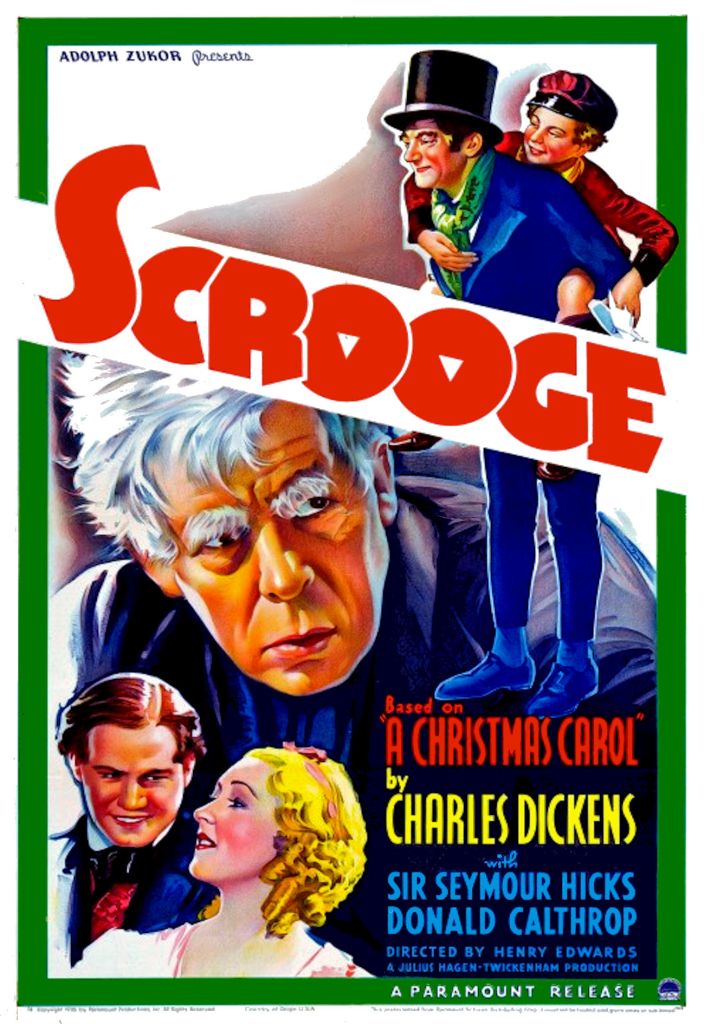
There’s a definite attempt at realism in this version of the story — the band playing in the street outside Scrooge & Marley is just as out of tune as one would have been in real life, I’m sure, and inside the office itself we see that Scrooge’s desk and work look very little different from Bob Cratchit’s, as might well have been the case for someone as dedicated to miserhood as Ebenezer was. The portrayal of Scrooge by Seymour Hicks is much more infirm and physically shaky: he seems both closer to the grave and more frail (and less intimidating) than in a lot of other approaches I’ve seen. But being less imposing doesn’t make him less malicious: to the contrary, this adaptation is a lot more personal in his jabs at Bob, asking him about his family before reminding him of how painful it would be to lose his salary.
We see a little more of a montage after the end of the workday than sometimes appears in a Carol — scenes evoking lots of Christmas energy and spirit, including the Lord Mayor’s Christmas toast to the Queen which I think I’ve never seen in another Carol. Also this version does show us Scrooge eating dinner in a tavern (alone, and dining on a pretty meager feast), which further extends the passage of time before the supernatural invades the plot. I’d say the integration of the supernatural here is, in fact, a bit shaky — Scrooge doesn’t react aloud to the Marley doorknob effect, so that any viewer unfamiliar with the story (there have to be a few of them left in the world, don’t there?) wouldn’t really know what’s up. He’s silent, too, in searching the house, which nevertheless he does do on camera, and slowly — arguably suspense is building for the audience, but to me this dragged a bit. A really fun choice, though, is made in depicting Marley as invisible — Scrooge can see him, but we can’t. So we see Scrooge’s horrified response to a ghost we only hear, and we watch as the camera pans slowly as though following Marley around the room — it’s eerie, and probably a lot more effective at spooking us than whatever practical “ghost” effect they might have tried would be.
Less successful, to me, are the depiction of the three spirits: Christmas Past is neither diminutive nor someone who pulls him to the window, and Christmas Present is neither large nor quite jovial enough, for my taste. (Yet to Come is harder to screw up, and this film’s shadowy depiction was fine, I thought.) It was odd to see a Carol that doesn’t show any of Scrooge as a younger man, but Christmas Past jumps only to him as a middle-aged moneylender, foreclosing on some poor people and enraging his fiancee (Scrooge’s childhood isn’t in EVERY adaptation, but is there another one that, like this film, also skips Fezziwig’s party?). Unfortunately, as I’ll observe at more length below, this takes away a little of the film’s power.
The Christmas Present section is more successful, to me — the Cratchit family antics are joyful and ring true, and I think there’s something novel and plausible here about Bob’s comments to his wife about Tiny Tim (which suggest to me a man who’s just unnerved enough by some of his little son’s words that he worries about him). Let’s face it, Tiny Tim’s a soul so old that any parent might find him a challenge, which this adaptation leans into, making his “God bless us, every one” into less an exuberant cheer and more a wistful hope. The adaptation does manage a nice if brief version of the montage through a lot of nameless folks keeping Christmas in their way, before installing us at Fred’s. The scene just does carry off the explanation of why Fred doesn’t resent Scrooge, but I’m afraid it doesn’t linger long enough to convey the real fun of that gathering, to me.
The Yet to Come sequence, as I mentioned earlier, does a fine job with the shadowy Ghost, but much of the rest of it feels a little off to me. The ragpicker scene is weirdly staged, seemingly due to the director’s conviction that it would be a lot more unsettling (and less dull) than I found it, and we get a glimpse of an unidentified dead body (Scrooge’s, surely) that doesn’t pay off. The Cratchit family scene is as affecting as always, but the graveyard scene that follows is tonally very weird: the music sounds like an action sequence as opposed to a heartbreaking revelation, and Scrooge’s wrestling with the spirit feels both forced and aimless. Also a bit rote is Scrooge’s joy at the finale, though it’s fun to see Hicks transform his Scrooge into someone with a bit more energy. I’d wish for a Christmas Day a little lighter on “business” — there’s too much to-do with how exactly to order and deliver a turkey — and heavier on the emotional journey he’s made, but his connection with Fred and Clara gets there, in the end. And I do love any Carol that leaves in a little of Scrooge having fun at Bob’s expense, so I was pleased to see it here, and Hicks does a fine job as the reformed Scrooge “playing” at being cantankerous. Scrooge joining the Cratchits at church is, I think, another singular element in this adaptation, and it’s where it concludes.
I Know That Face: There’s not a lot of connections to be made here (that I can find), but I think it’s really remarkable that Seymour Hicks, who of course plays the title character here, had somehow also played Ebenezer Scrooge over two decades earlier, in the 1913 short film entitled Scrooge. If I ever do watch a silent film version of A Christmas Carol, maybe that’s the one I should pick.
Spirit of Christmas Carol Present: This section, which celebrates the inclusion of elements from the novella that are often cut out, could be long for any traditional adaptation like this one, but I’ll just note a couple of highlights. I always like Martha Cratchit hiding playfully from her dad, and I think this adaptation pulls off the fun in that scene (and all it implies about Cratchit family fun) really well. And I think the montages were unusually and marvelously inclusive of the story’s smaller details — I’m thinking especially of the Lord Mayor (who, again, is in a single sentence early in the story) toasting Queen Victoria and then, much later, Christmas Present taking Scrooge to a Christmas celebration at a lighthouse (which comprises a slightly longer and lovely scene in the book).
Spirit of Christmas Carol Absent: This section, which denounces foolish exclusions from the original written version of the story, could be equally long here. I’ll just note in particular that the loss of both Scrooge’s boyhood and Fezziwig messes up the story pretty fiercely — Dickens does a fine job in just a couple of scenes to establish that Scrooge is a man profoundly affected by the trauma of his lonely upbringing (and probably a harsh, if not abusive, father), and that he nevertheless once had the capacity to at least enjoy Christmas generosity when it was doled out by someone as relentlessly merry as his master, Fezziwig. The idea that within this withered old miser there’s both a child who can be healed and a reveler ready to dance a jig is hard enough to sustain WITH those two scenes, and it’s basically impossible to envision without having either one.
Christmas Carol Vibes (8.5/10): Any attempt at a “straight” adaptation is going to score pretty high, and I’ll admit, especially when I consider the practical limitations of both sound recording and visual effects in this mid-1930s, I think this really captures the vibe of the book well for big portions of its running time. Sure, I am frustrated with choices in the Christmas Past section (and I think a couple choices in Yet to Come are just weird), but when I think of all the ways this story’s been scrambled and reconfigured and borrowed from, I think this is a solid entry in the long list of Christmas Carol adaptations. That list’s long enough, though, that there’s plenty to be mentioned above this one in terms of connection with the story, too.
Actual Quality (7.5/10): I mean, I’m still trying to cut this film some slack for its era, but I can’t deny — the quality of the print exacerbates the problems with the film’s already murky and sometimes aimless visual language. I’ll talk about the actors below, but I’ll just say that in general there’s good but not great work being done here; the screenplay has some strange omissions (and welcome additions, to be sure), and the direction is really mannered and sometimes much too stiff. It hangs together as a film due to the power of this story, which is so good it’s almost impossible to make something bad out of it, but the seams show throughout.
Scrooge?
Every Carol adaptation depends a lot on its version of Scrooge, so what of this one? Well, Seymour Hicks plays the bitter, warped old man better than the reformed saint, who feels more deranged than human — I fear that Hicks, who by this time had been playing the role on stage for more than thirty years, had just aged to the point that it was tough to have the full range the part really demands. But it’s not a bad performance by any stretch, and you can see the seeds of later performers here without question: some of Hicks’s physical gestures and line readings are very clearly either being borrowed or being given an homage by later actors, and that’s praise of a meaningful kind.
Supporting Cast?
The movie is brief enough and lingers enough in weird moments that only a couple of actors in the cast really get the chance to leave an impression. Robert Cochran’s Fred is pretty successful as a guy you can believe would honestly both invite his awful uncle to dinner and laugh about it when the old goat doesn’t turn up. Donald Calthrop as Bob Cratchit is a little more limited, but there’s a sweetness and a piety to him here that works within this particular adaptation — he’s less timid than some other Cratchit performances, too, so he’s not an outlier in that sense. I do think it’s a bit of a mark against the rest of the cast that they just don’t linger — I really ought to have strong feelings about either Christmas Past or Present, and to have something to say about Tiny Tim, or Mrs. Cratchit, or Marley, all of which are often really memorable turns in other films. I do blame some of this on the screenplay, but only some of it.
Recommended Frequency?
The 1935 film Scrooge is absolutely worth a one time watch, especially if you love A Christmas Carol — it’s laying some groundwork that I do think you’ll see in a lot of later versions, especially with the character of Scrooge himself. But it’s hard to find a good quality version of the film, and even at its full length it feels a bit choppy and hasty — I’d be very surprised if it was anyone’s favorite version of the story. I am willing to think, though, that a couple of its scenes just might be the best versions of those particular moments from the story: if you’re a big enough fan of the tale, this one would be an important element in getting a “completionist” perspective on it.
Finding the original black and white version of this film streaming is a little challenging. Tubi has the shorter, colorized version, as do both Pluto and Plex. (If you don’t know those three free services, by the way, they’re a great source of more obscure and older films — yes, with ad breaks, but they’ve got to pay bills somehow, and you can spend the ad breaks re-reading my review in delighted awe. Okay, or you can just use that time to go down rabbit holes in IMDB; that’s what I’d do, honestly.) Even Amazon Prime has the shortened, colorized version. The only place I found the black and white original cut of the film was on YouTube — for those of you who are fastidious about copyright protection, you can be comforted that, to the best of my knowledge, the movie has fallen into the public domain. You can buy the black and white original on DVD, too, from Amazon, and my hope is that some libraries carry the DVD, but Worldcat is down right now, so I can’t post a link to give you more information about that (I’ll update this whenever I next get the chance).


