How the Grinch Stole Christmas (2000)

Review Essay

We might as well get this out into the open from the outset: I like the 2000 film, How The Grinch Stole Christmas.  That’s a semi-controversial take already: the movie has long had plenty of detractors, and in some circles I’ve seen people make disparaging swipes at movies being “like that Jim Carrey Grinch movie,” as though it was shorthand for a bad holiday flick.  But it may not be THAT controversial—the film’s a perennial holiday showing even now, 25 years (!) after it was released, and I think a lot of people have at least moderately fond memories of it.  What’s probably going to be a little more startling, though, is my argument that, in fact, I love this movie, and I think it might be one of the best holiday movies ever made.  And what will be sacrilege for at least some of you is my argument that it’s a far better film than the 1966 Chuck Jones animated version of Dr. Seuss’s original book, which a couple of generations (mine included) grew up on.  It’s how I feel, though, and however hot the take, I’m going to do my best to persuade you that I’m onto something, anyway, even if you aren’t as taken with this movie as I am.

The basic premise of the Grinch tales in all their manifestations—and I’ll acknowledge up front, I’ve not seen the 2018 animated film or the televised Broadway musical, so I’ll have to leave them for some future blog post—is well known to almost anybody in the American cultural sphere.  Somewhere in the world of Dr. Seuss’s imagination, there’s a town called Whoville, populated by the Whos, a people about whom all we really know is that they celebrate Christmas with enthusiasm.  Neighboring this bucolic village is Mount Crumpit, and on the slopes of that mountain lives a sour, solitary creature called The Grinch, who hates Christmas (and, by extension, Whoville), because his heart is “two sizes too small.”  He eventually gets fed up with the sound of holiday festivities and steals all Christmas accoutrements from the homes of the Whos, before his inevitable change of heart.  It’s a simple story, fit for a children’s picture book, and I think it works just fine as Seussian spectacle (and as a short animated special).  I wasn’t ever really in love with the original, though, I’ll admit: it’s not among my 2-3 favorite Seuss books, and of all the midcentury Christmas specials airing on my family’s TV in my childhood, it was honestly one of the least essential, as far as I was concerned.  There just wasn’t much to the story—the animation was stylish and the voice acting was fun, but that’s about as far as it went.

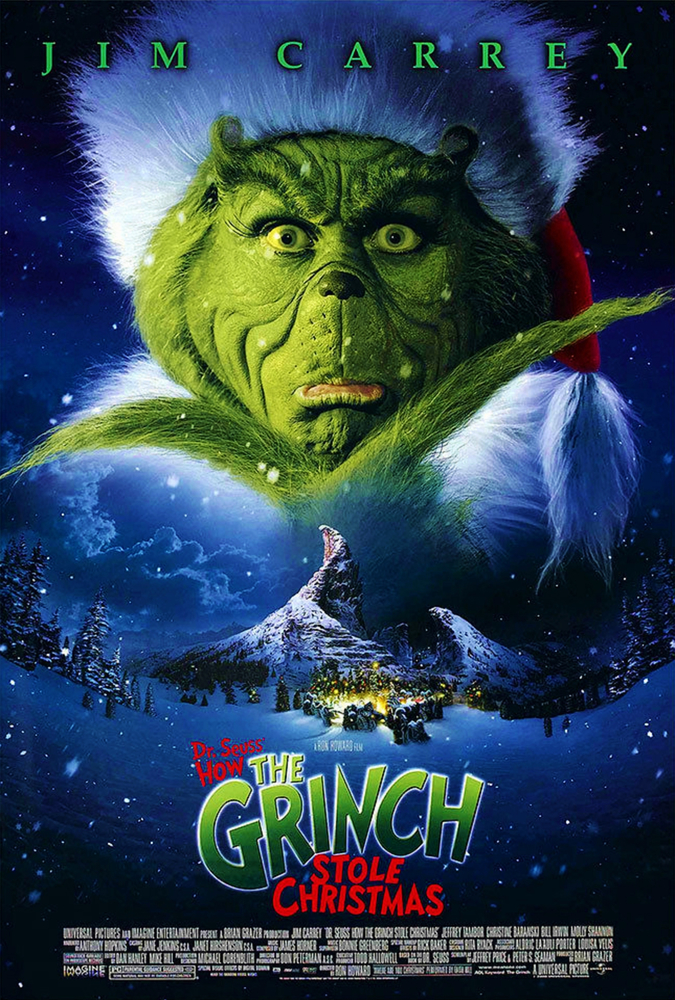
On the poster for How the Grinch Stole Christmas, Jim Carrey in his Grinch makeup (wearing a Santa costume) is staring at the viewer with his hand holding his chin.  Below his image, we see a snowy landscape, with a glowing vilage next to a thin, winding mountain peak, that establishes the scene in which it takes place.

The genius of the 2000 film adaptation, in my opinion, originates in its need to bulk up a very simple story into a feature-length screenplay.  As a result, the movie is forced to grapple with the Grinch as a character—why is he the way he is?  What’s his history with Christmas, or the Whos?  Depth is needed, and the script supplies it.  Furthermore, the only Who with any persistent importance in the story from its original book form (Cindy Lou) has to be given a sense of connection to the Grinch also, and here I think it’s managed really successfully.  The emotional investment she makes in The Grinch builds something powerful into the movie’s final act.  It all matters.

I suspect that one of the reasons the 2000 film takes heat from long-time Grinch fans is that it more or less up-ends the moral landscape of the original story—and in doing so, it puts our society in an unflattering light.  But that’s what I love about it.  The original tale is a simple one: us nice Christmas-observing nuclear families are the good guys, singing our little songs and having our little feasts.  The villain of the piece is the outsider: he does not look like us, he does not celebrate our holiday, and when our innocent celebration has made him angry, he tries to wreck our joy.  The fact that we continue to be happy because we have right-sized hearts convicts him at the last possible moment, so that he can repent and be integrated into the Christmas celebration.  Put it like that, and it doesn’t sound so nice, does it?  No offense to Ted Geisel, but it sounds a lot like the kind of pro-conformity message that he is otherwise famous for undermining in stories like “The Sneetches.”  The 2000 version, on the other hand, rightly understands that to the extent that there’s a plausible villain in this scenario, it’s the people of Whoville: they’re the ones whose material wealth is overflowing while a solitary creature is isolated outside their community, subsisting on their trash.  Their obsession with celebration is so all-consuming that they don’t consider the side effects of it—all the noise, noise, noise, noise!—which would be bad enough if the Grinch was merely someone indifferent to Christmas.  But of course it’s more complicated than that: from his youngest days, his experience of Christmas was isolating.  The holiday celebrated in Whoville demanded a great deal of cultural conformity that was unhealthy—the Grinch is mocked openly for his differences, and ultimately is driven out of town by bullying and ridicule at a young age.  Later, when the sound of the Whobilation’s Yuletide festivities is driving him crazy, the Grinch grabs a hammer to knock himself out with, saying, “Now, to take care of those pesky memories”: he knows that what bothers him here isn’t the noise, it’s the mistreatment that it now represents to him, because of his experience of the Whos.  And of course, most of the people of Whoville aren’t evil (their Mayor being the prime exception to the rule).  They’re just cheerfully complicit in some pretty cruel abuses out of a desire to remain comfortable and untargeted, themselves—they’ll quietly allow a powerful, arrogant blowhard to stand in public at a microphone, abusing outsiders for his own self-aggrandizement and making up passages from The Book of Who to suit his demented purposes while dismissing the one true believer willing to stand up to him in public and insist that the community’s values are actually imperiled.  Yep, if you thought you could escape the politics of 2025 here, I’m afraid I can’t let you.  What an incredibly apt movie for the moment.

And yet, what I think is most impressive about this movie is that the Grinch’s critique of the society bordering him is—for a movie in which Jim Carrey is a huge wisecracking green Yeti, essentially—pretty nuanced.  In a crucial scene, mid-film, The Grinch is given a triggering Christmas “gift” by the Mayor, in front of the whole town: it’s a reminder of the Grinch’s trauma, and the gathering treats it as a chuckle-inducing anecdote.  Remember that day where we made fun of you so badly that you fled into the mountains to live as a hermit….when you were, like, 8 years old?  Kids do the darnedest stuff, don’t they?  (I’m telling you, this film is wiser than it has any right to be about how “good” people do bad things.)  Anyway, you’d expect the guy to blow up in that moment: this is personal, it’s painful, and he could say so.  But he doesn’t confront Whoville until their town’s materialism is the thing on display, because I think on some level, the Grinch understands that that’s the real problem.  A society that’s more focused on the superficial, on presents and costumes and conspicuous consumption, is a society that loses touch with its own heart.  He doesn’t tell them it’s what leads them to hurt an outsider like him.  He doesn’t believe in their capacity to understand that truth, really—he has no faith in the Whos, and they’ve done little to deserve such faith, in any case.  This is what makes the triumph at the end of the story something powerful—it’s not just some mountain gremlin returning everyone’s Christmas ornaments so they can have the party they’d been planning on.  The Grinch comes back to them because they showed him that something he didn’t believe in was real—that this community could learn to find more joy in each other as people (him included) than they ever had in their stacks of Christmas presents.  He apologizes to them for how he’s behaved because they’ve earned his trust on a level he never imagined.

And yes, I know, I’m talking in soaring thematic terms about the ethical messages of a movie primarily intended to give us Jim Carrey making a fool of himself on screen.  Well, look, Jim’s not for everybody (and I don’t feel a ton of affection for some of his wildest comedic performances), but to me putting his manic energy inside this huge green fur suit is a match made in heaven.  My wife and I can (and do) quote half his lines all year long, from “Nice kid…. Baaaaaad judge of character.” to “One man’s toxic sludge is another man’s potpourri!” to “Oh no….I’m speaking in RHYME.”  I can imagine, of course, responding negatively to some of Carrey’s antics, but I just think it works for the character—it lightens what might otherwise be too heavy a story, honestly, to have the Grinch be someone who’s responded to being ostracized by becoming a standup comedian, transmuting his pain into a PG-friendly Don Rickles routine.

The other thing that gives this movie its needed heart is the performance by Taylor Momsen as Cindy Lou Who—sure, the character is earnestness personified, but that’s her dramatic function.  What I appreciate about Cindy Lou, and this only increases with time, is the way she expresses something far more mature than a child performance normally would.  This Cindy Lou is not merely some little kid woken up by the Grinch’s theft, as she is in the original.  She’s someone wrestling with the question of why Christmas doesn’t feel the way it used to—asking herself what the magic was, and where it’s gone.  This is not, I acknowledge, something an elementary schooler would normally feel.  But speaking as a kid who was a melancholy elementary schooler (somewhere I still have the Last Will and Testament I wrote at the age of about nine), it tracks.  More than that, though, what Cindy’s wrestling with is what we all wrestle with, no matter what holidays we do or don’t celebrate: where does our capacity for that childhood sense of wonder and delight go?  Is it just nostalgia for something that never existed and we’re smart enough to see that now, or was it real and we can find it again?  Given all that, it’s a really lovely (and touching) message that Cindy discovers that we can have that holiday happiness again, but only if we get our heads on correctly about what the holiday’s actually about.  We can’t find the joy in ever-increasing material consumption—the joy isn’t there.  It’s in the hearts of people who see and hear each other, of people who not only have the capacity to love but who put that capacity to work.  It’s in a community that, rather than seeing outsiders as threats to their stability, can look at those outsiders through the lens of the values they claim to profess, of welcome and inclusion and care.  THAT’S what can leave us singing “Fahoo, fores; dahoo, dores,” hand in hand with our neighbors.

And I think folks forget what high-quality craft goes into this film—Anthony Hopkins’s narration providing a lovely, lyrical insight into the story.  Incredible production design, from the costuming and makeup worn by the ridiculous Whos to the junkpunk vibes of the Grinch’s “lair” that’s filled with what are apparently his inventions.  A great symphonic score by the always reliable James Horner, and a sentimental song that seems to have stuck around in the Christmas pop canon in “Where Are You, Christmas?”  I think the admittedly larger-than-life presence of Jim Carrey in outlandish makeup slinging one-liners leaves people misremembering that that’s all this film has to offer.  Again, I know mileage varies.  A lot of you won’t get out of the movie what I see here.  But if you love it also, well, I hope I’m helping articulate some of the things that we might both be seeing in this film.

I Know That Face: Molly Shannon, who here plays Betty Lou Who (Cindy Lou’s decoration-obsessed mother), is a veteran of seasonal projects: she’s Tracy in The Santa Clause 2, she plays a fictionalized version of herself in It’s a Very Merry Muppet Christmas Movie, and in 2004’s The Twelve Days of Christmas Eve she plays Angie, a kind of angel who gives the protagonist 12 attempts to get Christmas Eve right (a la Groundhog Day).  But she can’t match the even more holiday-infused track record of Christine Baranski, the Grinch’s love interest here as Martha May Whovier—Christine’s playing Regina in 2020’s Christmas on the Square (a Dolly Parton project), she’s Ruth in A Bad Moms Christmas (a comedy I fear I’ll have to review one of these years), and she’s Lee Bellmont in Recipe for a Perfect Christmas.  Christine also voices Flo in Timothy Tweedle the First Christmas Elf, and she’s Prunella Stickler in Eloise at Christmastime, and of course as a sitcom regular (on Cybill, as Maryann Thorpe) she appears in Christmas episodes, including season 3’s “A Hell of a Christmas.”  I would be remiss if I didn’t take the chance to shine the spotlight on the director’s dad, Rance Howard, who’s Whoville’s “Elderly Timekeeper”—he voices Rudolph in Elf Sparkle and the Special Red Dress, he plays a blind man in Holiday in Your Heart (a LeAnn Rimes vehicle), and back in 1986 he was in his own Dolly Parton project, A Smoky Mountain Christmas, playing Dr. Jennings.  Lastly, we have to tip our cap to Jim Carrey, the Grinch himself, who of course got a much more negative review from me when I reviewed his work as nine different people in Disney’s A Christmas Carol.

That Takes Me Back: The whole village is wired in series, so that a single loosened bulb on the Whoville Christmas Tree turns out the lights all over town.  It reminded me, for a moment, of having to test every single bulb in the lights on the tree in order to figure out what had gone wrong.

I Understood That Reference: Of course, as the Grinch prepares to deploy his plan to steal Christmas, Santa’s been there ahead of him.  In any case, the Grinch is aware of the Rudolph narrative, since he riffs briefly with his dog, Max, about the reindeer’s having saved Christmas.


Holiday Vibes (8/10): Christmas in Whoville obviously both is and is not like Christmas anywhere else: there’s a lot here that “feels holiday” as Cindy Lou’s dad would probably have said, and of course my watching it routinely each December must add to that feeling.  To me, the feast and the presents and the decorations certainly create the right kind of feeling…but even more so, the message of love and our capacity to create community together is just what I want to feel at this time of year, and I’m glad it helps me do this.

Actual Quality (9/10): Look, I know this isn’t a flawless masterpiece—any movie where one of the jokes is getting a sleeping man (however odious) to kiss a dog’s butt is definitely not hoping to win any awards.  But I also think it absolutely deserves a much better reputation: it takes what is, frankly, a reactionary message about insiders and outsiders in the original tale, and transforms it into a much more thoughtful exploration of ostracism and its consequences.  It’s also funny, and sweet, and the whole movie takes place inside of a snowflake, like the one on your sleeve.  It’s great in my book, anyway.

Party Mood-Setter?  It’s absolutely quotable enough to just be rolling in the background while you do other things, and the story’s cultural saturation is so high that a Grinch on the screen probably won’t be too distracting to party-goers, even though it easily could suck people in.

Plucked Heart Strings?  I find some of Cindy Lou’s struggles pretty easy to identify with, but they don’t exactly make me mist up.  It’s an effective emotional arc, but I think you probably won’t need to watch the movie with a tissue box next to you.

Recommended Frequency: I’m not sure how to get through a year without watching this one.  It’s just too deeply ingrained into my memory (and my wife’s).  If you’ve never seen it, or just haven’t in a while, I hope you’ll consider giving it another spin.

This movie is fairly easy to access, though not necessarily for free—you can stream it if you’re a member of Amazon Prime, or Peacock, or Hulu.  You can pay to rent it from most of the usual places too, it looks like.  Barnes and Noble will sell it to you on disc, and around 1,500 libraries have a copy to check out for free, according to Worldcat.

Scrooge (1951)

Review Essay:

Cheers to you, friends, and thanks for sticking around through most of a blog season, at this point.  The end (and Christmas!) is in sight.  It’s the last of this year’s Christmas Carol Sundays at FFTH and I knew from months ago where I wanted to finish up this sequence.  My first year as a holiday movie blogger, I wanted to finish the quartet of Christmas Carol adaptations with my personal favorite of the many I’ve seen (the Muppets), and this year, I wanted to pay homage to the one I grew up on, my mother’s favorite, the 1951 film, Scrooge, starring Alastair Sim.  I hadn’t seen it in many years, but I remembered that in my childhood, whenever it was on television, it was important to my mom to watch it, and my memory was that I’d really liked it.  I added it to the schedule and hoped it would meet my high expectations, and the great news is, I feel like it fully did so.

Every really good adaptation of Dickens’s novella has some kind of thematic hook—a way of reading his story that, both in what they include or exclude from the original tale as well as in what they choose to add to the narrative, shows what the filmmakers believe is central to its message.  The hook for this film is fear, and I think one of the things that surprised me most (in a great way) is how much the exploration of that fear turns out to be a key that unlocks a lot of really interesting elements in characters and scenes I know so well that sometimes it feels a bit silly to keep coming back to new adaptations thinking I’ll find something here.

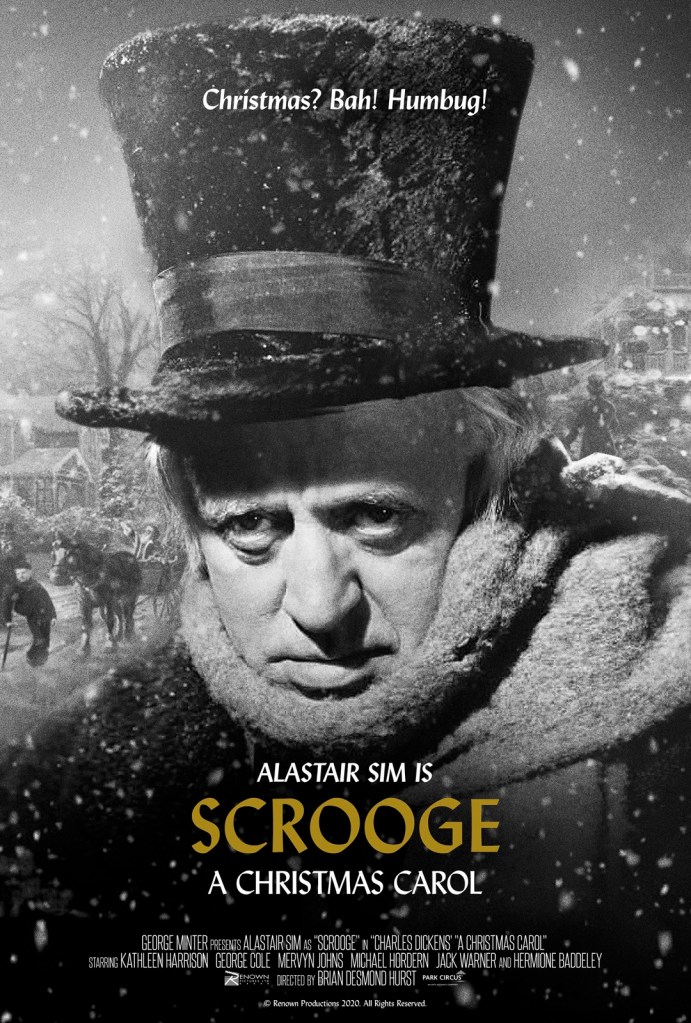
The poster for the 2020 re-release of Scrooge depicts, in black and white, Alastair Sim's haunted face, wrapped up with a thick scarf and set under a large top hat.  Snow is falling around him, and over his shoulder we can glimpse some horses in harness, and the indication of some trees and houses.  The tagline, "Christmas? Bah! Humbug," appears above his head.

For this incredibly faithful rendering of Dickens’s text, the first emergence of fear as a central preoccupation is in Alastair Sim’s magnetic performance as Scrooge.  Where other Scrooges on film tend to push other kinds of emotions forward—anger, for instance, or cruelty, or arrogance—Sim’s old moneylender looks haunted from the moment he appears on screen.  Some of this is just the hand Sim was dealt by time and fate: his huge, hooded eyes (reminiscent in some ways of Peter Lorre’s) are, by the early 1950s, better at expressing that kind of paralyzed anxiety than they would be most other kinds of emotion.  But let’s not sell Sim short: he’s doing a lot of work, too, as a performer to evoke the sense of his fear.  We see him darting away from interactions (startled by the man on the steps of the Exchange, for instance, or quietly but firmly insistent that the child carolers move on from the sidewalk outside his office), and indeed, the one flash of his anger early in the story only emerges in response to the touch of his nephew Fred’s cheerful, welcoming hand on his shoulder.  Scrooge lashes out in response, pounding the desk and shouting, as though it’s that kind of intimate human contact that frightens and upsets him more than anything else in the world.  Other than that, though, the Scrooge we get in these sequences is softer of voice, more restrained than many Scrooges—still a covetous old sinner, to be clear, but it’s apparent that he’s been made the way he is, somehow, by his experience of fear.  He seems baffled by Fred’s happy, impoverished marriage more than he is wrathful about it, as though it’s not possible for him to make sense of a life lived outside of the fear of not having his wealth to protect him, and in one sad moment at dinner on Christmas Eve, we see him retract his request for extra bread with his meal once he realizes it will cost a haypenny.  It’s a reminder that Scrooge’s severity isn’t just for people under his thumb—he’s just as severe with himself.  The miserly impulses of his heart are less a cage he’s trying to trap the poor inside, and more a prison he feels chained within, as well.

Scrooge’s fears are amplified by a number of decisions made by the screenplay that I think add a lot of texture to the story: Ebenezer, in this film, had been the means of his mother’s death as she died in childbirth, and he’d lived a remote and deprived life after his father rejected him.  When his older sister (in this version), Fan, comes to get him from school, he tells her how overjoyed he is to be with her again, and she promises him that he will never be lonely again, “as long as I shall live.”  But of course Fan does not live; she dies bearing Fred as Scrooge’s mother died bearing him.  He opened up his heart once before and lost the one safe harbor in his whole world—no wonder he shrinks from humanity, and from Fred’s kind hand in particular.  Furthermore, we learn over the course of the Christmas Past sequence that Scrooge’s whole life is a kind of haunting: his pinched, chilly office was once the warm, friendly office belonging to Mr. Fezziwig, an office that young Scrooge and his partner Marley basically forced Fezziwig out of, years ago.  Scrooge’s life, too, is lived in a shadow—he inherited Marley’s house and furniture upon Jacob’s death, which means that of COURSE Marley’s haunting him here, this is literally the man’s home, and the bed from which Scrooge rises to see the first two spirits is the bed that Marley died in.  To me, this enriches the film so much: I understand better both why Scrooge doubts the apparitions he at first encounters, and why he comes to believe in them so fully.

The writing, then, is a real strength: I’ll say that, for me, the acting is a slightly more mixed bag.  Sim himself as Scrooge is really wonderful, expressive in almost every scene at a level that engages me.  Some of the supporting cast rise to his level, but others feel a little stiff or amateurish, which probably reflects just the relatively limited budget and simple approach of this small British production in the 1950s.  Maybe the worst of the offenders, for me, is the Ghost of Christmas Past, about whom my complaint really is that he’s forgettable: there’s just not that much personality here on a level that would make his work with Scrooge more memorable.  This fault is amplified slightly by the fact that the movie extends the Christmas Past sequence by quite a bit, adding in scenes to help convey how Scrooge changed over time.  But these are minor complaints: truthfully, the movie committing to a deep exploration of Scrooge’s past is really effective, because it helps me understand how a young clerk who loved the joy of his kindly boss did grow into the walking black hole of this aged Scrooge, towards whom money is drawn and out of whom no good human emotion seems likely to emerge.  And the other side benefit of this long exploration is that it gives the old Scrooge time to make sense of things—he starts to anticipate what each next scene will reveal, and he pleads not to have to face them.  This is true in a lot of adaptations, but I think Sim more than any other Scrooge I’ve seen manages to persuade me that by the time the Past section is done, he’s basically been convinced of what he’s done wrong in life.  The key to Sim’s version of the man, then, is that even knowing he’s done wrong, he’s still not ready to change, and that brings us back around to fear: Scrooge pleads with both Christmas Present and Christmas Yet to Come that he is simply too old, too far gone.  He begs them to leave him in peace as a lost cause and go find “some younger, more promising creature” to transform.  This is a Scrooge whose depression has so chained down his heart that even when he knows he is a bad man, he cannot believe himself capable of good.  And so the Present and Yet to Come sequences become less about punishing Scrooge and more about forcing him to understand that he has ample opportunity to have an impact, right now and before he’s in the cold ground.  It’s marvelously effective.

As a result we get a different vision of the Present than most adaptations supply: we see far more about the whole Cratchit family (and not just Tiny Tim), who really are poised to be helped by a man who can create wealth and opportunity for a bunch of young people on the verge of adulthood.  Our glimpse of Fred’s party skips the guessing game entirely (no need to skewer Scrooge further) in exchange for a longer conversation between the partygoers in which Fred can defend his belief that Ebenezer has the capacity to change, and show up as a guest someday.  Again, that party’s full of exactly the kind of young people Scrooge was once, people who, as I think he must understand, are about to make the same choices he once made, and maybe could live differently than he has.  And most poignantly (here departing again from Dickens), Scrooge’s once-betrothed, here named Alice instead of Belle, is a woman working at one of those poorhouses Ebenezer’s such a big fan of—an angel of mercy to those in desperate need.  I said critically of Scrooged that I thought giving him a love interest to reconnect with was too cheap, because it reduces Scrooge’s reforming to being transactional, something he’s doing to “get the girl”.  So what I love here is that Alice is never mentioned again—we understand, as Ebenezer surely does, that she’s out there.  That a more compassionate, more loving man might even find a bridge of connection to her, in the future.  But there’s no guarantee of this, and I think it’s quite possible he never even sought her out: that he understood that the Spirits’ message was not “hey….guess who’s still single?” but rather “you jerk, the only good thing about the poorhouse is the kindness of people too good to stand in a room with you: it’s time to grow up.”

And then Scrooge’s Christmas Day here is such a moving and happy celebration: Sim, who has played the man’s fear so successfully, can unleash the relief of this unlikely chance to live a better life with incredible joy.  I like the elevation of his servant, the “charlady” as she calls herself, in prominence as a character here, so that he can have an extended dialogue about how he’s feeling and what he’s thinking about, and apply his generosity directly to the woman he’s frightening.  And because this is a story of how a fearful man found the courage to trust other people instead of hiding from them, Scrooge’s arrival at Fred’s house has never hit me with more emotion.  Everything about it, from how gingerly he steps across the threshold to the gentle encouragement he gets from the maid at the door to Fred’s wife getting up to extend her arms to him in welcome, and lead him in a merry little dance, is so fully expressive of the gladness of complete redemption.  Scrooge can change because loving community is possible, and because (to follow the logic of Dickens’s original tale) in Christmas we are given a holiday that asks us to create that kind of welcome for others.  Even if in some ways it feels a little too easy for the old moneylender, in other ways that’s just the dream the story asks us to believe in.  As Scrooge himself comments in nearly the film’s final scene, “I don’t deserve to be happy.  But I can’t help it!”  What better description of grace could there be?

I Know That Face: Kathleen Harrison, who here appears as Scrooge’s charlady servant, is in IMDB’s credits for the 1974 TV movie Charles Dickens’ World of Christmas, but I have no idea what role she played.  Michael Hordern, who portrays Jacob Marley (both living and dead), is the voice of the narrator for the British TV series Paddington Bear, which includes the 1976 episode, “Paddington and the Christmas Shopping”.  Hordern also voices Badger in the 1980s stop-motion animated series The Wind in the Willows which aired several lovely Christmas-themed episodes, and the man wasn’t done with Dickens by a long shot, it seems, since he voices Jacob Marley again in the award-winning animated 1971 film A Christmas Carol (which I will definitely get to on the blog someday), and he appears in live action as Ebenezer Scrooge in a 1977 TV movie A Christmas Carol, one of dozens of such productions that I’ve simply never heard of.  Hordern’s joined in 1971 by Alastair Sim, in fact, who voices Scrooge in that film, reprising his role in this one.  And I learned to my surprise, in digging into this cast, that there’s a crossover I hadn’t spotted with another earlier film this year: Roddy Hughes, who here plays good-natured old Fezziwig, has I think a single line as a chemist dispensing medicine in The Crowded Day.

Spirit of Christmas Carol Present: This is a fairly comprehensive version of the original tale, including a lot of things I love to see.  A couple in particular caught my ear and eye: not many productions leave in the comment by Marley that he’s procured this chance for Scrooge, with Ebenezer replying, “Thank ‘ee, Jacob.”  It’s a sweet note of grace early on.  This is one of the very few adaptations that manage to leave in Scrooge being taken by Christmas Present to a coal mine where the workers are singing carols together (alas, we don’t also get their visit to a lighthouse, as in the original).  And Christmas Present here gives us a brief glimpse of those starving, near-feral children, Ignorance and Want—less unsettling than the Disney version I watched earlier this year, and I think therefore more affecting?

Spirit of Christmas Carol Absent: As I mentioned, we don’t get the guessing game at Fred’s where the company’s meaner to Scrooge than they are earlier in the evening: it’s an unusual cut, but like I noted, I think I get why emotionally the filmmakers wanted something else.  We also don’t get the young couple rejoicing because Scrooge’s death may give them a chance of keeping their home, exchanging that time instead for a very long dialogue scene with “Old Joe” the ragpicker, who’s buying up whatever the dead have left behind.


Christmas Carol Vibes (10/10): The evocation of the original tale, and this time and place, is so effective.  There are adjustments, as any adaptation would have to make, but here they’re so in line with the tone of the novella that I had to double check a couple of these innovations to make sure they weren’t in there and I’d forgotten them.  If you want the feeling of reading the book, this will suit you to a T.

Actual Quality (9.5/10): Thanks to a well-paced screenplay and a really effective performer in the role of Scrooge, this is a nearly perfect film to immerse ourselves in.  Sure, I complained about a couple of semi-flat performances, but really, you hardly notice: the rest of the film keeps chugging along with great skill.  I can’t believe it’s taken me this long to revisit it, since it deserves more attention than I’ve given it.

Scrooge? Sim is tremendously successful at imbuing him with humanity: making Scrooge a fearful person instead of a furious one unlocks a way of understanding him as a victim as well as a villain.  He’s younger than he looks, too—a mere 51 when this was released—and as a result he has the physical energy to be able to really leap about giddily on Christmas morning, enough that we can believe his housekeeper was rattled.  Definitely a top tier performance, and one that is the secret to the movie’s success.

Supporting Cast? This is a slightly more mixed bag—Mervyn Johns is genial but less memorable as Bob Cratchit, and I’d say both the Spirits with speaking lines are just a little underwhelming.  Glyn Dearman does a good job with a Tiny Tim who’s right on the edge of being too perfect for even this heightened fable, though, and Rona Anderson probably gives the best performance I’ve ever seen of Scrooge’s betrothed (with apologies to Meredith Braun, who does such a lovely job as Belle in the Muppet version, but Rona’s been handed more dialogue and more screen time, and that makes a difference).  Also, as I note, we get a lot more “Christmas Past” time here, which means that we see a lot of Marley and Fezziwig we wouldn’t normally (as well as the actor playing a young Ebenezer), and all of that goes really well.  I’d say that this isn’t really the movie’s strength but there’s plenty to enjoy in it.

Recommended Frequency? I haven’t been watching this version every year, given how well I knew it from my childhood, but this viewing made me feel like it really ought to make it into my annual rotation.  Sim is so good at the role, and the emotion of the story hit home for me as a result.

You can watch this film pretty easily, if you like: Tubi has a copy, as does Plex, if you don’t mind the ads.  If you’d rather pay for an ad-free experience, you can rent it from Amazon Prime.  I own a digital copy from Amazon (which I assume is the same version they stream) and I’ll mention that the audio levels are slightly off in some sections: if you notice that kind of thing more than others, I figure it’s best to be forewarned.  The film is available under its alternate title of A Christmas Carol (I wonder where they got that?) on disc at Barnes and Noble, and though it’s not as universally accessible as some films, it’s in several hundred libraries, according to Worldcat, and therefore I hope you can borrow a copy for free that way, if you so desire.

The Lion in Winter (1968)

Review Essay

It has been suggested (not unfairly) by some of this little blog’s faithful readers that I don’t have much sympathy for mean-spirited movies.  My relatively harsh reviews for films like National Lampoon’s Christmas Vacation, Mixed Nuts, and most recently Scrooged do seem to bear that out: I didn’t respond well to the tone of any of those films, which all felt to me like they were dragging me in unwillingly as an audience member to participate in some downward-punching humor.  Well, I didn’t place this film on the slate for this year thinking that it would offer a counterargument: in truth, I’d never seen it, and in my head I had imagined it would provide a little more solemnity, a perhaps slightly stiff historical drama to give some restraint to this final weekend before Christmas and the end of the blog season.  Well, boy, was I wrong…but the fiery, aggressive, and (yes) mean-spirited film I got gave me a lot to delight in.  I’ll see if I can explain why.

The premise of The Lion in Winter (a film adapting a stage play of the same name) consists of complicated family politics unfolding at a difficult Christmas gathering…only, unlike most films of this kind, the gathering occurs in a medieval castle (Chinon, in what is now France, for the Christmas feast in 1183), and the family’s internal politics govern the control of most of Western Europe.  The family in question is that of Henry II, one of the Plantagenet kings of England, who by might and savvy and deft diplomacy had maneuvered himself to such heights that by this Christmas, he styles himself the Angevin Emperor: at the age of 50, he is a man who knows that his time grows short, and his legacy needs to be provided for.  “I’ve built an empire,” he says early on, “and I must know that it is going to last.”  Now that his eldest son is dead, he’s left with three potential heirs, and he invites all of them (Richard, Geoffrey, and John) to Chinon for the feast, knowing each of them thinks they can plot their way to the crown as his successor.  Invited, too, is the boys’ mother, Henry’s rich and powerful queen Eleanor of Aquitaine, whom he has kept imprisoned in Salisbury Tower for many years now as he’s followed his heart in pursuit of other women: Eleanor may be here as a temporarily paroled prisoner, but she is still Henry’s equal as a politician and a schemer.  Henry will, of course, have his mistress there, too: young Alais is her own complication, since she’s formally betrothed to Richard, but Henry has no intention of giving her up.  Alais’s half-brother, though, the teenage King of France, Philip, will be at this gathering also, and he intends to force the matter of her marriage or else demand her dowry back from Henry.  And you thought your family’s Christmas dinner conversations took place on thin ice, eh?

You might think, upon reading this still-insufficiently-detailed summary, that this will be far too complicated a web to make sense of as a viewer (especially if you’re not really up on your 12th Century politics) and that could be true for some, I’m sure.  But I think the film works far better than you’d expect for a couple of key reasons, and the first is the strength of the acting.  When you put Henry II and Eleanor of Aquitaine in the hands of Peter O’Toole (then at the height of his powers as an energetic British leading man) and Katharine Hepburn (nearing the end of her dominance as a midcentury actress, but still capable of enormous screen presence at any moment, as proven when she wins her fourth Academy Award for this role), you give the audience a real gift: even when we can’t follow every detail of every double-cross, the sound and fury of these characters bears us along with the plot like a boat adrift in a flooding river.  Add in a brilliant supporting cast—maybe none of them more scintillating than a young Anthony Hopkins as the brash juggernaut, Richard, whom we know best by his nickname, “the Lionheart”—and almost any dialogue would ring out like dueling swords.

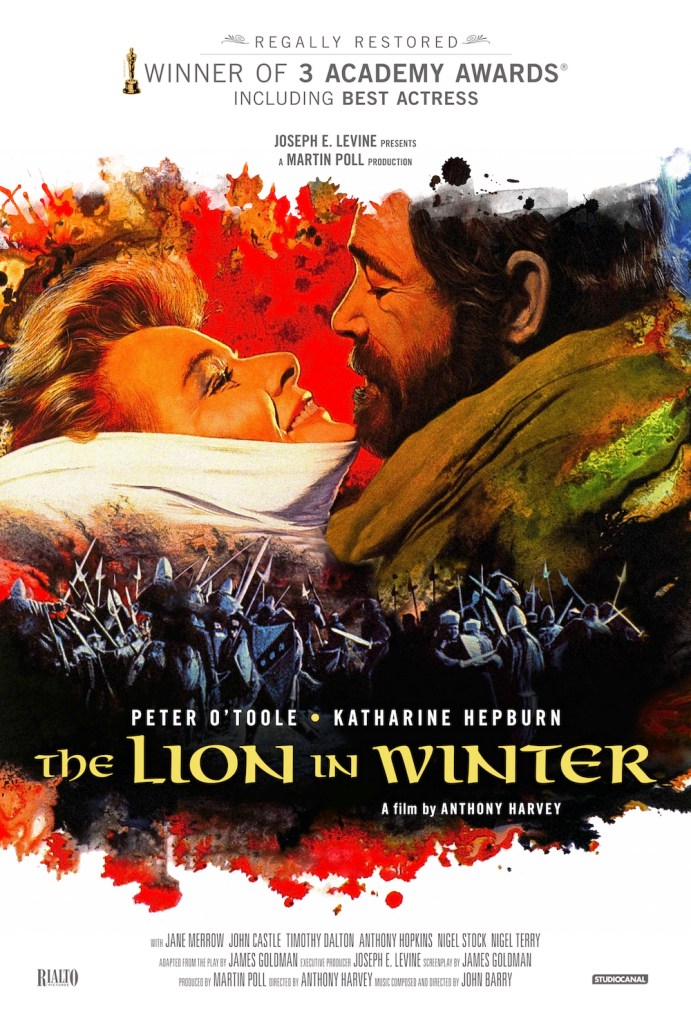
The poster for The Lion in Winter depicts Katharine Hepburn, clutched closely to himself by a bearded Peter O'Toole: she looks up at him beaming a smile that could be sweet delight or poisonous malice, while he narrows his eyes looking down at her, whether in love or in contempt.  Below them, we see the painted image of two medieval armies in pitched battle, and behind the couple and this battle, the poster is splotched abstractly with a red paint that suggests blood.

It’s not just “any” dialogue, though: the screenplay (also Academy Award winning) is full of the most poetically intense exchanges, written for the heightened surreality of the theatrical stage, so much so that on film it borders on camp (and might topple over the edge into ridiculousness in the hands of any less gifted cast).  I wrote down dozens of quotations as I watched, and will share examples to give you a taste of what I mean: at one point, Richard, goaded into fury by his whinging little brother John (who grows up into the tyrannical King John of the Robin Hood legends), whips out a dagger and chases John around Eleanor’s bedroom, seemingly intent on murdering his brother then and there.  John screams out to his mother for help, exclaiming in apparent shock that Richard’s got a knife, to which his mother exasperatedly flings back, “of course he has a knife; he’s always got a knife: we ALL have knives!  It’s 1183, and we’re barbarians!”  At another moment, Eleanor’s reminiscing about her first husband, King Louis VII of France, and how she accompanied him on crusade—she recalls, “I dressed my maids as Amazons and rode bare-breasted halfway to Damascus. Louis had a seizure, and I damn near died of windburn… but the troops were dazzled.”  Did I say it “borders on camp”?  Maybe I should correct that: it takes place deep inside camp’s territory.  The writing’s not just fireworks, though: sometimes there’s a quiet weight in it that reveals a character’s inner wisdom.  Henry, at one point, defends his latest conniving by saying, “I’ve snapped and plotted all my life. There’s no other way to be alive, king, and fifty all at once.”  Later, in a crisis, when Richard insists that whatever comes he won’t drop to his knees and beg, Geoffrey mocks his brother, saying, “You chivalric fool… as if the way one fell down mattered.”  And Richard eyes Geoffrey, as if from a height his brother cannot touch, and replies, “When the fall is all there is, it matters.”

How is it that I can laugh at the soap opera of this maddening family, and a Christmas gathering in which the vast majority of the words flung between them are harsh, or cruel, or insincere, or condescending, or deceitful….and often more than one of those at a time?  Again, I think the strength of the acting and the writing help: the worst insults carry the humor a little better when they’re delivered through really high art, I suspect.  But I think it’s also that these people and their problems are so remote from me and mine: I can comprehend (after having played enough hours of Crusader Kings 3) a world in which people have these problems, betrothals lasting decades because they’re complicated feudal land arrangements, and marriages that are annulled decades after the fact but only if you effectively own the Pope, but that’s not the kind of thing I have to maneuver while eating Christmas dinner.  Moreover, every single character on screen is just that—they are self-consciously characters.  Eleanor and Henry are playing roles, roles that change at a moment’s notice depending on who’s in the room and what they want, and these children raised by them (Alais included) have learned to play the game too or else have learned how to benefit from it.  Almost none of these words draw blood because the combatants are too scarred from decades of dueling, and everyone knows that this morning’s enemy may be your ally (or at least the mutual enemy of a more dangerous foe) by day’s end.  Every bridge still up between these people was built for the sake of burning.  If you watch this film, you’ll hear people saying some of the worst things they can think of—Eleanor and Henry, in particular, are gifted at this—and only you can know if that’s the kind of thing you can let yourself enjoy as a spectacle.  I found that, more often than not, I could, and did.

I like, too, the way the movie gives us just enough to keep these characters straight: the three princes, for instance, are all introduced to us while fighting, in three quick, nearly wordless scenes.  The economy of it from a screenwriting perspective is impressive.  John (“Johnny” as Henry calls him) is dueling his indulgent father, who easily bests this teenager who seems to have no plan at all in life but to swing wildly, trusting that his father won’t hurt him really.  Richard, on the other hand, we see at a joust, effortlessly tossing his opponent to the ground like Marshawn Lynch in Beast Mode, and then moving with a swift and apparent ruthless purpose to take his life before something interrupts: we perceive that Richard is a man of action, a fellow who likes to run directly ahead and trust his strength to carry him through obstacles.  Geoffrey, then, we see perched high above a beach where his men are stationed secretly: he is never in any danger, and with a few swift hand signals to knights waiting below, he springs a trap he’d clearly set long in advance.  He is cold and cunning, a strategist who if given time can get an advantage on his opponent, and who will never ever expose himself to risk.  We’re only a handful of minutes in and we can already see the ways this family will find themselves at each other’s throats, with a kingdom up for grabs.  As Henry himself later comments, “they may snap at me, and plot… and that makes them the kind of sons I want.”  He loves the battles he fights with these young men, and he looks forward to them with a relish that suggests the energy of this conflict is what keeps him young, himself.

I know I haven’t touched on the holiday elements of the film much, but to be honest, despite the feast of Christmas being the ostensible reason for them all to be here (especially King Philip of France, and Henry’s prisoner queen, Eleanor), it comes up very little.  It provides a context for some good japes—”What shall we hang, the holly, or each other?” made me laugh—and there are moments when both Henry and Eleanor make reference to religion, and sometimes even elements of Christmas itself, to clarify something about their purpose, but they’re momentary flashes at most.  This is a story about power: “power is the only fact,” says Henry, though as the movie unfolds, we learn that there are other “facts” besides power that Henry struggles to understand.  Among them is love, though it’s love in a lot of guises, few of them deeply sentimental.  Eleanor’s seemingly deep attachment to Henry (much like his own strange, strained attachment to both Eleanor and Alais) is hard to parse: how much of it is performed for the sake of getting what she (or he) wants, and how much of it is honest?  How real are Alais’s feelings, either—the girl seems passionate, but is it a passion for the crown, for the chance to bear sons to a king, or is it love for that aging king, himself?  Surprisingly, maybe the sincerest expression of love we see in the whole film is an expression of same-sex affection: Richard the Lionheart, we learn in a couple of key scenes, is a man who loves another man, and as Richard is maybe the least subtle or deceitful of all the people in Chinon Castle this Christmas, I found it hard to interpret the things he says as being anything less than true, often painful feeling.  For 1968, it was genuinely unexpected to encounter a gay character on screen, not to mention a character who in every other way seems to avoid the kind of stereotypes that would have then been commonly believed about gay men.

I could keep talking about this film for a long while—there are so many splashy scenes to comment on, so many lines of deliciously wicked repartee to quote—but I doubt that really serves you as a reader.  If by now I’ve persuaded you to try the film, you’ll get more fun out of these things happening without my advance notice, and if you’re pretty sure it’s not for you, you should probably not be subjected further to my secondhand version.  It’s probably just as polarizing a film as A Christmas Tale, which I wrote about earlier this year—shockingly similar, in fact, since in this film as in that French arthouse picture, we get a son asking his mother why she doesn’t love him, and we get to hear her complicated answer—but it’s just that somehow in this situation I “get” the film, in a way that I never “got” the other one.  It’s not that this film is historically accurate, to be clear: none of this happened.  These people existed, in one form or another, and they were almost certainly all schemers and plotters who played politics with each others’ lives, but they didn’t have a Christmas at Chinon Castle, in 1183 or at any other time.  The resolution we get from the film’s final act is a resolution that deepens our understanding of these characters, but it’s not giving us much sense of what would happen next in a tumultuous era in medieval history.  The truths that The Lion in Winter has to tell are truths about people, and the ways we lie to ourselves and each other to get what we think we want.

I Know That Face: Peter O’Toole, here the larger-than-life Henry II, appears later in his career as an elderly artist mentor named Glen in Thomas Kinkade’s Christmas Cottage, and lends his voice to Pantaloon, a toy soldier general, in 1990’s animated film, The Nutcracker Prince.  John Castle, who in this film portrays the cold, scheming Prince Geoffrey, shows up in 2013 in one episode of the TV series A Ghost Story for Christmas as John Eldred.  Nigel Stock, Henry II’s loyal servant William Marshal, plays Dr. Watson in a 1968 British TV episode of a Sherlock Holmes series, “The Blue Carbuncle,” which is the Holmes mystery set at Christmas (Star Wars fans may enjoy that Peter Cushing, Grand Moff Tarkin, plays the great detective in this episode).  Anthony Hopkins, an electric presence in this early career-making role as Richard the Lionheart, at nearly the end of his career turns up as an aging and violent king—King Herod the Great—in the 2024 television movie Mary.  He’s also an often-forgotten presence as the unseen narrator in the Jim Carrey How the Grinch Stole Christmas, which I’ll review here in the final days of this blog season.  And of course blog readers will need little reminder of Katharine Hepburn’s other holiday performances, but in case you do, here she is obviously the Eleanor of Aquitaine, the most skillful of schemers, but we’ve seen her recently as Bunny Watson in 1957’s Desk Set, and as I remarked at the time, she also appears as Cornelia Beaumont in the 1994 TV movie One Christmas, which I kind of doubt will make it to FFTH anytime soon, and as Jo March in 1933’s Little Women, which I think stands a slightly better chance (though it’s undeniably less of a “holiday movie” per se).

That Takes Me Back: Haha, despite the jokes sometimes told by young people about my advancing age, no, I am not nostalgic for the High Middle Ages.  I mean…given my personality, I suppose I kind of am.  But I don’t have anything here I can point at, saying, “can you believe they’re chanting in plainsong, haha, remember the days before polyphonic harmony?”

I Understood That Reference: At one point, Eleanor slips into Alais’s room and hears her singing a carol—she praises the young woman’s singing as the only thing that keeps the castle from feeling “like Lent”, and goes on to comment that, growing up, she was so conscious of the earthly king’s power (as opposed to God’s) that when she was little she was never sure if Christmas was the birthday of the King of Heaven or of her Uncle Raymond.  Shortly thereafter, Henry steps back inside the castle, having stood outside on the ramparts for a while and looked up at the great sea of stars in the night sky, and comments, “What eyes the wise men must have had, to see a new one in so many?  I wonder, were there fewer stars then?  It is a mystery.”


Holiday Vibes (2.5/10): As I mention above, we know it’s Christmas, but very little celebration occurs: I’d expected a Christmas mass or a big feast, but the events of the story either skip or preclude such gatherings, and as a result, though we do see wrapped presents and hear a little talk of the holiday, it’s not much at all to go on.

Actual Quality (8.5/10): This is a big, loud, well-acted and well-written royal soap opera.  It’s probably about the best version of such a thing I can imagine, but it’s also not really high art.  I found a lot of it fun, some of it confusing, and at least a few moments were pretty uncomfortable—especially when characters find ways to hurt one another that really do cut to the bone.  I mostly loved the fireworks, though, and honestly, so do these characters.  Eleanor and Henry are like bitter athletic rivals, who at the end of their careers can take some delight not just from their own remaining talent but from seeing it still burning in their ancient foe: game does not always respect game, maybe, but here, these competitors are happier when they’re getting as well as they give, for the sake of the sport.

Party Mood-Setter?  It’s either too complicated to follow or too involving to watch: I don’t think I could leave it on the background of a gathering, though I guess maybe I could be decorating Christmas cookies while laughing at the banter between these spoiled princes and their seasoned warrior parents.

Plucked Heart Strings?  Not even Eleanor herself, I think, has any idea how many of her tears are real, if any, and though Alais is badly treated by Henry, in time we see her true colors as a schemer, too.  Maybe a person with a very particular romantic history could find themselves leaning in and feeling Eleanor’s attachment to Henry in spite of it all, but it doesn’t resonate for me.  If I can feel it in any part of the film, I think it is in Richard, and what little we are shown of a love he knows must remain a secret.

Recommended Frequency: It’s a lot of fun, but there’s so little Christmas content here that I really think this is best left for whatever time of year you feel like picking it up, especially because it’s not just that we’re missing much in the way of references to the holiday, but because I feel like most of the thematic content runs counter to the best holiday narratives we’ve got to work with.  It’s just out of step with the season, I feel like, though if you feel like trying it out once to see if a wintry medieval castle is close enough to the holiday spirit for you, I don’t think there’s any harm in it.

There doesn’t seem to be any free streaming option for watching The Lion in Winter, but you can rent it from all of the usual streaming services, it appears: pick your favorite.  Or, of course, you can get it on disc: Barnes and Noble would be happy to sell you a copy, obviously.  The easiest approach, though, might just be to trust your local public library—Worldcat promises that over two thousand libraries have a copy of this on the shelves, and my guess is that of all the “holiday” movies I review here, this one might not be in quite as high demand at this time of year.  If ever you watch it, I hope you can get the entertainment out of it that I was able to find.

Last Christmas (2019)

Review Essay

One of the American authors who has written the most widely in connection with Christmas is the science fiction grandmaster Connie Willis, one of the most award-winning writers of her generation and a personal favorite of mine.  Connie’s a big reason this blog exists, in fact, but I won’t distract myself down that road in this post, anyway.  The reason I’m bringing her up in connection with Last Christmas is enough of a story.  I had the good fortune to get to speak with Connie this August, after having “won” the opportunity in a fund-raiser: she was a delightful and effusive conversationalist, and happily engaged with my questions on a variety of subjects.  One of them, naturally, was the subject of “the real Christmas movie,” as Connie referred to it: I asked her what she looks for in a great holiday film, and she said a lot of wise and thought-provoking things.  One of her observations was about the holiday romantic comedy: she thought that a lot of modern holiday rom-coms seem to approach the subject matter thinking that the point of the movie is to find someone to love, whereas what distinguishes a great romantic comedy is that the journey is about self-discovery.  You find your true self through the encounter with the person you love…whether or not you even get them in the end, in fact, since it’s finding yourself that matters.  And, in addition to a number of great older classic films she encouraged me to watch, she suggested that Last Christmas was really a good modern example of exactly the kind of self-discovery she was talking about, so I put it on this year’s slate.  (To be clear, I am obviously paraphrasing here from my memories of our conversation: I may well not be capturing Connie’s message perfectly, though I certainly felt I learned a lot from the talk!)

Maybe the most immediately interesting element in Last Christmas is how completely and disastrously self-sabotaging the main character, Kate, is: she lost her last living arrangement and is so desperate to find a new one that doesn’t involve slinking home to her immigrant family (who emigrated from the former Yugoslavia to London in the late 1990s) that she’s throwing herself into ill-advised one night stands and making selfish demands of the few remaining friends who will pick up the phone when she calls.  She’s a terrible employee at a Christmas shop run by a long-suffering Chinese woman Kate calls “Santa”, and she’s perhaps doing an even worse job of trying to make it in musical theater, running late and unprepared into the rare auditions she figures out how to get to at all.  Kate’s a hot mess…but let’s give it to her, she’s a self-aware hot mess, exclaiming out loud after one of her early failures, “why is my life so shit?”  Well, let’s give it to her that she’s aware things are not going well—how aware she is of the ways she’s contributing to the problems is a little less clear, at least at first.

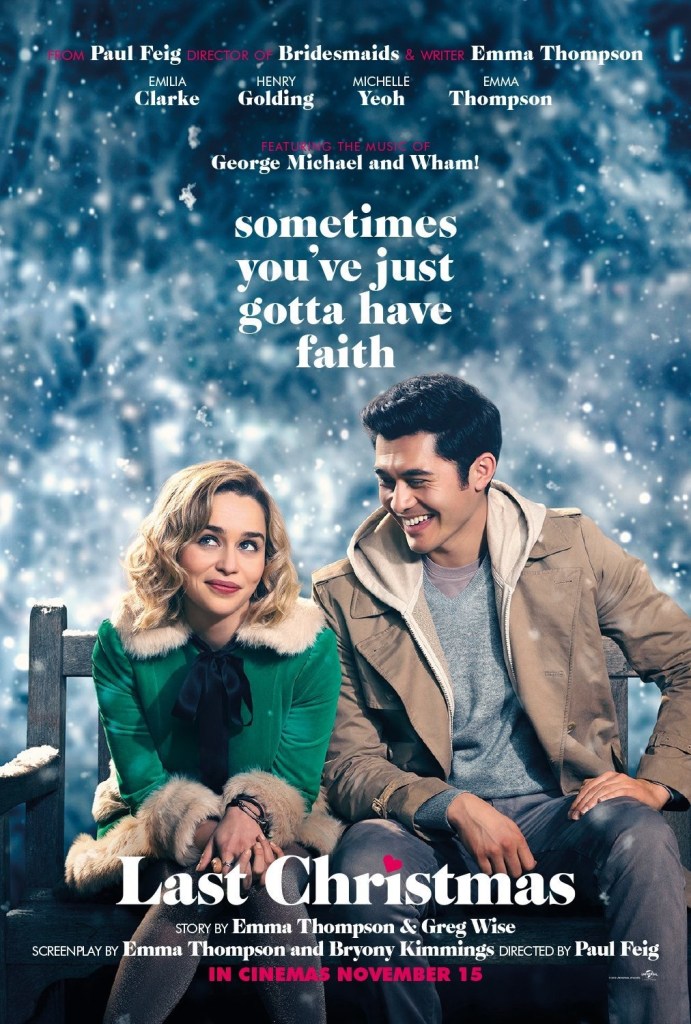
The poster for Last Christmas depicts Emilia Clarke in her elf costume, sitting on an outdoor park bench and smiling next to a grinning Henry Golding: the background is an out-of-focus snowy forest, it looks like.  Above their heads floats the movie's tagline: "sometimes you've just gotta have faith"

The romance in this romantic comedy comes along eventually, though, in the shape of a nice young fellow named Tom who keeps running into her.  Sure, in some ways, he’s a little too good to be true, since he always seems to know some lovely secret alley to stroll down, he appears to spend all his free time volunteering for the homeless, and he is patient and cheerful in the face of all of Kate’s frustrated exasperation with the world around him and sometimes with him, himself.  He sees something in her that she hasn’t figured out yet how to see in herself.  And though it’s not totally clear how this is working, contact with Tom seems to bring a little needed stability into Kate’s life.  She relents and finally goes to visit her impossible mother, Petra, who insists on accompanying Kate to a doctor’s appointment she clearly would rather skip: while there, we see the two women for who they are, confident and unyielding ladies who know everything in the world other than the woman sitting next to them.  There’s a weight on Kate, who seems to resent how much she already owes everyone in her life, how fragile she feels when she looks backwards and sees only the life of a first-generation immigrant kid on whom her parents placed too much pressure, not to mention the survivor of a serious medical emergency on whom now there’s even more pressure to eat right and live healthy in order to keep herself out of the hospital again.

One of the reasons all of this works is just a tremendously gifted cast of actresses: Emilia Clarke as Kate is maybe not quite up to the level of the supporting cast in talent, but this role seems to be right in her wheelhouse, playing the charisma someone this calamitous would have to have in order to survive, but also the woundedness that would live underneath that charisma.  She can’t quite rise to the level of a Barbara Stanwyck in Remember the Night, for me, but that’s a high bar to clear and Clarke’s getting close.  And the folks around her are justly famous: the always-brilliant Emma Thompson inhabits the role of Petra with the baffled dignity of a woman who intends only to understand enough of her new country and the new century to just get by.  Michelle Yeoh is frankly too much talent for the supporting role of “Santa” but all that means is that the store subplot, which would probably otherwise feel undercooked, actually carries a little dramatic weight…especially once we add in the explosively bold Patti LuPone as Joyce, a difficult-to-satisfy customer.  It would be hard to put these four women on the screen and not get something worth watching out of it.  And another key element here is just what Connie pointed out to me in recommending the film: if this was just a movie about Kate falling for Tom, it would be too slight to matter.  The fact that it’s about Kate as a holistic person—coming to terms with the damage she’s done, trying to rebuild a few bridges she’s burned, learning to find joy in places she wouldn’t have looked for it before—makes the Tom and Kate scenes sing a lot more sweetly.

I mentioned singing just now and of course you might expect this to be a musical, since it’s a film named for the Wham! holiday pop song, after all, and Kate’s interested in musical theater, and also we’ve got Patti LuPone, a Broadway and West End legend, in the cast.  I think it’s to the movie’s benefit that it doesn’t try to force that onto itself: music matters here, of course, and we do get some musical performances scattered throughout.  We also get a lot of George Michael / Wham! on the soundtrack, so much so that it can feel a little like a non-diegetic jukebox musical, and I’d say that it both doesn’t really work and it doesn’t hurt the film too much: again, luckily the movie isn’t forcing it too hard, and therefore the songs don’t always fit the story, but I prefer those slight mismatches to a situation where they’re twisting the plot around to try to hit a couple more song lyrics.  And it’s hard to complain about a movie dropping a lot of George Michael at me as an audience member, since that man knew his way around a pop song, and when the connection’s there, it really does enhance the experience.

One of the things I appreciated most about the film was its modest aims: for all that the screenplay starts us with a woman whose mistakes and faults are comically exaggerated, from then on, I thought it took an increasingly realistic tack.  Kate’s going to change herself, but it’s slow.  She makes the kind of amends a real person who’s made these mistakes might be able to make.  In one key conversation, in which she confesses to Tom that she’s “a mess”, he tells her to focus on the everyday, because every little action in our day makes or unmakes character.  And we start to see those dominos fall, as Kate seizes the little opportunities.  There are times when the situations that arise (or the dialogue exchanges within them) felt slightly cringey, but romantic comedies are always at risk of that kind of awkwardness.  It’s not a deep flaw of the film that at times it’s susceptible.

And while maybe you’ll see this movie’s ending coming, I didn’t.  I thought I understood where we were going and I was expecting to be happy about it.  But the layers that are applied near the end of the film really help me reconsider what the film’s ultimate message is, about what it means to reckon with who we are (and how complicated it is to answer the question “who am I?” honestly).  There are some genuinely moving moments as Kate takes hold of the understanding she’s being given, and we get more politics than I think I was expecting, as one of the things she really comes to terms with is her identity (and her family’s) as Croatian immigrants to the UK.  The true self she discovers is a beautiful one, one that is loving and therefore so easy to love.

I Know That Face: Margaret Clunie, a woman named Sarah who accidentally discovers Kate taking a shower after an overnight fling with (it turns out) Sarah’s boyfriend, also appears as Sherry in 2015’s Christmas Eve, a film about New Yorkers trapped in elevators on Christmas Eve in a power outage.  Margaret’s clearly typecast as someone having a bad holiday season, I guess?  Emilia Clarke, this movie’s star, of course, as Kate, recently voiced the Queen of Hearts for the animated TV movie, The Night Before Christmas in Wonderland.  The always funny Sue Perkins, who pops up here in a cameo as the director of an ice show Kate’s auditioning for, is of course best known to Americans as a host/presenter on The Great British Baking Show, including the two-part Christmas special that first aired in 2017.  And you likely don’t need the reminder that Emma Thompson, this movie’s difficult and overbearing immigrant mother, Petra, is no stranger to holiday fare: she plays Karen, a woman confronting infidelity while trying to manage parenting two children, in Love Actually, which this blog will someday cover, and she’s the uncredited narrator of a very short film based on the book Mog’s Christmas Calamity (a “short film” that was really mostly an advertisement for Sainsbury’s), which I highly doubt I will get to if I run this blog for twenty years, but I hope they paid her well..

That Takes Me Back: I don’t know that I was taken back anywhere—this is so close to the present.

I Understood That Reference: They say “Santa” all the time, of course, given that Kate treats the moniker as though it’s her boss’s real name, and the screenplay makes a ton of elf jokes, but they don’t deal too much in the Santa mythology, really.  That’s about all the film wants to do with any pre-existing Christmas texts, that I noticed.


Holiday Vibes (8.5/10): We don’t just have a Christmas setting (and many different versions of a classic modern Christmas pop song), but we have a main character who literally works in a seasonal retail environment.  Add in reluctantly reconnecting with family and some preparations for a big Christmas celebration, and we get I think a very Christmassy rom-com, and one that will please a lot of viewers.

Actual Quality (9/10): I think folks are going to be pleased by the quality of the film, too: if the romance seems a little too pat initially (Tom’s almost a Manic Pixie Dream Boy), just hang in there.  Trust me, it gets more complicated in time.  Honestly, with really good performances and a script that manages to spin a few plates at once because they feed into each other (rather than the more disjointed modern rom-coms I’ve tried lately), I found myself happily settling in for this one.  It delivers what a movie like this promises us, for the most part, which is a rare enough gift that it’s worth celebrating.

Party Mood-Setter?  It’s a great fit for cookie baking, I think, or a party where you don’t have anybody innocent enough to be scandalized by Kate jumping in and out of bed with all sorts of men, in the early going.  The extensive George Michael and George Michael cover soundtrack works to its advantage in this context, too, since you can hum along as you decorate.

Plucked Heart Strings?  I really wasn’t expecting this film to hit me, but it does succeed, maybe a little like the Remember the Night experience I allude to in the review above: watching a character’s tough exterior (whether Stanwyck or Clarke) slowly lower to reveal what their real pain is, and accept the possibility of love, is really powerful.

Recommended Frequency:  I wouldn’t say this was a home run for me, a film I’ll want every year.  But the leads are incredibly charismatic and the message of it is heartwarming enough that I think it would be welcome almost anytime I encountered it at the holidays: I’m sure I’ll return to it at least once every couple of years, if not more often.

If you’d like to try it out also, Netflix has it waiting for you: you can also rent it on streaming from basically all the places you’d think to look.  Barnes and Noble will sell you a hard copy, but if you’re thinking of snagging it for free at the local library, Worldcat suggests you have almost 1,400 options.  Happy viewing to you!

A Midnight Clear (1992)

Review Essay

It’s in some ways remarkable how powerfully the World War II experience looms over American Christmas movies.  Just in the last two years, this blog has run the gamut of possible intersections—the war is the context for Christmas in Connecticut even though it’s not being commented on, and the legacy of the war haunts Dan Grudge in Carol for Another Christmas.  The war is a locus for slightly premature holiday celebration for Wallace and Davis in White Christmas, and a distant field of glory from which George Bailey’s brother Harry makes his heroic return in It’s A Wonderful Life.  It is a system that subjects men to torture in Merry Christmas, Mr. Lawrence, and it creates the post-conflict hardships that the veterans band together to overcome in It Happened on Fifth Avenue.  I came to A Midnight Clear thinking that I basically understood what I might get from a WWII Christmas movie.  I was wrong.  This movie surprised me, and then devastated me.  It is an incredibly powerful anti-war film, and it’s also a holiday film, and I’m not going to forget it, and I’m not totally sure when I’ll be ready to see it again.  It earns its place in the FFTH canon.

A Midnight Clear doesn’t waste any time—the opening sequence establishes us in the Ardennes in December 1944, and suddenly we follow the sound of a howling scream to find an American soldier bursting out of his snowy foxhole to run heedlessly through the forest, stripping himself naked as he stumbles between the trees, chased by his panicked comrade who is trying desperately to corral him.  We come to learn that these are members of The Squad, an intelligence and reconnaissance platoon formed of the soldiers from various outfits who had each scored at the top of their unit on IQ tests.  The Squad, as we meet them, has lost half its strength in brutally violent combat, and the surviving six men are all, in various ways, already broken by their experience of the conflict, not least among them Vance Wilkins, the man we just saw crumbling before our eyes as he fled through the Alsatian woods.  Even so, in some ways none of them have yet seen the worst of war’s horrors.

The DVD cover for A Midnight Clear depicts six weary soldiers in full combat gear, standing in a snowy, wooded place, all facing the camera somewhat defiantly.  Beneath them, two critic quotes are given: Richard Schickel of Time Magazine calls it a movie to seek out and treasure, and Siskel & Ebert give it their patented two thumbs up.

We learn, partially through retrospective voiceover narration, the ways in which the Squad has tried to insulate itself from what’s going on around them.  The guys call Vance Wilkins “Mother” for the ways he, a practically elderly 26 year old, tries to protect them all, and Paul Mundy, a fellow who dropped out of training for the priesthood, they call “Father”—Father and Mother have certain expectations, among them the avoidance of profanity, and the rest of the unit tries to live up to them.  As our primary POV character, William Knott, observes to us via narration, “we want to make it clear we’re not actually a part of this army.”  Knot is the Squad’s formal leader, the recent recipient of a battlefield promotion to Sergeant, but between his certainty that Mel Avakian’s a better soldier than him and his respect for the moral leadership of Father and Mother, Knot seems totally incapable of wielding the office, and hasn’t even bothered yet to sew the stripes onto his uniform.  The guys have figured out his name, abbreviated, is “Will Knott” and have taken to affectionately calling him “Won’t”.  In a sense, that’s what all of them—the four I’ve named, plus Bud Miller (“mechanical genius and resident wit”) and Stan Shutzer (“our avenging Jewish angel”)—are trying to say to the war.  They won’t.  But this isn’t a kooky countercultural comedy about opting out of being a soldier: these aren’t Kelly’s Heroes.  The Squad is simply a group of men too conscious of themselves and the world around them to go to battle calmly, and when they’re ordered to do so, the emotional and psychological consequences are profound.

The cast of this strangely forgotten 1990s film is almost a who’s who of gifted young character actors—Mother is played by Gary Sinise with incredibly brittle, fragile composure; Father’s presence is warmer and stronger in the hands of Frank Whaley, who’s the kind of actor you think “I don’t know that name” and then you look at his credits and realize you’ve seen him six times and he’s been good each one of them.  The list continues here—brash, cheerful confidence from Peter Berg; quiet, sure competence from Kevin Dillon; an over-the-top bullying commanding officer who’s right in John C. McGinley’s wheelhouse—and even granting that all of these dudes are basically perfectly matched to their roles, it’s still probably true that the best performance in the film is a young Ethan Hawke as Will Knott.  Hawke’s been one of the finest actors of his generation basically since his generation started taking adult roles on film, and in 1992 he’s poised between memorably great roles as a kid growing up fast in Dead Poets Society and White Fang and his entry into life as an adult leading man in films like Before Sunrise and Gattaca…perfectly poised, in other words, to play a nineteen year old shoved by the Army into responsibility for the lives of five other men, none of whom really think of him as the man in charge.  We feel this film’s urgency, its tragedy, its moments of relief, and its profound grief and loss because these actors know how to take us there, and they do so unflinchingly.

I know, I’m doing a lot of table-setting here, but it’s because I’d like to persuade you to watch the kind of movie you almost certainly won’t seek out at the holidays.  The fact of the matter here is that The Squad receives orders (from McGinley’s Major Griffin, whom we instantly understand is the kind of self-important fiend who not only considers his men expendable but takes a certain amount of pleasure from reminding them that they are) to advance ahead of American lines to an abandoned chateau which intelligence suggests may be poised near the source of a pending German counteroffensive.  He’s already sent one patrol out that way and nobody came back.  So, why not send the battalion’s wise guys—what else are these eggheads for?  And off they roll (in two requisitioned Jeeps) into the quiet terror of no man’s land, where they almost immediately encounter the truly unsettling tableau of two dead soldiers, one German and one American, whose frozen bodies have been propped up on their feet and posed as if in an embrace.  What in God’s name is this, the Squad asks themselves?  Nazi obscenity?  Bleak comedy by soldiers as broken as they are?  An ironic mockery of armed conflict?  Father blesses the bodies and lays them to rest.  They continue forward, edgier than ever.  It feels like nothing about this is going to go according to plan.

I want to hold back a fair amount of what they find at the chateau and in the woods surrounding it, since much of the movie’s power for me comes in its surprises—the pleasant and the blood-chilling alike.  The film makes it clear, though, that we are entering a strange world: Knott comments at one point, “I’m not exactly sure what country we’re in.  I don’t know what day it is, or what time it is.  I don’t even know my name.”  He says this to set up a joke, but he’s also telling us where this story is happening: this is a placeless place.  A timeless time.  Whatever it is that happens here, it is removed in some ways from the outside world, or at least it is until that world comes crashing back in around them.  Part of what unfolds in the movie’s second act is in flashback—we see these men developing connections to each other, and the efforts a handful of them made to lose their virginity back in the States before they shipped out to France.  There’s a gentle quality to the interactions they have with the woman they encounter that tells us something about these men—the still-living ones we’re watching in the snowy Ardennes but also one we’ve never met, since by now his body is buried back behind them somewhere, underneath that same snow.  Back in the movie’s “real time”, we watch an unfolding set of encounters with a perplexing, mysterious German unit in the woods surrounding the chateau (and The Squad’s internal conflicts over what, if anything, to do about what they’re encountering).

Last year I watched a film similarly set at Christmas somewhere in eastern France, and there’s no denying I found something powerful and moving in Joyeux Noel, a film about the Christmas Truce on the Western Front in World War I’s first December, 1914.  But I think there’s a way in which I find the encounter with Christmas here—as experienced by both American and German soldiers—more honest and therefore more moving.  What little happens in connection with the holiday here has an authenticity because of how sparse the joys are for these men, and because of how much we know they’ve already lost.  If they even make it to Christmas, there’s not a whole lot left inside these guys to release themselves into that kind of festivity—and when, late in the film, one soldier tells another, “Merry Christmas”, it is an irony more than a salutation, an acknowledgement that in war we are given very little to celebrate, even in a “good war” like the Second World War.

I don’t want to sugarcoat this film at all: it is more than willing to present you with violence and violence’s aftermath.  Most of the soldiers we meet are going to die, and if there are military heroes in the Battle of the Bulge, I think we never really see one here, though the heroic challenge of resilience in these events is real, and I admire the hell out of these guys, both the ones who survive and the ones who “join the great majority” as Corporal Avakian calls it.  After all, he comments, most of the people who ever lived are dead.  To some extent, coming to terms with death is what each of these men is trying to do.  Coming to terms with the deaths we see on screen—making sense of them, making sense of what they might mean—is our work, as an audience.  Unlike many war films, you feel the weight of every body that falls here.  No one is truly anonymous, on either side. Even after their death, their bodies remain present in the film to an unusual degree, and the intimacy of being in that proximity to the dead and feeling an obligation to them is an almost unbearably heavy burden.  The weight of those losses won’t just be felt on the battlefront; it’ll be carried home, too, by men too young to know how to shrug it off their shoulders, or else men old enough to not want to shrug it off.  And it matters, friends, it matters.  This screenplay is adapted from a novel written by William Wharton, a man who was severely wounded fighting in the Ardennes in 1944.  He knew better than any thousand Americans in 2025 with cocksure, vapid  “FREEDOM ISN’T FREE” bumper stickers just exactly what the cost of even a just war really was, and in A Midnight Clear, we have to look his truth in the eyes.  Especially for anyone who fell in that forest and never got up to come home again, I think we owe it to them to consider what it was for and what it was worth.  This film helped me do that.

I Know That Face: Despite being a cast that’s stacked with great actors, both leading men and character actors, hardly anyone here ever appeared in a holiday-themed production again, that I can find.  The big exception is John C. McGinley, who here plays the arrogant and brutal Major Griffin: McGinley played Chuck Manetti-Hanahan in a 2024 Hallmark miniseries called Holidazed, as well as appearing as himself in It’s a Very Merry Muppet Christmas Movie in 2002, which is one of the few Muppet films I’ve never seen (I really ought to add it to next year’s slate).  McGinley of course is also a veteran of TV acting, in particular his role as Dr. Perry Cox on Scrubs, where he appears in multiple Christmas episodes, maybe most memorably the first season’s “My Own Personal Jesus.”  I can’t check every single TV appearance by hand in the filmographies of the other guys, so I’m assuming there are possibly more matches like that—the only one I know for sure is just my memory of Peter Berg (here playing the bold, confident Bud Miller) as Dr. Billy Kronk on Chicago Hope for several seasons, which I know encompassed an appearance in at least one Christmas episode.

That Takes Me Back: This isn’t nostalgic for me, obviously, but at its most powerful, the film reminds me of the worst of the war stories I heard from one of my grandfathers, whose recollections of the agonies he saw at the end of the war were too painful for him to share in full.  At most, I heard from him the whispered, tearful memories of the people he couldn’t save, and I learned from him at a young age the toll of war’s echoes in those who have lived through one.  I wish I could have understood him better and I also know that I never, ever could have: it was a mercy, probably, that I couldn’t.  I thought of Grandpa, though, watching this film, and I wonder what he would have told me about it, if he could have sat through it and then spoken at all once it was done.

I Understood That Reference: The story’s too bleak for Santa jokes, and nobody gets to any other Christmas story that might be a little more emotionally taut or sober for the circumstances.


Holiday Vibes (3/10): There are a couple of scenes in which Christmas and its celebration are fairly central to what’s happening, both in terms of plot and of thematic arc, and they’re incredibly moving.  Beyond them, though, the only seasonal element really is the ever-present snow.  If you’re looking for a classic holiday movie experience, this isn’t the place to start.

Actual Quality (9.5/10): I found this movie profoundly affecting and effective—tremendous performances, dialogue and narration that sometimes bordered on the philosophical, and an effective cinematic use of an evocative landscape.  There were, at a few moments, some pieces that felt slightly too convenient (or too implausible), but I can be pretty forgiving of those elements when I can see where they take me, and here I developed a high level of confidence that the movie was taking me someplace worthwhile.  It’s a powerful film.

Party Mood-Setter?  No, absolutely not.  There’s nothing casual or cozy about this movie’s experience.  Whatever you’re getting from it is going to have to be faced head-on.

Plucked Heart Strings?  It’s a profoundly emotional viewing experience: you may or may not tear up, given how inevitable so much of the film’s saddest moments come to feel.  I can’t imagine, though, sticking with this movie without becoming so invested in these men that their demises (or survival) are a matter of profound importance.  You’re going to feel something about the events of the movie’s third act.

Recommended Frequency: I have no idea how often I could watch this movie, but I am so glad I’ve seen it, and I will watch it again.  If you’ve not seen it, it fully deserves your attention.  Just don’t try to write Christmas cards while it plays out in front of you.

I know I may not have won you over about watching a bleak, violent anti-war film, but I hope you’ll at least consider it: it’s an easy one to watch in terms of access, at least.  Amazon Prime subscribers can watch it ad-free, and if you’re willing to sit through ads, you can catch it on Tubi, Pluto, The Roku Channel, or Fandango at Home.  Apple, Google, and Amazon would be happy to rent it to you, if you’d prefer to stream it that way.  Barnes and Noble is happy to sell you the film on disc, and Worldcat reports that about 450 libraries have physical copies, too, so you may have luck borrowing it for free.  I hope you’ll seek it out, though, if you’re ever in a mood to receive the kind of messages I’m suggesting it can send you.

The Crowded Day (1954)

Review Essay

One of the gifts I get from writing this blog is tracking down films I’ve never heard of before, just out of a desire to add to the diversity of what I’m getting to watch as the marathon continues.  Today’s motion picture is certainly a prime example: The Crowded Day is, as far as I can tell, a nearly forgotten glimpse of post-war Britain, a movie that doesn’t even make most of those “Fifty Forgotten Christmas Movie” lists that proliferate across the Internet.  I had never heard of it before, at least—the cast is (with one or two exceptions) totally unknown to me, too—and so I’m hoping that, in sharing it here, I give it a slightly wider audience.

The Crowded Day delivers the viewing experience that the title promises: we see one truly crowded day of the “Christmas rush” at a central London department store, which in the movie is named “Bunting & Hobbs” although, as the signage visible in the film even reveals, it’s shot on the premises of Bourne & Hollingsworth, an iconic Art Deco department store building on Oxford Street in Soho.  Our primary characters are an ensemble of shopgirls who work at Bunting & Hobbs while living nearby in a boarding house operated by the store—one of the department heads in women’s wear, Mrs. Morgan, seems to double as a hostel matron, barking orders at the girls whether they’re at work or at “home”.  Over the course of a full day that includes the B&H Christmas party, we follow the ups and downs of life as young single women caught up in a modernizing Britain, a cultural landscape that seems to expect a certain amount of pre-war decorum while also accommodating the changing post-war mindset of these young folks.  The generational gap between the shopgirls and the older managers and executives is vast, and a source of both comedy and drama as the day unfolds.

This DVD cover for a two-film pack advertises The Crowded Day and Song of Paris, both films directed by John Guillermin. The image is from The Crowded Day: a black and white image of a stiff, proper British man looking mildly horrified as he holds clothing in his hands while standing next to a naked mannequin. Staring at him are one of the shopgirls along with two lady customers: the shopgirl is smirking slightly, while the customers look puzzled and curious.

The light-hearted comedy is certainly where the movie spends the bulk of its time.  Young Peggy French’s storyline, for instance, is definitely a comic one—her beau, Leslie Randall, is too obsessed with his car, and so she engages in a little performance art to convince him that she’s ditching him for the store’s dignified and somewhat older personnel manager, Mr. Stanton, in an attempt to make Randall jealous enough to sell his car and devote himself to her.  Peggy tries to pull all this off without telling Mr. Stanton, which creates some amusing moments tinged with cringe as she insinuates herself into Mr. Stanton’s day repeatedly so as to make a spectacle of her apparent attachment to him, and the older fellow tries in every possible polite and civil way to keep her at arm’s length.  And there’s a lot of comedy here and there around the store, as shopgirls quip to each other (one tells another, in reply to a complaint about the supervisors, to vote Labour in the next election), and in particular in an extended sequence where one girl, Suzy, manages to trick Mrs. Morgan into wasting the afternoon on a fool’s errand so that she’ll stop stealing Suzy’s commissions.

The film walks a line, though, between the fun of this shopgirl life and its tragedies.  The heaviest story by far is that of Yvonne Pascoe, whom we’re introduced to as she’s getting out of bed and is clearly under the weather.  We gradually come to realize, through hinted comments and eventually plain statements, that Yvonne is secretly pregnant, and is desperate to make contact with the baby’s father, Michael, whom she hasn’t heard from in many weeks.  In this time and place, Yvonne has few options—she knows there’s no job for a pregnant shopgirl—and the movie does not shy away from how negatively people would respond to her revelation (Michael’s mother in particular is shockingly cruel), nor how desperate Yvonne would feel.  I was impressed that a film of this era would depict someone wrestling with the appeal of suicide as an escape from a life that feels “ruined” at such a young age, and it does so with some real gravity.

The film walks other tightropes in its balancing act, too: there are times, for instance, when the life of these shopgirls isn’t glamourized at all, and we understand how little they live on and how much they prize tiny victories and indulgences.  But there’s also at least a little fantasy here—certainly the opening sequences, in which these attractive girls are all running around in nightgowns teasing each other and interrupting each other’s baths, etc., feel more like the director wanting to imagine something idealized (and appealing to an imagined male gaze).  Sex and sexuality certainly is an undercurrent through a lot of the film: Yvonne’s aforementioned predicament, of course, but we also see several different variations on these young women and their relationships to men that remind us of the full range of treatment the shopgirls can expect, from gentlemanly to predatory.  It’s 1954, though, so the film is only going to explore these things in limited fashion, of course.  And I think the film’s premise is, itself, a balancing act: how do we tell satisfying stories that still feel like they could fit within the confines of one day, even if it’s an unusually hectic one?  There are times when I wish there was a little more air to breathe in the movie, and more of a chance to connect with these characters, who can become interchangeable, or who simply aren’t very easy to understand because I don’t know enough about most of them.

In the end, I’d say that the movie delivers on the simple promise of immersing me in this world and the lives of these characters, but it doesn’t quite reach the level of profundity it might have achieved if it could have helped me become more invested in most of their stories (Yvonne is a notable exception).  For people who, like me, find both the 1950s and British society fascinating, it’s a great period piece that will leave you wanting to see more of the world inhabited by the young women who work at Bunting & Hobbs.  One character, for instance, who doesn’t live at the shopgirls’ hostel, goes home instead of attending the staff Christmas party, and I get such a revelation about her life that I suddenly wanted a film just about her.  As Christmas films go, this one fits the genre really well—almost all the activity we see on screen is connected with holiday celebrations of one kind or another—while also not really giving us a traditional holiday experience, since the titular “crowded day” concludes before the celebration of Christmas has really commenced.  It’s not the first film from this year’s list that I would urge you to see, but if you try it out, I think it’ll be worth your time.

I Know That Face: Prunella Scales, who here is a customer named Eunice in search of a white nylon wedding dress, has some holiday media connections—she is young Vicky Hobson in Hobson’s Choice, my mother’s favorite film and one set partly on New Year’s Day, and she plays Kate Starling in two TV episodes of A Christmas Night With the Stars—but she will be most familiar to most of us for her work as the put-upon hotelier Sybil Fawlty in the classic comedy series, Fawlty Towers, which really ought to have had a calamitous Christmas episode but never did.  In The Crowded Day, Prunella shares the screen again with Richard Wattis, performing here as a bewildered man trying to manage a mannequin, who earlier in his career had also been cast in Hobson’s Choice, playing the part of Albert Prosser, the young solicitor.  John Gregson, appearing in this film as the gearhead Mr. Randall whose obsession threatens to lose him a girlfriend, showed up last year on the blog in The Holly and the Ivy, playing the role of David Paterson, the ambitious engineer in love with Jenny Gregory.  

That Takes Me Back: I know department store shopping still exists, but that crush of Christmas really feels like a childhood memory, to me.  The way we shop has changed so much, due to the Internet, the rise of big box retailers, and the pandemic, and while I don’t want to idealize old department stores as some kind of wonderland (this film sure confirms that they were never that), there’s a charm to it that makes me smile and think of the past.

I Understood That Reference: I detected no references to Christmas stories, even when one character’s stop inside a church gave us an opportunity for some holiday-specific messaging, and a more heavy-handed film probably would have seized such an opportunity.


Holiday Vibes (4.5/10): Holiday shopping is very much on display, but that’s most of what we get—there’s surprisingly little talk about Christmas presents or traditions, and we basically never see anybody with their family doing more ordinary kinds of Christmas observance.  If you’re someone who still goes out and Christmas shops in person, or even if that’s just a memory of yours but a clear one, you’ll find resonant moments here.

Actual Quality (8/10): The film’s most effective, as I describe above, at evoking the world inhabited by the shopgirls, and whether it’s the screenplay’s dialogue or the acting performances, I think the film is least successful at helping me invest deeply in most of the individual characters.  Sometimes the film’s surprisingly strong at evoking feelings just through the editing and cinematography (there’s pretty intentional and effective use of Dutch angles, for instance, in the final act).  I think the overall effect is solid though not really spectacular: I can imagine many of you would get something good out of the movie and I would be surprised if it was (or became) anybody’s favorite holiday film.

Party Mood-Setter?  It’s a slightly missed opportunity, since I’m certain that portions of the film definitely could do this, with bustling store aisles and light-hearted banter, but the suicide subplot is much too intense for this purpose and would be very hard to ignore or set aside.

Plucked Heart Strings?  It’s impossible not to have some feeling for Yvonne’s plight, regardless of how you feel about how she’s choosing to handle the stresses she’s under.  It’s the strongest element in this film, there’s no question, for me.

Recommended Frequency: This film, as I’ve mentioned, was an unknown one to me, and therefore interesting to see.  I would certainly watch it again someday, but it’s more a social document of the 1950s in the UK than it is a holiday movie, and one I probably won’t return to all that often at this particular time of year.

How are you going to watch it, yourself, if you decide to do so?  Ol’ Reliable has our backs again—I don’t know how Tubi manages to get all these relatively unknown holiday flicks onto its roster each December, but I’m grateful for it.  If you’d rather avoid the ads, though, this one’s a very cheap rental right now, available for a couple dollars at Amazon, Google Play, or YouTube.  This is a rare film that’ll be nearly impossible to get on disc: there doesn’t seem ever to have been an American release, so Amazon will sell you an expensive copy but one you will only be able to watch if your player can handle discs from Europe, and Worldcat reports a mere 7 libraries seem to have this disc available in their collections.  I complain sometimes about our overreliance on streaming, but this is a perfect example of a film I basically could not have seen were it not for the streaming services.

A Christmas Story (1983)

Review Essay

I know plenty of people grew up watching A Christmas Story, but I have to emphasize, whatever it meant in your family, it was almost surely a more central media experience in mine.  Much of that owed to my father’s interest in Jean Shepherd, the writer of the short stories on which the film was based (and the man who narrates the film from the perspective of a grown-up, nostalgic Ralphie).  I can close my eyes and instantly picture the covers of his short story collections, In God We Trust: All Others Pay Cash or A Fistful of Fig Newtons, sitting on our bookshelves.  I still vividly remember a 1988 TV movie about Ralphie and his friends and family, set a few years after A Christmas Story during summer vacation—it’s called Ollie Hopnoodle’s Haven of Bliss and it’s a sweet, silly good time (also narrated by Shepherd) that I definitely saw multiple times as a child, as well.  From 1997, the first year that TNT started airing A Christmas Story for 24 hours, from Christmas Eve to Christmas Day, I know a lot of families started building holiday memories with this film on in the background, and make no mistake, mine did also.  “The Old Man” (as Jean Shepherd would call my father) turned it on the moment it started airing and I feel like there were years when he just left the TV on TNT until the marathon was over.  It certainly was the backdrop for gift opening on Christmas Eve evening, or sitting by the fireplace the next morning eating Christmas cookies, in my years of  transition from teen into adult, but again, I was well familiar with the movie and with Jean Shepherd long before that time.  It’s baked into my brain—so much so that I didn’t even try to write about it last year, intimidated by the prospect of trying to make sense of how I feel about the film.  But it’s a new year, and I felt like I finally had a handle on what the movie meant to me, so let’s see where the journey takes us.

The setup, if you’re one of the people who has somehow made it this far in life without seeing A Christmas Story, is straightforward.  Our protagonist, Ralphie Parker, is a 9 year old living in small town Indiana as Christmas approaches in 1939, and we follow the ups and downs of his life as narrated through the gauzy, heightened nostalgic memories of an older man who’s transforming his childhood into a set of fables as he speaks.  Ralphie’s central preoccupation is the acquisition of the perfect Christmas present—an official Red Ryder, carbine action, two-hundred shot, range model air rifle—but the film encompasses other intense childhood experiences, from being bullied by Scut Farkas (he had yellow eyes, so help me God, yellow eyes!) to being cheated by the producers of the Little Orphan Annie radio serial and the makers of Ovaltine.  The secondary unfolding storyline is a strange mirror of Ralphie’s—his father, who presumably has a name but whom the credits and narrator consistently refer to as The Old Man, who just wants a little material satisfaction of his own at the holidays, whether we’re talking about him basking in the erotic glow of his “major award,” a lamp shaped like a woman’s leg in fishnet stockings, or him wrestling amid exuberant profanity with the house’s cantankerous furnace.  Everybody wants something, in A Christmas Story, but what they get….well, that’s the movie’s genius, I think, or at least it’s part of why it works so well.

The DVD cover for A Christmas Story features the large, bespectacled, smiling face of Ralphie looking at the viewer in the lower left.  Extending up and to the right from Ralphie are his smiling parents, his brother Randy wrapped up like a tick about to pop, and above Randy, a wild-eyed Santa Claus and his dismissive helper elf.

There is no question that one of the things the movie gets right (for those who love it) is the perfectly balanced tone of wistfulness and wry observation.  Any American who feels a little hankering for the “good old days” sees a beautifully sanitized version of it in the old house on Cleveland Street, and the mythologizing of everything from the toy display in Higbee’s department store corner window to the soft crackle in the voices on the radio.  Ralphie’s world is one adrift in time—in part because it sits neatly between a Depression that’s mostly past and a war that hasn’t yet filled the papers with death and loss, but also just in part because it is the world of a nine year old’s memories.  There is a simplicity to the world we see through those eyes that Shepherd captures beautifully.  But Shepherd’s good, too, at reminding us how deeply we feel the highs and lows of life as a child, as his narrator spins out phrases like, “in our world, you were either a bully, a toady, or one of the nameless rabble of victims.”  The amused notes in his voice as he narrates extend to us a gentle ironic distance from the events—we can both sympathize with Ralphie’s indignant feeling that “mothers know nothing about marauders creeping through the snow,” while chuckling as adults who know that Ralphie’s mom actually has a pretty accurate sense of how “important” it is that he get a Red Ryder BB gun (which is to say, it’s not at all important).  This keenly honed voice that ties events together, offers us context, and interprets the otherwise inscrutable aims and intentions of 9 year old Ralphie is the movie’s secret sauce, and it goes well with everything, including an adult’s deeper understanding of how Ralphie’s mother might have felt about the “major award”—at one point, Shepherd comments, “my mother was trying to insinuate herself between us and the statue,” and the grin we hear on the other side of his microphone tells us how to feel about the passive aggressive battle that emerges around the electric red light district that her husband insists on displaying to the neighborhood in the front room’s picture window.

A consistent theme the film explores is the way a child’s life unfolds at the mercy of powers too great to be controlled, with which we are in constant effort to appease and to cajole in the hopes of catching a break.  Ralphie’s kid brother Randy can’t even walk to school unaided, once his mother has bundled him so tightly that, in Randy’s iconic whine, “I can’t put my arms down!”  His mother, wearily, simply retorts, “you’ll put your arms down when you get to school” and shoves her helpless kindergartener out into the snow to be absent-mindedly looked after by his gun-obsessed older brother.  Ralphie’s friend Flick can’t seem to buy a break—a sequence of childhood dares, culminating in the unstoppable force that is a triple dog dare, leaves his tongue stuck to a flagpole at recess, abandoned even by his closest friends.  Later, he’s left behind again, sacrificed to Scut Farkas and Grover Dill to experience man’s inhumanity to man.  Poor Schwartz, of course, has his own scene in which to cry “UNCLE!” as his arm twists, and moreover is the target of capricious (if technically accurate) accusations in Ralphie’s desperate attempt to deflect blame for a poorly timed F-bomb.  Ralphie himself feels perpetually thwarted by every adult in his life, and lives in fear of violence that’s not just the Old West outlaws of his fevered imagination, given his daily sprint to escape random acts of harm at the hands of the local bullies, not to mention his fear of total “destruction” by The Old Man after Ralphie finally snaps in a flurry of thrown punches and hurled obscenities.  Again, the narrator’s irony lets us choose how deeply to feel any of this—do we chuckle at Ralphie running from Farkas, or do we remember painfully those kids from our own childhood who wielded violence as a weapon in the spaces where they could get away with it?  Maybe we do both.

But the film’s primary interest is materialism, and it’s where I think our cultural memory of this motion picture sells it a little short, thematically.  Ralphie’s whole world revolves around his desire for the Red Ryder BB gun—it’s the first thing we hear him mumbling about when we meet him, and it’s certainly still his monomaniacal fixation at the movie’s end.  Materialism isn’t just for Ralphie, though: as I mentioned earlier, The Old Man is tangling with it also.  One of the first things we learn about The Old Man is Ralphie’s solemn commentary that “some men are Baptists; others Catholics; my father was an Oldsmobile man.”  The beloved retail good as an object of worship is what both of them are contending with, and it’s reinforced by everything that surrounds them.  Like, we might largely remember Ralphie’s teacher as an obstacle to his materialism, one of many adults who responds to his Red Ryder enthusiasm by calmly stating to him, “you’ll shoot your eye out.”  But if we reflect on it, she’s told the whole class to “write a theme: ‘What I Want for Christmas.’”  The materialism, in other words, goes all the way to the top.  We are being presented the holiday primarily as an opportunity to express desires and have those desires fulfilled.  On Christmas morning, surrounded by gifts, all four members of the Parker family “plunge into the cornucopia quivering with desire and the ecstasy of unbridled avarice,” as the narrator remembers it.

That’s why I think the movie has something to say, because, having established the central importance of material satisfaction, Shepherd undercuts it throughout the film’s final act.  One of the movie’s most haunting lines, if we can lift it away from the glossy, warm Christmas feelings that surround it and hear it for what it is, is the adult Ralph telling us, “sometimes at the height of our revelries, when our joy is at its zenith, when all is most right with the world, the most unthinkable disasters descend upon us.”  The Bumpuses’ dogs, for instance, in this movie are not really neighborhood dogs—we never see the Bumpus family, for one thing, and the dogs do not exist as actors in the film with any perceivable motives or desires.  They simply appear at the worst possible moment, like the hands of Fate.  They portend ill.  The dogs emerge from the world outside the story to remind the characters within that we are all at the mercy of forces we cannot contain—this isn’t a childhood experience, it’s a human one.  We laugh at the dogs because, in their tongue-lolling destruction, we come face-to-face with the absurdity of the things that rob us of tangible joys.  The material world in A Christmas Story is both satisfying and fleeting.  We can admire our major award but, sooner or later, it’s going to break.  The gun of our imagination is a happier (and less painful) experience than the gun of reality.  We can taste the roasted turkey but we will not get to sit at the banquet table and eat it.  A Christmas Story can, at times, drift into the moral landscape of Ecclesiastes: all is vanity, it seems to say.  Nothing lasts.

And yet.  The experience of all this doesn’t seem to have wounded Ralphie permanently—to the contrary, the narrator reminds us at times how he walks away wiser from his losses.  As the film draws to a close, what the characters have been given, really, is a deeper understanding of what it is that really matters to them.  Ralphie’s world of imagination gives him more delight than the corporeal things he’s been expecting to enhance that world.  His parents’ love for each other, snuggled beside one another as “Silent Night” plays on the radio, supplies a peace neither of them have felt all movie long.  The family’s Christmas dinner (which does, alas, include a joke or two that are insensitive, though not outlandishly so) is not what they planned for, but they’ll remember it for much longer than the one they would have eaten.  I don’t want to turn this movie into Citizen Kane—it is a funny, nostalgic romp through midcentury American suburban childhood, and it’s more cohesive as a collection of stories that give us Jean Shepherd’s perspective on the world than it is anything else.  But I think part of why we can watch it over and over, and so many of us do, is that underneath the hood of its effective aesthetics and its very quotable one-liners, this is a movie that has something to tell us about ourselves, and about Christmas.

I Know That Face: Perhaps obviously, several of these performers reprise their roles almost 40 years later, when Peter Billingsley, R. D. Robb, and Scott Schwartz return in the same roles in 2022’s A Christmas Story Christmas as adult versions of Ralphie, Schwartz, and Flick (yes, it’s wild, but the actor who plays Flick is surnamed Schwartz, which surely causes some kind of confusion on set).  Billingsley has a short acting career but one that’s heavily Christmas-inflected: he’s a ticket agent in Four Christmases, an uncredited “Ming Ming” in Elf, which is one of those modern “classics” I have to cover here someday, and amusingly in his very first role back in 1978 he had appeared as “child at Christmas party” in If Ever I See You Again.  Robb goes on to voice Miguel in 1985’s He-Man and She-Ra: A Christmas Special, while Schwartz, after trying to make a career out of being an adult film star, appears as Ronald in A Wrestling Christmas Miracle, which looks….I’m going to say, “horrible”?  They’re not the only returning characters, either: Zack Ward, who plays the yellow-eyed bully, Scut Farkas, returns in that role in A Christmas Story Christmas also, with a career about as Yuletide-infused as Billingsley’s.  Ward appears as David Briggs in A Christmas in Vermont (I’ve made this joke before, but streaming fans, seriously, are there fifty of these?) and as Dave in 2nd Chance for Christmas.

That Takes Me Back: The number of things this movie could make a person nostalgic for is exhausting, so I just jotted down some observations along the way: I’m sure you have your own lists!  Ralphie’s parents have twin beds in their bedroom, which are kind of a funny nod to the past, to me, since I think of that as the 1950s sitcom concession to morality expectations for broadcasters.  Were real married couples in the 1930s routinely sleeping in twin beds, or is this a case where an adult Ralphie’s memories of his family are getting overlaid with his media impressions of days gone by?  It’s wild to think that there was a time we might have had 3rd graders reading Silas Marner: post-pandemic, I’m not even sure we can get college freshmen to read George Eliot, though I suppose we can get them to ask ChatGPT to pretend they did.  Young people may think it’s comedic exaggeration but I can affirm: that’s about how many electric plugs we used to cram on the same outlet—old houses really were like this, and we were ridiculously reckless with extension cords into extension cords.  I do remember drinking Ovaltine once, I think, maybe at my grandparents, though even then, it was a novelty, something I was doing mostly because I had grown up watching A Christmas Story and I wondered what it tasted like.  Do kids today still cry “uncle” when they’re under duress and trying to tap out, or has that gone the way of Ovaltine?  Oh, and lastly, I definitely have long childhood memories of someone needing to “play Santa” and distribute gifts for opening (though “Santa” is not what we called it, I feel like?  Though what else would we have said?).

I Understood That Reference: Obviously, the one Christmas media figure who matters in this story is that jolly old elf himself, as Ralphie realizes when exclaiming, “Santa!  I’ll ask Santa!”  After that point, of course, there’s emphasis on seeing Santa in the parade and inside Higbee’s, though we don’t get a ton more Santa mythology—Ralphie seems to have a more mercenary perspective on Saint Nick.


Holiday Vibes (10/10): As always, my rating here is influenced by how I’ve experienced this movie, and again, it’s the literal soundtrack of Christmas Eve to me: even holiday movies I love more than this one are not “more holiday” to me than this.  Even if you don’t have that background, though, this is a film about a thoroughly American Christmas—tree haggling, parade going, gift lists and appeals to Santa, the decoration of a tree and the preparation of Christmas dinner.  The holiday is, as adult Ralphie observes early on, the high point of “the kid year” and the movie treats it as such.

Actual Quality (9/10): It’s a very effective movie, given what it wants to do.  There are elements I wish it would explore more deeply—the fixation on the Red Ryder BB gun is perfectly honest but it becomes dramatically a little boring in the last half of the movie, and I’d rather find out about lots of other memories instead.  Mostly, though, it’s just a delivery mechanism for nostalgia, but a nostalgia seen through the lens of an experienced humorist who knows how not to make it so sentimental that it becomes tedious.  Instead there’s a slight countercultural undercurrent, the suggestion of sympathy with some of the more scoundrelly (and less squeaky clean) sides of all these characters, that lets us both enjoy the memories and smirk at the ways we can identify with people who really aren’t even a little bit perfect.  I know it’s not for everyone but it still, after all these years, works for me.

Party Mood-Setter?  I mean, it is absolutely a movie you can put on in the background while celebrating almost any kind of holiday event.  This is not just because it’s marathoned on Christmas every year, or at least I assume it still is, but I’m sure those experiences help add to the feeling that it works as a soundtrack.  The film is also episodic and very quotable, so that we can enjoy it very much on the surface level as we walk by, leaning in for a couple of minutes for favorite scenes or lines, and then ducking out since, after all, we know where it’s going.

Plucked Heart Strings?  Nobody involved with this film expected us to get tearful, and it sure doesn’t happen.  Even if you agree with me that the movie’s exploring the edges of the darker truths about being a human being and the ways we are at the universe’s mercy, it’s doing that through humor and detachment that blunts much possibility of deeply felt emotion.

Recommended Frequency: I can’t count how many times I’ve seen this one: I basically have it committed to memory.  And it still is a lot of fun to watch, when I do.  It’s not quite an every year movie for me, anymore, but there’s nothing quite like it, and I’m sure I’ll see it many more times in my life.  And if I did end up seeing it every single Christmas from now on, there’s no way I would get tired of it: it’s A Christmas Story.  It’s part of the holidays.

You’ve got lots of ways to watch this one: are you a Disney+ or Hulu subscriber, or maybe HBO Max?  If you still pay for cable (and heck, millions of Americans still do, it seems?), TNT or TBS will show it to you for free.  You can rent it from basically any service, of course, or buy it on disc from Barnes and Noble.  Though if you just want to check it out at your library, that’s exactly what you should do: there are almost 2,500 libraries with a copy on their shelves, according to Worldcat.  I hope you’ll track it down, one way or another!

Black Nativity (2013)

Review Essay

It’s often the case at Film for the Holidays that I’m criticizing (if not lambasting) some movie that other people really love, sometimes a lot of people.  Yesterday’s salvo at Scrooged, for instance, presumably ruffled at least a few feathers: that movie has its fans, and I get that I might have irritated some of them with my reading of it.  So sometimes it’s good for me instead, I think, to try to make the case for a movie that most people don’t like very much, since I don’t just want to seem like a guy taking potshots.  Certainly that’s the context of today’s post, in which I really had a good experience watching Kasi Lemmons’s adaptation of the Langston Hughes play Black Nativity, a film that seems to have left audiences and critics alike feeling disappointed at its mediocrity.  I’ll confess, I’m not sure I get why people disliked it, and I’ll do my best at least to explain what it is that moved me about the film.

This movie adaptation takes the Hughes original—a retelling of the original narrative of Jesus’ birth through the lens of the Black experience in America and richly infused with gospel music—and encases it in a new narrative written for the screenplay, the story of a fatherless boy named Langston, growing up on the streets of Baltimore.  When he and his mother, Naima, are about to face eviction from their home, Langston is packed off via Greyhound bus to New York City, where the grandfather he doesn’t know presides over a thriving Black church in the heart of Harlem.  Langston doesn’t understand a lot of the context of his life: who was his father, anyway, and where’d he go?  Who are his grandparents, and why have they been estranged from his mother for so long?  How can he, a boy on the cusp of manhood, stand up for himself and his mother, and provide the home he knows they both need—can he, in fact, do that at all?  And, speaking of context, what does it mean to him and to those around him to be Black Americans at this point in history—why is he named Langston, and what does the legacy of the civil rights era mean to people living generations in its wake?  It’s a film trying to do and say a lot…and I think it succeeds.

The poster for Black Nativity calls it "The Musical Event of the Holiday Season".  The six main cast members all appear, superimposed on each other, in a column in the center of the poster, flanked on either side by colorful, snowy New York City streets.  Above them, in a dark blue night sky, a light shines down on an angel with her wings outspread over them all.

One of the ways it succeeds is by building a lot of thoughtful complexity into the conflicts between characters.  As Langston goes unwillingly out of Baltimore via bus, we get to see his mother Naima (played by the multi-talented Jennifer Hudson) singing about the challenges of parenting that she keeps navigating because she believes in him more than she believes in herself, while also seeing his POV, in which he assumes his mother thinks of him as an obstacle and a burden, sent away to relieve herself of a problem.  The duality of that parent/child misunderstanding is going to be revisited, of course, when we eventually contend with the much more deeply embedded divides between Naima and her parents (Forest Whitaker and Angela Bassett—friends, if this movie fails its audience, it’s sure not for lack of on-screen talent), and by then we’ve got this lens to help us anticipate that neither side sees the whole story.  And even the parents’ side is complicated—a simpler, less thoughtful movie would likely give us a couple upset at their runaway daughter, waiting for her to apologize to them for all the grief they put her through.  But here, when Langston starts to get some answers out of his grandparents, his Grandma Aretha says that they’re waiting for Naima to forgive them.  And when he painfully confronts them about their absence from his life, almost shouting, “What kind of parents are you?” he hears the pain in their own experience, in the words of the reply: “We’re the broken-hearted kind.”  This is a family so haunted by regret and so walled in by grief that they don’t know how to stop hurting each other, yet they also clearly have the capacity to understand that this isn’t a case of the right and the wrong—at least Langston’s grandparents get it on some level from the beginning, and he and his mother are on a journey towards understanding.  As Aretha says, herself, at a later moment, “We’re so human.  We’ve all done things.  That’s between us and God.”  Is that an acceptance of blame, though, or an evasion of it?  Given her tone and her body language, I see Langston’s grandmother as accepting the reality of what she’s done wrong; her husband’s a more complicated guy, maybe in part because as a minister he’s a little more liable to moralize or try to explicate some ethical truth, but I also see him owning some part of the harm he’s done.  When I compare this family and their emotional landscape to the much better reviewed A Christmas Tale, which I wrote about a few days ago, I don’t know—I just find this film a lot more thoughtful, and more willing to believe in our capacity to understand ourselves and each other, which is what I want this time of year, maybe.

Some of the elements in the movie, I’ll acknowledge, are a little too simplified for the sake of the screenplay: Langston’s arrest right after his arrival in New York City feels implausible even for a justice system that’s biased against Black suspects, given what we and the characters in that scene can clearly observe, and the connections he makes with the criminal side of NYC, both in the jail cell and then persisting on the sidewalks of Harlem once he’s free, might be a little too sanitized and convenient.  The setup, though, is meant to keep Langston poised between pathways in life.  Is he going to be a young man who’s proud of his heritage or one who’s ready to sell his birthright for a bowl of pottage, to use an analogy his grandfather, Reverend Cobbs, would appreciate?  Is he going to walk down the sidewalk to the church where he’s the beloved (if wayward) grandson of a family he isn’t sure he belongs in, or to the street corner where, if he plays his cards right, he can pick up the weapon or the illegal goods that maybe can make him the cash he needs to halt eviction proceedings?  Everywhere he goes, from a jail cell to a pawn shop to the front pew of Holy Resurrection Baptist Church, he is confronted by not only his legacy, but what his legacy means to generations of older Black men who are putting a burden of expectation on him that he’s not sure he wants (or is able to carry).  I’m sure there’s a lot to this context I don’t understand as a guy who hasn’t lived Langston’s life (or Reverend Cobbs’s), but what I could understand of it had a lot of power.  I’ll also accept that musicals are hard for a lot of modern audiences, especially musicals set in the real world—it can be a strange juxtaposition between gritty life in the street and a character singing their feelings, and if that’s part of what people reacted to negatively, well, I get it even if I think the musical elements are good more often than they are cheesy.

The movie reaches its high point on Christmas Eve, when Reverend Cobbs insists on Langston accompanying his grandparents to church.  From the pulpit at Holy Resurrection, we develop a deeper understanding of what Reverend Cobbs means to his community, as he begins to expound on the story of Jesus’ birth, “according to my brother Luke.”  Langston falls into a bit of a reverie here—a dream? A daydream?—and his dream sequence consists of elements of the original Hughes play, staged dramatically all around Langston as though the events of the gospels were happening in the streets of Harlem.  The young pregnant woman his grandfather tried to help with a little money is the Virgin Mary; the crook he met in jail has a makeshift tent in an alleyway that Langston pleads for him to share so that the baby can be born.  We get an angel and a promise, and as song and dance start to involve all of these characters, even Langston, in the narrative, the events and the words combine to present one of the movie’s basic thematic claims: that Christmas is about a baby who came to put right a world broken by sin, and what “sin” means here is the weight of having done things you regret, things that hurt others and left their mark on you too.  From that perspective, we all need the opportunity for a renewal that hardly ever comes back around to lives that missed their chance at it the first time.  This is a deeply religious claim about the metaphysics of salvation, of course, but it’s also a simple secular truth that in each new generation—the birth of Maria’s baby, the birth of Langston to Naima—there is a chance of healing where there once was harm.  And it’s so overwhelming an experience for Langston that it shakes him right out of his pew.  He won’t believe in redemption when he lives in such an unredeemed family; he can’t accept grace in the world if it’s so obvious there isn’t grace for him and his mom.  He sprints out the doors of the church into the cold of a Christmas Eve night in New York City, alone.

And even if this movie’s not as good as I think it is, I’m not going to spoil for you what happens then.  Black Nativity has a lot to say about it not being too late for any of us, if we’re willing to tell the truth, not just about the hurt done to us but the ways we’ve hurt others.  We can be failures by plenty of society’s metrics without being unredeemable—in fact, I’d say this is a film that argues there’s no such thing as “unredeemable.”  And an act of unexpected mercy can re-order not just one life, but the lives of many.  Sure, there are ways that some of the film’s final confrontations are too clean, too simple.  Family is messy, and so is the kind of sin that several characters bring to each other to acknowledge, to accept, to make amends for, and the movie pretends for our sake that it won’t be all that messy in the end if we can be grateful for what we have.  I don’t think that’s true enough to the story this film has been telling.  I’d say that, far more than “be grateful,” the message we need echoed back to us in the end is that, yes, broken people break those around them.  But it is only people who can be authentic in their brokenness who will have the capacity to bring the kind of healing we all need.  Regardless, though, the end credits roll on a Black church in the heart of Harlem, a community that knows a thing or two about injustice and hope and dreams deferred, where the choir and congregation are on their feet singing about the troubles of the world and what’s coming to end them all.  It’s an exhilarating feeling, for this audience member, anyway.  I hope it will be for you, too.

I Know That Face: Forest Whitaker, here playing Reverend Cobbs, Langston’s grandfather, was of course a different kind of distant grandfather as Jeronicus in Jingle Jangle: A Christmas Journey, which I covered last year.  Tyrese Gibson, who plays Tyson (or “Loot”) in this film, appears in the role of “Bob” in The Christmas Chronicles: Part Two, the second in a series of Kurt Russell / Goldie Hawn Santa Claus movies that, I suspect, I will have to surrender to and watch at some point.

That Takes Me Back: There’s a pay phone in this motion picture….and it WORKS.  I wonder if 2013 is nearly the last year you could put a working pay phone in a movie and not have it feel like a period piece.  It sure took me back to having to carry around 35 cents in case I needed to call home.  Oh, and one of the ways Langston learns something about his mother is that, when he gets to his grandparents, Naima’s room is full of CDs she left behind her, which express her musical taste (and how young she must have been when she left).  I wonder how a modern movie would handle that….stumbling into your mom’s teenage Spotify playlists?

I Understood That Reference: This is the most elaborate / stylized “original Christmas” story I’ve seen in a movie – Joseph and Mary, the innkeeper, the stable, an angel speaking to shepherds in the field, etc., but all of it transformed by this gospel fantasia lens into the story as Langston understands it.  That’s certainly the Christmas tale that Black Nativity is in conversation with, as the title makes no disguise of.


Holiday Vibes (7.5/10): We don’t get a ton of “holiday gathering at the family home” stuff, since this family’s in such a weird place, but New York City at Christmas is a pretty powerful energy all of its own, and for anybody who like me grew up with church experiences at Christmas being pretty formative, the experience at Holy Resurrection Baptist Church is very resonant.  It’s good at evoking the time of year in lots of ways.

Actual Quality (9/10): Like I said, not a whole lot of people agree with me on this one, but I’m sticking with my own experiences here, and I thought this was a really powerful film.  Some wobbles here and there, as noted above, but overall I felt really moved by the characters’ relationships to each other, I enjoyed the gospel music thoroughly, and I think if you’re either someone whose experience of Christmas is similar to the Cobbs family (lots of praying and singing) or if you at least can be culturally curious about the experience of Christmas in the Black American church as an outsider, I think this movie has a lot to say about how those spaces can and ideally should give life to people.  2025 has been a rough year and I’ll take the hope I’m given.

Party Mood-Setter?  I’m leaning no, since so much of it is more emotional and intense than I’d normally look for in a background movie, but it’s also true that one of the movie’s big strengths is its gospel soundtrack and you can get plenty of joy out of that just letting it play in the background, I bet.

Plucked Heart Strings?  I’ve got to admit: I was genuinely caught off-guard by the movie more than once, with a moment that felt emotionally real in a way I was not expecting.  I was tearful by the end, and my guess is that lots of people might feel similarly moved: the emotions being tapped into here felt pretty universal to me, though as I’ve noted, apparently this is not a well-reviewed movie, so there’s something I’m missing (or something others are).

Recommended Frequency: I’d say that this is one I’d love to work into an annual rotation, and certainly one I think you should return to regularly, especially if you’re someone for whom the original story of Christmas “from brother Luke” is a meaningful part of your holiday experience.

Subscribers to Peacock can watch this one ad-free, and if you are happy to watch it with ads, our old standby, Tubi, has got your back again.  All the usual places will rent you a streaming copy for about four bucks, and ten dollars will get you a Blu-ray/DVD combo pack at either Amazon or Walmart (Barnes and Noble didn’t have it when I checked).  Worldcat says you public library users have options, though: about 700 libraries hold it on disc.

Scrooged (1988)

Review Essay:

On Sundays at FFTH, I take on adaptations of Charles Dickens’s classic novella, A Christmas Carol.  This year, as with last, I tried to bring in one adaptation of the novella that’s more daring (and diverts more from the original text) in an attempt to see what kinds of interesting art can be made from the underlying structure of the tale.  And much as with last year’s total failure (I found Ghosts of Girlfriends Past almost unendurably awful, as you can see from the review I’m linking to there), Scrooged just really, really doesn’t work for me.  It’s at least a little better in my eyes than the openly misogynistic romantic “comedy” I watched last year, but after multiple tries, I just can’t find much sympathy in me for this approach to the story.  Let’s see if I can unpack where I think it goes wrong.

The premise feels high-concept but workable: instead of withered London moneylender Ebenezer Scrooge, this is the story of a narcissistic creep named Frank Cross, a quintessentially American mid-level manager who aspires to TV executive stardom.  His big swing for the limelight is a star-studded live broadcast of A Christmas Carol, which he wants to make the television event of the century when it airs on Christmas Eve.  Instead, though, he is confronted by the dead form of his former employer, and as he tries to stumble his way through Christmas Eve at the TV studio, he keeps drifting in and out of a warped version of Scrooge’s experience, in which Spirits have been sent to visit and confront him.  The whole thing is bleak right up until it’s very, very sincere, a tonal shift that is just one factor in the film’s primary problem: it hasn’t figured out what kind of movie it intends to be, and that’s pretty important given the attempts it is making to simultaneously produce a fairly straightforward mimicry of the Dickens original while also kind of sending it up by escalating some elements to the level of parody.

The DVD cover for Scrooged features the manic face of Bill Murray, looking directly into your soul with eyes and mouth agape and an intensity that suggests he's just told what he believes to be the funniest joke in existence and he is willing you to laugh at it. Next to the yawning rictus of his unsettling mouth, Murray holds a cigar gingerly between two fingers, waiting for it to be lit by a match held in the skeletal hand of an unseen creature (who appears to be wearing a Santa Claus coat, judging by the cuff of the sleeve).  In the background is an inexplicable full moon, looming above the New York City skyline.

At the beginning of the movie, though, I almost thought they had it worked out.  Cross and his lackeys are screening promos for various movies, and it’s clear: this is the Bah Humbug of 1980s America, in which Christmas is not dismissed, but rather it’s treated so cynically that all sincere sentiment in connection with the holiday has been eradicated.  What’s hard to take from the beginning, though, and never really gets calibrated successfully in my opinion, is the character of Frank Cross as played by Bill Murray: Murray, of course, is responsible for some truly remarkable and successful film performances, but he’s also an actor with a weirdly limited range, especially in the earlier stages of his career.  There’s no question that Cross as a character needs to be unpleasant—he’s Scrooge!—and in that sense, casting Murray to play this pompous, sardonic, condescending, panicky television executive can work, since he’s got the capacity to do that well.  Murray’s impulses as a comedian, though, undermine his performance here as an actor, since he trades in his opportunities to exhibit some kind of character growth for the chances to land quippy one-liners or the perfect smirk.  But it’s not just Bill’s fault: I think the screenplay is also so in love with the idea of all the jokes it can generate out of him in the lead role that it doesn’t give him much of a man to play even if he’d tried harder to do so.  I’ve enjoyed Murray in lots of films, even movies that count on a certain level of cringeworthiness to succeed (What About Bob?, anyone?), but I’ve watched Scrooged multiple times and I’ve never been able to invest myself at all in his performance.  There’s something desperate about it, like an actor who understands the film isn’t quite working while he’s making it, but he can’t figure out how to fix it from the inside.

I think that the film’s sense of humor overall is really where I consistently struggled to figure out what the filmmakers were trying to do.  A Christmas Carol definitely can be funny: Scrooge loves a good wisecrack, and many of the surrounding cast of characters are people in a light-hearted mood.  But the tone of Scrooged is so sour.  The character of Loudermilk is one example: he’s one of Cross’s underlings, who gets dressed down and then fired in the film’s opening minutes.  Thereafter, he keeps reappearing in the film, but almost always just so that there can be some gag in which he is mistreated again, often by Cross (directly or indirectly).  To me, there’s just no sympathy in the film for him: every single joke is punching down at a guy who exists only to be humiliated.  We’re supposed to laugh at how pathetic Loudermilk is, or at least the scenes are shot and edited like comedy sketches, rather than as haunting examples of the way Cross mistreats those under him.  Imagine if A Christmas Carol was designed so that, when Scrooge maliciously refuses coal to Bob Cratchit, we get a reaction shot of Bob turning blue that’s intended to make us laugh at how miserable he is.  Do they know what this story is about?  And Loudermilk’s not even the worst example of this: one of Cross’s many enemies is a woman from the network censorship office who is worried about the “family-friendly” nature of his crass, exploitative, live TV cavalcade, and she seems to exist in the story purely to be abused (often physically) for laughs like she’s one of the Three Stooges.  Except the Stooges are main characters and the audience is expected to root for them, whereas I can only describe the treatment of the network censor as accidentally misogynistic at best (and honestly, it doesn’t feel accidental to me).  The problem extends to the Spirits themselves, whose sense of humor is as mean-spirited as the rest of the movie’s: Christmas Past and Christmas Present are supposed to be here for Scrooge’s welfare, trying to wake in him a less callous and more humane understanding of himself.  I honestly don’t know what the heck the movie thinks it’s up to, but here, the Spirits are tormentors on a level that has nothing really to do with Dickens.  Christmas Past steals from Loudermilk for his own amusement—can we imagine a world in which one of the Spirits steals something from the Cratchits, as a joke at their expense?  Christmas Present seems to have been written as a woman who is simultaneously a sexually adventurous flirt with Cross, a hyperactive toddler he needs to manage, and a comically violent menace whose primary goal is to hurt Frank repeatedly…I have no clue why any of it is happening, other than that someone thought it would be funny.  If it makes you laugh, friend, I’m glad for you but also I don’t think I understand why.

Honestly, the humor is so bleak that I tried to construct an understanding of this movie as essentially a parody of A Christmas Carol.  I wouldn’t have much sympathy with the ethics of a film that thinks the Dickens classic is goody two-shoes nonsense, but I think I would at least find the motion picture interesting as a curiosity: can you persuade us that it’s dramatically satisfying to have an unrepentant Scrooge, surrounded by Spirits who are supposed to reform him but are having more fun being as gleefully mean as he is?  But that’s definitely not what this film is doing.  One reason is that they’ve cast the luminous Karen Allen, a woman who deserves SO much more than this screenplay is giving her, as Claire (the equivalent to Scrooge’s Belle), a dedicated social worker and professional bleeding heart.  It’s clear that the movie wants us to understand that she’s a good person and Frank needs to reform himself to get her back—a prospect as baffling and implausible as the primary relationship dynamic in Ghosts of Girlfriends Past, sure, but it’s the obvious point of the movie nevertheless.  At this point, I think I’ve decided that any Christmas Carol adaptation that wants to give Scrooge romantic happiness at the end is likely doomed to failure: it just requires too forgiving a woman (or else too appealing a Scrooge), and it turns his reform into something he’s doing in order to win a prize rather than a genuine change of heart.  And as I alluded to earlier, this movie is going to end with a sincere (well, sincere except for a final few jokes they couldn’t stop themselves from adding in) expression of holiday sentiment and goodwill from Frank Cross to the world via television broadcast.  A rich and self-satisfied man with no previous holiday spirit to speak of will suddenly lecture millions of viewers at home about their own callousness in watching the TV program he himself created and shoved down their throats….okay, that part actually does seem true to life, let’s give it to the movie.  Anyway, my point is, Scrooged, in trying to be both a black comedy and a soaring ode to virtue, is a film at war with itself, and as a viewer, I wanted to surrender.

What goes well?  Like I said, I think the jokes in the opening scenes are mostly aimed right: the film’s mocking sensationalism and the exploitation of Christmas for media stardom and millions in profits, and I get why the initial pitch for this movie persuaded producers and talent that it could be a great update of A Christmas Carol.  Grace, Cross’s long-suffering servant and our closest Cratchit analogue, has a story with some heart, and my few glimpses of her with her family made me wish I was watching her story instead of Frank’s.  Although I think the Christmas Past spirit is very badly written as a character, at least some of that segment of the movie works, especially Cross’s memories of his relationship with Claire, which feel authentic enough that there’s some real emotion in the break-up, and you can see where a better kind of Frank once existed.  I do think that some of the scare tactics of the ghosts/spirits work effectively (even though—or maybe because—they are pretty disgusting, like the Marley equivalent’s disintegrating body).  And, though here I’m at odds with the motion picture itself, I kind of like the character of Bryce Cummings, an “L.A. slimeball” (to quote Frank) who’s here to threaten Cross’s hold on his job—the screenplay sees him as a villain because he’s Frank’s antagonist and needs to be humiliated in the final act in order to give Frank a happy ending.  But what I liked about Cummings is how mean he is to Frank—in a way, he’s revealing that Cross was never as good at being a big shot as he wanted to be, and given how horrifyingly Frank’s treated everyone else in his life, I loved seeing our Scrooge character squirm for once as someone being thwarted by his competition.  I’m not sure how the movie itself doesn’t get that Cummings isn’t the villain—Scrooge is his own villain.  Whatever process this screenplay went through, I feel sure that too many hands touched it, and the result is an incoherent mess.

In the end, I think part of what I respond to negatively in Scrooged is just that I live in a world run by Frank Crosses, where media moguls (and the ghouls they have made famous) dominate far too much of society, amusing themselves excessively at the expense of people they think of as extras.  If I’m going to see a story about a Frank Cross, I need it to contend with his monstrous capacity for harm in a way that I can make sense of.  The narrative presented by Scrooged, on the other hand, is a chaotic muddle—a film that thinks Frank is funny enough that we can’t help chuckling at his mistreatment of others, but also redeemable enough that he won’t even need to apologize for most of that in order to get us to forgive him.  It wants to satirize an industry that fills our screens with sex and violence and special effects…but one of the consequences of that is a film selling itself to us with a lot of those very elements.  And even the movie at its most noble remains confused: what is the lesson Frank Cross needed to learn?  (His “Marley”—a former network boss named Hayward—is confusing to me.  He arrives neither chained nor haunted by any specific misdeeds, telling Cross to avoid the fate he has suffered as a “worm feast”…but that’s nonsense, since nothing Cross does is going to let him avoid mortality, and the message of A Christmas Carol isn’t “avoid death at all costs” in any case.)  And when/how does Frank Cross learn whatever it is he learns in the noise and mayhem of the events he experiences?  I’m still not sure.  That’s probably one of the most damning reviews I can give of an adaptation of A Christmas Carol: I don’t understand how this Scrooge has been transformed. 

I Know That Face:  Bobcat Goldthwait, who appears here in the astonishingly ill-conceived role of Eliot Loudermilk, plays the role of the Narrator in 2005’s A Halfway House Christmas, which from what I’m seeing online looks like an equally ill-conceived television program.  Alfre Woodard, an iconic performer who’s mostly wasted here in the part of Grace Cooley (the Bob Cratchit analogue), appears later in her career as Wanda Dean, a drug-addicted mother rescued at Christmastime by a drag queen, in 2000’s Holiday Heart.  It will be not at all surprising that Bill Murray (who in Scrooged is of course Frank Cross, the Scrooge-equivalent) appears as himself in the TV special, A Very Murray Christmas, but it might surprise you that the bartender in that program is a role played by David Johansen, who had appeared alongside Murray here as the Ghost of Christmas Past.  And John Houseman, who appears here in his final credited role as a thinly fictionalized version of himself, narrating the live Scrooge television broadcast that Frank Cross is trying to produce, had appeared as Ephraim Adams, the imperious old choirmaster, in 1980’s A Christmas Without Snow.  Houseman also plays a small role—Mr. Wabash, a CIA officer—in 1973’s Three Days of the Condor, a relatively taut thriller that happens to be set around the Christmas holidays (a la Die Hard) and will probably at some point make it onto this blog.

Spirit of Christmas Carol Present:  In fairness, we do get a very creepy undead Marley, and I think Yet to Come’s a good modern American version of the Spirit just in terms of character design.  The rest of the spirit work, as aforementioned, isn’t clicking for me, but I liked these elements and felt they captured something of the Dickens original.

Spirit of Christmas Carol Absent:  It’s surprising to me that nobody comes calling on Cross for donations, like the men who call on Scrooge in the original tale, and it is flat out weird that Marley isn’t burdened by chains or any other symbolism to communicate that he’s specifically suffering for his crimes against humanity.  Sure, Hayward mumbles something about how mankind should be his welfare, but it feels so tacked on to a scene that otherwise communicates nothing about the Hayward-Cross dynamic (as opposed to the depth of that Marley-Scrooge encounter) that I think the movie essentially whiffs on the dialogue itself.  Everything from the appearance in the film of Christmas Yet to Come through to the end credits is very different from the original story, and in a way that saps the story’s power, I think.


Christmas Carol Vibes (6/10): Starting with the title, there’s no way you’ll be confused about this being an adaptation of A Christmas Carol, and given that Frank Cross is trying to produce a much more faithful (in some respects) live version of the story at his TV studio, we do get images of traditional costumes, etc.  Spirits are taking him to the past, present and future, and he becomes sympathetic to the unwell child of his employee.  You know, the pieces are here.  But also, this really doesn’t capture the right tone of the story at far too many points.  If you’re in the mood for A Christmas Carol, I’m not sure this one will resolve a big chunk of that need.

Actual Quality (5/10): There’s a lot of money and talent on the screen here, and at the right moments (a fair proportion of the interactions between Frank and Claire, anytime Grace is center stage, etc.) I could see there was a movie I kind of wanted to watch.  And then everything else happens, and makes me feel foolish for coming back to this film more than once, trying to understand a motion picture that clearly doesn’t understand itself.  It’s an interesting effort in some ways, but it’s also a failed effort, without question.

Scrooge?  Murray’s register as an actor is great in the right roles, but when the writing lets him down, at least in the 1980s I just think he didn’t have the tools it would have taken to escape the problem of being obviously and exhaustingly self-satisfied on screen.  It undermines both sides of the Scrooge experience, in my opinion, even though I’ll admit he persuades me that he is a person other people hate and might love to see dead.  And especially when it’s time to be the reformed Frank Cross, he’s still leaning so hard into this smug, condescending persona that it undermines most of his lines of dialogue in a way that maybe another actor could have sold me on.

Supporting Cast?  I wish there was more for Claire to do, since Karen Allen’s got a lot more range than what’s asked of her, to be a largely trodden-upon do-gooder who in the final scene seems almost like a woman relieved that her abusive boyfriend has forgiven her (rather than a woman who rightly ought to be receiving his apology and weighing whether to forgive HIM).  The Spirits are badly written and directed—I don’t blame David Johansen or Carol Kane, even though I think it’s also true that really they’d be poorly cast as better written versions of the Spirits in most adaptations since their comedic energy is hostile and aggressive in ways that would be hard to calibrate when it comes to this story.  

Recommended Frequency?  I have tried so many times to like this film, given how many talented actors are in it, and given my feeling that there’s got to be a way to tell a good modern American version of the story.  It’s better than last year’s entry (Ghosts of Girlfriends Past), but that bar was ludicrously low, and frankly, I think I’m done trying to understand or appreciate this movie.  Despite its own self-satisfaction at its big swoopy emotional ending, I think the choices of the film-makers end up creating a work that’s almost as sour and bitter as Ebenezer Scrooge.  If they understood how to make a movie that celebrated human connection, compassion, and care, they applied very little of that understanding to huge sections of Scrooged.  An unfortunate miss, and one I won’t be coming back to again.

You might feel very differently, of course, which I respect, so how might you watch Scrooged?  Well, if you subscribe to some of the slightly less well-known streamers—Paramount+, AMC+, MGM+, for instance—you can stream it for free, and you can rent it streaming from all the usual places.  It’s quite inexpensive at Barnes and Noble on disc, and some 1,500 libraries have it for checkout, according to Worldcat, if you’d like to try it without paying (a wise option, in my opinion).  For those of you still waiting for a good, straightforward adaptation of A Christmas Carol, hey—watch this space.  Next Sunday, I should have something for you.

Christmas in Connecticut (1945)

Review Essay

Relationships to films are complicated—today’s entry, Christmas in Connecticut, being a helpful illustration in my own life—since so much depends not just on the contents of the movie itself but on who we are in the moment we’re watching, what we’re prepared to see in a work of art, and what expectations we bring to the experience.  I first watched this film years ago, and found it underwhelming at the time: I was just getting started on this fascination with holiday movies that led to the blog you’re reading, and I think the title (and some of the advance praise I’d read) made me think this would be an instant classic.  When it wasn’t, I set it on the heap of “fine, I guess” films, and I hadn’t re-examined that rating until my recent viewing.  To my pleasant surprise, I found myself really engaged by Christmas in Connecticut, and excited to share it with you all.  I can see both sides of this movie, that’s for sure, and I’ll try to make them both clear by the end.

The premise of the film is absolutely of its era—Jeff Jones, a sailor who survived the sinking of his destroyer, has gotten himself engaged to his nurse, which his buddy convinced him would secure Jeff better hospital food in recovery, and she thinks the only way to get him to want to settle down and get married for real is by having a real down home Christmas.  Her problem is that she and every other member of her social circle is living out of hotels and boarding houses as they contribute to the war effort, so she needs to borrow someone’s Christmas.  She calls in a favor, and Jeff’s signed up to be sent to the perfect celebration taking place on the idyllic Connecticut farm of nationally-famous homemaker Mrs. Elizabeth Lane, whose column about the lavish meals she cooks for her husband is a sensation from coast to coast.  The only problem?  There is no Elizabeth Lane—or rather, there is, but she’s a single gal in a Manhattan apartment who churns out bucolic fiction about a life she’s never lived, with the stories loosely based on a description of a Connecticut farm belonging to John Sloan, a suave architect whose marriage proposals she’s deflected countless times.  To save her job (and her editor’s), since their publisher has no idea her columns are a pack of lies, Lane agrees hastily to marry Sloan, and then fake her way through the perfect Christmas at a home she’s never seen, dealing out meals from a kitchen she has no ability to cook in.  As they arrive at the farmhouse, though, Lane’s not technically married to Sloan yet, which of course is going to create some complications of the heart when she gets a look at the grinning war hero she’s hosting for the holidays.

The poster for Christmas in Connecticut features, below the names of the three stars, a tiny image of Sydney Greenstreet looking down happily on a large central image of Barbara Stanwyck and Dennis Morgan cuddled up together on a rocking chair (she in his lap).  All around them, small red stars bedazzle an otherwise mostly white background.

How well all this works for you is going to depend a lot on your interest in / patience with the particular tropes and style of a 1940s rom-com, an era and genre to which, as experienced readers of the blog will know, I’m pretty susceptible.  Since the first time I watched this movie, I’ve seen a lot more of them, and I think that’s a big factor in my warming up to this movie on a second viewing: I mean, Barbara Stanwyck’s a highlight of anything she’s in, and here she manages the quirky charm of a woman who plans to bluff her way to success with a pair of deuces in her hand just about perfectly.  Even in black and white, her Edith Head costumes are as striking as ever.  More surprising to me is how skillfully Dennis Morgan as war hero Jefferson Jones plays off of her—Morgan’s career was mostly made up of roles where he’s the likeable square who loses the girl to a slightly grittier star (like Humphrey Bogart), but the structure of the screenplay here allows him to play that same naive persona as the star.  In this film, Lane’s already got the attentions of the brandy-drinking sophisticate in John Sloan, but what warms her heart is the corn-fed friendliness of a Midwestern boy who cheerfully offers to bathe and diaper the baby (an infant on loan in a hasty arrangement that is definitely not going to backfire spectacularly on Elizabeth, who holds the child like it’s a radioactive parcel) and spends his after-dinner energy sitting at the piano, warbling out Christmas carols and old love songs in an angelic tenor.  Sloan owns the farm, but Jones is the guy who seems at home there, in the fantasy world Lane never figured she could have (and is only slowly realizing she might want).  Stanwyck and Morgan’s flirtatious and furtive conversations crackle with romance long before it’s clear how they could possibly pair up, since the whole premise of their meeting is that she’s “happily married” and likely to remain so.  They’re fantastic.

The supporting cast are no slouches, either—Lane’s performance of the perfect Christmas is under the microscope thanks to the presence of her domineering publisher, Alexander Yardley, played with gleeful pomposity by Sydney Greenstreet, and she’s only pulling off the illusion of ideal domesticity thanks to the help of Felix Bessenak (“Uncle Felix” as she calls him, to maintain the cover story), the bespectacled Hungarian immigrant who runs a delicious New York City restaurant on the ground floor of the apartment Lane lives in, and who reluctantly agrees to come out to the farm to whip up a Christmas to remember.  Felix is maybe my favorite character (and in a movie starring Barbara Stanwyck, that’s saying something)—like a benevolent trickster spirit, Felix manages to be in the right place at the right time every step of the way to prevent Elizabeth from tying herself down in a marriage he knows she doesn’t really want, and to keep all options open for her to have a happy future.  He’s generous and joyful, while also having a sassy edge to him that plays really well on camera, and after learning the English word “catastrophe”, he takes great delight in declaring any kind of even mild difficulty as a “cat-as-TROAFF” (as he pronounces it).  S. Z. Sakall, who plays the part of Felix, was himself a Hungarian immigrant, and one who had narrowly avoided disaster fleeing his homeland in 1940—several close family members remained there, and died in Hitler’s concentration camps—and knowing that adds a layer of wonder for me as an audience member, watching an immigrant actor who’d known such grief become such an integral and happy part of this quintessentially American story.  Maybe it’s just that it’s 2025, and I feel a special debt these days to refugees and asylum seekers from around the globe who’ve given so much to make my country the vibrant place that it is.

What doesn’t work here?  Well, the thing I struggled with on my first viewing hasn’t really gotten better, and that’s the fact that there’s not all that much of a plot.  It’s obvious from early on that we’re being given an incredibly complicated Rube Goldberg device to orchestrate something pretty simple—Elizabeth and Jeff are going to fall for each other, but in a context where they just can’t really admit that openly, and we get the slightly illicit good time of rooting for Jeff to kiss a “married woman” and/or rooting for Elizabeth to throw herself at a guy she will eventually figure out has a fiancee waiting for him back at the hospital.  As a result, to the extent that we have a plot, it’s a farce, but really great farce requires pretty impeccably tight writing to make the tension wind itself up more and more as scenes progress, and this is a much more languid screenplay than that.  We have to accept a lot of strange coincidences and impulsive choices by characters to generate the necessary narrative energy and reach the resolutions we know we’re rooting for.  I’d also say that it’s a story with very little character development: the changes in any of the people on screen are subtle, from my perspective, and this is more about well-defined characters overcoming the plot obstacles in their path than it is about characters coming to learn something about themselves and grow.  I don’t think that makes a film bad, but if you’re looking for deeper emotional resonance, there won’t be as much here as I think there easily could have been.  And of course, in any film of the era, some of the dialogue is going to be corny: for me the worst example is Jeff trying to dole out advice about “how to rock in a rocking chair” but your mileage may vary.

There’s a lot here to enjoy, though.  For one thing, I applaud any movie of this era that handles race well in even a limited way, and this film gets high marks for its context: in the first act, there are two Black performers with speaking parts, and they’re both depicted positively and without stereotypes (a confident and efficient deliverywoman with a package for Elizabeth, and then an erudite young waiter who informs his boss, Felix, of the definition and Greek etymology of the word “catastrophe”).  Felix, too, really is playing the part of a minority, in this era, and while the movie’s having a little fun with his exclamations of “catastroph!” he’s not the butt of jokes as an outsider—as I noted, to the contrary, he’s almost the film’s ultimate insider, embraced and appreciated for who he is by basically everyone he encounters (other than perhaps Sloan’s Irish housekeeper, Nora).  Sure, I’m praising fairly limited progress on diversity in film, but given that it’s 1945 (and remembering other films of this vintage that I’ve seen) I’m grateful for what’s here.  Also, in terms of gender politics, it’s ahead of its time, or at least I was really pleasantly surprised that nobody in the film shames Elizabeth when it’s revealed she doesn’t really know how to care for an infant or cook.  Jeff’s jumping in to help with the baby is treated as natural and positive—he doesn’t consider it “women’s work,” and the only reason Elizabeth feels uneasy about it is her need to play her persona as Happy Homemaker and not the mere fact of her gender.  It’s hard not to feel affection for basically everyone on screen, and the folks who have done the most to deserve a little comeuppance do get it, though even this movie’s harshest consequences are pretty gentle.  Show up to just spend time with these characters, and you’ll get a good evening at the movies.

I Know That Face: We’ve got to acknowledge out of the gate that this is yet another film starring Barbara Stanwyck, arguably the queen of ‘40s Christmas movies, given her role as the guarded, wounded Lee Leander in Remember the Night, which I covered last year on the blog, and as the savvy, ambitious Ann Mitchell, the reporter to invites America to Meet John Doe, a movie I’ll be covering here before the month is out.  The man playing her alleged husband, John Sloan, in this film is one Reginald Gardner, who’d appeared as the writer Beverly Carlton in 1941’s The Man Who Came to Dinner, a screwball Christmas comedy that’s absolutely on my longlist and which I’m hoping I’ll get to in 2026.  S. Z. Sakall, who in this movie is my beloved “Uncle Felix”, will show up in 1949’s In the Good Old Summertime, a remake of The Shop Around the Corner which I glowingly reviewed last year: he plays Otto Oberkugen, the owner of Oberkugen’s Music Store, in that film, and his name appears in the end credits as “S. Z. ‘Cuddles’ Sakall.”  Maybe everybody loved this guy?  And lastly, I would be falling down on the job if I didn’t help you figure out why Judge Crowthers, who keeps showing up to try to perform a quick at-home wedding ceremony for Sloan and Lane, feels so familiar…I was sure I’d seen him somewhere.  Well, it turns out, that actor, Dick Elliott, makes a brief uncredited appearance the following year in a little movie called It’s a Wonderful Life, in which he is the man sitting on his porch who tells George Bailey to “kiss the girl instead of talking her to death,” before complaining loudly that “youth is wasted on the wrong people”.  What a legend.

That Takes Me Back: Obviously it’s always at least slightly jarring in films set before the 1990s how socially accepted smoking is at all times and in all places, but even so, it was especially wild to me to see Jeff smoking a cigarette in the hospital while being pushed around the recovery ward in a wheelchair.  Times have changed.  Shortly thereafter, Mary Lee, Jeff’s nurse fiancee, manages to secure the favor of a Christmas in Connecticut for her beau by reminding Mr. Yardley that she helped save his granddaughter when she was suffering from measles…a reminder of the past, yes, and also of the disease-riddled future the nation’s Health and Human Services Secretary dreams of at night, but I guess in polite company we’re supposed to pretend that the death and disability of children is just another of those political matters we shouldn’t mention at the Christmas table.  Apologies if it bothers you that I’m bringing it up anyway.  Speaking of things inhumane, it is always a little fascinating to me how luxurious and universally appealing furs were, in this era: I’m not going to throw paint at anybody, and obviously a vintage fur isn’t doing any additional harm on its own (those animals are long gone), but what little I know of the conditions under which mink fur coats were made suggests to me that maybe it’s nice they’re no longer considered the gold standard of wealth.

I Understood That Reference: I didn’t catch any references to any Christmas stories or poems, myself, which is at least slightly surprising.


Holiday Vibes (4.5/10): It is honestly kind of surprising how little holiday content is worked into a film that’s allegedly about giving a man a classic Christmas experience.  But we skip past a lot: we don’t sit for Christmas dinner, we don’t open gifts around the tree, we don’t go caroling, etc.  There’s definitely some pieces that are seasonal, with sleigh rides everywhere (as though the automobile has yet to reach rural Connecticut by 1945) and at least one scene of tree trimming, and a community dance on Christmas evening.  Really the movie’s energy is far less given to the holiday than it is to the mechanics of the plot devices—how to get Elizabeth and Jeff into a room together to flirt unobserved, how to heighten the comedic tension of things that will expose the lies, etc.  I am pretty sure this was a flaw in the movie for me the first time I watched it, since the title seems to promise a totally Yuletide extravaganza, so I’d advise you to keep expectations moderate on this front.

Actual Quality (9/10): So, this isn’t high art, but it is a confection—sweet and lighthearted and designed to gallop us through six crises quickly enough that they don’t inflict much stress.  We know where we’re going, and we get there comfortably.  There are just so many great performers here who can do a lot with even fairly pedestrian dialogue, and the setting couldn’t be more charming, with lavishly furnished 1940s glamour constantly intruded on by wandering cows and the needs of a countryside that’s mostly oriented around doing war work.  I had a great time with it this time around, and even though I know why I didn’t love my first viewing (and why I know some of you likely won’t love it either), I think this is the best assessment of how well the movie’s doing what it’s setting out to do.

Party Mood-Setter?  It’s hard to casually view a farce given the need to understand context in order to follow a lot of each scene’s potential humor, and there’s not quite enough holiday scenery for this to be a great background for a Christmas party or something similar.  If you know it well enough that it’s a film you know well, though, the energy of it is so cheerful that perhaps you could find the right time to throw it on while you’re working on something.

Plucked Heart Strings?  The film’s emotional only to the extent that there’s some pretty great chemistry between Elizabeth and Jeff, but it’s not a film that puts a lump in your throat out of either sadness or joy.  If you want the release of a little tearful delight, I think you’d need a different movie.

Recommended Frequency: Like I said above, it grows on you!  It’s working its way into my rotation, though, now that I think I’ve figured out the ways it works (and the things not to worry about).  I definitely intend to make it a regular (if not annual) part of my holiday viewing.

Christmas in Connecticut is a little frustratingly inaccessible compared to some other films on the slate this year: you can rent it from almost any of the streaming services, but only at the rate of $4.99, which to me is a trifle higher than I like to pay for a streaming rental.  You may want to consider picking up a Blu-ray or DVD copy at Barnes and Noble, given the relative difference in price, honestly—that or just do what I did, and get it on disc from your local library, of which some 1,200+ have it on the shelves, according to Worldcat.  I will say, though, if your only access to it is the streaming rental, I don’t think $5 would be too high a price to pay, if it sounds like your kind of movie: if I hadn’t had it at my local library, I wouldn’t have felt cheated at that amount to have streamed it, myself.