The Nightmare Before Christmas (1993)

Review Essay

It’s kind of funny that The Nightmare Before Christmas lingers in the public consciousness far more as a Halloween movie than a Christmas movie, despite the fact that (with the exception of the opening scene) the film is really entirely about the late December and not the late October holiday.  In a way, we make the same error in understanding that the denizens of Halloween Town do when Jack persuades them to celebrate Christmas—thinking that this experience should be primarily about the expansion of the empire of Halloween’s cultural material into Christmas rather than respecting Christmas as having a value of its own as an entirely different kind of celebration.  If we look at the film itself more closely, to the extent that it’s about either holiday (and I’m about to admit some doubts on that front), it’s much more a film about Christmas and what it means, even if sometimes it’s speaking by means of its silence.  The movie is a fitting subject, therefore, for the work done here at Film for the Holidays.

The initial premise of the movie is simple enough: the cultural (if not political) leader of Halloween Town, Jack Skellington, the Pumpkin King, concludes the celebration of Halloween one October 31st with a sense of depression and malaise.  He’s tired of “the same old thing” and wants to rejuvenate his sense of identity by finding whatever it is he’s missing right now in merely putting on a more-or-less perfect Halloween celebration once a year.  His sense of longing is echoed by another resident of Halloween Town, Sally, a stitched-together undead young woman who was created to serve the needs (never fully explicated) of the local mad scientist, Dr. Finkelstein.  Sally wants independence from that life and some kind of connection with Jack, but she is both unsure how to get free and unsure how Jack might respond to an overture.  When Jack fortuitously stumbles into Christmas Town via a tree-shaped door in the woods, he comes away certain that the cultural conquest of Christmas by Halloween Town will pose exactly the kind of thrilling challenge that will invigorate him again, whereas Sally’s deeply worried about the whole endeavor, foreseeing disaster if Jack pursues this path.
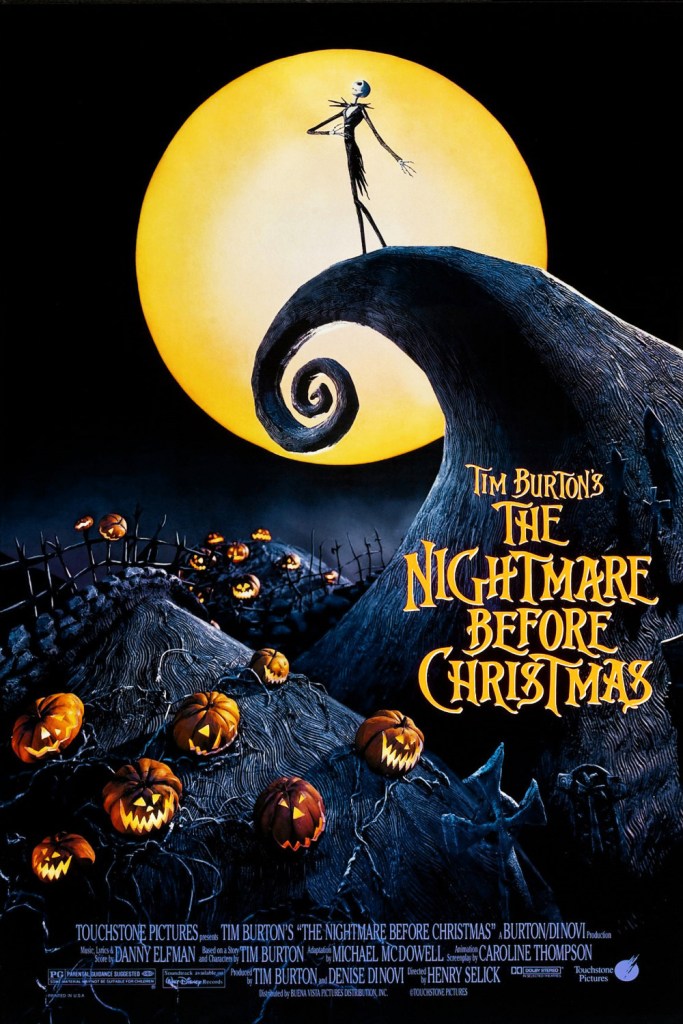
The poster for The Nightmare Before Christmas features Jack Skellington, the Pumpkin King, standing atop a strange curlicue hill, backlit by the full moon.  Below him are many ominous looking jack-o'-lanterns strewn across a cemetery and along a rickety wooden fence.

The film’s successful communication of the creepy delights of Halloween Town (realized, of course, both by Henry Selick’s amazing talents as an animator and by maybe the best score Danny Elfman ever composed, which would be saying something) is, I think, part of how we come to mistake the message of this movie.  It would be easy, if you haven’t seen it in years or only know it through cultural osmosis, to think that the thesis of Nightmare is that Christmas would be cooler/edgier/more awesome if it had a lot of ghouls and frights and toys with teeth, etc., and Jack Skellington & Co. basically save Christmas by making it hip again.  Those weird juxtapositions of Christmas cozy and Halloween horror are the really memorable moments in this motion picture, unquestionably.  But the message is in fact completely the opposite: Jack sucks at doing Christmas.  The residents of Halloween Town create a Christmas that is so chaotic and stressful that worldwide panic ensues, capped off by a military assault on Jack and his (undead?) flying “reindeer”.  Jack is so cavalier about the wellbeing of his Yuletide counterpart, “Sandy Claws” (as the Halloweenians call him), that he leaves the security of “Sandy” to three known juvenile delinquents whose primary allegiance is to the one genuinely bad person in Halloween Town, a sociopath named Oogie Boogie, who proceeds to subject an innocent and panicked Santa Claus to abuses designed to culminate in his murder.  I don’t mean to “spoil” a 30-year-old classic that surely almost all of my readers have seen at some point in their lives, but the final outcome of all this is certainly not a newly Halloweenized Christmas, but to the contrary a sense that the two holidays belong very much in their respective corners.  This is a story about the importance of a world with BOTH Halloween and Christmas, and of knowing which side of that line to be on.

And that’s what’s always going to be at issue in a project proceeding from the brilliant though often one-track mind of Tim Burton, who generates this film’s original story and acts as producer.  Burton is good at celebrating outsiders (and, despite all his successes and riches, at playing the role of the “outsider” himself) but usually he considers it impossible for them to make peace with the society Burton finds both appalling and weirdly appealing.  Edward Scissorhands does not find himself integrated into the world around him, any more than Lydia Deetz finds a way to be happy in the world away from the Maitland house.  I get the sense that Burton privately thinks Jack’s Christmas is in fact more fun than the real one, but also genuinely believes that it’s just not plausible that Jack’s version would catch on among the “normies” who want to find something pleasant in their stocking rather than something lethal.  We are allowed to visit Burton’s Halloween Town and admire its delights, but only he and his stable of outcasts are going to find it a happy place to settle down.

You may not think this a very fair take about a film you love—though, to be clear, I’ve watched this movie happily dozens of times, and I can sing along with it in numerous places, so it’s not a film I dislike!  I just think that, viewed through the lens of the holidays it purports to have something to say about, Nightmare’s message in the end is that Christmas people should do their thing and Halloween people theirs.  Jack maybe has a renewed sense of vigor at the end of the story, but it’s only a vigor that he ought to apply to making Halloween better, rather than dabbling in something else.  This was a film about people initially feeling hollow, aimless, wistful, and in the end, it’s arguing that they can be shaken back to life through a shared sense of crisis, but that probably they should have left well enough alone to begin with.  That’s the only sense I can make of the Sally subplot, in which she has a vision, argues for what ought to happen, and then is vindicated almost completely by what occurs.  Sally was right, and Jack should have listened—as another character tells him at the film’s conclusion, in fact.  Some kind of freedom is possible (as experienced by most of our characters, by the end), but we also need to know where home is, and not to wander too far from it, whether that home is the picket-fenced suburbs or the iron-fenced cemetery.  And what IS the Christmas that Jack doesn’t really understand?  It’s snowfall.  It’s nice toys.  It’s a predictable and cheerful celebration in which nothing strange or unexpected happens.  Not exactly the most ringing endorsement of a holiday, especially from a movie that has taken such delight in depicting the truly macabre people who make up the population of Halloween Town.

Luckily, I also don’t think that we’re forced to accept the messages art gives us without any agency of our own.  We can argue that the characters (and the screenplay) misread this situation, and that other, better outcomes were possible.  Part of the magic of Jack’s big number, “What’s This,” is that there is actually something profoundly wonderful about stepping outside the boundaries of your life and seeing something new.  I can’t explain why Burton wanted to make a movie that argues Jack shouldn’t ever step through the door into Christmas Town again, but I can at least make the case, for myself, that I think Jack knew a lot more about Christmas’s power than he seems to implement when it comes down to celebrating the holiday, and I would have been glad to see a movie give him (and Christmas) more credit for already having a lot on the ball.  After all, when he pitches Christmas at the town meeting, he seems to come from the point of view that the holiday isn’t much like Halloween at all—he’s constantly deflecting weird inquiries and at one point he basically breaks the fourth wall to tell us in the audience that he anticipated that he would have to ham up the relatively innocent figure of “Sandy Claws” to make Christmas sound intense enough to get people’s attention.  Why he forgets all this in practice for the next half hour of the movie is not really something I can explain.  Furthermore, I’m not sure it’s true: Christmas is a much spookier holiday than Burton gives it credit for being.  Its most famous modern tale is a ghost story.  Its original narrative is a story of terror (one of the characters appearing in every nativity set is an angel whose opening line is “Do not be afraid!”) and murder (Herod and the slaughter of the innocents) and squalor (both the stable and the shepherds).  It is neither a neat nor a tidy holiday—it’s only the sanitized commercial version of Christmas that seems that way, and it’s a disappointment, I think, that Burton didn’t apply his considerable talents to unearthing something more vital in it than he did.

It is a very mild disappointment, though.  The more I break this movie down, yeah, I can sure pick the plot and premise apart, but I don’t particularly enjoy doing that.  My critique of its missed opportunities is honest, and I think it’s a valid assessment of the film we’re given.  But more than critiquing it, I want to enjoy it, and I do: I find Jack charming and the residents of Halloween Town amusing and I sing along happily with almost every zany musical number.  In the end, the experience of the art has to matter as much as the analysis of it, right?  Anyway, it’s a movie that gives a lot to a lot of people, and I’m one of them, and if you’ve not seen it before (or not in a while) I hope I’ve steered you to it in a way that will help you both delight in it and engage with it thoughtfully.

I Know That Face: William Hickey voices the decrepit, predatory Dr. Finkelstein here—he’s Clark’s Uncle Lewis in National Lampoon’s Christmas Vacation, which I covered with criticism in a post on the blog last year, and in a 1987 television movie called A Hobo’s Christmas he plays a character named (well, surely nicknamed) Cincinnati Harold.  Ken Page, who in this film provides his memorable bass voice for Oogie Boogie, appears as Dwight in 1990’s The Kid Who Loved Christmas, an emotionally heavy television drama with an all-star cast of Black performers.  Paul Reubens, who made such a career out of playing charming oddballs and who voices Lock (one of “Boogie’s Boys”) in this film, shows up again as a voice actor in the direct-to-video Beauty and the Beast: The Enchanted Christmas, in which Reubens plays Fife, a piccolo who plays turncoat against the villain at a crucial moment.  Most famously, of course, Reubens plays his character of Pee-wee Herman in lots of settings, including as the titular star of 1988’s Christmas at Pee-wee’s Playhouse, and, bizarrely, as a performer in the 1985 Bryan Adams music video, “Reggae Christmas”.  Yikes.  Lastly, Catherine O’Hara voices Sally in this movie; she’s familiar to most of us from lots of other projects, but in the holiday realm in particular, she plays Christine Valco in 2004’s Surviving Christmas, as well as the aging character actress Marilyn Hack in For Your Consideration, a Christopher Guest film that ultimately is at least Thanksgiving-adjacent.  Oh, and of course she is Kevin’s frantic but seemingly not-that-attentive mother Kate in both Home Alone (which I will cover someday on this blog) and Home Alone 2: Lost in New York (which features a cameo appearance by one of the worst Americans of all time, so I probably am going to skip it for the rest of my life).

That Takes Me Back: It would be hilarious if I spotted elements from life in the demented chaos of Halloween Town that reminded me of growing up in the suburbs outside of Seattle, but no, I’m afraid the delirious world of Tim Burton / Henry Selick didn’t spark anything nostalgic for me.

I Understood That Reference: Jack skims A Christmas Carol and a book called Rudolph, as he seeks “a logical way to explain this Christmas thing”.  He later divides chestnuts by an open fire, in an echo of “A Visit From St. Nicholas.”


Holiday Vibes (4/10): This is a film with a ton of talk about Christmas and preparations for it, as well as some of its actual celebration, and Santa Claus (ahem, sorry, Sandy Claws) is a major supporting character, so it’s not nothing!  But as I note above, the movie’s intentions here definitely seem to carry it away from much real engagement with Christmas and towards the emotional journey of the main characters (and their realization, in the end, that Christmas isn’t for them).  So, it’s doing some of what we look for, but it’s missing a lot.

Actual Quality (9/10): Again, separate from the message and however we feel about it, this is an incredibly well made film: a great voice cast, great music, great stop-motion animation.  Sure, I have some mild irritation at the Burton of it all, but even there, I admire a lot of what Burton’s capable of as a filmmaker.  I’ve just come to find his stuff a little empty and self-aggrandizing over the years, and while there’s still some gems in his filmography, there’s fewer “10s” in there than I used to think, at least in my opinion.  Even if Burton’s wrong about Christmas, though, he knows how to make a compelling story, and so do all the other artists who worked on this.

Party Mood-Setter?  If this feels like the holidays to you, absolutely: the songs invite you to sing along and the story’s lightweight enough that you don’t need to focus at all.  But if it’s not “holiday” enough for you, I think it’s a little too weird a presence to be in the background.

Plucked Heart Strings?  I’m sure some people feel a deep resonance with Sally (and delight that she gets Jack at the end) but I don’t think anybody here is fully realized enough to make an emotional response happen for me.

Recommended Frequency: Oh, this is annual at some point in my household—whether in October, November, or December—and we all know the words to at least most of the songs.  If it isn’t for you yet, it’s worth trying to add it to your holiday rotation, in my opinion.  Proceed with a little caution, though, about what the movie’s really trying to persuade you to believe.

If you want to give the movie a whirl, it’s on Disney+, of course, since Disney paid for it in the first place.  It can be rented anywhere you think of renting a streaming film, and several versions are available on disc at your Barnes & Noble.  But there’s no need to pay for it: hundreds of libraries, according to Worldcat, carry this one on disc.
The Silent Partner (1978)

Review Essay

Last year, I commented in my review of the Albert Finney musical Scrooge that I’d selected it in part because the 1970s have a dearth of holiday feature films, and that if I wanted to cover at least one movie from each decade from the 1930s to the 2020s, one of my few other options was “a Santa Claus bank heist filmed in Canada.”  Well, it’s a new year and I need a new 1970s representative lined up, so here we go, folks.  A couple of readers last year encouraged me to give this one a try, and I appreciate them steering me to something very different artistically, since I’m enjoying exploring the scope of what a “holiday movie” might be.  But be forewarned—this film’s very graphic, both sexually and violently, and it’s the violence (and often the sexual violence) of this film that ultimately made it too tough a viewing experience for me to enjoy it much.

There’s plenty of reason why The Silent Partner seems at the outset like a potential hidden gem—in addition to just the amusing nature of the premise of a Santa Claus bank robbery, I notice right away that our main character, the timid bank teller Miles Cullen, is played by Elliott Gould back in his undeniable leading man era, and one of his colleagues is played by a young, fresh-faced John Candy.  So far so good, right?  Add to that the fact that, as I eventually realize, the crooked Santa is being portrayed by the famously talented Christopher Plummer (in an admitted lull in his long and illustrious career) and it just seems like this film should pop off the screen.  The film’s great at evoking the 1970s by just capturing the era as it was—big hair and earth tones, the smoky haze of the air anywhere indoors adding a slightly dreamlike quality—and as a guy who grew up just a few years later, a lot of the imagery made me nostalgic for the media of my youth, at least initially.  I was hopeful.

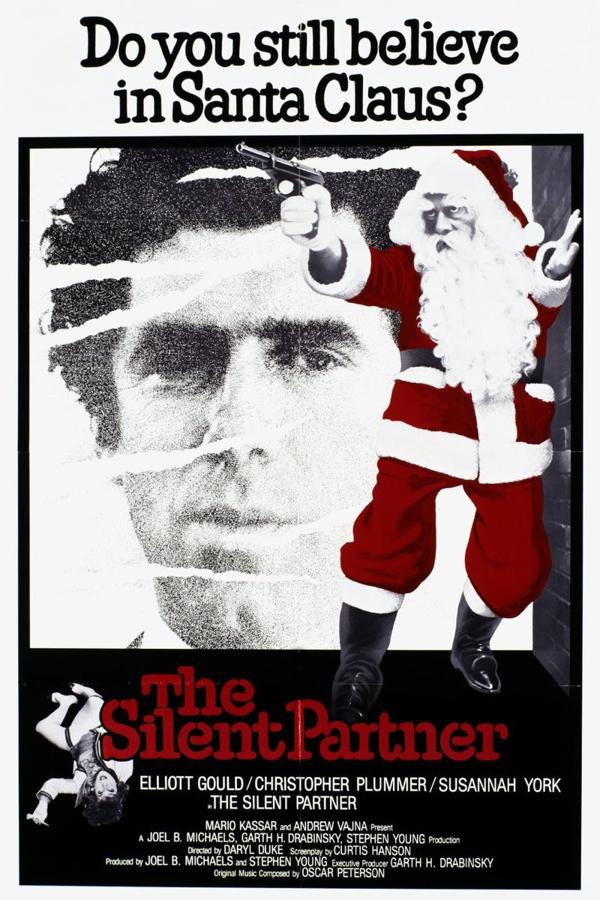
The poster for The Silent Partner depicts a faded, creased black and white photograph of the face of Elliott Gould as Miles Cullen, in front of which we see superimposed Christopher Plummer in a full body red-and-white Santa costume, brandishing a revolver.  Above them appears the tagline "Do you still believe in Santa Claus?" Below them, next to the film's title and major credits, the small black and white image of a collapsed (murdered?) woman is lying at the bottom left corner of the poster.

The plot is engaging also, in the first act, when the dominos are aligning.  Through a slightly implausible set of occurrences, Miles Cullen realizes that there’s a Santa Claus who intends to rob his mall bank branch, and who specifically plans to come in right after a major retailer has dropped a huge wad of Christmas cash off as a deposit.  Planning in advance, he arranges to hide the cash in his lunchbox, so that the Santa robber will walk off with a MUCH smaller heist, while taking the heat for the thousands in missing cash that Cullen will pocket.  The robber can’t complain to anybody, of course, given his criminal liability, and thus Cullen will slip away laughing with the perfect crime.  The only thing Cullen hasn’t thought about is that the crook under that Santa costume, a hardened tough named Reikle, is absolutely ruthless enough to hunt him down and cause no end of pain and suffering in pursuit of getting the cash he knows Cullen screwed him out of.  At that point, it’s a cat and mouse game: Reikle can’t kill Cullen until he knows where the cash is, and Cullen can’t escape Reikle because he isn’t really capable of the kind of violence it takes to permanently rid yourself of a guy like that once you’ve stolen “his” money.

To some extent, your ability to have a good time watching this movie will depend on your patience with a cast of characters who are, almost without exception, neither charming nor interesting.  Cullen’s sad sack bank teller desperately wants a woman, and he’s surrounded by people having a ton of semi-fulfilling sex, including a lucky-in-love John Candy—moreover, the environment at the bank is so sexually charged that one of his fellow tellers is a young woman walking around in a tight shirt that says “bankers do it with interest”, a walking HR problem if HR had meaningfully existed in 1978.  Anyway, I’d love to tell you that rooting for Cullen feels like I’m pulling for the underdog, but somehow Gould’s portrayal of Cullen never felt appealing to me: he’s sleazy, he’s selfish, he hides a fair amount of misogyny under his “nice guy” exterior, and ultimately he risks way too much danger (and not just for himself) in pursuit of an amount of cash he himself admits isn’t really life-changing.  I want him to “win” because Reikle is a monster, and because I know the screenplay has Cullen set up as the hero, but knowing that the movie wants me to think of Cullen as the hero ends up becoming an unsettling experience, since for me, men like Cullen are guys I don’t identify with and don’t want to.  And I don’t think the movie is at all self-aware in wanting to explore Cullen’s flaws, though others might see it differently.  The same goes for basically every character in the film, other than Reikle, a character the movie’s working overtime to present to us as evil incarnate since that justifies everybody else’s actions (to some extent).

It’s Reikle and the world around him that moves this film from an unsettling watch for me into a really upsetting one.  We see multiple acts of violence committed by Reikle against partly or fully nude women, at least one of whom is a sex worker, as he expresses his frustration and his dominance by hurting them.  And “hurting” is too gentle a word—I don’t want anybody to be as unaware as I was, going into this movie, that one of the scenes involves the violent decapitation of a woman using the broken glass side of a fish tank.  I’m obviously familiar with the fact that horror movies traffic in this kind of outlandish violence all the time, and maybe it doesn’t sound all that intense to you, but speaking as a guy who generally doesn’t watch movies like that, it was an incredibly tough scene to sit through.  I think part of the sourness of all this is that I consistently felt the sex and violence were exploitative and not communicative.  The woman Reikle murders exists only to be hot enough to have sex with Cullen, and then fragile enough for Reikle to destroy so that he can get back at Cullen, and then important enough to Cullen that he’s motivated by that killing to really ruin Reikle once and for all.  But she’s not a person with her own ideas or angle that I can decipher—she’s not a character in this story the way Reikle and Cullen are.  I won’t tell anybody they can’t find purpose in the horror of this movie at its most violent, but I couldn’t find it, and I couldn’t really give myself a reason in retrospect why most of the events of the film had happened, other than to engineer either naked women or gruesome violence (or both) onto the screen I was watching.  I’ve handled both sexuality and violence really sympathetically here with regard to past films, too, in Carol and Merry Christmas, Mr. Lawrence, so I’m confident it’s not that I’m automatically stuffy or Puritanical about what belongs in a holiday movie.  I just want these choices to matter, especially when they’re exposing performers to really vulnerable or even potentially degrading moments on screen, and it’s troubling to me when I think that they’re not being treated with respect.

In the end, I’d say that the film also lets me down by never really knowing what story it’s telling.  Cullen at the outset is this nebbishy nobody, someone so harmless that his boss reliably uses him as “cover” by having Cullen bring the boss’s girlfriend to the Christmas party so that the boss’s wife doesn’t figure things out.  And yet at some point a switch flips and he’s openly defying a murderous criminal, tailing him home down dark streets and setting up elaborate schemes to entrap him.  It’s just not clear why or how he knows how to do any of this, and if he was Kevin McAllister in Home Alone I would shrug and say, this is a child’s fantasy, who cares how Kevin knows to do these things?  But this isn’t a child’s fantasy, and it’s too bleak to be a satisfying grownup fantasy (for this adult viewer, anyway…I could believe this is the fantasy of some Reddit incel but the less I think about that, the better).  As a result, I don’t know how I’m supposed to understand who Cullen is or what he’s doing, which is a problem in a film that’s 100% about this guy’s triumphs and travails.  Reikle, too, is weirdly underwritten: I can’t tell you whether Plummer was playing him as con man or as unhinged megalomaniac or as sadistic freak, and my sense is that the director wasn’t giving him much help to find the character either.  I get the feeling that the filmmakers were most motivated by creating something for the male gaze—hot women and gritty violence and in the end the guy that everybody discounted (especially the women!) was the cleverest of them all and gets to both engineer some violence and have a hot woman, maybe even more than one.

I Know That Face: Christopher Plummer (here playing Reikle, our primary villain) narrates a Claymation short film in 1998 called The First Christmas, and in 1990 narrates two other holiday films, namely Madeline’s Christmas and The Little Crooked Christmas Tree.  Plummer also appears as Scrooge in 2017’s The Man Who Invented Christmas, which maybe someday I’ll add to my rotation of Christmas Carol adjacent films.  Indeed, Dickens makes a lot of intersections with members of this cast: Susannah York, for instance, (here portraying the much put-upon Julie) plays Mrs. Cratchit in the George C. Scott adaptation of A Christmas Carol from 1984.  Ken Pogue, whose familiar weathered face appears in this film as Detective Willard, is a veteran of multiple Christmas outings: he’s Hank Fisher in 2009’s A Dog Named Christmas, Dr. Norman Ferguson in 2000’s The Christmas Secret, and back in the day he was Jack Latham in 1979’s An American Christmas Carol, in which Henry Winkler plays the miser Benedict Slade under a massive amount of old-age makeup.  Most of all, though, you (like me) will have spotted a very young and unexpectedly trim John Candy who here is in the minor supporting role as the bank clerk Simonsen, but who we will all well remember as Del Griffith, the shower curtain ring salesman from the 1987 Thanksgiving movie, Planes, Trains, and Automobiles, as well as, of course, Gus Polinski, the Polka King of the Midwest, in 1990’s Home Alone.

That Takes Me Back: Everything about the bank situation for Miles Cullen was so reminiscent of days gone by (for me): some of you out there have safety deposit boxes, but I haven’t opened one in decades.  I can’t remember the last time I was counting out a cash deposit at the bank….maybe back when I ran the staff soda machine at the high school I taught at?  And I also can’t remember the last time I handled carbon paper, despite it being everywhere in my youth.  Oh, and while this is less specific, I just have to say, every single coat I saw on the Canadian extras roaming around whatever mall this was filmed at reminded me of the coats I was buying in the late 1980s from the local thrift store: I don’t know why it was the winter coats, in particular, that felt nostalgic to me, but it was.  Maybe it’s that I didn’t have much occasion as a 10 year old boy to wear a tight t-shirt that said “bankers do it with interest”.

I Understood That Reference: I’ll give it to The Silent Partner: Santa Claus is all over this movie, both cheerfully and violently.  It’s really the one successful holiday element in an otherwise not at all Christmassy movie.  I wouldn’t say the film deals much in the details of the various Santa legends, but maybe that’s for the best.


Holiday Vibes (3/10): It’s all about those mall scenes—ringing bells and Santa outfits, decorations up at the bank, etc.  But they’re done with pretty early on, and once the initial heist takes place, we’re fast-forwarding well beyond the holiday season and not headed back there.  Christmas is a bit player here, and since it occurs at the beginning instead of at the end of the film, I think it loses even a little more weight in terms of impact.

Actual Quality (3.5/10): There’s something interesting about the plot machinations here—Cullen’s creativity in solving his problems is interesting, and while neither Gould nor Plummer is really given a great role to play, they’re both talented enough to elevate at least some of the scenes into something more gripping and memorable.  For me, though, that’s about where it stops: in the end I don’t think the plot or the characters make enough sense on their own terms, and I’m sure not excited about the ways this story is being presented.  It feels far more hackish and less purposeful than I was hoping for.

Party Mood-Setter?  Haha, dear reader, I hope you are not throwing any parties in which a violent decapitation would seem like chill background media.  If you’re watching this movie at a gathering, I think it must be because this is a film you want to pay full attention to.

Plucked Heart Strings?  I mean, there’s emotion in the horrifying acts of violence against women here, but that’s not really what I’m talking about in this category.  Ultimately those women aren’t made real enough by the script to be people I’m moved by.  I’m just upset, and that’s not the kind of emotion you’re reaching for from a holiday film, or at least that’s how I feel about it.

Recommended Frequency: I’m really not sure how to recommend this movie, which I doubt I will ever watch again—it will work for audiences that are ready for it, but I’m not entirely sure who that is.  I think it might well work better as a horror thriller than it does in any kind of Christmas context, but if you like a Santa slasher movie (and I know many such films exist), this is probably one for you to try.  Good luck with it.

If, despite my warnings, you’re up for a viewing experience with this film, it can be rented from most of the big players in streaming land for a few dollars.  You can buy it on Blu-ray if you’re really sure this is your thing, though I might suggest a quick try at your local library first (Worldcat says about 300 libraries have it on disc) to see if you’re really sure it’s worth owning.  And if you’re in line at the bank in front of a guy in a Santa costume, I say, why not offer to let him go ahead of you?

The Family Man (2000)

Review Essay

Folks, here’s the thing about The Family Man.  It’s somehow 12 different movies you’ve seen before and it’s none of them at all.  It’s A Christmas Carol and It’s A Wonderful Life and Groundhog Day and Big and 13 Going On 30, but it’s also really not like any of those movies in so many key ways that you should probably forget I just mentioned them.  It’s a film that, for me, gets some things so right and then fumbles the ball in such weirdly unexpected ways that it’s maybe one of the hardest films I’ve had to reach a numerical rating for, since it’s incredibly hard to reduce this motion picture to a single number (of any magnitude) without feeling like I’m only describing some of the movie I had in front of me.  If you’ve seen it, I really wonder what you think of it, and if you haven’t, I’ll work at avoiding spoiling the ending but you may want to take it in before I ramble on about it.  In the end, there’s one element at work inside The Family Man that does kind of explain all of it—its genius at its best and its wobbliness at its worst.  And that element is a man we’ve come to know (and love?) under the stage name Nicolas Cage.

It’s probably at about this point that you want to tap my shoulder and say, “James, you still haven’t told us literally anything about this movie?”  Okay, okay: on the one hand, this is a film with such a clear central premise that it should be easy to summarize.  It seems like a classic tale about the road not taken: Jack, a thirty-something Manhattan high finance whiz got where he is in life by leaving behind him a stable girlfriend, Kate, whose goals were more altruistic.  But a Christmas miracle suddenly places him in the world where he made the other choice—waking up in bed with his wife Kate on Christmas morning, with loud young kids and a needy dog and in-laws crashing through the front door.  And then of course he’d like to escape this bad dream he’s having, but instead he’s got to live his way through it until….well, the “until” is part of this movie’s mystery and either its ultimate success or its failure.  But the basic structure of a body swap / life swap / alternate timeline movie in which the fancy big city guy learns something as he stumbles through life in the suburbs is largely going to show up on screen in the way you’re expecting, at least for the movie’s long and chaotic second act.  The third act, on the other hand, is unexpected in ways I’m really not sure about—maybe it’s a strength of the movie or maybe it’s a weakness that it didn’t really arrive at its outcomes in one of the ways I’d expect films of this kind to work.  I really don’t want to spoil it, so I may have to leave that judgment to you.

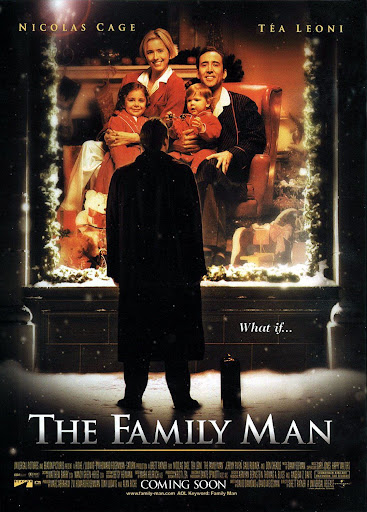
The poster for The Family Man depicts Nicolas Cage from behind as he stands in a trenchcoat on a snowy street with his briefcase on the sidewalk beside him. He is looking in through a large picture window at an image of himself seated in an armchair with Tea Leoni and their kids, cuddling together to post for a family Christmas photograph.  The tagline appearing next to him reads, "What if..."

Back to Nic Cage, though, and the reason this film is both really good and not really successful in landing the punches it wants to.  Cage is an astounding, generational talent: there’s nobody like him, and he does things nobody else can do, which is not to say he’s the finest actor working but he may be one of the most irreplaceable.  He’s on screen for nearly the entire running time of the movie, since this alternate universe switcheroo is one that effectively he alone is conscious of, so it’s his experience we’re tracking.  Given that fact, Cage’s fundamental watchability is hugely important—he makes everything from his character’s frustration to his character’s delight feel energized, even thrilling, as he takes the roller coaster ride of a man trying to figure out how he feels about this new life he’s been dropped into.  Even when the movie’s probably taking too long to complete the roller coaster ride (and it starts to feel a little pedestrian), you know Cage is capable of anything, and you keep your eyes on him.  As the character of Jack works out who he is, not as a balance sheet but as a person, he starts to understand why a man with his financial genius “settled” for the life of a suburban dad.  At its best, the film is both funny and heartfelt, as Jack navigates the sometimes outlandish silliness of his new world and discovers who he really cares about, and, maybe more importantly, discovers what it means to care about them.

And what makes all this not quite work, in my opinion, or at least not quite work in the ways that all-time great multiverse movies like Groundhog Day work, is that Jack is too compelling from the very beginning of the story.  The scenes we see of him on Christmas Eve prior to the dimensional shift are of a man who, sure, is a little arrogant and flighty in his personal relationships, a man maybe too used to the opera and fine whiskey and out of touch with “everyday life”.  But he’s also really happy?  And he’s not even a cruel person, that we see—sure, he’s in a world of high finance and mergers, etc., but there’s no obvious ways he’s complicit in ethical violations, and he’s upbeat and funny with his coworkers in ways that feel basically positive.  It’s not a bad life; to the contrary, it feels like a guy who’s figured out how to live at the top in ways he’s pretty fulfilled by.  Even if we consider the inciting incident that drags him to a new plane of existence, it’s not something he did wrong—to the contrary, he risks his own life pretty needlessly, since he could have remained an “innocent bystander”, but instead he steps forward to try to de-escalate a potentially lethal confrontation at the cash register of the shop he’s in, only to learn that the dangerous criminal is actually an angel.  Or something…honestly, the movie’s pretty bad at explaining the metaphysics of why this switch-up even happens or what qualified Jack for the experience.  Don Cheadle just smiles and tells Jack to remember he did this to himself, but what does that even mean?  Anyway, the result of all this is that we never really understand why we should be rooting for Jack not to go back to the life he came from, other than that Tea Leoni is hot (I mean, no arguments there), and that we know that in a Hollywood movie we’re supposed to be rooting for marriage and the suburbs and 2.3 children and a car in every garage, etc.  And knowing why we would be rooting for the suburbs is pretty darn important in a movie that is about really nothing else.

One of the other problems, fundamentally, is that the movie starts like it’s shot out of a cannon.  We literally know nothing about the Jack/Kate relationship prior to the breakup other than them standing at the airport gate in 1987 with her telling him she’s got a premonition he shouldn’t fly to London for his internship, and him telling her it’s ludicrous for her to ditch law school and him to ditch the internship.  It’s the only glimpse we’ll see of the relationship he left behind, and as a result, I just think it’s hard to invest myself fully in believing that clearly this young grad student should have listened to his girlfriend’s weird dream logic rather than continue to pursue a career he clearly thrives in.  And then once you start to lean on the logic of the movie, it does break down a bit…maybe most importantly, why is it true that Jack has to give up all his dreams and opportunities, whereas Kate still gets to go to law school (she’s an underpaid lawyer for a nonprofit in the “future” of the movie) and practice her craft, and the house and the life near her parents and all the rest of it are clearly the things she values in life.  Why are her values more important than his?  Again, if the movie made him an obvious monster at the outset—a selfish, cruel man who uses his gifts to oppress other folks—then it might be a simplistic moral fable but at least I would understand why Kate = good and Jack = bad.  As it is, the film’s values feel unfortunately like the echo of a ‘90s movie that presumes we know who the good and bad guys are without needing to actually make the case.

The holidayness of the movie is tough to calculate: again, I know that messages about family, etc., are often associated with this season of the year, but given how weird the movie’s ethics are, I’m not sure how much I want to credit it with having a meaningful message in that regard.  The magic of Christmas Eve / Christmas morning is definitely central to the film’s opening and closing sequences, but in the middle it’s just January in New Jersey, and given how detached from reality Jack is (either because of his palatial life as a wealthy financier, or because it’s Christmas Day and he woke up in the wrong house in someone else’s underpants and he’s frantically trying to put it all together) we don’t get a ton of Christmas celebration to lean into.  Add in the vagueness of the character Cheadle plays, who could easily have been more explicitly made an angel or an elf or Santa Claus or anything you like, and we lose even more chances to ground this experience in something more explicitly Yuletide.

I think in the end, this is a movie that feels like maybe it hooked Hollywood producers as a great premise, and then between that point and the final cut, neither the screenwriters (Diamond and Weissman, a partnership also responsible for….yikes, Evolution and Old Dogs, okay, some of this movie’s problems are making more sense now) nor the director (Brett Ratner, DOUBLE yikes, that man’s Wikipedia page has a whole section devoted to “sexual assault allegations”) figured out how to make it really work.  And the more I’m looking at what I just found out about the three guys involved, yeah, their struggle to tell a magical, nuanced tale about love and family life is maybe just a bit more explicable.  But here’s the thing: that premise is still really powerful.  And Cage and Leoni are probably just about perfect casting for a movie like this, in this era.  The second act may sag, and the third act may have a couple of unexpected curves in it, but ultimately their performances keep me hooked on the film, maybe in part because they make Jack and Kate alive enough that I don’t care too much about the screenplay not justifying why I should be rooting for them to be together again.  I just want these two people who are clearly passionate about each other to be together again.  That’s the kind of thing a movie can do, and this one does it well enough that it may be my most memorable takeaway.

I Know That Face: Saul Rubinek, who here plays the generally nebbish Alan Mintz, appears as Mr. Green in 2005’s Santa’s Slay, in which Mr. Claus is a demon who lost a bet with an angel.  Jeremy Piven, who in this film is Jack’s suburban buddy Arnie, plays the titular father in 2020’s My Dad’s Christmas Date, which sure sounds like a winner from the title, eh?  Nicolas Cage, Jack himself of course, was the surprising choice to voice Jacob Marley in a widely panned British adaptation of the classic story in 2001’s animated Christmas Carol: The Movie.  And Don Cheadle, here portraying “Cash” (an angel?), is of course well known for his role in the MCU as Colonel James Rhodes, including in the film Iron Man 3, which is acclaimed by the Die Hard crowd as yet another action movie that counts as a Christmas flick….and yes, by the forgiving standards of this very blog, I have to give it to them.  It counts.

That Takes Me Back: As a real fan of the paper map (who, yes, acknowledges that Google Maps has made everything simpler), I did love the chaos of Jack having to fumble with a paper map while driving his way around chaotically, like we used to.  It was nostalgic, too, to see a CRT monitor the size of a destroyer on his office desk, not to mention a checkbook with a bunch of entries for deposits and withdrawals in its register.  I wonder…do we even teach students to “balance a checkbook” in Home Economics these days, and if so, why?  Lastly, I couldn’t help but think of September 11th and all that’s changed since—certainly when I got a brief and shocking glimpse of the Twin Towers in an establishing shot (like we always used to do when filming New York City in the 1990s), and also when I watched a character making that old movie classic, the impulsive sprint to the gate at the airport, which now of course is simply impossible.

I Understood That Reference: Other than one character’s quip, “Santa Claus, you’re half an hour late,” I didn’t spot anything.


Holiday Vibes (4/10): As I note above, there’s not enough Christmas in the screenplay, or on screen, to really make this movie feel like Christmas to me.  But it’s in there enough that I can see this being a movie this time of year for some folks, and certainly any movie involving magic and snowfall has to get at least an extra half point, doesn’t it?

Actual Quality (8/10): Like I said at the outset, this movie defies numbers.  I could watch Cage prancing and singing around his enormous walk-in closet for 45 minutes but that doesn’t make this movie a 10, you know?  As it is, I’m trying to split the difference between my remaining really engaged with this movie throughout and my having a ton of notes about the ways I would have improved the film, given a chance.

Party Mood-Setter?  Probably not?  It’s hard to explain how weirdly intense the movie is—Jack’s outbursts are a lot to handle, even though I can generally track where they’re coming from.  Not really background fare.

Plucked Heart Strings?  There’s a moment or two that felt pretty authentic, but I’d be surprised if the film brought anybody to tears.  The complicated combination of the multiverse angle and therefore the weird emotional truth/falsity of these moments makes it harder to relate to than it would otherwise have been, I think.

Recommended Frequency: I have to be honest: I feel like I’ll watch it again, although I think there are other films that cover this kind of material better. There’s something to this movie, and maybe after another watch or two, I’ll understand better what, if anything, it means to me?

If you’d like to watch The Family Man yourself, right now you’ve got some options.  Subscribers to Peacock or to Amazon Prime will have an easy time.  You can rent it from all the usual streaming services, and Barnes and Noble will sell you the film on Blu-ray or DVD.  Public library users, Worldcat assures me you can snag this one from over 1,600 libraries in its database, so hopefully there’s a handy copy near you. Happy viewing to you!

The Thin Man (1934)

Review Essay

Here at Film for the Holidays, one of my inexplicable commitments each holiday season has been to commit to watching at least one movie from every decade spanning from the 1930s to the 2020s.  Last year I cheated slightly by making my pick from the 1930s a Christmas Carol adaptation, so it’s only this year that I’m picking something just a little more unusual off of the (relatively small) pile of 1930s holiday flicks.  I am sure some of my readers will have gotten to this movie long before I did, but if perhaps you (like me) have waited until this point in life to check out maybe the first great fictional couple of Hollywood’s sound era, Nick and Nora Charles, well, I think it’s time to give The Thin Man a viewing.  Say what we will about its seasonal content—and I will say it, eventually—there’s no denying that the spark under the hood of this motion picture is the crackle of romantic banter that’s been imitated in a thousand movies, and yet there’s still something fresh and fun about encountering the original article.

Before we can revel in Nick and Nora, though, this is a mystery with a ton of characters to set up, and set them up it does—the Charleses don’t appear until a good ten minutes into this film, which only has a running time of about an hour and a half.  By then, we’ve established a wide array of characters—the brilliant inventor Clyde Wynant, his greedy ex-wife Mimi Jorgensen (and her new husband, a real ne’er-do-well’s ne’er-do-well named Chris), his doting daughter Dorothy, and his creepy son Gilbert (who, had he been born about a century later, would definitely be either a true crime YouTuber or the moderator of a deeply unsettling subreddit).  Wynant, of course, has a wider array of orbiting humans than this—a couple of put-upon employees, among them a secretary named Julia Wolf who seems to have her way with his money (and maybe not just his money, if you catch my drift), a lawyer named MacCaulay who fusses about managing Wynant’s business affairs every time he disappears, a prospective son-in-law named Tommy, and a rival for Julia Wolf’s affections in the form of the most outlandish ‘30s mobster caricature imaginable, the spitfire-talking lowlife Joe Morelli (though there’s at least one other guy lurking around in the shadows, here, whose name we don’t have at first).  I think I still haven’t listed everyone we meet in this story BEFORE we meet our detective, Nick Charles, but maybe that makes sense, since at first there’s no crime to solve….just Clyde Wynant leaving town for a while, mysteriously, having promised his daughter Dorothy to be home by Christmas in time for her wedding, so he can give her away at the altar, angering his ex-wife in the process.  But then the movie hops forward to the dining room / bar / ballroom at New York City’s Hotel Normandie on Christmas Eve, where Dorothy is nervously chatting with her fiancé about how worried she is that her father still hasn’t shown up, and we have ourselves at least some of the makings of a mystery to investigate, though it’s certainly not the film’s most pressing conundrum by the time we really get going.

The poster for the movie, The Thin Man, advertises, at the top, "William Powell, Myrna Loy, in Dashiell Hammett's master mystery".  Below that, we see a man and woman, staring intently into each other's eyes as they each curl their right arm around the other's, and drink a cocktail from a small, clear glass.  The woman's in black with a white collar and black hat; the man is in a black suit with a white collared shirt and striped tie.  Below them, a different auburn-haired woman in a black dress and scarf faces towards the viewer and is looking down and to the viewer's left.

I have to admit, though, and this is me speaking as a big fan of mysteries in general (novels, movies, TV shows: you name it)—the appeal of The Thin Man isn’t really the mystery and its (somewhat creaky) solution.  It’s the effortlessly charming Nick Charles and his vivacious, cheerfully cutting wife, Nora.  The characters and their quippy, booze-soaked repartee seem to have worked in almost every format and setting from Dashiell Hammett’s original novel to later appearances in series written for radio and then television, but it’s really undeniable that the reason “Nick and Nora” still have cultural cachet in the 21st Century, whether we’re talking about a style of martini glass or an infinite playlist, is the film version of these characters as inhabited by William Powell and Myrna Loy.  Powell, a slender, coolly casual presence who, by 1934, has stepped smoothly from silent screen stardom into the talkies with such ease that he’s about to pick up his first of three Academy Award nominations for this movie, is definitely firing on all cylinders, but I’ll be honest and say that his co-star is this movie’s secret sauce.  Myrna Loy in the early 1930s is a kid from Helena who started out grabbing every bit part she could in silent ‘20s films and had mostly graduated to secondary roles as either femme fatales or “exotic” women of color—maybe only 1930’s Hollywood could look at a Montanan woman named Myrna and think “she’s believable as a Chinese villainess, right?”, but think it they did.  Anyway, this is her big swing of the bat, and she hits it out of the park like Ohtani, so fully connecting with audiences that she goes on a run for the rest of the 1930s and 1940s where she plays opposite almost every major male star of the era, not to mention demonstrating such magnetism side-by-side with William Powell that he’ll go on to play opposite her in an incredible THIRTEEN additional movies, including five more outings as Nick and Nora between 1936 and 1947.

I think what’s magical about Nick and Nora is the way they keep us convinced how much they’re in love with each other even while they are pretty verbally ruthless towards each other (and, in fairness, everyone around them, but they’re surrounded by such a cavalcade of rogues and fools that it’s easy to laugh along with the Charleses as they land jokes at the expense of the rest of the characters).  They’re helped to some extent by the fact that The Thin Man is one of the last Hollywood films to come out in a pre-Code environment: it hits the nation’s theaters in late May of 1934, right before the Hays Code takes effect on July 1st of that year, which means that every “morally questionable” element of this film, from its violence to Nick and Nora’s overindulgence in martinis to the not-too-subtle winks in the direction of their life in the bedroom, is allowed to be just a little more salacious.  It mostly does come down, though, to Powell and Loy being that good on screen together—good enough that when Nora accuses Nick a little jealously of his attentions to the starry-eyed young Dorothy, he can protest that, to the contrary, his type is “lanky brunettes with wicked jaws,” and the phrase sounds sweet as molasses.  He can shove an unwilling Nora into a taxi, telling the driver to “take her to Grant’s Tomb” to keep her out of harm’s way, and later, when he faux-innocently asks her how she liked the place, receive her reply of “It’s lovely. I’m having a copy made for you.” with a smile on his face that we genuinely believe.  Most of all, I think what works about the two of them here is that the script successfully makes them a team that completes the work of one good detective—sure, Nick’s the one with the professional experience and seemingly the skill, but it takes Nora’s persistence to get him to engage in the first place, and more than a little of her dogged resilience to get all the pieces to fall into place by the end in just the way Nick needs them.  When he says at one point, “Come on, Dr. Watson, let’s go places,” as he pulls her out the door of their suite, it feels a little less like a jab and a little more like a man starting to admit to himself that his frivolous, rich wife is turning out to be better at this private eye work than he would have thought….though this is Nick and Nora, of course it’s also a jab, and one she’ll hit back over the net at him sooner or later.

But James, I hear you saying….you just keep talking about Nick and Nora.  What about the mystery?  Heck, what about Christmas?  Isn’t this a holiday movie blog?  Look, friends, if you want to know why you should watch The Thin Man, it is 90% Nick and Nora saying things like “The next person that says ‘Merry Christmas’ to me? I’ll kill him.” or “Waiter, please serve the nuts. Sorry, I mean, waiter, please serve the guests the nuts.”  But sure, let’s at least nod at the rest of all this.  The real mystery kicks into gear on Christmas Day, when Mimi Jorgensen goes to try and get some money out of Julia Wolf (since apparently, despite the divorce, Clyde Wynant has been keeping his ex-wife’s household afloat financially, and not just Dorothy and Gilbert) and finds the young woman dead.  Mimi shrieks, she calls the police….and then she surreptitiously pockets something we can’t see off of the body.  What is it?  Time will tell.  Anyway, this triggers a parade of Wynants (and ex-Wynants) to the Charleses’ hotel suite, crashing an incredibly lively, some might say “bacchanalian” Christmas party, as first Dorothy and eventually her mother and her creepy kid brother show up seeking the help of old family friend and semi-retired detective Nick Charles.  From here, the chaos never really stops—the film flips back and forth between Nick interviewing at least one potential suspect and the discovery of either a new body or a new piece of evidence.  It’s not obvious for a big chunk of the running time if this is a mystery involving where the murderous Clyde Wynant could possibly have gone or one involving who killed Clyde Wynant and then framed him for a series of murders: the film will of course tell you by the end, and so there’s no need for me to do so.  To be honest, the mystery isn’t paced particularly well, since we learn some information so early that it doesn’t create a ton of suspense and some fairly key details emerge so late that there’s not much hope of an audience member solving the case through anything beyond a lucky (if semi-educated) guess.  The investigation of one or more crimes serves more as the backdrop that allows Nora to pester Nick (and Nick to infuriate Nora), with just enough twists along the way that your interest is held.  It’s been years since I read Hammett’s original novel, but my memory of it is that it’s slightly better as a mystery than the movie is, but that it also is fundamentally a detective story that is at least 75% about the vibes and not the plot (unlike, say, a Hercule Poirot).  When you get to the final scene where all the suspects are in one room together, sure, you’re looking forward to the resolution of the mystery, but honestly I think most of the fun even then is coming from the cheeky asides Nick and Nora are making to each other at the expense of the folks around them.

As far as Christmas goes, well, we meet Nora in the first place as a woman stumbling back from holiday shopping, who subsequently wakes up with a horrible hangover on Christmas morning, mumbling about the urgency of “trimming that darn Christmas tree”.  I mention Nick and Nora’s anarchic Christmas party earlier in the review, and really it’s the one seasonal element in the whole film: the party is a set piece that lasts long enough to be memorable, but it’s not exactly central to the story, either of the mystery or of Nick and Nora’s relationship.  The party is full of characters we never meet who will never play much of a role in the story beyond creating some nucleation sites for locating a great one-liner, like the fellow who tells Nora, “I think your husband’s great!”  She throws him back that feline smile of hers as she replies, “Well, I’m glad somebody does.”  Near the end of the gathering, as Nora and Nick watch the revelers belting out a very inebriated version of “O Christmas Tree”, she turns to him and says “Oh Nicky, I love you because you know such lovely people.”  And it’s a slam on Nick’s truly depraved social milieu from the rich woman who married him, while also being the bubbling up of genuine admiration from a woman who seems to feel like, after years of ease and wealth out west in California, this return to the seamy, seedy underbelly of Prohibition-era New York City is thrilling on a level she never anticipated.  In the end, though, this is far less a Christmas movie than it is a movie about mobsters who say “yeah, see?” right before pulling out a revolver like a cartoon character trying to threaten Bugs Bunny, or molls who, when they realize they’ve been dating an informant for the cops, burst tearfully out the door rather than remain in a relationship with a stool pigeon.  Not everyone will want this film bellying up to the bar alongside some much more evergreen-bedecked and candy-cane-fueled festive fare, but if you’re inclined to let it in the door, I think you’ll find it (like both Nick and Nora) is a charmer.

I Know That Face: Porter Hall, here playing MacCaulay, Wynant’s lawyer, appears, of course, in 1947’s Miracle on 34th Street, recently chronicled on this very blog, where he plays Sawyer, the malevolent psychologist who tries to get Kris Kringle locked up at Bellevue.  Edward Brophy, portraying the street tough Joe Morelli in this movie, swaps sides of the law to play a patrolman, Cecil Felton, in 1947’s It Happened on 5th Avenue, which I wrote about last year.  Myrna Loy, irreplaceable here as Nora, will later portray Mrs. Anna Smith in the TV movie version of Meet Me in St. Louis (1959), and at the start of her career she’d been an uncredited slave girl in 1925’s Ben-Hur: A Tale of the Christ, which of course stages the first Christmas in the early going.  And, in a real blink-and-you-might-miss-it appearance, one of the Christmas merrymakers at Nick and Nora’s party is played by an uncredited Charles Williams, who will, much later in a career that was otherwise mostly full of similarly uncredited performances, make his way into a film’s credits as Cousin Eustace, one of the fretful employees at the Bailey Savings & Loan in 1946’s It’s A Wonderful Life, which I covered for you all here last year on Christmas Eve.

That Takes Me Back: When, near the end of the film, Nora hosts a dinner party, it was fun to see her and Nick talking about putting down little name cards at places around the dinner table: maybe there are still some folks out there doing dinners like this (if so, invite me over!), but for me it feels mostly like a pleasant throwback to holiday dinners when I was a kid.  And it doesn’t matter how often it comes up, as it does during Nick and Nora’s Christmas party, but it will never fail to take me back in time when I see a character making a long distance call (especially when, as in this case, it’s clearly part of the joke to think about how wastefully expensive it is).  In a world where we basically never think about “long distance” anymore—so much so that I’m not sure my 12 year old would even know what the phrase means—it’s wild to think of how universal that experience once was.

I Understood That Reference: The only real reference to anything textually Christmassy is a quick back-and-forth quip between (who else?) Nora and Nick, when on Christmas morning she hears a knock at the door.  “Who’s that,” she asks Nick?  And he replies, “Probably Santa Claus.”


Holiday Vibes (2.5/10): As I cover in the review, really we get all of Christmas in just a couple of scenes—Christmas Eve down at the bar/ballroom portion of the Hotel Normandie and then Christmas Day up in Nick and Nora’s hotel suite, neither of them really classic depictions of holiday joy.  I have to give a little bit of credit to the party for at least being so exuberant that it really does feel like every two-bit ex-con and dipsomaniac in the five boroughs has found his or her way to reconnect with Nick Charles this holiday, but ultimately if you want a seasonally festive film experience, this isn’t going to deliver much.

Actual Quality (8.5/10): It’s hard in some ways to really rate the quality of a movie that is all about the energy and dialogue and not really at all about the plot, especially when the movie’s at least pretending to be primarily a mystery, a genre that is ordinarily heavily dependent on a successfully intricate plot.  It all really hangs on how much fun you’re having with Nick and Nora: if you find them more tedious or mean-spirited than I do, this could drop to a 7.5 or a 7 if we’re just judging it on the basis of “how good a detective story is this?”  And if the rat-a-tat of both comic delivery and 1930’s mobster gunfire is the music you love to hear, I can imagine this film climbing to a 9 or higher: Roger Ebert, the noted critic, listed this as one of his “Great Movies” of all time.  I think the fairest assessment is somewhere in the middle of that curve—I didn’t have quite as great a time with this flick as I have with a number of others I’ve reviewed for the blog, but I enjoyed myself, and I think you likely will too.

Party Mood-Setter?  The answer’s definitely “No,” not only because it’s not as “holiday” a movie as you’d really need for a seasonal celebration, but also because it’s so dependent on rapidfire banter and quick turns of phrase that to get the fun out of it, it really needs at least most if not all of your attention.

Plucked Heart Strings?  It’s just not that kind of movie.  The emotional register here is delight at how fun it is to watch Nick and Nora be semi-spitefully in love with each other, not pathos as you get in touch with wistful joy (or deep sadness).

Recommended Frequency: This one definitely rewards rewatching, since the first time through, there’s no way to avoid being mostly caught up in trying to track all the characters to figure out suspects and subplots and red herrings.  Once you’re freed from worrying about the mystery, a second viewing lets you settle in to just enjoy what the movie’s doing best—and I’d say that the end of the movie is what helps cement my certainty that Nick and Nora are actually good together (and genuinely attracted to each other), which altered to some extent my reading of their interactions the second time through the film.  I would definitely tell you to watch this one once, if you haven’t seen it (or haven’t in a long time), though I’ll admit that I think it would work almost as well in June as I find it does in December.

The Thin Man is still a few years away from the public domain, so your free options for streaming it are Tubi or Fandango at Home, both of them ad-supported, of course.  You can pay to rent it digitally from all the places you would normally think to do that.  The film’s widely available on disc, too, of course—just The Thin Man on Blu-ray if you like, or you could pick up all six films if you’re a real Nick-and-Nora-head.  And I’m nearly willing to issue a guarantee that you’ll be able to get the movie at your local library, since Worldcat says there’s over 1,600 libraries with at least one copy of the DVD.  If you want to try this movie out, it won’t be hard to do, and I encourage you to give it a try if it sounds remotely interesting.

Single All the Way (2021)

Review Essay

I’m going to open with the caveat that this is a movie living on the outskirts of a massive holiday movie industry that is absolutely serving a big and happy audience, and that I am not a part of that audience.  I’m not trying to get in anybody’s way as they consume the delightful fluff of Lifetime/Hallmark/Netflix Christmas flicks (and yes, diehards, I know that there are real tonal and stylistic differences between these channels/streamers when it comes to holiday media), and honestly, I’ve seen so few of them that even calling them “fluff” is probably unfair since if there’s some non-fluff in there, I wouldn’t know it.  My guess is that the movie I’m talking about today will work a lot better for folks who receive the tropes of the TV/streamer holiday romantic comedy like a warm hug.  For me, this is something less successful, but I’ll try to be generous where I can be.  That said, good grief, does Single All the Way feel like an extended Christmas episode for a cheesy sitcom that doesn’t exist.

The fundamental setup of the movie is trite but not necessarily doomed at the outset: Peter is a guy born in New Hampshire who escaped to the high-fashion world of models and marketing in Los Angeles years ago.  He’s headed back home to his small town for Christmas, accompanied by long-time best friend and roommate Nick who just dumped his trash fire of a boyfriend.  Peter’s family are (delightfully and not at all expectedly to me, given other films of this kind) really accepting of his identity as a gay man, even if they seem pretty clueless about LGBTQ+ folks in general.  So this isn’t a trek back home to the closet, as in Happiest Season, which I did genuinely appreciate.  But instead, alas, it’s a trip home to a family desperate to get Peter hitched to somebody—initially to his mom’s spinning instructor, James, via blind date, but then the family rapidly shifts to urgent, manic match-making maneuvers in an attempt to get Peter and Nick to fall for each other, despite their never having had any apparent romantic chemistry or tension in years of living together.  It’s a surprisingly exhausting experience, and if you think you know where it will end, yeah, you sure do.  Regardless of whether the ending makes any sense for these characters.

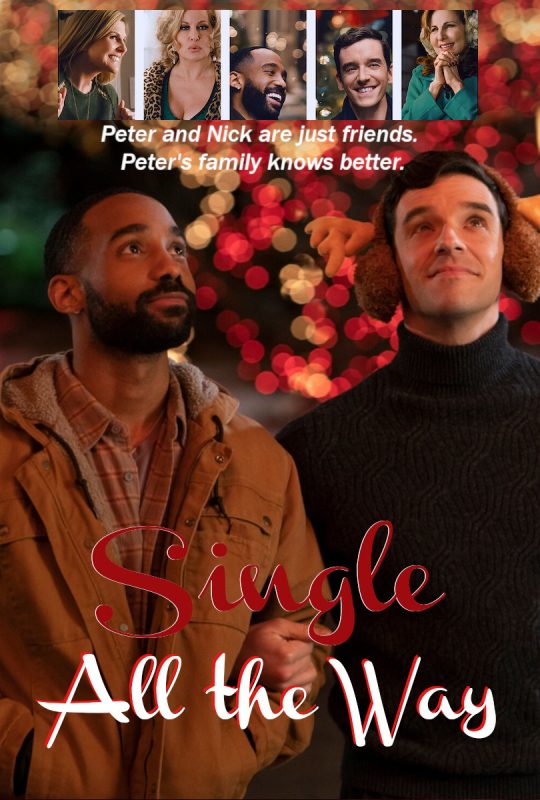
A promotional poster for Single All the Way depicts two men in their late 20s or early 30s standing together in the middle, looking upwards and smiling.  The man on the left is a Black man with short hair and beard; the man on the left is a clean-shaven white man wearing large earmuffs. Above them are five inset portrait photographs, two of them photos of the two men and the other three images of smiling middle-aged white women. The tagline reads "Peter and Nick are just friends. Peter's family knows better."

The tone of all this is, as I mentioned up top, really sitcom.  Like, really, really sitcom.  Jack from Will & Grace could wander into almost any of these scenes and not be totally out of place.  I don’t know at what point my eyes permanently rolled out of my head at the dialogue—I think I made it through “don your gay apparel” without collapsing, and I gritted my teeth through someone quipping that HGTV was the “Homosexual Gay Network”, but when someone described themselves as a “FOMO-sexual”, I was done.  And I want to emphasize that I love a good sitcom, so this isn’t me sniffing that the movie isn’t dark or artsy enough for me.  But the tone is so often broad and silly that it becomes incredibly hard to be invested in the emotional wellbeing of these characters when suddenly the screenplay expects me to take them seriously as people with hopes and dreams and baggage.  The antics they get up to—blind date hijinks for Peter, lots of home improvement work by Nick helping Peter’s father (since Nick works for Taskrabbit and he is really inspired by how Taskrabbit allows him to connect with and help others, and being a Taskrabbit at Christmas is almost like being a TaskElf, hahaha, hey, have I mentioned yet that Nick works for Taskrabbit and he feels kind of directionless in New Hampshire unless he’s working like a Taskrabbit?)—are incredibly mild. I’ll give it to this movie that, unlike Happiest Season, the goofiness is often less unhinged, but that also just means that the scenes are often a lot less memorable.  I’ve already forgotten a lot of the story beats within this movie’s second act.

There are things to praise here, to be clear, beyond my enthusiasm for a holiday movie that gives us a diverse cast (not just several key gay characters, but also at least a little welcome racial diversity for a movie set in New Hampshire).  Insane as both the characters they’re playing are, Kathy Najimy and Jennifer Coolidge (Peter’s mother and aunt) were kind of born to play sisters and to some extent they each make the other seem more realistic as a human being by being adjacent.  Coolidge as Aunt Sandy, the deranged megalomaniacal director of Jesus H. Christ, the town’s non-sectarian Christmas pageant, can at her best make even the wildest, most flailingly awkward moments seem plausible…she is not always at her best in this film, even so, but nobody could have done more to keep at least one of the movie’s toes on the ground where the pageant subplot is concerned.  Kathy Najimy as Peter’s mom….well, I have been to too many farmer’s markets to doubt the existence of people who buy kitschy, folksy, and at least allegedly funny wall decor, and Kathy is 100% landing the plane as a woman who would purchase a framed cross-stitch that says “Sleigh Queen”.  If you chuckled at that, friend, this is a movie you should check out.  The plan briefly entertained by Peter to pretend that he and Nick are dating (as a smokescreen to save himself from the blind date his mother’s going to send him on) dies a quick and fairly painless death more or less on arrival, which was a relief in the moment, at least.  And the best performance in the movie, bar none, is Luke Macfarlane as James, the spinning instructor for Peter’s mother, “Christmas Carol” (yes, that’s the name every character in this movie calls her, friends: how are you feeling about it, right now?), and also of course Peter’s blind date.  The character of James comes across as nuanced, thoughtful, patient: he undermines every likely stereotype, and he seems like a genuinely good dude with whom Peter might have built some really good chemistry, maybe even was initially building that chemistry.  I think this works against the film, to some extent, since it makes the ways Peter treats/mistreats James on his way to his destined-by-the-screenplay relationship with Nick even harder to enjoy when James is not only sympathetic but someone who feels more real, more human than our main character.

The overall arc of the film, really, was just too hard for me to enjoy: we’re asked to join all of Peter’s family in rooting for them to destroy his budding romance with James (based on a blind date his own mother started) and figure out how to basically force Peter and Nick to realize that they’re “perfect for each other”, by which I mean Peter’s dad who loves Nick’s handyman skills and a couple of teenage nieces who think it would be, like, sooooo cute if Peter and Nick dated and…well, you get the drift.  This isn’t a movie that’s figured out how to get these best friends to fall in love with each other by any means other than having a bunch of family members bashing them together like two Ken dolls they’re playing with.  I get that it’s supposed to be silly and sweet, but I don’t know: I was not in the mood for this movie’s brand of romance, and the whole thing ended up feeling almost offensive, as though the gay main characters were paper dolls being puppeted around by straight people who are, yes, “accepting” of their identity, but also not really treating them like people with their own desires and needs in relationships.  But honestly, using a word like “offensive” about Single All the Way would be inappropriate: this isn’t a movie that’s working hard enough in any direction to really mean the things it’s saying.  Like, this is a movie that wants us to nod along with a character claiming that if the town’s Christmas pageant is peppy enough, maybe it can “go on tour” after Christmas Day.  It wants us to accept that the highest powered marketing executives in the country would insist on an emergency photo shoot occurring on Christmas Eve at a moment’s notice….but they’re fine if the images produced are just iPhone snapshots in the woods, featuring whatever random local hunks are willing to pose in a hat and coat.  It’s never, ever mean-spirited, and as the queer main cast members are seemingly comfortable with what they’re appearing in, I wouldn’t tell you not to watch it.  I just think that, ultimately, this is not a script or a film that respects its characters in the ways I was looking for—the final scenes of revelation and admiration between Peter and Nick imply a greater psychological depth than has been developed for either of them.  The movie thinks it’s a story about self-discovery, but I experienced it much more as a story of social engineering, in which a family’s acceptance can also become a fenced yard in which your identity becomes a convenient way to pigeonhole you.  As always, though (and especially for films in this particular subgenre), your mileage may vary.

I Know That Face: Luke Macfarlane (as aforementioned, here he’s James, Peter’s incredibly attractive blind date) is an absolute veteran of TV Christmas movies, having appeared in at least NINE of them, including as Edward Ferris in 2019’s Sense, Sensibility and Snowmen, and as Chris, Santa Claus’s alleged son, in 2023’s Catch Me If You Claus.  I’ll give it to this subgenre: the movie titles are hilariously corny.  Barry Bostwick (here playing Peter’s genial father) is no stranger to the holiday circuit, himself, appearing in at least five such films, including 2017’s Christmas in Mississippi and 2019’s Christmas in Louisiana—the mind boggles at the potential for 48 sequels (more, even, if we throw in D.C., Puerto Rico, and Guam).  Add in Kathy Najimy (again, Peter’s well-meaning and overbearing mother), a member of the cast of at least four different holiday movies, including her appearance as Kim in 2013’s A Madea Christmas, and this little cast covers a remarkable breadth of the sizable collection of 21st Century TV movies that depict this special time of year.

That Takes Me Back: As a 2021 release, this movie’s too recent for any real nostalgia, of course, but someday the relentless Taskrabbit and Instagram references will be dated as hell.

I Understood That Reference: Kris Kringle shows up in the end credits song, and of course, thanks to Aunt Sandy’s lunatic obsession with a Christmas pageant that I will remind you again is titled Jesus H. Christ, we get a weirdly elaborate nativity scene on screen, since the movie can think of no more natural way to tie Peter and Nick together than forcing them to help out with the pageant before Aunt Sandy’s ego crushes every single participating child.  


Holiday Vibes (9.5/10): I have to hand it to this movie, it captures the feeling of a particular holiday energy, embodied by the kind of person who sees a framed poster in a country store that says “Nice Until Proven Naughty” and thinks, “That would be perfect for my entryway.”  And basically everything about the film once we reach New Hampshire is pretty Christmassy—snow and merriment and pageants and a countdown hanging on the wall that reminds passers-by to be good for St. Nick.  It’s generating plenty of holiday vibes, that’s for sure.

Actual Quality (6/10): As for the quality, on the other hand, this movie suffers.  Now, is it truly awful?  I can’t say that.  There are some fun performances and the movie’s pretty relaxing as a watch, as long as you don’t think too hard (as I clearly did) about the ethics of how this family is treating their visiting adult son/brother/uncle.  But is it good?  I struggle to even call it “fine”, given what I’m looking for in a movie: there’s just not enough ‘there’ there.  It’s a film that leans on the worst tropes in romantic comedy, for me, and (with my apologies) I just don’t think most of the cast is talented enough to really hold my attention: better actors might have saved some of this writing, but the two main characters here in particular are pretty bland, for me.

Party Mood-Setter?  Oh, 100%, especially if you’re at a party where those gathered will enjoy a little bit of eye candy from the hot men posing for the camera at multiple points throughout.  Sure, I think it’s empty calories, but that means that a party or a cookie baking afternoon is a potentially great venue for a movie that, if nothing else, fully lands the plane of “cute gay guys having a lovely white Christmas in small town New England”.

Plucked Heart Strings?  You’d have to find both Peter and Nick much more effectively realized as characters than I do to feel that lump in your throat as they finally confess their love for each other.  I guess I can imagine that reaction, even though I didn’t have it, but I don’t want to make you any promises!

Recommended Frequency: For a movie I didn’t like, honestly, this is maybe where I’d be gentlest: I can even imagine watching this one again, since I’ll acknowledge that I may just have been in too grouchy or critical a mood the first time around.  Most romantic comedies have premises that are at least a little unsettling or weird in the ethics department if you break them down far enough.  That said, I don’t know that I would ever seek it out again: there’s a lot of films out there, and this one missed me on too many levels for me to think it has much of a chance of warming my heart.  But if it sounds interesting to you, I think it’s well worth a try: you’ll decide early on if it’s really your style.

If you’d like to do just that, Single All the Way is one of those Netflix-produced movies that is really only available on the Netflix platform.  I see a couple DVD copies available from sketchy looking websites, which I assume are pirated, but other than that I can’t really give you options for renting it, buying it on disc, or securing it from your local library.  Apologies!  I try to stick mostly with films that we have a wider array of options to access, and I’ll try to get back to that array of options later this week.