Review Essay
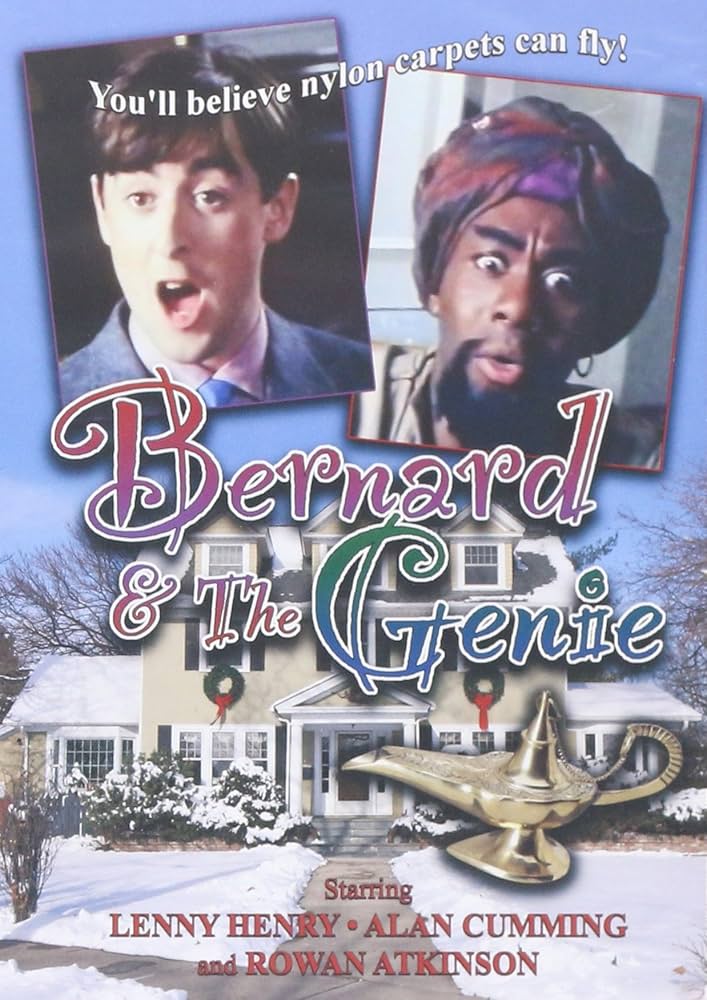
The selection process here at Film for the Holidays is pretty loose: it’s not like we’re being lobbied with gift baskets by streaming services (though Tubi, anything you want to send, I’m here for it), and other than a few very simple rules (1. Cover at least one movie per decade in the talkies era, 2. Every movie needs to have at least one unambiguous scene set at a winter holiday) I don’t really have much to guide me. I try to come up with a mix of things I’ve seen before and things I haven’t; things I like and things I don’t; different genres and film-making styles, etc. And along with all of the above, I’m always on the lookout for something that could be a diamond in the rough—some neglected, little-known gem that I can share with you all and add to our collective holiday fun. That’s why I reached for this BBC production—an early ‘90s British TV vehicle for a young Alan Cumming and a just-hitting-his-prime Rowan Atkinson, along with a big role for Lenny Henry, who’s less famous than the other two fellows but who I’ve thought was hilarious from his early days on Chef! to his recent work on The Lord of the Rings: The Rings of Power. Throw in that this is a screenplay by Richard Curtis—he of Four Weddings and a Funeral fame, with 4-5 other Christmas-related screenplays under his belt over the course of his career? It just seemed like the perfect pick to be a surprisingly delightful lark. . . . Well, it ain’t.
The setup of this movie probably should have made me wary from the outset. Cumming, as Bernard Bottle, is a bumbling young art dealer, fired by his outlandishly narcissistic boss, Charles Pinkworth (Atkinson), for having even raised the possibility of being generous to the senior citizens from whom he’d purchased some paintings that had proved to be hugely profitable at auction. Bottle stumbles back weepily to his apartment where he learns that his best friend Kevin has been knocking boots with his long-time girlfriend Judy, so he really is at the end of his rope. He polishes some old lamp he’s found, though, and KABOOM, just one singed testicle later (I’m sorry, but it’s literally what the doctors say when he wakes up), he finds himself in possession of a 2,000 year old genie named Josephus (Lenny Henry), with whom he is only able to communicate because in a moment of terror he shrieks, “I wish we could understand each other” and magically they can now talk freely, despite the language barrier. The screenplay’s version of the ancient Middle East is so comically stupid that I can’t always tell if it’s offensive or just incoherent—though my guess is most people will find at least some moments and jokes offensive—and the problems of Bernard Bottle are so cartoonish (but also so easily resolved) that it’s not exactly clear how invested we’re supposed to be in his triumphs.
By far the biggest problem with the script, a problem so big that if we just fixed this one element I think the movie’s at least 25% better, is Curtis’s decision to place no real limits on the genie’s power. Josephus can literally snap his fingers and turn back time by minutes, hours, even days as needed to correct any mistakes he or Bottle might have made. More seriously, though, the lack of limit extends to the number of wishes. Bernard Bottle can make an infinite number of wishes. There’s a reason that basically every wish story you’ve ever heard of extends a small number of wishes (usually three) to the wish-maker, from Aladdin to Darby O’Gill. It’s just not that interesting to know what I would wish for if I have endless wishes: all pressure is off. I can fix my house, my car, my job…I can fix the houses, cars, and jobs of anybody I meet, in fact, and I can take revenge on people who’ve wronged me, and I can do something about the world and its problems writ large, without any moment where I have to make a difficult choice. It turns out that this one element—having only three wishes—is a load-bearing element in these stories, since it places a lot of weight on each individual decision to wish. It forces the protagonist to learn to solve most of their problems themselves (in order to “save a wish”) and over time, by means of all that learning, our hero becomes, well, heroic. A world in which Bernard has only three wishes is one in which he is forced to actually grow up, and become something other than a kind of life-sized Charlie Brown, but one with an infinite magic wand.
This is the point in a negative review where I stop and try to catalog the movie’s high points, but there’s not a lot to supply you with. Lenny Henry, an actor I think has real comedic talent, has clearly been set loose in this role without any restraint from the writing or direction, and as a result his mugging for the camera is exhausting, like a kid running on too many Christmas cookies who you can’t wait to send to bed. Because anything can happen, none of the chaos feels all that meaningful—like a series of Family Guy sight gags, whole stretches of the film’s second act just become jokes based on the fact that Josephus can do literally anything, from summoning a Big Mac to summoning the Mona Lisa. Bernard can arrange the arrest of his former best friend on drug charges or transform himself into Bob Geldof or murder a police officer by accident (okay, I guess Mr. Bottle’s lawyer would like me to say “commit manslaughter” instead of “murder”), and all of these things will last for about fifteen seconds, and then anything bad about them can be undone, and anything good about them won’t last since there’s another wish coming. Curtis’s screenplay is so overstuffed that there are definitely ideas that I think could have been funny in a movie that gave them room to breathe, like Bottle’s apartment having an elevator operator who is a charmingly pathological liar or Josephus having an obsession with the music of Barry White, but it’s the room to breathe that we’re missing.
And when I say overstuffed, I mean it. I’ve made it to the fifth paragraph of my Bernard and the Genie review and I haven’t yet mentioned that a big chunk of the movie involves Josephus eventually claiming to have been a close personal friend of Jesus Christ, present at everything from the wedding at Cana to the feeding of the five thousand. That’s the sort of thing that would in any other movie qualify as the singularly bananas story element you can’t wait to unpack, but here, by the time Josephus brings it up, all I could do was smile and shrug. Sure, Josephus. Why not? His friendship with Jesus, who was a really chill guy (he says), supposedly makes him angry about Christmas commercialism, which is not what Jesus was all about (well, okay, that part checks out). But Josephus makes this claim within a few minutes of him dispensing lottery cash to a guy he thinks deserves it, and doling out a ton of great presents for Christmas, etc., so what exactly is the movie’s anti-commercial message? I’m not sure.
Okay, let me try a little harder: what can I actually praise here? There’s something sort of right about Cumming as a naive young fellow counteracted by Atkinson as a brooding, domineering force of malevolence: this could have worked, and it almost does, though the film never comes up with great explanations for why the two characters do what they do. Cumming as Bernard Bottle is in fact an appealing sad sack—as aforementioned, in a Charlie Brown kind of way—so that I remained a little more hopeful on his behalf than I’ve managed to be in some films where I just can’t care that much about Chevy Chase in Christmas Vacation or Steve Martin in Mixed Nuts. And there’s a comfortable camaraderie between him and Josephus at times, where it does seem like these two bros would have had a lovely time just hanging out in a London flat wishing for cheeseburgers and one more chance to chat up that Santa’s elf in hot pants that they met earlier in the day. There’s this funny bit the film does a couple of times where the soundtrack shifts into a song sung by a choir that functions kind of like a Greek chorus, commenting on what’s happening to Bernard in an amusing way, though it’s not deployed consistently enough. That’s about it. Oh, wait! It’s really short. The premise could definitely have taken up a lot more time, and I was grateful that everyone involved knew to keep this one brief with a plot that doesn’t slow down.
But when you’re praising a movie for only being 70 minutes long, dear reader, not much went well. And the appalling thing here is just the waste of talent: I know for a fact this collection of people could make better art than this. A simpler approach—down-on-his-luck art dealer meets a less stereotypical spirit from inside an old lamp who grants him a very limited number of powerful wishes to fix his life problems at Christmastime—with the exact same BBC resources and running time could have been something, if not special, at least amusing as a diversion and remembered with some fondness. Sometimes less is more, you know? Someone needed to say that to a young Lenny Henry, for a start, poor fellow.
I Know That Face: Rowan Atkinson, here portraying the villainous Charles Pinkworth, had previously played the various Blackadders in 1988’s Blackadder’s Christmas Carol, and of course will later appear memorably if briefly as Rufus the jewelry salesman in the always controversial Love, Actually. Kevin Allen, who plays the unfaithful (in I guess more than one sense of the word) “friend” Kevin in this movie, had earlier played a taxi driver in the 1984 short film The Man Who Shot Christmas. Our hero, Bernard Bottle, is of course the widely-beloved Alan Cumming, who’s in the cast of the 1995 television movie Coping with Christmas, who holds the role of a desk clerk in 1999’s Eyes Wide Shut (which, if Die Hard is a Christmas movie, it surely is also), who voices the titular Cinnamon Bear in the podcast series, The Cinnamon Bear: A Holiday Adventure, and who….wait, what? Plays Mr. Flaxman, the villainous boss in the REMAKE of Bernard and the Genie, a 2023 Peacock movie titled Genie, starring Melissa McCarthy? That exists?? Uff da.
That Takes Me Back: It’s a silly little thing, but something about seeing Josephus conjuring up Big Macs for himself in those tan styrofoam containers really took me back to childhood. It’s not like I ate a ton of Big Macs, but they were in every ad of course, and I definitely remember finally feeling old enough/big enough that instead of ordering a cheeseburger on a rare visit to McDonald’s, I could get a Big Mac. Very weird, in some ways, to see Big Macs used so prominently in a British production, but maybe McDonald’s was paying for product placement.
I Understood That Reference: Josephus’s talk about Jesus is all focused on him as an adult, so we don’t really get references to the nativity story. There is plenty of chat about Santa, though—Josephus is surprised to learn that “the chap in the beard” goes around on flying reindeer, and later comments that “Mr. Beardy’s starting to sound like a non-event.” Josephus ultimately sees himself on some level as having taken over Santa’s job, doling out wishes.
Holiday Vibes (6/10): There’s a surprising amount of Christmas stuff in a movie that didn’t necessarily need it, but that’s just part of the overstuffing, I guess. From wishing for decorations through arranging for the right presents to the previously mentioned Santa’s helper in hot pants, there sure is a lot of activity around the holiday, even if the biggest story beats really don’t have anything to do with Christmas, per se.
Actual Quality (3.5/10): The movie’s only saved from the worst ratings I’ve handed out by finding ways to be pleasant company: certainly on the level of plot, pacing, performances, there’s a lot to criticize here and not a ton to enjoy. This is not good work.
Party Mood-Setter? I don’t know. I guess in the sense that almost everything in the movie is just a quick gag followed by another quick gag, and another, you could watch it with very intermittent attention and get whatever it’s giving you. But what it’s giving isn’t exactly cozy or gentle, and depending on which gags you’re checking in for, you might be getting some really uncomfortable jokes about life in the ancient Middle East. I don’t think I’d use it for this.
Plucked Heart Strings? There’s something real going on in the friendship of the two title characters, but it’s not going to move you emotionally unless you are way more sensitive to screenplay machinations than I am.
Recommended Frequency: I can’t in good conscience tell you to watch it once. Part of me wants to watch it again to make sure it’s as bad as I think, and part of me remembers how these rewatches have basically never rescued a movie for me, so why waste even a brief 70 minutes? I just don’t think this works.
If you’d like to see if I’m wrong about it (totally plausible), this little British TV movie can be streamed from Amazon Prime this December. I’m not 100% sure if it’s rentable from Amazon if you’re not Prime members (we are, at my house, in part so we can get access to these holiday movies), but no other service seems to have it. Barnes and Noble is out of copies on DVD, but Amazon has a few to sell, and if you happen to live near one of the 40 libraries in North America that own a copy (just one in the Pacific Northwest, for my local readers), you might be able to borrow the disc for free. Or, and I’m just throwing this out there, you could just forget about tracking it down and move on to other fare!

