Review Essay
There was a time, I think, when it was countercultural to argue that the best adaptation of Charles Dickens’s A Christmas Carol was a version presented by the Muppets, but I see it often enough now that I think it’s become a kind of shared wisdom, at least among the Xennial generation I’m a part of. Some of you arrive at this post already persuaded, but for the rest of you, I hope I can bring you at least closer to that perspective, since I fully agree with it. In fact, I’d go a step further and say that anytime I meet someone who unabashedly loves this film, they’re always someone I feel an immediate kinship with, and I’ve not yet been disappointed — indeed, I’ve got a couple of friendships that were essentially cemented by the existence of this movie and our love for it.
There are some widely held and expressed sentiments about this film that I’m going to note as givens at the outset. It is largely agreed that the genius of this film is located in Michael Caine’s performance as Scrooge, and specifically his consistently treating every Muppet on screen seriously — there is never a wink at us, or a sense that he’s hamming it up for the sake of an imagined children’s audience. The songs in this musical version of the story are all written by the great Paul Williams, already beloved by Muppet fans for his composition of “Rainbow Connection” that provided the soaring emotional finale to The Muppet Movie and well established as a gifted songwriter for many films and bands in the 1970s and 1980s. What’s more, Williams himself had undergone a redemptive awakening perhaps not that different from Scrooge’s — overcoming profound struggles with substance abuse in the years immediately before writing the songs for this film. I think there’s no question that the maturity of adult experience people like Caine and Williams are bringing to a movie underpinned by the ageless antics of the Muppets creates the blend that those of us who love the film are looking for. We want the fun of Rizzo shrieking “Light the lamp, not the rat! Light the LAMP, NOT THE RAT!!!” but we also want to hear the haunted fear in Scrooge’s voice as Christmas Past is about to show him a painful memory he doesn’t want to face. We want a movie that trusts the child in us with adult regrets and adult redemption.
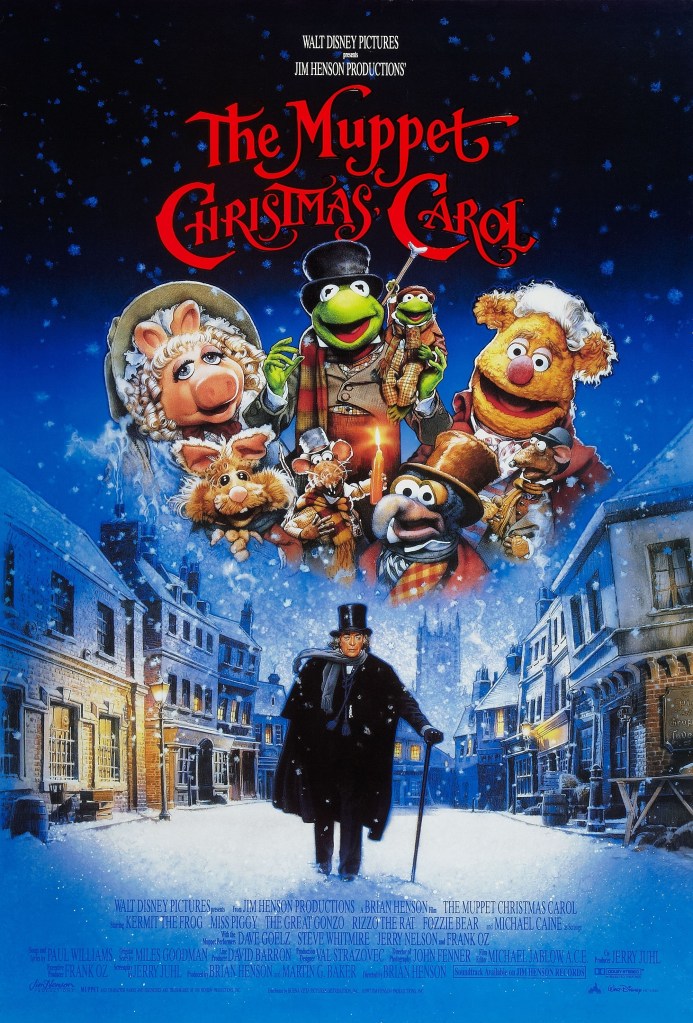
I think an underrated element in this movie’s success is the decision to present the story via the medium of Gonzo as Charles Dickens. Everyone has a favorite Muppet (other than Kermit, whom we all adore), and mine’s Gonzo, that delightful eccentric, so I’ll admit to some bias. But the advantage of Gonzo’s Dickens, first of all, is the preservation of the narration in the original — he can address the audience directly, saying that Scrooge is as solitary as an oyster, or that as he enters the vision of his childhood he is conscious of a thousand odors. These aren’t lines you hear in any other adaptation that I know of, but the script trusts that Gonzo’s evocative delivery (and the visuals on screen) will help convey the story’s original strangeness and lyricism even to an audience younger than it was ever intended to speak to. I mean, look at that opening — after a little comic patter with Rizzo, when his friend tells him to tell the story, Gonzo looks right at us and says, “The Marleys were dead, to begin with. As dead as a door-nail.” Sure, we’ve doubled the Marleys for the sake of our Muppet casting. But otherwise, this is where the original story begins — before we even hear that there’s such a person as Ebenezer Scrooge, we understand that this is a story about the dead….well, people who are dead, to begin with. The resurrections in this story are at first ghostly, of course, when we meet Jacob and Robert Marley, but ultimately it is the person inside Ebenezer Scrooge who will be restored to life.
Another thing that allows the movie to hew closer to the original than you would expect is that the Muppets can leaven the harshness of some moments with comedy — I bet this drives some people crazy, but to me, it’s a wonderful balancing act. When the rat bookkeepers respond to Scrooge’s threats about the coal by singing “Heat wave! This is my island, in the sun!”, sure, it’s an element of goofiness Dickens didn’t depict (and a line my family quotes to each other all through the year). But it also lightens the mood enough that when Scrooge tells his “dear nephew” Fred that he thinks people who celebrate Christmas should be buried with a stake of holly through their hearts, Caine can play the vicious language of the novella straight. Rizzo will comment on this occasionally, even, when it’s getting intense — I love the moment where he asks Gonzo, “Hey, that’s scary stuff, should we be worried about the kids in the audience?” only to be answered with, “Nah, this is culture.” There’s where the winks belong — not in Scrooge’s performance, as Caine was wise enough to understand, but with the wisecracking Muppets, always a bit childlike to adults and always a bit adult to children, who are reassuring us that we can handle this. And we can.
I know this is going to be too long, but I feel like I have to gush about how they present every element here. The reveals of the Spirits are, at each turn, handled basically perfectly: the burst of divine light that terrifies Scrooge as Past appears, then the warmer, gentler light from the next room that lures and invites him to join the feast with Present, and lastly the overwhelming of the fog as it envelopes him and pulls him into the future he doesn’t want to face with Yet to Come. The film does a lot with Dutch angles — presenting certain shots as askew or out of balance to convey the mood — that I think are really effective. Scrooge is at a precarious angle as the Marleys arrive, but their distance shots are presented as flat and even: they are grounded, even as ethereal spirits, in a way he is not. There’s a little bit askew in the initial visit to the Cratchits with Present, but the return to that street with Yet to Come is astonishingly out of balance, as befits a scene where Scrooge is about to confront the painful truths he’ll find there.
Ultimately this is an adaptation interested in love’s power. Thankfully Disney finally fixed a long-standing problem, giving us back the film’s original cut with Belle’s sad song, “The Love is Gone”…sure, you can only watch it if you’re one of the people who know you need to go to Disney+ and then into “Extras” to pick the actual full version, but I know it and now so do you. For so many years, Disney had shied away from the power of that song — it was seen as too sad, too heavy for a kids movie starring puppets. Again, though, that’s its power: the song convicts Scrooge to a depth we might not have expected, and can be moved by. He had love and he turned away from it — not just love, but generosity, given that Belle’s lyrics suggest that she’s releasing him to pursue the “adventure” that calls Scrooge with an “unknown voice”. But Scrooge knows the truth — no adventure pulled him away from Belle, only the black hole of selfishness and greed that has pulled him away from all human contact. When the young Scrooge turns and abandons her there on the bridge, Caine’s older Scrooge steps in his place, and it’s heartbreaking to hear him doubling her vocals in that final verse — is he saying the things he knew even then? Or is he finally discovering who she was, and who he was, in listening to her at last? Regardless, it seems to unlock something in him that the movie explores more deeply thereafter: if, as Present tells him, wherever you find love it feels like Christmas, perhaps this explains why Scrooge has not been able to understand Christmas (or love) all these years. He’s cut himself off from that kind of experience, and he’s awakened to it most by Tiny Tim, a child laboring under heavier burdens than Scrooge has known, but someone who has a peace Scrooge has never found before. Tim sings about the love he sees around him, and his openness to that loving world, and it makes Scrooge aware of the path he’s finally able to choose. And Scrooge’s ultimate acceptance of love, and willingness to show love, is why we need “The Love is Gone” in the movie, because when in the final scene it is reimagined and offered to us in a new light, we hear “The Love We’ve Found” sung by the whole cast — the melody that had been an expression of loss and grief is now also the melody of light and peace.
I Know That Face: Steven Mackintosh, who plays Scrooge’s “dear nephew” Fred here, plays the supporting role of Henry in Lost Christmas, a film in which Eddie Izzard portrays a mysterious man who has some kind of quasi-magical power to find missing things. Michael Caine, who of course is this movie’s Ebenezer Scrooge, plays quite a different role as Elliot, an unfaithful husband, in Hannah and Her Sisters, a film that is deeply tied to two Thanksgiving celebrations. And you may be familiar with a number of members of our main cast from other holiday media: Kermit the Frog who here plays Bob Cratchit, Miss Piggy who plays his wife Emily Cratchit, Fozzie Bear who here plays Fozziwig, and many of the other Muppet supporting cast members, have appeared in such works of holiday media as John Denver and the Muppets: A Christmas Together, It’s a Very Merry Muppet Christmas Movie, and Lady Gaga & the Muppets’ Holiday Spectacular.
Spirit of Christmas Carol Present: Again, what I find enriching about this adaptation of the original novella is how much of the language it preserves, including turns of phrase that you’d think would be too archaic to work for a modern audience. But from Gonzo’s opening lines about the Marleys to his final comment about Scrooge having become “as good a friend, as good a master, and as good a man as the good old city knew,” the production commits to it. And I’ll call out one very particular element present here that you might not expect from the novella — it is in fact true to the original that, when Christmas Past leaps from one point early in Scrooge’s schooling to a later Christmas, Scrooge literally watches the room crumble and decay around him at high speed, so the comical entropy bursting around Gonzo and Rizzo (including the loss of Shakespeare’s nose) is in fact totally on point.
Spirit of Christmas Carol Absent: I appreciate the emotion this production applies to Scrooge’s encounter with his younger self, but I do wish it had kept in his conversation with Fan, his sister, since I do think that adds a lot to the importance of his relationship to Fred. And while I love the Christmas Present sequences we do get, I do think there’s something lost in the production skipping the more aggressive travelogue as Scrooge is taken to all sorts of heartwarming Christmas scenes.
Christmas Carol Vibes (9.5/10): I know, I know, Charles Dickens didn’t envision Bob Cratchit as a talking frog, but let’s face it, this film does an impressive job of presenting us a more-vivid-than-life Victorian London, with some pretty incredible costuming for all cast members (I love Rizzo’s outfit, and frankly, young adult Scrooge is a cad to Belle but that coat he’s wearing is phenomenal). The commitment to the use of Dickens’s language is high, and Caine’s performance as Scrooge in particular is so committed that I think there’s no question that the themes Dickens wanted to explore are largely present here. It’s very hard to get a 10 here just because the original novella is so distinctive — I don’t think I can imagine the Muppets successfully portraying Ignorance and Want at the end of the Christmas Present sequence, and I don’t blame them therefore for not attempting it — but this makes me think about the Dickens story at great length.
Actual Quality (10/10): Look, this is subjective, but I promise, I’ve at least been systematic about it. There’s a website called Flickchart that just shows you two movies and asks you to pick which one you prefer, and it keeps track over time. Over the years, I have rated my preferences for 1,085 movies at Flickchart. The Muppet Christmas Carol ranks 4th on my all time list. So, I can’t possibly imagine what it’s like not to love this movie. Every inch of it fills me with positive emotions, I love every single casting decision, I can sing along with every word on the soundtrack album (which has a couple of songs that didn’t make the film), and I and my wife quote this film at each other basically all year long. I think it’s the best Muppet movie ever made and it might also be the best holiday movie ever made, and it’s certainly such a good combination of the two that I love it unrelentingly. If you don’t feel the same way, well, I’m glad you came along for the ride anyway!
Scrooge? There are a lot of successful versions of Ebenezer Scrooge, but I do feel like Michael Caine is probably my favorite. When we first meet him, he’s largely filmed from a Muppet eye level, which makes Scrooge loom — he’s ominous here, and imposing. Caine is just old enough to feel like a man full of regrets but still young enough to have a great deal of vitality. He’s talked in interviews about trying to base his portrayal in Wall Street tycoon types, and that’s the right energy: he reminds us of the kind of rich man we see at work in society around us, and that’s what Scrooge is meant to do. And I have to emphasize how sensitively I think the production draws out the emotions in Scrooge’s story. For instance, it might be easy to miss it, but in the sequence at his countinghouse, Scrooge really loses it at one point. Fred’s talk of falling in love seems to have awoken Scrooge’s most desperate anger — an acting/directing decision that makes perfect sense given Scrooge’s painful memories of all he lost with Belle — and Scrooge tries to rip Fred’s wreath apart before throwing it violently at the little caroler. Watch Caine’s expression and body language in the moment just afterwards: his Scrooge seems to feel awkward about having lost control, even regretful, as though he is becoming aware that there’s this rage in him he doesn’t really understand. Shortly afterwards, when he extends the tiny generosity to his staff of giving them Christmas Day off, they burst forth in gratitude to him, and it makes him so angry he shouts furiously at them to stop it. He’s someone who is pained by love, not comforted by it, and his only way to handle it is to lash out to keep the world at bay. It’s a lovely level of nuance to add to the arc Scrooge takes in this story, giving us this insight into his character from early on.
Supporting Cast? Gosh, I love this film. Okay, so, to be more precise, I think Kermit as Cratchit is such perfect casting: it was inevitable, sure, but that doesn’t diminish how well it works. The “One More Sleep Til Christmas” number (paired with the penguins’ skating party) is so perfect, pairing the childllike enthusiasm and the childlike innocent hope of Cratchit in a way that really warms the film after Scrooge’s relentless bitterness. Kermit singing that last verse and then the beautiful shot of him at full height, looking up at the night sky, makes me misty-eyed every time. I’ve already talked about Gonzo, but let’s give it up for Rizzo — it’s hard to be comic relief for Gonzo the Great, who is already comedy gold, but Rizzo takes the chaos up to the next level, eating apples to drive up scarcity, screaming in terror as they arc through the sky (and through the timespace continuum), cracking wise to Mr. Dickens about literature. If I had a nickel for every time my wife or I said the phrase, “well, hoity-toity Mr. Godlike Smartypants,” I wouldn’t be rich but I’d be surprisingly well off. And the humans are no slouches here: I love the good cheer and the cheeky grin of Steven Mackintosh as Fred, and his young wife Clara as portrayed by Robin Weaver does a lot in a little time. I am always astonished to be reminded that the actress playing Belle, Meredith Braun, had essentially no screen acting career (one TV movie and four individual episodes in television series over the course of 26 years). She was an accomplished stage actress, with several notable credits on the West End, so it’s not shocking that she’s great, but again, much like Robin Weaver’s performance, I think what’s remarkable here is just how much she does with almost no time at all. She and Caine, between them, make us believe he’s still haunted by her, and that’s a real achievement. And because if I don’t mention her she would karate chop me through a brick wall, let me just say that while Miss Piggy’s Emily Cratchit is, assuredly, more aggro and sassy than anything envisioned by Charles Dickens, that energy brings a lot of helpful spice to a household that might (between Bob’s essential sweetness and Tiny Tim’s near saintly demeanor) be otherwise too cloying.
Recommended Frequency? If my family watches only two films between Thanksgiving and Christmas, The Muppet Christmas Carol is going to be one of them…and honestly, we might watch it twice before watching most other holiday films once. I think if you’ve never seen it you have to try it, and if it’s been a while you should give it another go. It’s a wonderful adaptation and well worth your time.
Okay, so, again, the way you’re going to watch this is to go to Disney+, but you’re not playing the standard version there: you’ve got to select “Extras” and pick the full-length version from that menu, since otherwise you miss out on Belle’s big song. There are people getting ready to write comments right now about how the movie in fact works better without the song, and I know who you are, folks, and you are wrong about this. Lovely people, but wrong. You can rent the movie from lots of places online if you’re not a Disney+ subscriber, but I’ve got to warn you: as far as I know, you will be renting the version of the movie without Belle’s song. The only way to get the full version of the movie on disc is to buy the DVD from 2005 (“Kermit’s 50th Anniversary Edition”) and NOT the Blu-ray from 2012, which is a real failure on Disney’s part — come on, folks, re-release the Blu-ray with the complete version and take my money. Anyway, Barnes & Noble will sell you the 50th Anniversary Edition on DVD, which is good, but it’s not remastered like the Disney+ version is. And of course it’ll be a real crapshoot with library copies to see what you get, but any version of this movie is better than not seeing it at all: Worldcat says over 2,000 libraries carry a copy. Good luck!


2 thoughts on “The Muppet Christmas Carol (1992)”