Review Essay
It probably is no surprise that I, a fairly committed Anglophile and devotee of choral music, would count among my favorite pieces of holiday music the English carol, “The Holly and the Ivy” — indeed, I have a tendency to start singing it (to myself) at almost any time of year. Given that reality, it’s a little strange that this film was one I only finally watched for the first time a few days ago, the last of this year’s 26 films to be screened by me. I’ve heard there was this sort of somber, thoughtful Christmas movie set in the rectory of a country village Anglican priest for years, and it sounded so on brand for me that I’d long meant to watch it. Although I’ll have both praise and criticism to offer in what follows, I can certainly begin by saying with emphasis, I’m so glad I did finally watch it.
The premise of the film is simple enough: an extended family is converging in a small town in Norfolk for its first Christmas after the death of the mother/wife who, it seems, was a sort of social glue holding them together. Father Martin and his devoted daughter, Jenny, who keeps house for him and basically minds him as though he were her child, will be joined by her siblings, David and Margaret, whom we first encounter as, respectively, a soldier fooling around with a local girl past curfew and an unseen but apparently vivacious young fashionista (one man refers to her as “a streamlined bit of work” which I can’t quite interpret, but also feel I understand all the same). Tensions would be high, then, and higher for the presence of their father’s sister Bridget (a forbidding, resentful old maid), their mother’s sister Lydia (a fussy but gentle woman who has been a widow for decades), and a distant cousin Dick Wyndham (a polished, somewhat austere aging bachelor), all of whom seem to consider the comforts of a country Christmas a kind of family inheritance owed to them (and none of whom seem to have thought at all about how changed the emotional landscape will be in the wake of a death).
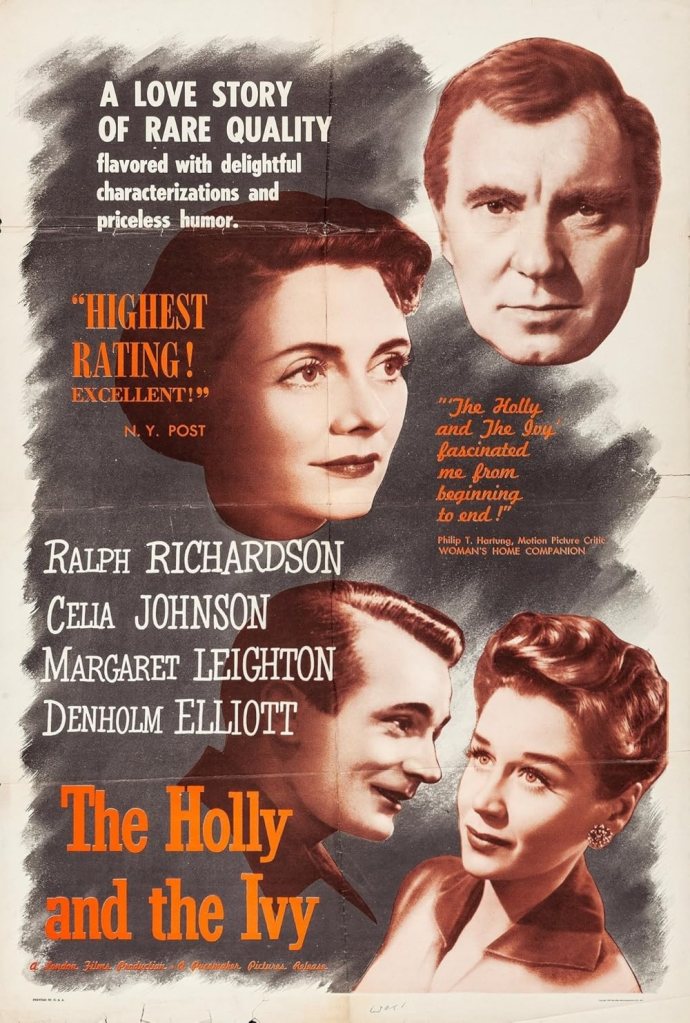
The pressure that threatens to blow the lid off of this cozy Christmas has to do with secrets — and specifically, the kind of secrets children keep from their parents, no matter how old they get. These are the kind of secrets kept in a so-called “good family” — there is pressure on the younger generation (they think) to be upright and dutiful, especially as their father is a priest. Jenny’s secret is in our hands first — we learn almost immediately that her ambitious boyfriend wants to marry her and bring her with him to a multi-year contract for work in Brazil, but she feels she cannot leave her father untended. She knows he would tell her to go if she asked, and that’s why she cannot ask — Jenny’s the good child, and imposing on his indulgence even that much is more than she can stand. The only outlet she can envision is her flashy big city sister Margaret coming home to take her place, but Margaret (as we also learn early on) won’t even bring herself to actually come home for Christmas. When Margaret finally appears, in the movie’s second act, we learn early on that she has secrets of her own –secrets she is sure her father’s rigid moral code could never understand, let alone forgive. Both of them are trapped by love, then — a sense of a father’s love that either imposes too heavy a burden to be free from, or is hemmed in by so many conditions it cannot be relied upon.
And the film is the unwinding of all of this — the structure of Christmas observation (both secular and sacred) holds all these people in proximity to each other long enough that truths are spoken because they must be, though maybe not always by the people who ought to be spilling the secrets they’re spilling. We’re solidly in post-war Britain — the pleasures available are measured, even meager. The sense of a canyon between the lives of the older generation and the younger, between the people whose lives were shaped by a first world war and those altered instead by the second, is profound. A new world may be dawning, but here in this aging rectory, the questions look backward more than forward — what good is the faith of the past to the people living in the present? What good is humanity in the age of the engineer? At one point, when they’ve found a space to be alone in conversation, Jenny says to Margaret, “You’re not happy, are you?” And Margaret replies, “Who is?” That’s perhaps the most prevalent tension the film wants to examine and resolve — the idea that the younger generation either cannot find happiness, or cannot share it with elders whom they do not trust to accept them as they are when they’re happy.
I don’t want to tell you that everything works about this film, because it doesn’t — the supporting cast of extended relatives have their moments, but often come across as stiff, even unpractised, like stage actors still adjusting to the screen or retired actors hustled out of mothballs for a return to work. Jenny and Margaret may have serious concerns and secrets to hold and work through, but their brother Mick (played pretty effectively by Dernholm Elliott) just isn’t given much by the script — he seems just as resentful and guarded as his sisters, but with far less reason and therefore far fewer meaningful conversations or resolutions over the course of the movie. Some of the attitudes and opinions of a conservative English family in the early ‘50s grate on me a little, as they go past.
But mostly it works for me — it feels like a real family working through real grief together. Every few minutes, we’re in a new Christmas context that offers both relief and new potential for tension. And the Christmas narratives here are almost too obvious — Jenny and Margaret assume they’re dealing with a father too holy to make sense of their humanity, and the possibility of love and acceptance is therefore as miraculous and potentially moving as the story of the Incarnation at the heart of the holiday is meant to be. And Martin, their father, who has developed a comfortable sense of himself as a model priest in a society that no longer needs him, has to confront the opposite reality that he has not in fact found a way to be the messenger of love he hoped to be, and that he and his love are badly needed not just by society but by his closest family members. In a sense, everything hinges on the question posed by one character — what is the point of love, if those we love die? Especially if we deny ourselves the potential comfort of an afterlife, how can we bridge the chasm of that grief successfully enough to have made the love worthwhile? Whether or not you can accept the answers that are given, most of these characters get resolutions that make sense to them — Christmas has done something to them or around them that’s made them ready to meet each other and hear each other. And given that the film takes place next door to this 14th century church where Martin serves, basically every scene of the final act unfolds with the peal of Christmas bells in the background as local worshippers engage in the observation of a feast so old it feels timeless (as the characters comment, at one point) — it’s as though the movie understands the ways that this is a celebration and a triumph long before most of the characters (or us in the audience) do. Ultimately this is a movie about how the connection a family makes at the holidays — at this particular holiday of Christmas, maybe especially — is both strained and life-giving. We can feel the stresses of family without denying the restorative power family can and does bring to so many of us.
I Know That Face: Dernholm Elliott, here playing the rakish soldier son Mick (and better known to most of us, much later in his career, as Dr. Marcus Brody in two Indiana Jones films), is The Signalman in one episode of a BBC short film series entitled A Ghost Story for Christmas, and is Old Geraint in a TV movie version of A Child’s Christmas in Wales. John Gregson, who here plays David Patterson, the Scottish engineer boyfriend to Jenny, appears as Mijnheer Brinker in a TV movie version of Hans Brinker, a Dutch story that has so much Christmas content in it, I’m always a little surprised it’s not treated as a holiday classic. William Hartnell, who here plays the Sergeant Major (and who is far better known to most of us, later in his career, as the original Doctor in Doctor Who), is a credited cast member for a 1957 television movie called A Santa for Christmas, though even IMDB knows so little about it that I can’t tell you what role he played. And lastly, Ralph Richardson, who here was the Reverend Martin Gregory, appears in one episode of the television miniseries Jesus of Nazareth: I might not have counted it as a holiday appearance, but Richardson plays the role of Simeon, the aged man who had received a prophecy that he would live to see the Messiah, and who holds the eight-day-old infant Jesus in his arms briefly while asking God to let him depart this world in peace, having received his promise. That’s pretty dang Christmassy, and therefore I had to include it. Richardson seems to have spent a lot of time in and around religious roles, in fact: I first saw him playing the Supreme Being in a movie you might know called Time Bandits, which is not much at all like Jesus of Nazareth or The Holly and the Ivy.
That Takes Me Back: There’s plenty of nostalgia to go around in this immersive ‘50s film — I suppose the days are long gone where a parent has to call a bunch of places because they can’t find a child and wonder where they’ve gotten to. I felt nostalgic, certainly, at the sight and sound of young people caroling at people’s doors: I remember doing that a lot in my childhood and teens, and I haven’t seen it or heard reference to it in a long time — which is a shame, since choral singing and outdoor exercise are both good for the human body and spirit, I feel like, especially in the dark weeks surrounding Christmas Day. It was fun to realize that for Martin, writing a sermon involves actually writing one by hand: I don’t think I had ever really thought about that?
I Understood That Reference: Shockingly, I think we get fewer direct references to the original Christmas story here than I got out of Tokyo Godfathers — certainly in a very formally written movie with plenty of scope for literary reference, etc., I might have expected a lot more careful allusion to other Christmas tales, but I didn’t hear anything.
Holiday Vibes (9.5/10): This is such a hard category to rate, but I think it has to be very, very high: the whole premise of the film is about a Christmas family gathering, and basically everything that happens is, to me, fully believable and immersive as part of a both tense and festive holiday celebration. After a couple of early scenes, we are really locked into events at the house itself that made me feel like I was there for Christmas, as surely as if I was cousin Dick, driving down from Peterborough or wherever Dick’s driving from. Add in the talk about church business at Christmas — which I know is not everybody’s Christmas experience but it’s a big part of my time with the holiday — and I have to rate this very high, even though I wouldn’t call this the movie that puts me in the most festive mood? I think it’s that, by the end, it’s both reminded me of the discomfort we can feel at Christmas but also of what comfort it brings, too.
Actual Quality (8/10): I wish I could set it a little higher, but the production does feel a bit threadbare at times: as I mentioned, the supporting cast’s performances are often stiff or stagey, and honestly there are scenes where I think the writing just isn’t as sharp. Still, the central themes of the story, and the ways I am dragged along by events, make this a solid viewing experience — not a great film, I think, but at least a good one.
Party Mood-Setter? I can’t see it working in this context — it’s talky, it’s a little slow, and the things it has to give will probably come across least well if you’re only half paying attention to it. It could work if you just want a midcentury period feeling in the background while you address envelopes or whatever, but I think there’s a lot of superior choices in that regard (including a couple of films on the roster here on the blog).
Plucked Heart Strings? You know, it’s not exactly tear-inducing for me, but the emotional impact of the final act, much like Happiest Season, hits a little harder than maybe it’s earned? Though I can’t say what “earns” a movie its impact — all I can say is that the family’s griefs had felt a little more remote to me initially, but then they came home in a way I felt. I think it might do the same for you.
Recommended Frequency: This was only my first viewing of the movie, but right now I feel sure that I would be really glad to watch it again. And based on my reaction to it, I can imagine that, once I’ve seen it another time or two, it would become something I schedule for myself every single year. I think it’s more than good enough for you to give it a try if anything about the premise suggests to you that you’d enjoy it.
This is the first film I’ve run into where I know it’s streamable but you can only get it via the library, as far as I can tell — I used my public library’s Hoopla service to borrow and stream it, and if you instead have access to Kanopy via your local or university library, I think it’s available on that platform also. The movie’s available for purchase on Blu-ray or DVD from Amazon, of course, and if your library doesn’t have Hoopla or Kanopy (or you just prefer movies on disc), Worldcat tells me it’s in nearly 200 library systems, so hopefully it’s a simple interlibrary loan away, at most.


One thought on “The Holly and the Ivy (1952)”