Review Essay
So much great art arises from a confrontation with our deepest fears and senses of unease about being human, and I feel like that’s the force that propels The Shop Around the Corner every year into being a film where the whole is somehow greater than the sum of its parts. When I try to sketch out the plot, it feels like a simple (if clever) premise for a film I would watch and smile at but quickly forget. And yet, it’s more than that for me. In watching it multiple times in the last year, with this blog in the back of my mind and beginning to loom larger, I think what I’ve worked out is that this is a film about how hard it is to know yourself or other people — how easy it is to mistake and misdiagnose matters of human interaction — and yet how thrilling it is to finally see someone else or be seen.
Again, the premise of this movie, if you don’t know it, is simple enough: we are concerned with the people who work at Matuschek & Co., a leather goods retailer trying to keep afloat in Budapest amid the Great Depression. Specifically, we’re most concerned with Matuschek’s star employee, the brilliant if brittle Alfred Kralik, and the young woman who slips through the door early in the movie’s first act hoping for a job at Matuschek, the effervescent Klara Novak who seems never to have had an unexpressed thought. Sparks fly immediately and Novak’s success in securing a position via her moxie don’t reduce the tension — he’s bothered by her frankness and she by his reserve. And what neither of them know is that, by an extraordinary chance, they’ve come into contact with their secret, romantic pen pal, since Kralik and Novak have been sending impassioned, elaborately written letters to each other via a postal box with pseudonyms, along with an express agreement not to sully the intellectual beauty of their conversation with such mundane details as where they live and work. Yeah, yeah, it feels like a premise cooked up in a lab to support a romantic comedy — if the movie wasn’t working well, I guarantee it would feel creaky. Yet, to me, it never does.
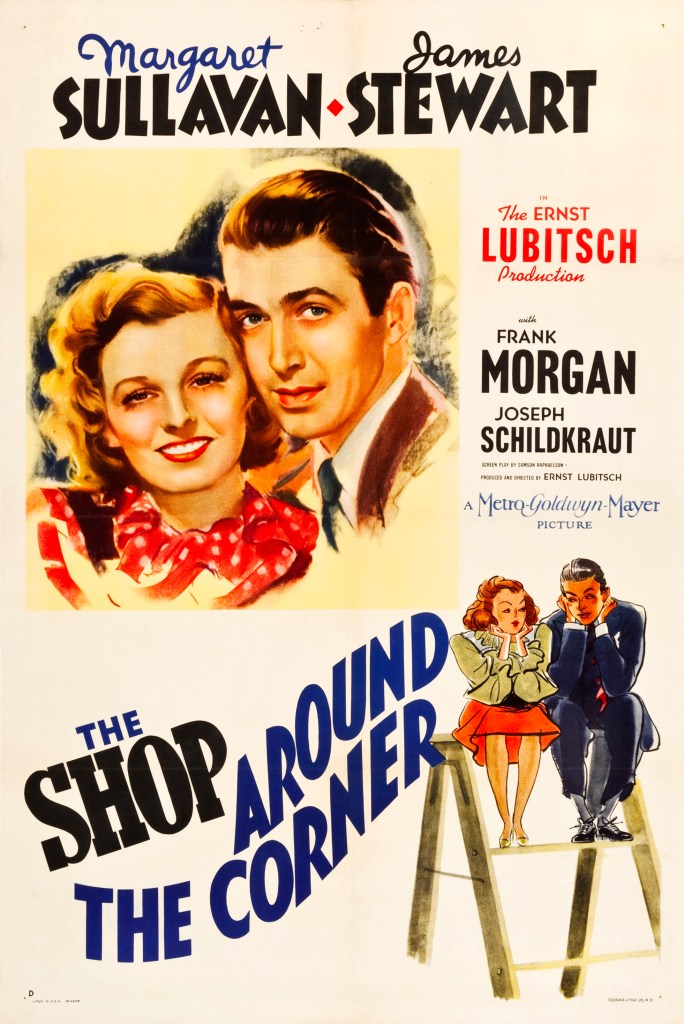
One reason this secret pen pal structure survives scrutiny, I think, is that the movie is about other things too — for instance, a major subplot involves the strange and steady rise in tensions between Kralik and his employer, Mr. Matuschek, for no reason Kralik can fully understand. And in almost every conversation, we hear the backdrop hum of these people clawing their way towards what they think of as stability or respectability — the right living situation, the right clothes, the right opinion from the boss. There are moments that can feel almost like an Austen or a Wharton novel, as the rigid formalities of conversation among genteel shop clerks threaten to bubble over with the tensions that characters feel under the surface. As a result, watching Kralik and Novak’s romance progressing feels less like a singular event about which I need full understanding, and more like another chess piece in an elaborate game: what will become of any of these people when they finally start speaking plainly to each other? How safe is it to say what you mean — or to have someone else understand what you mean when you say it?
So much of how it works, too, is in the incredible performances of the whole cast: sure, a lot of this hangs on Jimmy Stewart, who in the 1940s was at a peak few performers achieve of knowing just how far he could take an audience without losing its affection. That charisma enables him to exhibit anger or pride or any number of other destabilizing emotions on screen and remain the film’s comfortable protagonist — he creates depth in a character that wasn’t going to have it automatically. And opposite his frosty Kralik, Margaret Sullavan is the perfect Novak: Sullavan had brought Stewart into the limelight, requesting him as a lead opposite herself in the mid-30s and coaching Stewart (then more of a character actor) into stardom, and there’s a kind of music in every dialogue between them. Sullavan, too, knows how to deploy her charisma perfectly, so that no matter how many abrupt and slightly cruel things Novak says in her filterless monologues, we never find ourselves turning away from her.
So much of the film is interested in the balance between bravado and insecurity. In the leads, we get to see both sides — Kralik’s assured manner in assessing the value of a cigarette box that plays Ochi Chërnye (almost zero) is juxtaposed against his fretting about his intellect as he discusses with a coworker the acquiring and reading of an encyclopedia volume. Novak’s brassy sales pitch for that terrible cigarette box before she’s even secured a job for Matuschek stands in contrast against the nearly immobilizing despair she feels when she thinks her beau took one look at her and skipped their dinner without introducing himself. Among the secondary cast, we get types — the self-effacing but sweet-tempered loveliness of Pirovitch; the self-promoting, cheeky chutzpah of Pepi Katona, the delivery boy — that build out these ways of responding to the fundamentally unsettling challenge of being a human who both wants and does not want to be seen, who both wants and does not want to see.
Christmas, James, I hear you say: what the heck does this have to do with Christmas? Well, as the film progresses through its year, we approach the busy shopping season of Christmas and all the pressures descend even more severely on the shop’s employees. More than that, Christmas itself as a festival having some connections with marriage — at least in this era, Christmastime engagements and weddings were pretty common, in my experience researching family histories anyway — means that the pressure rises on Kralik and Novak’s pen pal romance. Will the truth be revealed? Is an engagement in the offing? Especially once we reach the point where one of them knows the truth (and isn’t revealing it) while the other is in the dark, there’s a way in which we as an audience know that Christmas will raise the final curtain and at last allow us to exhale with relief and delight.
This is a strange film to try to classify — for a romantic comedy, there’s very little romance (at least, very little romance where both characters on screen know they are romancing each other) and not a lot of comedy (though the moments that are funny are, to me, very funny). Instead, it pulls as much as it can out of the tensions that build before the release that either a successful romance or a good joke brings — out of conversations where one thing is said and another meant, or where a character stops a phrase short of actually bringing the clarity they could supply. It’s strange that this is one of two ‘40s Christmas movies starring Jimmy Stewart that involve a thwarted suicide, but at least I’ll note that this suicide has nothing to do with Kralik and Novak’s romance — the film isn’t interested in the overwrought tragedy of love, only in the tragicomedy of trying to know one’s self, and to know what one actually thinks about the people around them.
I find a lot of delight, too, in the fact that this is by definition a romantic comedy that’s not about falling in love with someone because you have the hots for them. I mean, Margaret Sullavan is an attractive woman, no question, but also, we know that Kralik doesn’t get hung up on Novak’s looks — to the contrary, he barely thinks about her at all, at first. What appeals to him are the quick and lively thoughts of the woman he corresponds with compulsively, the woman who fills his dreams. Similarly, if Novak’s attention is caught at all by Kralik (who, as a youngish Jimmy Stewart, is no slouch in the looks department either), we don’t learn much about it up front. Sure, both parties are evidently a little anxious about whether or not they’ll be attracted to their pen pals when they meet, but I think the movie really hits its stride in exploring how delightful it is to love someone’s mind, and to discover how beautiful the mind of a person standing right next to you has been, this whole time. It’s sure helped, I think, by the fact that maybe nobody’s voice in 20th Century film is more evocatively intimate and passionate than Jimmy Stewart when he’s just slightly hushed — reading a letter aloud to Pirovitch, say, or talking with Novak about what a wallet can mean to a man in love.
The movie, too, says so much by not saying things — it is a movie in 1940 set in Budapest but Europe’s rising political and military tensions don’t take the stage. The closest we get to a mention of the Depression is when, at one point, someone says “that’s the biggest day since ‘28!” about the store’s one day profit total. And the ending — which I have, I hope you’ve noticed, been rigorous in avoiding anything that might spoil you — is fast and understated, too. I think Lubitsch, the film’s director, knows that we can fill in the gaps around and between these people very capably, if he makes them human enough. Even when they’re playing games with each other, or devastating each other with little comments (both harsh truths and devious lies), they feel like people — heightened, brilliant people with screenwriters composing their dialogue, maybe, but people — and they’re people I love to watch every Christmas. I hope you do too.
I Know That Face: It’s wild how many performers from It’s a Wonderful Life show up in this fairly small cast, six years earlier — Jimmy Stewart, of course, is Alfred Kralik here and George Bailey in that film. But we can add in Charles Halton, who is the police detective in this film and Mr. Carter, the bank examiner, in It’s a Wonderful Life, as well as William Edmunds, who plays the waiter at the restaurant in this movie and who is unforgettable as Mr. Martini in the 1946 classic. Moving on from Capra’s iconic movie, I can’t leave out a mention of the delightful Sara Haden (Flora, another of Mr. Matuschek’s shop employees), who will later play Mildred Cassaway, the secretary to the titular bishop in The Bishop’s Wife, a movie about an angel hitting on a married woman while building a cathedral, and the judgmental Mrs. Katie Dingle in The Great Rupert, a movie about a squirrel redistributing a miser’s wealth in answer to a Christmas prayer. Both of those movies sound made up (okay, I may be having a little fun with how to describe them), but I’ve watched them both with at least interest and sometimes delight, and I bet they’ll make this blog if it persists into next year.
That Takes Me Back: It’s funny: the internet should make it easier than ever to have anonymous pen pals, and yet it feels so old-fashioned here? I guess there was a sense in which half the people you talked to on Twitter were anonymous pen pals, but let me tell you, there was precious little that was intellectually elevating about those conversations. I have commented on this before, of course, but it remains wild how many plots in the pre-cellphone era consist of having arrangements for dinner that can’t be changed, since characters have no way to contact each other, and therefore hijinks ensue. Oh, and though we certainly still have all sorts of weird dieting habits as a nation, when Novak tells the customer that, after gaining a few pounds from candy, you need massages and electric cabinets, I did smile to think of what on earth that was like. Electric cabinets?
I Understood That Reference: We don’t get much here, but late in the movie at one point Pepi tells Mr. Matuschek that he’s going to be “Santa Claus” to the girl standing on the street corner. Creepy, Pepi. Take it down a notch.
Holiday Vibes (4/10): I mean, as I acknowledge above, Christmas only really comes in at the hour mark. I would argue that, from there, it slowly zooms to fill the whole space as retailers and potential fiancees get immersed in the holiday. And even if I turn away from the central relationship in the movie, there’s plenty of talk about Christmas between characters in ways that feel like the build up to the holiday to me. Not enough to make this overwhelmingly a Christmassy vibe, but enough to earn its 4, I think.
Actual Quality (9.5/10): I love this movie, and I’m not alone in that — the American Film Institute put it in their top hundred love stories of all time, and of course it’s been memorably remade (more than once, though the one most of us think of is You’ve Got Mail). I think in terms of what a romantic comedy can achieve, it really does almost everything it ought to do — it avoids most of the clumsy hurdles that such films often throw in the way of their protagonists (there’s no external threat from an attractive man or woman, there’s no real obstacle at all between them other than the fact that their correspondence is a secret and it remains that way for some time due to the insecurity both of them seem to feel) in ways that I find really satisfying. It is just a very successful ‘40s romance that’ll sweep you off your feet if you let it. I hope you will.
Party Mood-Setter? This one depends enough on rapid fire dialogue, or subtext and pretexts when it comes to these interactions, that I doubt it’s one you could pay attention to while painting an ornament. It’s good enough (and brisk enough) though that I think you could make it a “let’s get together and watch this” event this December pretty successfully.
Plucked Heart Strings? My heart sure soars as some of these passages unfold — I don’t know if I’m just a sucker for Jimmy Stewart in this setting or if there really is a deeper emotional connection available from these characters, but yeah, I think it’s there.
Recommended Frequency: I mean, as far as, what am I going to do? I’m going to watch it every single year. No question. I think for you, it will have to depend on how much this feels like a Christmas movie to you. I’d love it if you gave it a try, though — here’s hoping it resonates for you as it does for me.
You can watch this movie on Max (which some of us subscribe to via their Amazon Prime channel) or rent it from Amazon, Fandango, Google, or Apple. It looks to me like it’s available via a premium add-on at lots of services too, though I won’t try to game all those out. If you want to be like me (in this one respect) you can own it on Blu-ray or DVD from someplace like Amazon. And Worldcat says it’s in over 1,000 libraries on disc, so don’t forget about that wonderful resource.


2 thoughts on “The Shop Around the Corner (1940)”