Review Essay
As it opens, it’s not entirely clear what kind of film you’re watching in Fitzwilly – a jaunty, peppy score bounds along as we take in a perfectly professional and focused household staff at work in maintaining a grand New York mansion. Sure, it seems a little strange at moments: the 1960s aren’t exactly the hey-day of old money socialites, and there’s something weirdly knowing, almost conspiratorial about the way our title character, the household’s butler, addresses us straight to camera. But it takes a few minutes for the premise to emerge…it also takes a few minutes for it to become clear that it’s the Christmas season, but by now I hope readers at Film for the Holidays are accustomed to my broadly inclusive take on the holiday film.
What is Fitzwilly about, you might ask? Well, there really are two films here, one of which makes sense commercially and one of which really doesn’t. The commercial film is a light-hearted romantic comedy starring two well-known and loved television performers: Dick Van Dyke (overflowing, as always, with charm and a kind of spry delight) as Fitzwilly, a bright young butler, meets Miss Juliet Nowell (a Christmas pun, I suspect), a graduate student and recently hired secretary to Fitzwilly’s employer, Miss Vickie. Juliet, played by Barbara Feldon (better known as the knockout member of the spy tandem in a sitcom called Get Smart), quickly finds herself at odds with Fitzwilly – some of it has to do with the other half of this film (which I’ll get to), but some of it is pretty standard rom-com fare. She finds him overbearing, he finds her impertinent; they both come to realize the other is pretty special; she thinks he should aim higher in life than being a butler and he takes offense. Their dialogue isn’t Shakespeare (Beatrice and Benedick they ain’t), but it’s lively and sometimes pointed, and there’s a real spark between the two of them. Feldon and Van Dyke are both fun to just watch in action, and there’s a world in which they made a very by-the-numbers romantic comedy that has nothing at all to do with Christmas and I never saw it.
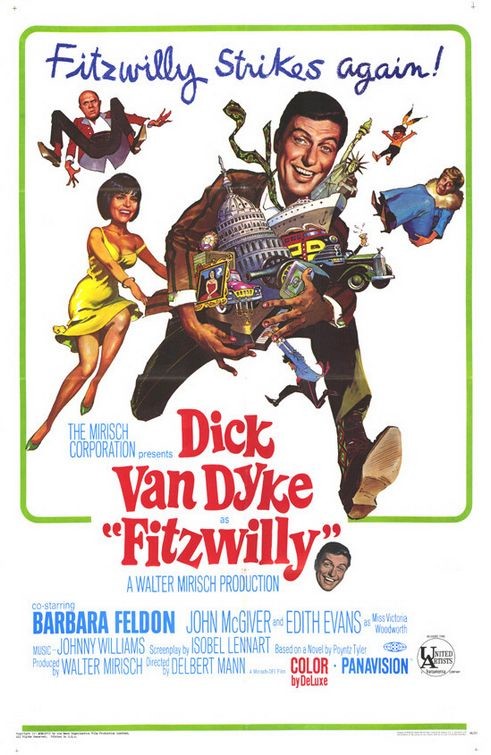
Here in the real world, though, a very different thing is happening, as we realize before the film is ten minutes old: Fitzwilly is the story of how an efficient brigade of servants in an upper class household operate a secret and successful thieving ring, right under the noses of their employer, the local constabulary, and the New York City elite social scene. Fitzwilly himself is the ringleader and mastermind – when he was a child, Miss Vickie took him under her wing, and when her father died and Fitzwilly discovered the aging socialite was left destitute (unbeknownst to her), he decided the knowledge of it would kill the woman. Instead, far simpler (ha!) for him to coordinate an elaborate black market operation out of the house’s basement, ripping off major retailers and funneling the profits into Miss Vickie’s accounts just in time to ensure her bills are always paid. They funnel the hottest items in their hands to an outlet in Philadelphia – St. Dismas Thrift Shoppe, to be precise, named cheekily for the “good thief” who was crucified next to Christ in the gospels. They have to keep Miss Vickie in the dark, so he encourages her every eccentricity, especially if it either takes her out of the house (leading her absurd Platypus Troop of knock-off Boy Scouts) or sequesters her upstairs in her office (composing Inquire Within, her demented dictionary for people who cannot spell – as Miss Vickie herself says to Juliet, “when it is done, children and illiterates like you will rise from ignorance”). Such a criminal conspiracy clearly can’t last forever without discovery…and it is, more to the point, badly imperiled by the arrival of a nosy young secretary who realizes early on that something doesn’t smell right about the situation in the house. Hijinks ensue.
And in the background of all this, Christmas is under way – wreaths are on doors and trees are being set up. An elaborate side scheme emerges in which Fitzwilly and the servants agree to lavishly furnish another family’s vacation home, skimming the profits for their own purposes, just in time for a good old-fashioned Florida Christmas. The glitz of a technicolor red and green mid-60s holiday really pops on the screen, whenever it gets the chance, even if none of these people are really thinking much about Christmas. Much, that is, until a series of setbacks makes a highwire Christmas Eve robbery – a heist that requires the speed and secrecy we associate with Santa Claus himself – more or less mandatory. What a truly, truly bizarre plot.
For the sake of you, a potential viewer, I have to acknowledge that the plot really does strain the audience’s confidence (if not patience) throughout. Money is coming in and out so often – with so many dollar amounts in the air – that it is very hard to understand how far ahead or behind they are: this is a problem in the third act, since the whole explanation for a high risk robbery sequence rests on the servants having their backs to the wall, financially. Some capers are problematic (I understand that in 1967 they might still have been making weirdly racist mannequins of African tribal people for shopping displays, but maybe they didn’t need to be in the film) and others are just incredible in the oldest sense of that word (in no bar in America at any time could you get wildly enthusiastic men betting large sums of money on their certainty that Delilah cut Samson’s hair in the Bible’s book of Judges, let alone so widely and reliably that it was a guaranteed money-making endeavor). But I have to acknowledge also that in some ways it doesn’t matter all that much – we’re watching because we want to see the main characters canoodle a little; we want to see if their elaborate, Ocean’s-Eleven-with-a-heart-of-gold heist can actually work; we want to see how they’ll all get out of this without going to jail. And it’s not like I’m going to tell you how it all ends, but I think I can tell you that the film’s third act is consistent with the rest of it – if you’re liking it you’ll like it, I’m guessing, and if you aren’t it’s not going to salvage itself.
In a way, the whole film is designed to create a sense of dangerous allure, but defanged in a way that makes it totally safe. Dick Van Dyke can play a master thief and even scoundrel, except he’s doing it with the best of intentions and hurting almost nobody but insurance companies. Barbara Feldon can play a slightly slinky, even sexy young woman without the plot ever taking us too close to something that would be uncomfortable to watch with your grandmother in the room. It’s done something sort of similar to Christmas as a backdrop, I’m afraid – there’s the sense that big Christmas celebrations need to come off with success, but we never really feel them as stakes. Christmas might have provided an opportunity to explore things like charity or miraculous intervention, but the feast never really touches the key events of the story (other than, for instance, making sure there were many shoppers present on the day they need to knock over the department store and run away with cash). Even the music is defanged – the peppy score I mentioned earlier? It’s composed and arranged by a young Johnny Williams…yes, THAT John Williams, whose music memorably and powerfully enlivens pop culture properties from Star Wars to Indiana Jones to Harry Potter. And, it’s fine. But not really very special. With apologies, Fitzwilly, that’s a reasonable assessment of you as a film, holistically.
I Know That Face: This cast is full of holiday performers: Barbara Feldon (the brightly inquisitive Miss Juliet Nowell) voices Patti Bear in The Bear Who Slept Through Christmas. Dick Van Dyke (the titular Fitzwilly) plays an angel in Buttons: A Christmas Tale and narrates The Town Santa Forgot. John McGiver (Albert, the servant with a troubled conscience) voices the Mayor in the Rankin-Bass ‘Twas the Night Before Christmas. A very young Sam Waterston (here playing the young chauffeur Oliver – I’m telling you, it’s a stacked cast and crew) appears in Hannah and Her Sisters, a film that is bookended by Thanksgiving celebrations. Edith Evans (the indomitable Miss Vickie) was of course the Ghost of Christmas Past in Scrooge, which I reviewed just last Sunday – she’s far better here. And John Fiedler (the nervous music store employee, Moron Dunne, who makes a truly inadvisable arrangement with Fitzwilly in disguise) has a long track record as a voice actor in the Hundred Acre Wood: he’s Piglet’s voice in, among other things, Winnie the Pooh: A Very Merry Pooh Year and A Winnie the Pooh Thanksgiving, not to mention Winnie the Pooh and Christmas Too. Beyond his voice career, too, Fiedler played the role of Vollenhoven in the first film adaptation of Hans Brinker and the Silver Skates, a story brimful with allusions to Dutch Christmas customs, as the primary events take place throughout a holiday season.
That Takes Me Back: This is going to be a little inconsistent, since I rolled my eyes at the drudgery of being a typist for those three old men in Beyond Tomorrow, but something about the vibe of this movie and maybe also Miss Vickie’s energy gave me a certain nostalgia for the era when a typist was someone you needed to hire. I know it wasn’t actually glamorous, but it still took me back in a way that felt more pleasant this time around. At one point there’s a significant plot moment centered around an enormous and incredibly expensive Xerox machine: just the sight of that massive brick of an appliance and how they’ll get it to work feels wild to me – what a different era. Miss Vickie’s dedicated work on Inquire Within does make me long somewhat for a dictionary as a physical book to be consulted – what a lovely time to be alive. Oh, and it was such a sweet return to the simplicity of a society in which someone could be enchanted by the world-altering allure of a color TV set.
I Understood That Reference: In a film this elusive about its Christmas material, there’s less than I would have liked, but we do hear Fitzwilly saying, “On the night before Christmas when all through New York, large lumps of money are bouncing like cork…” as he cooks up their biggest heist, which is a fun parody of A Visit from St. Nicholas. And then later, mid-heist, we hear someone shout, “Hey, they went thattaway, Scrooge!” to a police officer on the street as misdirection.
Holiday Vibes (3/10): For a film that has Christmas squarely in its sights for almost the whole running time (due to its connection to various schemes) it doesn’t deliver very much at all that felt like the holidays, to me, beyond some attractive backdrops. If you’re looking for immersion in those cozy feelings (or even less comfortable vibes that do still go along with the holidays, awkward family visits and such), this isn’t really the film for you.
Actual Quality (7.5/10): The plot arcs are probably the film’s weakest point, and unfortunately, the movie is constructed in such a way that we really needed a tight script to make it work. There’s too much business to take care of (and too little character development, with a couple of exceptions) for me to feel really invested in it. I do enjoy watching Van Dyke and Feldon pull off some romantic chemistry together, and some of the scenes from 60s New York (finally a more fully multi-ethnic space on screen than the older holiday flicks manage, even if it still has a long way to go) did feel inviting to me. Well, and who wouldn’t enjoy thinking about getting to be Robin Hood at least briefly, tricking and cheating and stealing but all of it for a wholesome cause? In the end, it does seem like a C+ movie to me, but it’s a C+ movie with some upside.
Party Mood-Setter? I can’t really imagine this working (it’s got too many little twists and turns for inattentive viewing), though I also doubt it would be too distracting, since the events of the story don’t come across as all that urgent given how the narrative unfolds.
Plucked Heart Strings? There really aren’t any at all – but the film’s not trying for it either. The film’s about the fun side of a rom-com far more than it is about sincere emotional resonance.
Recommended Frequency: Fitzwilly is a very slight little thing – you’d be fine never having seen it, but if you’re the kind of person who’ll enjoy seeing Barbara Feldon and Dick Van Dyke lure each other into some passionate embraces, it’s not a bad way to spend an evening. And if you’d like to just see this bizarre plot unfold at least once, I do think it’ll amuse you enough to see it through to the end. I would say that, having now seen it twice for the blog, I’ll probably see it again at least one more time in my lifetime, but I’m not rushing back to it.
To try out Fitzwilly, this year, the easy way is to stream it free (with ads) on Pluto, unless you’re a subscriber to Screenpix, which is a premium add-on at Amazon Prime and the Roku Channel and lots of other places, showing older movies for a modest monthly fee (I am not). You can rent it on Fandango at Home, too. You can, of course, buy it on DVD (or Blu-ray, which surprised me a little) at Amazon, and according to Worldcat a few more than a hundred libraries have it for you on disc.

